
Research article · 2026 · Full text
International Journal of Advanced Chemistry ResearchTrends in atomic research and expanding notions of physical chemistry
Volume 8(8) · Pages 01–03 · DOI: 10.33545/26646781.2026.v8.i8a.723 ↗
Research areasHistory and advancements in chemistryPhilosophy and History of ScienceHistory of Science and Medicine
Abstract
Author-writtenThere have always been two ways of thinking about the composition of matter, with proponents in both ancient and modern times. These perspectives correspond to two methods of considering quantity, the arithmetical and the geometrical. Atomists believe that the proper way to measure the amount of matter in a body is by counting its atoms, disregarding the empty space between them. On the other hand, those who associate matter with extension argue that the volume occupied by the body is the sole measure of its matter. The rapid progress in understanding the microscopic structure of matter over the last fifty years has provided chemists with confidence in the reality of the chemical atom, and they now trust that any theory based on atomic principles rests on firm and solid ground. It’s important to note, however, that this confidence does not stem from the discoveries of classical chemistry. In fact, at the end of the 19th century, the leading figures in physical chemistry were searching for a more reliable foundation for their field than chemical atomism, which had little direct experimental support at the time and seemed to offer limited success in predicting physical-chemical phenomena.
Summary
Source-checkedPlain-language reading of the full paper, prepared with AI and checked against the text. Each point links to the authors' own words.
Why it matters
- Historically, there have been two primary perspectives on the composition of matter: an arithmetical approach (atomism) and a geometrical approach (extension). View evidence ↗
- Atomists define the amount of matter by counting atoms regardless of empty space, while proponents of extension view volume as the only measure of matter. View evidence ↗
- By the late 19th century, physical chemists sought alternatives to chemical atomism because it lacked direct experimental support and struggled to predict phenomena. View evidence ↗
What they did
- The analysis examines how structural organic chemistry relied on rigid Daltonian atomism to represent data through fixed masses and spatial arrangements. View evidence ↗
What they found
- In 1849, William Rankine proposed a molecular vortex hypothesis consisting of particulate elastic atmospheres revolving around central nuclei. View evidence ↗
- Lord Kelvin's vortex theory replaced arbitrary atomic properties (like hardness) with properties derived from the mathematical principles of motion in a perfect liquid. View evidence ↗
- James Clerk Maxwell viewed the vortex atom as viable because it provided a potential explanation for gravitation, which other models of the time lacked. View evidence ↗
- Josiah Willard Gibbs developed chemical thermodynamics and statistical mechanics based on assumptions independent of the internal structure of substances. View evidence ↗
- By 1907, the non-atomism school of Duhem and Ostwald declined as experimental strides led to Niels Bohr's nuclear atom model in 1913. View evidence ↗
What it means
- The author concludes that the generality and practicality of thermodynamics resulted from its detachment from the specific internal structure of matter. View evidence ↗
- The author states that physical chemistry was founded by scientists who were willing to set aside rigid atomism to achieve broader scientific generalizations. View evidence ↗
Visual summary
1 visualsIllustrations explain the paper; they do not show study data.
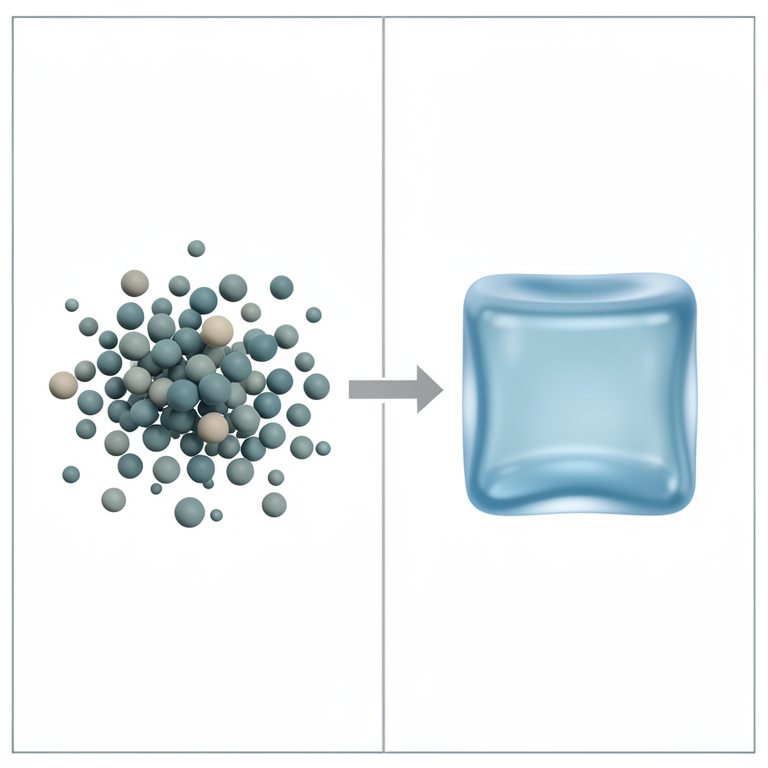
Arithmetical vs Geometrical Matter
AI-generated conceptual illustration (atomic particles and a continuous fluid volume). It explains the idea and does not show study data.
View source evidence ↗Introduction
The concept of the modern chemical atom can be traced back to its formulation by John Dalton between 1800 and 1803. The Daltonian atom was fiercely debated for a quarter of a century, fell out of favor for another 25 years, and was revitalized in 1858 by Stanislao Cannizzaro in his Sunto di un Corso di Filosofia Chimica. Along with Cannizzaro's work, Friedrich Kekule's postulation of the carbon-carbon bond (1858) and his use of graphical formulas (1861) marked the beginning of a rapid development in structural organic chemistry. This development allowed for the correlation of a vast array of experimental data. Structural organic chemistry explicitly requires distinct atoms with fixed mass, stable chemical bonds, and a specific spatial arrangement, which are all fundamental to rigid Daltonian atomism applied to carbon chemistry. This approach was accepted at the time because it was an effective way to represent data, and it continues to be useful today for the same reason. As physical chemistry gained prominence, key figures in theoretical chemistry, including Lord Kelvin, Wilhelm Ostwald, Josiah Willard Gibbs, Pierre Duhem, and Marcelin Berthelot, began to seriously question the utility of atomic theory. Alternative theories were proposed, and a comprehensive treatise on inorganic and physical chemistry was written without the assumption of atoms. The formalisms of thermodynamics and classical statistical mechanics were developed with no explicit reliance on the nature of matter. Why did these physical chemists find the atomic hypothesis unhelpful? In the 19th century, atomic theory was an ad hoc concept, which struggled to explain many of the new physical phenomena being discovered. Organic chemists had already called for a halt in the questioning of valency and chemical bonding mechanisms but had not received satisfactory answers. As a result, organic chemists resorted to using pictorial formulas and accepted the notion of atoms temporarily. However, physical chemists, who were less invested in atomic theory, raised fundamental questions such as: How could polyatomic molecules of elements form? What distinguishes oxygen from hydrogen? How does an atom emit energy to produce its characteristic spectral lines? Why doesn't an atom break into smaller pieces? The first attempts to address such questions about atoms were focused on developing models that would explain the observed macroscopic behavior of matter. William Rankine proposed a molecular vortex hypothesis in 1849, which was surprisingly close to modern theories. His model featured particulate elastic atmospheres revolving around central nuclei. In discussing his theory in 1855, Rankine emphasized the role of experimental investigation, suggesting that laws governing the expansive action of heat could be derived from the mechanical hypothesis of molecular vortices. While these laws could be proven independently of the hypothesis, he believed that the molecular vortex model, though not definitively provable, was useful for anticipating laws that could later be confirmed by experiment and had mathematical value. Rankine's molecular vortex theory was used to derive equations of elasticity and thermodynamics. However, the model had significant flaws. While Rankine proposed the existence of an elastic outer layer, he failed to explain why it should be elastic or why it should remain associated with the nucleus.
Revisiting the True Atom
In 1867, Sir William Thomson (later known as Lord Kelvin) proposed that the "true atom" was actually a vortex in a perfect liquid, with the perfect liquid being the ether. His theory maintained the concept of discreteness in matter while also preserving an underlying continuity, as the vortices were distinct whirlpools within the continuous ether. Thomson based his theory on a paper by Hermann Helmholtz, who had shown that in a frictionless, isotropic fluid of uniform density, vortices, once formed, would continue to exhibit persistent vortex motion and maintain their identity indefinitely. Thomson's theory was introduced with the following idea: After recognizing Helmholtz's discovery of vortex motion in a perfect liquid (a fluid free of viscosity) Thomson argued that Helmholtz's vortices could be considered the "true atoms." This was a response to the longstanding philosophical debate about the nature of atoms, echoing Lucretius and Newton's arguments that matter must have unchanging qualities. Helmholtz's work demonstrated that once a vortex is created in a perfect liquid, it retains a lasting, unalterable motion, thus embodying qualities similar to those attributed to Lucretius's atoms, such as an eternal and specific characteristic. Thomson's vortices were more than just theoretical constructs; they offered distinct advantages over earlier atomic models. Rather than arbitrarily assigning properties like indivisibility, hardness, and impenetrability to atoms, Thomson's vortices possessed properties derived from the mathematical principles governing their motion. His model was inherently elastic, and he believed it could be extended to derive a rigorous kinetic theory. He was also confident that the coefficient of thermal expansion could be calculated based on the vortex's expansion with increasing kinetic energy, and that spectral lines could be explained by the modes of vibration linked to the vortex. This promise of explaining spectral data from fundamental principles was particularly enticing. Thomson's theory inspired P. G. Tait to explore the analytic geometry of knots, as Tait thought a mathematical treatment of the twisting and knotting of vortices would be essential to fully develop the vortex atom theory. Vortex atoms could also be visually demonstrated through smoke rings, which mimic the motion and interaction of vortices. It is said that Tait's demonstration of smoke rings in early 1867, which illustrated Helmholtz's vortex motion, inspired Thomson's concept of the vortex atom. Tait also described an apparatus to create smoke rings and outlined how they could illustrate the properties of vortex atoms. Soon after Thomson's initial publication, the Philosophical Magazine published a report by Robert Ball detailing a demonstration of vortex rings at a Royal Society of Dublin meeting. It seems that the attendees had the opportunity to create smoke rings and observe the effects of their collisions. Thomson's vortex theory was generally well received by the scientific community, though it's unclear whether the reception was due to the inherent merit of the theory or the captivating nature of the smoke ring demonstrations, as well as Thomson's own stature in the scientific world. His leadership position, including his appointment to the editorial board of Philosophical Magazine in 1871, helped promote the theory, and in the following years, numerous articles appeared in the journal questioning the validity of classical atomic theory. One notable contributor to this debate was Edmund Mills, whose writing encapsulates some of the critiques of chemical atomism during this period. He pointed out the ongoing tension between the continuity in mathematics and the perceived absoluteness of limits in chemistry, arguing that chemistry's reluctance to embrace dynamical doctrines and its rigid understanding of substances as discrete entities was hindering progress. Mills suggested that the principle of continuity was essential to understanding chemical processes, emphasizing that the concept of the atom, while still dominant, was increasingly viewed with suspicion by those who were exploring the dynamics of matter. As chemists delved deeper into the structure of compounds, especially aromatic compounds, they focused on the position of individual atoms in relation to one another within the structure, a move that gradually distanced chemical theory from the rigid atomic theory of the past.
Other Trends
Mills observed several key trends in chemistry. He pointed out that the mathematics of continuous functions was not sufficient for fully addressing particulate matter, a limitation that led mathematical physical chemists to overlook the possibility of atomic structures when developing their theories. The mathematical approach became more elegant when matter was assumed to be continuous. Additionally, the principle of continuity was gaining popularity and was later expanded by Wilhelm Ostwald in his rejection of atomism. Mills also noted that organic chemistry faced challenges with its structural formulas, particularly when dealing with various molecular rearrangements. This difficulty, along with conflicting findings from organic laboratories, was used to undermine the atomic model in organic chemistry. James Clerk Maxwell seemed to accept the vortex atom as a viable model for understanding reality. He acknowledged that Thomson's atomic model offered something modern physicists couldn't achieve: an explanation for gravitation. According to Maxwell, vortices from outer space would collide with objects near Earth, but because the Earth would block most vortices coming from the opposite direction, the resulting force would be directed toward the Earth, which would be perceived as gravity. This idea echoed Le Sage's 1818 theory of gravitation based on ultramundane corpuscles. However, the vortex atom was ultimately a compromise and could not satisfactorily explain all phenomena. It was originally designed to maintain the continuity of matter by starting with an etheric plenum, but the ether quickly developed a particulate nature, as the vortices needed to be treated individually. Despite its aesthetic appeal, it proved challenging to sustain a physical continuum, and even concepts like the ether, luminiferous ether, and electric ether eventually required the introduction of atomicity. Maxwell himself was uncertain whether the ether was continuous or atomic. Despite these ongoing speculations about the fundamental nature of matter, a coherent and satisfying model had not been established. This led many theoretical chemists in the late 19th century to shift away from atomicity and focus on organizing physical chemistry around more tangible assumptions about the physical world. Wilhelm Ostwald was a key figure in this shift, advocating for a framework that didn't rely on atomic models. As the founder of Klassiker der exakten Wissenschaften (1889) and co-founder of Zeitschrift für Physikalische Chemie (1887), Ostwald had a significant influence on scientific thought. In his 1900 text on inorganic and physical chemistry, he explicitly rejected atomic and molecular theories of matter, a stance that was important enough to be translated into English. Pierre Duhem, a leading figure in thermodynamic theory, also aimed to free thermodynamics from mechanistic models and had little regard for atomism. In 1906, Duhem published a detailed positivistic analysis of physical theory, where he rejected atomistic explanations and questioned the value of atomic theories for advancing physics and physical chemistry. He reaffirmed these ideas in the preface to the second edition of his book in 1914. Josiah Willard Gibbs, in refining chemical thermodynamics and establishing statistical mechanics, grounded his work on assumptions that he believed were entirely independent of the internal structure of substances. In his development of thermodynamics, he emphasized that "the selection of substances to be considered as components of the mass can be made solely for convenience and without any reliance on theories about the internal constitution of the mass." As expected, Ostwald strongly supported Gibbs' approach. In his autobiography, Ostwald notes, "Gibbs focuses almost entirely on energy and its components, steering clear of all kinetic theories. Because of this, his results have an unparalleled level of certainty and durability, the highest achievable by human standards." Recognizing that Gibbs' work provided strong support for his stance against atomism, Ostwald translated Gibbs' thermodynamics papers into German and worked hard to promote Gibbs' methodology throughout Europe.
To Conclude
In the late 19th century, there was a prevailing intellectual trend suggesting that physical science would continue to move chemistry away from atomism as the 20th century began. As late as 1907, Ostwald was still pursuing this idea, aiming to develop a chemistry based on a rational scientific system without relying on the properties of individual substances. An example of Ostwald's ongoing influence can be found in a significant American physical chemistry book published in 1918, which stated that while the atomic theory has played an important role in modern chemistry, helping to clarify our thinking and enabling the visualization of tiny spheres forming a chemical compound, we must not forget that these atoms are purely hypothetical. Ostwald believes that in the near future, the atomic theory will be discarded, and chemists will rely entirely on experimental results. He argues that the atomic hypothesis is nearing its limit, and as history has often shown, such an end is inevitable. However, by 1907, Duhem and Ostwald, champions of the nonatomism school, were no longer heralds of a new scientific era but rather the remnants of an older one. By then, physicists had begun to make experimental strides with atomic theory, laying the groundwork for the development of the nuclear atom model by Niels Bohr in 1913. This model would become one of the most successful and unifying concepts in chemistry. Physical chemistry, which emerged as a distinct discipline at the end of the 19th century, was founded by individuals who questioned rigid chemical atomism. These scientists were open to revising the concept of the atom and were willing to set aside atomic theory when they believed it would allow for broader generalizations. Notably, one of the most significant physical-chemical theories of the 19th century, the formalism of thermodynamics, owes its generality and practicality precisely to its detachment from the specific internal structure of matter.
References
12 in the original paper- Gibbs JW. On the equilibrium of heterogeneous substances. Transactions of the Connecticut Academy. 1876-1878;3:108-248. Reprinted in: The Collected Works of J. Willard Gibbs. Vol. 1. New Haven: Yale University Press; 2024. p. 63.
- Gibbs JW. Elementary Principles in Statistical Mechanics: Developed with Especial Reference to the Rational Foundation of Thermodynamics. New York: Charles Scribner's Sons; 2025. Reprinted in: The Collected Works of J. Willard Gibbs. Vol. 2. p. ix.
- Ostwald W. Elements and compounds. Journal of the Chemical Society. 2026:506.
- Duhem P. La Théorie Physique: Son Objet et Sa Structure. Paris: Marcel Rivière; 1906. English translation: The Aim and Structure of Physical Theory. Wiener PP, translator. Princeton (NJ): Princeton University Press; 2024.
- Maxwell JC. Ether. In: Encyclopaedia Britannica. 8th ed. Vol. 8. Edinburgh: Encyclopaedia Britannica; 1857. p. 568-572.
- Mills EJ. On statical and dynamical ideas in chemistry Part IV: On the idea of motion. Philosophical Magazine. 2025;46:398-414.
- Smith JD. Theories of Molecular Structure: A Historical Perspective. Cambridge: Cambridge University Press; 2026.
- Alvarez M. The development of statistical mechanics in the early 20th century. Journal of Physical Chemistry. 2024;98(2):345-367.
- Fisher S. The Rise of Thermodynamics in Physical Chemistry. Cham: Springer; 2025.
- Franklin A, Peterson MC. Classical and modern perspectives on chemical bonding. Chemistry Today. 2026;44(5):76-89.
- Turner SR. Chemical Thermodynamics and Its Applications. 2nd ed. Oxford: Oxford University Press; 2024.
- Rogers IM. The role of quantum theory in modern chemistry. Journal of Quantum Chemistry. 2025;52(4):1123-1134.