
Research article · 2026 · Full text
International Journal of Geography Geology and EnvironmentContextualizing urban water consumption theories: Reconceptualizing demand drivers in the context of Gurugram
Volume 8(1) · Pages 83–89 · DOI: 10.22271/27067483.2026.v8.i1a.838 ↗
Research areasWater resources management and optimizationWater Resources and SustainabilityWater Governance and Infrastructure
Abstract
Author-writtenNowadays, most theories regarding water consumption are related to the cities’ development. However, there is a phenomenon that modern scientific communities try to analyze as it appears in the developing countries. The existing theory of water consumption was developed on a relationship between the horizontal urban structure, macroeconomic factors such as GDP, and stable population rates. Meanwhile, there exist skyscraper structures, usually associated with high business development and unstable population rates, and areas unfit for human existence due to severe ecological issues. The purpose of this paper is to provide a critical analysis of fourteen various studies of water consumption rates among global cities. The studies performed for Nigeria, India, China, Japan, Malaysia, Portugal, Sri Lanka, and OECD countries allow the analysis to establish some crucial discrepancies in water consumption theories used for the territories with vast horizontal structures and high business development. By studying the water consumption theory in these countries, one understands why Gurugram was chosen as the best practice example to demonstrate the relationship between innovative concepts and local peculiarities. Hence, this paper emphasizes the necessity to adapt water consumption theories for areas similar to the Gurugram region. Thus, the paper suggests several concepts that can be used for further research in areas with skyscraper structures. It should be noted that the paper is based on the critical analysis of the existing sources rather than an empirical study.
Summary
Source-checkedPlain-language reading of the full paper, prepared with AI and checked against the text. Each point links to the authors' own words.
Why it matters
- Traditional water consumption theories are primarily based on horizontal urban structures, stable population rates, and macroeconomic factors like GDP. View evidence ↗
- Gurugram represents a unique case of rapid service economy growth, vertical urban sprawl, and capital-driven aquifer depletion. View evidence ↗
- Theories designed for stable horizontal neighborhoods may fail to accurately predict water demand in expanding vertical townships that rely on private tanker services. View evidence ↗
The question
- The study aims to propose a new framework for modern megacities by reconceptualizing traditional water theories using the 'hyper-vertical' reality of Gurugram. View evidence ↗
What they did
- The review included data from Nigeria, India, China, Japan, Malaysia, Portugal, Sri Lanka, and OECD countries to identify discrepancies in existing theories. View evidence ↗
- The research is a conceptual analysis of existing literature and does not involve a new empirical study. View evidence ↗
What they found
- In Northern Portugal, urban households were predicted to use 30% more water than rural households. View evidence ↗
- Theoretical models define the 'Realistic Everyday Allowable Level' (REAL) of water consumption as 175 LPCD and 'Absolute Basic Consumption' (ABC) as 92 LPCD. View evidence ↗
- In Gurugram, water scarcity is driven by unregulated capital extraction by wealthy Resident Welfare Associations (RWAs) on alluvial plains, rather than geological constraints. View evidence ↗
- Extreme wealth in Gurugram allows residents to bypass public grid failures by purchasing private tanker water, which removes the feedback loop of public utility management. View evidence ↗
- In the context of 'hyper-verticality,' building height correlates with luxury, where ultra-modern high-rises with centralized cooling create non-linear, exponential water demand. View evidence ↗
- Water demand in luxury gated communities is driven by 'communal luxury' (e.g., pools, landscaping, RO plants), making individual household fixture metrics an inaccurate measure. View evidence ↗
- Short-term residents in Gurugram often lack a sense of behavioral control and territorial attachment, which negates long-term water conservation attitudes. View evidence ↗
What it means
- The authors conclude that a primary empirical study in Gurugram is essential to converge divergent theories and develop a modern understanding of water demand drivers. View evidence ↗
- The study is limited by its reliance on previously published data, making its findings and proposed framework primarily conceptual. View evidence ↗
Visual summary
2 visualsIllustrations explain the paper; they do not show study data.
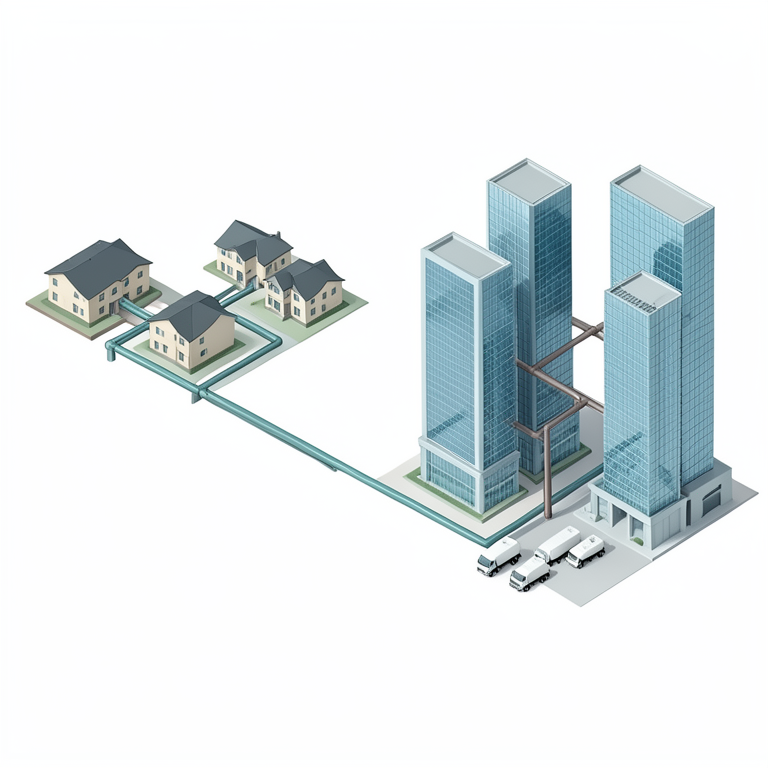
Horizontal vs. Hyper-Vertical Demand
AI-generated conceptual illustration (Urban residential architecture in Gurugram, India). It explains the idea and does not show study data.
View source evidence ↗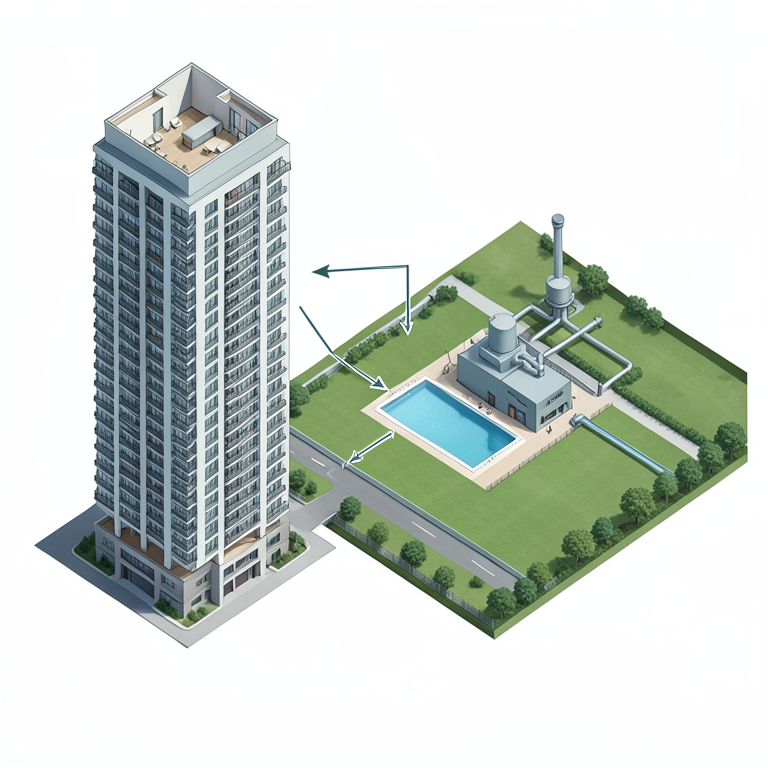
The Concept of Communal Luxury
AI-generated conceptual illustration (A luxury gated residential complex in Gurugram). It explains the idea and does not show study data.
View source evidence ↗Figures & tables
From the original paper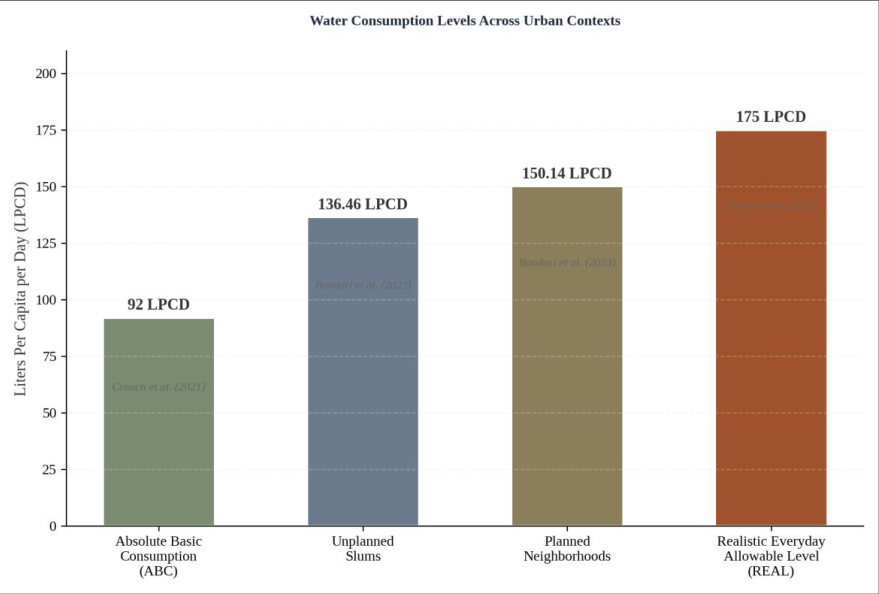 Figure 1
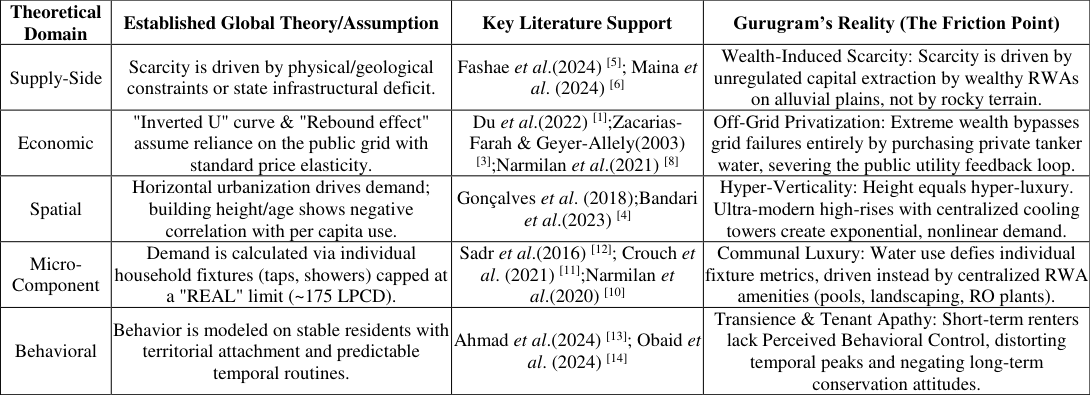 Table 1
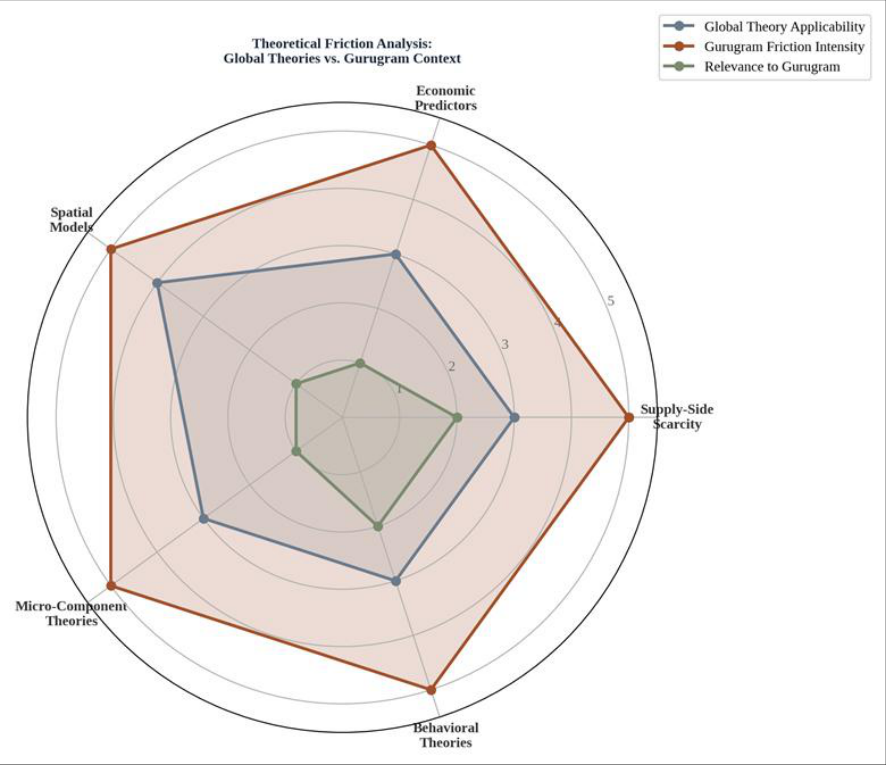 Figure 2
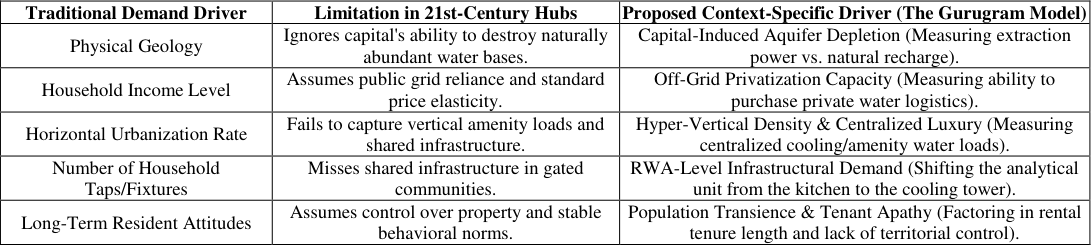 Table 2
Introduction
The theories surrounding domestic water consumption have so far been based on the wellestablished "inverted U" curves predicting peaks of consumption (Du et al., 2022) [1] , and the enduse breakdown peculiar to the horizontal society (Sadr et al., 2015) [2] . However, with the advent of new phenomena, such a theory either is refuted or rethought. To start with, the urban environment of the Global South has changed dramatically in recent decades. In India, Gurugram is now a city of contrasts regarding water consumption: it has emerged as one of India's fastest-growing service economies (Zacarias-Farah & Geyer-Allely, 2003) [3] , the hyper-modern Asian megalopolis's vertical sprawl (Bandari et al., 2023) [4] , and the localized, capital-driven aquifer depletion of the dry global south (Fashae et al., 2024) [5] . Therefore, when the theories derived from the analysis of global consumption trends are superimposed on such a territory, they either predict paradoxes or miss new phenomena entirely. In other words, if a theory worked for a stable horizontal neighborhood, it has limited success in an expanding vertical township with private tanker services. In this paper, the term hyper-verticality refers to the concentration of high-rise residential and commercial developments that substantially alter water demand through centralized infrastructure and shared amenities.
Objective of the Study
This study aims to reconceptualize traditional water theories through Gurugram's hyper-vertical reality, proposing a new framework for modern megacities.
Contextualizing Supply-side Theories: From Geological Constraints to Capital-Induced Depletion Within the literature on water access, the discussion of physical availability and the existing infrastructure is a natural starting point. However, in developing countries, the supply-side theories and hypotheses are intrinsically linked with the narrative of deprivation and inequity. Fashae et al. (2024) [5] describe the situation in Ibadan, Nigeria, where the rocky geology renders digging unviable and makes community boreholes seasonal. Similarly, Maina et al. (2024) [6] discuss the insufficiency of the infrastructure in Gombe, Nigeria, which makes residents turn to private water vendors. Within the supply-side theories, there is a growing body of literature that seeks to establish a link between access to water and social conflagration. Neo-Malthusian theories popular in the 19th century were refuted by Böhmelt et al. (2014) [7] , who analyzed the propensity for water-related violence in the context of 35 countries, managing to establish a conceptual framework about the causes of water conflicts. Thus, according to Böhmelt et al. (2014), water conflicts are demanddriven, with supply-side dynamics being "restraint" factors and predictors of conflagration, such as democratic regimes, lowering the likelihood of conflagration.
Gurugram's Supply-Side Paradox
With the supply-side theories, both physically and socially informed, discussed, it becomes apparent that applying them to a context such as Gurugram township would produce paradoxes. On the one hand, the Nigerian studies are a warning about the limitations of natural infrastructure (Fashae et al., 2024; Maina et al., 2024) [5,6] . However, in Gurugram, fertile alluvial sediment replaces the unreliable boreholes of Ibadan and Gombe. On the other, the municipal well is depleted to the point of capital-driven aquifer shrinkage, a phenomenon not discussed in the Nigerian literature. Fashae et al. (2024) [5] and Maina et al. (2024) [6] discuss the limitations of geology, but not the reverse phenomenon, which is the capital-driven shrinkage of natural water resources. Finally, according to Böhmelt et al. (2014) [7] , it is the democratic, middle-class Resident Welfare Association (RWA) neighborhoods of Gurugram that are factors driving the local natural capital to the brink through private tanker services.
Reassessing Economic Predictors: How the 'Inverted U' Curves Meet Microeconomics of a Dead Aquifer
When the task is to discuss consumption trends in societies experiencing rapid urbanization, it is impossible to ignore debates surrounding the theoretical patterns concerning the socalled 'inverted U ' and 'inverted V star. Having reviewed the supply-side theories and hypotheses, it becomes necessary to proceed to water-demand theories and models that may help understand the water imprint of a dynamic economy like Gurugram. Indeed, Du et al. (2022) [1] engage in an analysis that applies to several theories attempting to predict China's water footprint in developed economies. Using ordinary least squares regression, the authors examined the associations between water consumption per capita and China's GDP per capita as well as its urbanization rate, thus testing the predictive capacity of these theories. The results of the study contribute to the general understanding of water-consumption trends, as an application of the theories to China helps extrapolate the conclusions to similar developing urban centers like Gurugram. In particular, the authors identified an 'inverted U ' curve for water-consumption associations with GDP per capita and an 'inverted V ' curve for water-consumption associations with urbanization rate (Du et al., 2022) [1] . According to the findings, increases in the size of the economy and the process of urbanization lead to rises in water-consumption until the 70-80% level of urbanization, after which consumption begins to decrease due to the adoption of water-saving technologies. When it comes to applying demand theories to Gurugram, the discussion should begin with the general macro-trends. In that regard, the findings of Du et al. (2022) [1] can be supplemented and expanded upon by drawing from the analysis of the rebound effect by Zacarias-Farah and Geyer-Allely (2003) [3] . Indeed, the latter study is one of the comprehensive pieces of research that examined the phenomena in the context of the Organization of Economic Cooperation and Development (OECD) counties (Zacarias-Farah & Geyer-Allely, 2003) [3] . Specifically, as applied to water, Zacarias-Farah and Geyer-Allely (2003) [3] argue that every single technology, by its very nature, offsets itself by enabling the consumption of more of other goods due to the fact that water is an essential input in the production process of every good and service. Therefore, it is logical to state that unless consumption of other goods decreases, the rising water-consumption trends will remain a major concern for global sustainability and environmental conservation. It is in the rebound-effect analysis that it becomes possible to proceed to a discussion of waterconsumption theories at a micro level. Indeed, Narmilan et al. (2021) [8] examine the relationship between water use and income in the context of rapidly developing countries such as India. Later, the study is adapted to analyze the trends in Sri Lanka. As a result, the authors find a strong linear association (.968) between the waterconsumption patterns of RWA and residents' income levels (Narmilan et al., 2021) [8] . According to the study, the income effect accounts for every additional liter consumed for every additional dollar earned as a result of the acquisition of more electric appliances by citizens.
Questioning Spatial Norms: Why Do Urban Households in Gurugram Consume More Water than their Rural Counterparts?
When the objective is to identify the patterns of waterconsumption by urban and rural households, it is logical to begin once again with a discussion of theoretical foundations. In particular, the literature review section of the present paper demonstrates that there is a considerable body of literature that recognizes the link between residents' consumption habits and the gradation of their urbanization. For example, when analyzing the water-consumption patterns of households in Northern Portugal, Gonçalves et al. (2018) [9] applied ordinal logistic regression to examine the link between the level of urbanization and consumption trends. In particular, the authors' findings demonstrate that the water-use of urban households was predicted to be 30% higher than that of their rural counterparts (Gonçalves et al., 2018) [9] . The findings of Gonçalves et al. (2018) [9] can be supported by elaborating on the findings of Bandari et al. (2023) [4] , who examine the consumption patterns of Vijayawada's residents. In particular, Bandari et al. (2023) [4] apply multiple linear regression to predict water-consumption based on neighborhoods' characteristics, including their planning status. According to the authors, residents of organic and planned neighborhoods were predicted to consume the highest amount of water (150.14 lpcd), compared to unplanned slums (136.46 lpcd). Moreover, in Bandari et al. (2023) [4] , it is the building height and the year of its construction that show significant contributions to the regression model. Specifically, the authors find that, for their sample, the increase in height and the age of a building negatively predict potable water consumption per capita. It is possible to argue that it is the result of domestic water consumption being offset by the water-intensity of airconditioning in high-rise buildings. Finally, Bandari et al. (2023) [4] can be supplemented by Narmilan et al. (2020) [10] , who explore the association between residents' waterconsumption and the level of urbanization in Sri Lanka. According to Narmilan et al. (2020) [10] , the likelihood of having high-flow faucets and water-saving showerheads increases with the level of urbanization.
The Fallacy of Horizontal Models
As stated in the preliminary paragraphs, when the objective is to discuss consumption theories in the context of rapidly urbanizing societies, the discussion should begin with theories that address the consumption peculiar to vertical sprawl. However, as demonstrated by the findings of Bandari et al. (2023) [4] and Gonçalves et al. (2018) [9] , not a single study examined the implications of hyperverticality. Indeed, Bandari et al. (2023) [4] document the trends of water-intensity, yet they only address horizontal neighborhoods. In other words, the authors overlook the fact that, in Gurugram, high-rise buildings replaced low-rise ones. Similarly, Gonçalves et al. (2018) fail to address the question of whether or not, in a 30-story high-rise township, water-intensity will be predicted to increase exponentially. Finally, according to Bandari et al. (2023) [4] , building height negatively predicts potable water consumption per capita, whereas in Gurugram, verticality is a major predictor of ultra-luxury consumption: spatial theories should be rethought in the context of hyperverticality to account for the non-linear drivers of extreme consumption.
Contextualizing Micro-component Theories: Communal Luxury vs. Absolute Basic Needs
As far as physical micro-component studies are concerned, it is only natural to begin with the work of Sadr et al. (2015 [2] ; 2016). Indeed, the authors pioneered the analysis of water consumption in the context of Jaipur, India. Using survey-based research, Sadr et al. (2015; 2016) [2] identified the largest areas of consumption, finding bathroom and toilet flushing to account for the majority of it. Moreover, the authors find that family size is a negative predictor of water-consumption per capita, suggesting that small families are ill-adapted in terms of consumption. Other findings relate to the cultural specifics of the region, including the prevalence of bucket bathing over showers and toploading washing machines. It is interesting to note that, in order to operationalize the concepts of absolute necessities, Crouch et al. (2021) [11] developed a theoretical model around Maslow's hierarchy of needs. In particular, in their article, the authors discuss the concept of Absolute Basic Consumption (ABC), which is defined as the most deprived and barely sufficient level of consumption, which satisfies only the most primal needs. According to Crouch et al. (2021) [11] , it is ABC that underlies the 'Realistic Everyday Allowable Level' (REAL), which refers to a comfortable, but non-frugal level of living, wherein waste is minimized. As stated by the authors, REAL constitutes 175 LPCD, whereas ABC only comprises 92 LPCD. Finally, another approach to conceptualizing basic needs is discussed by Narmilan et al. (2020) [10] . In their study, the authors operationalized the term by identifying the number of taps as a theoretical micro-component that influences consumption. According to Narmilan et al. (2020) [10] , the number of taps significantly predicts water-consumption, independent of people's ability to conserve due to the differences in pipework and high-flow showerheads.
Source: Compiled by the authors based on Crouch et al. (2021) [11] and Bandari et al. (2023) [4] As can be inferred from the discussion presented above, the primary theoretical limitation in the context of Gurugram lies in the definition of 'needs', or, rather, the complete absence of 'communal luxury'. In this paper, communal luxury refers to water consumed through shared residential amenities such as swimming pools, landscaped areas, centralized cooling systems, and other common facilities within gated communities. Indeed, while Sadr et al. (2016) [12] only account for micro-components used for personal hygiene, such as bathing or cooking, it is reasonable to assume that, in ultraluxury RWAs the communal amenities are at the forefront of residents expenditure on water. In other words, RWAs' swimming pools, lawn maintenance, and car washes are examples of communal luxury that significantly offset the consumption of water by households. In that regard, it is logical to argue that RWAs' residents' expenditures on communal facilities challenge the concepts of ABC (Crouch et al., 2021) [11] or, at very least, significantly expand them. On the other hand, according to Narmilan et al. (2020) [10] , in a hyper-vertical RWA the theoretical micro-component that should be considered is the number of taps: in reality, they are replaced by centralized pumping stations of RWAs, reverse osmosis water purification plants, and air conditioning systems.
Contextualizing Behavioral and Temporal Theories: The Transience Variable
Finally, when it comes to consuming water in accordance with human behavior, the analysis conducted by Ahmad et al. (2024) [13] offer rather intriguing insights. In particular, the authors applied the Theory of Planned Behavior (TPB) to operationalize sustainable water consumption behavior (SWCB). According to Ahmad et al. (2024) [13] , behavior intention played a mediational role, and attitudes were identified as the strongest predictor of water consumption. In addition, the authors identified sociodemographic variables as significant moderators. Obaid et al. (2024) [14] , in their turn, examined human behavior in connection to water with a focus on temporal variables in the context of urban households in Japan. In particular, Obaid et al. (2024) [14] utilized water consumption data provided by highresolution water meters, thus analyzing consumption patterns of 'worker households. According to Obaid et al. (2024) [14] , 'worker households' demonstrate bi-modal consumption, peaking at 8:00 AM and 8:00 PM. At the same time, households with absent spouses demonstrated delayed and flattened consumption throughout the day. In other words, temporal patterns of consumption were entirely dictated by the behavior of the residents. However, Obaid et al. (2024) [14] and Ahmad et al. (2024) [13] failed to account for the fact that theoretical awareness rarely translates into practical necessity; in fact, Narmilan et al. (2021) [8] document the residents of hig RWAs in Colombo, Sri Lanka, being remarkably unaware of the value of water in terms of currency despite the environment of extreme luxury (73.3% of respondents were completely oblivious).
The Transience Factor: Why Short-Term Residents Do Not Conserve Water
It is only rational to begin this section by stating that Ahmad et al. (2024) [13] and Obaid et al. (2024) [14] only account for the stability of residents in RWA townships. However, as mentioned in passing earlier, it is a rare occurrence for IT professionals to stay in the same company for longer than 6-18 months, with many advancing both their professional careers and/or receiving an opportunity to pursue post-graduation. Similarly, migrant laborers from Bihar, Jharkhand, and West Bengal only stay in Gurugram for 12-24 months before returning home. As can be inferred from this information, there is a behavioral disposition among the residents of Gurugram, which must be taken into account. Firstly, it is common sense that a transient household is not going to renovate the rented accommodation, thus rendering Obaid et al.'s (2024) [14] conclusion about behavioral intention invalid. Secondly, although it is fair to assume that most migrant workers and IT employees prefer to live in a nuclear family, it is only going to be a matter of months or even weeks. Therefore, it is possible to argue that if we use the SWCB framework proposed by Ahmad et al. (2024) [13] , the bachelor living in a flat with another two worker friends, who have a shift-based duty-rotating system, do not fit the mold of "worker household" described by Obaid et al. (2024) [14] . In reality, the water consumption pattern of a "worker household" with a family of four, whose offspring commute to their respective colleges in separate cars, cannot be any different from the pattern of a migrant laborer family that lives in a rented apartment and pays for water separately. Overall, any behavioral intention suggested by Ahmad et al. (2024) [13] is utterly meaningless to the Gurugram residents who intend to stay for a maximum of 24 months. Figure 2 summarizes the conceptual differences between existing water consumption theories and the Gurugram context. It highlights the areas where conventional theories require contextual adaptation. These observations are further synthesized in Table 1. [5] ; Maina et al. (2024) [6] Wealth-Induced Scarcity: Scarcity is driven by unregulated capital extraction by wealthy RWAs on alluvial plains, not by rocky terrain.
Du et al.(2022)
Du et al.(2022)
Spatial
Horizontal urbanization drives demand; building height/age shows negative correlation with per capita use. 2023) [4] Hyper-Verticality: Height equals hyper-luxury. Ultra-modern high-rises with centralized cooling towers create exponential, nonlinear demand.
Micro-Component
Demand is calculated via individual household fixtures (taps, showers) capped at a "REAL" limit (~175 LPCD). [12] ; Crouch et al. (2021) [11] ;Narmilan et al.(2020) [10] Communal Luxury: Water use defies individual fixture metrics, driven instead by centralized RWA amenities (pools, landscaping, RO plants).
Sadr et al.(2016)
Sadr et al.(2016)
Behavioral
Behavior is modeled on stable residents with territorial attachment and predictable temporal routines.
Ahmad et al.(2024) [13] ; Obaid et al. (2024) [14] Transience & Tenant Apathy: Short-term renters lack Perceived Behavioral Control, distorting temporal peaks and negating long-term conservation attitudes. Source: Developed by the authors based on the reviewed literature.
Table 1 above presents the significant theoretical friction points emerged from the provided literature review in relation to the case of Gurugram. The comparison allows for concluding on the applicability of the reviewed theories to the patterns of domestic water consumption in the region. The analysis indicates that while the general trends can be related to the theoretical foundations, the specifics of the case, including the tendencies toward hyper-vertical development, groundwater depletion, shared infrastructure, and transience, need to be taken into account. Thus, it is necessary to interpret the theories through the prism of the peculiarities of the urban environment.
Conclusion
A critical analysis of these fourteen foundational studies leads to partially positive conclusions about the application of global theories for the study of demand. The theories adequately describe demand in horizontal, stable, and historically justified systems. However, they fail to meet when it comes to the contextualization of results within a vertical, highly-GDP, and transient system. In fact, Gurugram is the ultimate context for reinventing the theories that describe the forces driving demand. First, it is the ultimate source of GDP to counterbalance the OECD rebound effect (Zacarias-Farah & Geyer-Allely, 2003) [3] . Second, it is the ultimate vertical for testing the spatial height model (Bandari et al., 2023) [4] . Third, it can provide the ultimate opportunity to interact with a transient workforce for pioneering behavioral models (Obaid et al., 2024) [14] . Fourth, it is the ultimate capital to discuss the creation of supplyindependent scarcity (Fashae et al., 2024) [5] . Fifth, it can offer ultimate luxury assets to deconstruct the need-based microcomponent approach (Crouch et al., 2021) [11] . Therefore, conducting a primary study in Gurugram is a must because it is the only chance to converge the divergent theories and pioneer a modern understanding of the forces that drive demand. Specifically, according to Table 2, there is a need to conceptualize the drivers of demand anew. The proposed framework is merely conceptual and aims to provide guidelines for further empirical research. As discussed above, the current water crisis in Gurugram is mainly caused by the housing real estate sector through groundwater extraction, making the analysis purely economic. Traditional approaches are inefficient in addressing municipal consumption, given the significant consumption gap between urban and rural areas. In the case of Gurugram, such a divide can no longer be applied, given the tremendous rise of high-rises in favor of low-rises. This fact allows concluding that when estimating consumption, attention should be paid to luxury developments, swimming pools, and other infrastructure in the researched area. Last but not least, a considerable number of people only reside in the city temporarily, which is vital information about the consumption to be taken into account. Ultimately, the research will allow analyzing consumption beyond the traditional aspects and introduce alternative approaches, better understanding the forces that contribute to water consumption in the twenty-first century. The limitation of this study is that it only relies on published data, meaning that it is mostly conceptual and requires further empirical research to identify the actual drivers of demand.
Figures and tables from the paper
References
14 in the original paper- Du B, Guo X, Yan Q, Duan H, Liu G. Analysis of domestic water consumption in typical countries and its enlightenment to China. E3S Web of Conferences. 2022;352:03017.
- Sadr SMK, Memon FA, Jain A, Gulati S, Duncan AP, Hussein W, et al. An investigation into domestic water consumption and water use habits in Indian urban areas. In Water Efficiency Conference 2015. 2015:1-13.
- Zacarias-Farah A, Geyer-Allely E. Household consumption patterns in OECD countries: Trends and figures. Journal of Cleaner Production. 2003;11(8):819827.
- Bandari A, Puttaparthi PV, Sadhukhan S. Domestic water consumption determinants in urban neighborhoods: A case study of Vijayawada, India. 18th International Conference on Environmental Science and Technology, Athens, Greece. 2023.
- Fashae O, Akanle O, Olusola A, Orekoya S, Ola-Lawson OD, Olaniyan OI. Household access to portable water and consumption pattern in Ibadan Metropolis, Oyo State, Nigeria. Ibadan Journal of Sociology. 2024;15(1):50-58.
- Maina B, Idoma K, Maiguwu CC, Dayil DC. Assessment of domestic water supply patterns in Gombe Metropolis, Nigeria. In 1st North-East Conference of the Association of Nigerian Geographers. 2024:405-414.
- Böhmelt T, Bernauer T, Buhaug H, Gleditsch NP, Tribaldos T, Wischnath G. Demand, supply, and restraint: Determinants of domestic water conflict and cooperation. Global Environmental Change. 2014;29:337-348.
- Narmilan A, Puvanitha N, Niroash G, Sugirtharan M, Vassanthini R. Domestic water consumption pattern and awareness of urban households. International Journal of Human Capital in Urban Management. 2021;6(3):225-236.
- Gonçalves AM, Matos C, Briga-Sá A, Pereira S, Bentes I, Faria D. Determinants of domestic water consumption: A case study in Northern Portugal [ Poster presentation]. International Conference on Energy and Water. 2018.
- Narmilan A, Puvanitha N, Niroash G, Sugirtharan M, Vassanthini R. Domestic water consumption pattern by urban households. Drinking Water Engineering and Science Discussions. 2020:1-12.
- Crouch ML, Jacobs HE, Speight VL. Defining domestic water consumption based on personal water use activities. AQUA -Water Infrastructure, Ecosystems and Society. 2021;70(7):1002-1011.
- Sadr SMK, Memon FA, Jain A, Gulati S, Duncan AP, Hussein W, et al. An analysis of domestic water consumption in Jaipur, India. British Journal of Environment & Climate Change. 2016;6(2):97-115.
- Ahmad RAR, Samsudin S, Azmi NA, Yatim NHM. Assessing and modelling domestic water consumption behavior. Information Management and Business Review. 2024;16(2):151-162.
- Obaid S, Hosoi K, Ngoc NM, Inoue T, Yokota K. Assessment of water consumption behavior in single households using smart water meters. Applied Sciences. 2024;14(19):8857.