
Research article · 2026 · Full text
International Journal of Geography Geology and EnvironmentPatterns and determinants of migration of interstate migrant brick kiln workers in Haryana
Volume 8(7) · Pages 273–281 · DOI: 10.22271/27067483.2026.v8.i7c.842 ↗
Research areasMigration and Labor DynamicsRegional Socio-Economic Development TrendsSocial and Economic Development in India
Abstract
Author-writtenMigration is an essential determinant of population change along with fertility and mortality which shapes the population dynamics of any area. Notably, the migrant count surged from 207 million in 1981 to 455 million in 2011. Haryana, a rapidly growing Indian state, stands as an economic hub offering job prospects in agriculture and industry. Census data from 2011 highlights that out of Haryana's total population of 25.3 million, 41.73 percent (10.5 million) were migrants. The brick kiln sector, a major employer in India, absorbs a substantial share of migrant labour, with over 1,15,000 brick-making units in the country providing jobs to around 2.11 million workers. Haryana's brick production dominance is supported by more than 3000 brick kilns. These kilns are significant employers of migrants, resulting in demographic and socio-economic effects on both the state and the migrants themselves. The present study delves into the migration patterns and determinants of brick kiln workers in Haryana. The research relies on primary data collected via field surveys of 60 brick kilns, representing 2 percent of the total functioning kilns, and encompassing 600 households from 22 districts of Haryana chosen through multistage sampling. The results of this study highlight that maximum number of migrants at the brick kiln of Haryana are coming from the state of Uttar Pradesh followed by Bihar. Thus, migration shows a clustered pattern of districts in east, south, and south west direction of the state of Haryana. Along with this, employment is the most important determinant of migration in terms of male migration. Although in case of female migration, move with family is also a significant determinant of migration.
Summary
Source-checkedPlain-language reading of the full paper, prepared with AI and checked against the text. Each point links to the authors' own words.
Why it matters
- The brick kiln sector is a major source of employment in India, employing approximately 2.11 million workers across more than 115,000 units. View evidence ↗
- Haryana serves as an economic hub with a high migrant population; 2011 census data shows that 41.73% (10.5 million) of its 25.3 million residents were migrants. View evidence ↗
- With over 3,000 brick kilns, Haryana is a dominant producer of bricks and a significant employer of migrant workers, which impacts the socio-economics of both the state and the workers. View evidence ↗
The question
- The study aims to investigate the patterns and the factors that determine the migration of brick kiln workers in Haryana. View evidence ↗
What they did
- Researchers collected primary data through field surveys of 600 households across 60 brick kilns (2% of total kilns) in 22 districts of Haryana using multistage sampling. View evidence ↗
What they found
- The highest number of migrant workers come from Uttar Pradesh (43.17%, 259 households) and Bihar (32.50%, 195 households). View evidence ↗
- Contractors, known as Thekedars, are the primary link for employment, with approximately 80% of respondents securing work through them. View evidence ↗
- Brick molding (Pathers) is the most common job, with 69.5% of the 600 surveyed households (417 workers) engaged in this process. View evidence ↗
- Employment is the primary driver for migration, cited by 96% of the total workers surveyed. View evidence ↗
- For male migrants, unemployment in their home region was the leading determinant, cited by 72% of working males. View evidence ↗
- Female migration differs from male migration; while 57% of women migrated for employment, 37% moved specifically to accompany their families. View evidence ↗
What it means
- The authors conclude that migration to Haryana's brick kilns is primarily driven by economic necessity and follows a seasonal cycle. View evidence ↗
- The authors state that while the work provides economic benefits, it is characterized by low wages, long hours, and harsh working conditions. View evidence ↗
Figures & tables
From the original paper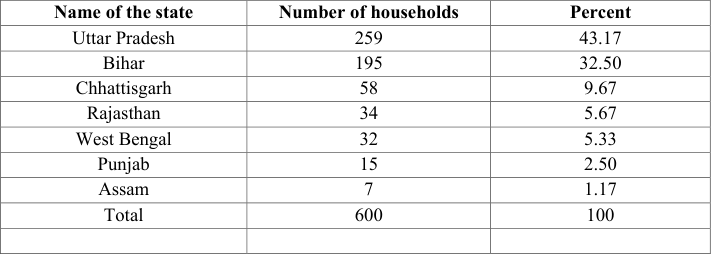 Table 1
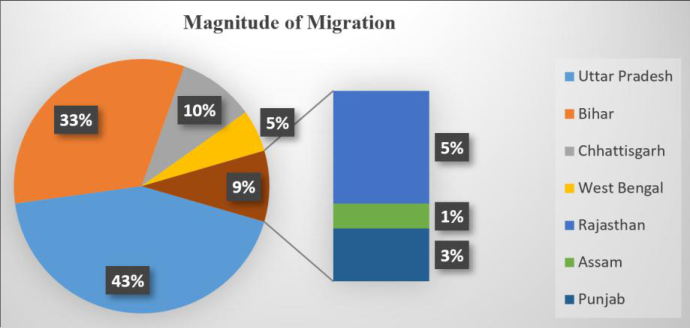 Figure 1
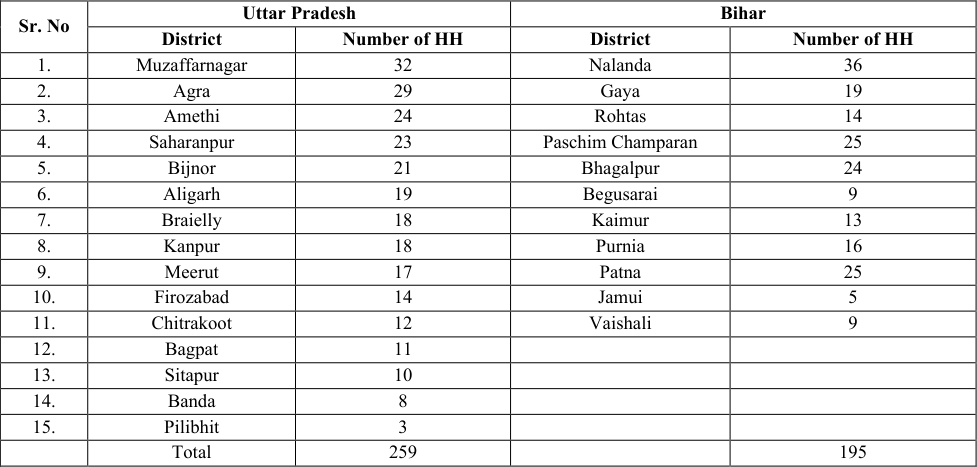 Table 2
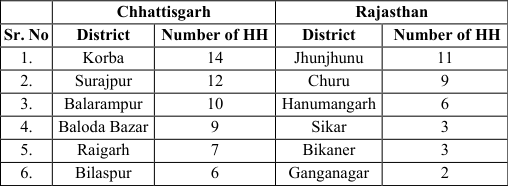 Table 3
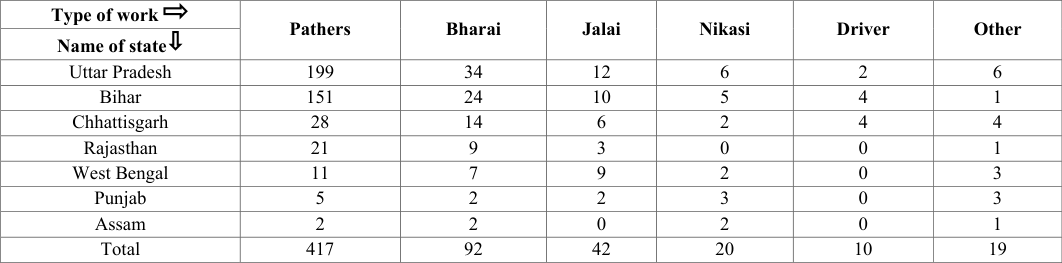 Table 5
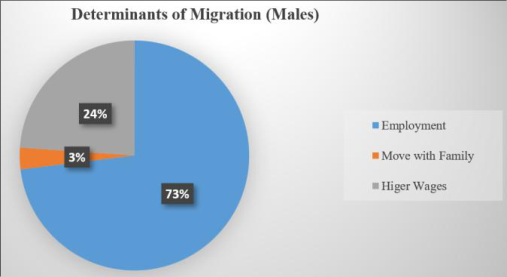 Figure 4
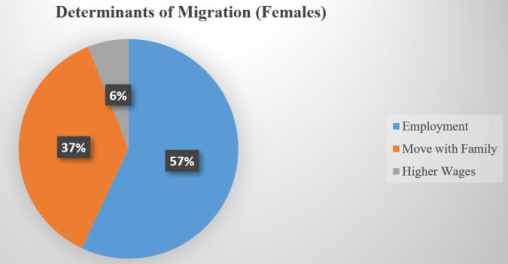 Figure 3
Introduction Objective:
The major objective of this study is to highlight the patterns and determinants of migration of interstate migrant brick kiln workers in Haryana.
Methodology: This study is based on primary data collected through field survey. A sample of 60 brick kiln is taken from 22 districts of Haryana based on proportion of brick kilns in concerned district to the total brick kilns in Haryana. At next level, brick kilns have been taken from the villages of each Tehsil and block to make the sample representative. 10 households from each brick kiln were surveyed on random basis. In this way, a sample of 600 households were taken to identify the patterns of migration along with the major determinants. Interview schedule method of primary data collection has been used in this study. Results have been represented with the help of maps, tables, and diagrams.
Patterns of migration of brick kiln workers
In Haryana, the migration patterns of brick kiln workers unfold a narrative of economic necessity and seasonal fluctuations. Many workers migrate from rural areas of neighbouring states like Uttar Pradesh, Bihar, and Rajasthan, drawn by the promise of employment in the brick kilns of Haryana. The migration typically occurs in waves, coinciding with the agricultural off-season when opportunities for rural employment are scarce. These workers often endure harsh living conditions, residing in temporary settlements near the kilns, where they toil under challenging circumstances. The cyclical nature of brick production means that their migration follows a seasonal rhythm, with workers returning to their hometowns during periods of low demand. This pattern highlights the intricate interplay between economic factors, labour dynamics, and geographic mobility in shaping the lives of migrant brick kiln workers in Haryana. Total number of states from where the migrant workers are coming was recorded 7. It is evident from the analysis of the data that the number of migrants decreased with the increase in the distance from the destination. Thus, Ravan stein law of migration in which he stated that migration has negative correlation with the distance, applicable in case of the present study. The analysis of data revealed that the maximum number of migrant workers at the brick kilns of Haryana are coming from the neighbouring state. Out of the total 600 surveyed households, 259 were from the Uttar Pradesh followed by the migrant workers form Bihar, number of which was 195. Muzaffarnagar, Saharanpur, Peelipheet and Moradabad were the major source districts in Uttar Pradesh. Nalanda, Purnia and Bhagalpur were major source districts in the Bihar from where migrant workers migrate to the brick kilns of Haryana. The third largest number of households of workers at brick kiln belong to the state of Chhattisgarh (58) followed by the respondent from West Bengal (32) and Rajasthan (34). Other states which were identified as the home state of migrant workers were Assam (7), Punjab (15).
Chhattisgarh and Rajasthan
Chhattisgarh and Rajasthan also account for about 10 percent and 5 percent of the total surveyed households respectively. 58 out of total 600 surveyed households were belonging to Chhattisgarh while there were 34 households of migrant brick kiln workers who migrated from Rajasthan to Haryana. In Rajasthan, the majority of the workers came from the districts adjacent to Haryana. Churu, Jhunjhunu, Hanumangarh and Ganga Nagar are the major districts of Rajasthan from where brick kiln workers come to Haryana.
Out of 32 households, 20 were from Churu and Jhunjhunu districts. Bikaner, Sikar, Ganganagar and Hanumangarh were other districts from where migrant workers were reported. From Chhattisgarh, majority of workers were from Korba and Surajpur and Balarampur districts. 36 out of the 58 workers were from these three districts of Chhattisgarh. Other districts from migrant workers were reported were Raigarh, Baloda Bazar and Bilaspur. The maps depict the patterns of migration from Rajasthan and Chhattisgarh.
Punjab, West Bengal, and Assam
The states of Punjab, West Bengal and Assam also send the workers to the brick kilns of Haryana. Although number of these workers is lower as compared to the state of Uttar Pradesh and Bihar. The reason in case of Assam and West Bengal is more distance from Haryana and in case of Punjab is the significant presence of the brick kiln industry in Punjab. Only 15 out of the total 600 surveyed households were reported from Punjab which constitutes only 2.5 percent of the total studied households. The major districts sending migrant workers from Punjab were Mansa, Fazilka, Bhatinda, Sangrur and Moga. 10 out of the total 15 households from Punjab were from Fazilka and Mansa. Migration from Punjab is mainly confined to the districts of Punjab adjacent to Haryana. It was reported from the analysis of data that 6.3 percent of the total surveyed households were belonging to West Bengal, number of which was 32.
Nature and type of work at Brick Kilns
Brick kilns in Haryana engage workers in various types of labour, each demanding its own set of skills and endurance. The brick-making process involves multiple stages, from clay preparation to melding, drying, firing, and stacking. At these kilns, workers typically engage in tasks such as clay excavation, mixing, and shaping the raw material into bricks. There are also those involved in operating the kilns, ensuring the right temperature for firing bricks. Additionally, workers handle tasks related to transporting bricks within the kiln site or to external locations. The labour is physically demanding, often requiring long hours of work in harsh conditions, including exposure to extreme heat and dust. Despite the challenges, these workers play a crucial role in the construction industry, supplying bricks that are fundamental to infrastructure development in the region. Moulding of bricks is the most labour extensive type of work at the brick kiln. The workers engaged in this process are called Pathers as mentioned earlier. This process involves this preparing by removing impurities from it. It is followed by the putting the clay into the metal or wooden moulds and preparing raw bricks. Bharai workers are the workers who transport the raw bricks from the place of their moulding to the kiln. They are transported with the help of manual cart and mules. After transporting the bricks to kiln, they are set into the kiln for baking. Jalai workers bake the bricks by maintaining the temperature of kiln, by controlling the fuel supply. Nikasi workers usually extract the baked bricks out of the kiln. It is evident from the table that the maximum number of workers at brick kiln are engaged in brick moulding work and are known as Pathers. It is because the primary process involved in brick making is the preparing clay and making raw bricks of it. Out of the total 600 surveyed households, 69.5% were involved in brick making process. This group of workers was followed by the Bharai workers who transport the raw bricks from the place of moulding of bricks to the kiln where they are burnt. 15 percent of the total surveyed households were engaged in Bharai work. 7% of the total households were engaged in Jalai work. They burn the fuel at the kiln and bake the brick by maintaining the appropriate temperature. Other types of workers who were working at brick kiln included the Nikasi workers, drivers, chowkidars etc. Among the migrants, they were less in number, reason being the engagement of local workers in such occupations. The table also indicates the number of migrant workers from various states engaged in different types of work at brick kiln. About 80 percent of the workers who are from Uttar Pradesh are engaged as the Pathers, duty of whose is to mound the clay in the shape of bricks. This group constitutes the largest number of workers at the surveyed brick kilns of Haryana. Migrant workers from the Bihar are engaged in the Bharai workers. They transport the dried brick to the kiln to get them baked. Although workers from other states are also engaged in the above-mentioned tasks. Workers from Rajasthan were drivers, Nikasi workers and Jalai workers at surveyed brick kilns.
Determinants of migration Pull factors
Economic necessity is the primary driver of migration for brick kiln workers. Many come from impoverished regions where job opportunities are scarce and wages are low. The prospect of better-paying jobs in Haryana's brick kilns acts as a significant pull factor. It is evident from the data that 96 percent of the total workers came in search of employment opportunity at the brick kilns of Haryana followed by 4 percent migrated due to other reasons. The figure depicts the determinants of male migration at the brick kilns of Haryana. Employment is the most important factor responsible for migration. 72 percent working males of the surveyed households cited the unemployment at source as the major determinant of migration. 24 percent males migrated because of lower wages in the State of Origin. Often, the brick kiln industry offers higher wages compared to agriculture or other forms of rural employment. Additionally, the piece-rate wage system in kilns can attract workers who believe they can increase their earnings through hard work and extended hours. The promise of a regular income, even under harsh working conditions, is a powerful motivator for families living in poverty. 3 Percent of the males moved with family. They were mainly dependents who were not able to manage themselves at the place of origin. This is why they moved with their children.
Determinants of female migration
In case of female migration, factors were almost similar as in case of male migration but less female migrated in search of employment as compared to males. It was found that 57 percent of the women of surveyed household migrated in search of employment while in case of males the percentage was 72. On the other hand, 37 percent of the women of surveyed households moved with family as their husbands migrated to kiln in search of employment. The percent of women who migrated to brick kilns of Haryana because of lower wages at their native place was only 3 percent. This scenario depicts that many of the women at brick kiln migrate because of the movement of family and employment was not the primary reason of their migration, although they got employment at brick kilns.
Conclusion
The migration pattern of brick kiln workers in Haryana is shaped by economic necessity and seasonal fluctuations. Workers, primarily from Uttar Pradesh, Bihar, Chhattisgarh, Rajasthan, West Bengal, Punjab, and Assam, travel to Haryana during the agricultural off-season. Census data indicates that distance plays a role in migration trends, as most workers come from neighbouring states, with Uttar Pradesh and Bihar contributing the highest numbers. Contractors, or Thekedars, act as intermediaries, recruiting workers from their home states. In some cases, inter-state matrimonial connections also influence migration patterns. Workers at brick kilns engage in various tasks such as molding, transporting, and baking bricks. The majority are involved in brick molding, a physically demanding process that requires significant labour. The migration cycle follows a seasonal pattern, with workers returning to their native places during the monsoon when kilns shut down. Approximately 80% of workers leave during the off-season, while others seek temporary employment in agriculture or construction. Despite economic benefits, workers face harsh conditions, long hours, and low wages. Determinants of migration include economic factors like unemployment and wage disparity. About 96% of surveyed households cited employment as their primary reason for migration. While male workers mainly migrate for work, a considerable number of women migrate with their families. However, female workers also contribute to the workforce, albeit in smaller numbers than men.
Figures and tables from the paper
| Name of the state | Number of households | Percent |
|---|---|---|
| Uttar Pradesh | 259 | 43.17 |
| Bihar | 195 | 32.50 |
| Chhattisgarh | 58 | 9.67 |
| Rajasthan | 34 | 5.67 |
| West Bengal | 32 | 5.33 |
| Punjab | 15 | 2.50 |
| Assam | 7 | 1.17 |
| Total | 600 | 100 |
Table text extracted from the original PDF; superscript letters are shown inline. The original table image is below.
View original table image
| Sr. No | Uttar Pradesh | — | Bihar | — |
|---|---|---|---|---|
| District | Number of HH | District | Number of HH | |
| 1. | Muzaffarnagar | 32 | Nalanda | 36 |
| 2. | Agra | 29 | Gaya | 19 |
| 3. | Amethi | 24 | Rohtas | 14 |
| 4. | Saharanpur | 23 | Paschim Champaran | 25 |
| 5. | Bijnor | 21 | Bhagalpur | 24 |
| 6. | Aligarh | 19 | Begusarai | 9 |
| 7. | Braielly | 18 | Kaimur | 13 |
| 8. | Kanpur | 18 | Purnia | 16 |
| 9. | Meerut | 17 | Patna | 25 |
| 10. | Firozabad | 14 | Jamui | 5 |
| 11. | Chitrakoot | 12 | Vaishali | 9 |
| 12. | Bagpat | 11 | ||
| 13. | Sitapur | 10 | ||
| 14. | Banda | 8 | ||
| 15. | Pilibhit | 3 | ||
| Total | 259 | 195 |
Table text extracted from the original PDF; superscript letters are shown inline. The original table image is below.
View original table image
| — | Chhattisgarh | — | Rajasthan | — |
|---|---|---|---|---|
| Sr. No | District | Number of HH | District | Number of HH |
| 1. | Korba | 14 | Jhunjhunu | 11 |
| 2. | Surajpur | 12 | Churu | 9 |
| 3. | Balarampur | 10 | Hanumangarh | 6 |
| 4. | Baloda Bazar | 9 | Sikar | 3 |
| 5. | Raigarh | 7 | Bikaner | 3 |
| 6. | Bilaspur | 6 | Ganganagar | 2 |
Table text extracted from the original PDF; superscript letters are shown inline. The original table image is below.
View original table image
| Type of work | Pathers | Bharai | Jalai | Nikasi | Driver | Other |
|---|---|---|---|---|---|---|
| Name of state | ||||||
| Uttar Pradesh | 199 | 34 | 12 | 6 | 2 | 6 |
| Bihar | 151 | 24 | 10 | 5 | 4 | 1 |
| Chhattisgarh | 28 | 14 | 6 | 2 | 4 | 4 |
| Rajasthan | 21 | 9 | 3 | 0 | 0 | 1 |
| West Bengal | 11 | 7 | 9 | 2 | 0 | 3 |
| Punjab | 5 | 2 | 2 | 3 | 0 | 3 |
| Assam | 2 | 2 | 0 | 2 | 0 | 1 |
| Total | 417 | 92 | 42 | 20 | 10 | 19 |
Table text extracted from the original PDF; superscript letters are shown inline. The original table image is below.
View original table image
References
16 in the original paper- Agarwala SN. Socio-economic and demographic characteristics of the rural migrants. J Inst Econ Res. 1968;3(2):1-15.
- Ali N, Khan JH. Daily labour market workers (DLMW) in Moradabad City of Uttar Pradesh, India: A causal analysis. Geographer. 2019;66(2):45-56.
- Anderson S, Banerji D. Report on a study of migration in four taluks of Bangalore district. Popul Rev. 1962;6(1):69-77.
- Dhar B, Bhagat RB. Return migration in India: Internal and international dimensions. Migr Dev. 2021;10(1):107-121.
- Bolaria BS, Bolaria R. International labour migrations. New York: Oxford University Press; 1997.
- Census of India. Functional classification of urban agglomerations/towns of India. Occasional Paper No. 3 of 1994. New Delhi: Office of the Registrar General; 1991.
- Census of India. General population tables and primary census abstract. Series-8, Haryana, Part II-A & B. Chandigarh: Directorate of Census Operations, Haryana; 1991.
- Census of India. Migration tables. Series 1-India, Part V-D, Vol. II (Parts I & II). New Delhi: Registrar General and Census Commissioner; 1991.
- Davis K. The population of India and Pakistan. Princeton (NJ): Princeton University Press; 1951.
- Joshi B, Khandelwal R. Circular migration streams from southern Rajasthan: Brick kiln work, work in textile markets, and ice cream vending. In: Deshingkar P, Farrington J, editors. Circular migration and multilocational livelihood strategies in rural India. New Delhi: Oxford University Press; 2009. p. 118-138.
- Kaur D, Singh S. Migrant farm workers in Punjab: A spatio-temporal analysis. Popul Geogr. 2020;42(2):7384.
- Mittal A. Health of kiln workers and exposure to emissions. New Delhi: Centre for Education and Communication; 2018.
- Mittal A. Decent work and green bricks in India's brick kiln industry. Research study under the project "Empowering CSOs for Decent Work and Green Bricks in India's Brick Kiln Industry". New Delhi: Prayas Centre for Labour Research and Action (PCLRA); 2018.
- Mittal A, John J, Pandya A, Gupta R, Debbarma A, Yadav S. Health status of brick kiln workers in North East India. 2018.
- Sharma DK, Varun A, Patel M. Qualitative study on clinico-social problems of brick-kiln workers: A study from Anand, Gujarat. Natl J Community Med. 2013;4(3):503-506.
- Shriraam V, Srihari R, Gayathri T, Murali L. Active case finding for tuberculosis among migrant brick kiln workers in South India. Indian J Tuberc. 2020;67(1):3842.