
Research article · 2026 · Full text
International Journal of Horticulture and Food ScienceEffect of different type of mulches on growth, flowering and yield of cucumber var. Pusa Sanyog
Volume 8(8) · Pages 01–10 · DOI: 10.33545/26631067.2026.v8.i8a.825 ↗
Research areasIrrigation Practices and Water ManagementPlant Growth and Agriculture TechniquesPlant Disease Management Techniques
Abstract
Author-writtenAn experiment was conducted at Polytechnic in Horticulture, ACH, NAU, Paria (Gujarat) during late kharif, 2021-24. The experiment was laid out in a Randomized Block Design (RBD) in nine treatments and three replications. The treatment consisted of T 1: Black polyethylene mulch (25 micron), T 2· Black polyethylene mulch (50 micron), T₃: Silver polyethylene mulch (25 micron), T₄:Silver polyethylene mulch (50 micron), T₅:Red polyethylene mulch (25 micron), T₆:Red polyethylene mulch (50 micron), T₇: White polyethylene mulch (25 micron), T₈: White polyethylene mulch (50 micron) and T₉: Control (No mulch). Crop earliness was recorded in treatment Silver polyethylene mulch (25 micron) in respect to days to first male & female flower appearance, and days to first fruit harvest as compared to other treatments. Treatment Silver polyethylene mulch (50 micron) was recorded maximum no. of female flowers per vine, maximum fruit diameter, fruit weight, no. of fruits per vine, yield and highest net realization as compared to other treatments. The farmers of South Gujarat, growing cucumber during late kharif are recommended to mulch with 50μm thickness silver polyethylene (covered with 70% area) before seed sowing along with recommended dose of fertilizers (100:60:60 kg NPK/ha) for getting higher yield and net realization.
Summary
Source-checkedPlain-language reading of the full paper, prepared with AI and checked against the text. Each point links to the authors' own words.
Why it matters
- Cucumber is a widely grown crop valued for its fruits, which are believed to provide cooling effects and aid in treating indigestion, jaundice, and constipation. View evidence ↗
- Mulching involves covering the soil surface with various materials to regulate soil temperature and reduce water evaporation, particularly around the plant roots. View evidence ↗
- The use of mulches helps in conserving soil moisture, suppressing weeds, and improving water use efficiency by modifying the soil microclimate. View evidence ↗
The question
- The study aimed to evaluate how different types of mulches affect the growth, flowering, and overall yield of the Pusa Sanyog cucumber variety. View evidence ↗
What they did
- Treatments included black, silver, red, and white polyethylene mulches at thicknesses of 25 and 50 microns, alongside a no-mulch control group. View evidence ↗
What they found
- Silver polyethylene mulch (50 µm) produced the maximum vine length at 60 days after sowing (pooled: 103.62 cm) and at final harvest (pooled: 181.05 cm). View evidence ↗
- The highest number of branches per vine was observed with 50 µm silver polyethylene mulch, reaching a pooled average of 6.65. View evidence ↗
- Silver polyethylene mulch (25 µm) led to the earliest appearance of the first male flower, with a pooled average of 34.29 days. View evidence ↗
- The 50 µm silver polyethylene mulch resulted in the highest number of female flowers per vine, with a pooled average of 25.26. View evidence ↗
- The earliest first fruit harvest was achieved using 25 µm silver polyethylene mulch, with a pooled average of 47.13 days. View evidence ↗
- The 50 µm silver polyethylene mulch produced the highest fruit yield per plot, with a pooled average of 22.33 kg/plot. View evidence ↗
- The highest total yield per hectare was achieved with 50 µm silver polyethylene mulch, reaching a pooled average of 34.46 t/ha. View evidence ↗
What it means
- The authors recommend that farmers in South Gujarat use 50 µm silver polyethylene mulch covering 70% of the area, combined with 100:60:60 kg NPK/ha fertilizer, to maximize yield and profit. View evidence ↗
Visual summary
3 visualsIllustrations explain the paper; charts are replotted from the paper's own table values.
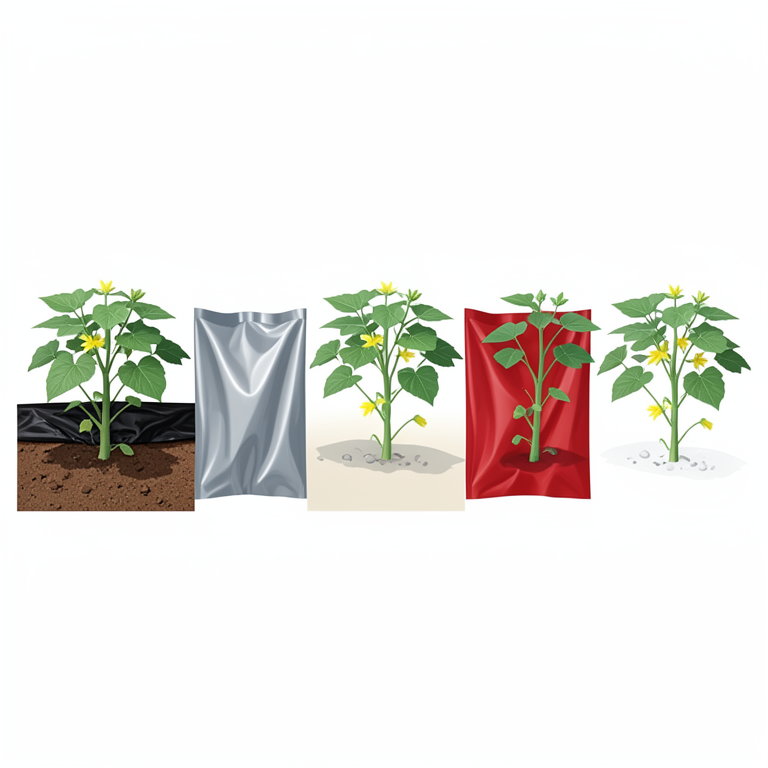
Mulch Treatment Comparison
AI-generated conceptual illustration (cucumber plants (var. Pusa Sanyog) in soil). It explains the idea and does not show study data.
View source evidence ↗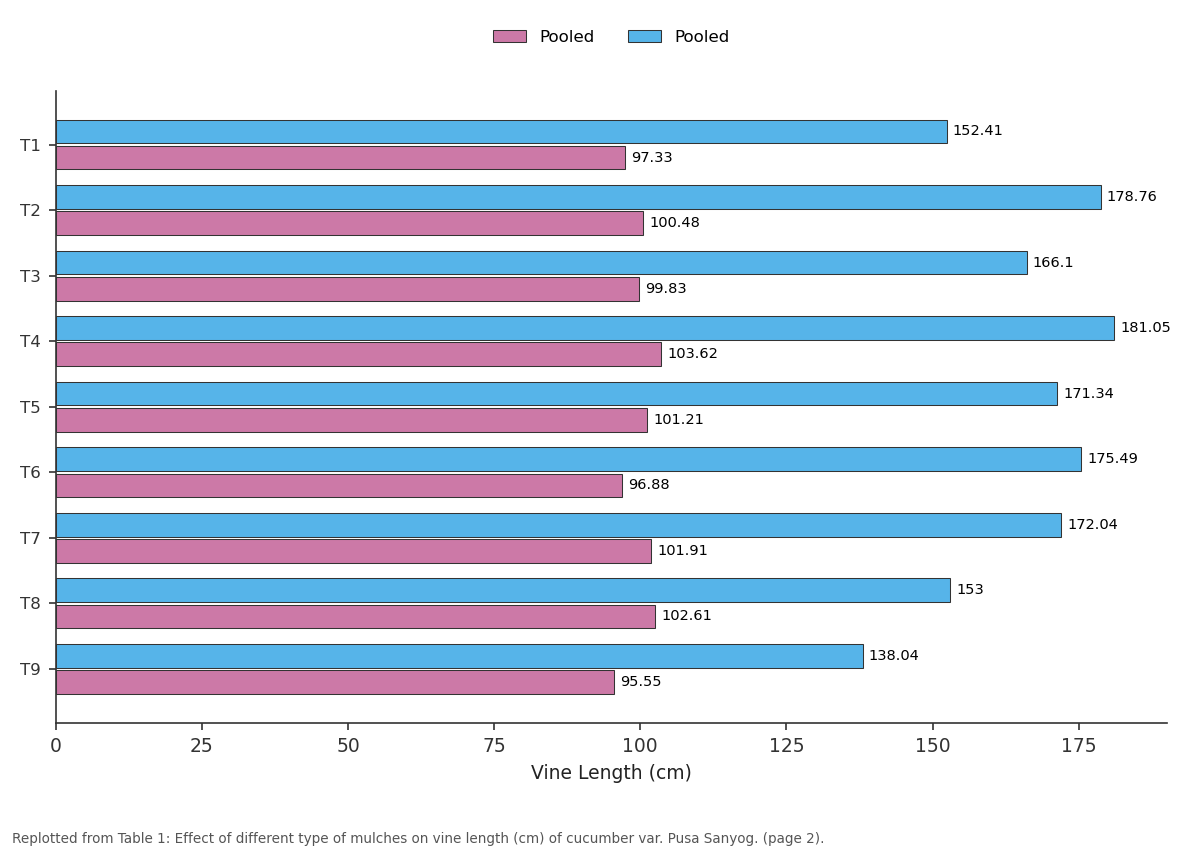
Pooled and Pooled: T1 vs T2 vs T3 vs T4 vs T5
Replotted from Table 1 (page 2) of the original paper. Every bar is the paper's own table value.
View source evidence ↗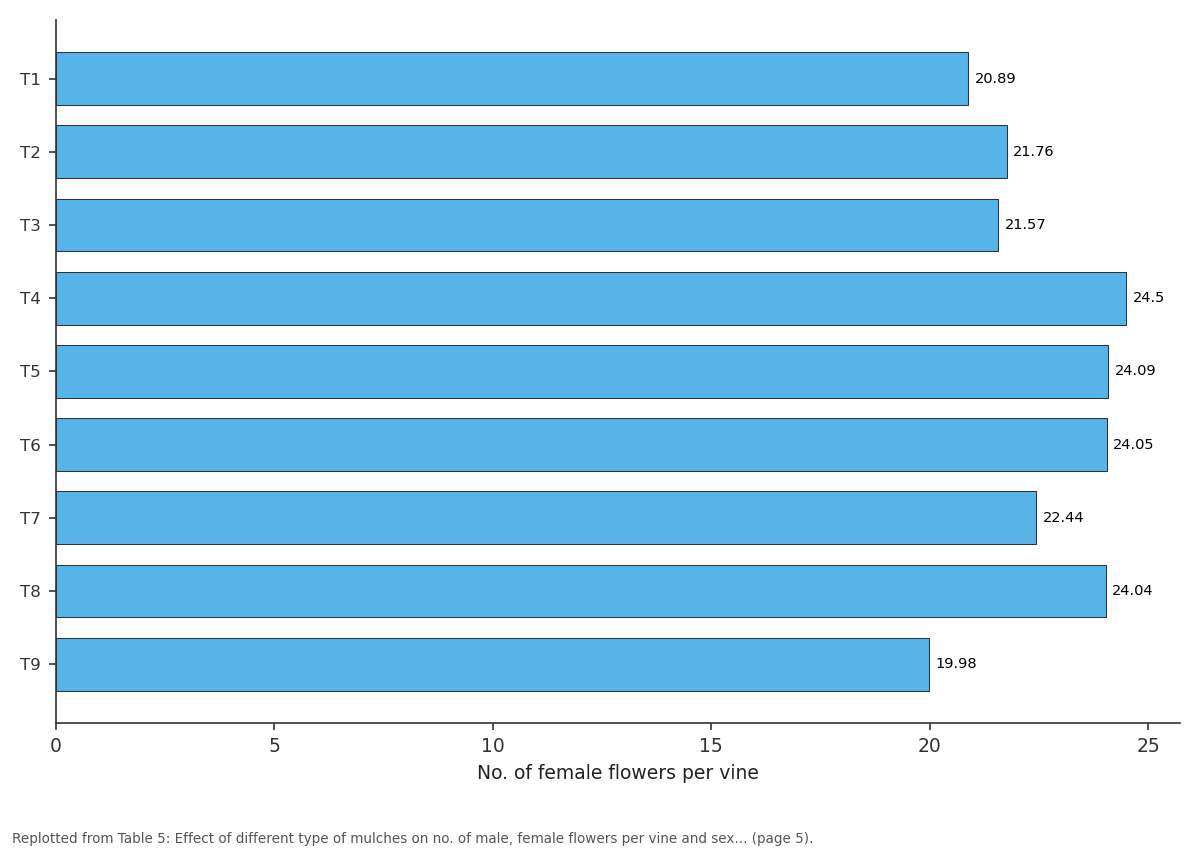
2024-25: T1 vs T2 vs T3 vs T4 vs T5
Replotted from Table 5 (page 5) of the original paper. Every bar is the paper's own table value.
View source evidence ↗Figures & tables
From the original paper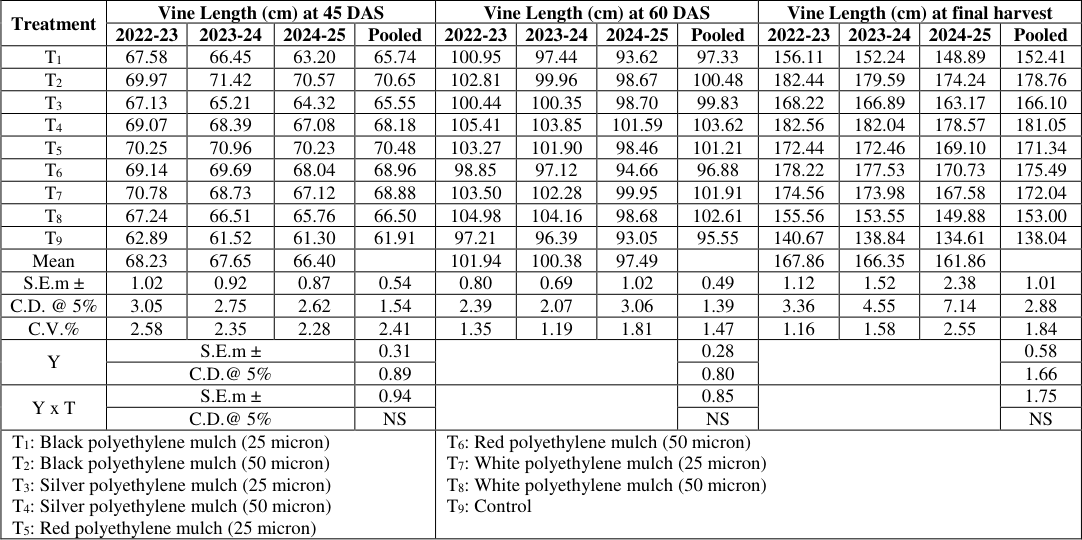 Table 1
 Table 2
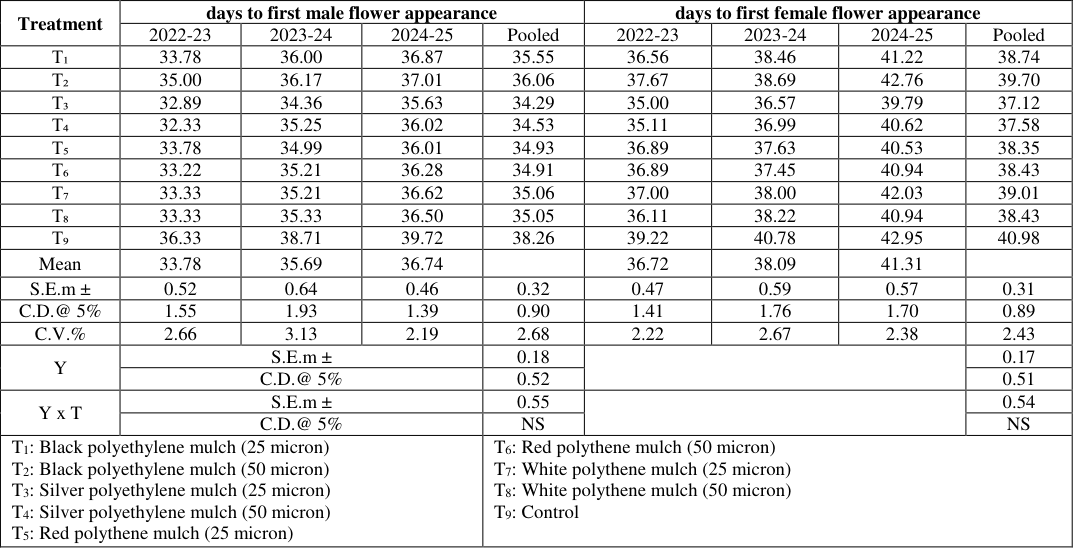 Table 3
 Table 4
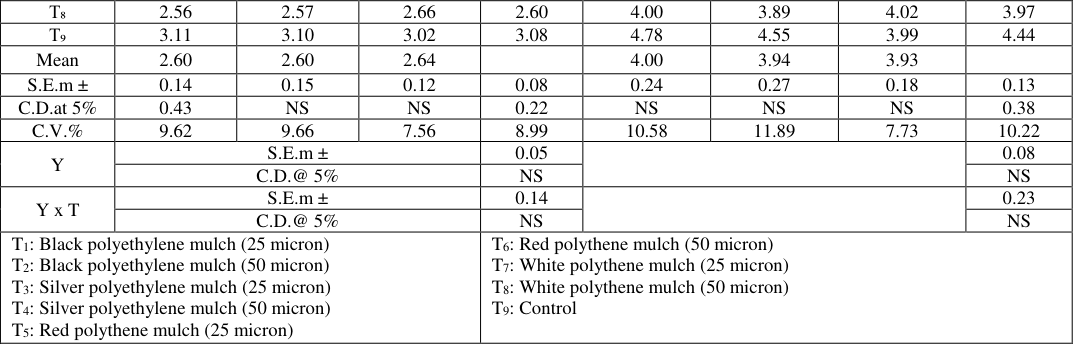 Table 5
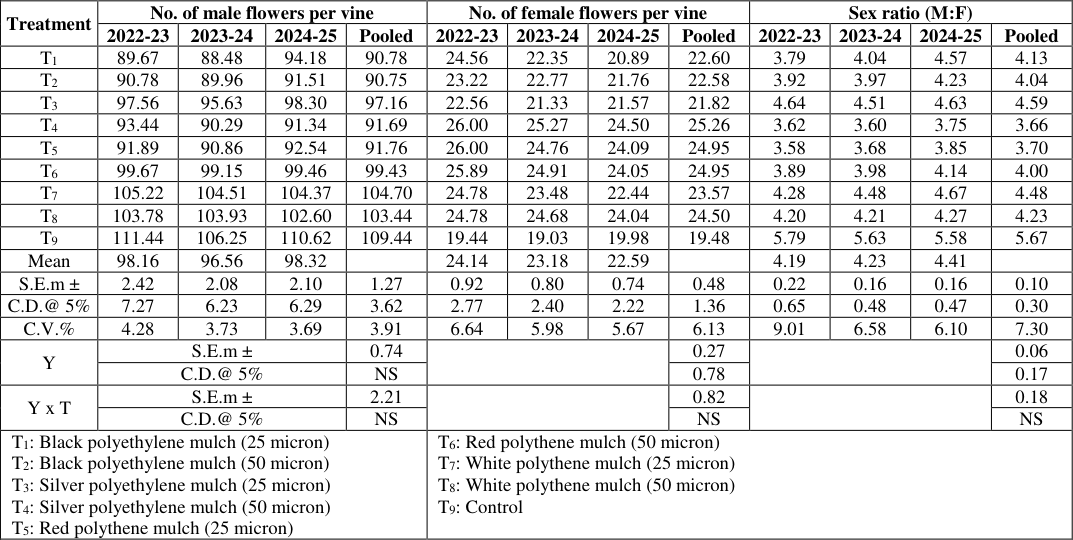 Table 5
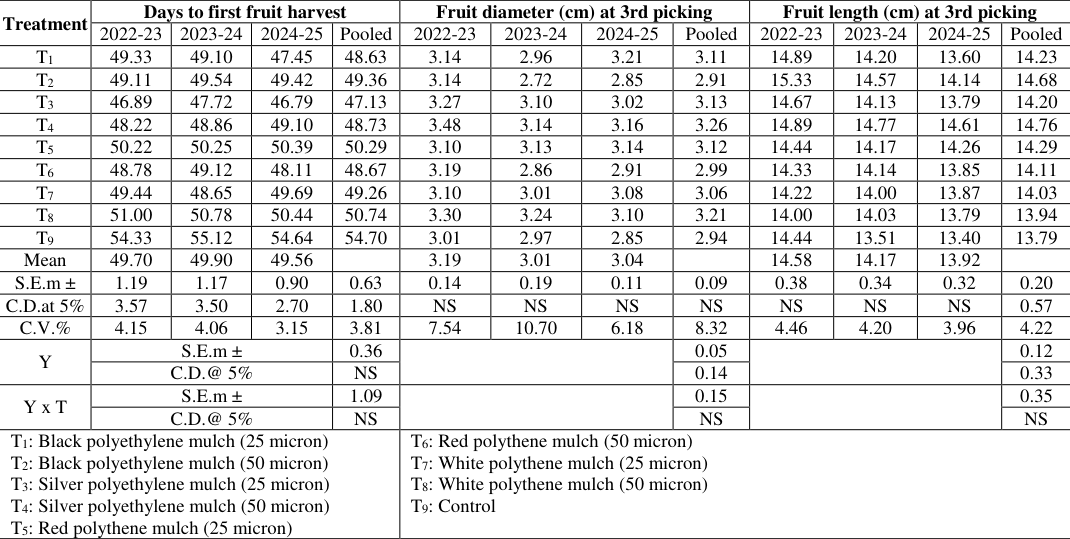 Table 6
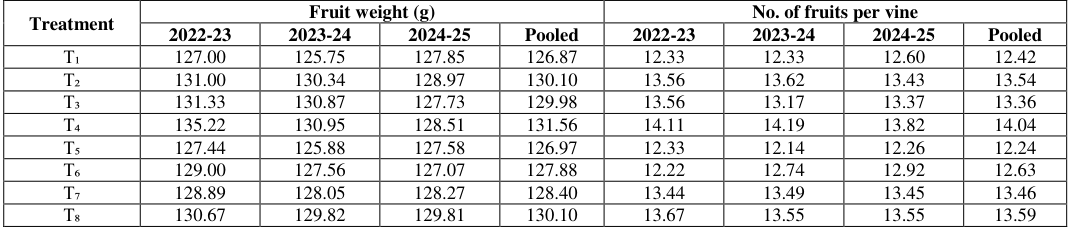 Table 7
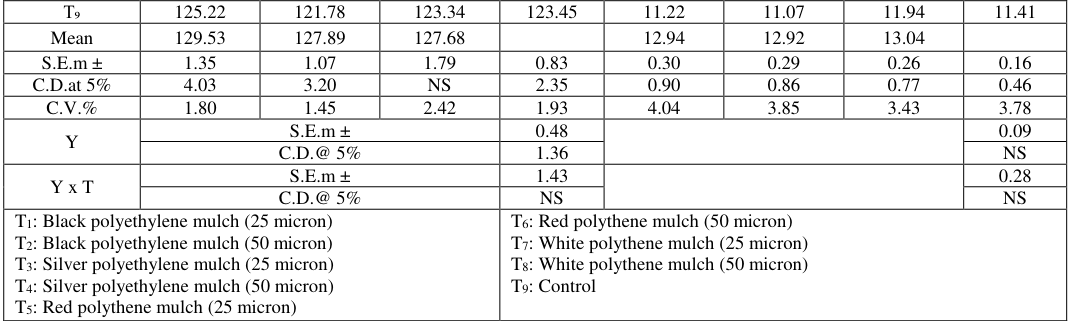 Table 8
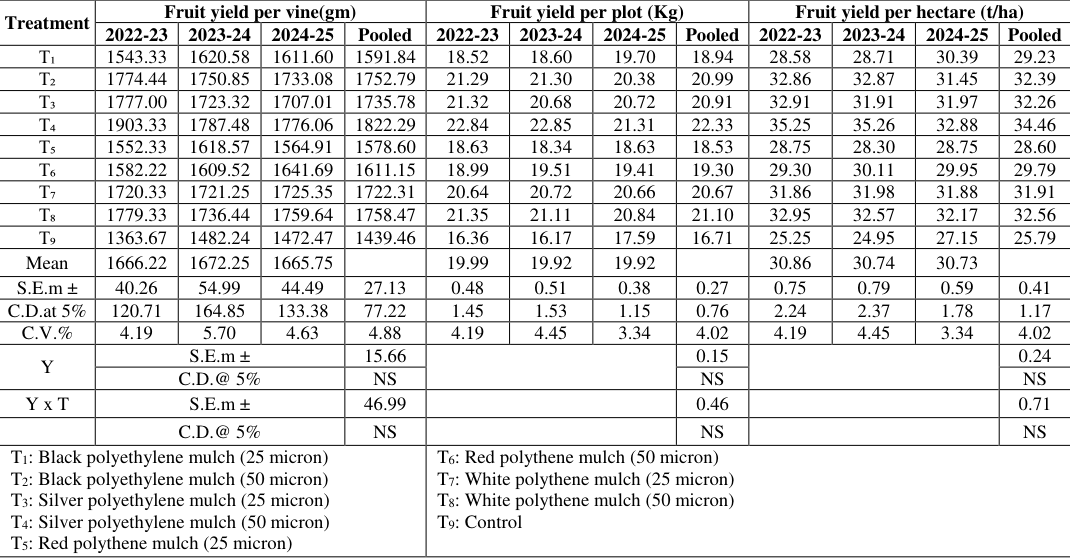 Table 8
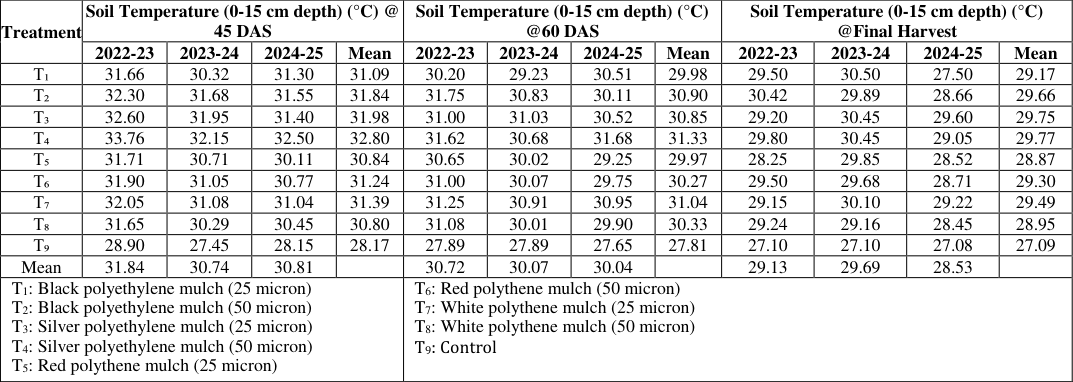 Table 9
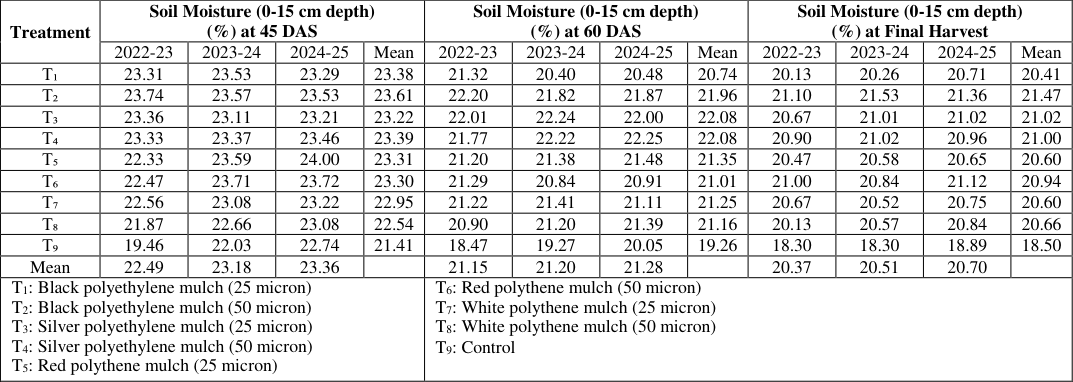 Table 10
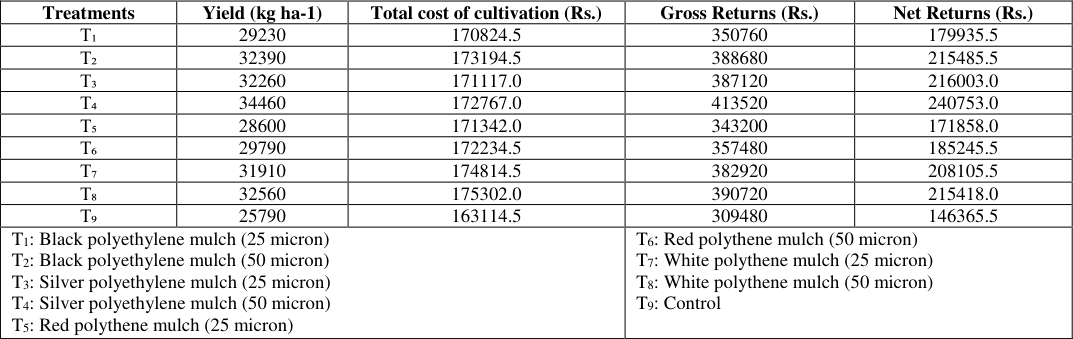 Table 11
Introduction
Cucumber (Cucumis sativus L.) is grown mainly for its fruits both in India and abroad. The fruit of cucumber is said to have cooling effect, prevent constipation, checks jaundice and indigestion. Besides, the seed of cucumber is used in Ayurvedic preparations and raw fruits are also being used in cosmetic preparations. It is reported that oil extracted from seed is good for brain and body (Shanmugauelu, 1989) [1] . Nutritively 100 g edible portion of cucumber contains 96.3 g moisture, 2.5 g carbohydrates, 0.4 g protein, 0.1 g fat, 0.3 g minerals, 10 mg calcium, 0.4 g fiber and traces of vitamin C and iron. It is eaten raw with salt and bell pepper or as a component of salad and pickles. Mulching is a practice of covering the surface of soil with plastics, organic and non-organic materials to reduce evaporation and moderate wide fluctuation in diurnal soil temperature, especially in the root zone environment. There are different types of mulch used in the field depending on the purpose. Mulches are used to regulate the soil temperature, protect the root of a plant from heat, check evaporation, conserve soil moisture, suppress weed growth, increase water use efficiency and modify the soil micro climate. Mulches reduce weed growth by making conditions unfavorable for germination of weed seeds and by providing a physical barrier for emerging weeds. A good mulch layer can save many hours of laborious weeding. The use of plastic mulch has brought a considerable change in vegetable production in many countries. In temperate countries, the year-round production of vegetables has been possible with the use of plastic mulches. Plant growth performance and yields of various vegetable crops such as tomato (Agrawal et al., 2010) [2] , watermelon (Rao et al., 2017) [3] , chilli (Ashrafuzzaman et al., 2011) [4] , summer squash (Kumar and Sharma, 2018) [5] , watermelon (Dadheech et al., 2018) [6] can be significantly improved by mulching.
Materials and Methods
An experiment was conducted at Polytechnic in Horticulture, ACH, NAU, Paria (Gujarat) during late kharif, 2021-24. The experiment was laid out in a Randomized Block Design (RBD) in nine treatments and three replications. The treatment consisted of T 1: Black polyethylene mulch (25 micron), T2• Black polyethylene mulch (50 micron), T₃: Silver polyethylene mulch (25 micron), T₄: Silver polyethylene mulch (50 micron), T₅: Red polyethylene mulch (25 micron), T₆: Red polyethylene mulch (50 micron), T₇: White polyethylene mulch (25 micron), T₈:
White polyethylene mulch (50 micron) and T₉: Control (No mulch). 2).The maximum number of nodes per vine (27.11) was recorded in T2 treatment (Black polyethylene mulch @ 50 µm) during 2022 and in treatments T8 (White polyethylene mulch @ 50 µm) during years 2023, 2024 and pooled analysis (26.06, 25.04 & 26.03) respectively, which was at par with treatments T1, T2, T3. T4 and T6. The minimum number of nodes per vine (23.33, 22.16, 21.52 & 22.34) was observed in treatment T9 (control) during individual years and in pooled analysis, respectively.
Number of branches per vine:
A perusal of data presented in Table 2 revealed a significant variation in number of branches per vine due to different mulching treatments in cucumber during all years and in pooled analysis. Significantly the maximum number of branches per vine (6.89, 6.70, 6.36 & 6.65) was observed in treatment T₄ (Silver polyethylene mulch @ 50 µm), during 2022, 2023, 2024 and in pooled analysis respectively, which was at par with treatments T₅, T₆, T₇ & T₈. The minimum number of branches per vine (5.11, 4.94, 4.54 & 4.86) was recorded in treatment T₉ (Control) during individual years and in pooled analysis, respectively.
| Treatment | Nodes per vine | — | — | — | No. of branches per vine | — | — | — | Internodal length (cm) | — | — | — |
|---|---|---|---|---|---|---|---|---|---|---|---|---|
| 2022-23 | 2023-24 | 2024-25 | Pooled | 2022-23 | 2023-24 | 2024-25 | Pooled | 2022-23 | 2023-24 | 2024-25 | Pooled | |
| T₁ | 26.56 | 24.63 | 24.04 | 25.07 | 5.89 | 5.00 | 4.81 | 5.23 | 13.11 | 11.54 | 12.97 | 12.54 |
| T₂ | 27.11 | 25.66 | 24.59 | 25.79 | 6.00 | 5.60 | 5.35 | 5.65 | 12.89 | 11.73 | 15.02 | 13.21 |
| T₃ | 25.89 | 24.95 | 24.03 | 24.96 | 6.11 | 5.79 | 5.49 | 5.80 | 13.22 | 12.61 | 12.95 | 12.93 |
Table text extracted from the original PDF; superscript letters are shown inline. The original table image is below.
View original table image
A perusal of data presented in Table for intermodal distance revealed significantly affect due to mulching treatments during year 2022 and 2024 while nonsignificantly influence during year 2023 and in pooled analysis. The minimum intermodal length (12.00cm) and (11.98cm) was recorded in treatment T₄ (silver polyethylene mulch @ 50 µm) and T₈ (White polyethylene mulch @ 50 µm) respectively, While maximum (14.44cm) and (15.02cm) found in treatment T₉ (control) and T6 respectively, during in year 2022 and 2024. The greater value for vine length at 45, 60 DAS and at the time of final harvesting during both the seasons and in pooled analysis was examined in T₂ (Black polyethylene mulch @ 50 µm) it might be due to the black color of the mulch enhances heat absorption which creating a warmer microclimate that promotes vine growth and the reflective nature of the mulch ensures better light distribution which stimulating photosynthesis and supporting elongation of the vine (Nwokwu and Aniekwe, 2014) [7] . The above finding was agreement with the results of Awasthi et al. (2021) [8] in cucumber, Parmar et al. (2013) [9] , Tyagi and Sharma (2013) in watermelon, Shinde et al. (2014) [10] in muskmelon, Chaudhary (2017) [11] in brinjal, and Radhika et al. (2021) [12] in summer squash. The treatment T₄ (Silver polyethylene mulch @ 50 µm) was reported superior as compared to other mulches and control for number of nodes per vine at the time of final harvesting during all seasons as well as in polled analysis. It could be attributed to microbial activities in soil improved by silver-black mulch and enhanced nutrient availability to the plant which were the key factors for greater plant growth and ultimately affected the node production (Kulkarni et al., 2015) [13] . This discovery closely aligned with Ajibola et al. (2019) [14] in cucumber, Sylvestre et al. (2014) [15] in watermelon, Khan et al. (2015) [16] in sponge gourd, Rai et al. (2018) [17] in bottle gourd and Shinde et al. (2014) [10] in muskmelon. The number of branches per vine at final harvesting was remain higher in T₄ (Silver polyethylene mulch @ 50 µm) during corresponding years and in pooled analysis it might be due to the silver-black mulch can retain moisture, suppress weeds, regulate root temperature and potentially enhance nutrient availability which promoting robust branching (Tyagi and Sharma, 2013). This finding was in close conformity with the observation reported by Mona et al. (2019) [18] in cucumber, Rao et al. (2017) [3] and Moe at al. (2018) [19] in watermelon, Kumar et al. (2019) [20] in brinjal, Choube et al. (2020) [21] in cauliflower and Bhatt et al. (2011) [22] in summer squash. The periodical data on internodal distance during respected seasons and in pooled analysis were recorded maximum in T₉ treatment (Control). Similar results obtained by Singha et al. (2023) [23] [24] in pointed gourd and Khan et al. (2015) [16] in sponge gourd. All the growth parameters were favourably influenced due to maximum energy utilization received by plant with T₄ (Silver polyethylene mulch @ 50 µm) treatment for higher biomass production and accumulation which increased vine length, number of branches per vine, number of nodes per vine except internodal distance during 2022, 2023, 2024 and in pooled analysis. The increased in plant growth parameters might be due to plastic mulches that provide proper soil temperature and moisture content during the entire growth stage of watermelon and create favorable condition for plant process which ultimately leads to an increased in photosynthetic capacity and metabolic activities of the plant. silver-black polyethylene mulch modified the crop growing environment by low evaporation and high moisture availability in the root zone, better uptake of nutrients, increased CO₂ level and absence of weed growth which leads to an increased in vegetative growth of plants (Rao et al., 2017) [3] .
b) Effect of different type of mulches on flowering parameters of cucumber var. Pusa Sanyog
Days to first male flower appearance: A perusal of data presented in Table 3 clearly revealed that the different mulching treatments had significant effect on days to first male flower during 2022, 2023,2024 and in pooled analysis. Significantly minimum days to first male flower in 2023, 2024 and in the pooled analysis (34.36, 35.63 & 34.29 days, respectively) were recorded in treatment T₃ (Silver polyethylene mulch @ 25 μm), which was statistically at par with treatment T₄, T₅, T₆, T₇ & T₈. While, significantly maximum days to first male flower in the all years and in pooled analysis (36.33, 38.71, 39.72 and 38.26 days, respectively) was noted in treatment T₉ (control).
Days to first female flower appearance:
A perusal of data presented in Table revealed that there were significant differences in days to first female flower due to the different mulching treatments. Significantly the minimum days to first female flower during 2022, 2023, 2024 and in pooled analysis (35.0, 36.57, 39.79 & 37.12 days, respectively) was recorded in treatment T₃ (Silver polyethylene mulch @ 25 μm), which was statistically at par with treatment T₄. Significantly the maximum days to first female flower (39.22, 40.78, 42.95& 40.98 days) was observed in treatment T₉ (control) during individual years and in the pooled analysis, respectively.
Node no. first male flower appearance:
The data presented in Table revealed a significant variation in nodal position of first male flower due to the different mulching treatments during the year 2022 & in pooled analysis. While node no. first male flower appearance found non-significant in year 2023 & 2024. The lowest nodal position of first male flower (2.22) during 2022 was recorded in treatment T₄ (Silver polyethylene mulch @ 50 μm), while in year 2023, 2024 and pooled analysis recorded in T₆ (Red polyethylene mulch @ 50 μm), which was statistically similar to treatment T₃. While, the highest nodal position of first male flower in each year and in pooled analysis (3.11, 3.10, 3.02 and 3.08, respectively) was recorded in treatment T₉ (control).
Node no. first female flower appearance:
The data presented in Table revealed a non-significantly variation in the nodal position of first female flower due to the different mulching treatments in cucumber in all years while significant in pooled analysis. The minimum nodal position of first female flower (3.33
A perusal of data presented in Table 5 revealed that there were significant differences in sex ratio (M:F) due to the different mulching treatments. Significantly the minimum sex ratio (M:F) during all years and pooled analysis (3.62, 3.60, 3.75 & 3.66, respectively) was recorded in treatmentT4 (Silver polyethylene mulch @ 50 μm), which was statistically at par with treatment T₅.Minimum sex ratio (M:F) during all years and pooled analysis (5.79, 5.63, 5.58 &5.67, respectively) was recorded in treatment T₉ (Control). Minimum days to first male and female flower were examined in T₃ (Silver polyethylene mulch @ 25 µm) during relevant years and in pooled analysis it might be due to heat-absorbing nature of the mulch may have provided a conducive environment for flower development which leading to observed early initiation of male and female flowers in watermelon (Sawant, 2021) [25] . These findings were in close accordance with the observation noted by Singha et al. (2023) [23] in watermelon, Nihar et al. (2023) [26] in cauliflower and Kumawat et al. (2021) [27] in chilli. The T₄ (Silver polyethylene mulch @ 50 µm) observed minimum value for nodal position of first male and female flower during 2022, 2023,2024 and in pooled analysis it might be due to the reflective nature of the silver mulch helps in maintaining lower soil temperature and creating a favorable environment for plant development. This cooler microclimate may have influenced the early differentiation and emergence of male flowers at lower nodal positions (Singha et al., 2023) [23] . Similar results obtained by Sawant (2021) [25] in watermelon, Chaudhary (2017) [11] in brinjal and Anjali et al. (2019) [28] in okra. c) Effect of different type of mulches on yield parameters of cucumber var. Pusa Sanyog: Days to first fruit harvest: It was evident from the data presented in Table 6 that the different mulching treatments showed significant effect on days to first harvest. Earliness (46.89, 47.72, 46.79 & 47.13 days) was recorded in treatment T₃ (Silver polyethylene mulch @ 25 µm) in all years and in pooled analysis which was statically at par with treatments T₁, T₄ & T₆. While maximum days (54.33, 55.12, 54.64 & 54.70) for first fruit harvest was recorded in T₉ (Control) during 2022, 2023, 2024& pooled analysis, respectively.
The data presented in Table 6 revealed nonsignificantly differences in diameter of fruit due to different mulching treatments in all experimental years and pooled analysis.
A perusal of data presented in Table 6 revealed a non-significant variation in length of fruit due to different mulching treatments in cucumber during all years while in pooled analysis was recorded significantly maximum fruit length in treatment T (14.76cm). While minimum fruit length (13.79 cm) was recorded in treatment T₉ (control) in pooled analysis.
The data pertaining to average fruit weight are presented in Table 7 indicated that there were significant differences due to different mulching treatments. The maximum average fruit weight (135.22, 130.95, 128.51&131.56g, respectively) during all experimental years as well as in pooled analysis was observed in treatment T₄ (Silver polyethylene mulch @ 50 μm) and it was statistically at par with T₂, T₃ & T₈.. The minimum average fruit weight (125.22, 121.78, 123.34 &123.45g) was observed in treatment T₉ (control) during individual years and in pooled analysis, respectively.
| Treatment | Fruit weight (g) | — | — | — | No. of fruits per vine | — | — | — |
|---|---|---|---|---|---|---|---|---|
| 2022-23 | 2023-24 | 2024-25 | Pooled | 2022-23 | 2023-24 | 2024-25 | Pooled | |
| T₁ | 127.00 | 125.75 | 127.85 | 126.87 | 12.33 | 12.33 | 12.60 | 12.42 |
| T₂ | 131.00 | 130.34 | 128.97 | 130.10 | 13.56 | 13.62 | 13.43 | 13.54 |
| T₃ | 131.33 | 130.87 | 127.73 | 129.98 | 13.56 | 13.17 | 13.37 | 13.36 |
| T₄ | 135.22 | 130.95 | 128.51 | 131.56 | 14.11 | 14.19 | 13.82 | 14.04 |
| T₅ | 127.44 | 125.88 | 127.58 | 126.97 | 12.33 | 12.14 | 12.26 | 12.24 |
| T₆ | 129.00 | 127.56 | 127.07 | 127.88 | 12.22 | 12.74 | 12.92 | 12.63 |
| T₇ | 128.89 | 128.05 | 128.27 | 128.40 | 13.44 | 13.49 | 13.45 | 13.46 |
| T₈ | 130.67 | 129.82 | 129.81 | 130.10 | 13.67 | 13.55 | 13.55 | 13.59 |
Table text extracted from the original PDF; superscript letters are shown inline. The original table image is below.
View original table image
No. of fruits per vine:
The data in Table 7 indicated that the different mulching treatments significantly influenced the number of fruits per vine in all years and pooled analysis. Significantly the maximum number of fruits (14.11, 14.19, 13.82 &14.04 was recorded in treatment T₄ (Silver polyethylene mulch @ 50 µm) during both the years and in pooled analysis respectively, which was at par with treatment T₈. While minimum number of fruits per vine (11.22, 11.07, 11.94&11.41 in 2022, 2023, 2024 and in pooled analysis, respectively) was recorded in treatment T₉ (control).
The data presented in Table 8, clearly revealed that there were significant differences in fruit yield per vine due to different mulching treatments during the experimental years and in pooled analysis. The treatment T₄ (Silver polyethylene mulch @ 50 µm) resulted in the maximum fruit yield per vine (1903.33, 1787.48, 1776.06&1822.29) in 2022, 2023, 2024& pooled analysis respectively. This performance was statistically at par with the treatment T2& T₈.. The treatment T₉ (control) had the minimum fruit yield per vine (1363.67, 1482.24, 1472.47&1439.46 g) in all years and pooled analysis respectively.
Fruit yield per plot (Kg/plot): Data pertaining to fruit yield per plot found significant due to different mulching treatments during all years as well as in pooled analysis (Table 8). Among the different mulching treatments, the treatment T₄ (Silver polyethylene mulch @ 50 µm) gave significantly maximum fruit yield per plot during 2022, 2023, 2024 and in pooled analysis (22.84, 22.85, 21.31 & 22.33 Kg/plot, respectively). While, significantly minimum fruit yield per plot (16.36, 16.17, 17.59& 16.71 Kg/plot) was observed in treatment T₉ (Control) during all years as well as in pooled analysis.
The data presented in Table 8clearly revealed that there were significant differences in the total yield due to different mulching treatments. The treatment T₄ (Silver polyethylene mulch @ 50 µm) resulted in the highest total yield (35.25, 35.26, 32.88 & 34.46 The results for yield parameters showed that the, mulching significantly affected the days to first harvest, days to last harvest, yield vine -1 , yield net plot -1 and total yield. The treatment T₃ (Silver polyethylene mulch @ 25 µm) recorded minimum days to first harvest and days to last harvest during 2022, 2023, 2024 and in pooled analysis it might be due to higher soil moisture content and soil temperature under plastic mulch improved the plant microclimate which leading to early growth, flowering as well as fruiting and lead to early harvesting of crops (Kulkarni et al., 2015) [13] . These findings are in line with Sawant (2021) [25] in watermelon, Nihar et al. (2023) [26] in cauliflower, Anjali et al. (2019) [28] in okra and Chaudhary (2017) [11] in brinjal. The T₄ treatment (Silver polyethylene mulch @ 50 µm) gave utmost length of fruit, diameter of fruit and average weight of fruit it might be due to least competition from weeds as silverblack polyethylene mulch affects weed growth adversely and uniform moisture conservation throughout the growing season which leading to higher length, diameter and average weight of fruit (Romic et al., 2003) [29] . These findings are similar with Parmar et al. (2013) [9] in watermelon, Mohammed et al. (2017) [30] in bottle gourd, Shinde et al. (2014) [10] in musk melon and Hossain et al. (2021) [31] in pointed gourd. During both the experiment seasons and in pooled analysis, the T₄ treatment (Silver polyethylene mulch @ 50 µm) recorded higher value for yield vine -1 , yield net plot -1 and total yield its might be due to silver-black mulch recorded the highest plant height, number of leaves and leaf length resulting in higher photosynthetic rate which leads to more synthesis and translocation of photosynthates toward the fruit formation (Sibale et al., 2015) [32] . The findings presented above are in agreement with the results obtained by Luis et al. (2008) [33] in cucumber, Parmar et al. (2013) [9] in watermelon, More et al. (2014) [34] in tomato and Ekwu et al. (2010) [35] in okra. The yield vine -1 , yield net plot -1 and total yield remain maximal in T₄ treatment (Silver polyethylene mulch @ 50 µm) during corresponding seasons and in polled analysis its might be due to with three fruits per vine, there is an optimal balance between resource allocation and fruit load. This allows the plant to efficiently distribute nutrients and water among the fruits which promoting their growth and development. These finding are similar with Bassiony et al. (2012) [36] as well as Campos et al. (2014) in watermelon and Khatun et al. (2020) [37] in tomato. D) Effect of different type of mulches on soil parameters of cucumber var. Pusa Sanyog Soil temperature (0-15 cm depth): The mean data recorded soil temperature (0-15 cm depth) at standard week (15 days interval) presented in Table 9.The impact of various types of mulches on soil temperature was assessed at 45 DAS, 60 DAS and final harvest. The soil temperature was influenced by different types of mulch. The higher soil temperature (33.76, 32.15 & 32.50 0 C) was recorded in T₄ (polyethylene mulch @ 50 µm) while the lower soil temperature (28.90, 27.45& 28.15 ^ 0C) was recorded in treatment T₉ (Control) in all years at 45DAS. The higher soil temperature (31.62, 31.68 °C) was recorded in T₄ (Silver polyethylene mulch @ 50 μm) in year 2022 and 2024 respectively and 31.03 ⁰C in T₃ (Silver polyethylene mulch @ 25 µm)) during year 2023.whilethe lower soil temperature (27.89, 27. 89 & 27.65 ⁰C) was recorded in treatment T₉ (Control) in all years at 60 DAS. The higher soil temperature (29.80, 30.45 0 C) was recorded in T₄ (Silver polyethylene mulch @ 50 µm) in year 2022 and 2023 respectively and 29.60 0 Cin T₃ (Silver polyethylene mulch @ 25 µm)) during year 2024.whilethe lower soil temperature (27.10, 27.10 & 27.08 ° C) was recorded in treatment T₉ (Control) in all years at 60 DAS. A similar result was observed by Tarara (2000) [38] . The soil temperature under silver mulch was observed to be highest followed by that under silver mulch, while temperature of soil without any mulch cover was seen to be the lowest (Kayande et al., 2016) [39] Soil Moisture (%): The mean data on soil moisture content (%) at 45DAS, 60DAS and final harvest was affected by various types of mulch are presented in The major consideration with the vegetable growers for the adoption of research based production technology is economics. The economics in terms of gross and net returns for various mulch treatments were worked out and presented in Table 11& Table 12. The different types of treatments were registered more or less a good value of benefitcost ratio. This indicated that the sowing of cucumber with proper type of mulching is economical under South Gujarat conditions. The conjoint application silver polythene mulch@ 50 μm (T) achieved the maximum fruit yield (34.46 t/ha) and highest net realization (Rs.2, 40,753/ha), which was followed by the treatment T3 (Silver polythene mulch@ 25 μm).
Summary and Conclusions
Crop earliness was recorded in treatment Silver polyethylene mulch (25 micron) in respect to days to first male & female flower appearance, and days to first fruit harvest as compared to other treatments. Treatment Silver polyethylene mulch (50 micron) was recorded maximum no. of female flowers per vine, maximum fruit diameter, fruit weight, no. of fruits per vine, yield and highest net realization as compared to other treatments. The farmers of South Gujarat, growing cucumber during late kharif are recommended to mulch with 50μm thickness silver polyethylene (covered with 70% area) before seed sowing along with recommended dose of fertilizers (100:60:60 kg NPK/ha) for getting higher yield and net realization.
Figures and tables from the paper
| Treatment | Node no. first male flower appearance | — | — | — | Node no. first female flower appearance | — | — | — |
|---|---|---|---|---|---|---|---|---|
| 2022-23 | 2023-24 | 2024-25 | Pooled | 2022-23 | 2023-24 | 2024-25 | Pooled | |
| T₁ | 2.78 | 2.57 | 2.53 | 2.62 | 4.00 | 4.02 | 4.20 | 4.07 |
| T₂ | 2.44 | 2.45 | 2.57 | 2.49 | 4.00 | 3.73 | 3.88 | 3.87 |
| T₃ | 2.67 | 2.66 | 2.67 | 2.66 | 4.00 | 3.92 | 3.89 | 3.94 |
| T₄ | 2.22 | 2.48 | 2.59 | 2.43 | 3.33 | 3.55 | 3.57 | 3.48 |
| T₅ | 2.44 | 2.51 | 2.57 | 2.51 | 4.00 | 4.14 | 3.69 | 3.94 |
| T₆ | 2.33 | 2.40 | 2.37 | 2.37 | 3.78 | 3.83 | 4.11 | 3.91 |
| T₇ | 2.89 | 2.68 | 2.75 | 2.77 | 4.11 | 3.85 | 4.05 | 4.00 |
Table text extracted from the original PDF; superscript letters are shown inline. The original table image is below.
View original table image
References
41 in the original paper- Shanmugauelu KG. Production technology of vegetable crops. New Delhi: Mohan Primiani Publication; 1989.
- Agrawal N, Panigrahi HK, Sharma D, Agrawal R. Effect of different colour mulches on the growth and yield of tomato under Chhattisgarh region. Indian J. Hort. 2010;67:295300.
- Rao KVR, Bajpai A, Gangwar S, Chourasia L, Soni K. Effect of mulching on growth, yield and economics of watermelon. Environ. and Ecol. 2017;35(3):2437-2441.
- Ashrafuzzaman M, Halim MA, Ismail MR, Shahidullah SM, Hossain MA. Effect of plastic mulch on growth and yield of chilli (Capsicum annuum L.). Brazilian Archives Bio. Tech. 2011;54(2):321-330.
- Kumar D, Sharma R. effect of mulching on growth, yield and quality in different varieties of summer squash (Cucurbita pepo L.). Int. J. Curr. Microbiol. Appl. Sci. 2018;7(6):2113-2119.
- Dadheech S, Ramawtar, Yadav CM. Impact of mulching material on the growth, yield and quality of water melon (Citrullus lanatus Thunb.). Int. J. Curr. Microbiol. and App. Sci. 2018;7(7):2774-2782.
- Nwokwu G, Aniekwe L. Impact of different mulching materials on the growth and yield of watermelon. J. Biol. Agril. and Healthcare. 2014;4(23):22-30.
- Awasthi P, Bogati S, Shah P, Joshi D, Adhikari S, Singh S, et al. Effect of different mulching materials on growth and yield of cucumber. Tropical Agrobiodiversity. 2021;3(2):30-35.
- Parmar HN, Polara ND, Viradiya RR. Effect of mulching material on growth, yield and quality of watermelon cv. Kiran. Universal J. Agric. Res. 2013;1(2):30-37.
- Shinde SD, Patel AG, Pawar Y, Varma LR. Effect of different type of mulches on growth, yield and quality of muskmelon. Eco. Environ. and Cons. 2014;20(1):1-4.
- Chaudhary LR. Effect of different type of mulches on growth, yield and quality of brinjal. Thesis M.Sc. (Hort.), Navsari Agricultural University, Navsari. 2017;137 p.
- Radhika R, Bhusal N, Neupane S. Efficacy of mulching materials on growth performance and yield characters of summer squash. Int. J. Res. App. Sci. and Biotech. 2021;8(1):57-63.
- Kulkarni MV, Lipane S, Pawar Y, Prajapati DR. Influence of planting geometry and mulching on growth and yield of watermelon under drip irrigation. J. Agril. Engg. and Food Tech. 2015;2(1):22-24.
- Ajibola V, Julius B, Olufemi A. Effect of seasons, mulching materials and fruit quality on cucumber variety. Asian J. Agric. and Horti. Res. 2019;3(2):1-11.
- Sylvestre H, Bosco NJ, Emmanuel N, Christine U. Growth and yield of watermelon as affected by different spacing and mulching types under Rubona conditions in Rwanda. Scholarly J. Agric. Sci. 2014;4(10):517-520.
- Khan S, Pal M, Kumar V. Influence of different mulches on growth and yield of sponge gourd (Luffa cylindrica L.). Pl. Arch. 2015;15(1):393-395.
- Rai P, Dinmani S. Off season bottle gourd cultivation using plastic mulch and low tunnel. Hortflora Res. Spectrum. 2018;7(1):19-23.
- Mona NS, Hady MA, Nahla AE. Effect of irrigation, some plant nutrients with mulching on growth and productivity of cucumber. J. Pl. Production Mansoura Univ. 2019;10(3):231-239.
- Moe AK, Soe TT, Hom NH, Lwin WW, Myint KT. Effects of different mulching materials on plant growth, fruit yield and quality of two cultivars of watermelon. J. Agril. Res. 2018;5(1):65-71.
- Kumar RR, Singh R, Nityanand, Sohane RK, Singh AK. Effect of different type mulch on growth and yield attributes of brinjal. Curr. J. App. Sci. and Tech. 2019;37(6):1-6.
- Choube K, Raidas DK, Jaiswal RK, Chakraborty S. Effect of different weed management practices on growth and yield of cauliflower. J. Pharmacogn. and Phytochem. 2020;9(3):603-605.
- Bhatt L, Rana R, Uniyal SP, Singh VP. Effect of mulch materials on vegetative characters, yield and economics of summer squash (Cucurbita pepo L.) under rainfed mid-hill condition of Uttarakhand. J. Veg. Sci. 2011;38(2):165-168.
- Singha M, Topno SE, Anita K. Effect of different mulching material on watermelon hybrid under Prayagraj agroclimatic condition. Int. J. Environ. Clim. Change. 2023;13(9):3205-3214.
- Nayak H, Sahoo D, Swain SC, Jena B, Paramjita D, Bisoyi BS. Influence of fertigation doses and mulching on yield attributing characters and post harvest shelf life of pointed gourd. Int. J. Curr. Microbiol. and App. Sci. 2018;7(4):3212-3220.
- M.Sc. (Hort.) Thesis, Dr. Balasaheb Sawant Konkan Krishi Vidhyapeeth, Dapoli; 2021.
- Nihar AP, Masaye SS, Chaudhari VM, Khasdar ZF, Gaikwad SS. Effect of different type of mulches on growth characteristics of cauliflower var. Pusa Snowball K-1. The Pharma Innov. J. 2023;12(12):2594-2597.
- Kumawat S, Kumawat A, Asati KP, Bhuriya R. Effect of different mulches on growth, yield and economics of chilli (Capsicum annum L.). The Pharma Innov. J. 2021;10(7):903-906.
- Anjali P, Masaye SS, Sharma DK, Krishna C. Effect of different types of mulches on growth, yield and quality of okra cv. GAO-5. Curr. Hort. 2019;7(1):50-52.
- Romic D, Borosic J, Poljak M, Romic M. Polyethylene mulches and drip irrigation increase growth and yield in watermelon. European J. Hort. Sci. 2003;68(4):192-198.
- Mohammed S, Emad A, Salem, Alaaeldin A. Impact of Mycorrhiza and polyethylene mulching on growth, yield and oil seed production of bottle gourd. J. Hort. Sci. and Ornam. Pl. 2017;9(1):28-38.
- Hossain SA, Kayum MA, Wang L, Shahin MD. Effect of drip irrigation scheduling and mulching practice on pointed gourd pot cultivation in Patuakhali Bangladesh. Int. J. Agril. Technol. 2021;17(4):1413-1424.
- Sibale D, Mane MS, Patil ST, Ayare BL, Desai VS. Effect of mulching on crop production under rainfed condition. J. Indian Soc. Coastal Agric. Res. 2015;33(2):28-35.
- Luis IJ, Alejandro ZG, Juan ML, Martin MA, Ibarra MD. Photosynthesis, soil temperature and yield of cucumber as affected by coloured mulch. Acta Agril. Scandinavica Section Pl. and Soil Sci. 2008;58:372-378.
- More SJ, Gohil JH, Bhanderi DR, Patil SJ, Tekale GS. Productivity and profitability of tomato influenced by various transplanting dates and mulches. Trends Biosci. 2014;7(17):2376-2381.
- Ekwu LG, Utobo EB, Ogah EO. Effect of mulching and nitrogen fertilizer on growth and yield of okra. Int. J. Agric. and Rural Dev. 2010;13(2):8-14.
- Bassiony EL, Fawzy ZF, Glala AA. Response of two watermelon cultivars to supplemental potassium application and fruit thinning. J. App. Sci. Res. 2012;8(5):2732-2740.
- Khatun K, Mostrin T, Haq E, Afsun J, Habiba U, Hossain M. Combined effect of zinc and boron with fruit thinning on the quality seed production of tomato. Assian Pl. Res. J. 2020;5(2):8-24.
- Tarara JM. Microclimate modification with plastic mulch. HortScience. 2000;32:659-663.
- Kayande GA, Kale MU, Wadatkar SB, Deshmukh MM, Talokar AS, Upadhye SK. Effect of polyethylene mulch on soil temperature. Asian J. Soil Sci. 2016;11(2):332-336.
- Campos AM, Luz JM, Santana DG, Marquez GR. Influence of plant density and fruit thinning on watermelon hybrid production cultivated in different. 2019.
- Tyagi SK, Sharma ML. Effect of plastic mulch on growth, yield and economics of watermelon under nimar plains conditions of Madhya Pradesh. Hortflora Res. Spectrum. 2023;2(3):215-219.