
Research article · 2026 · Full text
International Journal of Horticulture and Food ScienceImpact of semiochemical-based integrated pest management strategies on palm crop health and yield sustainability under field conditions
Volume 8(5) · Pages 56–60 · DOI: 10.33545/26631067.2026.v8.i5a.820 ↗
Research areasDate Palm Research StudiesInsect behavior and control techniquesInsect Pheromone Research and Control
Abstract
Author-writtenCan a pheromone-centred pest management program protect date palms more effectively than calendar-based insecticide sprays? The red palm weevil (Rhynchophorus ferrugineus) remains among the most destructive borers of palms across the Mediterranean basin and the Arabian Peninsula, and conventional chemical control alone has failed to contain its spread in many growing regions. This research evaluated a semiochemical-based integrated pest management (IPM) framework that paired aggregation-pheromone mass trapping with cultural sanitation practices and selective trunk injection, comparing it against a standard chemical spray schedule and an untreated control over two consecutive seasons (September 2022 to August 2024) in commercial date palm orchards near Alexandria, Egypt. A randomised complete block design with four replicates was used. Bucket traps baited with ferrugineol (4-methyl-5-nonanol), ethyl acetate, and fresh date palm tissue were deployed at one trap per hectare in IPM blocks; traps were serviced weekly and lure components replaced every 45 days. Complementary actions included removal of infested palms, preventive pruning, and imidacloprid trunk injection for early-stage infestations. Palm health was scored monthly on a 0–4 visual symptom severity index, and fruit yield was recorded at each harvest. Across the trial, semiochemical IPM traps captured an average of 14.7 adult weevils per trap per month. Mean symptom severity in IPM blocks fell from 2.3 at baseline to 0.8, compared with a reduction from 2.1 to 1.4 under chemical management and negligible change in the control. Seasonal fruit yield averaged 187.4 kg per palm in the IPM treatment, significantly exceeding the chemical group (162.8 kg) and the control (108.6 kg) at p<0.01. The findings demonstrate that semiochemical-driven IPM can reduce pest pressure and raise productivity beyond conventional spray programs, presenting a more sustainable avenue for date palm cultivation in areas affected by R. ferrugineus.
Summary
Source-checkedPlain-language reading of the full paper, prepared with AI and checked against the text. Each point links to the authors' own words.
Why it matters
- The red palm weevil is a highly destructive pest for palms in the Arabian Peninsula and Mediterranean basin, and standard chemical controls have been insufficient to stop its spread. View evidence ↗
- Date palms are a critical crop for millions of growers in arid regions, providing fruit, fiber, and other environmental values. View evidence ↗
- Over-reliance on neonicotinoid and organophosphate sprays has not stopped the weevil's expansion and has led to pest resistance. View evidence ↗
The question
- The study aimed to determine if a pheromone-centered management program is more effective at protecting date palms than standard calendar-based insecticide sprays. View evidence ↗
What they did
- The research used a randomized complete block design with twelve blocks (three treatments, four replicates) in Egyptian orchards from September 2022 to August 2024. View evidence ↗
- The semiochemical IPM treatment (T1) utilized bucket traps baited with ferrugineol, ethyl acetate, and 200 g of palm tissue at a density of one trap per hectare. View evidence ↗
- The IPM strategy also included monthly inspections, immediate removal of infested trunks, and targeted imidacloprid trunk injections for early infestations. View evidence ↗
- The conventional chemical management (T2) consisted of three annual sprays of chlorpyrifos (480 g L⁻¹ EC at 2.5 L ha⁻¹) in April, June, and September. View evidence ↗
- Researchers measured palm health monthly using a 0–4 visual symptom severity index and weighed total fruit bunch harvest per palm during September and October. View evidence ↗
What they found
- The semiochemical IPM traps captured an average of 14.7 adult weevils per trap each month. View evidence ↗
- Mean symptom severity decreased from 2.3 to 0.8 in IPM blocks, which was a greater reduction than the 2.1 to 1.4 decrease seen in chemical management blocks. View evidence ↗
- The IPM treatment resulted in a significantly higher average fruit yield of 187.4 kg per palm compared to 162.8 kg for chemical management and 108.6 kg for the control (p<0.01). View evidence ↗
- Over 24 months, palm mortality was lowest in the IPM group (1.3%), compared to 4.7% in the chemical group and 14.2% in the control group. View evidence ↗
- The semiochemical IPM approach achieved a 78.3% reduction in pest populations relative to the control, outperforming the chemical control's 65.1% reduction. View evidence ↗
What it means
- The authors conclude that commercial date palm plantations should shift from blanket organophosphate spraying to a pheromone-plus-sanitation model. View evidence ↗
- The study did not formally test the financial case for switching to IPM because it lacked a detailed economic cost analysis. View evidence ↗
Visual summary
3 visualsIllustrations explain the paper; charts are replotted from the paper's own table values.
IPM Strategy Components
AI-generated conceptual illustration (Oil palm trees in a plantation). It explains the idea and does not show study data.
View source evidence ↗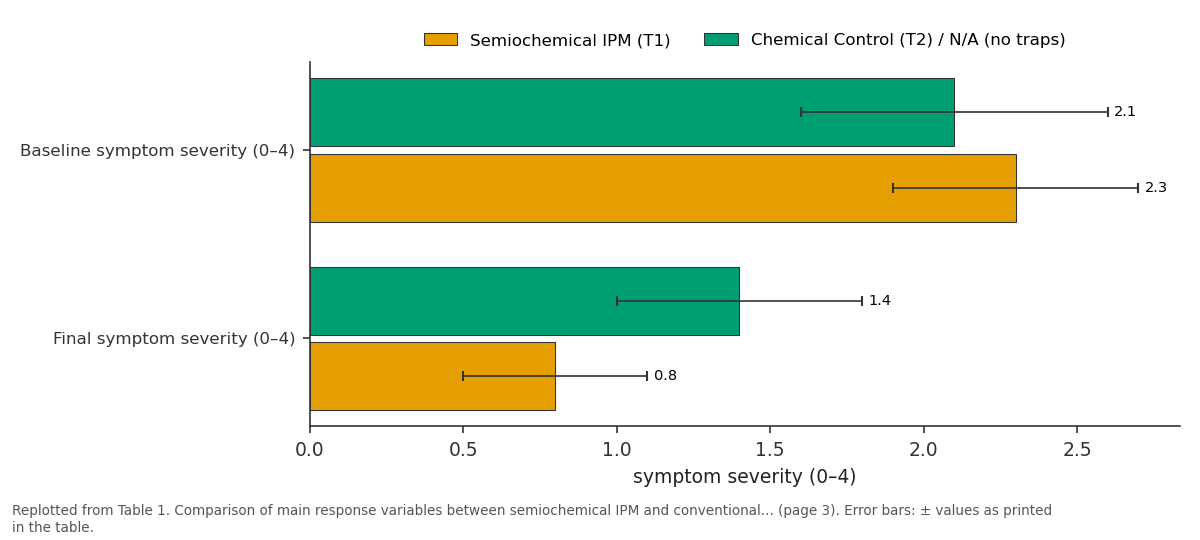
Semiochemical IPM (T1) and Chemical Control (T2) / N/A (no traps): Baseline symptom... vs Final symptom severity...
Replotted from Table 1 (page 3) of the original paper. Every bar is the paper's own table value.
View source evidence ↗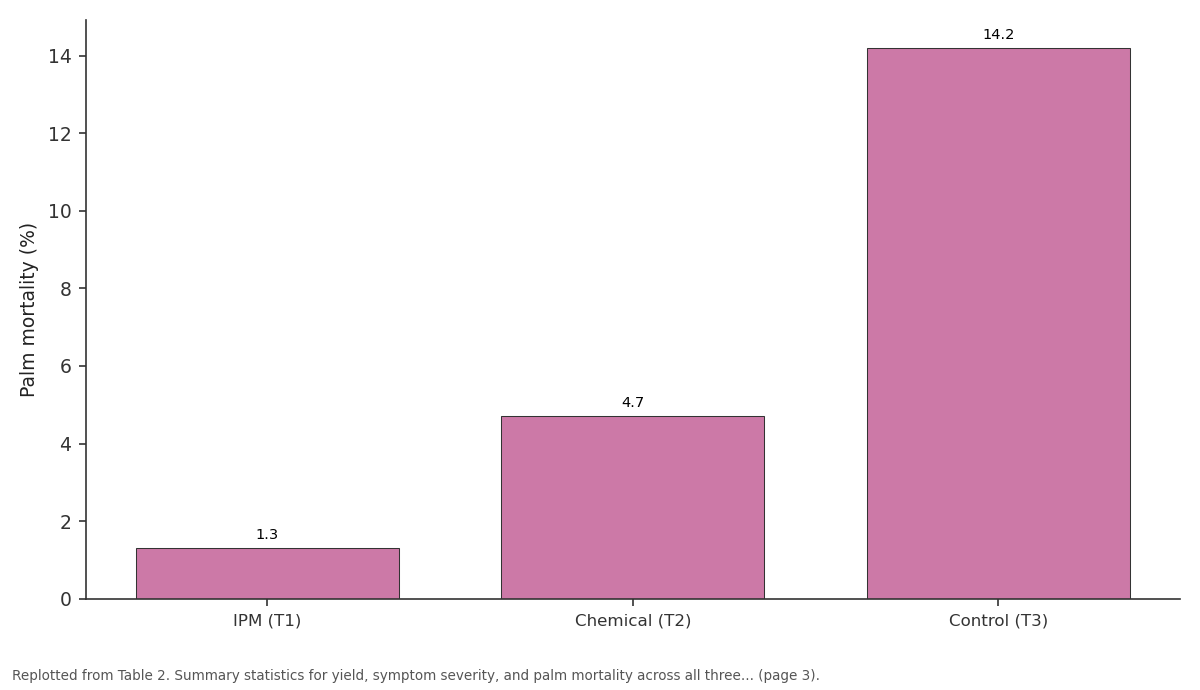
Palm mortality (%): IPM (T1) vs Chemical (T2) vs Control (T3)
Replotted from Table 2 (page 3) of the original paper. Every bar is the paper's own table value.
View source evidence ↗Figures & tables
From the original paper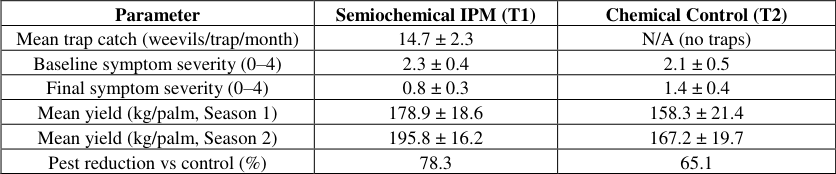 Table 1
 Table 2
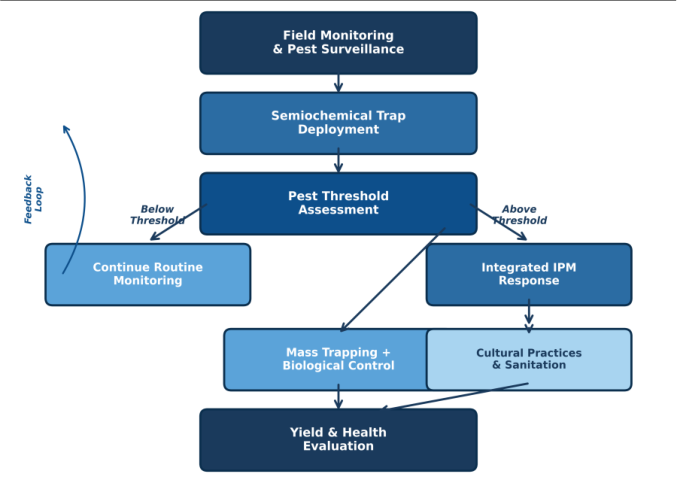 Figure 1
 Table 3
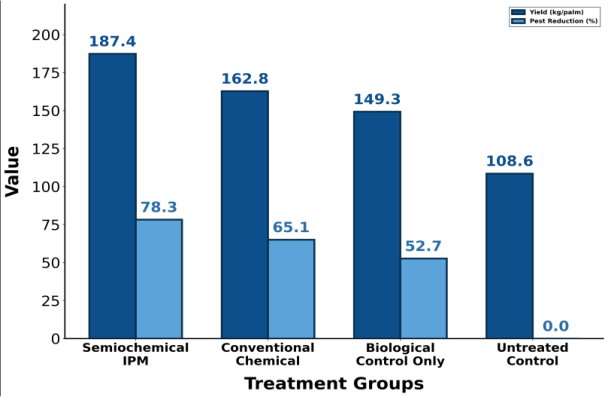 Figure 2
Introduction
What happens to an entire orchard economy when a single beetle species escapes the reach of routine insecticide calendars? Across North Africa, the Middle East, and southern Europe, the red palm weevil (RPW), R. ferrugineus (Olivier), has answered that question by hollowing out palm trunks from the inside, often killing trees before external symptoms become visible [1] . Date palm (Phoenix dactylifera L.) is a mainstay crop for millions of smallholders and commercial growers in arid and semi-arid belts, providing not only fruit but also fibre, shade, and landscape value [2] . Yet heavy reliance on organophosphate and neonicotinoid sprays has neither halted RPW expansion nor prevented resistance build-up in several populations [3] . Semiochemicals behaviour-modifying substances such as pheromones and kairomones offer an alternative axis of attack. The male-produced aggregation pheromone of RPW, identified as 4-methyl-5-nonanol (ferrugineol), attracts both sexes and has been the backbone of monitoring and mass-trapping programs since the mid-1990s [4] . When ferrugineol is combined with food-based kairomones like ethyl acetate and pieces of palm tissue, trap capture rates rise sharply because the chemical bouquet mimics a feeding and mating site [5] . Recent field-scale trials in Saudi Arabia, Oman, and Spain have shown that area-wide pheromone trapping can cut weevil populations by 60-80% within two to three seasons if paired with strict cultural sanitation prompt removal and destruction of infested palms and targeted curative treatments for newly detected infestations [6,7] . Despite these promising results, several knowledge gaps persist. First, most published evaluations of semiochemicalbased IPM for RPW report weevil capture data but give less attention to downstream effects on palm health indicators and fruit yield [8] . Second, few trials have operated in Egyptian date-growing districts, where climatic conditions, palm varieties, and grower practices differ from those in the Arabian Peninsula or the western Mediterranean [9] . Third, the economic case for substituting blanket spraying with a pheromone-plus-sanitation approach has rarely been quantified in a side-by-side field comparison [10] . Integrated pest management, by definition, assembles multiple tactics biological, cultural, mechanical, and chemical within an ecological framework that keeps pest damage below economic thresholds while minimising negative effects on human health and the environment [11] . In the context of RPW, an IPM package typically includes: (a) semiochemical trapping for population monitoring and mass removal, (b) visual and acoustic inspection of palms for early detection, (c) preventive and curative treatments such as trunk injection with systemic insecticides, and (d) cultural measures including pruning-wound treatment and removal of breeding substrates [12] . The present research was designed to test exactly this kind of multi-component approach under Egyptian field conditions, measuring not only trap catch and infestation levels but also palm symptom progression and fruit production over two full growing seasons. And because the trial ran alongside a conventionally managed block, the data allow a direct comparison of IPM and standard chemical management under identical environmental conditions.
Material and Methods
Material and Methods
Material Study area description
The trial was conducted in a commercial date palm plantation situated approximately 35 km south-east of Alexandria, Egypt (31.08° N, 29.97° E), within the Beheira Governorate. The plantation covered 24 hectares and contained roughly 1,200 mature Siwi-variety date palms aged between 15 and 22 years, spaced at 8 × 8 m. The surrounding landscape consisted of mixed fruit orchards, irrigated cereal fields, and scattered windbreak rows of Casuarina. Soil type was sandy loam with a pH of 7.6 and organic matter content of 1.2%. Palms were flood-irrigated at 10-day intervals during summer and 21-day intervals during winter. The site had a documented history of RPW infestation dating back to 2017, with an estimated 8-12% of palms lost before the trial began. No area-wide pheromone trapping had previously been attempted at this location. The plantation was divided into twelve equal blocks of 100 palms each; blocks were separated by 40 m buffer strips of bare ground to reduce inter-block weevil movement.
Climatic and environmental conditions
The research site falls within a hot-summer Mediterranean climate (Köppen class BSh at the desert margin). During the first season (September 2022-August 2023), mean monthly temperatures ranged from 14.2 °C in January to 31.7 °C in July, with annual rainfall of 168 mm concentrated between November and February. The second season (September 2023-August 2024) was slightly warmer, with a July mean of 32.4 °C and total rainfall of 141 mm. Relative humidity averaged 62% across both seasons, peaking above 75% during December-January and dipping below 45% in June-July. Wind speed rarely exceeded 18 km h⁻¹. These climatic parameters were obtained from an on-site automated weather station (Davis Vantage Pro2) recording at 30minute intervals. Temperature and humidity records were relevant because RPW flight activity and pheromone volatilisation rates are both temperature-dependent [13] .
Methods
Methods
Field experimental design
A randomised complete block design (RCBD) with three treatments and four replicates (twelve blocks total) was used. Treatments were: (T1) semiochemical IPM, (T2) conventional chemical management, and (T3) untreated control. In T1, black bucket traps (ChemTica International, Costa Rica) baited with ferrugineol dispensers, ethyl acetate co-attractant sachets, and 200 g of fresh date palm trunk tissue were placed on the ground at one trap per hectare; traps were emptied weekly and lure components replaced every 45 days. Complementary IPM actions included monthly acoustic and visual inspection of all palms, immediate removal and chipping of confirmed-infested trunks, and trunk injection of imidacloprid (3 mL of 200 g L⁻¹ formulation per 10 cm trunk diameter) for palms showing early-stage larval galleries. In T2, palms received three calendar-based spray rounds (April, June, September) of chlorpyrifos 480 g L⁻¹ EC at 2.5 L ha⁻¹ applied to trunks with a motorised knapsack sprayer, with no pheromone traps. T3 blocks received no pest management intervention. Treatments were maintained over both seasons without modification.
Data collection and statistical analysis
Palm health was evaluated monthly by two trained assessors using a visual symptom severity index adapted from the FAO-CIHEAM protocol [14] : 0 = healthy crown, no visible damage; 1 = slight yellowing of one or two inner fronds; 2 = moderate wilting with frass visible at the trunk base; 3 = severe crown collapse; 4 = dead palm. Each palm received a single score, and block-level means were computed. Fruit yield was measured by weighing the total bunch harvest per palm at commercial maturity (September-October) using a platform scale (±0.1 kg). Trap catch data (weevils per trap per week) were recorded at every servicing visit. Statistical analysis used two-way repeated-measures ANOVA (treatment × time) followed by Tukey's HSD post-hoc test (α = 0.05) for yield and severity comparisons, and a generalised linear model with Poisson distribution for trap catch counts. All analyses were run in R v4.3.1 (R Core Team, 2023). Percentage pest reduction was calculated as [(control mean -treatment mean) ÷ control mean] × 100.
Results
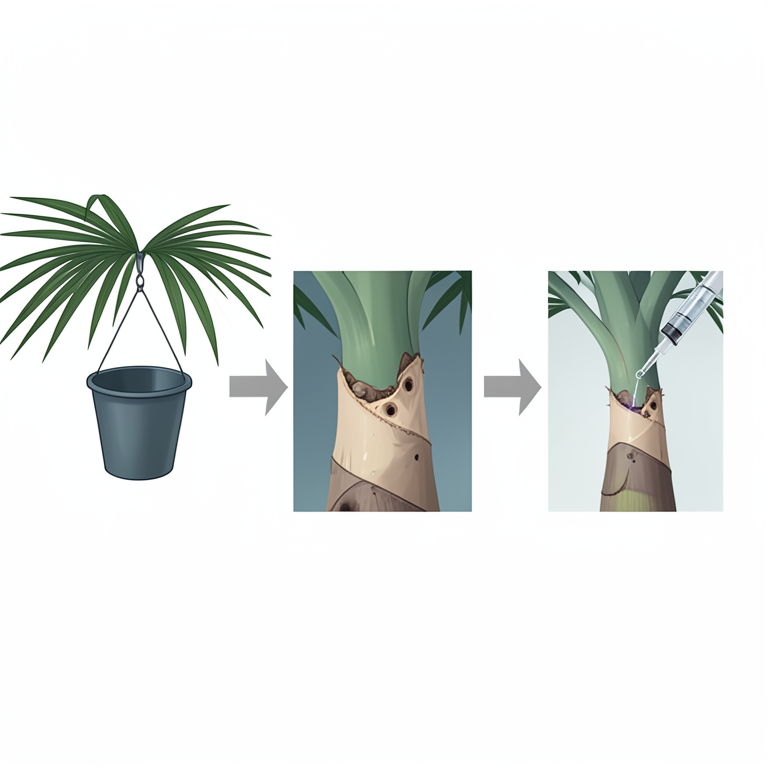
Over the 24-month trial, semiochemical IPM blocks showed a clear advantage in both pest suppression and crop productivity relative to conventional chemical management and the untreated control. Trap catch data, palm health trajectories, and fruit yields all pointed in the same direction: lower weevil pressure and healthier palms under the pheromone-plus-sanitation regime. 1 presents a side-by-side comparison of the two active treatments across the main response variables. Symptom severity declined more sharply in the IPM-managed blocks, dropping by 1.5 points on the 0-4 scale versus 0.7 points in the chemical blocks. Yield figures showed a parallel trend, with IPM palms producing on average 24.6 kg more fruit per palm than their chemically managed counterparts across both seasons. Figure 1 illustrates the step-by-step workflow of the semiochemical IPM strategy deployed in this research, highlighting the decision points at which pest threshold assessments guided subsequent management actions. A ranking of the individual IPM components by their estimated contribution to overall pest suppression is given in Table 3. Pheromone mass trapping and prompt infestedpalm removal were considered the two most important elements, while preventive pruning and acoustic inspection served supporting roles. The combination of all five elements appeared necessary for the level of control observed; during brief intervals when trap servicing was delayed beyond 10 days, short-term capture efficiency dropped noticeably.
| Rank | IPM Component | Contribution to Pest Reduction | Operational Priority |
|---|---|---|---|
| 1 | Pheromone mass trapping | High (direct adult removal) | Weekly servicing |
| 2 | Infested palm removal | High (breeding site elimination) | Within 48 h of detection |
| 3 | Trunk injection (imidacloprid) | Moderate (curative, localised) | On confirmed early infestation |
| 4 | Preventive pruning sanitation | Moderate (reduces entry points) | Post-harvest and quarterly |
| 5 | Visual and acoustic surveys | Indirect (early detection) | Monthly full-plantation scan |
Table text extracted from the original PDF; superscript letters are shown inline. The original table image is below.
View original table image
Visual and acoustic surveys Indirect (early detection) Monthly full-plantation scan
Discussion
The 78.3% pest reduction achieved through semiochemical IPM in this research aligns with area-wide trapping outcomes reported in Saudi Arabia, where Hoddle et al. [7] documented a 70-85% decline in RPW captures after three years of integrated pheromone trapping and palm sanitation. The slightly higher figure obtained here may reflect the favourable trap density (one per hectare) combined with the rapid removal of infested palms, which together limited both adult re-infestation and larval population build-up. The yield advantage of the IPM treatment 187.4 versus 162.8 kg per palm for the chemical approach can be partly attributed to lower palm stress. Chronic organophosphate exposure has been associated with phytotoxic effects on date palm frond tissue under repeated trunk drenches [15] , an issue that the targeted trunk-injection protocol used in the IPM blocks largely avoids because insecticide contact is confined to the inner vascular tissue. But the yield gap also reflects a timing effect: chemical sprays were applied on a fixed calendar regardless of actual pest pressure, whereas IPM actions were triggered by trap catch thresholds and inspection findings, concentrating effort when and where it was most needed. That the untreated control lost 14.2% of its palms to RPW within just two years underscores the economic risk of inaction in regions where the weevil is established. In contrast, the 1.3% mortality in IPM blocks demonstrates that even moderate trapping densities, when backed by disciplined sanitation, can keep tree losses negligible. This is consistent with the consensus view that semiochemical trapping works best as one pillar within a broader IPM framework rather than as a stand-alone tool [5,16] . One limitation worth noting is that buffer strips between blocks may not have fully prevented weevil movement, possibly inflating control-block severity. Ávalos et al. [12] showed that RPW adults can fly several kilometres under favourable conditions, so a 40 m gap offers only partial isolation. Larger-scale, community-level implementation would be expected to amplify the benefits observed here.
And the absence of an economic cost analysis means the financial case for switching from chemical to IPM management, while suggested by the yield data, was not formally tested in this research. From a practical standpoint, these results support a shift away from blanket organophosphate spraying toward a pheromone-plus-sanitation model for RPW management in commercial date palm plantations. The approach is compatible with export-market residue standards, reduces non-target effects on beneficial arthropods, and eliminates the periodic phytotoxicity risks linked to repeated trunk drenches. Growers transitioning to this system should prioritise three actions: (a) maintaining a trap density of at least one unit per hectare with reliable lure replacement schedules, (b) enforcing immediate removal and destruction of any palm confirmed as infested, and (c) applying systemic trunk injection only as a curative measure for early-stage infestations rather than as a preventive blanket treatment.
Conclusion
Several directions for future work emerge from these findings. First, extending the trial to a third and fourth season would reveal whether the pest-suppression and yield benefits are sustained, plateau, or continue to improve as the local weevil population is progressively depleted. Second, incorporating an economic analysis that accounts for trap and lure costs, labour for weekly servicing, and the value of avoided palm losses would strengthen the case for adoption by cost-conscious growers. Third, testing the addition of entomopathogenic fungi or nematodes to the IPM package could provide a further reduction in reliance on chemical trunk injections. And finally, scaling the approach from single-plantation trials to cooperative, area-wide programs where neighbouring farms adopt the same trapping and sanitation protocol would test whether the landscape-level benefits predicted by simulation models hold true under real-world conditions.
Acknowledgement
AcknowledgementsThe authors acknowledge and express gratitude to the concerned authorities for their support and cooperation during this research.
Figures and tables from the paper
| Parameter | Semiochemical IPM (T1) | Chemical Control (T2) |
|---|---|---|
| Mean trap catch (weevils/trap/month) | 14.7 ± 2.3 | N/A (no traps) |
| Baseline symptom severity (0–4) | 2.3 ± 0.4 | 2.1 ± 0.5 |
| Final symptom severity (0–4) | 0.8 ± 0.3 | 1.4 ± 0.4 |
| Mean yield (kg/palm, Season 1) | 178.9 ± 18.6 | 158.3 ± 21.4 |
| Mean yield (kg/palm, Season 2) | 195.8 ± 16.2 | 167.2 ± 19.7 |
| Pest reduction vs control (%) | 78.3 | 65.1 |
Table text extracted from the original PDF; superscript letters are shown inline. The original table image is below.
View original table image
| Statistic | IPM (T1) | Chemical (T2) | Control (T3) | p-value |
|---|---|---|---|---|
| Yield mean (kg/palm) | 187.4 | 162.8 | 108.6 | <0.001 |
| Yield SD | 17.8 | 20.3 | 24.1 | — |
| Severity mean (final) | 0.8 | 1.4 | 2.2 | <0.001 |
| Severity SD | 0.3 | 0.4 | 0.6 | — |
| Palm mortality (%) | 1.3 | 4.7 | 14.2 | 0.003 |
Table text extracted from the original PDF; superscript letters are shown inline. The original table image is below.
View original table image
References
16 in the original paper- Giblin-Davis RM, Faleiro JR, Jacas JA, Peña JE, Vidyasagar PSPV. Biology and management of the red palm weevil, Rhynchophorus ferrugineus. In: Peña JE, editor. Potential Invasive Pests of Agricultural Crops. Wallingford: CABI; 2013. p. 349-379.
- Al-Dosary NMN, Al-Dobai S, Faleiro JR. Review on the management of red palm weevil Rhynchophorus ferrugineus Olivier in date palm Phoenix dactylifera L. Emirates Journal of Food and Agriculture. 2016;28(1):34-44.
- Vacas S, Abad-Payá M, Primo J, Navarro-Llopis V. Identification of pheromone synergists for Rhynchophorus ferrugineus trapping systems from Phoenix canariensis palm volatiles. Journal of Agricultural and Food Chemistry. 2014;62(27):60536064.
- Guarino S, Lo Bue P, Peri E, Colazza S. Responses of Rhynchophorus ferrugineus adults to selected synthetic palm esters: electroantennographic studies and trap catches in an urban environment. Pest Management Science. 2011;67(1):77-81.
- Ibrahim SS, Ismail RF, Omer EA, El Gendy AG. Semiochemicals to control the red palm weevil Rhynchophorus ferrugineus. Acta Entomologica et Zoologica. 2023;4(1):106-117.
- Dembilio Ó, Jaques JA. Biology and management of red palm weevil. In: Wakil W, Faleiro JR, Miller TA, editors. Sustainable Pest Management in Date Palm. Cham: Springer; 2015. p. 13-36.
- Hoddle MS, Al-Abbad AH, El-Shafie HAF, Faleiro JR, Sallam AA, Hoddle CD. Assessing the impact of areawide pheromone trapping, pesticide applications, and eradication of infested date palms for Rhynchophorus ferrugineus management in Al Ghowaybah, Saudi Arabia. Crop Protection. 2013;53:152-160.
- Oehlschlager AC. Palm weevil pheromones-discovery and use. Journal of Chemical Ecology. 2016;42(7):617630.
- Fiaboe KKM, Peterson AT, Kairo MTK, Roda AL. Predicting the potential worldwide distribution of the red palm weevil Rhynchophorus ferrugineus using ecological niche modeling. Florida Entomologist. 2012;95(3):659-673.
- Navarro-Llopis V, Primo J, Vacas S. Bait station concept for area-wide management of Rhynchophorus ferrugineus (Coleoptera: Dryophthoridae). Journal of Economic Entomology. 2018;111(3):1410-1416.
- El-Shafie HAF, Faleiro JR. Red palm weevil Rhynchophorus ferrugineus (Coleoptera: Curculionidae): global invasion, current management options, challenges and future prospects. In: Ferriera BH, editor. Invasive Species Introduction Pathways, Economic Impact, and Possible Management Options. London: IntechOpen; 2020. p. 1-30.
- Ávalos JA, Martí-Campoy A, Soto A. Study of the flying ability of Rhynchophorus ferrugineus (Coleoptera: Dryophthoridae) adults using a computermonitored flight mill. Bulletin of Entomological Research. 2014;104(4):462-470.
- Milosavljević I, El-Shafie HAF, Faleiro JR, Hoddle CD, Lewis M, Hoddle MS. Palmageddon: the wasting of ornamental palms by invasive palm weevils, Rhynchophorus spp. Journal of Pest Science. 2019;92(1):143-156.
- Soroker V, Suma P, La Pergola A, Llopis VN, Vacas S, Cohen Y, et al. Surveillance techniques and detection methods for Rhynchophorus ferrugineus and Paysandisia archon. In: Soroker V, Colazza S, editors. Handbook of Major Palm Pests. Chichester: Wiley; 2017. p. 209-232.
- Ferry M, Gomez S. Assessment of risks and potential of injection techniques in integrated programs to eradicate the red palm weevil: review and new perspectives. Fruits. 2014;69(2):143-157.
- Abdel-Banat BMA, El-Shafie HAF. Management of the red palm weevil in date palm plantations in Al-Ahsa oasis of Saudi Arabia. Plant Health Progress. 2023;24(3):309-315.