
Research article · 2026 · Full text
International Journal of Agriculture and NutritionHydroponic maize, barley, and cowpea fodder as partial replacements for conventional rabbit diets: A feeding trial approach
Volume 8(6) · Pages 167–171 · DOI: 10.33545/26646064.2026.v8.i6b.720 ↗
Research areasRabbits: Nutrition, Reproduction, HealthAnimal Nutrition and PhysiologyRuminant Nutrition and Digestive Physiology
Abstract
Author-writtenReplacing 20-30% of a pelleted rabbit ration with fresh hydroponic sprouts can reduce purchased feed costs without penalising growth-provided the right species is chosen. This research evaluated hydroponic maize (Zea mays), barley (Hordeum vulgare), and cowpea (Vigna unguiculata) as partial diet replacements for growing New Zealand White rabbits at São Paulo Research Institute, Brazil, between April and September 2022. Sprouted fodder was produced on plastic trays (seed density 3.0 kg m⁻²) under greenhouse conditions (26 ± 2 °C, 75% RH, 14 h photoperiod) and harvested on day 8. Proximate analysis showed cowpea sprouts contained the highest crude protein (24.1% DM), while barley had the lowest crude fibre (13.8% DM). Forty-five weaned rabbits (35 d old, 641 ± 21 g) were assigned to three groups (n = 15) in a completely randomised design. Each group received a basal pellet (17.1% CP) ad libitum, with 25% of daily DM replaced by one sprout species over 60 days. Cowpea-supplemented rabbits recorded the highest daily gain (25.2 g d⁻¹) and final body weight (2,153 g), whereas barley-fed animals achieved the best feed conversion ratio (3.28). Maize-fed rabbits showed intermediate gain (21.9 g d⁻¹) but the poorest FCR (3.71). Scatter-plot regression of cumulative feed intake against cumulative weight gain revealed a steeper slope for cowpea (0.33 kg gain per kg DM) than for maize (0.28) or barley (0.31), confirming that the legume sprout delivered greater growth per unit of feed consumed. Nutrient-balance calculations indicated nitrogen retention was 14.2 g per rabbit in the cowpea group versus 10.1 g in the maize group over the trial period. These data support the partial replacement of conventional pellets with hydroponic cowpea sprouts as a cost-effective strategy for improving protein supply and growth efficiency in small-scale rabbit production.
Summary
Source-checkedPlain-language reading of the full paper, prepared with AI and checked against the text. Each point links to the authors' own words.
Why it matters
- Hydroponic sprouting is a highly water-efficient method for producing green fodder, requiring less than 3 liters of water per kilogram of biomass. View evidence ↗
- This technology is particularly useful for rabbit producers in peri-urban Brazil due to rising land prices and water costs. View evidence ↗
- Legume sprouts generally provide higher protein (18-27% DM) than cereal sprouts, although they typically yield less fresh weight per tray. View evidence ↗
The question
- The study aimed to analyze the nutritional composition of maize, barley, and cowpea sprouts and compare their effects on the growth performance and nitrogen utilization of rabbits over 60 days. View evidence ↗
What they did
- The experimental diet consisted of a basal pellet where 25% of the daily dry matter (DM) was replaced by one of the three sprout species. View evidence ↗
- Fodder was grown on trays at a density of 3.0 kg m⁻² in a greenhouse (26 ± 2 °C, 75% RH, 14 h photoperiod) and harvested after 8 days. View evidence ↗
What they found
- Rabbits fed cowpea sprouts achieved the highest daily weight gain at 25.2 g d⁻¹, significantly outperforming those fed maize or barley. View evidence ↗
- Barley-fed rabbits showed the best feed conversion ratio (FCR) of 3.28, which was nearly identical to the cowpea group's 3.31. View evidence ↗
- Regression analysis showed that cowpea had the steepest slope (0.33 kg gain per kg DM), indicating superior nutrient conversion efficiency. View evidence ↗
- Nitrogen retention was highest in the cowpea group (14.2 g), followed by barley (11.8 g) and maize (10.1 g). View evidence ↗
What it means
- The authors recommend a dual-crop strategy using cereals for bulk roughage and cowpea to increase dietary protein. View evidence ↗
- Replacing 25% of the diet with this sprout blend can reduce concentrate costs by 18-22% without harming growth performance. View evidence ↗
- Future research is needed to determine if the weight gain from cowpea sprouts leads to better meat yield and dressing percentages at market weight. View evidence ↗
Visual summary
3 visualsIllustrations explain the paper; charts are replotted from the paper's own table values.
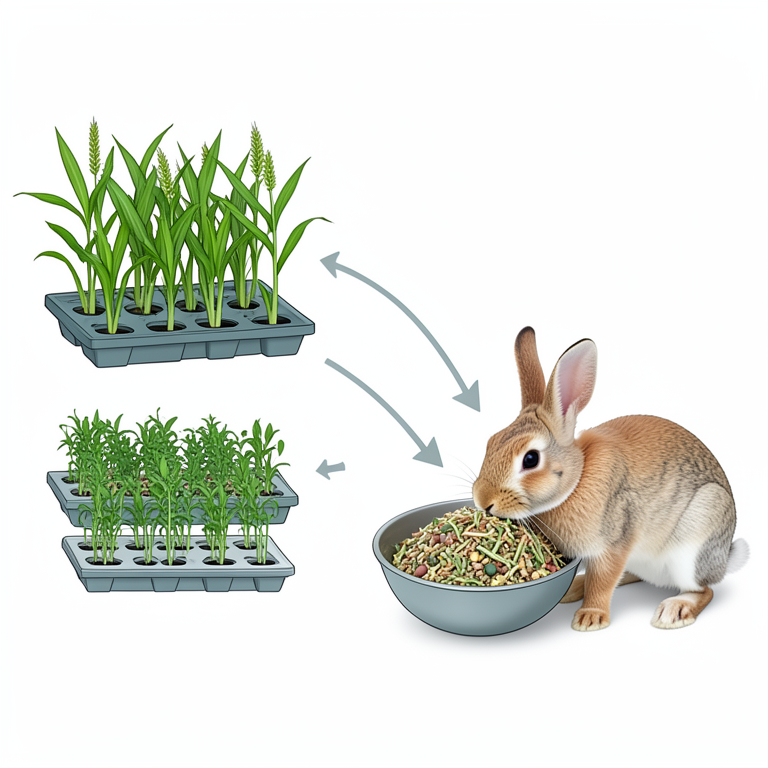
Dual-Crop Sprouting Strategy
AI-generated conceptual illustration (hydroponic maize, barley, and cowpea fodder and domestic rabbits). It explains the idea and does not show study data.
View source evidence ↗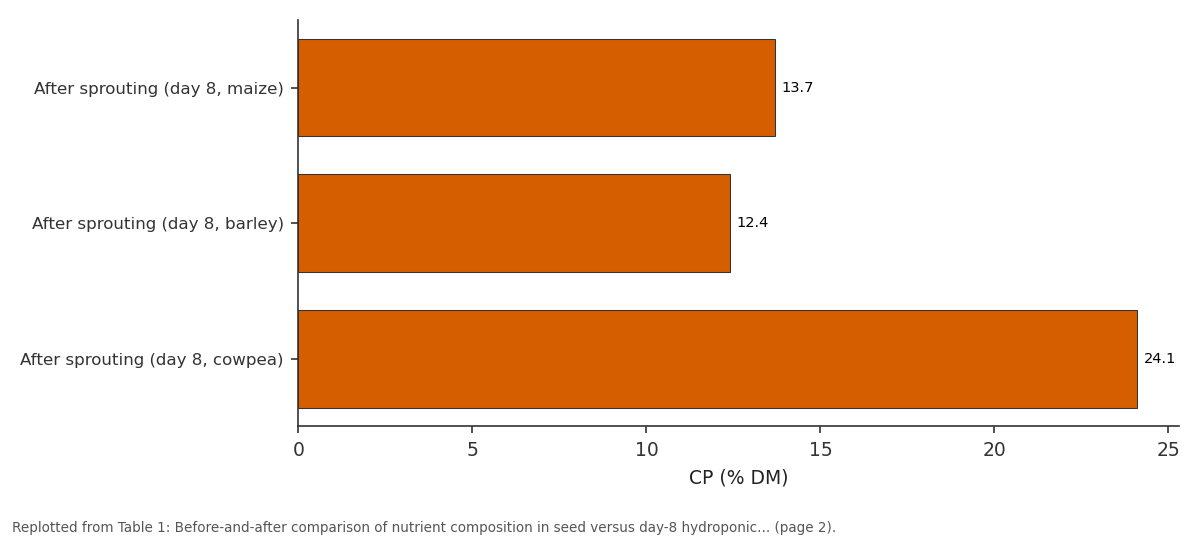
CP (% DM): After sprouting (day 8... vs After sprouting (day 8... vs After sprouting (day 8...
Replotted from Table 1 (page 2) of the original paper. Every bar is the paper's own table value.
View source evidence ↗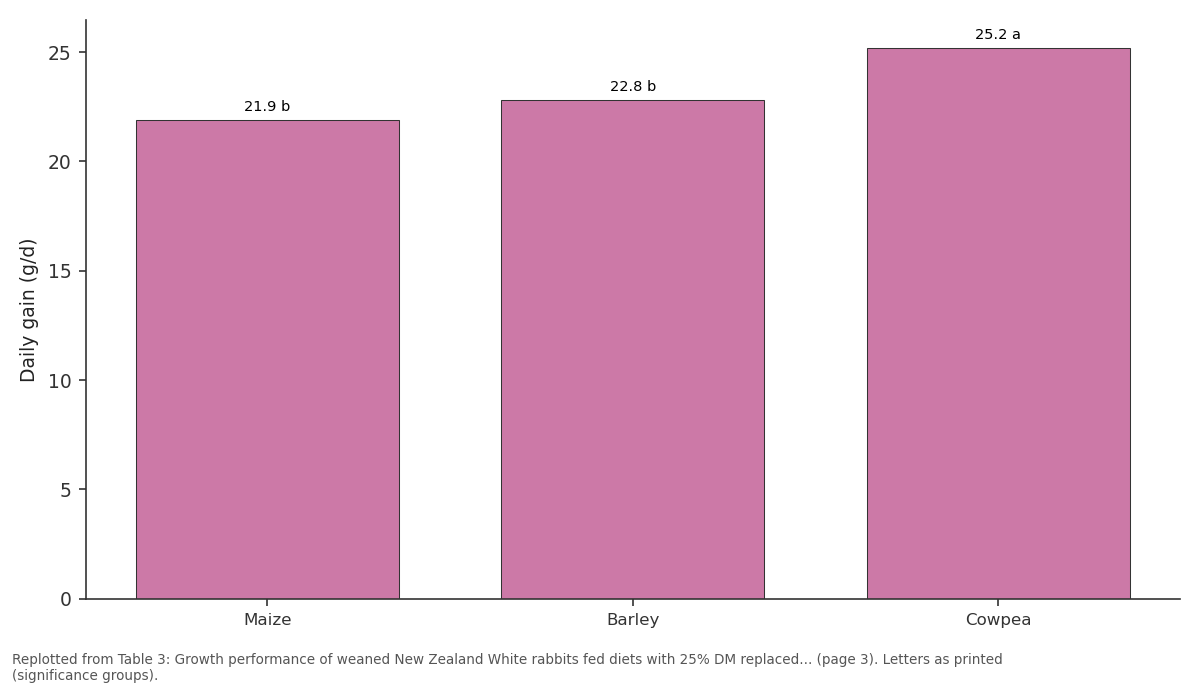
Daily gain (g/d): Maize vs Barley vs Cowpea
Replotted from Table 3 (page 3) of the original paper. Every bar is the paper's own table value.
View source evidence ↗Figures & tables
From the original paper Table 1
 Table 2
 Table 3
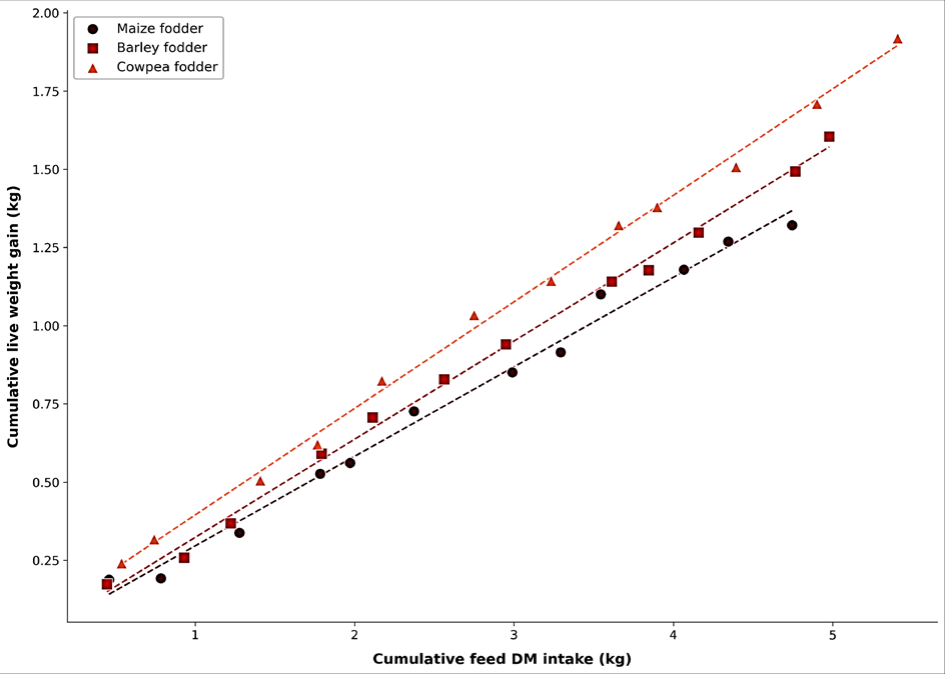 Figure 1
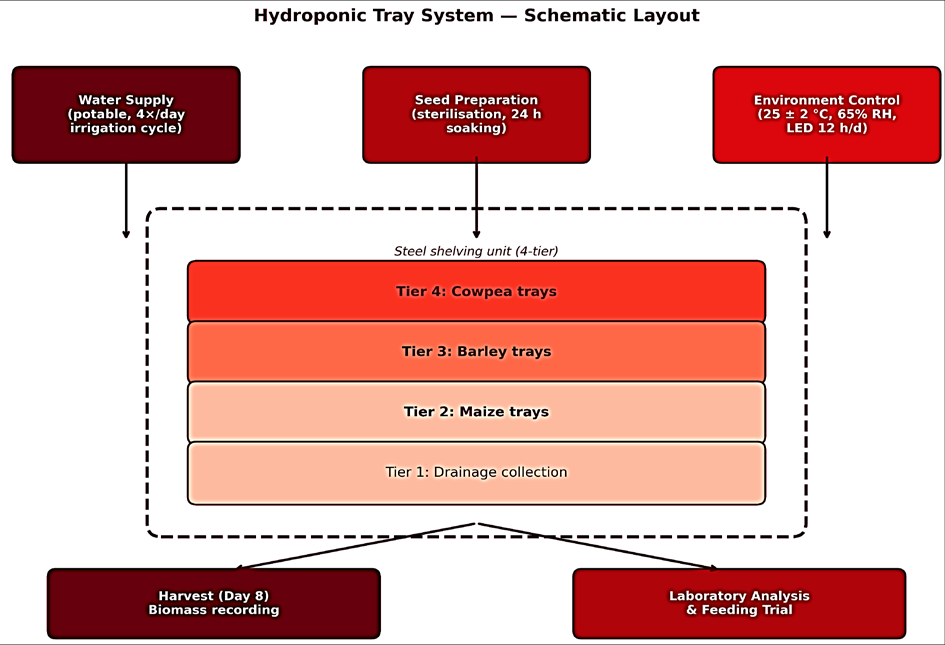 Figure 2
Introduction
Soilless green fodder can be produced in eight days using less than 3 litres of water per kilogram of fresh biomass-a figure that makes hydroponic sprouting one of the most waterefficient forage technologies available to livestock keepers in water-scarce environments [1] . For rabbit producers operating in peri-urban Brazil, where land prices and municipal water tariffs continue to climb, this efficiency has practical appeal. Yet the question that matters most to the farmer is not how much green mass a tray of seeds can yield, but whether feeding that mass to rabbits actually improves growth relative to a well-formulated commercial pellet. Previous work has shown that hydroponic sprouts from cereals such as barley and maize supply moderate protein (10-15% DM), moderate fibre (14-19% DM), and a suite of vitamins that can buffer heat-stress-related intake depression in tropical climates [2,3] . Legume sprouts-cowpea, mung bean, soybean-offer a richer protein package (18-27% DM), but their fresh-weight yield per tray is typically lower, and their higher ash and calcium content can skew mineral ratios if inclusion levels are not managed carefully [4,5] . Despite a growing body of agronomic data, feeding trials that compare cereal and legume hydroponic fodders head-to-head as partial replacements for a standard pelleted ration in rabbits remain limited. Most published experiments have supplemented rather than replaced concentrate, making it difficult to isolate the fodder's contribution to overall performance [6] . And regression-based analyses that relate cumulative feed intake to cumulative weight Gain-an approach that reveals feed-use efficiency more transparently than simple FCR averages-are rare in the hydroponic-rabbit literature [7] . This research therefore adopted a feeding-trial framework in which 25% of daily DM was replaced (not merely supplemented) by hydroponic maize, barley, or cowpea sprouts in growing New Zealand White rabbits at São Paulo Research Institute, Brazil.
The objectives were threefold: 1. To determine the proximate and mineral composition of each sprout species produced under a standardised greenhouse protocol; 2. To compare daily weight gain, feed intake, and feed conversion ratio across the three dietary treatments over 60 days; and 3. c) To construct scatter-plot regressions and nitrogen budgets that clarify the relationship between sprout species, nutrient utilisation, and lean-tissue deposition.
Materials and Methods
Materials and Methods
Study area description
Study area description
Methods
The research was approved by the Institutional Ethics Committee for Animal Use (Protocol CEUA-SPRI-2022-011, dated 28 March 2022). Seeds were disinfected with 1% sodium hypochlorite (20 min), rinsed, and soaked for 24 h. Pre-soaked seeds were spread at 3.0 kg m⁻² on perforated trays (60 × 40 cm) lined with coconut-coir fabric and placed on steel shelving inside the greenhouse. Irrigation was supplied by micro-sprinklers at four daily intervals; temperature was held at 26 ± 2 °C, relative humidity at 75%, and photoperiod at 14 h using supplemental LED lighting. Fodder mats were harvested on day 8; fresh weight was recorded per tray and sub-samples oven-dried at 60 °C for 72 h for DM determination. Proximate analysis used AOAC (2005) procedures: CP (Kjeldahl, N × 6.25), CF (acid-alkali digestion), EE (Soxhlet), ash (muffle furnace, 550 °C, 4 h). Calcium was measured by AAS; phosphorus by the vanadomolybdate method. For the feeding trial, rabbits were blocked by sex and weight, then randomly allocated to three groups (n = 15). Each group received the basal pellet with 25% of daily DM replaced by one hydroponic sprout species. Body weight was recorded weekly; feed offered and refused were recorded daily. FCR was computed as total DM consumed / total live-weight gain. Nitrogen balance was estimated from CP intake minus faecal and urinary N. Data were analysed by one-way ANOVA in SAS 9.4; means were separated by Tukey's HSD (p < 0.05).
Results
Table Sprouting transformed the nutritional profile of all three species in predictable ways: DM content dropped from the original seed level of 87.4% to 13-15%, while CP increased-most dramatically in cowpea, where it rose from 9.8% in the dry seed to 24.1% in the day-8 sprout (Table 1). The correlation matrix (Table 2) confirms strong positive associations between CP, ash, Ca, and P across species, driven largely by cowpea's simultaneous enrichment in protein and minerals. Fibre fractions showed weaker, mostly negative correlations with protein, reflecting the inverse relationship between cell-wall deposition and nitrogen concentration observed in short-duration sprouts. Growth performance data (Table 3) showed that cowpeasupplemented rabbits gained 25.2 g d⁻¹, outperforming both cereal groups (p < 0.01). Barley-fed animals, however, matched cowpea's FCR (3.28 vs 3.31), a result likely attributable to barley's lower feed intake coupled with efficient fibre digestion. No mortalities occurred in any group. The scatter plot (Figure 1) visualises the feed-intakeweight-gain relationship across all 45 animals, with cowpea data points clustering along the steepest regression line (slope 0.33), confirming its superior nutrient conversion efficiency.
| Group | Daily gain (g/d) | Feed intake (g DM/d) | FCR | Final BW (g) | Mortality (%) |
|---|---|---|---|---|---|
| Maize | 21.9ᵇ | 81.2 | 3.71ᵇ | 1,955ᵇ | 0 |
| Barley | 22.8ᵇ | 74.8 | 3.28ᵃ | 2,009ᵇ | 0 |
| Cowpea | 25.2ᵃ | 83.4 | 3.31ᵃ | 2,153ᵃ | 0 |
| SEM | 0.71 | 2.14 | 0.09 | 31.8 | - |
| P-value | <0.01 | 0.08 | <0.05 | <0.01 | - |
Table text extracted from the original PDF; superscript letters are shown inline. The original table image is below.
View original table image
| — | CP | CF | EE | Ash | Ca | P |
|---|---|---|---|---|---|---|
| CP | 1.00 | - | - | - | - | - |
| CF | -0.41 | 1.00 | - | - | - | - |
| EE | -0.68 | -0.12 | 1.00 | - | - | - |
| Ash | 0.87 | -0.29 | -0.71 | 1.00 | - | - |
| Ca | 0.93 | -0.36 | -0.74 | 0.96 | 1.00 | - |
| P | 0.81 | -0.22 | -0.59 | 0.88 | 0.91 | 1.00 |
Table text extracted from the original PDF; superscript letters are shown inline. The original table image is below.
View original table image
| Parameter | Before sprouting (seed) | After sprouting (day 8, maize) | After sprouting (day 8, barley) | After sprouting (day 8, cowpea) |
|---|---|---|---|---|
| DM (%) | 87.4 | 13.2 | 13.9 | 14.6 |
| CP (% DM) | 9.8 | 13.7 | 12.4 | 24.1 |
| CF (% DM) | 2.1 | 16.4 | 13.8 | 15.2 |
| EE (% DM) | 4.3 | 3.2 | 2.9 | 2.1 |
| Ash (% DM) | 1.5 | 3.6 | 4.0 | 5.7 |
| Ca (% DM) | 0.03 | 0.37 | 0.41 | 1.79 |
| P (% DM) | 0.28 | 0.32 | 0.35 | 0.42 |
Table text extracted from the original PDF; superscript letters are shown inline. The original table image is below.
View original table image
Nutrient budget
Cumulative nitrogen intake over 60 days averaged 52.8 g (cowpea), 43.6 g (barley), and 44.1 g (maize) per rabbit. Estimated nitrogen retention was 14.2 g in the cowpea group, 11.8 g in barley, and 10.1 g in maize. These figures indicate that cowpea-supplemented rabbits retained roughly 27% of ingested nitrogen as body protein, compared with 23% for maize-fed animals-a difference driven almost entirely by the legume sprout's higher CP content and more favourable amino acid profile.
Comprehensive interpretation
The paired compositional and performance data converge on a clear conclusion: partial replacement of a conventional pellet with cowpea sprouts delivers the most favourable balance of protein supply and growth response, while barley offers a competitive feed efficiency that becomes important when the objective is to minimise total feed cost rather than maximise weight gain. The before-and-after comparison (Table 1) and the correlation matrix (Table 2) together illustrate why cowpea excels-its nutrient package scales together, with protein, minerals, and fibre moving in directions that favour rabbit growth.
Discussion
Cowpea's CP concentration at day 8 (24.1% DM) is among the highest reported for short-duration hydroponic legume sprouts and sits at the upper end of the 20-27% range documented in African and Asian screening trials [4,7] . The rise from 9.8% in the dry seed to 24.1% in the sprout reflects not net protein synthesis but rather dilution of starch reserves during germination, which concentrates the nitrogen-bearing fraction on a DM basis. For practical ration formulation, this means that 1 kg of cowpea sprout DM supplies roughly 2.5 times the protein of 1 kg of maize sprout DM-a differential large enough to reduce dependence on commercial soybean meal or other protein concentrates [8] . Barley's competitive FCR (3.28) despite a lower CP content (12.4% DM) is consistent with findings in temperate rabbit trials where low-fibre barley rations improved apparent DM digestibility by 3-5 percentage points over higher-fibre alternatives [9] . The likely mechanism is faster caecal passage and reduced fermentation heat loss, which together leave more metabolisable energy available for growth. That said, barley's daily gain trailed cowpea's by 2.4 g d⁻¹, suggesting that feed efficiency gains were offset by an absolute protein shortfall. The scatter-plot regressions bring an analytical perspective that simple FCR comparisons miss. By plotting every animal's cumulative intake against cumulative gain, the graphs reveal not just the average efficiency but also the within-group variance-which was narrower in the cowpea group (R² = 0.94) than in maize (R² = 0.87), hinting at more consistent nutrient delivery. This tighter animal-to-animal response could simplify batch management on commercial farms where uniformity at slaughter is valued [10] . One caveat concerns cowpea's wide Ca: P ratio (4.26: 1), which exceeds the 1.5-2: 1 guideline for growing rabbits. At a 25% DM replacement level, the overall dietary ratio remained within an acceptable band (2.1: 1 when combined with the basal pellet), but higher inclusion levels could risk phosphorus absorption interference. Producers scaling up cowpea sprout feeding should monitor bone mineralisation or add a modest phosphorus supplement to the concentrate fraction [11] . Looking ahead, longer trials that carry animals through to market weight and include carcass evaluation would clarify whether the live-weight-gain advantage of cowpea translates into proportional improvements in dressing percentage and meat yield. Testing mixed-species trays-where cereal and legume seeds germinate together-could further simplify the production process. Reproductive performance under hydroponic-supplemented diets also deserves attention, as protein quality and mineral balance during pregnancy and lactation directly affect litter size and kit survival. Finally, conducting the trial across seasons would test the robustness of the sprouting protocol under the cooler, drier conditions of the Brazilian winter.
Conclusion
Conclusion
Acknowledgement
Acknowledgements Funding sourcesThis research was supported by the internal research development fund of São Paulo Research Institute. No external grants or commercial sponsorship were received. Institutional supportThe authors thank São Paulo Research Institute for access to the greenhouse, rabbit housing unit, and analytical chemistry laboratory.
Figures and tables from the paper
References
14 in the original paper- Naik PK, Dhuri RB, Swain BK, Singh NP. Water management for green fodder production as livestock feed in Goa. Indian J Anim Sci. 2014;84(9):1007-1010.
- Fazaeli H, Golmohammadi HA, Tabatabayee SN, Asghari-Tabrizi M. Productivity and nutritive value of barley green fodder yield in a hydroponic system. World Appl Sci J. 2012;16(4):531-539.
- Al-Sagheer AA, Abdel-Rahman GA, Elsawy SA. Potential of hydroponic barley fodder as a feed supplement for ruminants in hot arid regions. Trop Anim Health Prod. 2019;51(5):1209-1217.
- Dung DD, Godwin IR, Nolan JV. Nutrient content and in sacco digestibility of barley grain and sprouted barley. J Anim Vet Adv. 2010;9(19):2485-2492.
- De Blas C, Wiseman J, editors. Nutrition of the Rabbit. 2nd ed. Wallingford: CABI Publishing; 2010.
- Lukefahr SD, Cheeke PR. Rabbit project development strategies in subsistence farming systems. World Anim Rev. 2015;68:60-70.
- Aganga AA, Tshwenyane SO. Potentials of guinea grass (Panicum maximum) as a forage crop in animal nutrition. Pak J Nutr. 2004;3(1):1-4.
- Sneath R, McIntosh F. Review of hydroponic fodder production for beef cattle. Meat & Livestock Australia Report. 2003;1:1-54.
- Moin TM, Salam NB, Sarker T, Islam SS, Sun MA. Biomass production and nutritive value of different hydroponic fodder species and their effects on growth performance of rabbits. South Asian J Agric Sci. 2023;3(2):49-54.
- Lebas F, Coudert P, De Rochambeau H, Thébault RG. The Rabbit: Husbandry, Health and Production. Rome: Food and Agriculture Organization of the United Nations; 1997.
- Mateos GG, Rebollar PG, De Blas C. Minerals, vitamins and additives. In: De Blas C, Wiseman J, editors. Nutrition of the Rabbit. 2nd ed. Wallingford: CABI Publishing; 2010. p. 119-150.
- Peer DJ, Leeson S. Nutrient content of hydroponically sprouted barley. Anim Feed Sci Technol. 1985;13(34):191-202.
- Cuddeford D. Hydroponic grass. In Pract. 1989;11(5):211-214.
- Morgan J, Hunter RR, O'Haire R. Limiting factors in hydroponic barley grass production. In: Proceedings of the 8th International Congress on Soilless Culture; 1992. p. 241-261.