
Research article · 2026 · Full text
International Journal of Horticulture and Food SciencePerformance analysis of a developed self-propelled mini rotary weeder under field conditions
Volume 8(7) · Pages 138–145 · DOI: 10.33545/26631067.2026.v8.i7b.819 ↗
Research areasAgricultural Engineering and MechanizationWeed Control and Herbicide ApplicationsSoil Mechanics and Vehicle Dynamics
Abstract
Author-writtenThe performance evaluation of a self-propelled mini rotary weeder was conducted to assess its suitability for inter-row weed control in agricultural fields. The machine, powered by a 2.0 hp two-stroke petrol engine and equipped with a centrally driven rotary blade mechanism, was tested under field conditions to evaluate its operational efficiency, weed removal effectiveness, field capacity, and maneuverability. The developed weeder was operated in row crops with varying row spacings, and observations were recorded for weeding efficiency, plant damage, fuel consumption, and time required for operation. The test results indicated that the rotary weeder effectively uprooted and buried weeds while maintaining proper soil pulverization around the crop rows. The adjustable working width ranging from 140 mm to 250 mm enabled the machine to operate efficiently under different crop spacing conditions. The self-propelled feature reduced operator fatigue and improved ease of operation compared with conventional hand weeding methods. The rotating blades operating at approximately 176 rpm provided satisfactory soil stirring and weed-cutting action without causing significant crop damage. The machine demonstrated higher field capacity and lower labor requirements than traditional manual weeding practices. The evaluation confirmed that the developed self-propelled mini rotary weeder is a reliable and economical solution for small and medium-scale farming operations. Its compact design, low weight, and efficient power transmission system contribute to improved field performance and reduced weeding costs. The machine has significant potential to enhance farm productivity by reducing labor dependency and increasing the timeliness of weed management operations.
Summary
Source-checkedPlain-language reading of the full paper, prepared with AI and checked against the text. Each point links to the authors' own words.
Why it matters
- There is a growing demand in the agricultural sector for non-chemical weed control methods to ensure food safety. View evidence ↗
- Weed control is critical because weeds compete with crops for essential resources like water, nutrients, and light. View evidence ↗
- Traditional manual weeding tools and labor often make it impossible to achieve the necessary timeliness for effective weed control. View evidence ↗
The question
- The study aimed to evaluate the performance and suitability of a developed self-propelled mini rotary weeder for inter-row weed control. View evidence ↗
What they did
- The tested machine featured a centrally driven rotary blade mechanism powered by a 2.0 hp two-stroke petrol engine. View evidence ↗
- The weeder was designed with an adjustable working width between 140 mm and 250 mm to accommodate various crop spacings. View evidence ↗
- Testing followed the IS: 1976:1976 code, using six combinations of row spacing and weeding depth with five replications for each. View evidence ↗
- The machine's rotating blades operated at a speed of approximately 176 rpm. View evidence ↗
What they found
- Treatment T3 achieved the highest mean weeding efficiency at 92.3%, while T6 and T2 followed at 91.2% and 89.6% respectively. View evidence ↗
- Fuel consumption ranged from a low of 0.85 L/ha in T5 to a high of 1.14 L/ha in T3. View evidence ↗
- Field efficiency was highest for T4 (83.7%) and lowest for T1 (70.3%). View evidence ↗
- T4 achieved the maximum field capacity of 0.099 ha/h, while T1 showed the lowest at 0.083 ha/h. View evidence ↗
- The estimated operational cost of the machine is approximately Rs. 1,434 per hectare. View evidence ↗
What it means
- The developed weeder is concluded to be a reliable and economical solution for small and medium-scale farming. View evidence ↗
Visual summary
1 visualsIllustrations explain the paper; they do not show study data.
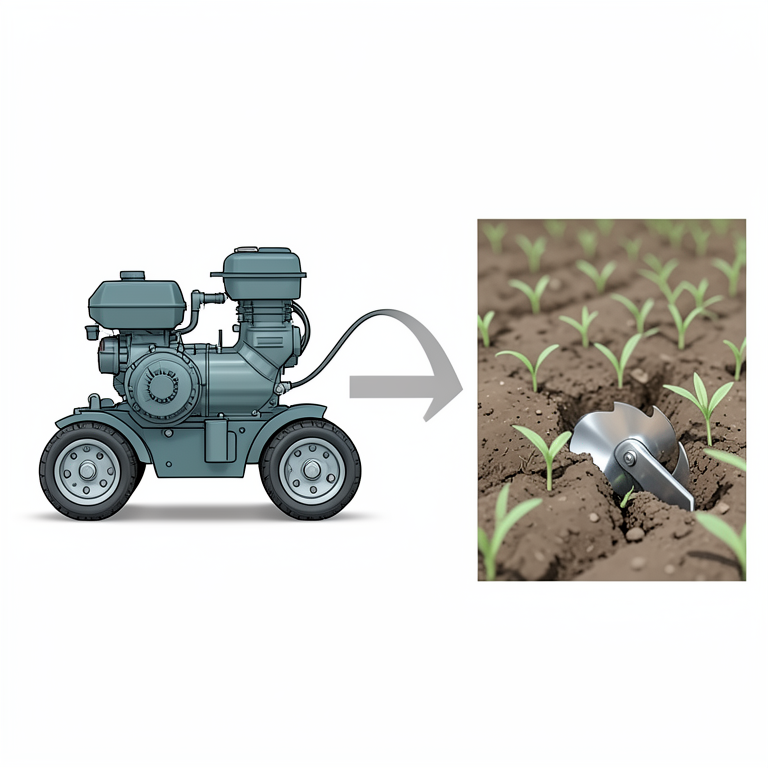
Mini Rotary Weeder Concept
AI-generated conceptual illustration (self-propelled mini rotary weeder in a crop field). It explains the idea and does not show study data.
View source evidence ↗Figures & tables
From the original paper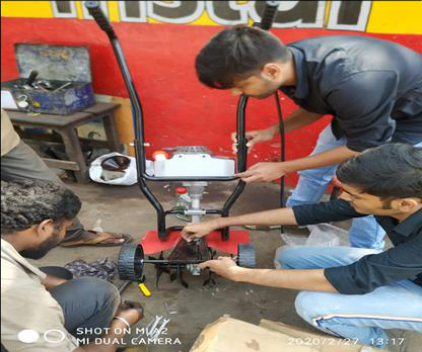 Figure 1
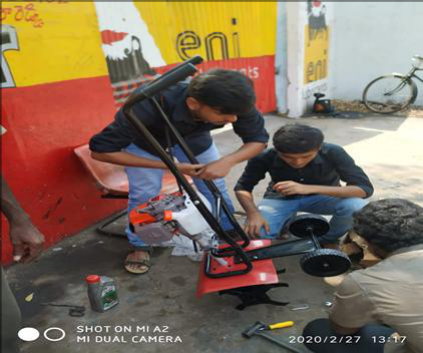 Figure 1
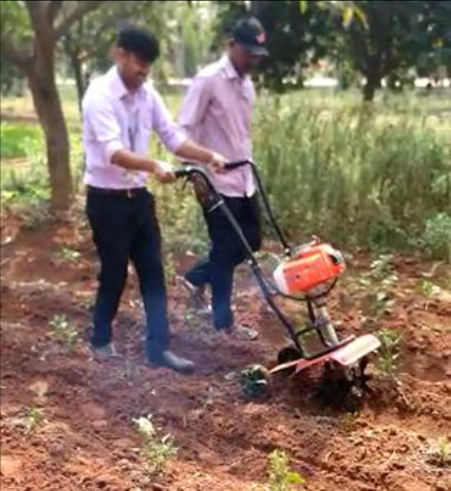 Figure 2
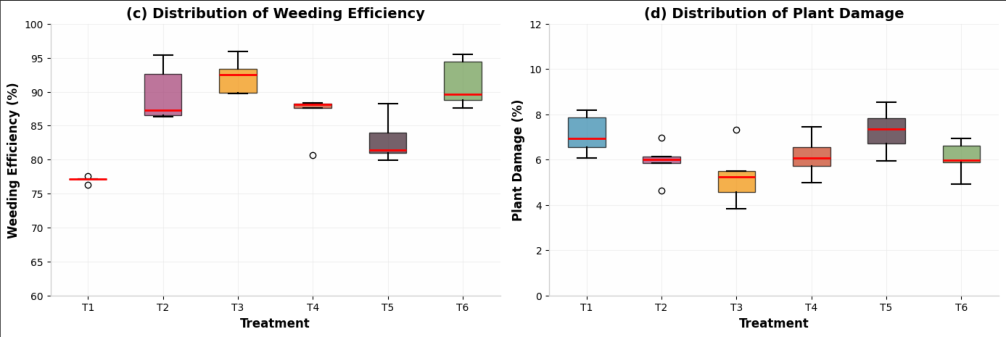 Figure 3
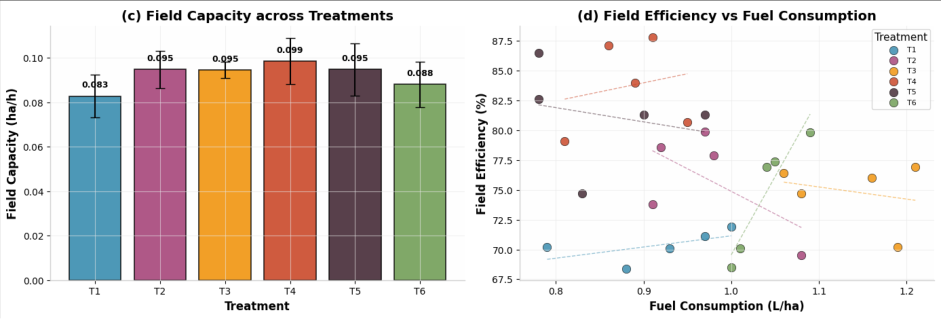 Figure 4
Introduction
In tillage, rotary tiller blades may be rotated on vertical-axis rotor shifts. The resulting texture of rotary tiller tilled soil is a function of the soil condition, blade kinematics and soil flow dynamics (Kinzel, Holmes & Huber). The soil flow dynamics depends on whether the rotor axis of the cultivator in horizontal or vertical and on the direction of rotation of the blades. For the horizontal rotor axis, the blades may be rotated in down-cut or up-cut direction; while for the vertical axis, the dedication of rotation may be clockwise or anticlockwise. In general, rotary tillers work on the horizontal axis rotor; and sedom on a vertical series of vertical axis rotors (Bukhari, Leghari& Memon). In addition to the aforementioned advantages, the rotary tiller is use for weeding, weeding is an important but equally labour-intensive agricultural unit operation. Today the agricultural sector requires non-chemical weed control that ensure food safety. Consumers demand high quality food products and pay special attention to food safety. Through the technical development of mechanisms for physical weed control, it might be possible to control weeds in a way that meets consumer and environmental demands. In spite of these advantages, the rotary tiller also mixes and pulverizes the tilled soil well; resulting in a good clod size distribution. The number of tillage passes required to achieve an acceptable tilth quality, using rotary tiller, is also significantly reduced (Destan & Houmy) in comparison to the series of operation that would result in the same tilth quality with the use of passive tools.
Weeds
Weeds are nothing but those unwanted plats which are grow with the crop and they compete with the growing crop for light, nutrients and water. For the controlling of weed it is essential to know about the weeds for the experimental study to fulfil the purpose of design and development of women friendly weeder. Smith (1964) staed that inter cultivation is an operation that required some kind of tool that stir the surface of the soil to a shallow depth in such a manner that young weeds could be destroyed and crop growth promoted. Agrawal and Singh (1968) listed the common weeds of agricultural land with their scientific and common names. Biswas (1984) reviewed and reported about weeds in Bhopal region. Weeds classified in different ways as per their place of occurrence or habitat, duration of life cycle, plant family etc. Devnani (1988) and Dingh (1996) reported that the aim of inter cultivation is to provide best opportunity for the crop to established and grow vigorously, up to the time of harvest. The purpose of inter cultivation is to control the weed growth, improve the soil conditions by reducing evaporation from the soil surface, improve infiltration of rain or surface water, and to maintain ridges or beds on which the crop is grown. The control of weed is major objective as they compete with the crop for light, nutrient and water. Most of the work on weeding therefore emphasizes the need for timeliness of weeding operation. The underlines the need for farmers to have operation control over power and machinery. Since timeliness in weeding is virtually impossible to achieve if one is to rely on the traditional manually operated hand tools such hoe, khurpi and family labours. Duff and Oricno (1971) reported that the timing rather than the frequency of weeding was a major determination of effective weed control for crop. Recommendation have been made for the first weeding to be done 2-3 weeks after sowing, followed by a second weeding three weeks later and if necessary.
Loses due to weeds
Smith (1961) reported that the weed competition is a serious problem in almost all rainy seasons' crops causing the losses in yield ranging from 9 to 60 % or more. Grist (1976) has reported that the weeds affected the microclimate around the plants harbour diseases and pests, increases the cost of production, plug irrigation and drainage canals and lower the quantity and quality of crop and showed that the competition of one grass plant (Echinocloa crusgalli) per square foot reduced yield of rice by 25%. Moorthy and manna (1989) [28] weeds compete severely with upland rice for light, nutrients, moisture and space. The yoeld losses are colossal ranging from 50-97%. Chandrakar and chandraker (1992) reported that the weeds compete severely for nutrients and depending upon the intensity of weeds growth, deletion of nutrients may be up to 86.5Kg N, 12.4Kg P and 134.5 Kg K per ha. Moorty (1996) reported that the percent yield loses due to weed competition for the first one month, two month and entire crop season were 23.7, 35.4 and 40.8 respectively.
Methods of weed control
Weed control is the process of limiting weed infestation so that crops could be growth profitably and other activities of man conducted efficiently. Researchers with varied degree of success have tried many methods of weed control. Knowing the several of weed control and applying some of them systematically, based on the requirements and the situations, the problem of weeds in the agricultural farm may be kept under control. Agarwal and singh (1968) study the important methods of weed control. Biswas (1984) gave the detailed account of various important weed control methods.
Methodology
The testing of the developed single row power weeder involves various factors like operation safety, light weight of machine, overcomes man power scarcity, saves time and cost, easiness in fabrication are taken into account for its design procedure. The operation and adjustment were made simple so that a village artesian can fabricate,repair the weeder and farmer can operate the weeder easily.
Assembling of power weeder
After finalizing the dimensions of manufactured parts, assembling of all parts together was done and located in suitable frame, which carry the different units without baulking the performance of the engine and the weeder. Where,
• Ƞ e = Field efficiency %,
• EFC = Effective field capacity, ha/h.
• TFC = Theoretical field capacity, ha/h.
Fuel consumption
The fuel consumption has direct effect the economics of the power weeder. It was measured by top fill method The fuel tank was filled to full capacity before the testing at levelled surface After completion of test operation, amount of fuel required to top fill again is the fuel consumption for the test duration. It was expressed in litre per hour.
Techno-Economic Feasibility 4.1 Cost of Weeding Operation
The cost of weeding operation for all treatments was estimated based on the prevailing market price of inputs, fabrication cost of the implement, rental charges of machinery, and wages of operators and labourers, wherever applicable. The operational cost of the power weeder was categorized into two components, namely fixed cost and operating (variable) cost, following the methodology suggested by Kamboj et al., 2012 [22] .
Fixed costs are independent of the extent of machine use, whereas operating costs vary proportionally with machine utilization. The fixed cost components included depreciation, interest on investment, taxes and insurance, and housing cost. The operating cost comprised fuel consumption, lubricants, repair and maintenance, and labour wages. The total cost of operation was expressed in Indian Rupees per hectare (Rs ha⁻¹).
Operation cost
Cost of weeding operation performed for all treatments was worked out on the basis of the prevailing input and fabrication price of the implements, machinery and rental wages of operator and labours if required. The cost of operation of power weeder is divided into two heads knowns as fixed cost and operation cost, where fixed cost is independent of operational use while variable cost varies proportionally with the amount of use (Kamboj et al., 2012) [22] .
Repair and maintenance cost
The repair and maintenance cost is a product of machines cost price and repair and maintenance percentage factor (Kamboj et al., 2012) [22] . RM = 2.5% × purchase price or capital investment per year
Fuel cost
Fuel cost is calculated based on actual fuel consumption for the operation.
Lubricants
It can be determined depending upon the maintenance cost or depending upon the oil price or oil consumption. Average lubrication cost is taken as 1.5% of fuel cost in Rs. /h. (Kamboj et al., 2012) [22]
Wages of operator
Wages are calculated based on actual wages of workers per hour.
Interest
Interest is calculated on the average investment of the machine talking into consideration the value of the machine in the first and last year. These are usually calculated on yearly basis. The annual interest on the investment can be calculated as.
I =
Where, I = Interest per hours i = 10% per year.
Taxes and insurance
Insurance charge is taken based on the actual payment to the insurance, it may be taken as 1 % of the initial cost of the machine per year.
Housing
Housing cost is calculated on the basis of the prevailing rates of the locality, but roughly, the housing cost may be taken as 1% of the initial cost of the machine per year.
Results and Discussion
Results and Discussion
Weeding Efficiency
The performance evaluation of the power weeder under different treatments revealed significant variation in weeding efficiency (Fig. 3a). Among the treatments, T 3 recorded the highest mean weeding efficiency of 92.3%, followed by T 6 (91.2%) and T 2 (89.6%). Treatments T 4 and T 5 achieved efficiencies of 86.6% and 82.9%, respectively, whereas the lowest efficiency was observed in T 1 (77.0%). The results indicated that treatments T 2 , T 3 , T 4 , and T 6 satisfied the Indian Standard (IS: 1976:1976) minimum requirement of 85% weeding efficiency, as represented by the reference line in Fig. 3a. In contrast, T 1 and T 5 failed to meet the prescribed standard. The superior performance of T 3 and T 6 may be attributed to improved soil-tool interaction, effective uprooting of weeds, and better field coverage during operation. Lower efficiency in T 1 could be due to inadequate penetration depth or improper operational parameters, resulting in incomplete weed removal.
The box plot distribution (Fig. 3c) further demonstrated that T 3 exhibited consistently high efficiency with comparatively lower variability, indicating stable performance under varying field conditions. Although T 6 also achieved high efficiency, a relatively wider spread suggested moderate variability in operational performance. T 5 displayed lower median efficiency and greater dispersion, indicating inconsistent weeding effectiveness.
Plant Damage Analysis
Plant damage caused during weeding operations varied among treatments (Fig. 3b). The highest plant damage was recorded in T 5 (7.28%), followed by T 1 (7.13%), while the lowest damage was observed in T 3 (5.29%). Treatments T 2 , T 4 , and T 6 resulted in plant damage of 5.92%, 6.15%, and 6.06%, respectively. All treatments remained within the acceptable plant damage limit of 8% specified under IS standards, indicating the suitability of the developed power weeder for intercultural operations without causing excessive crop injury. The lower plant damage observed in T 3 suggests that the treatment maintained an optimum balance between effective weed removal and crop safety. Conversely, higher damage in T 5 and T 1 may be associated with excessive blade aggressiveness, improper alignment, or inadequate maneuverability during operation. The distribution of plant damage shown in Fig. 3d, revealed relatively consistent performance for T 2 , T 4 , and T 6 , whereas T 5 exhibited higher variability with a broader interquartile range. The presence of outliers in some treatments indicated occasional instances of increased crop injury, possibly due to field heterogeneity or operator handling differences.
Operational Performance of Power Weeder
The figure presents the operational performance of a power weeder across six treatments (T 1 -T 6 ), focusing on fuel consumption, field efficiency, field capacity, and their interrelationship. Overall, the results highlight clear differences among treatments, indicating variations in operational effectiveness and energy utilization. Fuel consumption varies across treatments, with T 3 recording the highest value (1.14 L/ha), indicating comparatively higher energy requirement and lower fuel efficiency. In contrast, T 5 shows the lowest fuel consumption (0.85 L/ha), followed closely by T 4 (0.88 L/ha), suggesting better fuel efficiency in these treatments. T 1 , T 2 , and T 6 fall in the intermediate range, with T 6 showing relatively higher fuel use (1.04 L/ha) compared to most treatments except T 3 . Overall, T 4 emerges as the most effective treatment due to its combination of highest field efficiency, maximum field capacity, and low fuel consumption. T 5 also performs well, particularly in terms of fuel economy, but is slightly lower in efficiency compared to T 4 . Treatments T 1 and T 3 show comparatively weaker performance, with T 1 limited by low efficiency and capacity, and T 3 by excessive fuel consumption.
Conclusions
The field testing and performance evaluation of the developed single-row self-propelled mini rotary power weeder was conducted as per IS: 1976:1976 test code under six treatment combinations of weeding depth and row spacing, with five replications each. The overall results clearly demonstrated that both weeding depth and row spacing significantly influenced machine performance in terms of agronomic effectiveness, field efficiency, and energy requirement. Among all the tested parameters, treatment T 4 (5.0 cm weeding depth and 20 cm row spacing) emerged as the most balanced and practically suitable combination, delivering an optimum performance across multiple indicators. The weeding efficiency of the machine varied from 77.04% to 92.28%, with the highest value observed in treatment T 3 (7.5 cm depth, 15 cm spacing). Although deeper operation improved weed removal efficiency, it also increased draft requirement and fuel consumption. In contrast, treatment T 1 showed the lowest performance due to insufficient soil penetration. Overall, it was observed that increasing weeding depth improved weed removal effectiveness, but beyond an optimum level it resulted in higher energy demand and operational load. Plant damage remained within acceptable limits in all treatments (5.29% to 7.28%), confirming that the machine design ensured safe operation around crop rows. Notably, even at higher depths, plant damage remained low, indicating effective blade configuration and proper crop clearance. Fuel consumption ranged between 0.85 and 1.14 L/ha, increasing with greater weeding depth due to higher soil resistance and draft requirement. Wider row spacing contributed to reduced operational resistance and improved fuel economy. Field efficiency varied from 70.30% to 83.70%, with the highest value recorded in T 4 , where moderate depth and spacing minimized turning losses and improved operational continuity. Similarly, field capacity ranged from 0.083 to 0.099 ha/h, with T 4 again performing best due to its superior balance of working width and field efficiency. Draft requirement, slip percentage, vibration levels, and noise levels all remained within acceptable operational limits, confirming the machine's suitability for field conditions typical of loam soil.
Overall performance assessment indicated that T 4 provided the most desirable combination of high field efficiency, satisfactory weeding efficiency, low plant damage, and relatively low fuel consumption, making it the most practical operational setting for real-field applications. While T 3 achieved the highest weeding efficiency and lowest plant damage, it was associated with higher energy demand, making it less economical for routine use. Therefore, T 4 is recommended as the optimum operational treatment for the developed mini rotary power weeder. Economically, the machine demonstrated strong potential for small and marginal farmers, with an estimated operational cost of approximately Rs. 1,434 per hectare, which is significantly lower than manual weeding and competitive with other mechanical weed control methods. The reduced dependence on manual labour, improved field capacity, and adaptability to varying row spacings further enhance its suitability for Indian farming systems, particularly where labour shortages and small landholdings are major constraints. Overall, the developed self-propelled mini rotary power weeder successfully meets the design objectives of efficient weed control, minimal crop damage, operational economy, and field adaptability, making it a viable and practical solution for modern agricultural weed management.
Declaration of Generative AI and AI-assisted technologies
The authors take complete responsibility of the information present in the manuscript. They did not use any kind of AI tools or related technologies in drafting the review paper.
Figures and tables from the paper
References
50 in the original paper- Ahmad K, Haffar A. RNAM test codes and procedure for farm machinery. Technical Series No. 12. Bangkok: Economic and Social Commission for Asia and the Pacific, Regional Network for Agricultural Mechanization; 2023.
- Alizadeh MR. Field performance of mechanical weeder in the rice field. Scientific Research and Essays. 2011;6(25):5427-5434.
- Ambujam. Evaluation of power weeder performance. Agricultural Mechanisation in Asia, Africa and Latin America. 2024;24(4):16.
- Anonymous. Testing, evaluation and modification of weeder. Technical Series No. II. RNAM of ESCAP; Philippines; 1983.
- Anonymous. CIAE self-propelled weeder. Annual Report. Central Institute of Agricultural Engineering, Bhopal; 1997.
- Anyawu AC, Anyawu BO, Anyawu AA. Agriculture for school certificate. Africana Education Publication (Nig.) in association with FEP International Ltd.; 2016.
- Bajwa AA. Sustainable weed management in conservation agriculture. Crop Protection. 2014;65:105113.
- Balachand CH. Design, development and evaluation of animal drawn weeder suitable for non-descript bullock of C.G. region. M.Tech Thesis. IGKV, Raipur; 2010.
- Behera BK, Behera D, Swain S, Sahu RK. Performance evaluation of manual weeders for rice crop in Orissa. Agricultural Mechanisation in Asia, Africa and Latin America. 2016;27(3):820-822.
- Bernacki H, Haman J, Kanafojski CZ. Agricultural machines: Theory and construction. Washington, DC: USDA and NSF; 2011.
- Bhardwaj KC, Ganesan S, Pandey MM, Singh G. Equipment for weeding and inter-cultivation. In: Directory of Agricultural Machinery and Manufacturers. Bhopal: NATP, CIAE; 2024. p. 146156.
- Charudattan R, Dinoor A. Biological control of weeds using plant pathogens: Accomplishments and limitations. Crop Protection. 2000;19:691-695.
- Chauhan BS, Abeysekera ASK, Wickramarathe MS, Kulatunga SD, Wickrama UB. Effect of rice establishment methods on weedy rice infestation and grain yield. Crop Protection. 2024;55:42-49.
- Cloutier DC, Weide A, Peruzzi, Leblanc ML. Mechanical weed management in non-chemical systems. In: Upadhyaya MK, Blackshaw RE, editors. Non-chemical Weed Management. 2017. p. 111-134.
- Corlett EN, Bishop RP. A technique for assessing postural discomfort. Ergonomics. 2016;19(2):175-182.
- Dakogol FA, Kwaya PV, Yusuf RE. Development and performance evaluation of a garden flail mower. Proceedings of the 9th International Conference, Nigerian Institution of Agricultural Engineers. 2017. p. 73-76.
- Elumalai PV. Investigation of nanocomposite heat exchanger annular pipeline flow using CFD analysis for crude oil and water characteristics. Case Studies in Thermal Engineering. 2023;49.
- Gill G, Vanden S. Ergonomics considerations in development and fabrication of manual wheel hoe weeder. Indian Journal of Agricultural Engineering. 2018;2(4):234-243.
- Gongotchame S, Dieng IL, Ahouanton K, Johnson JM, Alognon AD, Tanaka A, et al. Participatory evaluation of mechanical weeders in lowland rice systems in Benin. Crop Protection. 2024;61:32-37.
- Grist DH. Rice. London: Longman Group Ltd.; 1976. p. 17-294.
- Hegazy RA, Abdelmotaleb IA, Imara ZM, Okasha MH. Development and evaluation of small-scale power weeder. Misr Journal of Agricultural Engineering. 2014;31(3):703-728.
- Kamboj P, Khurana R, Dixit A. Farm machinery services provided by selected cooperative societies. Agricultural Engineering International. 2012;14(4):123.
- Krishna VS, Jain SK, Panwar NL, Sunil J, Wadhawan N, Kumar A. Emergence of Internet of Things technology in food and agricultural sector: A review. Journal of Food Process Engineering. 2024;47(8):e14698.
- Kumar AA, Haribabu B, Srinivas Rao A, Someswararao C. Ergonomical evaluation of manually operated weeder under wetland condition. Scientific Research and Essays. 2013;8(6):249-255.
- Kumar VJF, Divaker DR. Development and evaluation of weeder simulation testing for estimating operator fatigue. Indian Journal of Agricultural Engineering. 2022;2(1):1-11.
- Mahal P, Agarwal JP, Singh OP. All about weeds. Aligarh: Atual Publishing House; 2022.
- Mahilang KKS, Kumar K, Kanwar GR. Design and development of power operated rotary weeder for rice. B.Tech Thesis. IGKV, Raipur; 2023.
- Moorthy BTS, Das FC. Performance evaluation of two manually operated weeders in upland rice. Orissa Journal of Agricultural Research. 2022;5(1-2):36-41.
- Muhammad AI, Attanda ML. Development of hand push mechanical weeder. Proceedings of the Nigerian Institute of Agricultural Engineers. 2022;33.
- Murthy GHK, Gowda MC. Effect of approach angle on performance of improved blade hoe. Agricultural Engineering Department, MRS, Hebbal, Karnataka. 2016;25(2):33-34.
- Nag PK. Effect of simple agricultural weeders on physiological response. Journal of Human Ergonomics. 2019:13-21.
- Nag PK, Chatterjee SK. Physiological reactions of female workers in Indian agricultural work. Human Factors. 2021;23:607-614.
- Niyamapa T, Chertkiattipol S. Development of blades for rotary tiller for Thai soils. Journal of Food, Agriculture and Environment. 2020;8(3-4):1336-1344.
- Raney A, Ziugg C. Annual Report 2013-14. Department of Agriculture and Cooperation, Ministry of Agriculture, Government of India, New Delhi; 2024.
- Sen RN. Tentative classification of strains in different types of jobs according to physiological responses. ICMR Report. New Delhi: Indian Council of Medical Research; 2019.
- Sharma HC, Singh HB, Firsow GH. Competition from weeds and their control in direct seeded rice. Weed Research. 2017;17(2):103-108.
- Shiru JJ. Design and development of a push-pull mechanical weeder for farmer's use. The Nigerian Academic Forum. 2021;21(1).
- Sighley JE. Standard handbook of machine design. 2016.
- Singh G. Development and fabrication techniques of improved grubber. Agricultural Mechanisation in Asia, Africa and Latin America. 2018;2:42-46.
- Tewari VK, Datta RK, Murthy ASR. Field performance of weeding blades of manually operated push-pull weeder. Journal of Agricultural Engineering Research. 2023;55:129-141.
- Thorat DS. Design and development of ridge profile power weeder. Journal of Agricultural Engineering. 2022;51(4).
- Varshney AC, Tiwari PS, Narang S, Mehta CR. Data book for agricultural machinery design. Bhopal: CIAE; 2024.
- Vedantam SK, Sagili JL, Dikkala PK, Sridhar K. Functional, thermal, pasting and rheological properties of gluten-free maize composite flour: Effect of moth bean flour and hydrocolloid addition. Journal of Food Processing and Preservation. 2021;45:e16104.
- Verma S. Farm size and economic efficiency in Punjab. M.Sc. Thesis. Punjab Agricultural University, Ludhiana; 2025.
- Victor VM, Verma A. Design and development of power-operated rotary weeder for wetland rice. Agricultural Mechanisation in Asia, Africa and Latin America. 2023;34(4):27-29.
- Yadav GC, Anderson DT. Farm operations and equipment for efficient dry land management. Technical Report. All India Coordinated Research Project for Dryland Agriculture, Hyderabad; 2018.
- Yadav R, Gite LP, Kaur N. Anthropometry of Indian female agricultural workers. Agricultural Mechanisation in Asia, Africa and Latin America. 2020;31(3):56-60.
- Yadav R, Tewari VK, Prasad S. Anthropometric survey of Indian farm workers. Ergonomics. 2019;35(11):1393-1398.
- Yatsuk EP, Panov IM. Design calculations for cutting tools for rotary cutters. In: Rotary Soil Working Machines: Construction, Calculations and Design. 2021. p. 223-228.
- Zareiforoush H, Komarizadeh MH, Alizadeh MR. Rotary tiller design proportional to a power tiller using specific work method. Natural Science. 2020;8(9):3945.