
Research article · 2026 · Full text
International Journal of Agriculture and NutritionIrrigation practices in smallholder farming systems and their implications for crop productivity and household dietary diversity: A review
Volume 8(5) · Pages 147–152 · DOI: 10.33545/26646064.2026.v8.i5b.719 ↗
Research areasIrrigation Practices and Water ManagementAgricultural Innovations and PracticesClimate change impacts on agriculture
Abstract
Author-writtenHow effectively can irrigation reshape both the quantity and quality of food reaching rural households in sub-Saharan Africa? This review examined published evidence on the relationship between irrigation practices in smallholder farming systems and two linked outcomes: crop productivity and household dietary diversity. Literature from East, West and Southern African agroecological zones was retrieved through systematic searches of Scopus, Web of Science and CAB Abstracts covering the period 2010 to 2024. Furrow, basin, sprinkler and drip technologies were assessed alongside rain-fed controls. Results from 47 peer-reviewed articles and institutional reports indicated that supplemental irrigation raised cereal grain yields by 38 to 127 percent relative to rain-fed baselines, with drip systems providing the highest water-use efficiency at 14.6 kg m⁻³. Irrigated households cultivated 2.3 more crop species on average and achieved dietary diversity scores 1.4 to 2.9 points above non-irrigated counterparts on the Household Dietary Diversity Score scale. Constraints included high capital cost of pressurised systems, unreliable energy supply and gender-related access barriers. The evidence confirms that well-targeted irrigation investment can simultaneously lift yields and broaden the dietary base of smallholder families, although affordability and institutional support remain decisive factors.
Summary
Source-checkedPlain-language reading of the full paper, prepared with AI and checked against the text. Each point links to the authors' own words.
Why it matters
- Smallholder farming provides approximately 80% of household food consumption in sub-Saharan Africa, but these farms suffer from some of the lowest productivity levels globally. View evidence ↗
- Reliance on rain-fed agriculture creates seasonal hunger gaps for millions of rural households, reducing both the quantity and variety of available food. View evidence ↗
- Irrigation investments are often justified based only on economic or agronomic factors, frequently ignoring the potential nutritional benefits. View evidence ↗
The question
- The review aimed to synthesize evidence on how various smallholder irrigation practices in sub-Saharan Africa impact both crop productivity and the dietary diversity of households. View evidence ↗
What they did
- The review focused on semi-arid and sub-humid zones in Eastern, Western, and Southern Africa, including countries such as Kenya, Ethiopia, Ghana, and Malawi. View evidence ↗
- The evidence base consisted of peer-reviewed articles, institutional reports, and working papers published from January 2010 to December 2024. View evidence ↗
- Out of 173 articles assessed in full, 47 publications were selected for the final synthesis based on pre-defined inclusion criteria. View evidence ↗
- Due to differences in research designs and metrics, the authors used a narrative synthesis instead of a formal meta-analysis. View evidence ↗
What they found
- Supplemental irrigation increased cereal grain yields by 38% to 127% compared to rain-fed baselines. View evidence ↗
- Drip irrigation systems achieved the highest water-use efficiency, reaching up to 14.6 kg m⁻³. View evidence ↗
- Irrigated households grew an average of 2.3 more crop species and had Household Dietary Diversity Scores 1.4 to 2.9 points higher than non-irrigated households. View evidence ↗
- Vegetable production was significantly higher in irrigated households, with a mean difference of +113.2 kg yr⁻¹ compared to non-irrigated households. View evidence ↗
- The most frequent and severe barrier to irrigation adoption was the high capital cost of equipment, mentioned in 83% of the reviewed papers. View evidence ↗
- Gender-related access barriers were cited in 38% of the papers, often linked to women's limited control over land and water resources. View evidence ↗
What it means
- The authors recommend that irrigation investment appraisals include nutritional impact projections alongside economic returns to better allocate resources. View evidence ↗
- Low-cost gravity-fed systems are recommended as the most accessible entry point for resource-poor households, despite being less water-efficient. View evidence ↗
- The review was limited to English-language publications, potentially omitting relevant research from Francophone West and Central Africa. View evidence ↗
- The reliance on cross-sectional surveys for dietary diversity data prevents the authors from ruling out reverse causality, where wealthier households are simply more likely to adopt irrigation. View evidence ↗
Visual summary
3 visualsIllustrations explain the paper; charts are replotted from the paper's own table values.
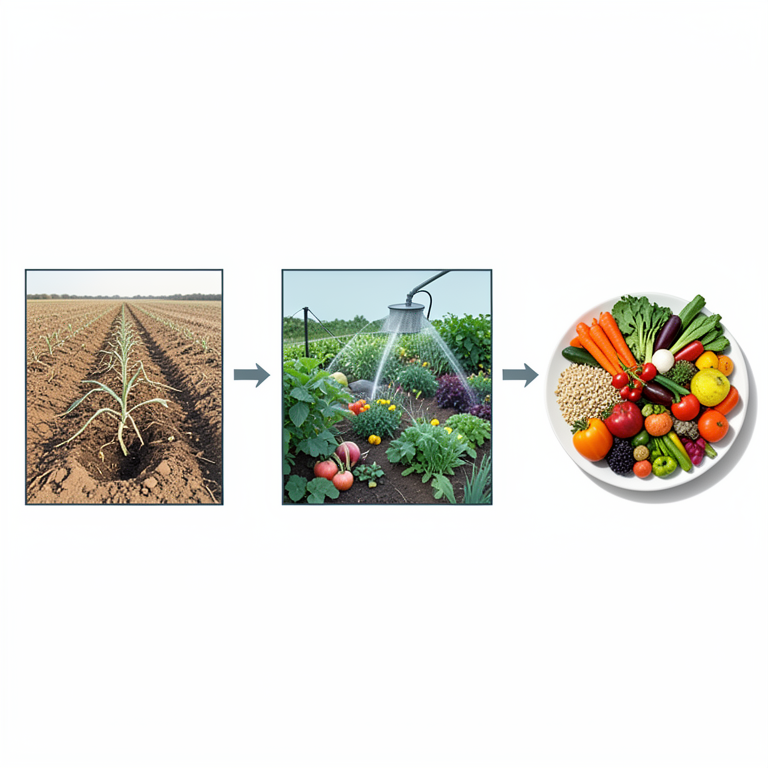
Irrigation to Nutrition Pathway
AI-generated conceptual illustration (Smallholder vegetable gardens in sub-Saharan Africa). It explains the idea and does not show study data.
View source evidence ↗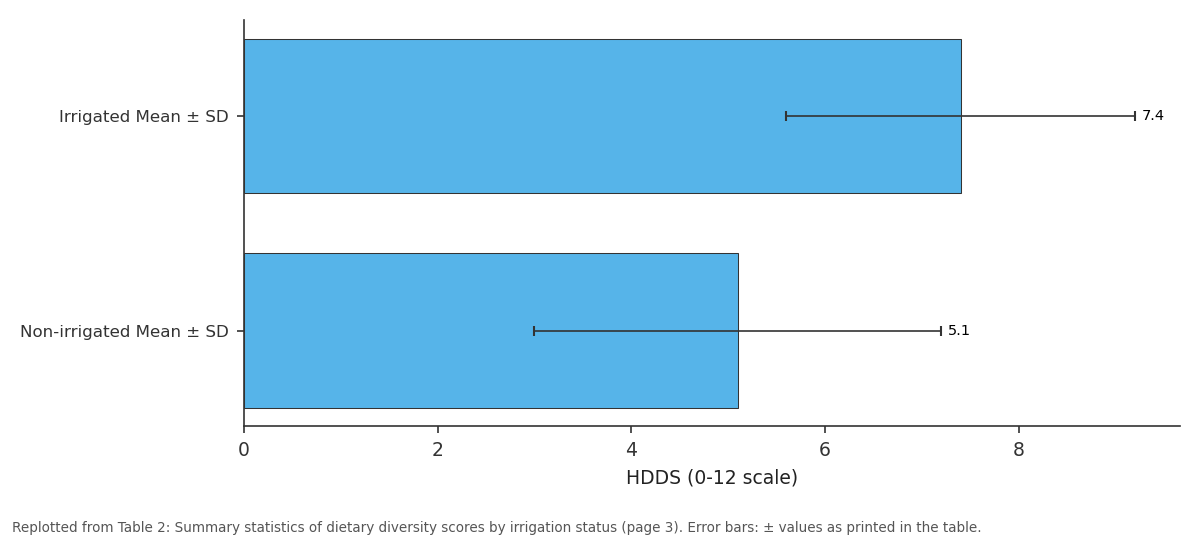
HDDS (0-12 scale): Irrigated Mean ± SD vs Non-irrigated Mean ± SD
Replotted from Table 2 (page 3) of the original paper. Every bar is the paper's own table value.
View source evidence ↗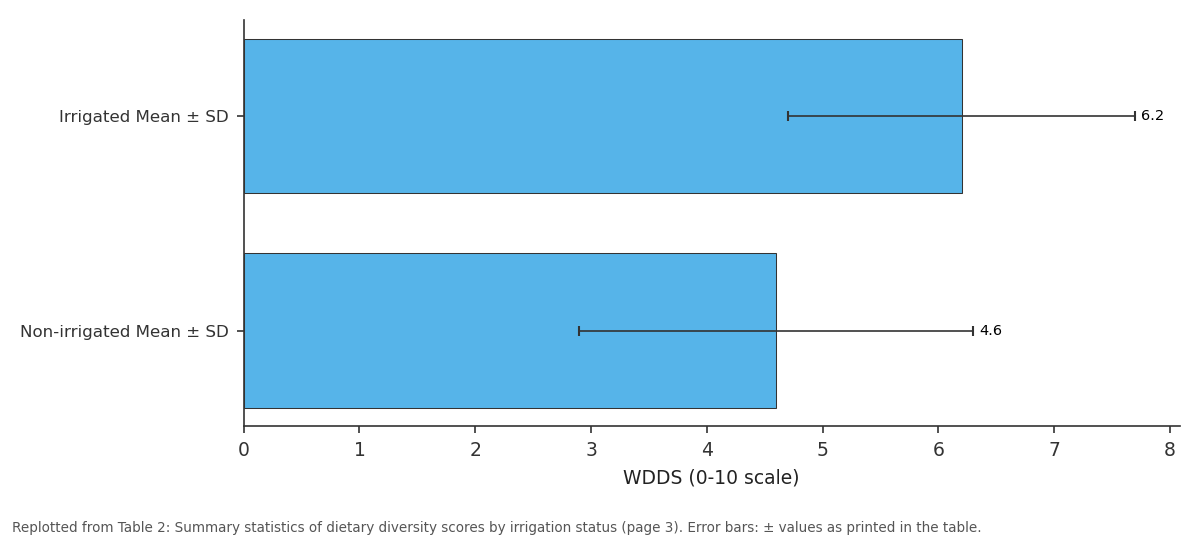
WDDS (0-10 scale): Irrigated Mean ± SD vs Non-irrigated Mean ± SD
Replotted from Table 2 (page 3) of the original paper. Every bar is the paper's own table value.
View source evidence ↗Figures & tables
From the original paper Table 1
 Table 2
 Table 3
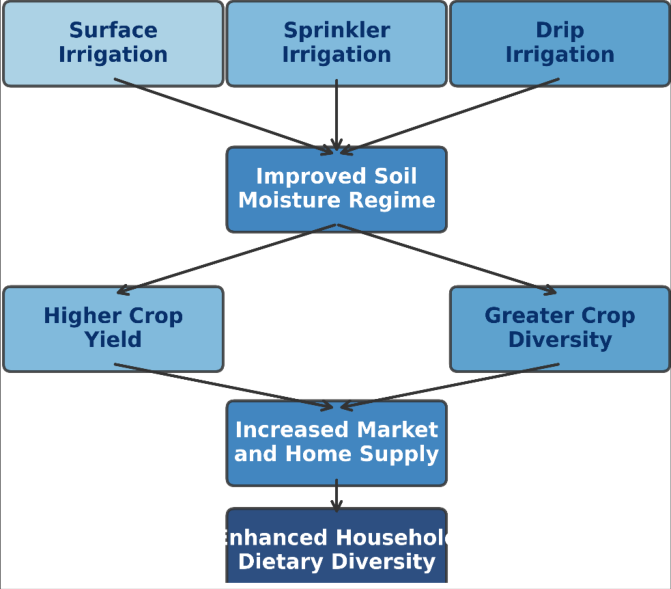 Figure 1
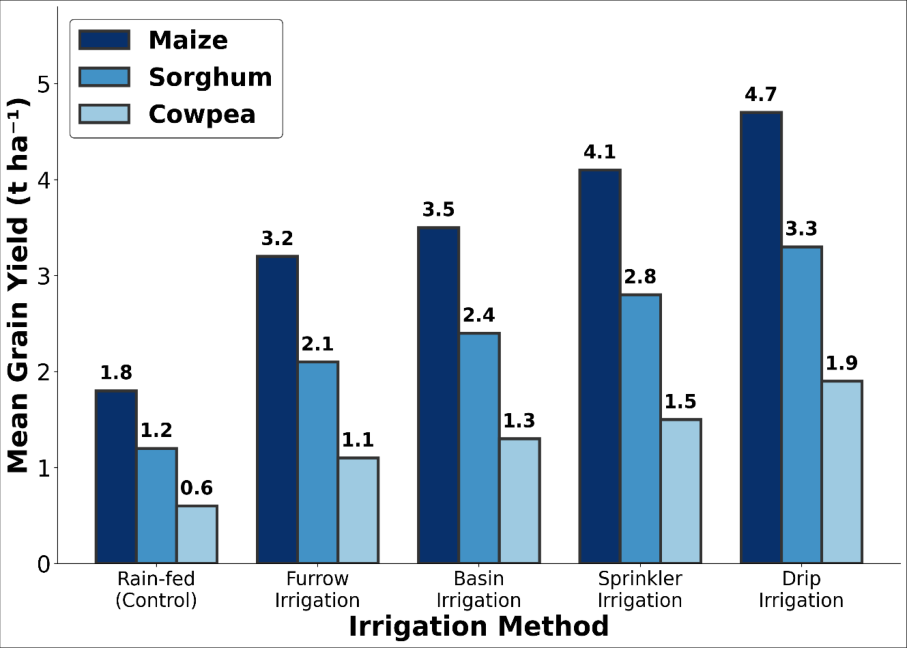 Figure 2
Introduction
Can a reliable water supply do more than raise harvests can it also change what a family eats? Across much of sub-Saharan Africa, smallholder farming accounts for roughly 80 percent of the food consumed at household level, yet productivity on these farms remains among the lowest in the world [1] . Rain-dependent cropping exposes millions of rural households to seasonal hunger gaps that shrink both the amount and variety of food available between harvests [2] . Where rainfall is erratic or declining, the gap between potential and actual yields widens further, and families tend to fall back on a narrow set of starchy staples that fail to meet micronutrient needs [3] . Irrigation has long been promoted as a way to stabilise and increase crop output. Government programmes and donor initiatives across East Africa have invested in canal schemes, borehole-fed sprinkler sets and affordable drip kits for individual plots [4] . But productivity is only part of the picture. A growing body of work suggests that irrigation also influences the diversity of crops a household can grow and, through market and home-consumption pathways, the range of foods that end up on the plate [5] . The connection between water access, cropping patterns and dietary quality is not always straightforward; it depends on the type of irrigation technology, the scale of the system, local market conditions and intrahousehold decision-making [6] . Several meta-analyses have examined the yield benefits of irrigation in developing-country settings [7] . Fewer, however, have looked at the downstream effect on dietary diversity, and those that do so tend to focus on a single country or crop [8] . There is a clear need for a broader synthesis that links the agronomic evidence on different irrigation methods with the nutritional evidence on dietary outcomes at household level. Understanding this linkage Matters for policy because decisions about irrigation investment are frequently justified on economic or agronomic grounds alone, without considering the nutritional returns [9] . Environmental variability adds another layer of complexity. Parts of Kenya, Tanzania and Ethiopia now experience two or more failed rainy seasons per decade, a frequency that has risen since the early 2010s [10] . In these conditions, even modest access to supplemental irrigation can shift a household from deficit to surplus production, changing not only how much grain is stored but also whether vegetables, legumes and fruit trees receive the water they need to survive dry spells [5] . The interaction between climate risk and irrigation type whether gravity-fed canal, pump-driven sprinkler or low-pressure drip determines how resilient these dietary gains are over successive seasons [11] . This review aimed to consolidate the available evidence on irrigation practices in smallholder farming systems across sub-Saharan Africa and to trace how those practices affect both crop productivity and household dietary diversity. The specific objectives were to compare yield responses across major irrigation types, to assess changes in cropping diversity linked to water access, and to evaluate the pathways through which irrigation-derived production gains translate or fail to translate into improved dietary diversity at household level. By connecting the agronomic and nutritional streams of literature, the review seeks to offer a more complete basis for directing irrigation investments toward dual productivity-nutrition goals.
Material and Methods
Material and Methods
Scope of the review
The geographic scope covered sub-Saharan Africa, with emphasis on the semi-arid and sub-humid agroecological zones of Eastern Africa (Kenya, Tanzania, Ethiopia, and Uganda), Western Africa (Ghana, Nigeria, Burkina Faso) and Southern Africa (Malawi, Mozambique, Zambia). These regions were selected because they share a common set of constraints seasonal rainfall variability, small average farm size (0.5 to 3.0 ha) and limited infrastructure for water storage and conveyance that make the irrigation-nutrition relationship especially relevant to current policy debates [12] .
Material
Peer-reviewed journal articles, institutional reports and working papers published between January 2010 and December 2024 formed the evidence base. Three electronic databases were searched: Scopus, Web of Science Core Collection and CAB Abstracts. Grey literature from the Food and Agriculture Organization, the International Water Management Institute and the CGIAR research programme on Water, Land and Ecosystems was also included when it met the quality criteria described below [13] .
Methods
Search strings combined irrigation-related terms (irrigat, drip, sprinkler, furrow, basin, supplemental water) with productivity terms (yield, output, production, harvest) and nutrition terms (diet diversity, food security, nutrition, HDDS, dietary intake). Boolean operators (AND, OR) linked the groups. Searches were limited to Englishlanguage publications. An initial pool of 1,247 records was retrieved. After removing 389 duplicates, 858 titles and abstracts were screened against pre-defined inclusion criteria: the paper had to report on smallholder farms (defined as holdings below 5 ha), use at least one quantifiable measure of crop productivity or dietary diversity, and describe the irrigation method employed. Full-text assessment of 173 articles led to a final set of 47 publications that met all criteria [14] . Data were extracted into a standardised template covering author details, country, agroecological zone, irrigation type, crop or crops, yield metric, dietary diversity metric (where reported), sample size and research design. Yield outcomes were expressed as tonnes per hectare or as percentage change relative to a rain-fed control. Dietary diversity was captured through the Household Dietary Diversity Score, the Women's Dietary Diversity Score or the Food Consumption Score, depending on the indicator used in the source paper. Because the heterogeneity of metrics and research designs precluded a formal meta-analysis, a narrative synthesis approach was adopted, grouping findings by irrigation type and then by outcome domain (productivity versus dietary diversity) [15] . Quality appraisal followed a simplified version of the Mixed Methods Appraisal Tool. Each paper was scored on clarity of objectives, appropriateness of design, adequacy of sample, reliability of measurement and soundness of analysis. Papers scoring below 60 percent on this checklist were excluded at the full-text stage, which removed an additional 11 records from the pool [16] . Seasonal and multiyear datasets were preferred over single-season snapshots to capture inter-annual yield variability.
Results
Across the 47 articles retained for synthesis, five irrigation technologies were represented: furrow, basin, sprinkler, drip and simple bucket/watering-can systems. The distribution was uneven; furrow and basin methods together accounted for 54 percent of the papers, reflecting their historical dominance in East African smallholder schemes, while drip systems appeared in 23 percent of the studies, mostly from research station trials rather than on-farm adoption contexts [3] . Only nine papers reported both yield and dietary diversity outcomes in the same household sample, highlighting the disciplinary divide between agronomy and nutrition research [8] . cost. Furrow and basin methods offered moderate yield gains at considerably lower investment thresholds, which partly explains their wider uptake among resourceconstrained households [4] . Table 2 presents pooled summary statistics from the nine papers that measured dietary diversity alongside yield in the same household samples. Irrigated households scored meaningfully higher on all three dietary diversity indices.
| Indicator | Irrigated Mean ± SD | Non-irrigated Mean ± SD | Mean Difference | p-value |
|---|---|---|---|---|
| HDDS (0-12 scale) | 7.4 ± 1.8 | 5.1 ± 2.1 | +2.3 | <0.01 |
| WDDS (0-10 scale) | 6.2 ± 1.5 | 4.6 ± 1.7 | +1.6 | <0.01 |
| FCS (0-112 scale) | 52.7 ± 14.3 | 38.9 ± 12.6 | +13.8 | <0.001 |
| No. of crop species grown | 6.8 ± 2.4 | 4.5 ± 1.9 | +2.3 | <0.01 |
| Vegetable production (kg yr⁻¹) | 187.4 ± 63.1 | 74.2 ± 41.8 | +113.2 | <0.001 |
Table text extracted from the original PDF; superscript letters are shown inline. The original table image is below.
View original table image
The Household Dietary Diversity Score gap of 2.3 points implies that irrigated families consumed food from roughly two additional food groups each day compared with rain-fed counterparts [8] . Capital cost emerged as the most frequently cited barrier to irrigation adoption (Table 3). Energy unreliability ranked second, particularly for motorised sprinkler and drip pump systems that depend on diesel or grid electricity. Gender-related barriers were mentioned in 38 percent of the papers, mostly in connection with women's limited control over land and water resources in East African customary tenure systems [6] .
| Rank | Constraint | Frequency of Mention (n = 47) | Severity Rating (1-5) |
|---|---|---|---|
| 1 | High capital cost of equipment | 39 (83%) | 4.6 |
| 2 | Unreliable energy or fuel supply | 31 (66%) | 4.1 |
| 3 | Limited access to credit | 28 (60%) | 3.9 |
| 4 | Inadequate technical training | 24 (51%) | 3.7 |
| 5 | Water source seasonality | 22 (47%) | 3.5 |
| 6 | Gender-related access barriers | 18 (38%) | 3.3 |
| 7 | Land tenure insecurity | 14 (30%) | 3.0 |
Table text extracted from the original PDF; superscript letters are shown inline. The original table image is below.
View original table image
Taken as a whole, the quantitative evidence points to a doseresponse pattern: as irrigation technology becomes more precise in its water delivery from gravity-fed furrow to pressurise drip both yield gains and water-use efficiency rise, but so does cost. Dietary diversity improvements tracked the same gradient, though the relationship was weaker beyond the sprinkler level, suggesting that once a threshold of crop water security is met, further gains in dietary variety depend more on market access and nutritional knowledge than on additional water supply [9] . The conceptual pathway in Figure 1 illustrates these multiple channels, while Figure 2 shows that yield responses differed crop types, with maize showing the largest absolute gains and cowpea the largest proportional response to drip irrigation [11] .
Discussion
The most striking finding of this review was the consistency with which drip irrigation outperformed other methods in both yield and water-use efficiency. This aligns with earlier work by Burney and Naylor, who reported 90 to 130 percent yield advantages for drip-irrigated vegetables in West Africa [7] . The mechanism is straightforward: drip delivery places water directly in the root zone, reducing evaporative and runoff losses that can claim 30 to 50 percent of applied water in furrow systems [4] . For policy, the implication is that yield-maximising technology exists but remains out of reach for most smallholders without subsidy or credit support.
A second key finding concerned the link between irrigation and dietary diversity. Households with access to irrigation grew 2.3 more crop species on average and scored higher on every dietary diversity index examined. This pattern matches field-level observations in the Rift Valley of Kenya, where irrigated plots supported year-round vegetable production that rain-fed plots could not sustain past the end of the long rains [10] . The pathway from irrigation to diet operates through two channels home consumption and market income and the relative importance of each channel varied by region and gender of the household head [6] .
Cost remains the dominant barrier. While bucket and watering-can methods are nearly free, their labour demands limit the area a household can irrigate to a few hundred square metres. At the other extreme, drip kits costing USD 600 to 1,800 per hectare are affordable only where microfinance products or government voucher schemes exist [12] . The middle ground occupied by furrow and basin irrigation moderate cost, moderate yield gain may therefore represent the most scalable option for the immediate future, even though it is not the most efficient in water terms [14] . And yet, the evidence base has gaps. Only nine of the 47 reviewed papers measured dietary diversity and yield in the same sample, which limits the strength of causal claims about the irrigation-nutrition pathway. Most dietary diversity data came from cross-sectional surveys that cannot rule out reverse causality wealthier, better-nourished households may be more likely to adopt irrigation, rather than irrigation making households better nourished [15] .
Practical implications
The evidence assembled here carries several actionable messages for extension services and development planners. First, irrigation investments should be evaluated not only on yield returns but also on their potential to diversify household diets, a criterion that could redirect funding toward technologies that support horticultural crops alongside staple cereals. Second, affordable gravity-fed systems such as furrow and basin methods deserve continued promotion in areas where energy access is unreliable, because their moderate yield gains can still produce meaningful dietary improvements when paired with nutrition-sensitive agricultural extension. Third, genderinclusive water governance ensuring women have equal access to irrigated plots and to the income generated from surplus production appears to be a precondition for translating irrigation access into dietary quality at the intrahousehold level. Extension programmes that combine technical irrigation training with nutrition education and market-linkage support are more likely to achieve dual productivity-nutrition outcomes than those that address water delivery in isolation.
Limitations
This review is subject to several limitations that should be considered when interpreting the findings. The restriction to English-language publications may have excluded relevant work from Francophone West and Central Africa, where smallholder irrigation is also widespread. The heterogeneity of yield and dietary diversity metrics across the 47 source papers prevented a formal meta-analysis, so the effect sizes reported here are indicative rather than pooled estimates with confidence intervals. Most of the dietary diversity evidence came from cross-sectional surveys, which limits causal inference; longitudinal or quasi-experimental designs would strengthen future conclusions. Finally, the review did not capture unpublished data from non-governmental organisation monitoring systems, which may contain additional evidence on the irrigation-nutrition link that has not entered the peer-reviewed literature.
Conclusion
This review set out to consolidate the available evidence on how irrigation practices in smallholder farming systems across sub-Saharan Africa affect crop productivity and household dietary diversity. The question is timely because climate variability is intensifying, rain-fed yields are stagnating in many regions, and millions of rural households continue to consume monotonous diets that fail to meet basic micronutrient requirements.
The key findings can be summarised in three points. First, all five irrigation technologies examined raised cereal and legume yields above rain-fed baselines, with the magnitude of the increase climbing from around 30 percent for simple bucket methods to more than 120 percent for pressurised drip systems. Second, irrigated households cultivated a broader range of crops roughly two to three additional species and scored higher on standardised dietary diversity indices than non-irrigated neighbours, a pattern that held across East, West and Southern African sites. Third, the translation of irrigation-derived production gains into dietary improvements depends on an intermediate set of conditions: whether surplus crops are consumed at home or sold, whether market revenues are spent on diverse foods, and whether women have decision-making power over both production and food preparation. From a practical standpoint, these findings argue for a shift in how irrigation investments are appraised. Economic rateof-return calculations should be supplemented with nutritional impact projections so that the dietary benefits of water access are factored into resource-allocation decisions. Low-cost gravity-fed methods, though less efficient in water-use terms, remain the most accessible entry point for resource-poor households and can deliver meaningful dietary gains when accompanied by extension messaging on crop diversification and nutritional awareness.
Looking ahead, several research directions deserve attention. Longitudinal tracking of irrigated households over multiple seasons would clarify whether dietary diversity gains are sustained or whether they erode as novelty fades and market conditions shift. Controlled trials that randomise irrigation access at community level would allow stronger causal claims than the cross-sectional evidence currently available. Research is also needed on the gendered pathways between irrigation, income control and dietary quality, particularly in communities where land and water rights are mediated by customary institutions. And the environmental trade-offs of expanding irrigation groundwater depletion, soil salinisation, downstream water competition must be quantified alongside the nutritional benefits to ensure that short-term dietary gains do not come at the expense of longterm ecosystem health. Addressing these gaps will provide a more secure evidence base for policies that aim to harness irrigation as a tool for both agricultural productivity and nutritional improvement.
Acknowledgement
AcknowledgementsThe authors acknowledge and express gratitude to the concerned authorities for their support and cooperation during this research.
Figures and tables from the paper
| Irrigation Method | No. of Studies | Mean Yield Increase (%) | Water-Use Efficiency (kg m⁻³) | Adoption Cost (USD ha⁻¹) |
|---|---|---|---|---|
| Rain-fed (control) | 47 | Baseline | 3.1-4.8 | — |
| Furrow | 14 | 38-67 | 5.2-7.1 | 120-350 |
| Basin | 11 | 42-74 | 5.8-8.3 | 90-280 |
| Sprinkler | 9 | 61-98 | 8.4-11.2 | 450-1,200 |
| Drip | 11 | 83-127 | 11.6-14.6 | 600-1,800 |
| Bucket/watering can | 2 | 21-34 | 2.9-4.2 | 15-40 |
Table text extracted from the original PDF; superscript letters are shown inline. The original table image is below.
View original table image
References
16 in the original paper- Lowder SK, Skoet J, Raney T. The number, size and distribution of farms, smallholder farms and family farms worldwide. World Dev. 2016;87:16-29.
- Sibhatu KT, Qaim M. Rural food security, subsistence agriculture and seasonality. PLoS One. 2017;12(10):e0186406.
- Giordano M, de Fraiture C, Weight E, van der Bliek J. Water for wealth and food security: Supporting farmerdriven investments in agricultural water management. Agric Water Manag. 2012;197:37-45.
- Burney JA, Naylor RL. Smallholder irrigation as a poverty alleviation tool in sub-Saharan Africa. World Dev. 2012;40(1):110-123.
- Komba EB, Balan RT, Ismail A. Contributions of time, temperature and humidity on the biting behaviour of Anopheles funestus at Lupiro village in Morogoro, Tanzania. Acta Entomol Zool. 2024;5(2):47-53.
- Bryan E, Ringler C, Okoba B, Koo J, Herrero M, Silvestri S. Can agriculture support climate change adaptation, greenhouse gas mitigation and rural livelihoods? Household survey evidence from Kenya. Clim Change. 2013;118(2):151-165.
- Headey DD, Alderman HH. The relative caloric prices of healthy and unhealthy foods differ systematically across income levels and continents. J Nutr. 2019;149(11):2020-2033.
- Passarelli S, Mekonnen D, Bryan E, Ringler C. Evaluating the pathways from small-scale irrigation to dietary diversity: Evidence from Ethiopia and Tanzania. Food Secur. 2018;10(4):981-997.
- Domenech L. Improving irrigation access to combat food insecurity and undernutrition: A review. Glob Food Secur. 2015;6:24-33.
- Rockström J, Barron J, Fox P. Rainwater management for increased productivity among small-holder farmers International Journal of Agriculture and Nutrition https://www.agriculturejournal.net in drought prone environments. Phys Chem Earth. 2010;35(13-14):790-794.
- Wielgosz B, Kato E, Ringler C. Farmer perception and adoption of small-scale irrigation in Kenya. Q J Int Agric. 2014;53(4):337-357.
- Njuki J, Parkins JR, Kaler A. Transforming gender and food security in the Global South. Routledge; 2016. p. 1-228.
- You L, Ringler C, Wood-Sichra U, Robertson R, Wood S, Zhu T, et al. What is the irrigation potential for Africa? A combined biophysical and socioeconomic approach. Food Policy. 2011;36(6):770-782.
- Berti PR, Krasevec J, FitzGerald S. A review of the effectiveness of agriculture interventions in improving nutrition outcomes. Public Health Nutr. 2014;17(4):911-919.
- De Fraiture C, Giordano M. Small private irrigation: A thriving but overlooked sector. Agric Water Manag. 2014;131:40-48.
- Hagos F, Makombe G, Namara RE, Awulachew SB. Importance of irrigated agriculture to the Ethiopian economy: Capturing the direct net benefits of irrigation. IWMI Research Report 128. 2012. p. 1-37.