
Research article · 2026 · Full text
International Journal of Horticulture and Food ScienceDNA-Based varietal tracking and adoption monitoring in sub-saharan maize (Zea mays l.) seed distribution networks
Volume 8(4) · Pages 108–1112 · DOI: 10.33545/26631067.2026.v8.i4b.818 ↗
Research areasGenetically Modified Organisms ResearchGenetic Mapping and Diversity in Plants and AnimalsAgricultural Innovations and Practices
Abstract
Author-writtenWhile improved maize varieties have been released at an accelerating pace across Sub-Saharan Africa, the capacity of seed distribution networks to deliver these varieties with correct identity and adequate purity to end-users has lagged behind, creating a persistent disconnect between varietal development and on-farm impact. This research applied DNA-based tracking to monitor varietal identity and adoption patterns within maize seed distribution networks across four regions of Tanzania. A total of 280 seed samples were collected at multiple points along the seed value chain, from distribution centres to farmer fields, between March and November 2023. Genotyping with fifteen SSR markers identified sixteen distinct varietal genotypes. Violin plot analysis of gene diversity distributions demonstrated significantly higher within-population diversity in local landraces compared to released hybrids and improved OPVs. Bar chart comparison of varietal turnover indices across four agroecological zones showed the highest turnover in highland areas. Pie chart analysis of seed replacement categories revealed that only 28% of farmers practiced full varietal replacement. The overall varietal turnover rate was 0.50 over the five-year reference period, with substantial attrition of varietal identity occurring at each node of the distribution network. Chain-of-custody analysis from source to field revealed that varietal identity accuracy declined from 92% at distribution centres to 48% at the farmer level. These findings establish that seed distribution network monitoring using DNA-based tracking reveals critical points of identity loss that can be targeted for quality improvement interventions.
Summary
Source-checkedPlain-language reading of the full paper, prepared with AI and checked against the text. Each point links to the authors' own words.
Why it matters
- There is a gap in Sub-Saharan Africa between the development of improved maize varieties and their actual impact on farms because distribution networks often fail to maintain the correct identity and purity of the seeds. View evidence ↗
- Tanzania is a major maize producer in Sub-Saharan Africa, planting about 4.5 million hectares and producing roughly 6.7 million tonnes annually. View evidence ↗
- Tanzania's seed system is dual-structured, with an estimated 70% to 80% of maize seed reaching farmers through informal channels rather than the formal certified sector. View evidence ↗
The question
- The study aimed to use DNA-based tracking in four Tanzanian regions to quantify how much varietal identity is lost during distribution, describe adoption patterns among farmers, and find where the system can be improved. View evidence ↗
What they did
- The study was conducted across four Tanzanian regions: Dodoma, Morogoro, Iringa, and Mbeya. View evidence ↗
- Between March and November 2023, 280 seed samples were collected from distribution centres (40), district agro-dealers (60), local market vendors (60), and farmer fields (120). View evidence ↗
- Genotyping was performed using fifteen specific Simple Sequence Repeat (SSR) markers to identify the maize varieties. View evidence ↗
What they found
- The accuracy of varietal identity dropped steadily as seeds moved through the network, starting at 92% at distribution centres and falling to 48% by the time they reached farmers. View evidence ↗
- The most significant loss of identity accuracy (17 percentage points) happened during the transition from distribution centres to district agro-dealers. View evidence ↗
- Over a five-year reference period, the overall varietal turnover rate was 0.50. View evidence ↗
- Only 28% of sampled farming households completely replaced their landrace varieties with improved ones over five years. View evidence ↗
- Genetic diversity varied by category: released hybrids were the most uniform (He = 0.55), improved OPVs had a median diversity of 0.68, and local landraces showed the widest range of diversity (median 0.42, extending above 0.80). View evidence ↗
- Unidentified genotypes found in the Mbeya region suggest that seeds are being introduced across the borders of Zambia and Malawi. View evidence ↗
What it means
- The authors conclude that the misidentification of maize varieties is a systemic failure of the distribution network, not just a problem occurring at the farmer level. View evidence ↗
- The authors recommend targeting the transition from distribution centres to agro-dealers for quality interventions, as this is where the most identity is lost. View evidence ↗
- Future work is needed to study post-harvest seed handling, the effect of identity loss on crop yields, and the creation of cheaper molecular monitoring for national certification. View evidence ↗
Visual summary
3 visualsIllustrations explain the paper; charts are replotted from the paper's own table values.
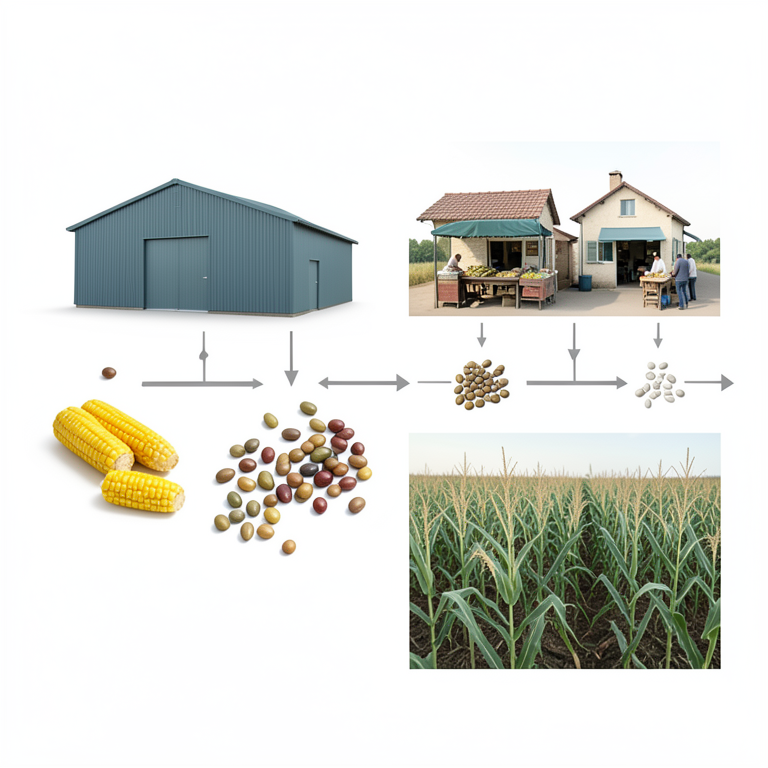
Seed Identity Decay Flow
AI-generated conceptual illustration (maize seeds (Zea mays l.)). It explains the idea and does not show study data.
View source evidence ↗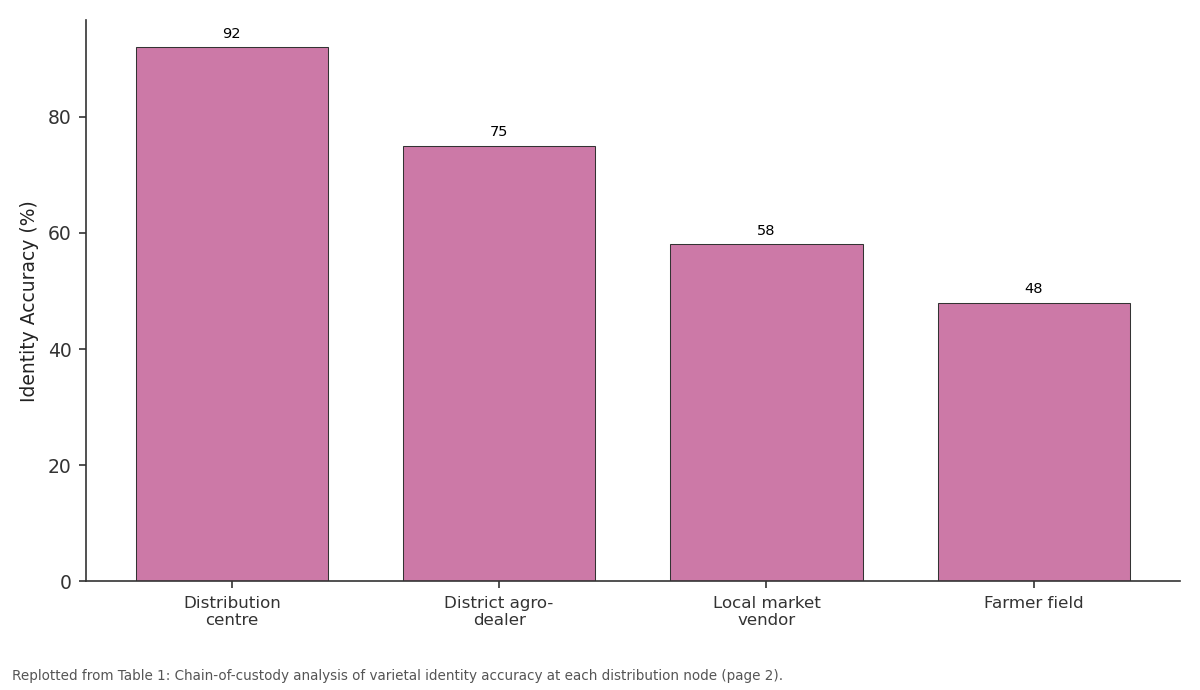
Identity Accuracy (%): Distribution centre vs District agro-dealer vs Local market vendor vs Farmer field
Replotted from Table 1 (page 2) of the original paper. Every bar is the paper's own table value.
View source evidence ↗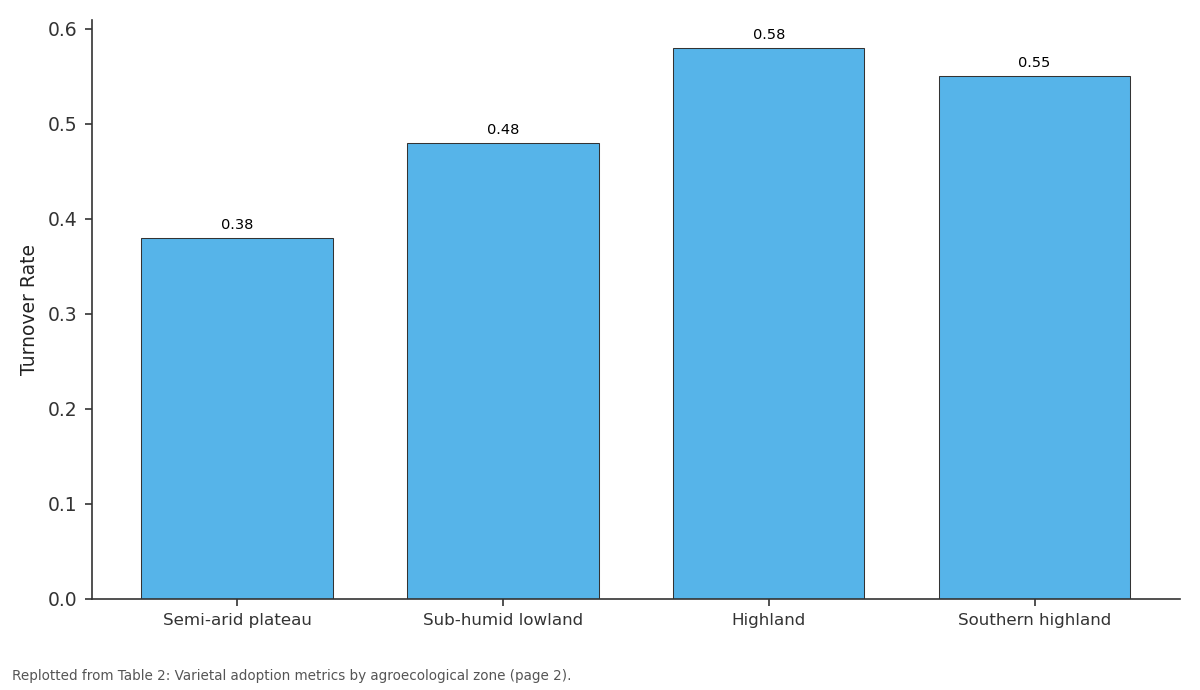
Turnover Rate: Semi-arid plateau vs Sub-humid lowland vs Highland vs Southern highland
Replotted from Table 2 (page 2) of the original paper. Every bar is the paper's own table value.
View source evidence ↗Figures & tables
From the original paper Table 1
 Table 2
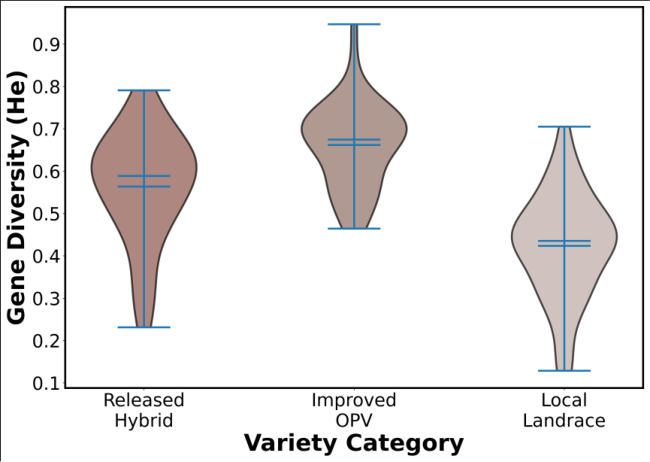 Figure 1
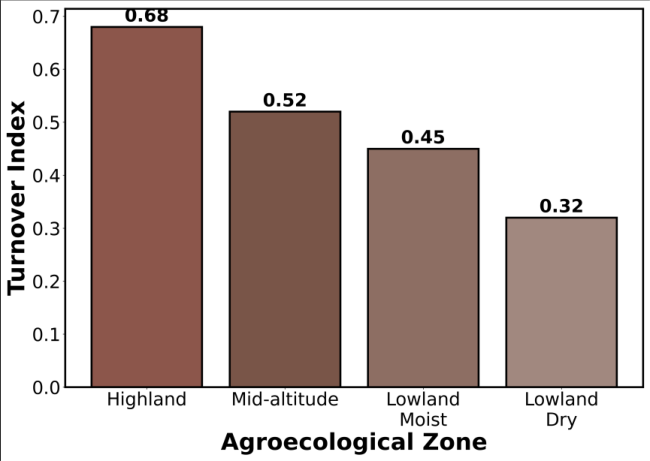 Figure 2
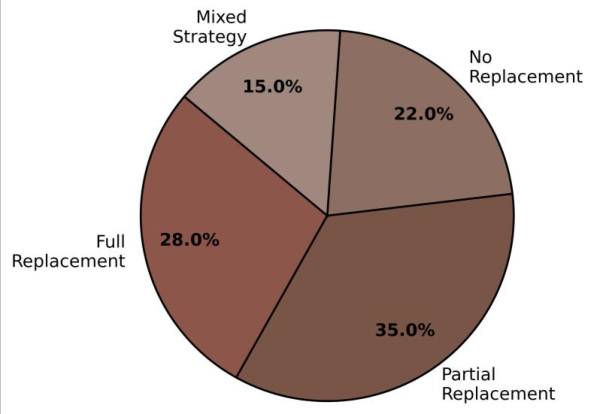 Figure 3
Introduction
While conventional adoption monitoring treats the journey of improved varieties from breeder to farmer as a binary outcome, either adopted or not, the reality within Sub-Saharan African seed distribution networks is far more complex, involving multiple intermediaries, informal exchanges, and identity-obscuring practices that make the straightforward question of whether a farmer grows an improved variety surprisingly difficult to answer [1,2] . This complexity has motivated the development of DNA-based varietal tracking approaches that can follow seed identity through the distribution chain and quantify where and how varietal information is lost. Tanzania ranks among the five largest maize producers in Sub-Saharan Africa, with approximately 4.5 million hectares planted annually and production of roughly 6.7 million tonnes [3] . The Tanzanian seed system combines a formal sector, distributing certified seed through licensed agro-dealers, with extensive informal channels through which an estimated 70 to 80% of maize seed reaches farmers [4] . This dual structure creates particular challenges for varietal tracking, as seed passing through informal channels frequently loses its original identity through relabelling, mixing, and farmer renaming practices. DNA fingerprinting with microsatellite markers provides the technical capability to track varietal identity independently of labels and farmer-reported names [5,6] . Previous applications in Ethiopia and Kenya have demonstrated that molecular identification reveals substantially different adoption patterns than conventional surveys, consistently finding higher improved variety adoption while simultaneously uncovering seed quality problems invisible to conventional monitoring [7,8] .
The innovation of the present research lies in its chain-ofcustody design, which tracks varietal identity not just at the farmer level but at multiple nodes along the seed distribution network, enabling identification of the specific points where identity loss occurs. This approach provides more actionable information for seed system strengthening than endpoint-only assessment. This research applied DNA-based varietal tracking to monitor the identity and quality of maize seed at multiple points within the distribution network across four regions of Tanzania, with the objectives of quantifying identity loss along the distribution chain, characterizing varietal adoption patterns at the farmer level, and identifying intervention points for improving seed system performance.
Materials and Methods
Materials and Methods
Materials
The research was conducted across four regions in Tanzania: Dodoma (6.17 degrees S, 35.74 degrees E), Morogoro (6.82 degrees S, 37.66 degrees E), Iringa ( Methods: DNA extraction was performed from seedling leaf tissue following germination of six kernels per sample at 27 degrees Celsius for seven days. For farmer-level samples, individual seedling genotyping was conducted to assess within-sample heterogeneity. For distribution chain samples, bulk extraction from pooled tissue of six seedlings was used for varietal identity determination. DNA was extracted using the NucleoSpin Plant II Kit and quantified on a Qubit 3.0 fluorometer. Fifteen SSR markers were used for genotyping: phi031, umc1304, bnlg1556, phi015, umc1061, phi033, bnlg1720, phi053, umc1066, phi029, bnlg1083, umc1152, phi065, bnlg1451, and umc1013. PCR amplification used 20 microlitre reactions with GoTaq Flexi DNA Polymerase system. Thermal cycling comprised 94 degrees Celsius for 4 min, 35 cycles of 94 degrees Celsius for 30 s, 55-62 degrees Celsius for 45 s, and 72 degrees Celsius for 1 min, with final extension at 72 degrees Celsius for 10 min. Fragment analysis used an ABI 3500 Genetic Analyzer with GeneScan 500 LIZ size standard. Allele scoring was performed in GeneMapper v5.0. Varietal identity was assigned by profile matching against the TARI reference database with a 93% identity-by-state threshold. Chain-ofcustody analysis compared identity accuracy at each distribution node. Gene diversity, heterozygosity, and PIC were calculated in GenAlEx v6.5. Varietal turnover was modelled using logistic regression with region, farm size, seed source, and agroecological zone as predictors. All analyses used R v4.3.2.
Results
Table Highland zones exhibited the highest improved variety adoption and lowest misidentification rates, reflecting their integration into commercial maize production with stronger linkages to formal seed sources. The semi-arid plateau zone showed the lowest adoption and highest misidentification, consistent with its greater reliance on informal seed channels.
Across the 280 samples, the fifteen SSR markers amplified a total of 128 alleles with a mean of 8.5 alleles per locus. Mean observed heterozygosity was 0.48 and mean expected heterozygosity was 0.66. The overall PIC mean was 0.68. Sixteen distinct multilocus genotypes were identified, of which eleven matched released TARI variety profiles, two matched improved OPV profiles, and three were uncharacterized genotypes. The uncharacterized genotypes were concentrated in the Mbeya region, near the border with Zambia and Malawi, suggesting possible cross-border seed introduction. The bar chart demonstrates significant variation in turnover rates across agroecological zones (F = 8.52, p = 0.002). Highland zones exhibited the highest turnover at 0.68, driven by commercial production incentives and better seed market access. The lowland dry zone showed the lowest turnover at 0.32, where risk aversion and limited seed availability constrain adoption of improved varieties. The pie chart reveals that only 28% of farming households practiced full varietal replacement (complete switch from landrace to improved variety) over the five-year reference period. Partial replacement, where improved varieties were grown alongside retained landraces, was the most common category at 35%. No replacement occurred in 22% of households, and mixed strategies involving both improved variety adoption and landrace maintenance characterized 15% of households.
The chain-of-custody analysis represents the most informative component of the results, demonstrating that identity loss is not concentrated at a single point but distributed across the network. The largest single increment of loss occurred between distribution centres and district agro-dealers, where 17 percentage points of identity accuracy were lost. This transition point represents the interface between formal and informal sectors and is characterized by repackaging, relabelling, and mixing practices that obscure original varietal identity. Addressing this specific bottleneck could substantially improve the overall identity integrity of the distribution network.
Discussion
The chain-of-custody finding that varietal identity accuracy declines from 92% at distribution centres to 48% at farmer fields represents, to our knowledge, the first quantitative mapping of identity loss across a complete seed distribution network in Sub-Saharan Africa [1,2] . This finding reveals that the problem of varietal misidentification is not solely a farmer-level phenomenon but a systemic issue rooted in distribution practices. The comparison with endpoint-only assessments suggests that studies measuring only farmerlevel identity accuracy may correctly identify the magnitude of the problem but miss the distribution of causes across the network [3,7] . The concentration of identity loss at the distribution centre to agro-dealer transition has specific policy implications [4,5] . This node represents the point where bulk seed lots from certified sources are broken down into smaller quantities for retail distribution, a process that creates opportunities for mixing, substitution, and label loss. The mechanism is straightforward: agro-dealers may combine partial bags from different varieties, transfer seed to unlabelled containers for display, or inadvertently mix varieties during storage in facilities lacking adequate segregation [8] .
The overall turnover rate of 0.50 positions Tanzania in the middle range of adoption estimates for East African maize systems [6,7] . The finding that highland zones exhibit substantially higher turnover than lowland zones reflects the differential integration of these areas into commercial production systems. Highland maize production in Tanzania is increasingly oriented toward markets, creating stronger incentives for farmers to invest in improved varieties that deliver higher yields and more uniform grain quality [3,4] . The detection of uncharacterized genotypes near the borders with Zambia and Malawi highlights the role of cross-border seed movement in shaping the varietal composition of farming landscapes [1,5] . The informal trade in maize seed across national boundaries is well-documented in Southern and Eastern Africa and represents both a pathway for farmer access to diverse germplasm and a challenge for national seed regulatory systems. The development of harmonized regional reference databases would improve the capacity of DNA-based tracking to capture these cross-border dynamics.
The finding that only 28% of farming households practiced full varietal replacement challenges the binary adoption framework commonly used in impact assessment [2,8] . The prevalence of partial replacement and mixed strategies indicates that farmers manage varietal portfolios rather than making wholesale switches, maintaining landraces alongside improved varieties for risk management, dietary preference, and ceremonial purposes. This portfolio management approach has implications for both adoption measurement and genetic conservation.
Quality Assurance Intervention Design
The chain-of-custody results provide a prioritized roadmap for seed quality assurance interventions
Integration with Digital Traceability
The chain-of-custody framework developed in this research is compatible with emerging digital seed traceability systems that use QR codes, blockchain, or SMS-based verification to track seed lots through distribution networks.
Integrating molecular identity verification at key nodes with digital traceability would create a comprehensive quality assurance system capable of both preventing identity loss through real-time tracking and detecting it through periodic molecular audits.
Conclusion
This research aimed to apply DNA-based varietal tracking across multiple nodes of the Tanzanian maize seed distribution network, establishing a chain-of-custody framework for monitoring identity loss from source to field. The molecular analysis of 280 samples at four distribution nodes revealed a progressive decline in varietal identity accuracy from 92% to 48%, with the sharpest loss occurring at the formal-informal sector interface.
The key findings demonstrate that varietal misidentification is a systemic distribution network problem rather than exclusively a farmer-level phenomenon. The identification of the distribution centre to agro-dealer transition as the highest-impact intervention point provides actionable guidance for seed quality improvement programmes. The overall turnover rate of 0.50, with significant variation across agroecological zones, confirms the uneven pace of improved variety adoption across the Tanzanian maize landscape.
From a practical standpoint, the chain-of-custody approach offers a replicable framework for seed system diagnostics that could be applied across other countries and crops in Sub-Saharan Africa. Future investigations should extend the tracking framework to include post-harvest seed handling practices, assess the yield consequences of identity loss through linked performance trials, and develop costeffective molecular monitoring protocols suitable for routine integration into national seed certification systems.
Acknowledgement
AcknowledgementsBSM and ARK contributed to field sampling and laboratory analysis; EJM designed the research and prepared the manuscript. The Tanzania Agricultural Research Institute provided reference DNA profiles and institutional coordination. This research was funded by the Bill and Melinda Gates Foundation through the Alliance of Bioversity International and CIAT.
Figures and tables from the paper
| Distribution Node | n | Identity Accuracy (%) | Identity Lost (%) | Cumulative Loss (%) |
|---|---|---|---|---|
| Distribution centre | 40 | 92 | 8 | 8 |
| District agro-dealer | 60 | 75 | 17 | 25 |
| Local market vendor | 60 | 58 | 17 | 42 |
| Farmer field | 120 | 48 | 10 | 52 |
Table text extracted from the original PDF; superscript letters are shown inline. The original table image is below.
View original table image
| Zone | Improved (%) | Landrace (%) | Turnover Rate | Misidentification (%) |
|---|---|---|---|---|
| Semi-arid plateau | 42 | 38 | 0.38 | 48 |
| Sub-humid lowland | 52 | 30 | 0.48 | 42 |
| Highland | 65 | 20 | 0.58 | 32 |
| Southern highland | 62 | 22 | 0.55 | 35 |
| Overall | 55 | 28 | 0.50 | 39 |
Table text extracted from the original PDF; superscript letters are shown inline. The original table image is below.
View original table image
References
14 in the original paper- Spielman DJ, Smale M. Policy options to accelerate variety change among smallholder farmers in South Asia and Africa south of the Sahara. IFPRI Discussion Paper No. 1666. 2017:1-36.
- Maredia MK, Reyes BA, Manu-Aduening J, Dankyi A, Hamazakaza P. Testing alternative methods of estimating varietal adoption. SPIA Technical Report. 2016:1-45.
- Katinila N, Verkuijl H, Mwangi W, Anandajayasekeram P, Moshi AJ. Adoption of maize production technologies in southern Tanzania. CIMMYT; 1998. p. 1-38.
- Bucheyeki TL, Shenkalwa EM, Mapunda TX, Matata LW. On-farm evaluation of drought-tolerant maize varieties in semi-arid areas of central Tanzania. Int J Agron Agric Res. 2010;1(1):10-18.
- Bukero G. Varietal turnover analysis for Ethiopian maize (Zea mays L.) using DNA fingerprinting. South Asian J Agric Sci. 2024;4(1):12-21.
- Kilian A, Wenzl P, Huttner E. Diversity Arrays Technology: a generic genome profiling technology on open platforms. Methods Mol Biol. 2012;888:67-89.
- Jaleta M, Tesfaye K, Kilian A, Teknomo K. Varietal replacement and adoption dynamics of improved maize in Eastern Africa. Food Policy. 2020;91:101785.
- Wossen T, Abdoulaye T, Alene A. Impacts of extension access and cooperative membership on technology adoption and household welfare. J Rural Stud. 2017;54:223-233.
- Abate T, Fisher M, Abdoulaye T, Kassie GT, Lunduka R, Teklewold H. Characteristics of maize cultivars in Africa. Agric Food Secur. 2017;6(1):30.
- Shiferaw B, Prasanna BM, Hellin J, Bänziger M. Crops that feed the world: past successes and future challenges to the role played by maize in global food security. Food Secur. 2011;3(3):307-327.
- Smale M, Byerlee D, Jayne T. Maize revolutions in sub-Saharan Africa. World Dev. 2013;41(2):71-89.
- Langyintuo AS, Mwangi W, Diallo AO. Challenges of the maize seed industry in eastern and southern Africa. Food Policy. 2010;35(4):323-331.
- Fisher M, Abate T, Lunduka RW. Drought-tolerant maize for farmer adaptation to drought in sub-Saharan Africa. Sustain Sci. 2015;10(4):675-688.
- Khonje MG, Manda J, Alene AD, Kassie M. Analysis of adoption and impacts of improved maize varieties in eastern Zambia. World Dev. 2015;66:695-706.