
Research article · 2026 · Full text
International Journal of Agriculture and NutritionConsumer awareness and purchase preferences for chemical fertilizers and biofertilizers among smallholder farmers in Southwestern Nigeria
Volume 8(5) · Pages 142–146 · DOI: 10.33545/26646064.2026.v8.i5b.718 ↗
Research areasAgricultural Innovations and PracticesAgricultural Science and FertilizationAgricultural Development and Management
Abstract
Author-writtenThe transition from chemical fertilizers to biofertilizers represents a critical paradigm shift in sustainable agricultural development across sub-Saharan Africa. This research investigated consumer awareness levels and purchase preferences regarding chemical fertilizers and biofertilizers among 420 smallholder farmers in southwestern Nigeria. A cross-sectional survey methodology was employed utilizing structured questionnaires administered across six agricultural zones within Lagos and Ogun states between March and September 2023. The research revealed that 78.4% of respondents demonstrated high awareness of chemical fertilizer products compared to only 34.7% awareness for biofertilizer alternatives. Purchase preference analysis indicated that 41.8% of farmers exclusively purchased chemical fertilizers, while merely 12.3% opted solely for biofertilizer products. Combined usage was reported by 24.6% of participants, suggesting a gradual market transition. Statistical analysis using chi-square tests revealed significant associations between awareness levels and educational attainment (p < 0.01), farm size (p < 0.05), and extension service contact frequency (p < 0.001). The research further demonstrated that cost considerations (88.7%), product availability (82.1%), and perceived effectiveness (71.3%) were the primary determinants influencing fertilizer purchase decisions. Biofertilizer awareness was significantly higher among farmers with tertiary education (61.4%) compared to those with primary education alone (18.2%). These findings underscore the necessity for targeted educational interventions and improved distribution networks to enhance biofertilizer market penetration in southwestern Nigeria. The research recommends integrated policy frameworks combining subsidized pricing mechanisms with extensive farmer training programmes to accelerate biofertilizer adoption.
Summary
Source-checkedPlain-language reading of the full paper, prepared with AI and checked against the text. Each point links to the authors' own words.
Why it matters
- Moving from chemical to biofertilizers is considered a critical shift for sustainable agricultural development in sub-Saharan Africa. View evidence ↗
- Interest in biofertilizers has grown due to the environmental damage caused by intensive chemical fertilizer use, such as biodiversity loss, groundwater contamination, and soil degradation. View evidence ↗
- Despite their benefits, biofertilizers have limited market penetration in Nigeria, with adoption rates estimated to be under 15% among smallholder farmers. View evidence ↗
The question
- The study aimed to investigate awareness levels and purchase preferences for chemical and biofertilizers among smallholder farmers in southwestern Nigeria, while identifying factors that influence these behaviors. View evidence ↗
What they did
- The study took place between March and September 2023 across six agricultural zones in Ogun and Lagos states, Nigeria. View evidence ↗
- Data were gathered from 420 smallholder farmers using structured questionnaires and 24 interviews with cooperative leaders, fertilizer retailers, and extension agents. View evidence ↗
- The researchers used binary logistic regression to find predictors of biofertilizer preference and chi-square tests to examine associations between categorical variables. View evidence ↗
What they found
- Awareness of chemical fertilizers was significantly higher (78.4%) than awareness of biofertilizer alternatives (34.7%). View evidence ↗
- Regarding purchase preferences, 41.8% of farmers bought only chemical fertilizers, whereas only 12.3% bought only biofertilizers. View evidence ↗
- About 24.6% of participants used both types of fertilizers, which the authors suggest indicates a gradual transition in the market. View evidence ↗
- The main factors influencing purchase decisions were cost (88.7%), availability (82.1%), and perceived effectiveness (71.3%). View evidence ↗
- Farmers with tertiary education had significantly higher biofertilizer awareness (61.4%) than those with only primary education (18.2%). View evidence ↗
- Significant predictors for preferring biofertilizers included educational level (OR=2.34), contact with extension services (OR=1.89), and farm income level (OR=1.56). View evidence ↗
What it means
- The authors recommend using integrated policy frameworks that combine farmer training programs with subsidized pricing to speed up the adoption of biofertilizers. View evidence ↗
- The study's cross-sectional design only captures data at one point in time, which limits the ability to make causal inferences. View evidence ↗
- Because the study was restricted to southwestern Nigeria, the results may not be generalizable to other agro-ecological zones with different institutional or market structures. View evidence ↗
Visual summary
2 visualsIllustrations explain the paper; charts are replotted from the paper's own table values.
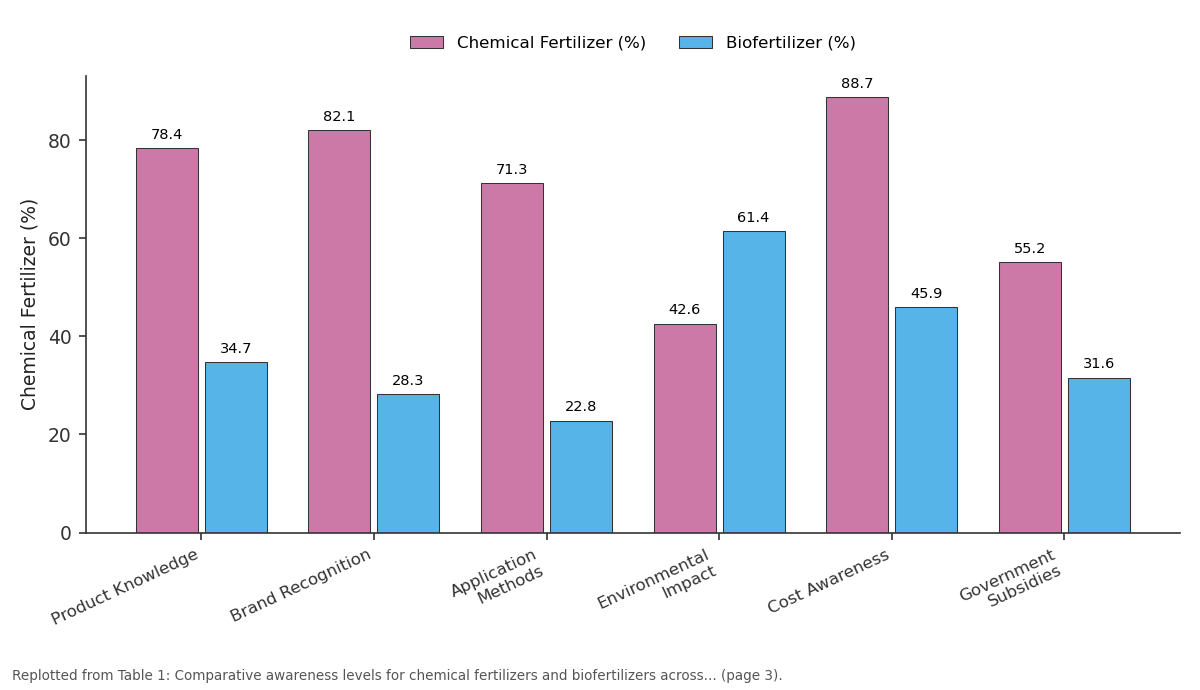
Chemical Fertilizer (%) and Biofertilizer (%): Product Knowledge vs Brand Recognition vs Application Methods vs Environmental Impact vs Cost Awareness
Replotted from Table 1 (page 3) of the original paper. Every bar is the paper's own table value.
View source evidence ↗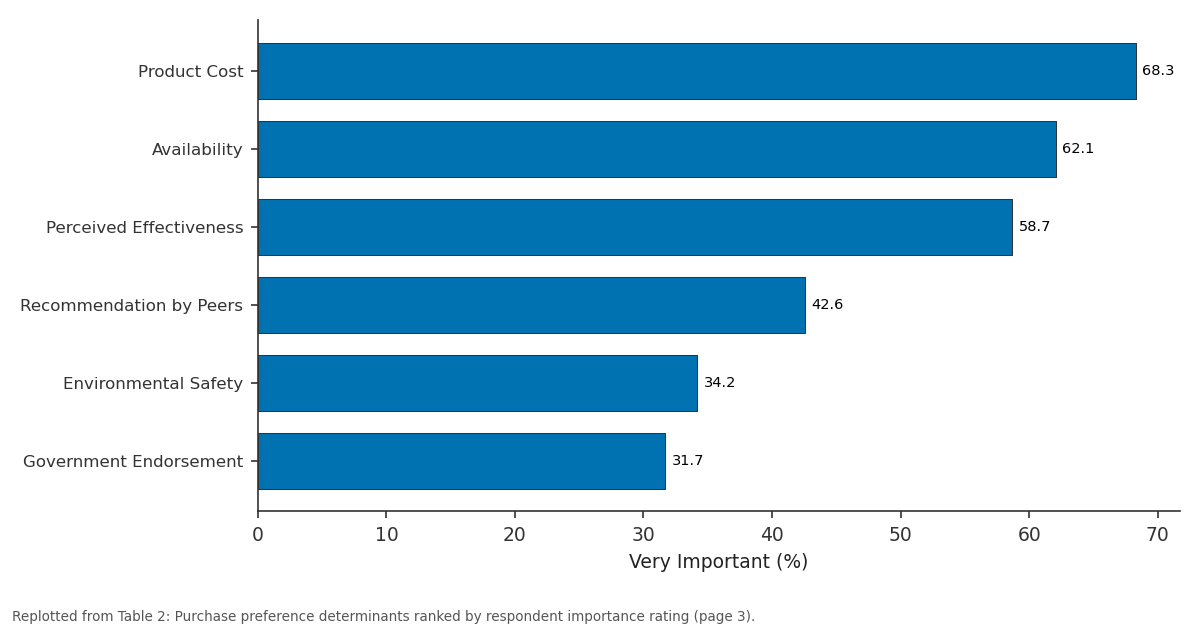
Very Important (%): Product Cost vs Availability vs Perceived Effectiveness vs Recommendation by Peers vs Environmental Safety
Replotted from Table 2 (page 3) of the original paper. Every bar is the paper's own table value.
View source evidence ↗Figures & tables
From the original paper Table 1
 Table 2
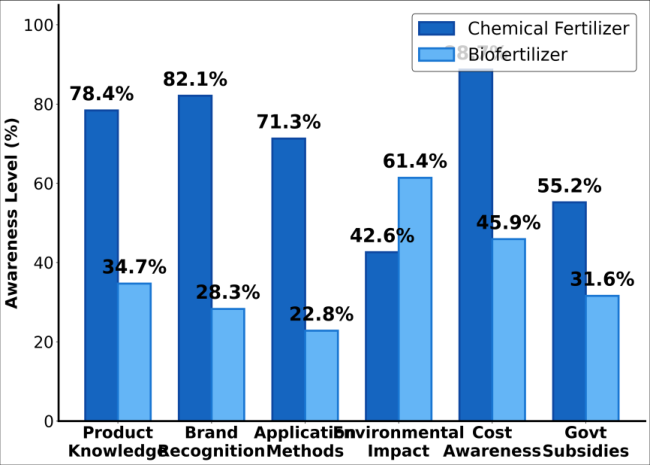 Figure 1
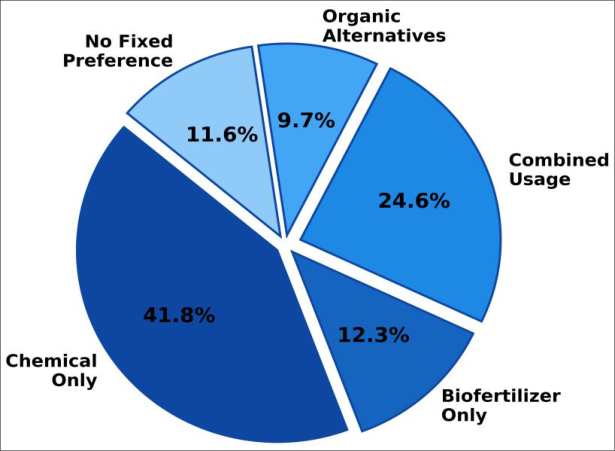 Figure 2
Introduction
What factors determine the purchasing decisions of smallholder farmers when confronted with the choice between conventional chemical fertilizers and emerging biofertilizer technologies? This fundamental question lies at the core of agricultural input market dynamics across developing economies, where the dual imperatives of productivity enhancement and environmental sustainability increasingly shape farmer behavior and policy formulation [1] . The fertilizer industry in sub-Saharan Africa has undergone substantial transformation over the past two decades, characterized by growing recognition of the environmental consequences associated with prolonged chemical fertilizer dependency and the concurrent emergence of biofertilizer alternatives as viable agricultural input options [2] . Nigeria, as the largest agricultural economy in West Africa, presents a particularly instructive case for examining consumer awareness and purchase preference patterns within the fertilizer market. The country's agricultural sector employs approximately 36% of the national workforce and contributes significantly to gross domestic product, with smallholder farmers constituting the predominant production unit [3] . Chemical fertilizers have historically dominated the Nigerian agricultural input market, with annual consumption exceeding 1.2 million metric tonnes, driven primarily by government subsidy programmes and established distribution networks [4] .
However, the environmental ramifications of intensive chemical fertilizer application, including soil degradation, groundwater contamination, and biodiversity loss, have prompted increasing interest in biofertilizer alternatives among agricultural stakeholders [5] . Biofertilizers, defined as preparations containing living microorganisms that colonize the rhizosphere and promote plant growth through enhanced nutrient availability, represent a sustainable alternative to synthetic chemical inputs [6] . These biological preparations encompass nitrogenfixing bacteria such as Rhizobium and Azotobacter, phosphate-solubilizing microorganisms including Bacillus megaterium, and mycorrhizal fungi that enhance nutrient absorption efficiency [7] . Despite their documented agronomic and environmental benefits, biofertilizer market penetration in Nigeria remains considerably limited, with estimated adoption rates below 15% among smallholder farming communities [8] . The disparity between chemical fertilizer dominance and biofertilizer underutilization in Nigerian agriculture reflects complex interactions among consumer awareness, product accessibility, pricing structures, and institutional support mechanisms [9] . Previous investigations have examined individual dimensions of this market dynamic, including farmer perception surveys [10] and economic feasibility assessments [11] , yet comprehensive analyses integrating awareness levels with actual purchase behavior remain scarce. Understanding the determinants of consumer choice between these fertilizer categories is essential for developing effective market strategies and policy interventions that can facilitate the transition toward sustainable agricultural input systems [12] . This research therefore aimed to investigate the current levels of consumer awareness regarding chemical fertilizers and biofertilizers among smallholder farmers in southwestern Nigeria, assess the purchase preference patterns characterizing fertilizer selection decisions, and identify the key socioeconomic and institutional factors influencing consumer behavior within the agricultural input market. The investigation contributes to the growing body of knowledge on fertilizer market dynamics in sub-Saharan Africa while providing actionable insights for policymakers, agricultural extension services, and fertilizer industry stakeholders.
Materials and Methods
Materials and Methods
Materials
The research was conducted across six agricultural zones within Lagos and Ogun states in southwestern Nigeria between March and September 2023. The investigation area was selected based on its diverse agricultural landscape, encompassing both peri-urban and rural farming communities with varying degrees of market access and extension service coverage. Lagos state, with its metropolitan agricultural periphery, and Ogun state, characterized by predominantly rural farming communities, provided contrasting market environments for comparative analysis. The research received ethical approval from the Lagos Institute of Agricultural Sciences Institutional Review Board (Protocol No. LIAS/IRB/2023-047) prior to data collection. Primary data were collected from 420 smallholder farmers through structured questionnaire administration, complemented by 24 key informant interviews with agricultural extension agents, fertilizer retailers, and cooperative leaders. The questionnaire instrument comprised five sections: demographic characteristics, awareness assessment using a modified Likert scale, purchase behavior documentation, preference determinant ranking, and institutional influence evaluation. Secondary data were obtained from the Nigerian Federal Ministry of Agriculture, state agricultural development programmes, and published fertilizer market reports.
Methods
A multi-stage stratified sampling procedure was employed to ensure representative coverage across the investigation area. The first stage involved purposive selection of three local government areas within each state based on agricultural productivity indicators. The second stage utilized systematic random sampling to identify farming households within selected communities, with a sampling interval of every fifth household along designated transect routes. Sample size determination followed the Cochran formula for cross-sectional surveys with a 95% confidence interval and 5% margin of error. Awareness levels were quantified using a composite awareness index constructed from six knowledge domains: product knowledge, brand recognition, application methods, environmental impact awareness, cost awareness, and government subsidy knowledge. Each domain was scored on a five-point Likert scale (1 = completely unaware to 5 = highly aware), and composite scores were categorized as low (6-14), moderate (15-22), or high (23-30). Purchase preference data were analysed using frequency distributions and cross-tabulation with demographic variables. Statistical analysis was performed using SPSS version 27.0. Chi-square tests of independence were employed to examine associations between categorical variables, while binary logistic regression models were fitted to identify significant predictors of biofertilizer purchase preference. Multiple correspondence analysis was applied to visualize relationships among awareness dimensions, demographic characteristics, and purchase patterns. Statistical significance was established at p < 0.05 for all inferential analyses.
Results
The demographic profiling of 420 respondents revealed that 62.4% were male and 37.6% were female, with a mean age of 43.7 years (SD = 11.2). The majority of respondents (54.8%) possessed secondary education, followed by primary education (24.3%) and tertiary education (20.9%). Average farm size was 2.8 hectares, with 71.2% of respondents cultivating holdings smaller than 3 hectares. Agricultural experience ranged from 3 to 42 years, with a mean of 18.6 years. Approximately 68.3% of respondents reported annual farm income below 500,000 Nigerian Naira, indicating the predominantly subsistence-oriented nature of farming operations in the investigation area. Awareness assessment across six knowledge domains revealed substantial disparities between chemical fertilizer and biofertilizer recognition among the sampled population. Chemical fertilizer awareness was consistently higher across all measured domains, with product knowledge (78.4%), brand recognition (82.1%), and cost awareness (88.7%) representing the highest awareness categories. Conversely, biofertilizer awareness was notably lower, with product knowledge at 34.7%, brand recognition at 28.3%, and application method awareness at merely 22.8%. Interestingly, environmental impact awareness for biofertilizers (61.4%) exceeded that of chemical fertilizers (42.6%), suggesting that farmers who were aware of biofertilizers tended to associate them with environmental benefits. Chi-square analysis confirmed that awareness levels for both fertilizer types were significantly associated with respondent educational attainment (χ² = 42.87, df = 4, p < 0.001), contact with agricultural extension services (χ² = 38.14, df = 2, p < 0.001), and proximity to commercial agricultural centers (χ² = 28.93, df = 3, p < 0.001). Farmers with tertiary education demonstrated biofertilizer awareness levels approximately three times higher than those with primary education only. The purchase preference distribution presented in Figure 2 reveals that chemical fertilizer exclusivity (41.8%) remains the dominant purchasing pattern, followed by combined usage (24.6%). Binary logistic regression analysis identified educational level (OR = 2.34, 95% CI: 1.67-3.28, p < 0.001), extension service contact (OR = 1.89, 95% CI: 1.42-2.51, p < 0.01), and farm income level (OR = 1.56, 95% CI: 1.18-2.06, p < 0.05) as significant predictors of biofertilizer purchase preference. The model demonstrated acceptable goodness of fit (Hosmer-Lemeshow χ² = 6.84, p = 0.554) with a classification accuracy of 74.8%.
Discussion
The pronounced disparity in awareness levels between chemical fertilizers and biofertilizers among smallholder farmers in southwestern Nigeria reflects the historical dominance of chemical fertilizer marketing and distribution infrastructure [5] . The finding that 78.4% of respondents demonstrated high chemical fertilizer product knowledge compared to only 34.7% for biofertilizers aligns with previous investigations conducted in comparable agricultural contexts across West Africa [13] . Ekwuruke and Nnadi reported similarly low biofertilizer awareness levels (31.2%) among farming communities in southeastern Nigeria, attributing the knowledge deficit primarily to inadequate extension service coverage and limited commercial availability of biofertilizer products [14] . The relatively higher environmental impact awareness for biofertilizers (61.4%) compared to chemical fertilizers (42.6%) represents a noteworthy finding with significant market implications. This pattern suggests that farmers who possess biofertilizer awareness tend to associate these products with environmental benefits rather than agronomic performance, a perception that may simultaneously facilitate and constrain market adoption [15] . Comparable observations were documented by Malusá and Vassilev, who noted that environmental consciousness among European farmers was a stronger predictor of biofertilizer interest than yield enhancement expectations [16] . However, the Nigerian context differs substantially from European agricultural systems in terms of market infrastructure, subsidy frameworks, and information dissemination channels, necessitating context-specific intervention strategies [5] .
The dominance of product cost (mean importance score = 4.54) as the primary purchase determinant corroborates the price-sensitive nature of agricultural input decisions among resource-constrained farmers [17] . This finding is consistent with the economic rationality framework proposed by agricultural economists who argue that smallholder farmers prioritize immediate cost considerations over long-term sustainability benefits [18] . Biofertilizer market expansion strategies must therefore address cost barriers through subsidy mechanisms, bulk purchasing cooperatives, or integrated soil management approaches [19] . Extension service contact frequency emerged as the second strongest predictor of biofertilizer purchase preference (OR = 1.89, p < 0.01), highlighting the continued importance of agricultural extension systems in shaping farmer decisionmaking [5] . The finding that 68.3% of farmers with regular extension contact demonstrated moderate to high biofertilizer awareness compared to only 23.7% among those without extension access demonstrates the critical mediating role of extension services [14] . These results support the recommendation for expanded biofertilizer demonstration programmes integrated within existing extension frameworks.
Limitations and Future Research Directions
The cross-sectional design captures awareness patterns at a single temporal point, limiting causal inference. Future longitudinal investigations tracking awareness evolution over multiple seasons would provide more robust evidence. The geographical restriction to southwestern Nigeria constrains generalizability to other agro-ecological zones with different market structures and institutional landscapes.
Policy Implications
Policy Implications
Acknowledgement
AcknowledgementsThis research was supported by funding from the Lagos State Agricultural Research Trust Fund. The authors gratefully acknowledge the institutional support provided by the Lagos Institute of Agricultural Sciences and the cooperation of the Lagos and Ogun State Agricultural Development Programmes. The authors also acknowledge the contributions of field enumerators and community liaison officers who facilitated data collection across the investigation zones.
Figures and tables from the paper
| Knowledge Domain | Chemical Fertilizer (%) | Biofertilizer (%) | p-value |
|---|---|---|---|
| Product Knowledge | 78.4 | 34.7 | < 0.001 |
| Brand Recognition | 82.1 | 28.3 | < 0.001 |
| Application Methods | 71.3 | 22.8 | < 0.001 |
| Environmental Impact | 42.6 | 61.4 | < 0.01 |
| Cost Awareness | 88.7 | 45.9 | < 0.001 |
| Government Subsidies | 55.2 | 31.6 | < 0.001 |
| Overall Mean | 69.7 | 37.5 | < 0.001 |
Table text extracted from the original PDF; superscript letters are shown inline. The original table image is below.
View original table image
| Determinant | Very Important (%) | Important (%) | Neutral (%) | Less Important (%) | Mean Score |
|---|---|---|---|---|---|
| Product Cost | 68.3 | 21.4 | 6.2 | 4.1 | 4.54 |
| Availability | 62.1 | 24.7 | 8.3 | 4.9 | 4.44 |
| Perceived Effectiveness | 58.7 | 26.3 | 9.8 | 5.2 | 4.39 |
| Recommendation by Peers | 42.6 | 31.8 | 16.4 | 9.2 | 4.08 |
| Environmental Safety | 34.2 | 28.4 | 22.1 | 15.3 | 3.82 |
| Government Endorsement | 31.7 | 25.6 | 24.8 | 17.9 | 3.71 |
Table text extracted from the original PDF; superscript letters are shown inline. The original table image is below.
View original table image
References
19 in the original paper- Chandra S, Askari K, Kumari P. Optimization of biofertilizers and their applications in agriculture. Int J Curr Microbiol Appl Sci. 2018;7(5):1530-1539.
- Mahanty T, Bhattacharjee S, Goswami M, Bhattacharyya P, Das B, Ghosh A, et al. Biofertilizers: a potential approach for sustainable agriculture development. Environ Sci Pollut Res. 2017;24(4):33153335.
- Mgbenka RN, Mbah EN, Ezeano CI. A review of smallholder farming in Nigeria: need for transformation. Int J Agric Ext Rural Dev Stud. 2016;3(2):43-54.
- Liverpool-Tasie LSO, Omonona BT, Sanou A, Ogunleye WO. Is increasing inorganic fertilizer use for maize production in sub-Saharan Africa a profitable proposition? Evidence from Nigeria. Food Policy. 2017;67:41-51.
- Dutta S, Hazra A, Paul I, Mitra N. Exploring the current consumer market status of chemical fertilizer versus biofertilizer industries in West Bengal, India: an on-site investigation. South Asian J Agric Sci. 2024;4(1):147153. doi:10.22271/27889289.2024.v4.i1b.124.
- Vessey JK. Plant growth-promoting rhizobacteria as biofertilizers. Plant Soil. 2003;255(2):571-586.
- Bhardwaj D, Ansari MW, Sahoo RK, Tuteja N. Biofertilizers function as key players in sustainable agriculture by improving soil fertility, plant tolerance and crop productivity. Microb Cell Fact. 2014;13:66.
- Alori ET, Babalola OO. Microbial inoculants for improving crop quality and human health in Africa. Front Microbiol. 2018;9:2213.
- Odoh CK, Sam K, Zabbey N, Eze CN, Nwankwegu AS, Okeke ES, et al. Microbial consortium as biofertilizers for sustainable agriculture. J Biotechnol. 2020;314-315:1-12.
- Herrmann L, Lesueur D. Challenges of formulation and quality of biofertilizers for successful inoculation. Appl Microbiol Biotechnol. 2013;97(20):8859-8873.
- Raimi A, Adeleke R, Roopnarain A. Soil fertility challenges and biofertiliser as a viable alternative for increasing smallholder farmer crop productivity in subSaharan Africa. Cogent Food Agric. 2017;3(1):1400933.
- Mishra J, Arora NK. Secondary metabolites of fluorescent pseudomonads in the biocontrol of phytopathogens for sustainable agriculture. Appl Soil Ecol. 2018;125:35-45.
- Santos VB, Araújo ASF, Leite LFC, Nunes LAPL, Melo WJ. Soil microbial biomass and organic matter fractions during transition from conventional to organic farming systems. Geoderma. 2012;170:227-231.
- Ekwuruke HI, Nnadi FN. Assessment of farmers' awareness and adoption of biofertilizer technology in Imo State, Nigeria. J Agric Vet Sci. 2019;12(4):28-36.
- Meena VS, Maurya BR, Verma JP, Meena RS, editors. Potassium solubilizing microorganisms for sustainable agriculture. New Delhi: Springer India; 2016. 331 p.
- Malusá E, Vassilev N. A contribution to setting a legal framework for biofertilisers. Appl Microbiol Biotechnol. 2014;98(15):6599-6607.
- Jayne TS, Rashid S. Input subsidy programs in subSaharan Africa: a synthesis of recent evidence. Agric Econ. 2013;44(6):547-562.
- Sheahan M, Barrett CB. Ten striking facts about agricultural input use in sub-Saharan Africa. Food Policy. 2017;67:12-25.
- Vanlauwe B, Descheemaeker K, Giller KE, Huising J, Merckx R, Nziguheba G, et al. Integrated soil fertility management in sub-Saharan Africa: unravelling local adaptation. Soil. 2015;1:491-508.