
Research article · 2026 · Full text
International Journal of Geography Geology and EnvironmentImpact of irrigation management practices and water quality on productivity and water use efficiency: A review
Volume 8(7) · Pages 183–187 · DOI: 10.22271/27067483.2026.v8.i7b.828 ↗
Research areasIrrigation Practices and Water ManagementEngineering and Agricultural InnovationsRice Cultivation and Yield Improvement
Abstract
Author-writtenWater scarcity, declining groundwater resources, and the deterioration of irrigation water quality have emerged as major constraints to sustainable agricultural production, particularly in India where agriculture accounts for more than 80% of freshwater withdrawals. Although numerous studies have independently investigated irrigation management practices, water quality, and water use efficiency (WUE), a comprehensive synthesis integrating these interrelated aspects under contemporary agricultural conditions remains limited. This review addresses this research gap by critically evaluating recent advances (2020-2025) in irrigation management practices and irrigation water quality, with emphasis on their combined effects on crop productivity and WUE in Indian agriculture. The review compares conventional surface irrigation, raised-bed irrigation, and pressurized irrigation systems, while examining the influence of salinity, sodicity, and irrigation scheduling on soil health, nutrient dynamics, and crop performance. Evidence indicates that pressurized irrigation systems substantially improve WUE by approximately 30-70%, reduce non-productive water losses, enhance nutrient-use efficiency through fertigation, and mitigate salt accumulation in the crop root zone compared with conventional irrigation methods. In contrast, surface irrigation continues to exhibit lower application efficiency and greater vulnerability to water losses and soil degradation. The novelty of this review lies in its integrated assessment of irrigation technologies and water quality management within the context of climate variability and sustainable water resource utilization. The findings highlight that combining efficient irrigation technologies, scientific scheduling, and water quality management is essential for improving agricultural resilience and productivity. Future research should prioritize precision irrigation, sensor- and AI-based irrigation scheduling, long-term field validation under diverse agro-climatic conditions, and policy interventions that enhance the adoption of water-efficient technologies among smallholder farmers.
Summary
Source-checkedPlain-language reading of the full paper, prepared with AI and checked against the text. Each point links to the authors' own words.
Why it matters
- Sustainable agricultural production in India is severely constrained by water scarcity, falling groundwater levels, and poor irrigation water quality, especially since agriculture uses over 80% of the country's freshwater. View evidence ↗
- Climate change has worsened water stress in the region by increasing temperatures, causing irregular monsoons, and raising evapotranspiration rates. View evidence ↗
- Traditional surface irrigation is common in India but is inefficient because of significant water losses from runoff, evaporation, and deep percolation. View evidence ↗
The question
- The review aims to evaluate recent advances from 2020 to 2025 regarding irrigation management and water quality to understand their combined impact on water use efficiency (WUE) and crop productivity in India. View evidence ↗
What they did
- The authors compared conventional surface, raised-bed, and pressurized irrigation systems, while analyzing how sodicity, salinity, and scheduling affect crop performance and soil health. View evidence ↗
- The study provides an integrated assessment of water quality, management practices, and productivity based on literature published between 2020 and 2025. View evidence ↗
What they found
- Pressurized irrigation systems increase water use efficiency by 30% to 70% compared to conventional methods by reducing non-productive losses and mitigating salt buildup in the root zone. View evidence ↗
- Surface irrigation systems are the least efficient, with efficiency typically ranging from 35% to 50%. View evidence ↗
- Salinity in irrigation water increases osmotic pressure in the soil, which prevents plants from absorbing water and can lead to physiological drought. View evidence ↗
- High sodium levels (sodicity) damage soil structure by replacing calcium and magnesium, causing clay particles to disperse and reducing infiltration rates. View evidence ↗
- Pressurized irrigation leads to significantly higher crop yields than both surface and raised-bed methods due to minimized water stress and better nutrient availability. View evidence ↗
- Using model-based irrigation scheduling improves water productivity more effectively than relying on traditional farmer-based practices. View evidence ↗
What it means
- The authors conclude that the best results for soil health and productivity are achieved by combining pressurized irrigation with scientific scheduling and water quality management. View evidence ↗
- Despite the benefits, the adoption of these advanced systems is limited for smallholder farmers due to technical, infrastructural, and economic barriers. View evidence ↗
- The authors state that future research needs to focus on AI and sensor-based scheduling, as well as long-term field validation across different agro-climatic zones. View evidence ↗
Visual summary
1 visualsIllustrations explain the paper; they do not show study data.
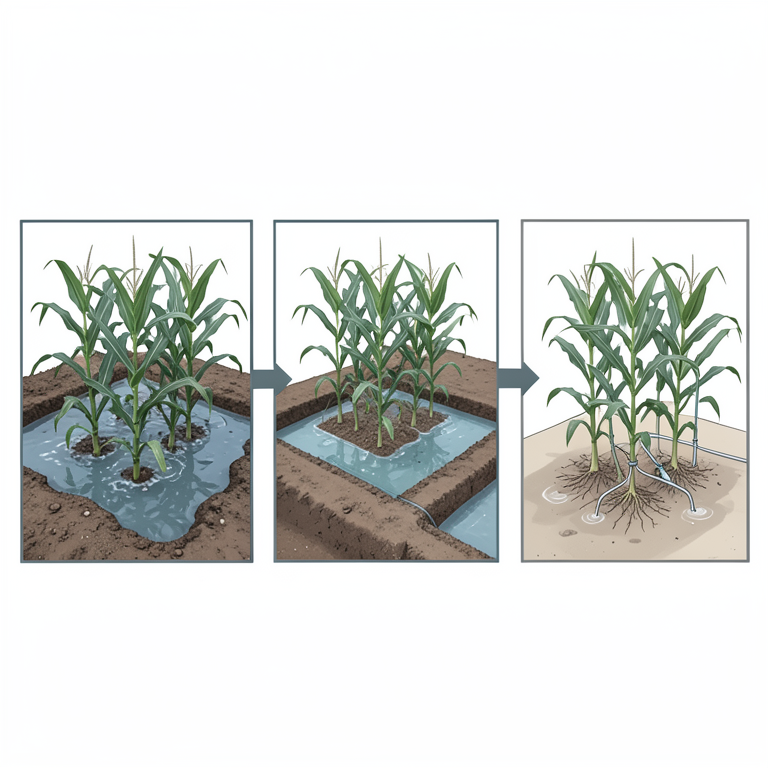
Irrigation Efficiency Comparison
AI-generated conceptual illustration (maize plants in soil). It explains the idea and does not show study data.
View source evidence ↗Figures & tables
From the original paper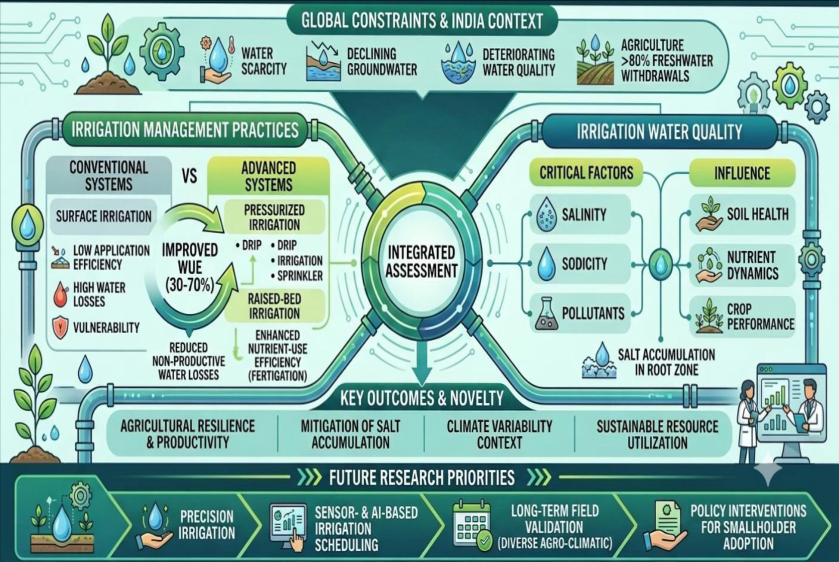 Figure 1
Introduction
Water is one of the most critical natural resources for agricultural sustainability, yet it is becoming increasingly scarce in India due to over-extraction, inefficient use, and climate change impacts. Agriculture consumes approximately 80% of freshwater resources in India, but irrigation efficiency remains low due to reliance on traditional methods and inadequate water management practices (Jain i8 et al., 2020) [1] . India's irrigation sector faces multiple challenges including declining groundwater tables, uneven rainfall distribution, and deterioration in irrigation water quality. In several regions, groundwater is increasingly saline or alkaline, limiting its suitability for irrigation and reducing long-term soil productivity (Verma et al., 2022) [6] . Recent advances in precision irrigation, including drip and sprinkler systems integrated with soil moisture sensors, remote sensing, Internet of Things (IoT)-based monitoring, and decision-support tools, have created new opportunities to improve irrigation efficiency and optimize water use. Simultaneously, irrigation water quality parameters such as salinity, sodicity, electrical conductivity (EC), sodium adsorption ratio (SAR), and residual sodium carbonate (RSC) have gained increasing importance because of their direct effects on soil health, nutrient availability, and crop productivity. Climate change has intensified water stress through increased temperature, irregular monsoon patterns, and higher evapotranspiration rates. These changes have increased irrigation demand while simultaneously reducing water availability, creating severe pressure on existing irrigation systems (Kumar et al., 2022) [22] . Although numerous studies have examined irrigation technologies, irrigation scheduling, water quality, and water use efficiency independently, comprehensive reviews integrating these interconnected aspects within the context of Indian agriculture remain limited. Existing reviews primarily focus on individual irrigation methods or water quality issues, providing limited critical evaluation of their combined influence on crop productivity, soil health, and long-term agricultural sustainability. Traditional surface irrigation systems dominate in many parts of India; however, they are associated with low water use efficiency due to high evaporation, runoff, and deep percolation losses (Sharma et al., 2020) [2] . As a result, improving irrigation efficiency has become a national priority. Modern irrigation technologies such as pressurized irrigation systems and improved field configurations (e.g., raised-bed systems) have been widely promoted to address these challenges. These systems aim to improve water productivity by optimizing water delivery and reducing losses (Singh et al., 2022) [5,8,14] . The novelty of this review lies in its integrated assessment of irrigation management practices, irrigation water quality, crop productivity, and water use efficiency using recent literature (2020-2025). The review critically compares different irrigation systems, evaluates the influence of water quality on agricultural performance, and highlights emerging technologies and future research priorities for sustainable irrigation management under changing climatic conditions.
Irrigation management practices
Irrigation management practices play a fundamental role in determining the efficiency of water use, soil health, and overall agricultural productivity in India. With increasing pressure on freshwater resources, declining groundwater levels, and rising climatic variability, the need for efficient irrigation systems has become more critical than ever. Traditional irrigation methods, although widely practiced, often fail to deliver water efficiently to the crop root zone, resulting in significant water losses and reduced productivity. In contrast, modern irrigation technologies aim to optimize water delivery and improve water use efficiency through precise control of irrigation application and timing. Pressurized irrigation systems, which include drip and sprinkler-based technologies, are widely recognized as the most efficient irrigation methods currently available. These systems operate under controlled pressure, allowing water to be delivered uniformly either directly to the root zone or across the field surface. The major advantage of these systems lies in their ability to significantly reduce water losses through evaporation, runoff, and deep percolation. Recent studies have shown that pressurized irrigation systems can improve water use efficiency by 30 to 70 percent compared to conventional surface irrigation methods (Yadav et al., 2024; Meena et al., 2024) [9,10] . This improvement is primarily due to precise water application, better soil moisture regulation, and improved synchronization between water and nutrient supply. Fertigation, which is the application of fertilizers through irrigation water, further enhances nutrient uptake efficiency and reduces nutrient losses (Singh et al., 2022) [5,8,14] . However, despite their advantages, the adoption of pressurized irrigation systems remains limited in many regions due to high installation costs, energy requirements, and lack of technical knowledge among small and marginal farmers. Raised-bed irrigation systems represent another important innovation in irrigation management. In this system, crops are grown on elevated beds while irrigation water is applied through furrows. This configuration improves soil aeration, enhances drainage, and reduces waterlogging stress, particularly in heavy soils. The modification of field topography allows for better root development and improved soil physical conditions. Research indicates that raised-bed systems improve water productivity compared to conventional surface irrigation systems; however, their efficiency is still lower than that of pressurized irrigation systems (Patel et al., 2021) [4] . The limitations of raised-bed systems arise mainly from uneven water distribution, higher evaporation losses from furrows, and limited control over the amount of water applied. Although these systems are beneficial under moderate irrigation conditions and in areas prone to waterlogging, they are less suitable in regions experiencing severe water scarcity (Yadav et al., 2023) [12] . Surface irrigation remains the most commonly used irrigation method in India due to its simplicity and low initial cost. Despite its widespread use, it is also the least efficient method of irrigation. The efficiency of surface irrigation systems generally ranges between 35 and 50 percent, with substantial water losses occurring due to runoff, evaporation, and deep percolation (Sharma et al., 2020) [2] . In addition, uneven distribution of water across the field leads to variability in soil moisture, which negatively affects plant growth and productivity. The continued reliance on surface irrigation reflects infrastructural limitations and economic constraints rather than its agronomic efficiency.
Effects of irrigation water quality
Irrigation water quality is one of the major factors affecting soil properties, plant growth, and overall agricultural productivity. Among all the different water quality parameters, the two most important ones which pose major constraints to irrigated agriculture in India are salinity and sodicity. Increased use of groundwater for irrigation has resulted in deterioration of water quality in many parts of the country and this has created enormous problems for consistent crop production. Salinity stress arises when salts present in irrigation water get accumulated in the soil which results in increase in osmotic pressure thus limiting the capability of the plants to uptake water. This results in a situation where the plants undergo physiological drought even though there may be sufficient moisture in the soil. Salinity exerts an impact on various physiological processes such as germination of seed, root growth, nutrient uptake, photosynthesis, and general metabolic activities. A longterm exposure of plants to saline conditions manifests itself in reduced growth and productivity of plants and in extreme cases, in complete crop failure. Apart from that, the longterm use of saline water invariably leads to soil salinization which in turn results in a decline of soil fertility and ultimately, in a reduction of land productivity (Kumar et al., 2021) [3] . Sodicity, which is the presence of high levels of sodium in water, causes significant deterioration of soil structure. Sodium replaces calcium and magnesium on soil particle surfaces and this results in clay particles going into dispersed state. This leads to a reduced soil aggregation, low infiltration rates, crusting of soil surface, and difficult root penetration. All these factors severely influence the hydraulic properties of the soil which in turn leads to unhealthy plant growth (Verma et al., 2022) [6] . Besides salinity and sodicity, use of poor quality irrigation water negatively affects soil fertility too. Excessive salts hinder the absorption of key nutrients such as potassium, calcium, and magnesium. Even when the soil is fertile, nutrient availability in the root zone decreases under saline conditions due to ionic competition and inefficient root absorption. This translates into deterioration of physiological function and reduced biomass generation in plants (Sharma et al., 2023) [13] .
Impact on productivity
There are many irrigation and water quality related factors which impact the crop productivity and the impact can be seen at almost all growth stages of development of a plant, from seedling to the development of final yield. During the first stage when the plant is being established, the availability of moisture that is uniform in soil is quite critical for proper germination and seedling development. Efficient irrigation methods will ensure regular moisture conditions, resulting in uniform germination and strong plant stands. On the other hand, uneven water distribution that may result from surface irrigation methods, will cause patchy germination and weak stands of the crop which in the end will result in a loss in productivity. During the vegetative growth period, the availability of water mainly governs the production of biomass and physiological development. The use of pressurized irrigation systems results in soil moisture levels in the root zone being maintained at optimal levels, which improve nutrient uptake capacity of the plants as well as photosynthetic activity. This in turn results in a better vegetative growth, stronger plant structure and more biomass accumulation. Multiple studies have strongly supported the view that improved irrigation management results in dramatically better growth performance as compared to conventional irrigation systems (Singh et al., 2022) [5,8,14] . During the phase when the crop is making the final yield, it is highly dependent on the availability as well as the quality of water. Several independent researchers have found that pressurized irrigation methods produce significantly higher yields than raised-bed and surface irrigation methods. The main reasons for increased yields are minimized water stress, enhanced availability of nutrients and higher efficiency of physiological processes. Yadav et al. (2024) [9] demonstrated that micro-irrigation methods greatly increase yield under varied Indian agro-climatic conditions by optimizing usage of water and alleviating stress during crucial development stages.
Water Use Efficiency (WUE)
Water use efficiency is a key indicator used to evaluate the performance of irrigation systems, defined as the ratio of agricultural output to the amount of water used. Improving water use efficiency is essential for ensuring sustainable agricultural production under conditions of increasing water scarcity. Among different irrigation systems, pressurized irrigation systems consistently demonstrate the highest water use efficiency due to their ability to deliver water precisely and minimize losses. These systems reduce nonproductive water consumption and maintain optimal soil moisture conditions, resulting in improved water productivity. Raised-bed irrigation systems provide moderate improvements in water use efficiency due to better field drainage and reduced waterlogging, but their efficiency is still limited by uneven water distribution and evaporation losses. Surface irrigation systems exhibit the lowest water use efficiency due to high water losses and poor application uniformity. Recent studies confirm that advanced irrigation systems significantly enhance water use efficiency by improving soil moisture regulation and reducing unnecessary water application (Meena et al., 2024) [10] .
Irrigation scheduling
Efficient irrigation scheduling is a crucial component of modern water management strategies. It ensures that water is applied at the right time and in the right quantity, thereby preventing both water stress and over-irrigation. Modern irrigation scheduling techniques increasingly rely on scientific tools such as soil moisture sensors, climatic data analysis, and simulation models like CROPWAT. Proper irrigation scheduling helps in optimizing water use by aligning irrigation timing with crop water requirements. This reduces water wastage and improves overall productivity. In addition, it enhances the efficiency of irrigation systems by ensuring that water is applied only when required. Studies have shown that model-based irrigation scheduling significantly improves water productivity compared to traditional farmer-based irrigation practices (Singh et al., 2022) [5,8,14] .
Discussion
The reviewed literature clearly demonstrates that irrigation management practices and water quality are closely interconnected factors that significantly influence agricultural productivity and water use efficiency. Pressurized irrigation systems consistently outperform other irrigation methods due to their ability to deliver water precisely and efficiently. Raised-bed systems offer intermediate benefits, particularly in improving soil physical conditions, while surface irrigation remains the least efficient method due to high water losses and poor distribution uniformity. Degradation of water quality, especially through salinity and sodicity, poses a serious problem in Indian agriculture. Both these factors adversely affect soil health, nutrient availability, and the physiological processes of plants. Even though advanced irrigation systems are capable of lessening some of these harmful effects, they cannot completely counteract the long-term effects of poor-quality water. Although the advantages associated with modern irrigation systems are quite evident, the level of their adoption is still very low owing to economic constraints, lack of awareness and inadequate technical support. In view of these facts, changes at the policy level, enhanced subsidies, as well as capacitybuilding programs are critical for promoting the adoption of efficient irrigation technologies in various parts of India.
Future directions
Future research should focus on developing integrated irrigation management frameworks that combine advanced irrigation technologies with real-time water quality monitoring under diverse agro-climatic conditions (Irmak et al., 2024; Abioye et al., 2020) [31,34] . Greater emphasis should be placed on precision irrigation using Internet of Things (IoT) sensors, remote sensing, artificial intelligence (AI), machine learning, and decision support systems to optimize irrigation scheduling according to crop water requirements and soil moisture dynamics (Talaviya et al., 2020; Jiménez et al., 2022; Liakos et al., 2018) [35,36,37] . Long-term, multi-location field experiments are needed to evaluate the combined impacts of irrigation methods, water quality, fertigation, and climate variability on soil health, carbon sequestration, nutrient-use efficiency, and crop productivity (FAO, 2021) [33] . Further investigation into the safe utilization of marginal-quality water through blending, cyclic irrigation, desalination technologies, and salt-tolerant crop cultivars is essential to address increasing freshwater scarcity (FAO, 2021; Corwin, 2021) [32,33] . Future studies should also integrate hydrological, agronomic, and socioeconomic analyses to evaluate the cost-effectiveness, scalability, and adoption potential of water-efficient technologies among smallholder farmers (Zhang et al., 2021; Poulton et al., 2021) [16,38,39] . Strengthening policy frameworks, promoting digital advisory services, and expanding farmer capacity-building programs will be critical to accelerating the adoption of climate-smart irrigation practices and ensuring sustainable water resource management under changing climatic conditions.
Conclusion
Efficient irrigation management and irrigation water quality are fundamental to sustaining agricultural productivity under increasing water scarcity and climate variability. This review demonstrates that integrating pressurized irrigation systems with scientific irrigation scheduling and appropriate water quality management substantially enhances water-use efficiency, nutrient-use efficiency, crop productivity, and soil health while reducing water losses and salinity-related constraints. Compared with conventional surface irrigation, drip and sprinkler systems offer significant advantages through precise water application, fertigation, and improved resource conservation. However, widespread adoption remains constrained by economic, infrastructural, and technical limitations, particularly among smallholder farmers. The review further highlights that sustainable irrigation cannot rely solely on technological innovations but requires integrated management strategies supported by digital technologies, climate-resilient policies, farmer training, and effective institutional support. Future agricultural water management should therefore adopt a holistic approach that integrates precision irrigation, water quality assessment, climate adaptation, and policy interventions to ensure long-term food security, environmental sustainability, and resilient agricultural production systems.
Figures and tables from the paper
References
39 in the original paper- Jain M, et al. Water scarcity and irrigation efficiency in India. Current Science. 2020; 118(5): 890-900.
- Sharma L, et al. Surface irrigation efficiency in India. Agricultural Reviews. 2020; 41(2): 210-220.
- Kumar S, et al. Salinity stress and irrigation water quality impacts. Ecological Indicators. 2021; 115: 106115.
- Patel S, et al. Raised-bed irrigation systems and productivity. Indian Journal of Agronomy. 2021; 66(3): 201-210.
- Singh A, et al. Irrigation efficiency improvement in India. Water Resources Management. 2022; 36: 112125.
- Verma A, et al. Groundwater salinity and agricultural impacts. Environmental Monitoring and Assessment. 2022; 194: 780-792.
- Kumar V, et al. Climate variability and irrigation demand. Climate Risk Management. 2022; 36: 100110.
- Singh P, et al. Irrigation scheduling and water productivity. Agronomy Journal. 2022; 113(2): 120132.
- Yadav V, et al. Micro-irrigation systems and water productivity. Agricultural Water Management. 2024; 290: 108120.
- Meena R, et al. Water use efficiency in Indian irrigation systems. Sustainability. 2024; 16(2): 155-168.
- Gupta R, et al. Salinity mitigation in irrigation systems. Plant and Soil. 2024; 475: 321-335.
- Yadav S, et al. Water productivity under different irrigation systems. Journal of Hydrology. 2023; 598: 110-122.
- Sharma P, et al. Salinity effects on soil and plant systems. Journal of Environmental Management. 2023; 310: 114-126.
- Singh M, et al. Micro-irrigation and drought resilience. Drought Studies Journal. 2022; 16: 55-66.
- Mehta P, et al. Soil moisture dynamics in pressurized irrigation. Soil Science Society of India Journal. 2022; 70: 155-165.
- Zhang Y, Wang J, Li X. Effects of drip irrigation on water productivity and soil salinity dynamics. Agricultural Water Management. 2021; 245: 106-123.
- Fereres E, Soriano MA. Deficit irrigation for reducing agricultural water use. Journal of Experimental Botany. 2020; 71(1): 35-49.
- Zotarelli L, Dukes MD, Morgan KT. Irrigation efficiency and scheduling in modern agriculture. HortScience. 2021; 56(3): 245-257.
- Howell TA. Irrigation efficiency and water conservation. Agricultural Water Management. 2020; 234: 106-112.
- Deb SK, Shukla MK. Soil salinity and irrigation water quality impacts on crop productivity. Soil Use and Management. 2021; 37(4): 678-690.
- Qureshi AS, Gill MA, Sarwar A. Sustainable irrigation management in South Asia. Agricultural Water Management. 2020; 241: 106-119.
- Rodrigues GC, Pereira LS. Assessing irrigation scheduling strategies under water scarcity. Water. 2021; 13(5): 610.
- Farooq M, Hussain M, Wahid A. Water management strategies for sustainable agriculture. Agronomy Journal. 2020; 112(4): 2580-2592.
- Gupta SK, Tyagi NK. Irrigation water quality and soil degradation issues in India. Current Science. 2022; 122(6): 732-741.
- Kisekka I, Migliaccio KW. Advances in microirrigation technologies. Irrigation Science. 2021; 39(3): 245-258.
- Parihar SS, et al. Soil and water management under irrigated systems. Field Crops Research. 2020; 255: 107888.
- Rhoades JD, Kandiah A, Mashali AM. The use of saline waters for crop production. FAO Irrigation and Drainage Paper 48. 2020.
- Srinivasarao C, et al. Water productivity enhancement in Indian agriculture. Land Degradation & Development. 2022; 33(12): 2051-2065.
- Pereira LS, Oweis T, Zairi A. Irrigation management under water scarcity conditions. Agricultural Water Management. 2020; 241: 106-117.
- Choudhary AK, et al. Impact of irrigation systems on soil health and productivity. Environmental Monitoring and Assessment. 2023; 195: 789.
- Abioye EA, Abidin MSZ, Mahmud MSA, et al. A review on monitoring and advanced control strategies for precision irrigation. Computers and Electronics in Agriculture. 2020; 173: 105441.
- Corwin DL. Climate change impacts on soil salinity in agricultural areas. European Journal of Soil Science. 2021; 72: 842-862.
- FAO. The State of the World's Land and Water Resources for Food and Agriculture (SOLAW 2021). Rome: FAO; 2021.
- Irmak S, Yari A, Andrade-Rodriguez M, et al. Precision Irrigation Management. Council for Agricultural Science and Technology. 2024.
- Jiménez AF, Cárdenas PF, Jiménez F. Intelligent IoTmultiagent precision irrigation approach for improving water use efficiency in irrigation systems at farm and district scales. Computers and Electronics in Agriculture. 2022; 192: 106635.
- Liakos KG, Busato P, Moshou D, Pearson S, Bochtis D. Machine learning in agriculture: A review. Sensors. 2018; 18: 2674.
- Talaviya T, Shah D, Patel N, Yagnik H, Shah M. Implementation of artificial intelligence in agriculture for optimisation of irrigation and application of pesticides and herbicides. Artificial Intelligence in Agriculture. 2020; 4: 58-73.
- Zhang J, Guan K, Peng B, et al. Challenges and opportunities in precision irrigation decision-support systems for center pivots. Environmental Research Letters. 2021; 16: 053003.
- Poulton PL, et al. Application, adoption and opportunities for improving decision support systems in irrigated agriculture: A review. Agricultural Water Management. 2021; 257: 107161.