
Research article · 2026 · Full text
International Journal of Horticulture and Food ScienceImpact of acute versus chronic gamma irradiation regimes on reproductive traits and fruit set in tomato genotypes
Volume 8(5) · Pages 45–49 · DOI: 10.33545/26631067.2026.v8.i5a.811 ↗
Research areasPlant Genetic and Mutation StudiesGenetics and Plant BreedingSunflower and Safflower Cultivation
Abstract
Author-writtenThe differential biological effects of acute versus chronic gamma irradiation on reproductive development in vegetable crops remain poorly understood, despite the fundamental importance of irradiation delivery rate in determining mutation spectra and biological outcomes. This research compared the effects of acute (single-exposure) and chronic (fractionated) gamma irradiation regimes at cumulative doses of 30 and 60 Gy on reproductive traits, pollen viability, flower morphology, fruit set efficiency, and early fruit development in three tomato genotypes (TF-01, TF-02, and TF-03) under tropical field conditions at Ibadan, Nigeria. In the acute regime, seeds received the full dose in a single exposure, while in the chronic regime, the same cumulative dose was delivered in three equal fractions at 24-hour intervals. The experiment was established in a randomized complete block design with four replications. Results indicated that acute irradiation at 30 Gy produced the highest flower number per plant (34.5 in TF-03, 13.2% increase) and the best fruit set percentage (74.5% pooled, compared to 68.2% control). Chronic irradiation at the same cumulative dose of 30 Gy also stimulated flower production but to a lesser extent (32.8 in TF-03, 8.6% increase), while maintaining higher pollen viability (78.4%) compared to acute treatment (72.1%). Both irradiation regimes at 60 Gy significantly suppressed reproductive parameters, with acute 60 Gy causing greater damage than chronic 60 Gy across all genotypes. TF-03 consistently exhibited the highest reproductive resilience to both irradiation regimes. These results demonstrate that delivery regime is a critical variable in gamma irradiation protocols for tomato, with acute exposure producing stronger hormetic stimulation at low doses but greater damage at elevated doses compared to the equivalent chronic treatment.
Summary
Source-checkedPlain-language reading of the full paper, prepared with AI and checked against the text. Each point links to the authors' own words.
Why it matters
- Reproductive success, including flowering and fruit set, is a key driver of overall crop yield and productivity. View evidence ↗
- Chronic irradiation may differ from acute irradiation because it allows plants to partially repair DNA damage between doses, which can change the resulting genetic mutations. View evidence ↗
- Most irradiation research has been done in temperate regions, making it necessary to study these effects in tropical environments like West Africa due to different temperature and humidity levels. View evidence ↗
The question
- The study aimed to compare how acute and chronic gamma irradiation at 30 and 60 Gy affect the reproductive traits and fruit development of three tomato genotypes in a tropical environment. View evidence ↗
What they did
- The researchers used three tomato genotypes: TF-01 (determinate), TF-02 (semi-determinate), and TF-03 (indeterminate). View evidence ↗
- Treatments included a control and four irradiation levels: acute 30 Gy and 60 Gy (single dose), and chronic 30 Gy and 60 Gy (delivered in three fractions at 24-hour intervals). View evidence ↗
- The study used a randomized complete block design with four replications, totaling 60 experimental units of 10 plants each. View evidence ↗
- Measured parameters included flowering time, flower number, pollen viability (using acetocarmine staining on 300 grains), fruit set percentage, fruit number, fruit diameter at 14 days, and seed count. View evidence ↗
What they found
- Acute irradiation at 30 Gy stimulated the most flowers (34.5 in TF-03, a 13.2% increase) and the highest pooled fruit set (74.5% vs 68.2% in control). View evidence ↗
- At 60 Gy, both regimes suppressed reproduction, but acute irradiation caused more damage than chronic irradiation across all genotypes. View evidence ↗
- The TF-03 genotype was the most resilient to both acute and chronic irradiation regimes. View evidence ↗
- Increasing the radiation dose reduced the number of seeds per fruit, with acute treatments causing a more severe reduction than chronic treatments. View evidence ↗
What it means
- The authors recommend acute irradiation at 25–35 Gy for maximum stimulation or chronic irradiation at 30–40 Gy to balance mutation with preserved reproductive function. View evidence ↗
- Future research is needed to understand the molecular basis of these effects, their heritability in M2 populations, seasonal interactions, and the potential for combining irradiation with chemical mutagens. View evidence ↗
Visual summary
3 visualsIllustrations explain the paper; charts are replotted from the paper's own table values.
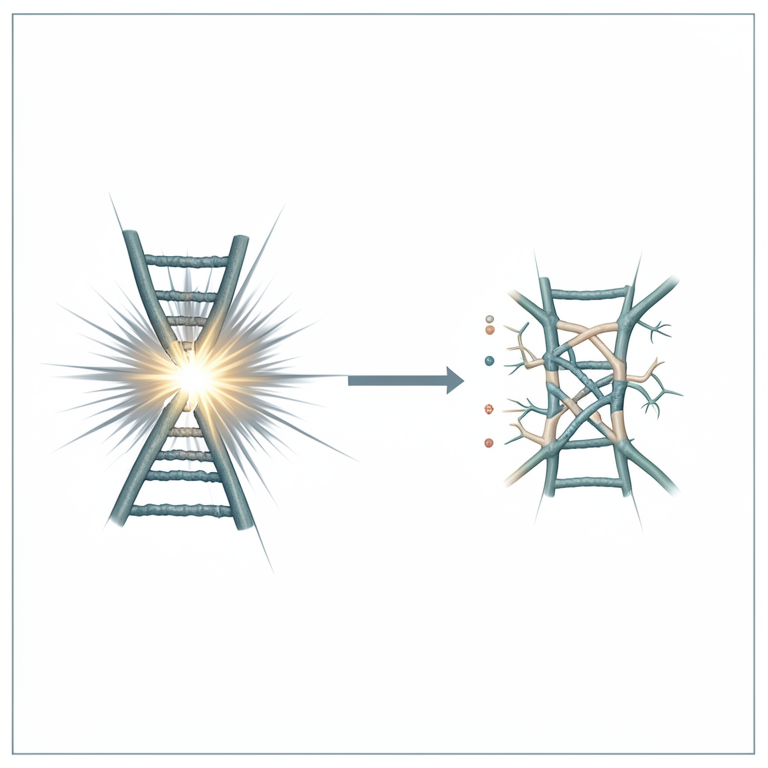
DNA Repair Mechanism in Chronic Irradiation
AI-generated conceptual illustration (tomato plant cells and DNA strands). It explains the idea and does not show study data.
View source evidence ↗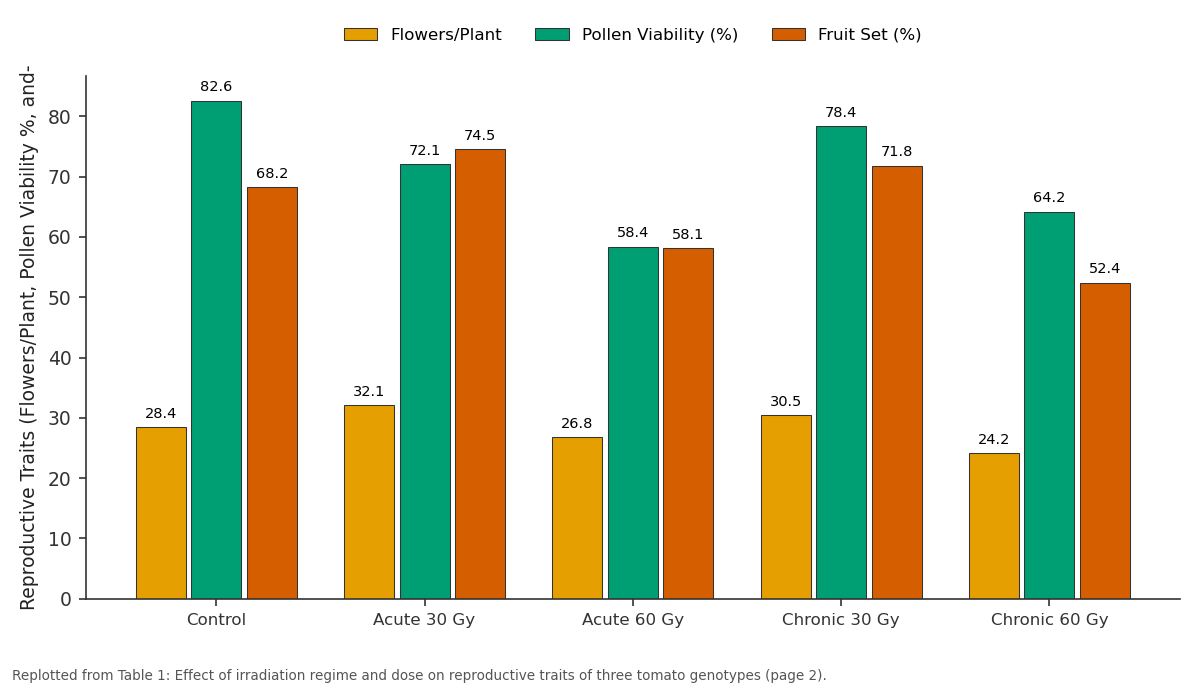
Flowers/Plant and Pollen Viability (%) and more: Control vs Acute 30 Gy vs Acute 60 Gy vs Chronic 30 Gy vs Chronic 60 Gy
Replotted from Table 1 (page 2) of the original paper. Every bar is the paper's own table value.
View source evidence ↗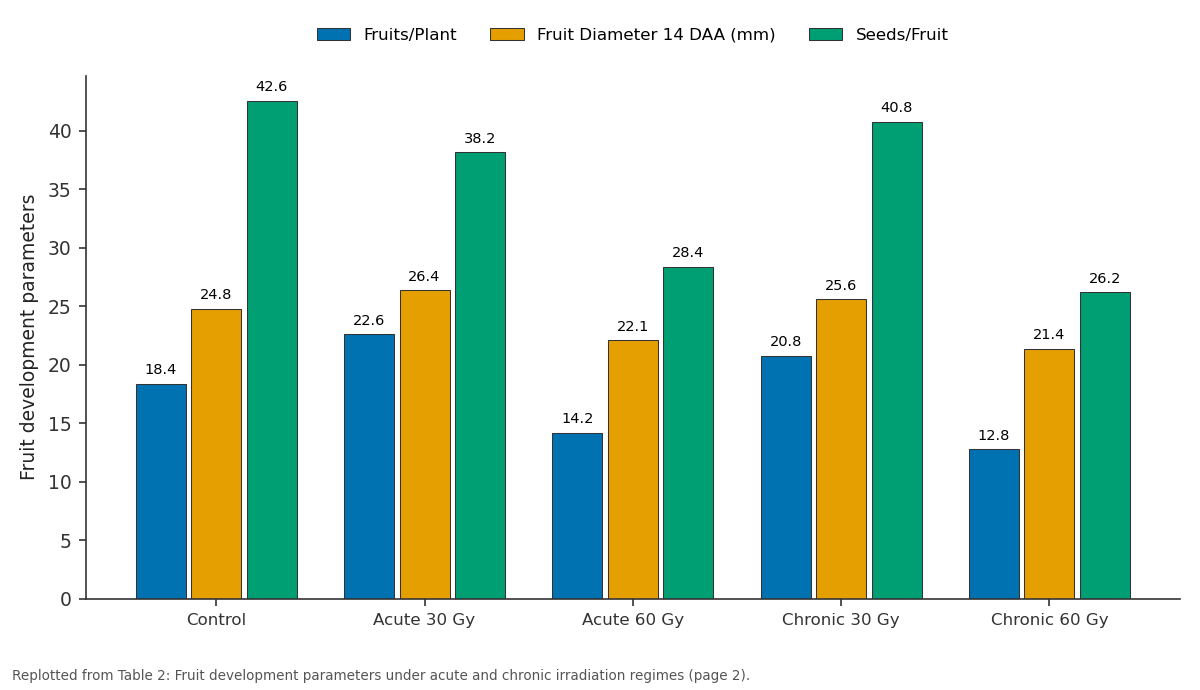
Fruits/Plant and Fruit Diameter 14 DAA (mm) and more: Control vs Acute 30 Gy vs Acute 60 Gy vs Chronic 30 Gy vs Chronic 60 Gy
Replotted from Table 2 (page 2) of the original paper. Every bar is the paper's own table value.
View source evidence ↗Figures & tables
From the original paper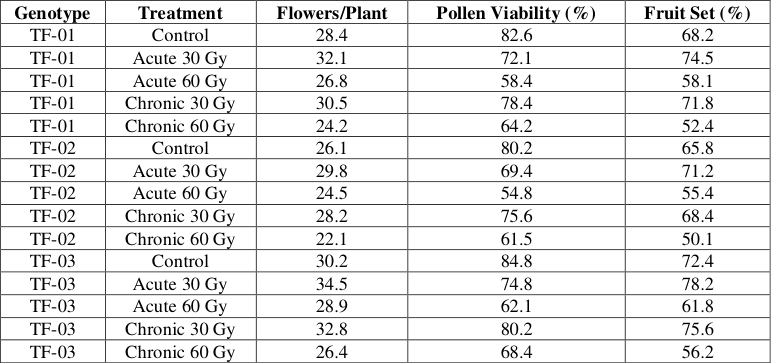 Table 1
 Table 2
 Table 3
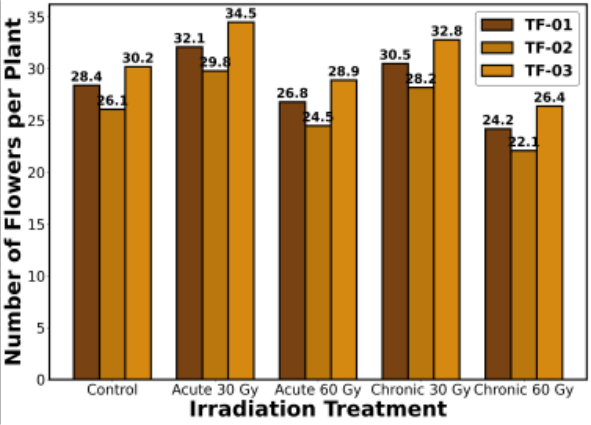 Figure 1
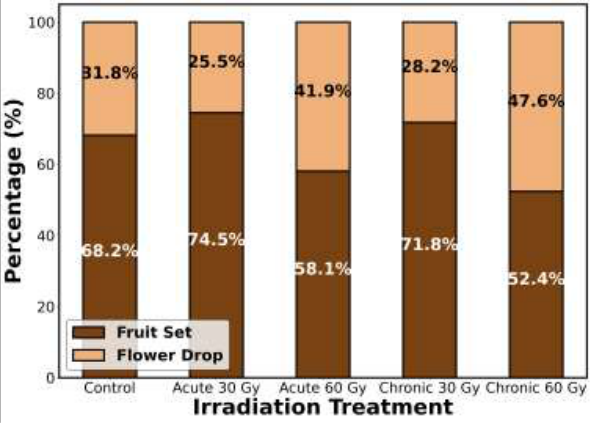 Figure 2
Introduction
Reproductive success in crop plants is a primary determinant of yield potential, and any factor that modifies flowering patterns, pollen functionality, or fruit set efficiency directly influences harvestable productivity. The effects of gamma irradiation on plant reproductive biology have been extensively investigated, yet a critical distinction that remains inadequately characterized is the differential impact of acute versus chronic irradiation regimes on reproductive outcomes. Acute irradiation involves delivery of the entire radiation dose in a single continuous exposure, typically lasting minutes to hours, while chronic irradiation distributes the same cumulative dose over extended periods through fractionated exposures separated by recovery intervals. The biological consequences of these contrasting delivery patterns differ fundamentally because chronic exposure allows partial repair of radiation-induced DNA damage between fractions, potentially modifying both the magnitude and spectrum of genetic alterations. This dose-rate effect, well characterized in mammalian radiobiology, has received comparatively limited attention in plant systems despite its obvious relevance to the design of mutagenesis protocols. In tomato (Solanum lycopersicum L.), reproductive traits including flower initiation, pollen development, pollination success, and fruit set represent complex developmental processes governed by intricate hormonal signaling networks and environmental interactions. The sensitivity of these processes to ionizing radiation varies across developmental stages, with microsporogenesis and megasporogenesis being particularly vulnerable periods.
Understanding how different irradiation delivery regimes affect these reproductive processes is essential for optimizing mutation breeding protocols that maintain adequate fertility while generating sufficient genetic variation. The tropical environment of West Africa presents unique conditions for evaluating irradiation effects on reproductive biology, as the combination of high temperature, humidity, and photoperiod creates a physiological context distinct from temperate regions where most irradiation research has been conducted. The present research was designed to compare the effects of acute and chronic gamma irradiation regimes at cumulative doses of 30 and 60 Gy on reproductive traits and fruit set in three tomato genotypes under tropical field conditions at Ibadan, Nigeria.
Materials and Methods
Materials and Methods
Materials
Three tomato genotypes designated TF-01 (determinate, medium-fruited), TF-02 (semi-determinate, small-fruited), and TF-03 (indeterminate, large-fruited) were obtained from the Genetic Resources Unit of the Ibadan Academy of Crop Sciences, Ibadan, Nigeria. Seeds with >90% viability were selected for uniformity and preconditioned at ambient temperature for 24 hours. Gamma irradiation was administered using a Cobalt-60 source at the Nigerian Nuclear Regulatory Authority facility at a dose rate of 1.8 Gy/minute for acute exposures. Five irradiation treatments were applied: non-irradiated control, acute 30 Gy (single exposure), acute 60 Gy (single exposure), chronic 30 Gy (3 × 10 Gy at 24-hour intervals), and chronic 60 Gy (3 × 20 Gy at 24-hour intervals). The field experiment was conducted from April to October 2023 at the research farm of the Ibadan Academy (7.38°N, 3.94°E) under rainfed tropical conditions with supplementary irrigation during dry spells.
Methods
The experiment was laid out in a randomized complete block design with four replications, comprising 15 treatment combinations (3 genotypes × 5 irradiation treatments) across 60 experimental units of 10 plants each. Seedlings were raised in nursery trays and transplanted at 30 days. Reproductive parameters assessed included days to first flowering, number of flowers per plant, number of flower clusters, pollen viability (acetocarmine staining, n=300 grains per treatment), pollen tube length, fruit set percentage (ratio of fruits to flowers × 100), number of fruits per plant, initial fruit diameter at 14 days after anthesis, and seed count per fruit. Data were recorded weekly from flowering onset through 60 days post-anthesis. Statistical analysis employed three-way ANOVA (genotype × regime × dose) in GenStat software (version 22), with means separated using Fisher's LSD (p ≤ 0.05). Orthogonal contrasts were computed for acute versus chronic regime comparisons at each dose level.
Results
The three-way ANOVA revealed significant (p < 0.01) main effects of genotype, irradiation regime, and dose, along with significant regime × dose and genotype × dose interactions for most reproductive parameters. The genotype × regime × dose three-way interaction was significant for flower number, fruit set percentage, and pollen viability. Flower production was stimulated by both acute and chronic treatments at 30 Gy but suppressed at 60 Gy. Acute 30 Gy produced a stronger stimulatory effect (13.0-14.2% increase over control) than chronic 30 Gy (7.6-8.6% increase) across genotypes. However, pollen viability was better preserved under chronic irradiation at both dose levels, with chronic 30 Gy maintaining 75.6-80.2% viability compared to 69.4-74.8% under acute 30 Gy. This pattern reflects the opportunity for DNA repair between chronic irradiation fractions, which partially mitigates the damage to developing microsporocytes. The orthogonal contrasts confirmed that acute irradiation produced significantly more flowers and higher fruit set at 30 Gy compared to chronic treatment, while chronic irradiation maintained significantly higher pollen viability at both dose levels. Seeds per fruit decreased with increasing dose under both regimes, with acute treatments causing greater reductions than chronic treatments at equivalent cumulative doses.
Discussion
The comparative evaluation of acute and chronic gamma irradiation regimes reveals important differences in their effects on tomato reproductive biology that have direct implications for mutation breeding protocol design. The finding that acute irradiation produced stronger hormetic stimulation of flower production at 30 Gy while causing greater reproductive damage at 60 Gy compared to chronic treatment establishes a clear dose-rate effect in tomato reproductive responses. The stronger hormetic stimulation under acute irradiation can be explained by the intensity of the initial stress signal. Acute delivery concentrates the radiation energy within a short temporal window, generating a more intense burst of reactive oxygen species that may trigger stronger activation of stress-responsive signaling pathways. These pathways, including those mediated by ethylene, jasmonic acid, and salicylic acid, have been implicated in the regulation of flowering timing and intensity, and their transient activation by radiation stress may accelerate the transition to reproductive development.
Conversely, the superior maintenance of pollen viability under chronic irradiation at both dose levels reflects the fundamental radiobiological principle of sublethal damage repair between dose fractions. During the 24-hour intervals between chronic irradiation fractions, cellular DNA repair mechanisms, particularly the non-homologous end joining and base excision repair pathways, can resolve a proportion of the radiation-induced DNA lesions in developing microsporocytes. This repair opportunity reduces the cumulative genetic damage to the male gametophyte and preserves pollen functionality. The observation that fruit set percentage was higher under acute 30 Gy despite lower pollen viability suggests that the irradiation-induced stimulation of flower production and potentially enhanced female receptivity at this dose more than compensated for the reduced pollen quality. This finding has practical significance, as it indicates that fruit set in irradiated tomato populations is determined by the integrated response of multiple reproductive components rather than pollen quality alone. The differential genotypic responses, with TF-03 consistently showing the greatest reproductive resilience, indicate that radiation tolerance in reproductive traits is genotype-dependent and should be characterized independently of vegetative growth tolerance when designing comprehensive irradiation protocols.
Protocol Design Implications
The results provide evidence-based guidance for selecting irradiation delivery regimes in tomato mutation breeding.
When the breeding objective is to maximize the probability of recovering fertile mutants in the M1 generation, chronic irradiation at moderate doses (30 Gy cumulative) is preferred due to its superior preservation of pollen viability and overall reproductive function. When the goal is to induce maximum phenotypic variability with acceptance of some fertility reduction, acute irradiation at the same dose may be more effective due to its stronger mutagenic impact per unit dose. The choice between regimes should thus be guided by the specific breeding objectives and the tolerance for M1 fertility reduction.
Tropical Environment Considerations
The tropical conditions under which this research was conducted, characterized by high ambient temperatures (mean daily maximum 32°C), high humidity (>75%), and moderate photoperiod, represent an important environmental context for interpreting irradiation effects on reproductive traits. Heat stress alone can reduce pollen viability in tomato, and the additive effects of irradiationinduced and heat-induced pollen damage may explain the relatively lower pollen viability values observed in this research compared to temperate-region reports. This environmental interaction underscores the need for locationspecific optimization of irradiation protocols, particularly in tropical regions where baseline reproductive stress is elevated.
Conclusion
This research established that the regime of gamma irradiation delivery is a significant determinant of reproductive outcomes in tomato, with acute and chronic exposure patterns producing qualitatively different effects on flower production, pollen functionality, and fruit set efficiency. The main contribution of this investigation lies in demonstrating that acute irradiation at 30 Gy generates a stronger hormetic stimulation of flower production and fruit set compared to the equivalent chronic dose, while chronic irradiation preserves pollen viability more effectively at both 30 and 60 Gy cumulative doses. Supporting evidence from orthogonal contrast analysis confirmed statistically significant regime effects for all major reproductive parameters, with the magnitude of regime differences varying by dose level. TF-03, with its indeterminate growth habit and vigorous reproductive capacity, demonstrated the highest resilience to both irradiation regimes, consistently producing the highest flower numbers and fruit set percentages across all treatments. The significance of these findings for tropical tomato mutation breeding lies in the establishment of regime-specific dose recommendations: acute irradiation at 25-35 Gy for maximum hormetic stimulation with moderate fertility reduction, or chronic irradiation at 30-40 Gy cumulative for balanced mutagenic effect with preserved reproductive function. Open questions remaining from this investigation include the molecular basis of the dose-rate effect on tomato reproductive development, the heritability of regimespecific reproductive modifications in M2 populations, the interaction between irradiation regime and seasonal environmental variation, and the potential for combining fractionated irradiation with chemical mutagens to enhance mutation spectra while preserving reproductive integrity.
Acknowledgement
AcknowledgementsThe Ibadan Academy of Crop Sciences provided the field experimental facilities, germplasm resources, and laboratory infrastructure that made this research possible. The technical contributions of Mr. Emmanuel Adeyemi in field plot management and pollination monitoring, and Ms. Folake Adebayo in pollen viability assessments, are sincerely acknowledged. The financial support from the Nigerian Agricultural Research Council is gratefully recognized.
Figures and tables from the paper
| Genotype | Treatment | Flowers/Plant | Pollen Viability (%) | Fruit Set (%) |
|---|---|---|---|---|
| TF-01 | Control | 28.4 | 82.6 | 68.2 |
| TF-01 | Acute 30 Gy | 32.1 | 72.1 | 74.5 |
| TF-01 | Acute 60 Gy | 26.8 | 58.4 | 58.1 |
| TF-01 | Chronic 30 Gy | 30.5 | 78.4 | 71.8 |
| TF-01 | Chronic 60 Gy | 24.2 | 64.2 | 52.4 |
| TF-02 | Control | 26.1 | 80.2 | 65.8 |
| TF-02 | Acute 30 Gy | 29.8 | 69.4 | 71.2 |
| TF-02 | Acute 60 Gy | 24.5 | 54.8 | 55.4 |
| TF-02 | Chronic 30 Gy | 28.2 | 75.6 | 68.4 |
| TF-02 | Chronic 60 Gy | 22.1 | 61.5 | 50.1 |
| TF-03 | Control | 30.2 | 84.8 | 72.4 |
| TF-03 | Acute 30 Gy | 34.5 | 74.8 | 78.2 |
| TF-03 | Acute 60 Gy | 28.9 | 62.1 | 61.8 |
| TF-03 | Chronic 30 Gy | 32.8 | 80.2 | 75.6 |
| TF-03 | Chronic 60 Gy | 26.4 | 68.4 | 56.2 |
Table text extracted from the original PDF; superscript letters are shown inline. The original table image is below.
View original table image
| Treatment | Fruits/Plant | Fruit Diameter 14 DAA (mm) | Seeds/Fruit |
|---|---|---|---|
| Control | 18.4 | 24.8 | 42.6 |
| Acute 30 Gy | 22.6 | 26.4 | 38.2 |
| Acute 60 Gy | 14.2 | 22.1 | 28.4 |
| Chronic 30 Gy | 20.8 | 25.6 | 40.8 |
| Chronic 60 Gy | 12.8 | 21.4 | 26.2 |
Table text extracted from the original PDF; superscript letters are shown inline. The original table image is below.
View original table image
| Parameter | Contrast | Mean Diff. | SE | p-value |
|---|---|---|---|---|
| Flowers/Plant | Acute vs Chronic at 30 Gy | +2.3 | 0.84 | 0.012 |
| Flowers/Plant | Acute vs Chronic at 60 Gy | +1.8 | 0.91 | 0.058 |
| Pollen Viability | Acute vs Chronic at 30 Gy | -6.2 | 1.42 | 0.001 |
| Pollen Viability | Acute vs Chronic at 60 Gy | -5.8 | 1.56 | 0.002 |
| Fruit Set % | Acute vs Chronic at 30 Gy | +2.7 | 1.18 | 0.032 |
| Fruit Set % | Acute vs Chronic at 60 Gy | +3.2 | 1.24 | 0.018 |
Table text extracted from the original PDF; superscript letters are shown inline. The original table image is below.
View original table image
References
15 in the original paper- Abdul-Baki AA, Anderson JD. Vigor determination in soybean seed by multiple criteria. Crop Science. 1973;13(6):630-633.
- Ahloowalia BS, Maluszynski M. Induced mutations: A new paradigm in plant breeding. Euphytica. 2001;118(2):167-173.
- Arena C, De Micco V, Macaeva E, Quintens R. Space radiation effects on plant and mammalian cells. Acta Astronautica. 2014;104(1):419-431.
- Calabrese EJ, Baldwin LA. Defining hormesis. Human and Experimental Toxicology. 2002;21(2):91-97.
- De Micco V, Arena C, Pignalosa D, Durante M. Effects of sparsely and densely ionizing radiation on plants. Radiation and Environmental Biophysics. 2011;50(1):1-19.
- Rauf MA, Islam MM, Tasmin S, Hira B, Islam R, Rahman M, Bashar MA, Hasan M, Islam MR. Effect of different gamma irradiation doses on growth and yield attributes of selected tomato genotypes. South Asian J Agric Sci. 2024;4(2):220-227. DOI:10.22271/27889289.2024.v4.i2c.169.
- Hallajian MT. Mutation breeding and drought stress tolerance in plants. Drought Stress Tolerance in Plants. 2016;2:359-383.
- Jain SM. Mutagenesis in crop improvement under the climate change. Romanian Biotechnological Letters. 2010;15(2):88-106.
- Kim JH, Baek MH, Chung BY, Wi SG, Kim JS. Alterations in the photosynthetic pigments and antioxidant machineries of red pepper seedlings from gamma-irradiated seeds. Journal of Plant Biology. 2004;47(4):314-321.
- Kodym A, Afza R. Physical and chemical mutagenesis. Methods in Molecular Biology. 2003;236:189-203.
- Kovacs E, Keresztes A. Effect of gamma and UV-B/C radiation on plant cells. Micron. 2002;33(2):199-210.
- Oladosu Y, Rafii MY, Abdullah N, Hussin G, Ramli A, Rahim HA, et al. Principle and application of plant mutagenesis in crop improvement: A review. Biotechnology and Biotechnological Equipment. 2016;30(1):1-16.
- Bioremediation, Biodiversity and Bioavailability. 2012;6(1):6-14.
- Sax K. The stimulation of plant growth by ionizing radiation. Radiation Botany. 1963;3:179-186.
- Wi SG, Chung BY, Kim JS, Kim JH, Baek MH, Lee JW, et al. Effects of gamma irradiation on morphological changes and biological responses in plants. Micron. 2007;38(6):553-564.