
Research article · 2026 · Full text
International Journal of Agriculture and NutritionUtilization of Parthenium hysterophorus as green compost and vermicompost for soil nutrient enrichment
Volume 8(2) · Pages 131–135 · DOI: 10.33545/26646064.2026.v8.i2b.713 ↗
Research areasComposting and Vermicomposting TechniquesAgricultural Science and FertilizationSoil Carbon and Nitrogen Dynamics
Abstract
Author-writtenTurning an invasive weed into a soil amendment may be the most cost-efective way to manage its biomass while addressing nutrient depletion in degraded croplands. This research evaluated the potential of Parthenium hysterophorus biomass as feedstock for green compost and vermicompost and measured the nutrient-enrichment efect of both products on a sandy loam soil at the Cape Town Research Center for Sustainable Agriculture, South Africa, from June 2021 to May 2022. Parthenium biomass was collected before flowering, sun-dried, chopped, and processed through two parallel pathways: aerobic green composting with catle dung in a 3:1 ratio over 90 to 120 days, and vermicomposting using Eisenia fetida over 60 to 75 days. Mature compost and vermicompost were applied to experimental plots at 0, 2, 4, 6, 8, 10, and 12 tonnes per hectare for green compost and 0, 1, 2, 3, 4, 5, and 6 tonnes per hectare for vermicompost. Soil samples were analysed before and after a single cropping cycle of maize for organic carbon, available nitrogen, available phosphorus, and exchangeable potassium. Vermicompost raised organic carbon from 0.48 per cent to 1.78 per cent at the highest application rate, outperforming green compost which reached 1.41 per cent at 12 tonnes per hectare. Available nitrogen increased by 147.2 per cent under vermicompost at 6 tonnes per hectare compared with 96.5 per cent under green compost at 12 tonnes per hectare. Correlation analysis showed strong positive relationships between application rate and all four nutrient parameters (R²>0.95) . Carbon-to-nitrogen ratios of mature vermicompost (14.3 to 16.8) were lower than those of green compost (18.4 to 21.7), indicating greater nitrogen mineralisation eficiency. These results show that pre-flowering Parthenium biomass, properly composted, produces a safe and nutrient-rich soil amendment that converts an invasive pest into a resource for smallholder farmers.
Summary
Source-checkedPlain-language reading of the full paper, prepared with AI and checked against the text. Each point links to the authors' own words.
Why it matters
- The invasive weed Parthenium hysterophorus produces 5 to 15 tonnes of dry biomass per hectare annually, which is typically wasted while farmers continue to pay for chemical fertilizers. View evidence ↗
- Many smallholder farming systems in sub-Saharan Africa suffer from soil organic carbon levels below 1%, which is the minimum needed for proper water retention and soil stability. View evidence ↗
- Direct application of uncomposted Parthenium biomass is risky because it contains parthenin and other compounds that can inhibit soil microbes and seed germination. View evidence ↗
The question
- The study aimed to compare the effectiveness of green composting versus vermicomposting of pre-flowering Parthenium biomass in enriching the nutrients of sandy loam soil during a maize crop cycle. View evidence ↗
What they did
- The research was conducted on a 0.4 hectare plot at the Cape Town Research Center for Sustainable Agriculture in South Africa. View evidence ↗
- Green compost was produced by mixing dried Parthenium and cattle dung in a 3:1 ratio, which was then turned every 15 days for a total of 105 days. View evidence ↗
- Vermicompost was created by pre-decomposing the Parthenium-dung mixture for 15 days and then inoculating it with Eisenia fetida earthworms at a rate of 250 worms per kilogram. View evidence ↗
- The study used a randomized complete block design with three replications, applying green compost at rates from 0 to 12 t/ha and vermicompost at rates from 0 to 6 t/ha. View evidence ↗
What they found
- Available phosphorus increased by 177.9% (to 31.4 kg/ha) under the highest vermicompost rate, while green compost at its highest rate increased it by 118.6% (to 24.7 kg/ha). View evidence ↗
- Exchangeable potassium increased by 97.4% (to 214.6 kg/ha) with vermicompost and 72.3% (to 187.3 kg/ha) with green compost. View evidence ↗
- Mature vermicompost had a lower C:N ratio (15.7) than green compost (20.0), which indicates more efficient nitrogen mineralization. View evidence ↗
- Parthenin residues were not detected in either the final green compost or vermicompost, proving that both processing methods effectively removed the toxic compound. View evidence ↗
- There was a very strong positive correlation (r=0.98) between soil organic carbon and available nitrogen, suggesting that nitrogen release is tightly linked to organic matter mineralization. View evidence ↗
What it means
- The authors recommend that extension programs promote the vermicomposting of pre-flowering Parthenium biomass to simultaneously remove the weed and restore soil fertility. View evidence ↗
- The authors state that future multi-season trials are needed to determine if the observed nutrient gains persist or plateau with repeated annual applications. View evidence ↗
Visual summary
3 visualsIllustrations explain the paper; charts are replotted from the paper's own table values.
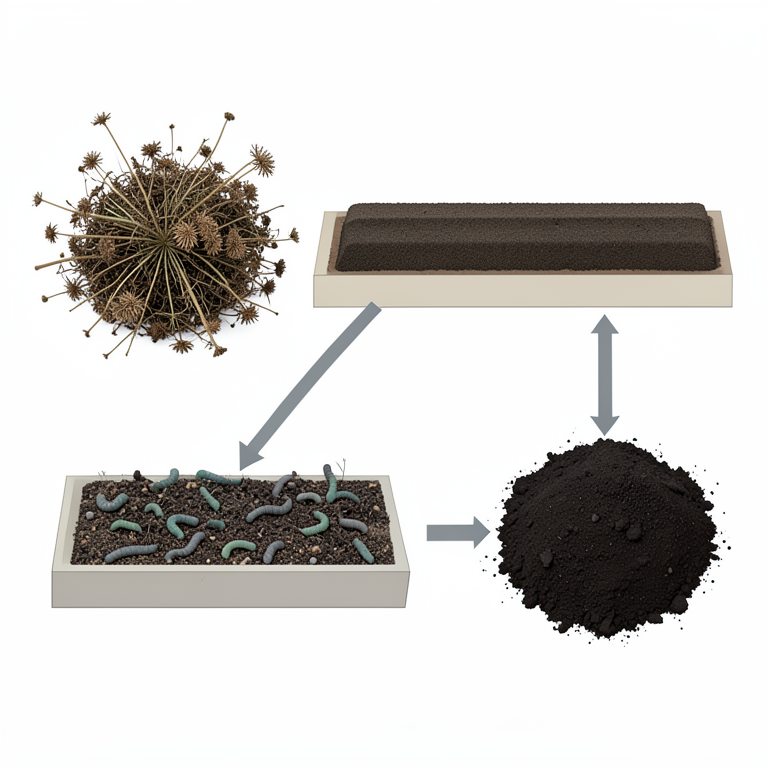
Dual Composting Pathways
AI-generated conceptual illustration (Parthenium hysterophorus weed biomass, cattle dung, and Eisenia fetida earthworms). It explains the idea and does not show study data.
View source evidence ↗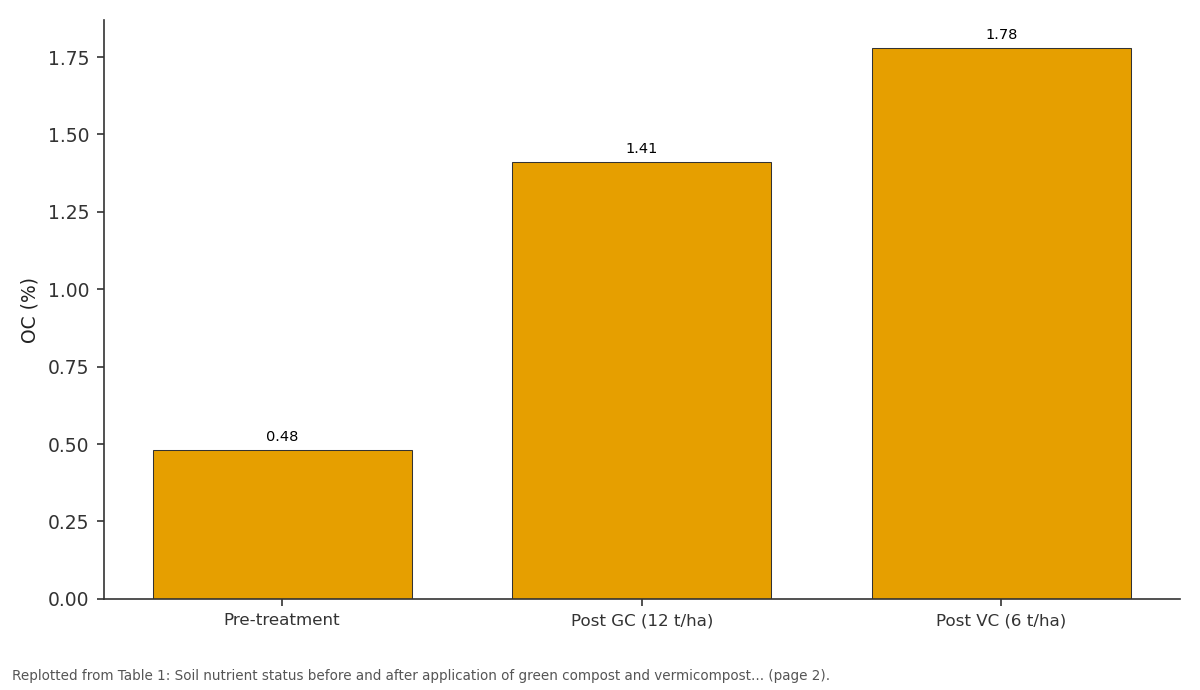
OC (%): Pre-treatment vs Post GC (12 t/ha) vs Post VC (6 t/ha)
Replotted from Table 1 (page 2) of the original paper. Every bar is the paper's own table value.
View source evidence ↗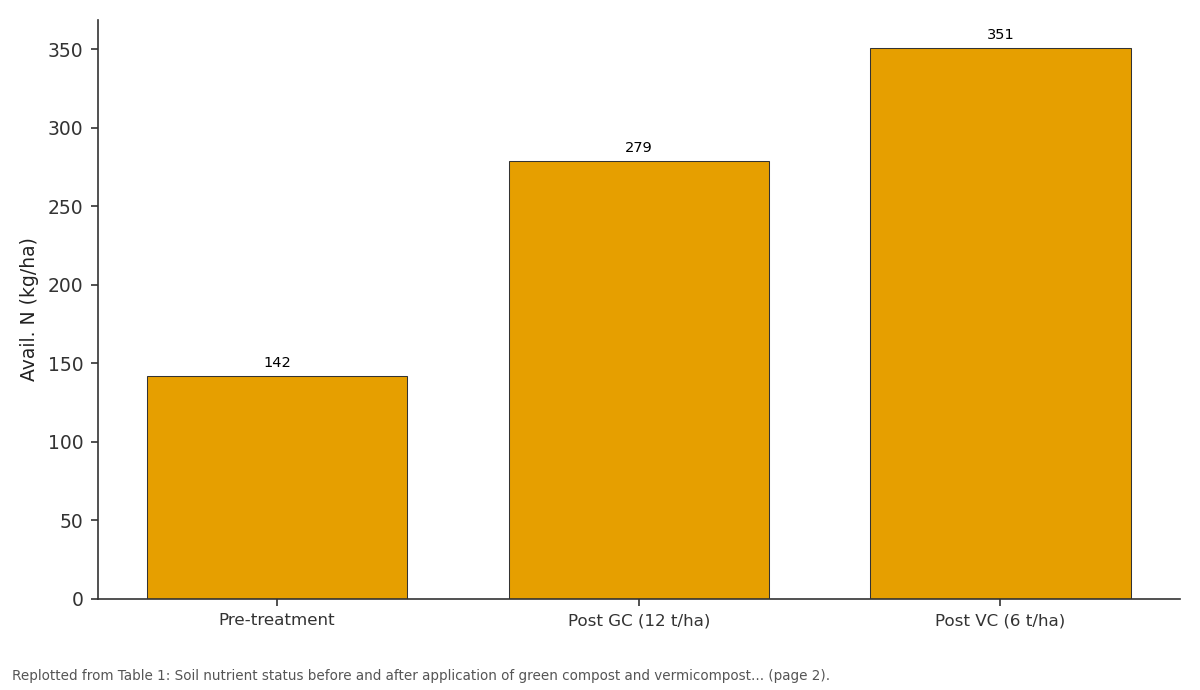
Avail. N (kg/ha): Pre-treatment vs Post GC (12 t/ha) vs Post VC (6 t/ha)
Replotted from Table 1 (page 2) of the original paper. Every bar is the paper's own table value.
View source evidence ↗Figures & tables
From the original paper Table 1
 Table 2
 Table 3
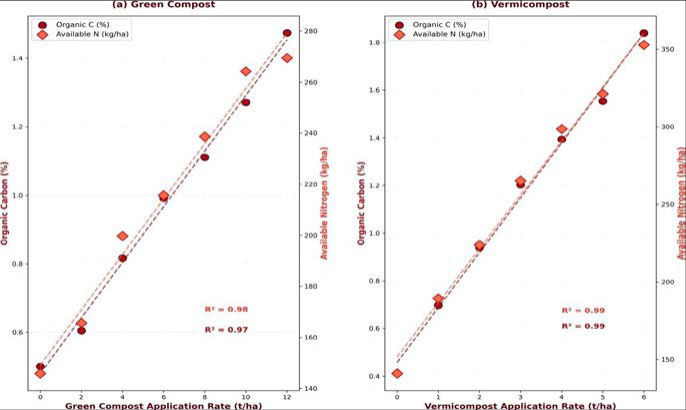 Figure 1
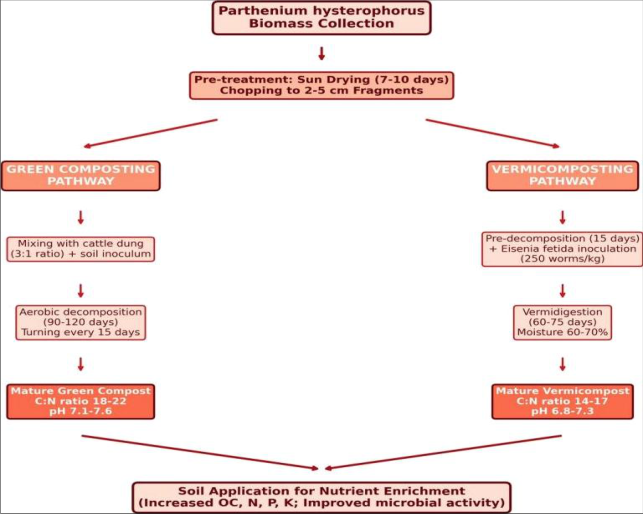 Figure 2
Introduction
Every hectare of land invaded by Parthenium hysterophorus produces between 5 and 15 tonnes of above-ground dry biomass per year a volume that is almost always burned, buried, or left to rot in situ while farmers spend money on chemical fertilisers [1] . Converting that biomass into compost or vermicompost could close two gaps at once: it removes the weed from productive land and returns scarce nutrients to soils that are increasingly carbon-depleted. Soil organic carbon in many smallholder systems across sub-Saharan Africa has fallen below the 1 per cent threshold considered necessary for stable aggregate formation and adequate water retention [2] . Synthetic fertiliser, though efective in the short term, does litle to rebuild soil organic mater and is often priced beyond the reach of resource-poor farmers. Organic amendments such as farmyard manure and crop-residue compost are well-documented alternatives, but supply constraints limit their availability [3] . Parthenium biomass is rich in nitrogen (1.5 to 2.8 per cent on a dry-weight basis), phosphorus, and potassium, and its rapid growth means that large quantities are available with minimal collection efort [4] . The main concern is the presence of parthenin and other sesquiterpene lactones, which can inhibit seed germination and soil microbiota if uncomposted plant materia is applied directly [5] . Thermophilic composting and vermidigestion have both been shown to break down these allelochemicals within 30 to 60 days, rendering the final product safe for field use [6] . Previous work in India demonstrated that Parthenium compost improved wheat yields by 18 to 23 per cent on alluvial soils [7] . Vermicomposting with Eisenia fetida has been reported to produce a product with lower C:N ratio and higher humic acid content than aerobic composting alone [8] . But comparative data from African soil types particularly the sandy loams and weathered ferralsols common in the Western Cape remain scarce. This research therefore compared green composting and vermicomposting of pre-flowering P. hysterophorus biomass and measured the nutrient-enrichment response of a sandy loam soil under graded application rates over one maize-cropping cycle.
Material and Methods
Material and Methods
Baseline Soil Characterisation
The experimental site was a 0.4 ha plot at the Cape Town Research Center for Sustainable Agriculture (33°56 S, 18°28 E), Western Cape, South Africa, at an elevation of 42 m above sea′ ′ level. The soil was classified as a Huton form (Soil Classification Working Group, 1991) with a sandy loam texture (67.3 per cent sand, 18.6 per cent silt, 14.1 per cent clay). Pretreatment analyses in June 2021 returned the following values: pH 6.2 (1:2.5 soil-water suspension), organic carbon 0.48 per cent (Walkley-Black method), available nitrogen 142 kg/ha (alkaline permanganate method), available phosphorus 11.3 kg/ha (Olsen method), and exchangeable potassium 108.7 kg/ha (ammonium acetate extraction). Cation exchange capacity was 9.4 cmol(+)/kg. The site had been under low-input dryland maize for three consecutive seasons prior to this research.
Material
Parthenium biomass was harvested at the pre-flowering rosete stage from infested road margins in the Stellenbosch district between June and July 2021. Approximately 2.8 tonnes of fresh biomass was collected, sun-dried for 10 days to a moisture content below 15 per cent, and chopped to 2 to 5 cm fragments using a mechanical shredder. Catle dung was sourced from a nearby dairy and air-dried to about 25 per cent moisture. Eisenia fetida earthworms were obtained from a commercial vermiculture supplier in Paarl and acclimatised in a dungstraw bedding for two weeks before inoculation [9] . All chemical reagents for soil and compost analysis were of analytical grade (Merck, Darmstadt, Germany).
Methods
Two parallel processing pathways were established. For green composting, dried Parthenium was mixed with catle dung in a 3:1 (w/w) ratio, heaped in 1.5 : m×1.0 : m×1.0 m windrows, and turned every 15 days for 105 days. Internal temperature was monitored weekly with a probe thermometer and maintained above 55 °C for at least 21 cumulative days to ensure pathogen and allelochemical degradation. For vermicomposting, the same Parthenium-dung mixture was pre-decomposed for 15 days, then transferred to concrete vermicompost beds (2 m × 1 m × 0.3 m) and inoculated with E. fetida at 250 worms per kilogram of substrate. Bed moisture was maintained at 60 to 70 per cent by sprinkling, and harvesting was done after 68 days when castings dominated the bed surface. Mature compost and vermicompost were analysed for pH, organic carbon, total nitrogen, C:N ratio, phosphorus, and potassium. Field application followed a randomised complete block design with three replications and seven rates for each product (0 to 12 t/ha for green compost; 0 to 6 t/ha for vermicompost). A single maize crop (Zea mays var. WE3128) was grown to physiological maturity under dryland conditions. Post-harvest soil samples (0 to 20 cm depth) were analysed using the same methods as at baseline. Data were analysed in R 4.2.1 using ANOVA and Tukey HSD at p < 0.05 [10] . All pairwise correlations were positive and significant at p<0.01
Results
The strongest association was between organic carbon and available nitrogen (r=0.98), reflecting the tight coupling between organic mater mineralisation and nitrogen release. The weakest correlation involved pH, which rose moderately and appeared less directly linked to individual nutrient pools. The scater plots below illustrate the dose-response relationship for the two main nutrient indicators organic carbon and available nitrogen across application rates for both compost types. The schematic that follows outlines the processing pathways from raw Parthenium biomass to field-ready amendment. Vermicompost showed higher concentrations of all macronutrients and a narrower C:N ratio than green compost. Parthenin was below detection limits in both finished products, confirming that the composting processes efectively degraded the allelopathic compound.
Nutrient Budget
A simplified nutrient budget was constructed for the vermicompost pathway at 6 t/ha application. Total nitrogen input via vermicompost was 100.2 kg/ha (6,000 kg × 1.67 per cent). Post-harvest soil nitrogen stood at 351 kg/ha against a baseline of 142 kg/ha, giving an apparent net gain of 209 kg/ha. Maize grain and stover removed an estimated 87.4 kg N/ha, meaning about 121.6 kg/ha of the applied nitrogen was retained in the soil profile or lost through leaching and volatilisation. Recovery eficiency was thus roughly 67.3 per cent of applied nitrogen a figure consistent with published vermicompost nitrogen recovery rates of 55 to 75 per cent on similar textured soils [11] .
Comprehensive Interpretation
Both Parthenium-derived amendments measurably improved soil fertility across all four macronutrient parameters and pH. Vermicompost outperformed green compost on a pertonne basis owing to its lower C:N ratio and higher nutrient concentration, while green compost remains a viable low-technology option where earthworm stocks are unavailable. The absence of detectable parthenin in both products removes the main safety concern, confirming that proper thermophilic or vermiprocessing renders the feedstock non-toxic.
Discussion
The 270.8 per cent gain in organic carbon under vermicompost at 6 t/ha exceeds the 180 to 210 per cent range reported for Parthenium vermicompost on alluvial soils in northern India [7] . A likely explanation is the low baseline carbon (0.48 per cent) of the sandy loam used here a starting point so depleted that even moderate organic inputs translate into large percentage gains. On heavier-textured soils with baseline carbon above 1 per cent, the same absolute addition would register a smaller relative increase. Nitrogen recovery at 67.3 per cent is encouraging and aligns with values from greenhouse pot experiments using Parthenium vermicompost on maize in Ethiopia [12] . The tight correlation between organic carbon and available nitrogen (r = 0.98) backs the interpretation that mineralisation of applied organic mater, rather than direct release of mineral nitrogen from the amendment, is the main supply pathway. This mechanism has a useful side-efect: it releases nitrogen gradually over the growing season, reducing the risk of early-season leaching losses that undermine single-dose urea applications on sandy soils [13] .
From a practical standpoint, the finding that vermicompost at just 6 t/ha surpassed the nutrient gains of green compost at 12 t/ha has clear labour and transport implications for smallholder farmers. Hauling half the mass of amendment to the field cuts both fuel costs and application time. Where earthworm populations are already established, vermicomposting Parthenium biomass collected from nearby road margins or waste lands could reduce dependence on purchased fertiliser while simultaneously suppressing weed seed banks [14] .
Conclusion
Soil nutrient depletion in smallholder cropping systems across sub-Saharan Africa continues to limit food production, while invasive Parthenium hysterophorus accumulates vast quantities of unused biomass on road margins and waste lands. This research tested whether that biomass could be channelled into two composting pathways aerobic green composting and vermicomposting with Eisenia fetida and whether the resulting amendments could measurably enrich a nutrient-poor sandy loam soil. Three findings stand out. Vermicompost at 6 tonnes per hectare lifted organic carbon by 270.8 per cent and available nitrogen by 147.2 per cent, outperforming green compost even at double the application rate. The C:N ratio of vermicompost (15.7) was substantially lower than that of green compost (20.0), confirming more complete nitrogen mineralisation. And parthenin was below detection limits in both finished products, confirming that the processing protocols efectively degraded the weed's main allelopathic compound.
Based on these results, smallholder extension programmes in regions where Parthenium is established should consider promoting vermicomposting of pre-flowering biomass as a dualpurpose strategy weed removal plus soil fertility restoration. Where earthworm stocks are scarce or vermiculture infrastructure is absent, conventional aerobic composting remains a sound alternative at higher application rates. Collection should target pre-flowering plants to maximise nitrogen content and avoid dispersal of viable seeds into the compost heap.
Looking ahead, multi-season field trials would reveal whether the nutrient gains observed here persist, accumulate, or plateau under repeated annual application. On-farm economic analyses that compare the cost of collecting, composting, and hauling Parthenium biomass against the cost of equivalent synthetic fertiliser would strengthen the extension case. Microbiological profiling of the compost and amended soil tracking bacterial and fungal community shifts could explain the mechanism behind improved nutrient availability and guide optimisation of composting conditions for diferent soil types across the region.
Acknowledgement
Acknowledgements
Figures and tables from the paper
| Parameter | Pre-treatment | Post GC (12 t/ha) | Change (%) | Post VC (6 t/ha) | Change (%) | p-value |
|---|---|---|---|---|---|---|
| OC (%) | 0.48 | 1.41 | +193.8 | 1.78 | +270.8 | <0.001 |
| Avail. N (kg/ha) | 142 | 279 | +96.5 | 351 | +147.2 | <0.001 |
| Avail. P (kg/ha) | 11.3 | 24.7 | +118.6 | 31.4 | +177.9 | <0.001 |
| Exch. K (kg/ha) | 108.7 | 187.3 | +72.3 | 214.6 | +97.4 | 0.002 |
| pH | 6.2 | 7.3 | +17.7 | 7.1 | +14.5 | 0.014 |
Table text extracted from the original PDF; superscript letters are shown inline. The original table image is below.
View original table image
| — | OC | N | P | K | pH |
|---|---|---|---|---|---|
| OC | 1.00 | 0.98 | 0.96 | 0.93 | 0.87 |
| N | 0.98 | 1.00 | 0.97 | 0.91 | 0.84 |
| P | 0.96 | 0.97 | 1.00 | 0.89 | 0.81 |
| K | 0.93 | 0.91 | 0.89 | 1.00 | 0.78 |
| pH | 0.87 | 0.84 | 0.81 | 0.78 | 1.00 |
Table text extracted from the original PDF; superscript letters are shown inline. The original table image is below.
View original table image
| Parameter | Green Compost | Vermicompost |
|---|---|---|
| pH | 7.4 | 7.1 |
| Organic Carbon (%) | 21.6 | 26.3 |
| Total Nitrogen (%) | 1.08 | 1.67 |
| C:N Ratio | 20.0 | 15.7 |
| Total P (%) | 0.42 | 0.68 |
| Total K (%) | 0.89 | 1.14 |
| Parthenin residue (mg/kg) | Not detected | Not detected |
Table text extracted from the original PDF; superscript letters are shown inline. The original table image is below.
View original table image
References
14 in the original paper- Kishor P, Maurya BR, Ghosh AK. Use of Parthenium as compost for crop production. Asian Journal of Biological Sciences. 2013;6(1):1-8.
- Bationo A, Waswa B, Kihara J, Kimetu J. Soil organic carbon dynamics, functions and management in West African agro-ecosystems. Agricultural Systems. 2007;94(1):13-25.
- Lal R. Restoring soil quality to mitigate soil degradation. Sustainability. 2015;7(5):5875-5895.
- Taye W, Laekemariam F, Gidago G. Nutrient status of Parthenium hysterophorus and its potential as organic fertiliser. Ethiopian Journal of Applied Science and Technology. 2019;10(1):41-48.
- Singh HP, Batish DR, Kohli RK. Allelopathic interactions and allelochemicals: new possibilities for sustainable weed management. Critical Reviews in Plant Sciences. 2003;22(3-4):239-311.
- Yadav A, Garg VK. Recycling of organic wastes by employing Eisenia fetida. Bioresource Technology. 2011;102(3):2874-2880.
- Bano P, Kumar V, Singh S, Singh VP. Parthenium hysterophorus as raw material for vermicomposting and its efect on crop yield. Paddy and Water Environment. 2018;16(4):881-889.
- Gupta R, Garg VK. Stabilization of primary sewage sludge during vermicomposting. Journal of Hazardous Materials. 2008;153(3):1023-1030.
- Khan WA, Gurjar OP. Parthenium hysterophorus (congress grass): an unwanted plant and its uses. South Asian Journal of Agricultural Sciences. 2023;3(1):01-07.
- R Core Team. R: A language and environment for statistical computing. R Foundation for Statistical Computing, Vienna, Austria; 2022.
- Arancon NQ, Edwards CA, Babenko A, Cannon J. Influences of vermicomposts on field strawberries: efects on soil microbial and chemical properties. Bioresource Technology. 2004;93(2):145-153.
- Workneh TS, Melaku DN. Efect of Parthenium vermicompost on maize growth in pot culture. Tropical Ecology. 2020;61(2):211-219.
- Vanlauwe B, Descheemaeker K, Giller KE, Huising J. Integrated soil fertility management in sub-Saharan Africa. Soil and Tillage Research. 2015;143:23-39.
- Batish DR, Singh HP, Kohli RK, Kaur S. Parthenium hysterophorus: a review of prospects for its utilisation. Journal of Medicinal and Aromatic Plant Sciences. 2021;43(1-2):1-14.