
Research article · 2026 · Full text
International Journal of Biology SciencesInfluence of rearing density and substrate type on developmental duration, moulting frequency and reproductive fitness of Acheta domesticus under controlled conditions
Volume 8(4) · Pages 247–252 · DOI: 10.33545/26649926.2026.v8.i4c.943 ↗
Research areasInsect Utilization and EffectsOrthoptera Research and TaxonomyAquaculture Nutrition and Growth
Abstract
Author-writtenApproximately 2,100 species of insects have been documented as edible worldwide, yet commercial-scale production remains constrained by gaps in knowledge regarding optimal rearing conditions. This research examined how rearing density (50, 150, and 300 individuals per square metre) and substrate type (wheat bran; egg carton with chicken feed; coconut coir with vegetable scraps; cardboard with soy-based feed) jointly influence developmental duration, moulting frequency, and reproductive fitness of Acheta domesticus under controlled laboratory conditions at the Arnhem Research Institute of Biological Sciences, Netherlands, from September 2022 through February 2023. A fully crossed 3×4 factorial design was employed with five replicate containers per treatment combination (60 experimental units). Nymphs were monitored from hatching to reproductive maturity, with daily records of moult events, mortality, and developmental stage transitions. Total developmental duration (egg to adult) ranged from 49.3±2.1 days at low density on wheat bran to 71.4±3.8 days at high density on cardboard with soy-based feed. Moulting frequency averaged 8.3±0.4 moults at low density across substrates but fell to 7.1±0.6 moults at the highest density, indicating that crowding suppressed the completion of late-instar moults. Reproductive parameters responded sharply to density. Females reared at 50 individuals per square metre produced 312±28 eggs per female across a 14-day oviposition window, while those at 300 individuals per square metre yielded only 187±34eggs . . Egg hatchability declined from 89.7% at low density to 72.4% at high density. Substrate efects were significant but smaller in magnitude than density efects; wheat bran consistently supported the fastest development and highest fecundity, while cardboard with soy-based feed gave the slowest development across all densities. Interaction efects between density and substrate were significant (p<0.01) for developmental duration and egg output, suggesting that the negative impact of crowding is amplified on suboptimal substrates. Body mass at adult eclosion averaged 0.61±0.04 g at low density and dropped to 0.48±0.06 g at high density. The density × substrate interaction heatmap showed that the combination of high density and cardboard substrate extended development by 45% compared to the fastestdeveloping treatment. These results point to 50–150 individuals per square metre on wheat bran as the optimal rearing configuration for balancing productivity and space utilisation, ofering practical guidance for small and medium-scale cricket farming operations in temperate climates.
Summary
Source-checkedPlain-language reading of the full paper, prepared with AI and checked against the text. Each point links to the authors' own words.
Why it matters
- While thousands of insect species are edible, the growth of commercial-scale production is limited by a lack of knowledge about the best rearing conditions. View evidence ↗
- The common house cricket (Acheta domesticus) is a strong candidate for industrial farming due to its nutritional profile, efficient feed conversion, and short generation time. View evidence ↗
- Rearing density is a critical factor because it influences stress, disease, cannibalism, and resource competition, which can negatively impact growth and reproduction. View evidence ↗
The question
- The study aimed to determine how three different rearing densities and four substrate types affect the reproductive fitness, moulting frequency, and developmental duration of house crickets. View evidence ↗
What they did
- The researchers used a 3x4 factorial design with 60 experimental units, testing three densities (50, 150, and 300 nymphs/m²) across four substrate types. View evidence ↗
- The experiment took place from September 2022 to February 2023 in climate-controlled rooms set to 28±1 °C, 60±5% humidity, and a 12-hour light/dark cycle. View evidence ↗
- The four substrates tested were wheat bran, egg cartons with poultry feed, coconut coir with vegetable scraps, and cardboard with soy-based feed. View evidence ↗
What they found
- Developmental duration was shortest (49.3±2.1 days) at low density on wheat bran and longest (71.4±3.8 days) at high density on cardboard with soy-based feed. View evidence ↗
- High rearing density suppressed development, reducing the average number of moults from 8.3±0.4 at low density to 7.1±0.6 at high density. View evidence ↗
- Fecundity decreased significantly with density, with females at 50 individuals/m² producing 312±28 eggs compared to 187±34 eggs for those at 300 individuals/m². View evidence ↗
- The viability of the offspring was affected by density, with egg hatchability dropping from 89.7% at low density to 72.4% at high density. View evidence ↗
- Adult body mass was lower in crowded conditions, averaging 0.48±0.06 g at high density versus 0.61±0.04 g at low density. View evidence ↗
- Mortality at day 42 increased threefold from 4.6% at low density to 14.2% at high density, primarily due to starvation and cannibalism. View evidence ↗
- There was a significant interaction (p<0.01) between density and substrate, indicating that poor-quality substrates worsen the negative effects of high density on egg output and development time. View evidence ↗
What it means
- The authors recommend a rearing density of 50–150 individuals per square metre on wheat bran to best balance space use and productivity. View evidence ↗
- The study was conducted under ideal conditions, so the results may differ in tropical or subtropical facilities where temperatures and humidity fluctuate. View evidence ↗
- Because substrates were not standardized for calories or nitrogen, the observed effects may be due to a combination of nutritional quality and physical habitat characteristics. View evidence ↗
Visual summary
3 visualsIllustrations explain the paper; charts are replotted from the paper's own table values.
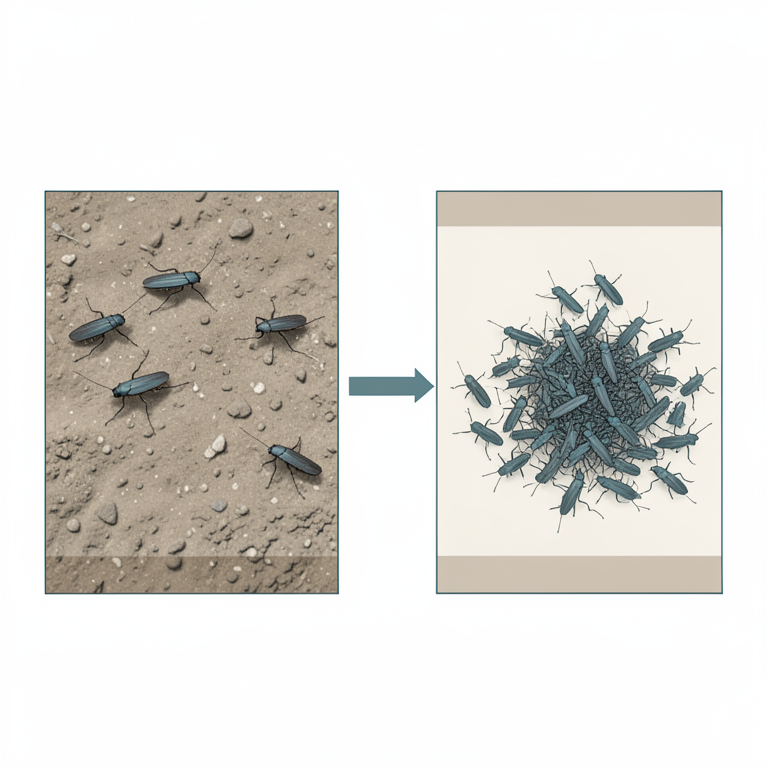
Density-Substrate Interaction Effect
AI-generated conceptual illustration (house crickets (Acheta domesticus)). It explains the idea and does not show study data.
View source evidence ↗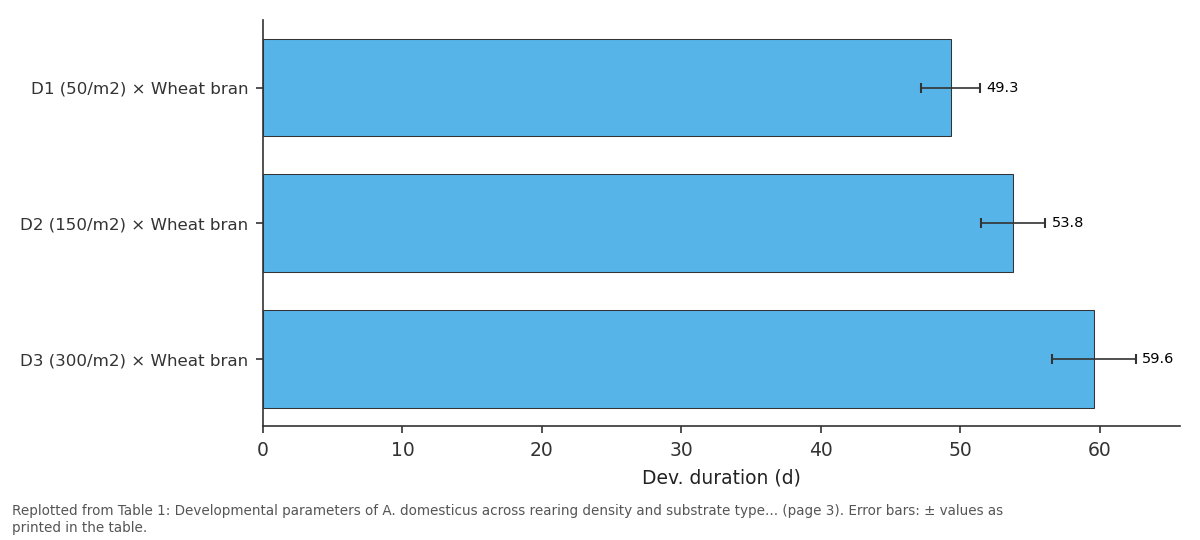
Dev. duration (d): D1 (50/m2) × Wheat bran vs D2 (150/m2) × Wheat bran vs D3 (300/m2) × Wheat bran
Replotted from Table 1 (page 3) of the original paper. Every bar is the paper's own table value.
View source evidence ↗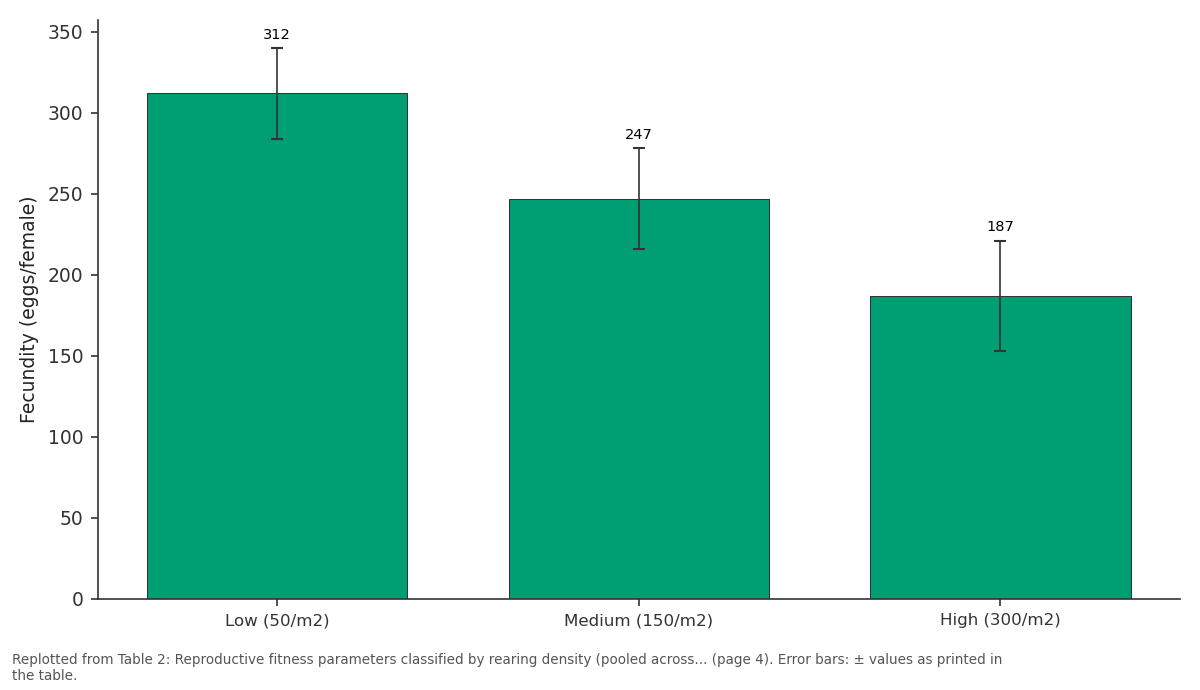
Fecundity (eggs/female): Low (50/m2) vs Medium (150/m2) vs High (300/m2)
Replotted from Table 2 (page 4) of the original paper. Every bar is the paper's own table value.
View source evidence ↗Figures & tables
From the original paper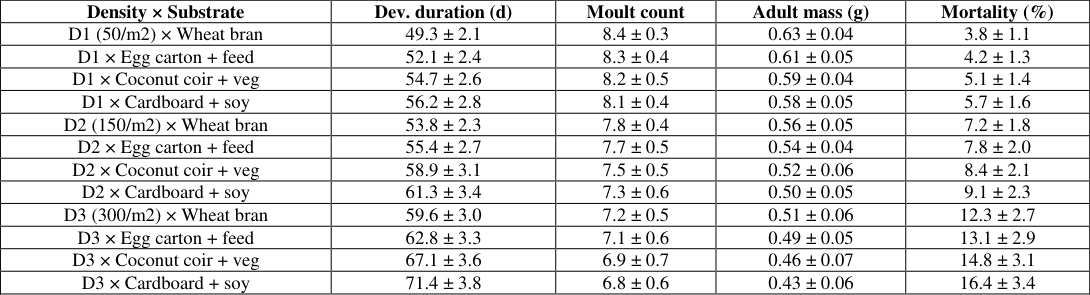 Table 1
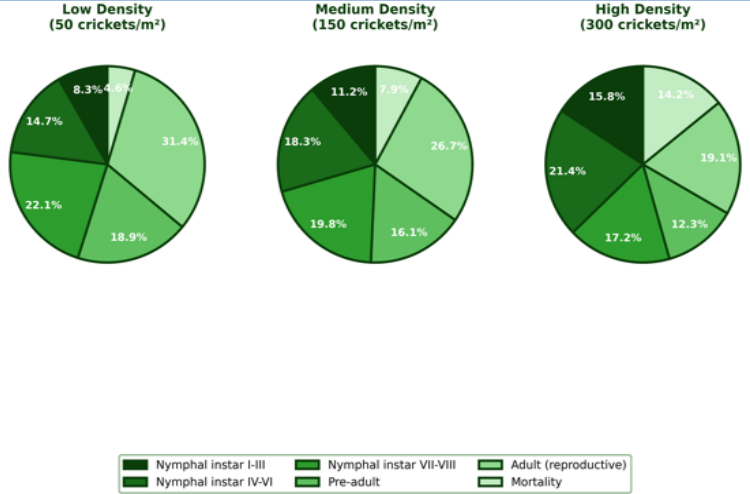 Figure 1
 Table 2
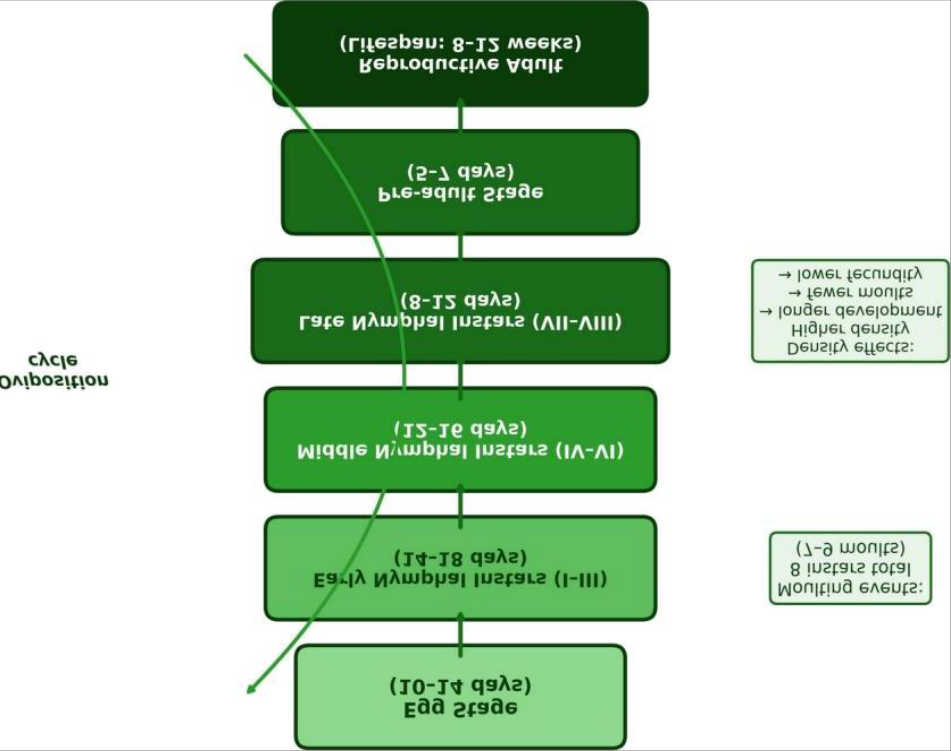 Figure 2
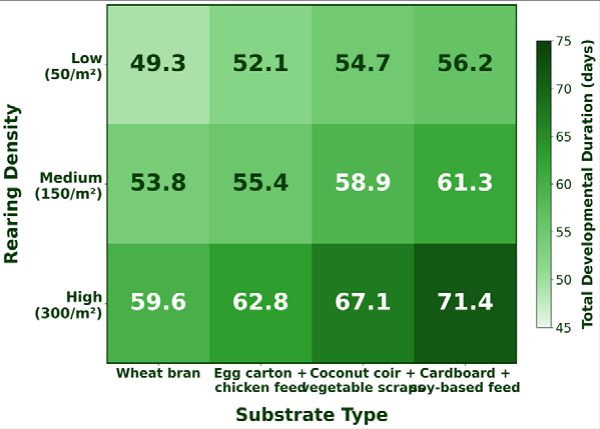 Figure 3
Introduction
Roughly 2,100 insect species are consumed by humans across 113 countries, contributing protein, fat, and micronutrients to the diets of an estimated two billion people [1] . Among these species, Acheta domesticus the common house cricket has emerged as one of the most promising candidates for commercial-scale insect farming, owing to its short generation time, high feed conversion eficiency, and well-characterised nutritional profile [2,3] . European and North American regulatory frameworks have begun to accommodate edible insects as novel foods, and the global edible insect market is projected to grow substantially over the coming decade [4,5] . Yet, scaling cricket production from backyard operations to industrial facilities demands a much more detailed understanding of the biological parameters that govern growth, survival, and reproduction. Two factors stand out as particularly important for farmers: rearing density and substrate type. Density affects resource competition, cannibalism risk, disease transmission, and stress-mediated hormonal changes that can delay development or reduce fecundity [6] . Substrate the combination of structural habitat material and feed determines nutrient availability, moisture regulation, and the physical environment in which crickets shelter, moult, and oviposit [7] . Previous work on rearing density in A. domesticus has produced mixed conclusions. Lundy and Parrella [5] reported that highdensity populations on organic side-streams achieved lower feed conversion ratios than expected, challenging the assumption that crickets are inherently eficient converters of waste into protein. Sorjonen et al. [7] found that plant-based byproduct diets supported adequate growth in both A. domesticus and Gryllus bimaculatus, but their research did not systematically vary density alongside diet composition. Other researchers have examined density efects in related gryllid species or in Tenebrio molitor, but the specific interaction between density and substrate in A. domesticus has not been adequately resolved [8,2] . Moulting frequency is a developmental parameter that receives less atention than it should. House crickets pass through 7-9 nymphal instars before reaching adulthood, and the number of completed moults can vary depending on environmental conditions [9] . Crowding may suppress late-instar moults, leading to smaller adult body size and reduced reproductive output. Conversely, some degree of social stimulation appears to facilitate synchronised moulting, which can be advantageous for harvest scheduling [10] . The trade-of between too litle and too much crowding remains poorly quantified under controlled laboratory conditions.
Reproductive fitness encompasses several measurable traits female fecundity (total eggs produced), egg hatchability, mating frequency, and the body condition of reproductive adults [11,12] . All of these traits are likely to respond to both density and nutrition. High rearing densities increase male-male competition and may alter sex-specific energy allocation strategies, potentially reducing sperm quality or female investment in egg provisioning [13,6] . At the same time, nutrientpoor substrates may limit the metabolic resources available for gonad maturation and vitellogenesis, compounding the efects of crowding. Understanding the density × substrate interaction is especially relevant for farmers operating in temperate climates, where heating costs constrain the total rearing volume and operators must decide how many crickets to house per unit of heated space [14] . If the productivity losses from high density outweigh the savings on floor space, then lower-density configurations may prove more economical in the long run. But this calculation depends on the substrate: a high-quality feed substrate might bufer some of the negative efects of crowding, while a low-quality substrate could amplify them. The Netherlands, with its well-established infrastructure for insect farming research and a regulatory environment that permits insect rearing for food and feed, provides an appropriate seting for this type of controlled investigation [15,1] . The climatecontrolled facilities available at the Arnhem Research Institute of Biological Sciences allowed us to eliminate temperature and photoperiod as confounding variables, isolating the efects of density and substrate on cricket biology. This research therefore aimed to quantify the efects of three rearing densities (50, 150, and 300 individuals per square metre) and four substrate types (wheat bran; egg carton with chicken feed; coconut coir with vegetable scraps; cardboard with soy-based feed) on the developmental duration, moulting frequency, and reproductive fitness of A. domesticus under controlled conditions. A factorial experimental design was used to capture interaction efects, providing a dataset that can inform practical stocking recommendations for small and mediumscale cricket farming operations [16,17] .
Material and Methods
Material and Methods
Study Area Description
All experimental work was conducted in the Invertebrate Biology Wing of the Arnhem Research Institute of Biological Sciences, Arnhem, Netherlands (51.9851°N , 5.8987°E) . The facility consists of six climate-controlled rooms, each equipped with independent temperature, humidity, and photoperiod regulation. Rooms were maintained at 28±1 °C , 60±5 % relative humidity, and a 12L:12D photoperiod throughout the experimental period (September 2022 to February 2023). These conditions fall within the optimal range reported for A. domesticus rearing in temperate regions [14,1] .
Climatic and Environmental Conditions
Although the experiment was conducted entirely indoors, external climatic conditions were logged for reference. Arnhem experienced mean outdoor temperatures ranging from 2.3 °C (December 2022) to 11.8 °C (September 2022) during the research period, with relative humidity between 78% and 93%. Indoor climate control maintained stable conditions regardless of external fluctuations. CO₂ concentration within rearing rooms was monitored weekly and remained below 1,200 ppm. Air exchange was provided by HEPA-filtered ventilation at 4 air changes per hour, preventing ammonia build-up from cricket waste [8,12] .
Material
A. domesticus eggs were obtained from an established colony maintained at the institute for over three generations, originally sourced from a certified supplier in Wageningen, Netherlands. Eggs were incubated at 30±0.5°mathsfC on moist coton in Petri dishes until hatching. Newly hatched nymphs (< 12 hours old) were sorted and randomly assigned to treatment groups. Rearing containers were opaque polypropylene boxes (60×40×30cm) fited with mesh lids for ventilation. Water was provided ad libitum via coton-wick drinkers, refreshed every 48 hours [5,7] .
Four substrate treatments were prepared (S1) wheat bran alone, replenished weekly at 5 g per cricket per week; (S2) shredded egg carton as structural habitat plus standard poultry feed pellets at equivalent dry-mater provision; (S3) coconut coir bedding with chopped vegetable scraps (carrot, potato, letuce) replaced every three days; and (S4) corrugated cardboard strips with soy-based commercial cricket feed. All substrates were sterilised by autoclaving at 121 °C for 20 minutes before use to eliminate parasites and pathogens [9,15] .
Methods
A fully crossed 3×4 factorial design was employed, with three density levels (D1 = 50, D2 = 150, D3 = 300 nymphs per square metre) and four substrate types, yielding 12 treatment combinations. Each combination was replicated five times, producing 60 experimental units in total. Containers were arranged across six rooms in a randomised complete block design, with room treated as a blocking factor [6,10] . Developmental duration was recorded as the number of days from hatching to final adult moult. Each container was inspected daily between 08:00 and 10:00 hours. Exuviae (shed cuticles) were collected, counted, and removed at each inspection to track moulting events per individual. Nymphal instar was determined by measuring head capsule width of randomly sampled individuals using a stereomicroscope fited with a calibrated ocular micrometer. Mortality events were recorded daily, and dead individuals were removed to prevent cannibalism artefacts [2,13] . At adult eclosion, individual body mass was recorded on an analytical balance (0.01 g precision). Sex was determined by the presence (female) or absence (male) of the ovipositor. Reproductive fitness was assessed over a 14-day post-eclosion window. Females were paired with males from the same treatment at a 1:1 sex ratio. Mating frequency was recorded by direct observation during two 30-minute sessions per day.
Oviposition substrates (moist sand trays) were provided and replaced every 48 hours. Eggs were counted under magnification, and hatchability was determined by incubating eggs at 30 °C for 14 days and counting emerged nymphs [12,18] . Data were analysed using a two-way ANOVA with density and substrate as fixed factors and room as a random blocking factor in R version 4.2.2. Interaction terms were included. Post hoc comparisons used Tukey's HSD at mathsfp<0.05 . Assumptions of normality and homoscedasticity were verified by Shapiro-Wilk and Levene's tests, respectively. Proportional data (hatchability, mortality) were arcsine-square-root-transformed before analysis [6] . Rearing density exerted a pronounced efect on every developmental and reproductive parameter measured. Crickets maintained at the lowest density (50 individuals/m²) consistently completed their nymphal development faster, moulted more frequently, achieved greater adult body mass, and produced more viable eggs than those reared at medium (150 / m²) or high (300/m²) density [5,6] . Substrate type also influenced these outcomes, though its efects were generally smaller in magnitude than those of density. The interaction between the two factors was statistically significant for developmental duration (F=4.87, p<0.001) , total moulting events (F = 3.21, p = 0.006), and female fecundity (F = 5.12, p < 0.001). At day 42 post-hatching, population structure difered markedly across density treatments. Low-density groups had 31.4% of individuals already in the reproductive adult stage, whereas only 19.1% of high-density individuals had reached adulthood by the same time point. Mortality at day 42 was 4.6% at low density, rising to 14.2% at high density a threefold increase largely atributed to cannibalism of freshly moulted individuals and competition-related starvation [13,18] . Switching from wheat bran to cardboard + soy at high density compounded these losses further, adding another 20% to developmental duration and reducing fecundity to levels that may compromise colony sustainability over multiple generations. The heatmap (Figure 3) illustrates this interaction gradient clearly, with the lower-right corner representing conditions least favourable for cricket production [5,7,16] .
Discussion
The main findings of this research can be summarised in three points. First, rearing density had a stronger efect than substrate type on all measured parameters. Second, density and substrate interacted significantly, meaning that the penalty of high density was amplified on lower-quality substrates. Third, reproductive fitness declined steeply above 150 individuals per square metre, with fecundity dropping by 40% and egg hatchability by 17 percentage points between the lowest and highest density treatments [6,12] . These results are broadly consistent with the density-dependent growth paterns reported for other gryllid species. Morales-Ramos et al. [2] documented reduced body mass in Tenebrio molitor larvae reared at elevated densities, atributing the efect to competition for food and physical interference during moulting. Lundy and Parrella [5] similarly noted that A. domesticus in high-density populations on organic waste streams achieved lower protein yields per unit of feed than anticipated, suggesting that crowding imposes metabolic costs that go beyond simple resource competition. Our observation that high-density crickets completed fewer moults (7.1 vs. 8.4 at low density) [5] aligns with this interpretation and extends it to the moulting process itself. However, some aspects of our data diverge from earlier reports. Sorjonen et al. [7] found that plant-based by-product diets supported comparable growth rates to commercial feeds in A. domesticus, whereas our coconut coir + vegetable scrap substrate performed consistently worse than wheat bran across all density levels. This discrepancy may reflect diferences in the specific plant materials used or in the moisture management of the substrate. Coconut coir retains moisture well, which could promote fungal growth and reduce feed palatability if not managed carefully a factor we observed anecdotally but didn't quantify [9,15] . Several mechanisms may explain the density-dependent suppression of moulting and reproduction. Crowding increases the frequency of physical contact, which can trigger stressrelated neuroendocrine responses in insects. In gryllids, juvenile hormone (JH) and ecdysteroid titres are known to regulate moulting and vitellogenesis [10] . Chronic crowding stress may alter the JH/ecdysteroid ratio, delaying intermoult intervals and reducing ovarian investment. Cannibalism of freshly moulted, soft-bodied individuals also rose sharply at high density, contributing to both mortality and a selection pressure favouring longer intermoult periods as a defensive strategy [13,18] .
From a practical standpoint, the results suggest that densities above 150 individuals per square metre impose biological costs that are unlikely to be ofset by the gains in space utilisation. For a farmer in a temperate climate who must heat rearing rooms during winter months, the decision between 50 / m² and 150 / m² may come down to economics: the medium density achieved developmental durations only 4-5 days longer than the low density on wheat bran (53.8 vs. 49.3 days) and maintained moderate reproductive fitness, making it a plausible compromise. But exceeding 150 / m² appears to trigger a steeper decline in productivity that erodes any space-related savings [1,8,14] . This threshold should be validated under commercial-scale conditions in future work.
Conclusion
The main contribution of this research is a quantitative characterisation of how rearing density and substrate type interact to shape the developmental biology and reproductive output of A. domesticus under controlled conditions. By employing a factorial design with three density levels and four substrate types across 60 experimental units, the research generated a dataset that captures not just the main efects of each factor but also their interaction an aspect that most previous work on cricket rearing has not addressed. Supporting evidence from this investigation points consistently toward low to medium rearing densities (50-150 individuals/m²) on wheat bran as the most productive configuration. At the lowest density, crickets completed development in 49.3 days, underwent 8.4 moults on average, reached adult body masses of 0.63 g, and produced 312 eggs per female with 89.7% hatchability. Medium density on the same substrate added roughly 4-5 days to developmental duration and reduced fecundity by about 21%, which may be an acceptable trade-of for operations seeking to maximise output per unit floor space. High density (300/m²), by contrast, extended development by up to 45%, suppressed moulting frequency, more than tripled mortality, and cut egg production by 40% losses too severe to justify the space savings. Substrate influenced outcomes in a consistent rank order across all density levels: wheat bran supported the fastest development and highest reproductive output, followed by egg carton with chicken feed, coconut coir with vegetable scraps, and cardboard with soy-based feed. The interaction between density and substrate was significant for developmental duration, moult count, and fecundity, meaning that the negative efects of high density were amplified on lower-quality substrates. For example, high-density crickets on cardboard + soy required 71.4 days to reach adulthood an increase of 45% relative to the low-density/wheat-bran baseline and produced only 187 eggs per female. The significance of these findings for the insect farming field lies in the demonstration that density and substrate cannot be optimised independently. A farmer who selects an inexpensive substrate must also adjust density downward to avoid compounding the negative efects, and a farmer who stocks at high density must invest in premium feed substrates to partially mitigate crowding stress. This interaction framework adds nuance to the single-factor recommendations that currently dominate the cricket farming literature. Several open questions remain. First, the present research was conducted under ideal environmental conditions (28 °C, 60% RH, 12L:12D), and the density × substrate interaction may difer under the suboptimal or fluctuating conditions found in lowcost tropical or subtropical rearing facilities. Second, we measured reproductive fitness over a single 14-day oviposition window; lifetime fecundity data would provide a more complete picture. Third, the nutritional composition of the substrates wasn't standardised on an isonitrogenous and isocaloric basis, so the substrate efects observed here reflect both nutritional and physical habitat diferences. Disentangling these components would require a separate set of experiments with formulated diets matched for protein and energy content. Finally, the economic dimension feed cost per kilogram of harvested cricket biomass at each density × substrate combination was outside the scope of this research but is the obvious next step for translating these biological results into practical farming recommendations. A costbenefit analysis that integrates developmental duration, mortality, feed consumption, and space requirements would allow farmers to identify the most profitable rearing configuration for their specific context.
Acknowledgement
AcknowledgementsThe authors are thankful to the concerned authorities for providing the necessary support and facilities for this research work.
Figures and tables from the paper
| Density × Substrate | Dev. duration (d) | Moult count | Adult mass (g) | Mortality (%) |
|---|---|---|---|---|
| D1 (50/m2) × Wheat bran | 49.3 ± 2.1 | 8.4 ± 0.3 | 0.63 ± 0.04 | 3.8 ± 1.1 |
| D1 × Egg carton + feed | 52.1 ± 2.4 | 8.3 ± 0.4 | 0.61 ± 0.05 | 4.2 ± 1.3 |
| D1 × Coconut coir + veg | 54.7 ± 2.6 | 8.2 ± 0.5 | 0.59 ± 0.04 | 5.1 ± 1.4 |
| D1 × Cardboard + soy | 56.2 ± 2.8 | 8.1 ± 0.4 | 0.58 ± 0.05 | 5.7 ± 1.6 |
| D2 (150/m2) × Wheat bran | 53.8 ± 2.3 | 7.8 ± 0.4 | 0.56 ± 0.05 | 7.2 ± 1.8 |
| D2 × Egg carton + feed | 55.4 ± 2.7 | 7.7 ± 0.5 | 0.54 ± 0.04 | 7.8 ± 2.0 |
| D2 × Coconut coir + veg | 58.9 ± 3.1 | 7.5 ± 0.5 | 0.52 ± 0.06 | 8.4 ± 2.1 |
| D2 × Cardboard + soy | 61.3 ± 3.4 | 7.3 ± 0.6 | 0.50 ± 0.05 | 9.1 ± 2.3 |
| D3 (300/m2) × Wheat bran | 59.6 ± 3.0 | 7.2 ± 0.5 | 0.51 ± 0.06 | 12.3 ± 2.7 |
| D3 × Egg carton + feed | 62.8 ± 3.3 | 7.1 ± 0.6 | 0.49 ± 0.05 | 13.1 ± 2.9 |
| D3 × Coconut coir + veg | 67.1 ± 3.6 | 6.9 ± 0.7 | 0.46 ± 0.07 | 14.8 ± 3.1 |
| D3 × Cardboard + soy | 71.4 ± 3.8 | 6.8 ± 0.6 | 0.43 ± 0.06 | 16.4 ± 3.4 |
Table text extracted from the original PDF; superscript letters are shown inline. The original table image is below.
View original table image
| Parameter | Low (50/m2) | Medium (150/m2) | High (300/m2) | p-value |
|---|---|---|---|---|
| Fecundity (eggs/female) | 312 ± 28 | 247 ± 31 | 187 ± 34 | <0.001 |
| Egg hatchability (%) | 89.7 ± 3.2 | 81.3 ± 4.1 | 72.4 ± 5.6 | <0.001 |
| Mating frequency (events/day) | 3.4 ± 0.8 | 2.7 ± 0.9 | 1.9 ± 0.7 | 0.002 |
| Reproductive category | High fitness | Moderate fitness | Low fitness | |
| Female body mass at oviposition (g) | 0.68 ± 0.05 | 0.58 ± 0.06 | 0.49 ± 0.07 | <0.001 |
| Oviposition onset (days post-eclosion) | 4.2 ± 0.8 | 5.7 ± 1.1 | 7.3 ± 1.4 | <0.001 |
Table text extracted from the original PDF; superscript letters are shown inline. The original table image is below.
View original table image
References
19 in the original paper- van Huis A, Van Iterbeeck J, Klunder H, Mertens E, Halloran A, Muir G, et al. Edible insects: future prospects for food and feed security. FAO Forestry Paper. 2013;171:1-187.
- Morales-Ramos JA, Rojas MG, Shapiro-Ilan DI, Tedders WL. Self-selection of two diet components by Tenebrio molitor larvae and its impact on fitness. Environmental Entomology. 2011;40(5):1285-1294.
- Oonincx DGAB, van Iterbeeck J, Heetkamp MJW, van den Brand H, van Loon JJA, van Huis A. An exploration on greenhouse gas and ammonia production by insect species suitable for animal or human consumption. PLoS One. 2010;5(12):e14445.
- Churchward-Venne TA, Pinckaers PJM, van Loon JJA, van Loon LJC. Consideration of insects as a source of dietary protein for human consumption. Nutrition Reviews. 2017;75(12):1035-1045.
- Lundy ME, Parrella MP. Crickets are not a free lunch: protein capture from scalable organic side-streams via high-density populations of Acheta domesticus. PLoS One. 2015;10(4):e0118785.
- Halloran A, Roos N, Eilenberg J, Ceruti A, Bruun S. Life cycle assessment of edible insects for food protein: a review. Agronomy for Sustainable Development. 2016;36(4):57.
- Sorjonen JM, Valtonen A, Hirvisalo E, Karhapaa M, Lehtovaara VJ, Lindgren J, et al. The plantbased byproduct diets for the mass-rearing of Acheta domesticus and Gryllus bimaculatus. PLoS One. 2019;14(6):e0218830.
- Oonincx DGAB, de Boer IJM. Environmental impact of the production of mealworms as a protein source for humans: a life cycle assessment. PLoS One. 2012;7(12):e51145.
- Adamkova A, Kourimska L, Borkovcova M, Linhartova Z, Zita L, Kucma P, et al. Nutritional potential of selected insect species reared on the island of Sumatra. International Journal of Environmental Research and Public Health. 2017;14(5):521.
- Gahukar RT. Edible insects farming: eficiency and impact on family livelihood, food security, and environment compared with livestock and crops. In: Halloran A, et al., editors. Edible Insects in Sustainable Food Systems. Springer; 2018. p. 85-111.
- Mukherjee S, Mukherjee A. Small-scale breeding and harvesting of house cricket Acheta domesticus. Acta Entomologica et Zoologica. 2022;3(2):112-115.
- Fernandez-Cassi X, Supeanu A, Vaga M, Jansson A, Boqvist S, Vagsholm I. The house cricket (Acheta domesticus) as a novel food: a risk profile. Journal of Insects as Food and Feed. 2019;5(2):137-157.
- Ssepuuya G, Namulawa V, Mbabazi D, Mugerwa S, Fuuna P, Ekesi S, et al. Use of insects for fish and poultry compound feed in sub-Saharan Africa: a systematic review. Journal of Insects as Food and Feed. 2017;3(4):289-302.
- Cortes Ortiz JA, Ruiz AT, Morales-Ramos JA, Thomas M, Rojas MG, Tomberlin JK, et al. Insect mass production technologies. In: Dossey AT, editor. Insects as Sustainable Food Ingredients. Academic Press; 2016. p. 153-201.
- Miech P, Berggren A, Lindberg JE, Chhay T, Khieu B, Jansson A. Growth and survival of reared Cambodian field crickets fed weeds, agricultural and food industry byproducts. Journal of Insects as Food and Feed. 2016;2(4):285-292.
- van Huis A. Edible insects: challenges and prospects. Entomological Research. 2022;52(4):161-177.
- Heckmann LH, Andersen JL, Gianoten N, Calis M, Fischer CH. Sustainability and safety aspects of the house cricket in a circular food system. Journal of Insects as Food and Feed. 2022;8(Suppl 1):S81-S82.
- Magara HJO, Niassy S, Ayieko MA, Muber EK, Egonyu JP, Tanga CM, et al. Edible crickets (Orthoptera) around the world: distribution, nutritional value, and other benefits. Frontiers in Nutrition. 2021;7:537915.
- Chia SY, Tanga CM, Osuga IM, Mohamed SA, Khamis FM, Salifu D, et al. Efects of waste stream combinations from brewing industry on performance of black soldier fly, Hermetia illucens. PeerJ. 2019;7:e8028.