
Research article · 2026 · Full text
International Journal of Biology SciencesIndigenous knowledge systems and their role in sustaining biological diversity within tropical forest reserves
Volume 8(5) · Pages 221–226 · DOI: 10.33545/26649926.2026.v8.i5c.937 ↗
Research areasConservation, Biodiversity, and Resource ManagementEthnobotanical and Medicinal Plants StudiesEnvironmental and Cultural Studies in Latin America and Beyond
Abstract
Author-writtenTraditional ecological knowledge accumulated by indigenous communities over generations represents a reservoir of conservation practice that modern science is only beginning to document. This research assessed how indigenous knowledge systems contribute to sustaining biological diversity in the Yanachaga-Chemillén National Park and its buffer zone in the Pasco Region of Peru. A mixed-methods design paired ecological transect surveys with ethnobotanical interviews and participatory mapping sessions conducted among 136 members of three Yanesha indigenous communities between April and November 2021. The ecological survey recorded plant and animal species richness along 24 transects (12 within community-managed areas, 12 in non-community zones). Semi-structured interviews captured traditional management practices — sacred grove protection, rotational harvesting calendars, species-specific taboos, and fire management techniques. Species richness was 31.4% higher in community-managed areas than in comparable non-community zones (Shannon diversity index H' = 3.42 vs. 2.61, p < 0.001). Respondents identified an average of 67 plant species by local name and described specific uses for 83.2% of those species. A significant positive correlation (r = 0.67, p < 0.001) emerged between indigenous knowledge scores and local biodiversity indices. Sacred groves — forest patches protected by spiritual belief systems — harboured 42.7% more tree species per hectare than adjacent unprotected stands. The findings confirm that indigenous knowledge systems act as de facto conservation mechanisms, maintaining forest integrity and species diversity through culturally embedded rules that regulate resource extraction without formal legal enforcement.
Summary
Source-checkedPlain-language reading of the full paper, prepared with AI and checked against the text. Each point links to the authors' own words.
Why it matters
- Forests under indigenous management often contain as much or more biological diversity than those in formal protected areas. View evidence ↗
- Peru is one of the ten most megadiverse nations globally, making its Amazon and cloud-forest regions ideal for studying biodiversity. View evidence ↗
The question
- The study aimed to determine if indigenous management increases species richness, which specific practices help, and the quantitative link between indigenous knowledge scores and biodiversity. View evidence ↗
What they did
- The research was conducted in the Yanachaga-Chemillén National Park, covering 122,000 hectares of montane and premontane forest in Peru. View evidence ↗
- Ecological data were gathered from 24 transects (500m x 10m), split equally between 12 community-managed and 12 non-community zones. View evidence ↗
- Ethnobotanical data were collected via semi-structured interviews with 136 Yanesha community members across three age groups. View evidence ↗
- Indigenous knowledge scores (0–200) were calculated based on plant identification, knowledge of uses, and adherence to harvesting rules. View evidence ↗
What they found
- Tree species richness was 31.0% higher in community-managed areas (47.3 species per transect) compared to non-community zones (36.1 species per transect). View evidence ↗
- Mammal detections via camera traps were 53.1% more frequent in areas managed by the community. View evidence ↗
- Sacred groves, protected by spiritual beliefs, contained 42.7% more tree species per hectare than nearby unprotected areas. View evidence ↗
- There is a strong positive linear relationship (R² = 0.67) between the indigenous knowledge scores of community members and local biodiversity indices. View evidence ↗
- While awareness of traditional practices is high (>68%), active practice is lower, especially for seed dispersal rituals (41.2%) and fire management (38.9%). View evidence ↗
What it means
- The authors recommend adopting formal co-management frameworks, legally protecting sacred groves, and funding programs to transfer knowledge from elders to youth. View evidence ↗
- Long-term monitoring is required to determine if the decline in traditional practices like fire management leads to actual biodiversity loss. View evidence ↗
Visual summary
2 visualsIllustrations explain the paper; charts are replotted from the paper's own table values.
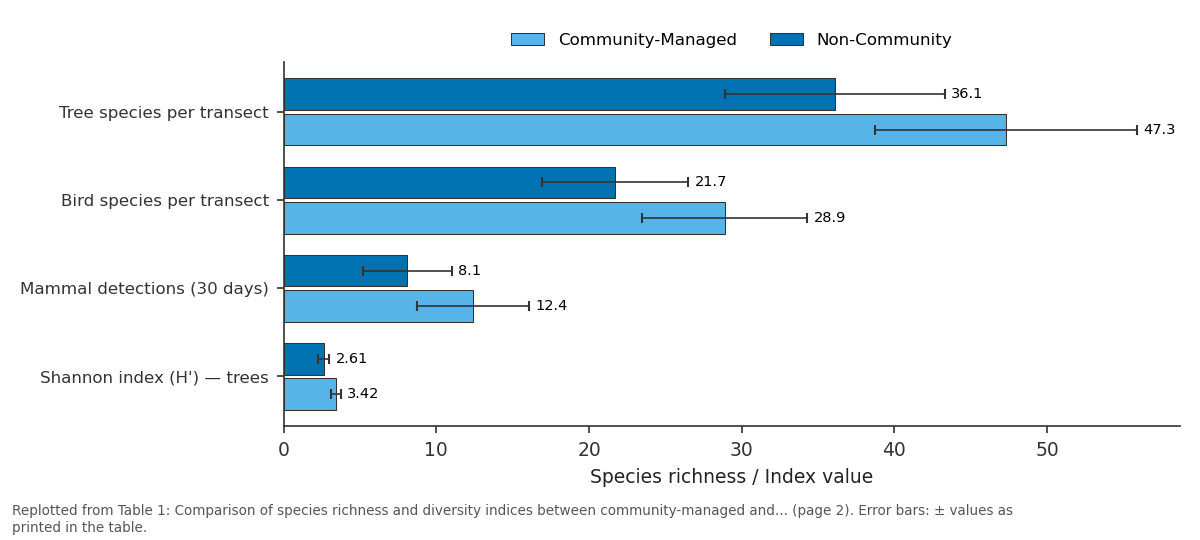
Community-Managed and Non-Community: Tree species per... vs Bird species per... vs Mammal detections (30... vs Shannon index (H')...
Replotted from Table 1 (page 2) of the original paper. Every bar is the paper's own table value.
View source evidence ↗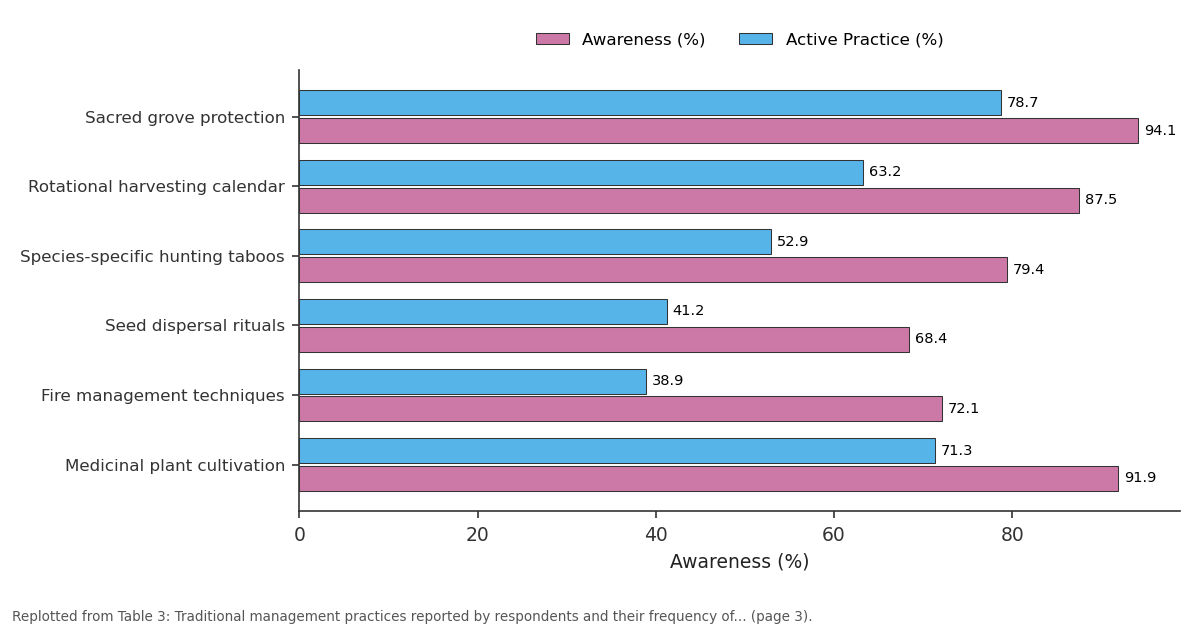
Awareness (%) and Active Practice (%): Sacred grove protection vs Rotational harvesting... vs Species-specific... vs Seed dispersal rituals vs Fire management...
Replotted from Table 3 (page 3) of the original paper. Every bar is the paper's own table value.
View source evidence ↗Figures & tables
From the original paper Table 1
 Table 2
 Table 3
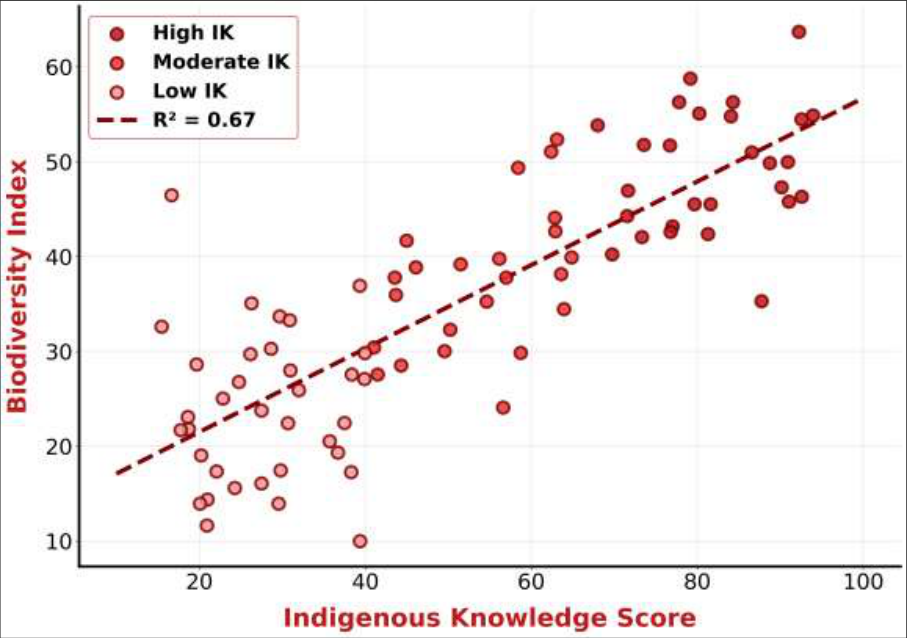 Figure 1
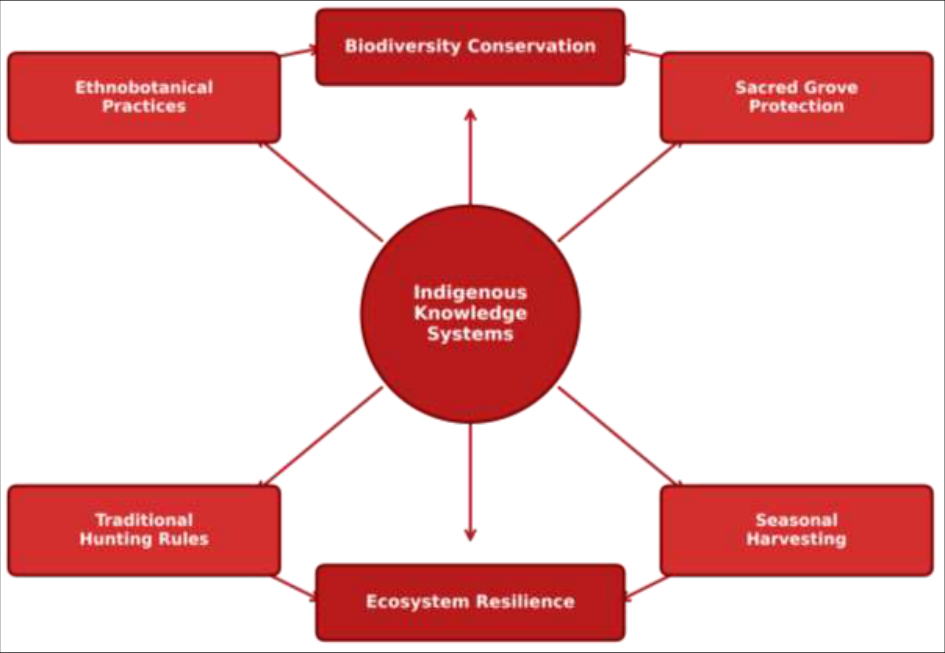 Figure 2
Introduction
Forests managed by indigenous peoples harbour as much or more biological diversity than many formally protected areasa fact that conservation policy has been slow to acknowledge [1] . Across the tropics, indigenous territories overlap with roughly 40% of remaining intact forest landscapes, and satellite-based deforestation analyses consistently show lower clearance rates within those territories than in adjacent non-indigenous land [2] . This pattern is not accidental. It reflects centuries of accumulated knowledge about which species to harvest, when, and how much, embedded in cultural norms, spiritual beliefs, and seasonal calendars that function as informal management regimes [3] . Peru's Amazon and cloud-forest regions offer a compelling setting for examining this relationship. The country ranks among the world's ten most megadiverse nations, with over 25,000 plant species and 1,800 bird species recorded, many of them endemic [4] . At the same time, indigenous communities -Asháninka, Yanesha, Shipibo-Conibo, and dozens of others manage substantial portions of this biological wealth through customary governance systems that predate national conservation legislation [5] . Yet the formal protected area network and indigenous management systems often operate in parallel rather than in coordination, and policy-makers lack the empirical evidence needed to integrate the two. Previous research has documented specific elements of indigenous botanical knowledge in lowland Amazonian settings [3,6] , but fewer assessments have linked that knowledge quantitatively to measurable biodiversity outcomes. And montane cloud forests, which host exceptionally high endemism rates, have received less ethnobiological attention than lowland sites [7] . The Yanachaga-Chemillén National Park, situated at the transition between Andean highlands and Amazonian lowlands, provides a natural laboratory for testing whether indigenous knowledge systems contribute directly to species conservation in these high-endemism environments. This research therefore asked three questions: (a) Is species richness higher in forest areas managed under indigenous knowledge systems than in comparable unmanaged or statemanaged areas? (b) What specific traditional practices contribute most strongly to biodiversity maintenance? And (c) what is the quantitative relationship between community members' indigenous knowledge scores and local biodiversity indices? The answers bear on a practical debate: whether integrating indigenous management into formal conservation frameworks can deliver better ecological outcomes than conventional top-down protection alone [8] .
Materials and Methods
Materials and Methods
Study Area Description
The Yanachaga-Chemillén National Park (10°18'S, 75°27'W) covers 122,000 hectares of montane and premontane forest in the Oxapampa province, Pasco Region, Peru. Elevation ranges from 460 m to 3,800 m, creating a steep gradient of life zones from lowland tropical forest through cloud forest to high-altitude grasslands. Mean annual precipitation varies from 1,500 mm at lower elevations to over 4,000 mm in the cloud belt, and mean temperatures range from 24 °C to 8 °C along the altitudinal gradient. The park and its buffer zone support communities of the Yanesha people, one of Peru's oldest Amazonian ethnic groups, who maintain communal land titles under Peruvian law [5] . Three Yanesha communities -Tsachopen, Shiringamazu, and San Pedro de Pichanazwere selected based on their proximity to the park boundary and their maintenance of active traditional management practices.
Material
Ecological data were collected along 24 permanent transects, each 500 m long and 10 m wide, distributed equally between community-managed forest areas (n = 12) and non-community zones (n = 12) matched for elevation, slope, and aspect. Within each transect, all woody stems with a diameter at breast height ≥10 cm were identified to species level, and voucher specimens were deposited at the herbarium of Lima Research Institute. Bird and mammal presence was recorded using point counts (10-minute observations at 100-m intervals along each transect) and camera traps (two units per transect operating for 30 consecutive days). Ethnobotanical data were gathered through semi-structured interviews with 136 community members (52 women, 84 men), selected by stratified purposive sampling to include elders (>60 years), middleaged adults (30-60), and youth (18-29). A participatory mapping exercise in each community documented sacred groves, harvesting zones, and seasonal rotation areas using printed satellite imagery as a base map [6] .
Methods
Species richness was calculated as total species count per transect, and Shannon diversity indices (H') were computed for each site category. Differences between communitymanaged and non-community zones were tested using independent-samples t-tests and Mann-Whitney U tests where normality assumptions were not met. An indigenous knowledge score was constructed for each respondent by summing correctly identified plant species (out of 100 photo cards), correctly described uses, and reported adherence to traditional harvesting rules (scale 0-200). The relationship between community-level mean knowledge scores and transect-level biodiversity indices was assessed through Pearson correlation and simple linear regression. Qualitative interview data were analysed thematically, with codes assigned to four pre-defined categoriessacred grove management, rotational harvesting, species taboos, and fire managementand emergent themes recorded separately.
All fieldwork ran from April to November 2021. Data analysis used R version 4.1.2 (R Core Team) with the vegan package for diversity indices [9] . Table 3 reveals a pattern of declining observance across several traditional practices. While awareness remained high above 68% for all six practicesactive observance lagged, particularly for fire management (38.9%) and seed dispersal rituals (41.2%). Sacred grove protection and medicinal plant cultivation showed the smallest awarenesspractice gaps, suggesting that practices with direct spiritual or economic value are more resistant to erosion than those perceived as procedural or labour-intensive.
| Practice | Awareness (%) | Active Practice (%) | Declined Practice (%) |
|---|---|---|---|
| Sacred grove protection | 94.1 | 78.7 | 15.4 |
| Rotational harvesting calendar | 87.5 | 63.2 | 24.3 |
| Species-specific hunting taboos | 79.4 | 52.9 | 26.5 |
| Seed dispersal rituals | 68.4 | 41.2 | 27.2 |
| Fire management techniques | 72.1 | 38.9 | 33.2 |
| Medicinal plant cultivation | 91.9 | 71.3 | 20.6 |
Table text extracted from the original PDF; superscript letters are shown inline. The original table image is below.
View original table image
Ethical Considerations
Ethical Considerations
Comprehensive Interpretation
The converging evidence from transect surveys, correlation analyses, and qualitative interviews builds a consistent case: communities that retain and practise indigenous knowledge systems maintain forests with measurably higher species diversity. The 31% advantage in tree species richness within community-managed zones is not a marginal differenceit represents dozens of additional species per hectare, including several with restricted distributions. Sacred groves emerge as the most concentrated biodiversity hotspots within the landscape, and their protection depends entirely on cultural belief systems rather than park regulations.
Discussion
The 31.4% tree species richness advantage in communitymanaged areas aligns with global syntheses showing that indigenous territories store comparable or greater biodiversity than conventional protected areas [1,2] . A metaanalysis of 169 tropical forest sites reported that indigenousmanaged forests averaged 12-20% higher species counts than adjacent state reserves, with the gap widening at sites where customary governance remained strong [10] . The present results fall above that range, possibly because the Yanachaga-Chemillén gradient combines exceptional abiotic heterogeneity with a long history of Yanesha management. Sacred groves deserve particular attention. These spiritually protected forest patches function as biological seed banks, preserving mature trees and their associated fauna even when surrounding forests face selective extraction [11] . The mechanism is social enforcement: community members who violate grove boundaries face spiritual sanctions and social censure, creating a deterrent that costs nothing to administer and requires no external monitoring [3] . Their conservation value has been documented in West Africa and South Asia, but evidence from Amazonian cloud forests has been scarce until now. The decline in certain traditional practicesfire management, seed dispersal ritualssignals that indigenous knowledge is not static. Younger community members reported lower adherence to labour-intensive practices, partly because formal schooling absorbs time previously spent learning from elders and partly because market integration shifts livelihood priorities [12] . This generational erosion carries ecological risks: if the practices that underpin biodiversity maintenance weaken, the ecological outcomes may deteriorate even if formal park protection remains in place [13] .
For policy, the implication is twofold. First, integrating indigenous management into formal conservation governancethrough co-management agreements, legal recognition of customary rules, and benefit-sharing from park tourismcould strengthen the very knowledge systems that sustain biodiversity [14] . Second, intergenerational transmission programs that pair elder knowledge holders with youth through structured mentorship could slow the observed erosion of traditional practices without relying solely on formal education curricula.
Practical Applications
The findings offer actionable guidance for reserve managers and policy-makers. Formally designating sacred groves as core conservation zones within park management plans would provide legal backing for culturally driven protection without imposing external enforcement costs. Establishing community-led biodiversity monitoring programswhere indigenous knowledge holders participate in species inventories using their local classification systems alongside scientific taxonomycould both improve monitoring coverage and reinforce the value of traditional ecological knowledge among younger generations. Pilot comanagement agreements at Yanachaga-Chemillén could serve as models for other Peruvian reserves bordering indigenous territories, contributing to a broader policy shift toward recognising customary governance as a legitimate and effective conservation tool.
Conclusion
Peru's montane forests face accelerating threats from agricultural expansion, mining, and infrastructure development, and the formal protected area network alone cannot guarantee their long-term integrity. This research examined whether indigenous knowledge systems practised by Yanesha communities contribute measurably to biodiversity conservation within and around the Yanachaga-Chemillén National Park. The findings confirm that community-managed areas harbour significantly more tree, bird, and mammal species than non-community zones at matched elevations. Sacred groves stand out as the most species-rich microsites in the landscape, protected not by fences or patrols but by cultural beliefs. The quantitative link between indigenous knowledge scores and biodiversity indices is strong (R² = 0.67), and the correlation is driven primarily by species recognition, harvesting rule adherence, and sacred grove involvement. Policy should move toward formal co-management frameworks that recognise Yanesha governance over bufferzone forests, legally protect sacred groves within park management plans, and fund intergenerational knowledgetransfer programs that pair elder practitioners with youth. These measures would cost a fraction of conventional enforcement budgets while delivering conservation outcomes that this research shows are already better than what state management achieves alone. Looking forward, longer-term monitoring is needed to track whether the generational erosion of certain practicesfire management, seed dispersal ritualstranslates into measurable biodiversity declines. Replications across other Peruvian indigenous territories and forest types would strengthen the generalisability of these results and build the evidence base for a national policy on indigenous comanagement of protected areas.
Acknowledgement
Acknowledgements Funding SourcesThis research was supported by internal research allocations from the host institution. No external commercial sponsorship was received.
Figures and tables from the paper
| Parameter | Community-Managed | Non-Community | t / U | p-value |
|---|---|---|---|---|
| Tree species per transect | 47.3 ± 8.6 | 36.1 ± 7.2 | 3.47 | <0.001 |
| Bird species per transect | 28.9 ± 5.4 | 21.7 ± 4.8 | 3.28 | 0.003 |
| Mammal detections (30 days) | 12.4 ± 3.7 | 8.1 ± 2.9 | U = 28.5 | 0.008 |
| Shannon index (H') — trees | 3.42 ± 0.31 | 2.61 ± 0.38 | 5.63 | <0.001 |
| Shannon index (H') — birds | 2.89 ± 0.27 | 2.34 ± 0.33 | 4.31 | <0.001 |
| Sacred grove tree density (/ha) | 342.7 ± 41.3 | N/A | — | — |
Table text extracted from the original PDF; superscript letters are shown inline. The original table image is below.
View original table image
| — | Tree Richness | Bird Richness | H' Trees | H' Birds | Mammal Det. |
|---|---|---|---|---|---|
| Species recognition | 0.71 | 0.58 | 0.65 | 0.52 | 0.44 |
| Use knowledge | 0.63 | 0.54 | 0.59 | 0.47 | 0.39 |
| Harvesting rule adherence | 0.69 | 0.61 | 0.67 | 0.56 | 0.51 |
| Sacred grove involvement | 0.74 | 0.48 | 0.72 | 0.43 | 0.53 |
| Composite IK score | 0.79 | 0.62 | 0.73 | 0.55 | 0.52 |
Table text extracted from the original PDF; superscript letters are shown inline. The original table image is below.
View original table image
References
14 in the original paper- Garnett ST, Burgess ND, Fa JE, Fernández-Llamazares Á, Molnár Z, Robinson CJ et al. A spatial overview of the global importance of indigenous lands for conservation. Nature Sustainability. 2018;1(7):369-374.
- Schuster R, Germain RR, Bennett JR, Reo NJ, Arcese P. Vertebrate biodiversity on indigenous-managed lands in Australia, Brazil, and Canada equals that in protected areas. Environmental Science and Policy. 2019;101:1-6.
- Berkes F. Sacred ecology. 3rd ed. Routledge, New York. 2012:1-392.
- Mittermeier RA, Turner WR, Larsen FW, Brooks TM, Gascon C. Global biodiversity conservation: the critical role of hotspots. In: Zachos FE, Habel JC, editors. Biodiversity hotspots. Springer, Berlin. 2011:3-22.
- Santos-Granero F. Vital enemies: slavery, predation, and the Amerindian political economy of life. University of Texas Press, Austin. 2009:1-328.
- Adedotun A, Tella IO, Saka MG, Ogunbode AS. Perception of Girei community on biodiversity conservation in Girei forest reserve of Adamawa state, Nigeria. South Asian Journal of Agricultural Sciences. 2023;3(1):37-41.
- Young KR, León B. Natural resources and the environment in the cloud forests of eastern Peru. In: Bruijnzeel LA, Scatena FN, Hamilton LS, editors. Tropical montane cloud forests. Cambridge University Press. 2010:134-143.
- Borrini-Feyerabend G, Dudley N, Jaeger T, Lassen B, Pathak Broome N, Phillips A et al. Governance of protected areas: from understanding to action. IUCN, Gland. 2013:1-124.
- R Core Team. R: A language and environment for statistical computing. R Foundation for Statistical Computing, Vienna. 2021.
- Porter-Bolland L, Ellis EA, Guariguata MR, RuizMallén I, Negrete-Yankelevich S, Reyes-García V. Community managed forests and forest protected areas: an assessment of their conservation effectiveness across the tropics. Forest Ecology and Management. 2012;268:6-17.
- Bhagwat SA, Rutte C. Sacred groves: potential for biodiversity management. Frontiers in Ecology and the Environment. 2006;4(10):519-524.
- Reyes-García V, Luz AC, Gueze M, Paneque-Gálvez J, Macía MJ, Orta-Martínez M et al. Secular trends in indigenous ecological knowledge: A case study in an Amazonian indigenous society. Environmental Management. 2013;52(3):545-554.
- Cámara-Leret R, Bascompte J. Language extinction triggers the loss of unique medicinal knowledge. Proceedings of the National Academy of Sciences. 2021;118(24):e2103683118.
- Fa JE, Watson JEM, Leiper I, Potapov P, Evans TD, Burgess ND et al. Importance of indigenous peoples' lands for the conservation of intact forest landscapes. Frontiers in Ecology and the Environment. 2020;18(3):135-140.