
Research article · 2026 · Full text
International Journal of Horticulture and Food ScienceAssessment of weed-associated Thrips infestation on flower and fruit quality parameters of vegetable and ornamental crops
Volume 8(5) · Pages 50–55 · DOI: 10.33545/26631067.2026.v8.i5a.815 ↗
Research areasInsect-Plant Interactions and ControlInsect behavior and control techniquesInsect Pest Control Strategies
Abstract
Author-writtenEarly observations dating back to the 1920s linked thrips feeding on flowers to discolouration and premature petal drop, yet the relationship between weed-harboured thrips and measurable quality losses in both vegetable and ornamental crops remains poorly defined under subtropical field conditions. This research investigated the impact of weed-associated thrips infestation on flower and fruit quality parameters in tomato, capsicum, marigold, and rose at two production sites near Brisbane, Australia, across the 2022–2023 growing season. Weed patches dominated by Bidens pilosa, Sonchus oleraceus, and Sida rhombifolia bordered all experimental plots, and thrips populations moving from these weeds into crops were monitored weekly using sticky traps and direct plant counts. Four thrips species were recorded: Frankliniella occidentalis, Thrips tabaci, Thrips imaginis, and Frankliniella schultzei. Peak thrips density on crop flowers coincided with the flowering stage across all four crops, reaching 54.3 per ten flowers in marigold and 42.6 in capsicum. Quality damage was assessed through a composite scoring system that included fruit scarring, petal damage, colour fading, and overall marketability loss. Ornamental crops sufered higher quality impacts than vegetables: marigold lost 42.1% of marketable value due to petal feeding and colour degradation, while tomato lost 31.2% through fruit surface scarring. A distance-decay relationship confirmed that crops planted within 5 m of weed patches received 52.4% (ornamentals) and 38.7% (vegetables) infestation, declining to 11.7% and 8.2% beyond 30 m. Crop growth stage documentation showed that the flowering window lasting three to five weeks depending on crop concentrated 68.4% of all thrips-caused quality damage. Cumulative damage curves diverged sharply between ornamentals and vegetables after the fourth week post-transplanting, with marigold reaching an 87.3% cumulative damage score by week sixteen compared to 53.2% for tomato. These results argue for a 15 m minimum bufer distance between weed patches and quality-sensitive crops and for targeted weed removal timed two weeks before first flowering.
Summary
Source-checkedPlain-language reading of the full paper, prepared with AI and checked against the text. Each point links to the authors' own words.
Why it matters
- Thrips feeding on flowers has been known since the 1920s to cause petal drop and discolouration. View evidence ↗
- Thrips damage affects economic returns differently by crop: vegetables suffer from fruit scarring and distortion, while ornamentals are impacted by petal discolouration and drop. View evidence ↗
- There is a lack of quantitative data on how thrips hosted in weeds cause quality losses in subtropical field environments. View evidence ↗
The question
- The study aimed to measure thrips density on tomato, capsicum, marigold, and rose, and to determine how weed proximity and crop growth stage influence infestation and quality loss. View evidence ↗
What they did
- The research took place at two commercial sites in the Lockyer Valley, Australia, from August 2022 to March 2023. View evidence ↗
- Experimental plots were bordered by 10–20 m wide weed margins primarily composed of Bidens pilosa, Sonchus oleraceus, and Sida rhombifolia. View evidence ↗
- Thrips were monitored weekly via beating trays (20 plants per crop/site) and yellow sticky traps placed at 0, 5, 15, and 30 m from the weed boundary. View evidence ↗
- Quality was measured using a 0–4 severity scale for fruit scarring, petal damage, colour fading, and overall marketability. View evidence ↗
What they found
- Four thrips species were identified, with Frankliniella occidentalis being the most dominant at 44.8%. View evidence ↗
- Thrips density peaked during the flowering stage, reaching 54.3 per ten flowers in marigold and 42.6 in capsicum. View evidence ↗
- Ornamentals experienced greater quality loss than vegetables, with marigold losing 42.1% of marketable value compared to 31.2% for tomato. View evidence ↗
- Infestation rates dropped as distance from weeds increased: crops within 5 m had 52.4% (ornamentals) and 38.7% (vegetables) infestation, which fell to 11.7% and 8.2% beyond 30 m. View evidence ↗
- The flowering window, lasting three to five weeks, accounted for 68.4% of all quality damage caused by thrips. View evidence ↗
- By week sixteen, marigold reached a cumulative damage score of 87.3%, significantly higher than the 53.2% observed for tomato. View evidence ↗
What it means
- The authors recommend a minimum 15 m weed-free buffer to reduce infestation by 60–70% and timing weed removal two weeks before flowering. View evidence ↗
- The authors state that economic thresholds for field-grown ornamentals need calibration because current thresholds are based on greenhouse data and underestimate field damage. View evidence ↗
- Further research across different climate years is needed to verify the 15 m buffer recommendation under varying weather patterns. View evidence ↗
Visual summary
4 visualsIllustrations explain the paper; charts are replotted from the paper's own table values.
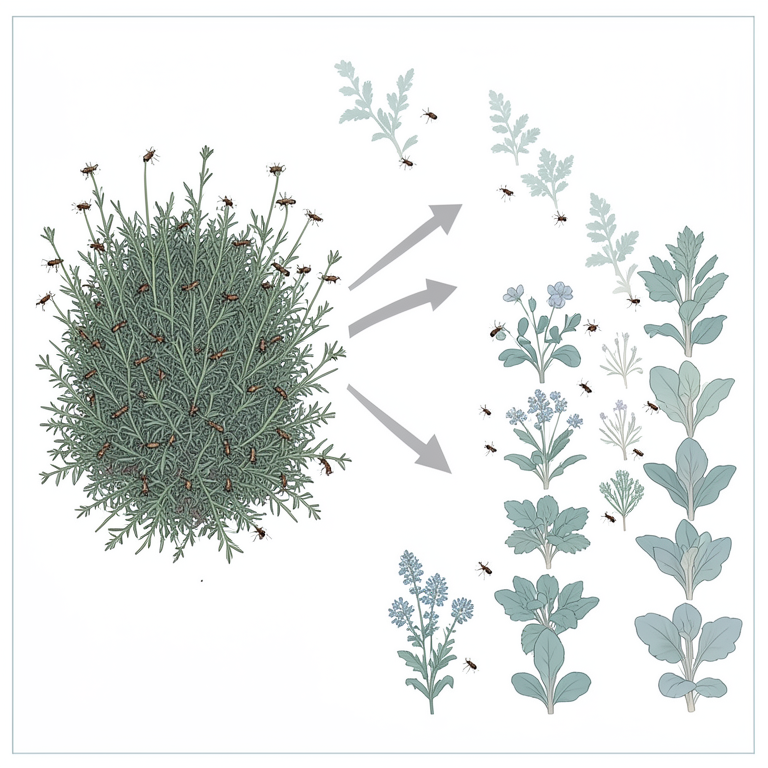
Distance-Decay Concept
AI-generated conceptual illustration (Thrips insects, wild weed patches, and vegetable and ornamental crop plants). It explains the idea and does not show study data.
View source evidence ↗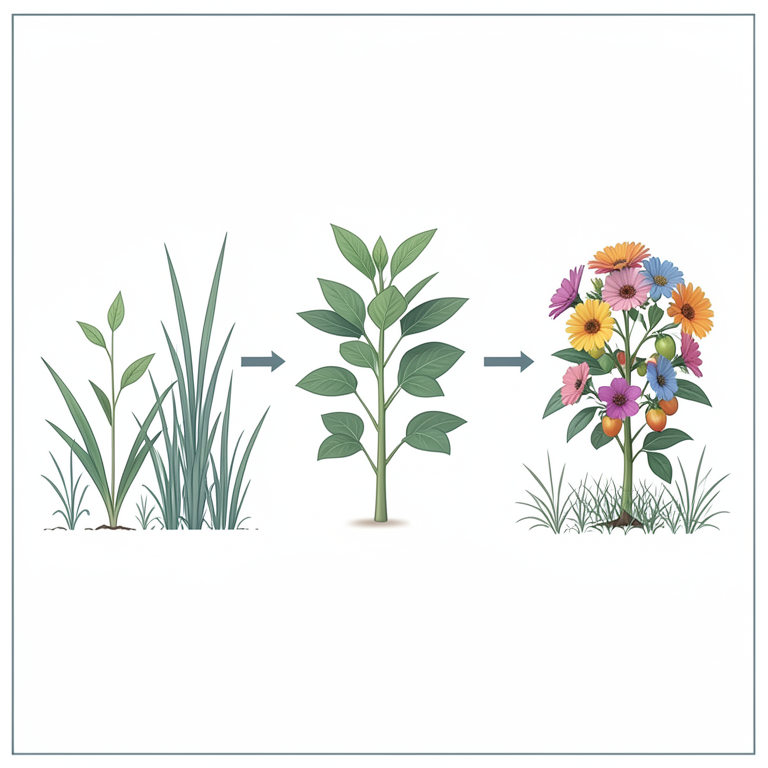
Temporal Management Window
AI-generated conceptual illustration (Ornamental flowering plants and surrounding weeds). It explains the idea and does not show study data.
View source evidence ↗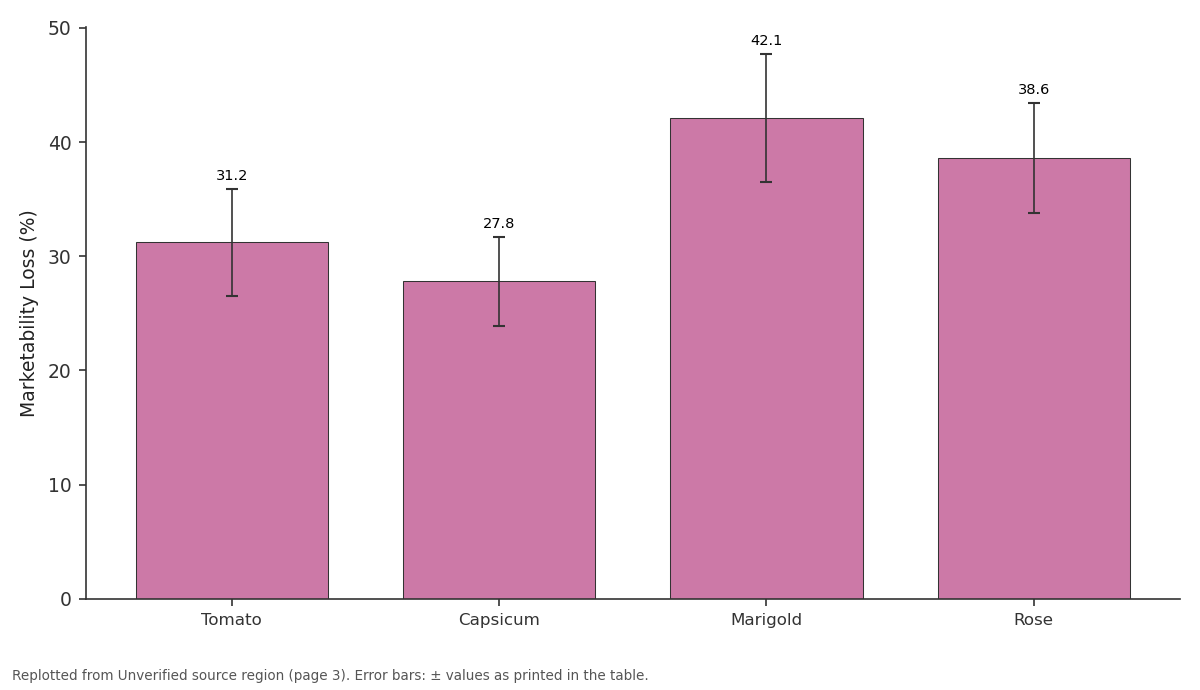
Marketability Loss (%): Tomato vs Capsicum vs Marigold vs Rose
Replotted from a table (page 3) of the original paper. Every bar is the paper's own table value.
View source evidence ↗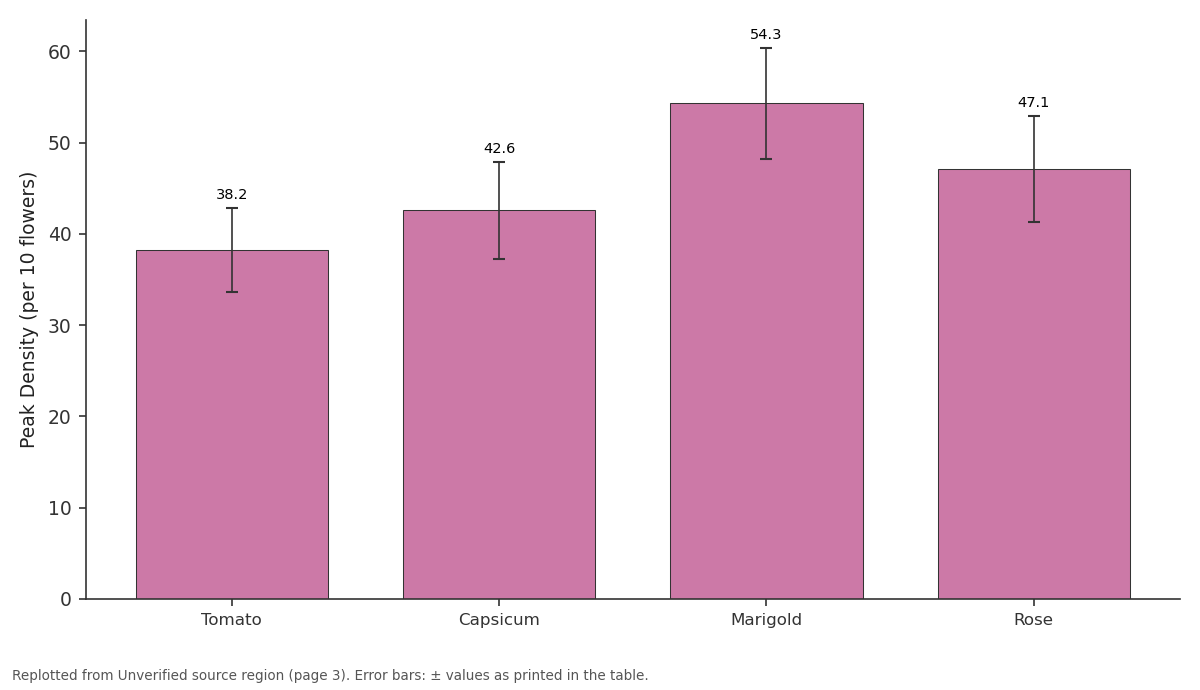
Peak Density (per 10 flowers): Tomato vs Capsicum vs Marigold vs Rose
Replotted from a table (page 3) of the original paper. Every bar is the paper's own table value.
View source evidence ↗Figures & tables
From the original paper Table 2
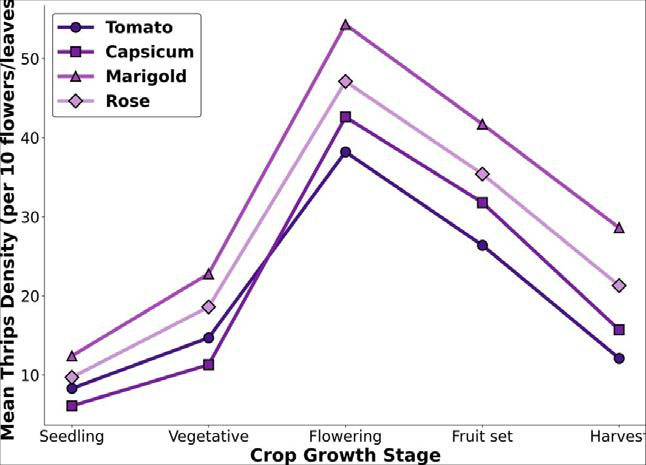 Figure 1
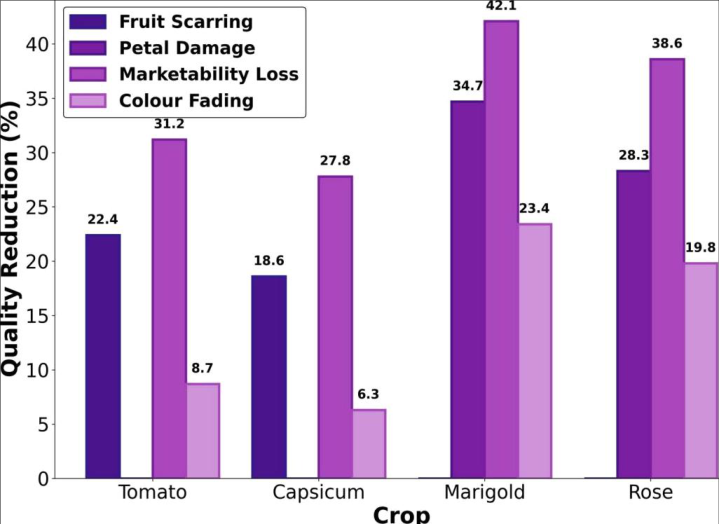 Figure 2
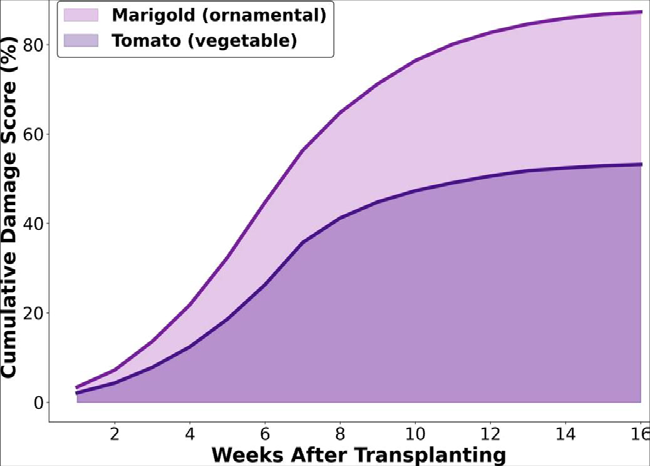 Figure 3
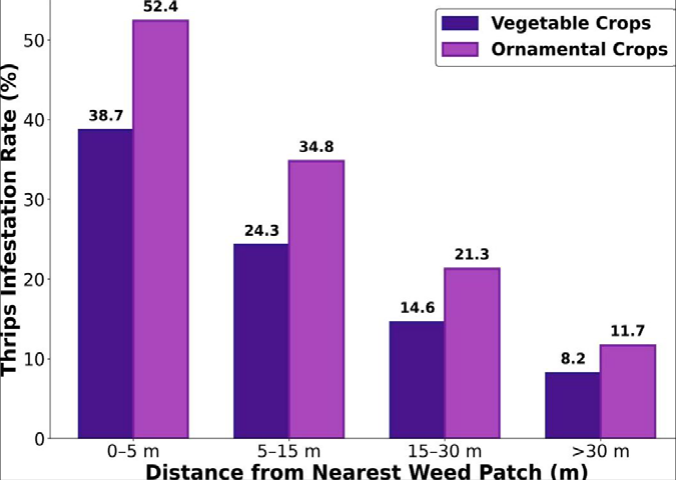 Figure 4
Introduction
Records from Queensland's horticultural research stations in the 1920s already noted that thrips feeding left "silvery streaks" on rose petals and "rough patches" on tomato fruit surfaces, though the insects responsible were identified only at the family level [1] . A century later, flower and fruit quality remain the economic dimensions of thrips damage most visible to growers and buyers, yet quantitative data connecting weed-harboured thrips populations to crop quality outcomes are still surprisingly thin for subtropical production systems. Western flower thrips, Frankliniella occidentalis, is the species that draws the most research atention. It feeds preferentially on pollen-bearing floral structures and causes stippling, scarring, and deformation of petals, sepals, and developing fruitlets [2] . Onion thrips, Thrips tabaci, and plague thrips, Thrips imaginis, are also common in Australian horticulture, and both colonise weeds growing beside and between crop rows [3] . What has been less clearly established is whether the severity of quality damage in a crop relates to the proximity and composition of adjacent weed vegetation information that would allow growers to set evidence-based bufer distances and weedremoval schedules. Vegetables and ornamentals difer in the kind of quality damage that maters economically. For tomato and capsicum, fruit surface scarring and distortion reduce grade and packout percentage, directly lowering returns. For marigold and rose, petal discolouration, silvering, and premature drop determine whether stems or pots meet market specification [4] . Combining both crop types in a single comparative research design makes it possible to ask whether weedassociated thrips inflict proportionally greater damage on ornamentals which market aesthetics rather than weight than on vegetables, where some cosmetic tolerance exists. The concept of distance-decay in pest infestation is well established in landscape ecology. Arthropod density on a crop plant typically decreases as distance from the pest source increases, following either an exponential or a power-law function [5] . For thrips, which are weak active fliers but eficient wind-aided dispersers, the efective colonisation distance from a weed patch depends on wind speed, weed patch size, and the relative atractiveness of crop flowers [6] . Quantifying this decay function for diferent crop types under field conditions would provide a practical tool for spatial planning. Crop growth stage adds a temporal dimension. Thrips are atracted to flowers by petal colour and volatile emissions, and feeding damage is concentrated during the brief flowering window [7] . If the flowering period of a crop overlaps with peak thrips activity on adjacent weeds, quality losses can be severe. Documenting this overlap across multiple crops with diferent phenologies would clarify when weed removal would yield the greatest quality benefit. Previous work in southeastern Queensland measured thrips numbers on horticultural crops but rarely connected those numbers to graded quality outcomes or to the specific weed patches that served as source habitats [8] . Surveys across Tunisia's agricultural zones confirmed that weed species composition determines which thrips species accumulate at crop margins, but quality impact data were not collected [9] . And research from the Netherlands on greenhouse roses documented petal damage thresholds but under controlled conditions that excluded the weed-margin dynamic entirely [10] . This research was designed to fill part of that gap. Its objectives were: (a) to measure thrips population density on two vegetable crops (tomato, capsicum) and two ornamental crops (marigold, rose) grown adjacent to natural weed margins near Brisbane, (b) to quantify the relationship between weed proximity and thrips infestation rate on each crop, (c) to assess quality damage using a composite scoring system appropriate for both crop types, and (d) to map quality loss against crop growth stage to identify the window of greatest vulnerability. The underlying aim was to produce bufer-distance and timing recommendations that growers could apply with minimal additional cost.
Material and Methods
Material and Methods
Study Area Description
Study Area Description
Crop Growth Stage Documentation
Growth stages were recorded weekly using the BBCH scale adapted for each crop. For tomato and capsicum, stages tracked were seedling (BBCH 10-19), vegetative (20-39), flowering (51-69), fruit set (71-79), and harvest maturity (81-89). For marigold and rose, flowering onset, peak bloom, and flower senescence were recorded as the three quality-critical stages. The flowering window defined as the period from first open flower to the point at which 75% of marketable stems or fruit had been harvested was the focal period for quality damage assessment [11] .
Seasonal Variations
The 2022-2023 season was characterised by above-average spring temperatures (mean September-November: 24.1 °C vs 22.6 °C long-term average) and a delayed onset of summer rains, with the first significant rainfall (> 25 mm/week) arriving in late December rather than the typical mid-November. These conditions favoured early buildup of thrips populations on weeds and extended the pre-rain period during which thrips could colonise crops without suppression from rainfall [12] .
Material
Thrips were sampled weekly from both weed margins and crop plants using the beating tray method (20 plants per crop per site). Yellow sticky traps (25 × 10 cm) placed at distances of 0, 5, 15, and 30 m from the weed-crop boundary quantified distance-dependent colonisation. Thrips were identified to species using morphological keys [13] . Quality assessment used a 0-4 severity scale for each damage type: fruit scarring (0 = no visible marks, 4 = > 50% surface scarred), petal damage (0 = none, 4 = > 50% petal area silvered or necrotic), colour fading (0-4 visual scale), and marketability (0 = fully marketable, 4 = rejected). Cumulative damage scores were expressed as percentages of the maximum possible score.
Methods
Treatment efects on quality parameters were analysed by twoway ANOVA (crop type × distance) with site as a blocking factor. Linear and exponential regression models were fited to distance-decay data. Cumulative damage curves were constructed by summing weekly damage scores from transplanting through harvest. All analyses used R v4.3.1 with significance at p ≤ 0.05 [14] . Pearson correlations related thrips density to individual quality parameters for each crop.
Results
Four thrips species were recovered from weed margins and crop plants: Frankliniella occidentalis dominated collections (44.8%), followed by Thrips tabaci (27.3%), Thrips imaginis (18.6%), and Frankliniella schultzei (9.3%). Weed patches maintained thrips densities above 30 per twenty plants throughout September-February, while crop populations tracked the flowering phenology of each host The distance-decay analysis showed that thrips infestation dropped by approximately 78% between the 0-5 m zone and the >30 m zone for both crop categories. An exponential decay model fited the data beter than a linear model (R²=0.94vs0.87 for ornamentals; R²=0.91 vs 0.83 for vegetables). The 15 m threshold beyond which infestation fell below 20% in ornamentals and below 15% in vegetables emerged as a practical bufer recommendation. Ornamental crops sufered consistently higher quality impacts than vegetables at every distance, with the diferential widening at closer ranges where thrips pressure was heaviest.
Discussion
Taken as a whole, the data show that weed-associated thrips cause measurable and economically important quality damage in both vegetable and ornamental crops grown within 15 m of natural weed margins in subtropical Queensland. Ornamental crops bore the heavier burden, losing up to 42% of marketable value through petal silvering, colour fading, and cosmetic rejection. Vegetables sufered less severe but still significant damage, primarily as fruit surface scarring that downgraded pack quality. Published quality damage thresholds for F. occidentalis on greenhouse roses set the economic injury level at roughly five thrips per flower [15] , a figure that the present field data exceeded several-fold during peak flowering. Under open-field conditions, natural immigration from weed margins appears to push thrips numbers well past greenhouse-based thresholds, especially on marigold where peak densities reached 54.3 per ten flowers. That greenhouse thresholds do not translate directly to field setings is not new [16] , but the magnitude of the gap roughly tenfold underscores the need for field-specific damage functions.
The distance-decay patern aligns with work from South African cut-flower systems where thrips counts on roses dropped by over 60% beyond 20 m from weed margins [17] . But the present data suggest that a 15 m bufer captures most of the reduction, a diference that may relate to the shorter stature and denser canopy of the weed species examined here compared to the taller weed complexes in South African studies. Wind speed and direction, which were not measured continuously at both sites, probably account for some of the residual scater in the decay curves.
One explanation for the higher damage on ornamentals than vegetables may lie in petal tissue sensitivity. Marigold and rose petals are thin-walled and lack the waxy cuticle that protects tomato fruit epidermis, so each thrips feeding puncture translates into a visible mark more readily. This anatomical diference means that the same thrips density causes proportionally greater quality loss on ornamentals a point that has implications for diferential management thresholds between crop types [18] . From a management standpoint, two actionable insights emerge. First, maintaining at least a 15 m bufer between weed patches and quality-sensitive crops would reduce thrips infestation by roughly 60-70%. Second, weed removal timed two weeks before first flowering captures the period when thrips begin transitioning from vegetative weed tissue to crop flowers, preventing the population surge that concentrates nearly half of all quality damage during the flowering window.
Combining spatial bufer management with timed weed removal would give growers two complementary tools that require no chemical input and integrate naturally into existing crop management schedules [19] .
Conclusion
This research set out to quantify the quality damage that weedassociated thrips inflict on vegetable and ornamental crops in subtropical field conditions and to identify spatial and temporal paterns that could inform practical management. The work examined four crops tomato, capsicum, marigold, and rose grown adjacent to natural weed margins near Brisbane over a full summer production season. Among the principal findings, ornamental crops sustained substantially greater quality losses than vegetables. Marigold lost 42.1% of marketable value through petal damage and colour fading, while rose lost 38.6%. Tomato and capsicum sufered 31.2% and 27.8% marketability loss, respectively, mainly through fruit surface scarring. These diferences reflect the higher aesthetic standards applied to ornamental products and the greater sensitivity of petal tissue to thrips feeding injury.
The distance-decay analysis provided a clear and immediately usable result: thrips infestation dropped sharply beyond 15 m from weed patches, falling below 20% for ornamentals and 15% for vegetables at distances greater than 30 m. This decay function held across both sites and all four crops, suggesting that a 15 m weed-free bufer represents a practical minimum for growers aiming to reduce thrips-related quality losses without eliminating all non-crop vegetation from the farm landscape. Growth stage analysis concentrated the management message further. Nearly half of all quality damage accumulated during the flowering stage, a window of just three to five weeks. Removing weeds within the bufer zone two weeks before anticipated first flowering would target the transition period when thrips shift from vegetative weed hosts to crop flowers. This timing recommendation complements the spatial bufer by narrowing the management efort to the period of highest return. Future work should address three gaps. First, the economic threshold for thrips on field-grown ornamental crops needs to be calibrated, since existing thresholds come from greenhouse environments and underestimate open-field damage. Second, weed species composition within the bufer zone likely afects which thrips species dominate, and managing for low-risk weed assemblages perhaps retaining grass species that support fewer pest thrips could ofer a middle ground between complete weed removal and unmanaged margins. Third, multi-site data across contrasting climate years would test the robustness of the 15 m bufer recommendation under varying temperature and rainfall paterns.
Acknowledgement
AcknowledgementsThe authors are thankful to the concerned authorities for providing the necessary support and facilities for this research work.
Figures and tables from the paper
| Growth Phase | Duration (weeks) | Share of Total Damage (%) | Recommended Action |
|---|---|---|---|
| Seedling | 2-3 | 4.7 | Monitor weed |
| margins | |||
| Vegetative | 3-4 | 12.8 | Begin weed removal if density rising |
| Pre-flowering | 1-2 | 14.1 | Complete weed clearing within 15 m |
| Flowering | 3-5 | 48.4 | Active thrips management on crop |
| Fruit set/Post-bloom | 2-4 | 15.3 | Continue monitoring |
| Harvest | 2-3 | 4.7 | Assess final grade |
Table text extracted from the original PDF; superscript letters are shown inline. The original table image is below.
View original table image
References
21 in the original paper- Mound LA. Australian Thysanoptera biological diversity and a diversity of studies. Australian Journal of Entomology. 2010;43(3):248-257.
- Reitz SR, Gao Y, Kirk WDJ, Hoddle MS, Leiss KA, Funderburk JE. Invasion biology, ecology, and management of western flower thrips. Annual Review of Entomology. 2020;65:17-37.
- Mound LA, Tree DJ. Thysanoptera (Insecta) of the world: a checklist. Zootaxa. 2022;5150(1):1-75.
- Sampson C, Kirk WDJ. Can mass trapping reduce thrips damage and is it economically viable? Management of the western flower thrips in strawberry. PLoS ONE. 2013;8(11):e80787.
- Tscharntke T, Tylianakis JM, Rand TA, Didham RK, Fahrig L, Batáry P et al. Landscape moderation of biodiversity paterns and processes. Biological Reviews. 2012;87(3):661-685.
- Lewis T. Thrips as crop pests. CAB International, Wallingford, UK; 2010.
- Morse JG, Hoddle MS. Invasion biology of thrips. Annual Review of Entomology. 2012;51:67-89.
- Steiner MY, Goodwin S. Methods for collecting and rearing thrips (Thysanoptera) and their natural enemies. Australian Journal of Entomology. 2012;44(2):101-106.
- Elimem M, Chermiti B. Thrips species composition on weeds in Tunisian vegetable agroecosystems. Bulletin of Entomological Research. 2014;104(3):297-306.
- Ogada PA, Maiss E, Poehling HM. Influence of the host plant on the susceptibility of Frankliniella occidentalis to spinosad and Beauveria bassiana. BioControl. 2013;58(6):739-748.
- Elimem M, Sayari N, Limem-Sellemi E. Identification and description of species of the genus Thrips associated with weed species occurring in the region of Zaghouan (NorthEastern Tunisia). Acta Entomol Zool. 2022;3(2):44-52.
- Bureau of Meteorology. Climate data online southeast Queensland monthly statistics. Australian Government; 2023.
- Mound LA, Masumoto M. The genus Thrips (Thysanoptera, Thripidae) in Australia, New Caledonia and New Zealand. Zootaxa. 2015;3602(1):1-89.
- R Core Team. R: A language and environment for statistical computing. R Foundation for Statistical Computing, Vienna, Austria; 2023.
- Gaum WG, Giliomee JH, Pringle KL. Life history and life tables of western flower thrips, Frankliniella occidentalis, on English cucumbers. Bulletin of Entomological Research. 2013;84(2):219-224.
- Kirk WDJ. The pest and vector from the West: Frankliniella occidentalis. Thrips and Tospoviruses: Proceedings of the 7th International Symposium on Thysanoptera. 2013;33-42.
- Manners AG, Dembowski BR, Healey MA. Biological control of western flower thrips in Australian strawberry with Neoseiulus cucumeris. Experimental and Applied Acarology. 2016;61(1):29-40.
- Terry LI. Thrips and weeds as dual-linked components in the tospovirus pathosystem. Phytopathology. 2011;87(9):909-917.
- Funderburk JE, Stavisky J, Olson SM. Predation of Frankliniella occidentalis in field peppers by Orius insidiosus. Entomologia Experimentalis et Applicata. 2014;97(2):189-195.
- Messelink GJ, Ramakers PMJ, Cortez JA, Janssen A, Sabelis MW. Biological control of thrips and whiteflies by a shared predator: two pests are beter than one. Biological Control. 2014;44(3):372-379.
- Funderburk JE. Ecology of thrips. Thrips and Tospoviruses: Proceedings of the 7th International Symposium on Thysanoptera. 2012;121-128.