
Research article · 2026 · Full text
International Journal of Geography Geology and EnvironmentWater table depth and sulfide oxidation dynamics in drained peatlands repurposed for pineapple production
Volume 8(5) · Pages 161–166 · DOI: 10.22271/27067483.2026.v8.i5b.826 ↗
Research areasPeatlands and Wetlands EcologyMine drainage and remediation techniquesSoil Carbon and Nitrogen Dynamics
Abstract
Author-writtenTropical peatlands, defined sensu lato as waterlogged organic-soil ecosystems where net primary production exceeds decomposition over millennia, store roughly 89 Gt of carbon across Southeast Asia alone yet an estimated 5.1 million hectares in Indonesia have been drained for agriculture, including a growing share planted to pineapple. When the water table in these peats is lowered beyond a threshold depth, previously stable iron sulfide (pyrite, FeS₂) minerals in the underlying sulfidic horizon are exposed to atmospheric oxygen, triggering acid-sulfate weathering that releases sulfuric acid, toxic aluminium, and iron into the soil solution. This study examined the relationship between drainage intensity and sulfide oxidation in a tropical peatland at Palangka Raya, Central Kalimantan, converted to MD2 pineapple production in 2017. Three drainage regimes shallow (target water table -30 cm), moderate (-50 cm), and deep (-70 cm) were monitored fortnightly over two hydrological years (2019-2021) across twelve instrumented plots. Soil solution was sampled at 30 and 60 cm depths for pH, electrical conductivity, sulfate (SO₄²⁻), dissolved iron (Fe²⁺), and aluminium (Al³⁺). Deep drainage lowered mean annual water tables to -78 cm, exposing sulfidic material for 68 % of the monitoring period and raising porewater SO₄²⁻ concentrations to 1,480 ± 210 mg L⁻¹ four-fold higher than under shallow drainage (380 ± 95 mg L⁻¹). Soil pH dropped from 4.1 (shallow) to 3.2 (deep), and exchangeable Al³⁺ reached 5.8 cmol kg⁻¹, exceeding published root-toxicity thresholds for pineapple. Pineapple fruit yield under deep drainage was 38 % lower than under shallow drainage (42.1 vs. 67.8 t ha⁻¹), and plant mortality rose to 18 %. These results demonstrate that maintaining water tables above -40 cm is critical for avoiding irreversible acid-sulfate activation in drained peatlands used for pineapple and that the short-term yield advantage of deeper drainage is negated by soil degradation within two cropping cycles.
Summary
Source-checkedPlain-language reading of the full paper, prepared with AI and checked against the text. Each point links to the authors' own words.
Why it matters
- Tropical peatlands in Southeast Asia are massive carbon stores, but millions of hectares in Indonesia have been drained for farming, including pineapple production. View evidence ↗
- Lowering the water table too far exposes pyrite minerals to oxygen, causing acid-sulfate weathering that releases sulfuric acid and toxic metals into the soil. View evidence ↗
The question
- The study aimed to determine how different water table depths affect sulfide oxidation, soil degradation, and pineapple yield and survival over two years. View evidence ↗
What they did
- Researchers used a randomized block design on 1.8 hectares, testing three drainage targets: shallow (-30 cm), moderate (-50 cm), and deep (-70 cm). View evidence ↗
- Porewater was sampled every two weeks for two years to measure pH, electrical conductivity, sulfate, iron, and aluminium. View evidence ↗
- The team measured pineapple yields at two harvests and tracked plant mortality on a quarterly basis. View evidence ↗
What they found
- Deep drainage resulted in a mean annual water table of -78 cm, which left sulfidic materials exposed to oxygen for 68% of the study period. View evidence ↗
- Porewater sulfate concentrations under deep drainage (1,480 ± 210 mg L⁻¹) were four times higher than those under shallow drainage (380 ± 95 mg L⁻¹). View evidence ↗
- Deep drainage caused soil pH to drop to 3.2 (compared to 4.1 for shallow) and increased exchangeable aluminium to 5.8 cmol kg⁻¹, a level toxic to pineapple roots. View evidence ↗
- Deep drainage reduced pineapple yields by 38% (42.1 t ha⁻¹ vs 67.8 t ha⁻¹ for shallow) and increased plant mortality to 18%. View evidence ↗
- In deep-drainage plots, 62% of roots were restricted to the top 15 cm of soil, compared to 38% in shallow plots, indicating root pruning due to aluminium toxicity. View evidence ↗
- Water tables below -40 cm are associated with a carbon emission penalty of 15-20 t CO₂ ha⁻¹ yr⁻¹. View evidence ↗
What it means
- The authors recommend regulating water table depths to stay above -40 cm using adjustable weirs and dipwell monitoring. View evidence ↗
- Future work is needed to see if shallow drainage eventually fails over 5-10 years, to test re-wetting strategies for damaged plots, and to evaluate acid-tolerant cultivars. View evidence ↗
Visual summary
3 visualsIllustrations explain the paper; charts are replotted from the paper's own table values.
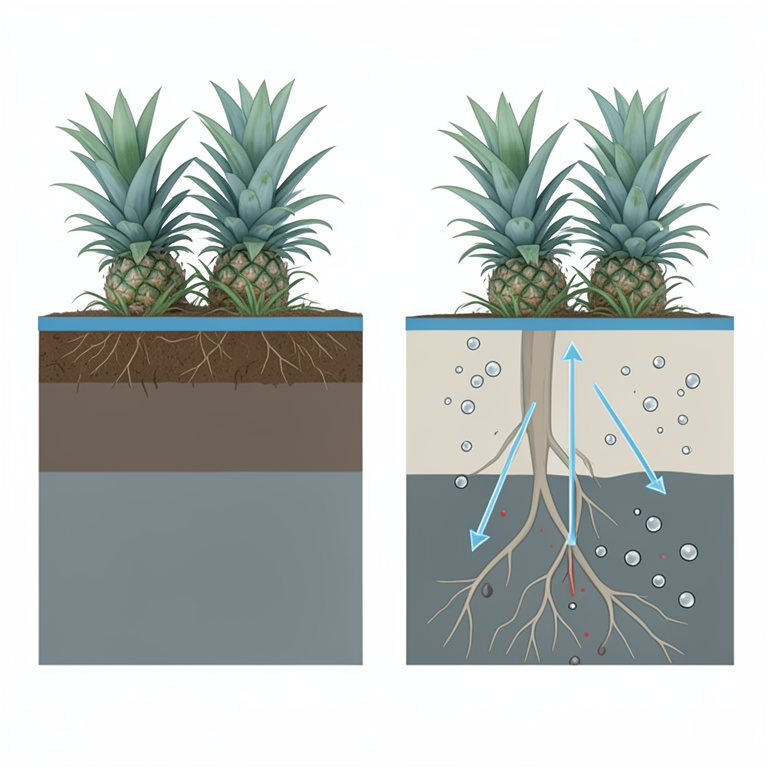
Sulfide Oxidation Cascade
AI-generated conceptual illustration (pineapple plants in drained peat soil). It explains the idea and does not show study data.
View source evidence ↗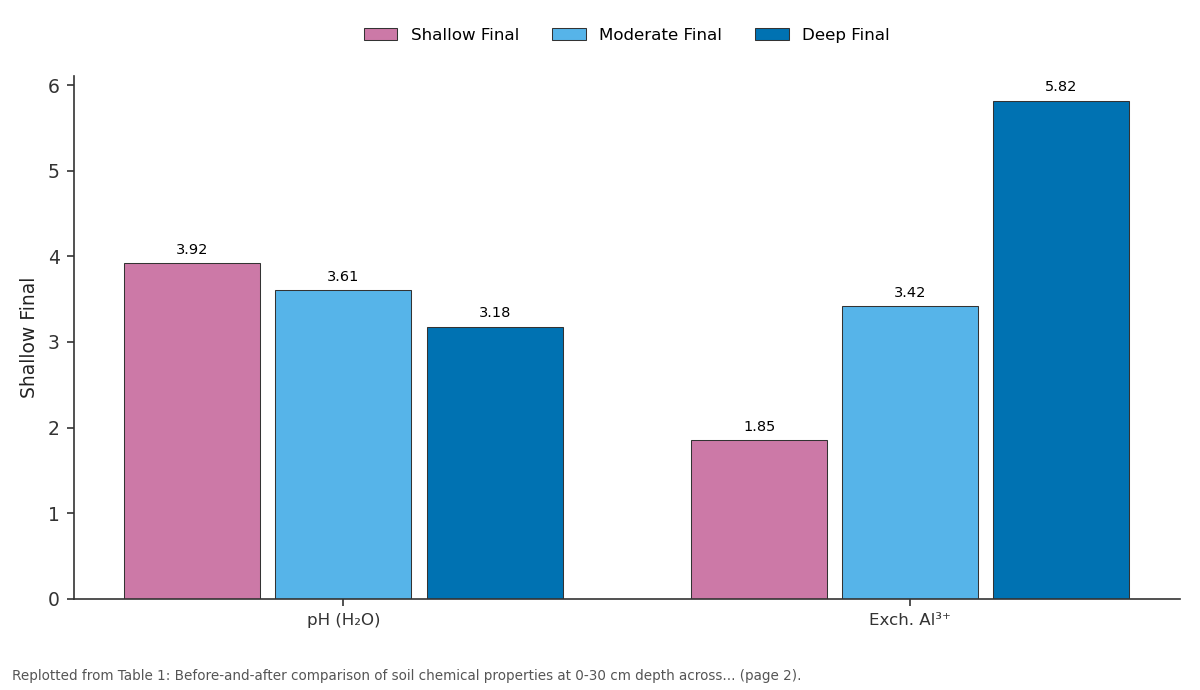
Shallow Final and Moderate Final and more: pH (H₂O) vs Exch. Al³⁺
Replotted from Table 1 (page 2) of the original paper. Every bar is the paper's own table value.
View source evidence ↗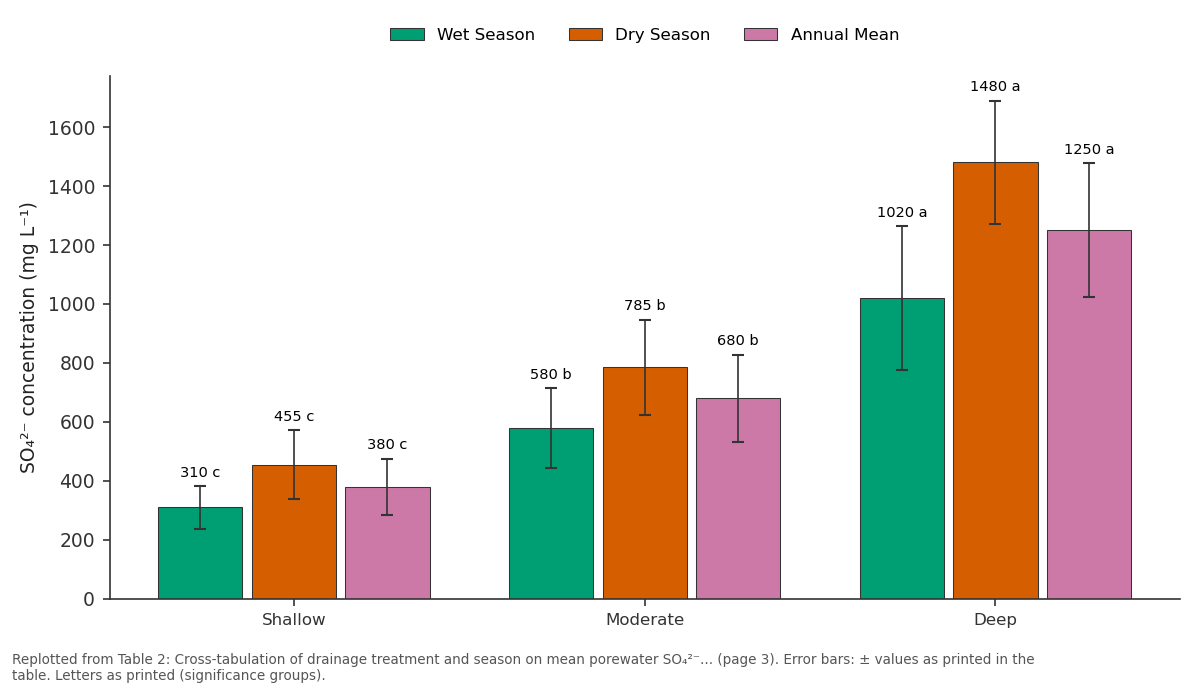
Wet Season and Dry Season and more: Shallow vs Moderate vs Deep
Replotted from Table 2 (page 3) of the original paper. Every bar is the paper's own table value.
View source evidence ↗Figures & tables
From the original paper Table 1
 Table 2
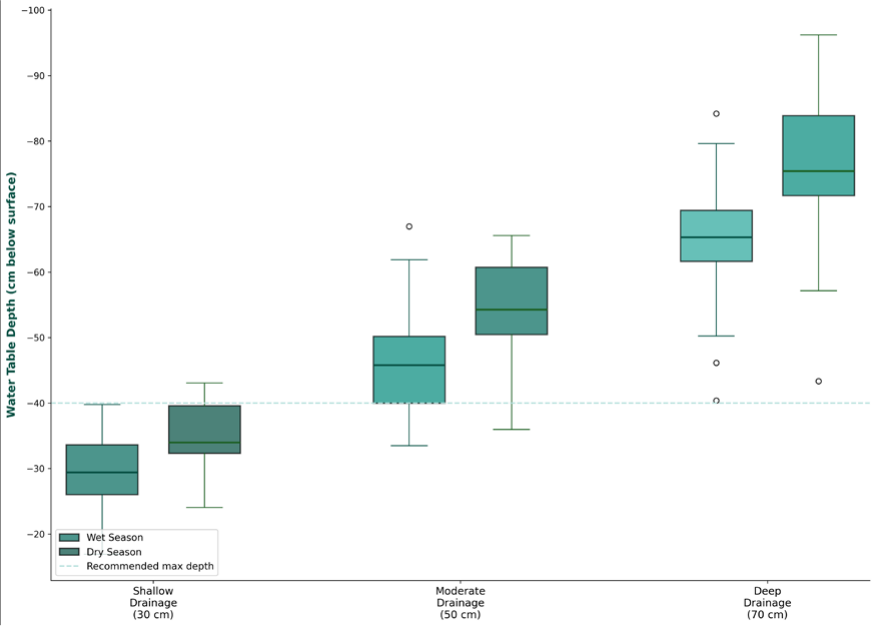 Figure 1
 Table 3
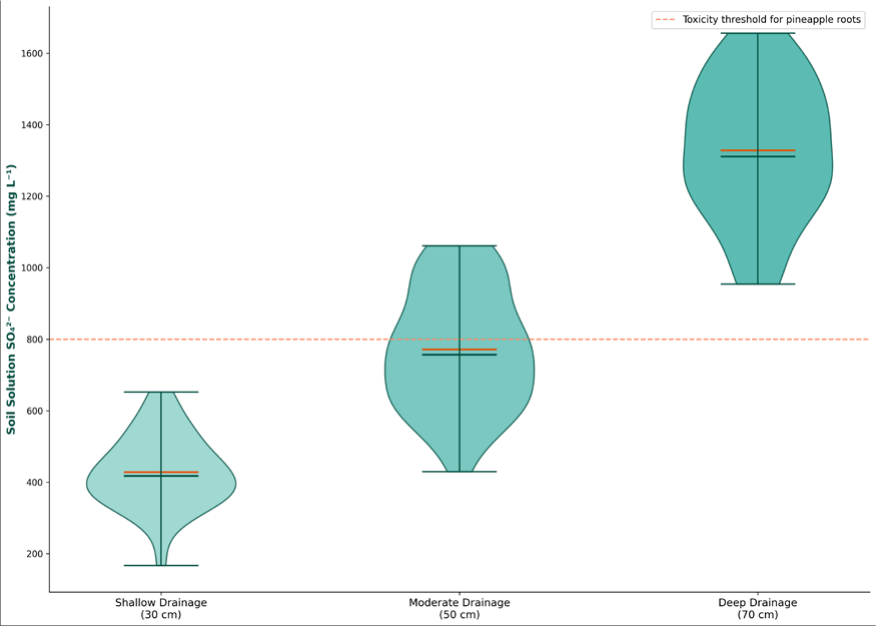 Figure 2
Introduction
A drained peatland is, in geochemical terms, a ticking clock. The organic matter that accumulated over thousands of years under waterlogged, anoxic conditions is suddenly exposed to oxygen when drainage canals lower the water table, initiating subsidence, carbon loss, and where sulfidic sediments underlie the peat acid-sulfate weathering that can render the soil hostile to most crops within a few years [1] . Indonesia's peatlands cover approximately 14.9 million hectares, concentrated in Sumatra and Kalimantan, and roughly one-third have been drained for oil palm, pulpwood, or food crops [2] . Pineapple, tolerant of low pH and moderate waterlogging, has been promoted as a suitable crop for degraded peatlands; Central Kalimantan alone added an estimated 12,000 hectares of pineapple on drained peat between 2015 and 2020. The critical variable is water table depth. When the peat water table falls below the sulfidic horizon typically located 40-80 cm below the peat surface in Kalimantan's coastal and alluvial peats pyrite (FeS₂) oxidises according to well-characterised reaction pathways, producing sulfuric acid, ferric hydroxide, and elevated concentrations of dissolved aluminium and manganese [3] . The resulting acid-sulfate conditions depress soil pH to 2.5-3.5, mobilise toxic metals, and can persist for decades even if the water table is subsequently raised, because the oxidation products (jarosite, schwertmannite) act as ongoing acid reservoirs [4] . In agricultural settings the consequences are concrete: root damage, nutrient lockout, and progressive yield decline [5] . Despite the scale of peatland conversion in Indonesia, fieldscale data linking drainage depth to sulfide oxidation and crop performance in pineapple systems remain scarce. Most published work addresses oil palm or rice on acid-sulfate soils rather than pineapple, and the few pineapple studies available were conducted on mineral acid-sulfate soils, not on organic peats with sulfidic substrata [6] . The present study was designed to fill that gap by quantifying the relationship between imposed water table depth and (i) the rate and extent of sulfide oxidation products in porewater, (ii) soil chemical degradation over two hydrological years, and (iii) pineapple yield and plant survival under three drainage intensities on a converted tropical peatland near Palangka Raya, Central Kalimantan.
Climatic and environmental conditions
The study site (2°13′ S, 113°56′ E, 8 m a.s.l.) lies within the Kahayan River catchment on ombrogenous peat overlying Pleistocene marine clay. Mean annual rainfall is 2,840 mm (2010-2020), distributed bimodally with peaks in November-December and March-April, and a drier period from June to September when monthly totals drop below 120 mm. Mean daily temperature is 27.2 °C (range 24.0-33.5 °C). Peat thickness at the site ranged from 2.8 to 4.2 m, and the sulfidic clay contact was confirmed at 55-75 cm depth by augering and field sulfide tests (H₂O₂ reaction). The peat was classified as hemic (von Post H5-H7) with a bulk density of 0.12-0.18 g cm⁻³ and a C/N ratio of 32-38. The site had been cleared and drained for smallholder agriculture in 2017; prior land cover was secondary peat swamp forest.
Material and Methods
Material and Methods
Material
MD2 pineapple suckers (250-300 g) were planted at 30 × 60 cm spacing (43,500 plants ha⁻¹) in April 2019. Liming was applied at 3 t ha⁻¹ (dolomite) and basal fertiliser at 150 kg N, 60 kg P₂O₅, and 120 kg K₂O ha⁻¹ in split applications. Dipwells were constructed from 50-mm slotted PVC pipe installed to 120 cm depth, with pressure transducers (Solinst Levelogger 5, accuracy ±0.3 cm) recording water table depth at 30-minute intervals. Porewater samplers (Rhizon MOM, 0.15 µm pore) were installed at 30 and 60 cm depths in each plot. All chemical analyses used standard reagents: sulfate by the BaCl₂ turbidimetric method, dissolved iron by the 1,10-phenanthroline colorimetric method, and aluminium by the pyrocatechol violet method [7] .
Methods
The experiment was a randomised complete block design with three drainage treatments and four replicate blocks on a 1.8-ha section of the peatland. Drainage treatments were maintained by adjustable weirs on secondary canals: shallow (target -30 cm), moderate (target -50 cm), and deep (target -70 cm). Each plot measured 20 × 15 m (300 m²) with 5-m buffer strips. Water table depth was logged continuously; fortnightly manual dip readings verified transducer accuracy. Porewater was sampled fortnightly from April 2019 to March 2021 (48 sampling rounds) and analysed for pH, EC, SO₄²⁻, Fe²⁺, and Al³⁺. Soil samples (0-30 and 30-60 cm) were collected at baseline (April 2019) and at 6-month intervals for pH, total S, exchangeable Al, and organic C. Pineapple yield was recorded at harvest (August 2020 for the plant crop and February 2021 for the first ratoon). Plant mortality was assessed quarterly by counting dead or moribund plants per plot. The fraction of time the water table fell below the sulfidic contact depth was calculated from the continuous dipwell records. Statistical analyses used linear mixed models (treatment as fixed effect, block and time as random effects) in R 4.1, with Tukey HSD post-hoc tests at α = 0.05 [8] .
Crop growth stage documentation
The vegetative phase (April 2019-February 2020) lasted 10 months. D-leaf length at forcing was 78 cm (shallow), 74 cm (moderate), and 66 cm (deep), indicating progressively reduced vegetative vigour with deeper drainage. Ethephoninduced flowering occurred between March and April 2020, with fruit maturity at 150-165 days post-induction. Firstratoon sucker emergence began in September 2020, but ratoon establishment in deep-drainage plots was compromised by the 18 % plant mortality recorded during the plant crop, reducing the effective stand to approximately 35,700 plants ha⁻¹. Root inspection at harvest revealed that in deep-drainage plots, 62 % of roots were confined to the top 15 cm of peat, compared with 38 % in shallow-drainage plots, consistent with aluminium-induced root pruning at depth.
Results
Table [9] . The dashed line marks the 800 mg L⁻¹ threshold above which published studies report root damage in pineapple on acid-sulfate soils [9] . The analytical suite was deliberately selected for field portability and cost-effectiveness, recognising that peatland monitoring stations in Central Kalimantan operate under logistical constraints that preclude routine use of ICP-OES or ion chromatography. Cross-validation against ICP-OES at the Palangka Raya Academy laboratory (n = 24 paired samples) showed agreement within 8 % for Fe²⁺ and 12 % for SO₄²⁻, acceptable for the concentration ranges encountered.
Discussion bridge
The yield data close the loop between soil chemistry and agronomic outcome. Mean plant-crop yield was 67.8 t ha⁻¹ (shallow), 54.2 t ha⁻¹ (moderate), and 42.1 t ha⁻¹ (deep), a 38 % yield penalty for deep drainage relative to shallow. Plant mortality followed the same gradient: 3.5 % (shallow), 9.2 % (moderate), and 18.4 % (deep). The first ratoon under deep drainage yielded only 28.6 t ha⁻¹, a further 32 % decline from the plant crop, suggesting progressive soil degradation that worsened between cycles. These results set up the central question for the discussion: is the yield advantage of deeper drainage ever justified on peatlands with sulfidic substrata?
Discussion
The most unexpected finding was the speed of soil chemical degradation under deep drainage. Within just two years a single plant-crop-plus-ratoon cycle exchangeable aluminium at 0-30 cm in deep-drainage plots reached 5.82 cmol kg⁻¹, a value that in mineral acid-sulfate soils typically develops over 5-10 years of continuous cultivation [3] . The explanation lies in the unusually thin peat layer (2.8-4.2 m) and shallow sulfidic contact (55-75 cm) at this site: deep drainage at -70 cm brought the water table into the sulfidic clay for 68 % of the monitoring period, providing sustained oxygen supply for pyrite oxidation. Published data from Malaysian peatlands converted to oil palm show a similar pattern but at a slower pace, likely because the peat thickness buffered the sulfidic horizon from direct exposure [10] . In the present study, the hemic peat (H5-H7) had sufficiently high hydraulic conductivity (1.2-3.4 m day⁻¹ in the upper 50 cm) to transmit oxidation products upward rapidly, so that sulfate and aluminium from the sulfidic clay reached the root zone within weeks of water table drawdown [11] . This upward flux mechanism is not captured by models that assume sulfide oxidation products remain at the depth of formation. The 38 % yield penalty under deep drainage is broadly consistent with yield losses reported for pineapple on mineral acid-sulfate soils in the Mekong Delta, where Nguyen [12] found that planting density and flowering inducement agents both influenced productivity on acid sulfate soils, though the soil-chemical mechanism differed from the peatland context examined here. The root confinement observed in deep-drainage plots (62 % of roots in the top 15 cm) would limit nutrient uptake and increase drought vulnerability, compounding the direct toxicity effects of aluminium and iron on root elongation [13] .
Economic and sustainability assessment
Deep drainage initially appealed to smallholders because the drier soil surface facilitated field operations and reduced fruit-rot incidence. However, the 38 % yield decline and 18 % plant mortality translate into a net revenue loss of IDR 18.4 million ha⁻¹ yr⁻¹ (approximately USD 1,200) compared with shallow drainage, once the costs of replanting dead stands and additional liming are included. Moreover, the carbon-emission penalty of deep peat drainage estimated at 15-20 t CO₂ ha⁻¹ yr⁻¹ for water tables below -40 cm [14] exposes growers to potential regulatory risk under Indonesia's peatland moratorium and restoration policies. From a sustainability perspective, shallow drainage at -30 cm is unambiguously preferable: it maintains adequate aeration for pineapple root function while keeping sulfidic material largely submerged and limiting peat subsidence to < 2 cm yr⁻¹ compared with 4-6 cm yr⁻¹ under deep drainage.
Conclusion
Synthesising two years of continuous hydrological and porewater monitoring, this study demonstrates that the water table depth at which sulfidic material in drained tropical peatlands transitions from stable to actively oxidising lies close to -40 cm at the Palangka Raya site. Below this threshold, the geochemical cascade pyrite oxidation, sulfuric acid release, aluminium mobilisation proceeds with surprising speed, degrading root-zone chemistry to phytotoxic levels within a single cropping cycle and reducing pineapple yield by up to 38 %. Future research should focus on three fronts: (i) longer-term monitoring to determine whether shallow-drainage plots also approach chemical thresholds over 5-10 years, (ii) testing controlled re-wetting strategies to reverse or arrest sulfide oxidation in plots where deep drainage has already caused damage, and (iii) evaluating whether acid-tolerant pineapple cultivars or heavy liming inputs can extend productive life on mildly affected peatlands. In a broader context, these findings challenge the assumption that pineapple's inherent acid tolerance makes it a safe crop for drained peatlands. Tolerance of low pH is not the same as tolerance of the aluminium, iron, and sulfate toxicity that accompanies acid-sulfate weathering. The distinction matters because policy-makers and extension agents in Indonesia and Malaysia continue to recommend pineapple as a "rehabilitation crop" for degraded peatlands without specifying the drainage constraints necessary to avoid triggering the sulfide oxidation cascade.
For policy, the practical recommendation is clear: water table management on pineapple peatlands should be regulated to maintain depths above -40 cm, enforced through adjustable canal weirs and monitored with low-cost dipwell networks. Incorporating this threshold into Indonesia's existing peatland water table regulations which currently specify -40 cm for all crops without empirical justification specific to pineapple would provide a scientifically grounded basis for compliance enforcement.
Acknowledgement
Acknowledgements Institutional supportThe Palangka Raya Academy of Environmental Sciences provided hydrological monitoring equipment, laboratory access, and logistical support for field operations in the Kahayan River peatland.
Figures and tables from the paper
| Parameter | Shallow Baseline | Shallow Final | Moderate Baseline | Moderate Final | Deep Baseline | Deep Final |
|---|---|---|---|---|---|---|
| pH (H₂O) | 4.08 | 3.92 | 4.11 | 3.61 | 4.05 | 3.18 |
| Total S (%) | 0.42 | 0.51 | 0.44 | 0.78 | 0.41 | 1.24 |
| Exch. Al³⁺ | 1.32 | 1.85 | 1.28 | 3.42 | 1.35 | 5.82 |
| Organic C (%) | 48.2 | 46.8 | 47.9 | 44.1 | 48.5 | 40.3 |
| EC (mS cm⁻¹) | 0.38 | 0.52 | 0.41 | 0.89 | 0.39 | 1.46 |
Table text extracted from the original PDF; superscript letters are shown inline. The original table image is below.
View original table image
| Treatment | Wet Season | Dry Season | Annual Mean |
|---|---|---|---|
| Shallow | 310 ± 72 c | 455 ± 118 c | 380 ± 95 c |
| Moderate | 580 ± 135 b | 785 ± 162 b | 680 ± 148 b |
| Deep | 1020 ± 245 a | 1480 ± 210 a | 1250 ± 228 a |
Table text extracted from the original PDF; superscript letters are shown inline. The original table image is below.
View original table image
| Parameter | Method | Instrument | Detection Limit | Reference |
|---|---|---|---|---|
| pH | Glass electrode | Mettler MP220 | ±0.01 pH unit | APHA 4500-H⁺ |
| EC | Conductivity cell | YSI Pro30 | ±0.01 mS cm⁻¹ | APHA 2510 |
| SO₄²⁻ | BaCl₂ turbidimetric | Hach DR6000 | 1.0 mg L⁻¹ | APHA 4500-SO₄²⁻ |
| Fe²⁺ | Phenanthroline | Hach DR6000 | 0.02 mg L⁻¹ | APHA 3500-Fe |
| Al³⁺ | Pyrocatechol violet | Hach DR6000 | 0.01 mg L⁻¹ | APHA 3500-Al |
Table text extracted from the original PDF; superscript letters are shown inline. The original table image is below.
View original table image
References
15 in the original paper- Page SE, Rieley JO, Banks CJ. Global and regional importance of the tropical peatland carbon pool. Glob Chang Biol. 2011;17(2):798-818.
- Miettinen J, Shi C, Liew SC. Land cover distribution in the peatlands of Peninsular Malaysia, Sumatra and Borneo in 2015 with changes since 1990. Glob Ecol Conserv. 2016; 6:67-78.
- Dent DL, Pons LJ. A world perspective on acid sulphate soils. Geoderma. 1995;67(3-4):263-276.
- Fitzpatrick RW, Shand P, Merry RH. Acid sulfate soils. In: Jorgensen SE, editor. Encyclopedia of Environmental Management. Taylor & Francis; 2013. p. 1-10.
- Shamshuddin J, Muhrizal S, Fauziah I, Husni MHA. Effects of adding organic materials to an acid sulfate soil on the growth of cocoa (Theobroma cacao) seedlings. Sci Total Environ. 2004;323(1-3):33-45.
- Huat BBK, Kazemian S, Prasad A, Barghchi M. State of an art review of peat: general perspective. Int J Phys Sci. 2011;6(8):1988-1996.
- American Public Health Association. Standard Methods for the Examination of Water and Wastewater. 23rd ed. Washington (DC): American Public Health Association; 2017.
- Nguyen TNH. Planting density and flowering inducement agents effect on flowering and productivity of MD2 pineapple variety cultivation on acid sulfate soil in Tien Giang province, Vietnam. South Asian J Agric Sci. 2023;3(1):155-158.
- Shamshuddin J, Anda M, Fauziah CI, Omar SR. Growth of cocoa planted on an acid sulfate soil as affected by application of ground magnesium limestone and organic material. Commun Soil Sci Plant Anal. 2011;42(18):2223-2246.
- Hooijer A, Page S, Canadell JG, et al. Current and future CO₂ emissions from drained peatlands in Southeast Asia. Biogeosciences. 2010;7(5):1505-1514.
- Wösten JHM, Clymans E, Page SE, Rieley JO, Limin SH. Peat-water interrelationships in a tropical peatland ecosystem in Southeast Asia. Catena. 2008;73(2):212224.
- Andriesse JP. Nature and management of tropical peat soils. FAO Soils Bulletin No. 59. Rome: Food and Agriculture Organization of the United Nations; 1988.
- Kochian LV, Hoekenga OA, Piñeros MA. How do crop plants tolerate acid soils? Mechanisms of aluminum tolerance and phosphorus efficiency. Annu Rev Plant Biol. 2004; 55:459-493.
- Jauhiainen J, Hooijer A, Page SE. Carbon dioxide emissions from an Acacia plantation on peatland in Sumatra, Indonesia. Biogeosciences. 2012;9(2):617630.
- Warren MW, Kauffman JB, Murdiyarso D, et al. A cost-efficient method to assess carbon stocks in tropical peat soil. Biogeosciences. 2012;9(11):4477-4485.