
Research article · 2026 · Full text
International Journal of Biology SciencesClimate change and insect pests: Impacts on distribution, biology, and integrated pest management strategies
Volume 8(7) · Pages 132–142 · DOI: 10.33545/26649926.2026.v8.i7b.942 ↗
Research areasInsect-Plant Interactions and ControlClimate change impacts on agricultureInsect behavior and control techniques
Abstract
Author-writtenClimate change represents one of the most significant ecological drivers influencing agricultural productivity and global food security. Increasing atmospheric temperatures, elevated carbon dioxide (CO₂) concentrations, altered precipitation patterns, and the growing frequency of extreme climatic events are profoundly reshaping insect pest dynamics across agricultural ecosystems. Because insects are ectothermic organisms, their physiological processes, developmental rates, reproductive performance, migration behaviour, and geographic distributions are strongly regulated by climatic conditions. Recent evidence indicates that global warming is facilitating the expansion of several agricultural pest species into previously unsuitable regions by improving overwintering survival, accelerating population growth, and increasing the number of generations completed annually (Skendžić et al., 2021) [23]. In addition, climate-induced modifications in plant nutritional quality and defensive chemistry under elevated CO₂ conditions can alter plant–herbivore interactions, potentially increasing pest fitness and crop vulnerability (Schoonhoven et al., 2022). Climate change also disrupts ecological relationships within agroecosystems by altering the synchrony between insect pests, host plants, predators, parasitoids, and entomopathogens. Such trophic mismatches may reduce the effectiveness of natural biological control and increase dependence on chemical insecticides, thereby accelerating insecticide resistance development and environmental risks (Bebber et al., 2014; Skendžić et al., 2021) [3, 23]. Furthermore, climate-driven range expansions of invasive pests and insect vectors increase the threat of emerging crop diseases and agricultural losses. This review provides a comprehensive synthesis of the impacts of climate change on insect pest distribution, life-history traits, population dynamics, and ecological interactions. It further examines the challenges faced by conventional pest management approaches and discusses the development of climate-resilient Integrated Pest Management (IPM) strategies. Emerging approaches, including predictive modelling, remote sensing-based surveillance, artificial intelligence-assisted forecasting, climate-adapted biological control, resistant crop varieties, and precision pesticide application, are highlighted as essential components of future pest management systems. Sustainable management of insect pests under changing climatic conditions will require interdisciplinary integration of entomology, climate science, molecular biology, and agricultural extension systems to ensure long-term crop productivity and food security.
Summary
Source-checkedPlain-language reading of the full paper, prepared with AI and checked against the text. Each point links to the authors' own words.
Why it matters
- Climate change is a major ecological driver that impacts global food security and agricultural productivity. View evidence ↗
- Insects are ectothermic, meaning their physiology, development, reproduction, and distribution are heavily dependent on external climatic conditions. View evidence ↗
The question
- The paper aims to synthesize how climate change affects the distribution, life-history traits, population dynamics, and ecological interactions of insect pests. View evidence ↗
- The review also examines the failures of traditional pest management and discusses the creation of climate-resilient Integrated Pest Management (IPM) strategies. View evidence ↗
What they did
- The authors analyzed the relationships between insect pests and major climate drivers, specifically temperature increases, elevated CO₂, and variable precipitation. View evidence ↗
- The evaluation focused on how these drivers impact pest distribution, biology, phenology, ecological interactions, and risks to crop production. View evidence ↗
What they found
- Small temperature increases can accelerate insect development and reduce generation time, allowing for more reproductive cycles per season. View evidence ↗
- Crop pests and pathogens have been observed shifting toward the poles by several kilometers per year due to warming. View evidence ↗
- Elevated CO₂ increases the carbon-to-nitrogen ratio in plants, which lowers the nutritional quality for herbivores. View evidence ↗
- To compensate for lower nitrogen in plants under high CO₂, some pests increase their feeding rates, which can lead to more crop damage. View evidence ↗
- Drought stress increases the risk of wood-boring insect outbreaks because it reduces the production of defensive resin in trees. View evidence ↗
- Warming increases the population and generation count of insect vectors (like aphids and whiteflies), which enhances the transmission of plant pathogens. View evidence ↗
- Differences in how pests and their natural enemies respond to temperature can cause phenological mismatches, reducing the effectiveness of biological control. View evidence ↗
What it means
- The authors conclude that future pest management must move away from calendar-based approaches toward climate-smart IPM that integrates AI, predictive modeling, and ecological conservation. View evidence ↗
- The authors state that long-term datasets are still needed to separate actual climate-driven trends from natural population fluctuations. View evidence ↗
Figures & tables
From the original paper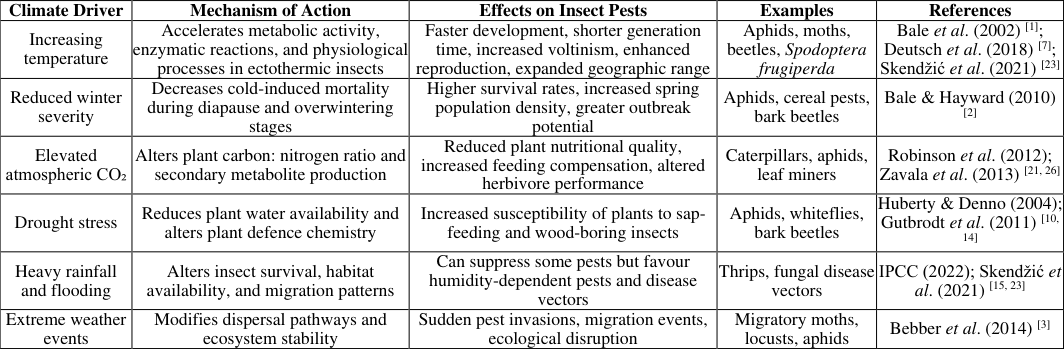 Table 1
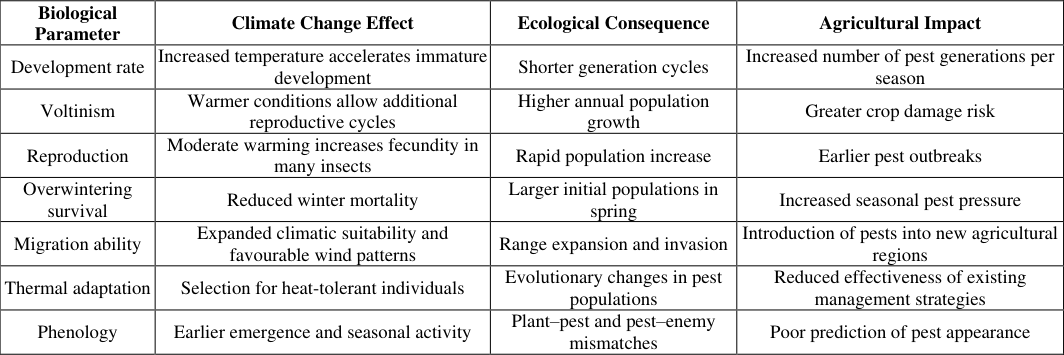 Table 2
Text
expansion (Deutsch et al., 2018; Skendžić et al., 2021) [7,23] . Insects are particularly sensitive indicators of climate change because their physiological processes are strongly dependent on environmental temperature. As ectothermic organisms, insects rely on external heat sources to regulate body temperature, resulting in direct relationships between ambient temperature and metabolic activity, developmental rate, fecundity, survival, and dispersal capacity (Bale et al., 2002; Skendžić et al., 2021) [1,23] . Even relatively small increases in temperature can influence insect population trajectories by accelerating immature development, reducing generation time, and enabling additional reproductive cycles within a cropping season. Consequently, warming trends may transform historically minor pests into economically important species by increasing their abundance and extending their seasonal activity periods. Climate change is also modifying the geographic distribution of agricultural insect pests. Warmer temperatures and reduced frequency of extreme cold events are allowing many species to expand beyond their traditional climatic boundaries towards higher latitudes and elevations (Bebber et al., 2014) [3] . For example, invasive pests such as the fall armyworm (Spodoptera frugiperda) have demonstrated rapid geographical expansion into new regions due to favourable climatic conditions, threatening maize and other staple crop production systems (Early et al., 2018) [8] . Similarly, changes in seasonal temperature patterns have enhanced overwintering survival of several temperate insect pests, resulting in larger spring populations and increased crop damage potential (Skendžić et al., 2021) [23] . Beyond temperature effects, elevated atmospheric CO₂ concentrations represent another important factor influencing insect-plant interactions. Increased CO₂ availability can stimulate plant photosynthesis and biomass production; however, it frequently reduces leaf nitrogen concentration and modifies carbon-to-nitrogen ratios, potentially decreasing nutritional quality for herbivorous insects (Zavala et al., 2013) [26] . To compensate for reduced nutritional value, some herbivores may increase feeding rates, resulting in greater plant tissue consumption and enhanced crop damage. Additionally, climate-associated changes in plant secondary metabolites can modify host suitability and influence insect feeding behaviour, development, and population growth (Robinson et al., 2012) [21] . Altered precipitation regimes further complicate pest dynamics by interacting with temperature and host plant responses. Drought stress can weaken plant defence mechanisms, making crops more susceptible to sap-feeding insects and wood-boring pests, while excessive rainfall and flooding events may influence pest dispersal, mortality, and pathogen transmission patterns (Gutbrodt et al., 2011) [10] .
Extreme weather events can also disrupt natural enemy populations, creating ecological imbalances that favour pest outbreaks. Historically, agricultural pest management has been largely based on established seasonal patterns, economic thresholds, and predictable pest-crop interactions. However, climate change is challenging these assumptions by introducing greater uncertainty into pest occurrence, population forecasting, and management timing (Skendžić et al., 2021) [23] . Traditional calendar-based pesticide applications may become increasingly ineffective as pest phenology shifts and new pest species emerge in previously unaffected regions. Moreover, increased dependence on chemical control can accelerate insecticide resistance evolution and negatively affect non-target organisms, including beneficial predators and pollinators. Therefore, there is an urgent need to transition from conventional pest management approaches towards adaptive, climate-resilient Integrated Pest Management (IPM) systems. Modern IPM strategies must incorporate climate-based forecasting, advanced monitoring technologies, ecological conservation, resistant crop varieties, biological control optimization, and precision chemical interventions. Such approaches require a comprehensive understanding of how climatic variables influence insect biology, population ecology, and ecosystem interactions. This review examines the complex relationships between climate change and agricultural insect pests by discussing major climatic drivers, including temperature rise, elevated CO₂, and precipitation variability. It evaluates their impacts on pest distribution, developmental biology, phenology, ecological interactions, and crop production risks. Furthermore, it explores emerging climate-smart IPM strategies and future research priorities necessary for sustainable insect pest management under rapidly changing environmental conditions.
Climate drivers affecting insect pest systems
Climate change influences insect pest populations through multiple interacting environmental drivers, including increasing temperature, rising atmospheric carbon dioxide (CO₂), altered precipitation patterns, and the increasing frequency of extreme climatic events. These climatic factors do not operate independently; rather, they interact with insect physiology, host-plant characteristics, ecosystem processes, and agricultural management practices to determine pest abundance, distribution, and outbreak potential. Understanding these climate-driven mechanisms is essential for predicting future pest risks and developing adaptive pest management strategies (Skendžić et al., 2021; Deutsch et al., 2018) [7,23] . [1] ; Deutsch et al. (2018) [7] ; Skendžić et al. (2021) [23] Reduced winter severity [21,26]
Drought stress
Reduces plant water availability and alters plant defence chemistry Increased susceptibility of plants to sapfeeding and wood-boring insects Aphids, whiteflies, bark beetles
Huberty & Denno (2004); Gutbrodt et al. (2011) [10,14] Heavy rainfall and flooding
Alters insect survival, habitat availability, and migration patterns
Can suppress some pests but favour humidity-dependent pests and disease vectors Thrips, fungal disease vectors IPCC (2022); Skendžić et al. (2021) [15,23] Extreme weather events
Modifies dispersal pathways and ecosystem stability
Sudden pest invasions, migration events, ecological disruption Migratory moths, locusts, aphids Bebber et al. (2014) [3] International Journal of Biology Sciences https://www.biologyjournal.net
Rising temperatures and thermal regulation of insect populations
Temperature is considered the most influential climatic factor regulating insect population dynamics because insects are ectothermic organisms whose metabolic activities depend strongly on environmental temperature. Unlike endothermic animals, insects cannot internally regulate body temperature, and therefore their growth, development, reproduction, survival, and behaviour are directly controlled by external thermal conditions (Bale et al., 2002) [2] . Global warming has resulted in a progressive increase in average temperatures, which has significant consequences for agricultural insect pests. Within their optimal thermal range, increased temperatures generally accelerate biochemical reactions, increase metabolic activity, shorten developmental periods, and enhance reproductive rates (Skendžić et al., 2021) [23] . Faster development allows many pest species to complete additional generations per year, increasing population growth rates and cumulative crop damage. For example, insects that were historically univoltine may become bivoltine or multivoltine under warmer conditions, thereby increasing their seasonal abundance and extending the period of crop vulnerability (Deutsch et al., 2018) [7] . Temperature-driven acceleration of insect development can be explained through thermal performance curves, where insect growth increases with temperature until reaching an optimum, after which physiological stress causes reduced survival and reproduction. Therefore, climate warming does not universally benefit all insect species; rather, its effects depend on species-specific thermal tolerance limits and geographical location (Kingsolver et al., 2011) [16] . Tropical and subtropical insect species may experience population declines under excessive warming due to physiological stress, whereas temperate pests may benefit from moderate temperature increases because previously limiting cold conditions are reduced. One of the most important consequences of rising temperature is improved overwintering survival. Historically, winter temperatures acted as a natural population regulator by causing substantial mortality among insect eggs, larvae, pupae, and adults. However, milder winters associated with climate warming reduce coldinduced mortality, allowing larger pest populations to survive into subsequent growing seasons (Bale & Hayward, 2010) [2] . This phenomenon has contributed to increased outbreaks of several agricultural pests, including aphids, moths, and beetles. Temperature increases also influence insect migration and geographical expansion. As climatic conditions become suitable in higher latitudes and elevations, many pest species are expanding beyond their historical ranges. Global analyses have demonstrated that agricultural pests and pathogens are progressively shifting towards the poles due to warming trends, creating new challenges for crop protection and quarantine systems (Bebber et al., 2014) [3] . The expansion of the fall armyworm (Spodoptera frugiperda) provides a prominent example of climatemediated pest invasion. Originally distributed in tropical and subtropical regions of the Americas, this species has rapidly expanded into Africa, Asia, and other regions where warmer climatic conditions support survival and reproduction (Early et al., 2018) [8] . Such range expansions demonstrate how temperature changes can transform regional pest dynamics and threaten previously unaffected agricultural systems.
Elevated atmospheric carbon dioxide and plantherbivore interactions
Atmospheric CO₂ concentration has increased substantially due to fossil fuel combustion, land-use changes, and industrial activities. Although elevated CO₂ generally enhances photosynthetic activity and plant biomass production, its effects on insect herbivores are complex and largely mediated through changes in host-plant physiology and nutritional composition (Zavala et al., 2013) [26] . Increased CO₂ availability frequently stimulates carbohydrate production in plants while reducing nitrogen concentration in plant tissues. This alteration increases the carbon-to-nitrogen ratio (C:N ratio), resulting in reduced nutritional quality for herbivorous insects. Consequently, many insect pests compensate by increasing feeding rates to obtain sufficient nitrogen, potentially causing greater crop damage despite unchanged or reduced individual insect growth rates (Robinson et al., 2012) [21] . Elevated CO₂ can also modify plant defence mechanisms by altering the production of secondary metabolites such as phenolics, alkaloids, terpenoids, and other defensive compounds. These chemical changes may either enhance or reduce plant resistance depending on the plant species, insect herbivore, and environmental context (Zavala et al., 2013) [23] . For example, some plants increase carbon-based defence compounds under elevated CO₂, reducing herbivore performance, whereas others experience reduced defensive capacity due to nutrient limitations. The effects of elevated CO₂ are therefore highly speciesspecific and involve complex interactions between plants and insect herbivores. Generalist pests may adapt more successfully because of their ability to exploit diverse host plants, whereas specialist herbivores may experience greater limitations due to dependence on specific host chemistry (Robinson et al., 2012) [21] . Furthermore, elevated CO₂ may indirectly influence pest outbreaks by modifying plant growth patterns and crop architecture. Increased biomass production may create favourable microhabitats that improve insect shelter, reproduction, and survival. Therefore, climate-induced changes in atmospheric composition must be considered alongside temperature and precipitation effects when predicting future pest risks.
Altered precipitation patterns and extreme climatic events
Changes in global precipitation patterns represent another major climate driver influencing insect pest ecology. Climate change is expected to increase variability in rainfall distribution, resulting in more frequent drought periods, intense rainfall events, flooding, and prolonged moisture stress conditions (IPCC, 2022). These changes affect insect populations directly through physiological stress and indirectly through modifications in host plants and natural enemy communities. Drought conditions often increase plant susceptibility to insect attack by reducing plant vigour and altering defence responses. Water-stressed plants may exhibit reduced production of defensive chemicals, impaired growth, and increased nutritional suitability for certain herbivorous insects. Sap-feeding insects such as aphids, whiteflies, and scale insects frequently benefit from drought-stressed plants because weakened hosts provide favourable conditions for population increase (Huberty & Denno, 2004) [14] . Drought stress can also increase outbreaks of wood-boring insects because weakened trees produce lower levels of defensive resin compounds, reducing resistance against infestation. The widespread increase in bark beetle outbreaks in forest ecosystems has been linked to the combined effects of drought stress, warming temperatures, and reduced winter mortality (Bentz et al., 2010) [4] . Conversely, excessive rainfall and flooding can influence pest populations through both positive and negative effects. Heavy rainfall may directly reduce insect survival by causing physical mortality, disrupting feeding behaviour, and destroying breeding habitats. However, high humidity and increased vegetation growth after rainfall may create favourable conditions for certain pests, particularly fungalvectoring insects and defoliators (Skendžić et al., 2021) [23] . Extreme weather events can also influence insect dispersal patterns. Storm systems and strong wind currents may facilitate long-distance migration of flying insects, allowing rapid colonization of new geographical areas. Migratory pests such as locusts, moths, and aphids can exploit favourable wind conditions associated with changing climatic patterns to expand their distribution ranges (Bebber et al., 2014) [3] .
Interaction among multiple climate drivers
Although individual climatic factors significantly influence insect pests, their combined effects determine the overall ecological outcome. Temperature, CO₂ concentration, precipitation, and extreme weather events interact through complex pathways involving insect physiology, host plants, natural enemies, and agricultural practices. For instance, elevated temperatures may accelerate insect development, while drought-induced nutritional stress may alter host-plant quality and increase pest susceptibility. Similarly, warming conditions may improve pest survival while simultaneously disrupting parasitoid and predator populations, resulting in reduced biological control (Skendžić et al., 2021). Therefore, predicting future pest outbreaks requires integrated climate-ecological models rather than singlefactor assessments. Mechanistic models incorporating temperature responses, host-plant changes, population dynamics, and species interactions provide more realistic predictions of climate-driven pest risks (Deutsch et al., 2018) [7] .
Range shifts, invasion risk, and climate-driven changes in pest biology and phenology
Climate change is fundamentally altering the geographical distribution and ecological behaviour of agricultural insect pests. Rising temperatures, modified precipitation regimes, and increasing climatic variability are enabling many insect species to expand beyond their historical geographic boundaries, resulting in the emergence of new pest threats in previously unaffected agricultural regions. These distributional changes are primarily driven by modifications in thermal suitability, overwintering conditions, host availability, and dispersal opportunities (Bebber et al., 2014; Skendžić et al., 2021) [3,23] . Consequently, climate change is transforming pest management from a localized crop protection challenge into a dynamic global concern requiring predictive and adaptive approaches.
Climate-induced geographic range expansion of insect pests
The expansion of insect pest ranges represents one of the most consistently documented ecological responses to global warming. Historically, temperature thresholds, particularly low winter temperatures, restricted the survival and establishment of many insect species. However, increasing average temperatures and reduced frequency of extreme cold events are relaxing these climatic limitations, allowing pests to survive and reproduce in regions that were previously unsuitable (Bale & Hayward, 2010) [2] . [1,2,13,23] Global analyses have demonstrated that many agricultural pests and pathogens are progressively shifting towards higher latitudes and elevations in response to climate warming. Bebber et al. ( 2014) [3] [8] . The establishment of S. frugiperda in new agricultural landscapes highlights the vulnerability of global food production systems to climate-driven biological invasions.
Similarly, warming conditions have contributed to increased occurrence and establishment of several invasive pests, including the brown marmorated stink bug (Halyomorpha halys), diamondback moth (Plutella xylostella), and various aphid species. These invasions create complex management challenges because introduced pests may encounter fewer ecological constraints compared with their native environments (Deutsch et al., 2018) [7] .
Climate change and overwintering survival
Winter mortality acts as a critical ecological filter regulating insect populations in temperate agricultural ecosystems. Many insect pests survive winter through diapause, a physiological state characterized by reduced metabolic activity and enhanced stress tolerance. However, warmer winters associated with climate change can disrupt this natural population regulation mechanism by increasing survival rates of overwintering stages (Bale & Hayward, 2010) [2] . Enhanced overwintering survival results in larger initial pest populations at the beginning of the growing season. These increased founder populations can accelerate population growth and increase the probability of reaching economic damage thresholds earlier than historical patterns predict. For example, aphids, cereal pests, and certain moth species have shown increased spring abundance in regions experiencing warmer winter conditions (Skendžić et al., 2021) [23] .
Changes in overwintering success also influence pest outbreak frequency. When winter mortality decreases, populations may avoid density bottlenecks, allowing multiple generations to develop during subsequent favourable seasons. This phenomenon is particularly important for species with high reproductive potential because small increases in survival can translate into exponential population increases. However, overwintering responses are species-specific. Some insects require specific temperature cues for diapause termination, and abnormal warming patterns may disrupt synchronization between insect emergence and host plant availability. Therefore, climate change may simultaneously enhance survival while creating new ecological mismatches.
Effects of climate change on insect development and generation time
Temperature strongly regulates insect developmental processes, including egg incubation, larval growth, pupation, and adult maturation. Within optimal thermal limits, increased temperatures accelerate enzymatic activity and metabolic processes, resulting in faster development and shorter generation intervals (Bale et al., 2002) [1] .
A reduction in generation time can substantially increase pest population growth because insects complete more reproductive cycles within a single cropping season. Species capable of increasing their voltinism (number of generations per year) represent a major climate-related threat to agriculture. For instance, pests that historically produced one generation annually may produce additional generations under warmer conditions, resulting in prolonged crop exposure and increased yield losses (Deutsch et al., 2018) [7] .
The relationship between temperature and insect development follows a nonlinear pattern. Development accelerates until an optimum temperature is reached; beyond this threshold, physiological stress, reduced fertility, and mortality may occur (Kingsolver et al., 2011) [16] . Therefore, climate warming may benefit some pest species while negatively affecting others depending on their thermal niche.
The expansion of multivoltine behaviour is particularly important in annual cropping systems. Additional generations allow pests to exploit successive crop stages, increase population pressure, and complicate management timing. As a result, traditional pest forecasting models based on historical temperature patterns may underestimate future outbreak risks.
Climate-driven changes in reproductive capacity and population growth
Climate change influences insect reproductive biology through effects on fecundity, egg viability, mating behaviour, and population growth rates. Warmer temperatures can increase reproductive output in many insect species by shortening maturation periods and extending reproductive seasons (Skendžić et al., 2021) [23] . For example, aphids often exhibit temperature-dependent increases in reproductive rates under moderate warming conditions. Higher temperatures may accelerate parthenogenetic reproduction, allowing rapid population multiplication during favourable periods. Similar responses have been observed in several agricultural pests, including whiteflies, leafhoppers, and certain lepidopteran species. However, reproductive responses to warming are highly dependent on species-specific thermal limits. Excessive temperatures may reduce fertility by disrupting gametogenesis, impairing mating behaviour, and increasing physiological stress. Therefore, future pest population predictions require accurate understanding of speciesspecific thermal performance relationships. Climate change may also influence insect population genetics by imposing selection pressure on thermal tolerance traits. Over multiple generations, pest populations may evolve adaptations that improve survival under warmer conditions, including altered metabolic pathways, behavioural thermoregulation, and changes in developmental thresholds (Hoffmann & Sgrò, 2011) [13] .
Phenological shifts and plant-pest synchronization
Phenology refers to the timing of biological events such as insect emergence, migration, reproduction, and plant flowering. Climate warming has significantly altered phenological patterns across ecosystems, often causing earlier seasonal activity in both plants and insects (Parmesan, 2007) [19] . In agricultural systems, successful pest development depends on synchronization between insect life stages and host plant availability. Climate change can modify this synchronization by causing different rates of phenological advancement between plants, pests, and natural enemies. When pest emergence occurs earlier than historical patterns, insects may encounter highly vulnerable crop stages, resulting in increased damage. Conversely, if host plants advance faster than pests, temporary reductions in pest pressure may occur. However, long-term climate variability increases uncertainty in these interactions and complicates pest forecasting (Skendžić et al., 2021) [23] . Phenological mismatches are also important for biological control. Predators and parasitoids often depend on precise timing of prey availability. If pests and natural enemies respond differently to warming, ecological synchrony may decline, reducing natural suppression of pest populations.
Evolutionary adaptation and genetic responses to climate change
Long-term exposure to changing climatic conditions may drive evolutionary responses in insect pest populations. Natural selection can favour individuals possessing traits associated with increased heat tolerance, altered developmental rates, improved water conservation, and behavioural adaptation (Hoffmann & Sgrò, 2011) [13] . Genetic adaptation to warming environments may allow pest populations to persist despite climatic stress. For example, populations experiencing repeated heat exposure may develop physiological mechanisms that improve cellular protection, enzyme stability, and stress tolerance. Although evolutionary responses are difficult to predict, they represent an important consideration for future pest management. Climate adaptation may reduce the effectiveness of existing control strategies by producing pest populations with altered biological characteristics. Therefore, integrated pest management programs must incorporate evolutionary principles when developing longterm climate adaptation strategies.
Implications of range expansion and biological changes for pest management
Climate-induced changes in pest distribution, development, and reproduction challenge conventional pest management systems. Historical pest calendars and economic thresholds are often based on long-term climatic patterns that may no longer accurately predict pest occurrence. The movement of pests into new regions requires strengthened surveillance, quarantine measures, and early warning systems. Furthermore, increased generation numbers and altered phenology demand dynamic decisionsupport tools capable of integrating real-time climatic information. Future pest management must therefore shift from reactive control strategies towards predictive approaches combining ecological modelling, remote sensing, molecular surveillance, and climate forecasting. Understanding climate-driven changes in pest biology is essential for developing resilient agricultural systems capable of maintaining productivity under future environmental conditions.
Disruption of ecological interactions, natural enemy dynamics, vector-borne plant diseases, and implications for crop production and food security
Climate change does not influence insect pests through isolated physiological effects alone; rather, it reshapes entire ecological networks by modifying interactions among plants, herbivores, predators, parasitoids, pathogens, and environmental factors. Agricultural ecosystems function through complex trophic relationships in which pest populations are naturally regulated by bottom-up forces (host plant quality and availability) and top-down forces (predation, parasitism, and disease). Climate-driven alterations in these interactions can destabilize ecological equilibrium, resulting in increased pest outbreaks, reduced biological control efficiency, and greater risks to agricultural productivity (Skendžić et al., 2021; Seidl et al., 2017) [22,23] . The ecological consequences of climate change are particularly significant because agricultural systems are already simplified environments with reduced biodiversity and limited ecological buffering capacity. As climatic conditions continue to shift, changes in species distributions, phenological timing, and physiological responses may disrupt long-established relationships that historically contributed to pest regulation.
Climate change and alteration of plant-insect herbivore interactions
Plant-insect interactions represent a fundamental component of agricultural ecosystems, where changes in plant physiology directly influence herbivore performance. Climate change affects these interactions through modifications in plant growth, nutritional composition, defensive chemistry, and stress responses. Elevated atmospheric CO₂ concentrations frequently increase carbohydrate accumulation in plants while reducing nitrogen concentration in leaves, resulting in increased carbon-to-nitrogen ratios. Since nitrogen is essential for insect growth and reproduction, reduced nutritional quality may negatively affect herbivore development. However, many insect pests compensate for reduced nitrogen availability by increasing feeding rates, which may ultimately increase total crop damage (Zavala et al., 2013) [23] . For example, under elevated CO₂ conditions, some chewing herbivores consume greater amounts of plant tissue to fulfil their nutritional requirements. Although individual insect growth rates may decline, increased feeding intensity can offset these effects and result in substantial agricultural losses. Therefore, elevated CO₂ may indirectly increase pest pressure by altering feeding behaviour rather than simply increasing insect population size (Robinson et al., 2012) [21] . Climate-induced changes in plant secondary metabolites further complicate plant-herbivore interactions. Plants produce a diverse range of defensive compounds, including phenolics, alkaloids, terpenoids, and proteinase inhibitors, which influence insect feeding preference and survival. Temperature elevation, drought stress, and increased CO₂ can modify the production and composition of these compounds, resulting in unpredictable effects on herbivore performance (Bidart-Bouzat & Imeh-Nathaniel, 2008) [5] . Drought stress is particularly important because water limitation often reduces plant defensive capacity. Waterstressed plants may exhibit altered chemical profiles, reduced tissue toughness, and changes in nutritional composition, making them more vulnerable to sap-feeding insects such as aphids, whiteflies, and leafhoppers (Huberty & Denno, 2004) [14] . Therefore, climate change may alter pest severity not only by directly affecting insect physiology but also by modifying the quality and defence mechanisms of their host plants.
Disruption of natural enemy dynamics and biological control services
Predators, parasitoids, and entomopathogenic organisms play essential roles in regulating agricultural pest populations. Natural enemies provide ecosystem services that reduce pest abundance and decrease dependence on chemical insecticides. However, climate change threatens these biological control mechanisms by altering the distribution, survival, and seasonal synchronization of natural enemies. Natural enemies often have narrower climatic tolerance ranges than their prey species. Consequently, climate warming may benefit pest populations while simultaneously reducing predator or parasitoid effectiveness. Differences in thermal sensitivity between pests and natural enemies can create ecological mismatches, where predators emerge too early, too late, or in insufficient numbers relative to pest population growth (Hance et al., 2007) [12] . For parasitoids, temperature influences developmental rates, reproductive capacity, host-searching behaviour, and survival. A small difference in thermal response between parasitoid and host development can disrupt synchronization and reduce parasitism efficiency. For example, if pest populations develop faster under warmer conditions while parasitoid populations respond more slowly, pest outbreaks may occur before adequate biological suppression develops. Climate change may also alter predator communities through habitat modification and species redistribution. Some natural enemies may expand into new regions, whereas others may decline due to unsuitable environmental conditions. Such changes can restructure predator-prey relationships and influence the stability of agricultural ecosystems (Skendžić et al., 2021) [23] . Recent modelling approaches demonstrate that climate change can produce asymmetric shifts between pest species and their natural enemies. For example, species distribution modelling of the red-necked longhorn beetle (Aromia bungii) and associated natural enemies revealed that future climate scenarios may alter habitat overlap between pests, parasitoids, and predators, potentially reducing biological control effectiveness (Zhang et al., 2024) [27] .
Effects on entomopathogens and microbial biological control
Microbial control agents, including entomopathogenic fungi, bacteria, and viruses, are important components of sustainable pest management. However, their effectiveness is strongly influenced by climatic conditions, particularly temperature and humidity. Entomopathogenic fungi such as Beauveria bassiana and Metarhizium anisopliae require suitable moisture conditions for spore germination, infection, and host colonization. Increased temperatures and drought conditions may reduce pathogen persistence and infection efficiency, limiting their effectiveness in warmer agricultural environments.
Conversely, changes in humidity and precipitation may create favourable conditions for certain pathogens, resulting in increased natural mortality of pest populations. Therefore, climate change may generate both positive and negative effects on microbial control depending on regional environmental conditions. Future biological control programs must therefore consider climate compatibility when selecting microbial agents. The development of climate-adapted microbial strains with improved thermal tolerance may become increasingly important under future warming scenarios.
Climate change and vector-borne plant diseases
Insect pests are not only important because of direct feeding damage; many species function as vectors of economically important plant pathogens. Climate change increases the risk of vector-borne plant diseases by modifying insect distribution, population density, feeding behaviour, and pathogen transmission efficiency. Warmer temperatures can accelerate insect development and increase the number of generations of vectors such as aphids, whiteflies, thrips, and leafhoppers. Increased vector abundance expands opportunities for pathogen acquisition and transmission. Additionally, climate change may extend the geographical range of insect vectors, allowing plant diseases to emerge in regions where they were previously absent (Bebber et al., 2014) [3] . Temperature also influences pathogen replication within insect vectors. Many plant pathogens multiply more efficiently within vectors under favourable thermal conditions, increasing transmission probability. Therefore, climate warming can amplify disease risks through simultaneous effects on both insect vectors and associated pathogens. For example, increased populations of whiteflies (Bemisia tabaci) under warmer conditions have contributed to greater transmission of begomoviruses affecting vegetable crops worldwide. Similarly, changes in aphid distribution and seasonal abundance influence the epidemiology of several economically important viral diseases. The combination of direct feeding injury and pathogen transmission significantly increases the economic importance of insect pests under climate change scenarios.
Climate change effects on agricultural biodiversity and ecosystem stability
Agricultural ecosystems depend on biodiversity to maintain ecological balance. Climate change-induced species redistribution can alter community composition, competitive relationships, and ecosystem functions. The arrival of invasive pests may result in ecological displacement of native species and disruption of existing food webs. Introduced pests often experience population outbreaks because natural enemies from their original environments are absent or ineffective in new locations. This ecological phenomenon, known as enemy release, contributes to the rapid establishment of invasive agricultural pests. Furthermore, climate-driven changes in biodiversity may affect ecosystem resilience. Diverse agricultural landscapes containing natural habitats, hedgerows, and flowering resources generally support stronger populations of beneficial insects. However, climate change combined with intensive agriculture may reduce biodiversity and weaken natural pest regulation mechanisms (Tscharntke et al., 2012) [25] .
Maintaining ecological complexity through habitat conservation and agroecological practices will therefore become increasingly important for climate-resilient pest management.
Implications of climate change for crop production and global food security
The cumulative effects of climate change on insect distribution, population growth, ecological interactions, and disease transmission represent a major threat to global food security. Agricultural production systems are already challenged by increasing food demand, land degradation, and resource limitations. Climate-driven increases in pest pressure add another significant constraint on sustainable crop production.
Global analyses indicate that crop losses caused by insect pests are expected to increase under warming scenarios. [7] demonstrated that rising temperatures can increase insect-related crop losses, particularly in temperate regions where pest populations benefit from warming conditions. Major staple crops, including wheat, maize, rice, and soybean, are vulnerable to increased insect pressure because many important pests exhibit temperature-dependent population increases. Additional generations, expanded geographic ranges, and improved overwintering survival may increase both the frequency and severity of pest outbreaks.
Deutsch et al. (2018)
Climate change may also increase reliance on chemical insecticides as farmers attempt to manage emerging pest threats. However, increased pesticide use can accelerate insecticide resistance evolution, reduce populations of beneficial organisms, and create environmental contamination problems. This creates a feedback cycle where declining biological control increases pesticide dependence, further weakening ecosystem stability. Food security risks are particularly severe in developing agricultural regions where farmers often lack access to advanced monitoring systems, resistant crop varieties, and climate-based decision-support tools. Therefore, climate adaptation strategies must integrate scientific innovation with farmer accessibility and socioeconomic considerations.
Need for climate-resilient pest management systems
The disruption of ecological interactions under climate change demonstrates that conventional pest management approaches are insufficient for future agricultural challenges. Effective pest management must move beyond pest elimination towards ecosystem-based strategies that enhance resilience. Climate-resilient pest management requires: Continuous monitoring of pest distribution and population changes. Climate-based forecasting systems. Conservation of natural enemy populations. Development of resistant crop varieties. Integration of biological and cultural control methods. Precision-based pesticide applications. Farmer-centred climate adaptation programs.
The future of agricultural pest management will depend on combining ecological knowledge with technological innovation to anticipate pest risks rather than responding after outbreaks occur.
Adaptive climate-smart integrated pest management strategies, emerging technologies, case studies, future research priorities, and conclusion 5.1 Transition towards climate-smart integrated pest management
The increasing complexity of climate-driven pest dynamics requires a fundamental transformation of conventional pest management systems. Traditional Integrated Pest Management (IPM) programs were primarily developed under relatively stable climatic conditions, where pest occurrence, crop phenology, and natural enemy activity followed predictable seasonal patterns. However, climate change has disrupted these relationships by altering pest distribution, accelerating insect development, modifying host-pest interactions, and reducing the reliability of historical pest forecasting systems (Skendžić et al., 2021) [23] . Future pest management must therefore shift from reactive approaches, where interventions are applied after pest populations exceed economic thresholds, towards proactive and adaptive systems capable of anticipating climateinduced risks. Climate-smart IPM integrates ecological knowledge, climate forecasting, digital technologies, biological control, resistant crop development, and precision agriculture to maintain agricultural productivity while reducing environmental impacts. A climate-resilient IPM framework should consider not only pest suppression but also ecosystem stability, biodiversity conservation, and long-term sustainability. The objective is no longer complete pest eradication but maintaining pest populations below economically damaging levels while preserving beneficial organisms and ecosystem functions.
Enhanced monitoring and early warning systems
Effective climate adaptation begins with improved surveillance systems capable of detecting changes in pest distribution, abundance, and seasonal activity. Traditional field scouting methods based on visual inspection and farmer experience remain valuable but are often insufficient for detecting rapid climate-driven changes occurring at regional and continental scales. Modern monitoring systems increasingly incorporate: Automated pheromone trapping networks. Remote sensing technologies. Geographic Information Systems (GIS). Satellite-based vegetation monitoring. Internet of Things (IoT)-enabled field sensors. Citizen-science observation platforms. These technologies enable continuous collection of real-time biological and environmental data, allowing early detection of invasive pests and emerging outbreaks. For example, automated insect traps equipped with imaging sensors and artificial intelligence algorithms can identify pest species and estimate population density without requiring constant human intervention. Such systems provide valuable information for timely management decisions and reduce unnecessary pesticide applications. Climate-based early warning systems combine pest observations with meteorological information to predict outbreak probabilities. By integrating temperature, humidity, rainfall, and insect developmental models, these systems can forecast pest emergence periods and guide farmers regarding optimal intervention timing (Skendžić et al., 2021) [23] .
Predictive modelling, artificial intelligence, and decision-support tools
Predictive modelling represents one of the most promising approaches for managing climate-driven pest risks. Species distribution models (SDMs), ecological niche models, and population simulation models allow researchers to predict future pest distributions under different climate scenarios. These models incorporate biological parameters such as: Thermal tolerance limits. Developmental thresholds. Reproductive capacity. Host availability. Migration behaviour.
Combined with climate projections, these approaches provide valuable insights into potential future invasion zones and outbreak risks (Bebber et al., 2014) [3] . Recent advances in artificial intelligence (AI) and machine learning have further improved pest prediction accuracy. Machine learning algorithms can analyse large datasets obtained from weather stations, satellite imagery, field sensors, and historical pest records to identify complex relationships between climate variables and pest outbreaks. Deep learning approaches, including convolutional neural networks (CNNs), are increasingly being applied for automated insect identification from field images. These technologies provide rapid pest diagnosis and support precision decision-making. Furthermore, digital decision-support platforms can integrate climate forecasts, crop growth models, and pest information to generate location-specific management recommendations. Such systems are particularly valuable for smallholder farmers who require accessible and practical climate adaptation tools. Advances in molecular breeding, genomics, and genomeediting technologies have accelerated the development of pest-resistant crops. Marker-assisted selection and genomic approaches allow identification of resistance-associated genes, while CRISPR-based technologies provide opportunities for precise modification of plant defence pathways. However, resistance durability remains a major challenge because insect populations may evolve counter-adaptations under environmental pressure. Therefore, resistance management strategies, including crop rotation and deployment of diverse resistance sources, are essential.
Climate-resilient crop varieties and host plant resistance
Climate-resilient crop varieties and host plant resistance
Adaptive biological control under changing climate conditions
Biological control is a central component of sustainable pest management; however, climate change requires reconsideration of how natural enemies are selected, conserved, and deployed. Future biological control programs should consider:
Selection of climate-compatible natural enemies
Natural enemies used in biological control should possess thermal characteristics compatible with future climate conditions. Species with broader temperature tolerance ranges may provide more stable pest suppression under variable climates.
Conservation biological control
Maintaining habitats that support natural enemies is essential for enhancing ecosystem resilience. Flowering strips, hedgerows, cover crops, and reduced pesticide use can increase populations of predators and parasitoids. Landscape diversification improves availability of alternative prey, nectar resources, and shelter habitats, thereby strengthening biological control services (Tscharntke et al., 2012) [25] .
Microbial biological control
Climate-adapted strains of entomopathogenic fungi, bacteria, and viruses may provide effective alternatives to synthetic insecticides. Research efforts should focus on improving pathogen stability under high temperature and variable humidity conditions.
Modification of cultural and agronomic practices
Cultural practices provide cost-effective approaches for reducing pest vulnerability under climate change. Agricultural management strategies can modify crop environments and influence pest population development. Important climate-adaptive cultural practices include:
Adjustment of planting dates
Changing planting schedules can help avoid periods of peak pest activity and synchronize crop development with favourable climatic conditions.
Crop diversification
Intercropping and crop rotation reduce pest establishment by disrupting host availability and reducing population buildup.
Improved irrigation management
Efficient irrigation reduces drought stress and improves plant resistance against insect attack.
Conservation agriculture
Practices such as minimum tillage and soil conservation enhance ecosystem biodiversity and support natural enemy populations. These approaches provide environmentally sustainable methods for reducing climate-associated pest risks.
Precision chemical management and resistance prevention
Although sustainable IPM emphasizes non-chemical approaches, pesticides will continue to play an important role in pest management. However, climate change may increase pesticide dependence and accelerate resistance evolution. The invasion has significantly affected maize production and highlighted the importance of international surveillance and rapid response systems (Early et al., 2018) [8] .
Future chemical management must focus on
Future chemical management must focus on
Aphid population shifts and virus transmission
Aphids are highly responsive to temperature changes because of their rapid reproduction and short generation times. Warmer temperatures can increase aphid population growth and extend seasonal activity. In addition to direct feeding damage, aphids transmit numerous plant viruses, increasing their agricultural importance. Climate-driven changes in aphid phenology may disrupt traditional pest monitoring schedules and require dynamic forecasting approaches.
Bark beetle outbreaks under warming conditions
Forest ecosystems provide another example of climatedriven insect outbreaks. Bark beetles have experienced severe population increases due to the combined effects of warming temperatures, drought stress, and reduced winter mortality. Drought weakens host trees by reducing resin-based defence mechanisms, while warmer winters improve beetle survival. These interactions demonstrate how climate change can amplify pest outbreaks through multiple interacting pathways (Bentz et al., 2010) [4] .
Future research priorities
Despite significant advances in understanding climate-pest relationships, several knowledge gaps remain.
Long-term ecological monitoring
Long-term datasets are required to distinguish climatedriven trends from natural population fluctuations. Standardized monitoring networks integrating biological and climatic information are essential for accurate predictions.
Improved mechanistic models
Future models should incorporate: Insect physiology. Evolutionary adaptation. Species interactions. Agricultural management practices.
Integrating ecological complexity will improve reliability under future climate scenarios.
Integration of genomics and climate science
Genomic approaches can identify genes associated with thermal tolerance, insecticide resistance, and adaptation. Combining genomic information with climate models may improve prediction of evolutionary responses. Such approaches can provide real-time, location-specific pest risk assessments.
Farmer-centred climate adaptation
Scientific advances must be translated into practical solutions for farmers. Extension programs, digital advisory services, and climate-smart agricultural education are essential for successful implementation.
Conclusion
Climate change is fundamentally transforming agricultural insect pest dynamics by altering species distributions, accelerating development rates, increasing overwintering survival, modifying ecological interactions, and reducing the predictability of traditional pest management systems. The expansion of invasive pests, increased generation numbers, disruption of plant-herbivore relationships, and weakening of natural enemy regulation collectively represent major challenges for global crop production and food security. Future pest management cannot rely on conventional calendar-based approaches. Instead, climate-smart Integrated Pest Management systems must integrate advanced monitoring, predictive modelling, artificial intelligence, resistant crop varieties, ecological conservation, biological control, and precision chemical strategies. The development of resilient agricultural systems will require interdisciplinary collaboration among entomologists, climatologists, agronomists, molecular biologists, data scientists, and farming communities. By combining ecological understanding with technological Innovation, it will be possible to develop adaptive pest management strategies capable of maintaining agricultural productivity under rapidly changing climatic conditions. Ultimately, sustainable food security in the coming decades will depend on the ability to anticipate climate-driven pest challenges and implement proactive management approaches that balance crop protection with environmental sustainability.
Figures and tables from the paper
References
27 in the original paper- Bale JS, Masters GJ, Hodkinson ID, Awmack C, Bezemer TM, Brown VK, et al. Herbivory in global climate change research: Direct effects of rising temperature on insect herbivores. Global Change Biology. 2002;8(1):1-16.
- Bale JS, Hayward SAL. Insect overwintering in a changing climate. Journal of Experimental Biology. 2010;213(6):980-994.
- Bebber DP, Ramotowski MAT, Gurr SJ. Crop pests and pathogens move polewards in a warming world. Nature Climate Change. 2014;4(11):985-989.
- Bentz BJ, Régnière J, Fettig CJ, Hansen EM, Hayes JL, Hicke JA, et al. Climate change and bark beetles of the western United States and Canada: Direct and indirect effects. BioScience. 2010;60(8):602-613.
- Bidart-Bouzat MG, Imeh-Nathaniel A. Global change effects on plant chemical defenses against insect herbivores. Journal of Integrative Plant Biology. 2008;50(11):1339-1354.
- Crespo-Pérez V, Kazakou E, Roubik DW, Cárdenas RE. The potential impacts of climate change on agricultural insect pests. Current Opinion in Insect Science. 2020;41:1-8.
- Deutsch CA, Tewksbury JJ, Huey RB, Sheldon KS, Ghalambor CK, Haak DC, et al. Increase in crop losses to insect pests in a warming climate. Science. 2018;361(6405):916-919.
- Early R, González-Moreno P, Murphy ST, Day R. Forecasting the global extent of invasion of the cereal pest Spodoptera frugiperda, the fall armyworm. Global Change Biology. 2018;24(6):e275-e286.
- Ferentinos KP. Deep learning models for plant disease detection and diagnosis. Computers and Electronics in Agriculture. 2018;145:311-318.
- Gutbrodt B, Mody K, Dorn S. Drought changes plant chemistry and causes contrasting responses in herbivorous insects. Oikos. 2011;120(11):1730-1739.
- Gutierrez AP, Ponti L, d'Oultremont T. Climate change effects on insect pest population dynamics and crop protection. Agricultural and Forest Entomology. 2021;23(1):1-12.
- Hance T, van Baaren J, Vernon P, Boivin G. Impact of extreme temperatures on parasitoids in a climate change perspective. Annual Review of Entomology. 2007;52:107-126.
- Hoffmann AA, Sgrò CM. Climate change and evolutionary adaptation. Nature. 2011;470(7335):479485.
- Huberty AF, Denno RF. Plant water stress and its consequences for herbivorous insects: A new synthesis. Proceedings of the National Academy of Sciences of the United States of America. 2004;101(48):1739717402.
- Intergovernmental Panel on Climate Change. Climate Change 2022: Impacts, Adaptation and Vulnerability. Cambridge: Cambridge University Press; 2022.
- Kingsolver JG, Diamond SE, Siepielski AM, Carlson SM. Synthetic analyses of the role of temperature in ecological systems. Functional Ecology. 2011;25(4):722-734.
- Li W, Chen P, Zhang B, Zhang D. Artificial intelligence-based insect monitoring and identification for sustainable agriculture. Computers and Electronics in Agriculture. 2023;204:107557.
- Ma CS, Ma G, Pincebourde S. Survive a warming world: Physiological mechanisms of insect thermal adaptation. Annual Review of Entomology. 2021;66:291-309.
- Parmesan C. Influences of species, latitudes and methodologies on estimates of phenological response to global warming. Global Change Biology. 2007;13(9):1860-1872.
- Pretty J, Bharucha ZP. Integrated pest management for sustainable intensification of agriculture. Insects. 2015;6(1):152-182.
- Robinson EA, Ryan GD, Newman JA. A metaanalytical review of the effects of elevated CO₂ on plant-arthropod interactions. Global Change Biology. 2012;18(6):1805-1820.
- Seidl R, Thom D, Kautz M, Martin-Benito D, Peltoniemi M, Vacchiano G, et al. Forest disturbances under climate change. Nature Climate Change. 2017;7(6):395-402.
- Skendžić S, Zovko M, Pajač Živković I, Lešić V, Lemić D. The impact of climate change on agricultural insect pests. Insects. 2021;12(5):440.
- Stenberg JA. A conceptual framework for integrated pest management. Trends in Plant Science. 2017;22(9):759-769.
- Tscharntke T, Clough Y, Wanger TC, Jackson L, Motzke I, Perfecto I, et al. Global food security, biodiversity conservation and the future of agricultural intensification. Biological Conservation. 2012;151(1):53-59.
- Zavala JA, Nabity PD, DeLucia EH. An emerging understanding of mechanisms governing insect herbivory under elevated CO₂. Annual Review of Entomology. 2013;58:79-97.
- Zhang Y, Wang X, Li H, Chen X, Liu Z. Adapting to climate extremes: Implications for insect populations and sustainable solutions. Journal of Insect Physiology. 2024;150:104566.