
Research article · 2026 · Full text
International Journal of Geography Geology and EnvironmentHabitat preference and altitudinal distribution patterns of heteropteryx dilatata (phasmatodea: Heteropterygidae) across tropical rainforest Ecosystems
Volume 8(5) · Pages 167–171 · DOI: 10.22271/27067483.2026.v8.i5b.827 ↗
Research areasOrthoptera Research and TaxonomyFreshwater macroinvertebrate diversity and ecologyWildlife Ecology and Conservation
Abstract
Author-writtenWhere exactly do the heaviest stick insects on Earth prefer to roost, and does altitude shape their distribution in ways that current conservation strategies overlook? Heteropteryx dilatata, the jungle nymph, ranks among the most massive phasmids globally, yet quantitative field data on its habitat requirements remain scarce. This research examined habitat preference and altitudinal distribution of H. dilatata across six transects spanning three altitudinal zones (100-400 m, 401-800 m, and 801-1200 m above sea level) within tropical rainforest ecosystems of Peninsular Malaysia. Nocturnal line-transect surveys were carried out over 14 months (March 2021 to April 2022), recording 487 individual sightings. Microhabitat variables canopy cover, relative humidity, ambient temperature, leaf litter depth, and host-plant density were measured at each encounter point. Results pointed to a strong preference for mid-elevation forests (401-800 m), which accounted for 58.3% of all records. A generalised linear model confirmed that canopy cover above 78% and relative humidity exceeding 87% were the strongest predictors of occurrence (p < 0.001). Shannon diversity indices varied between altitudinal zones, and principal component analysis separated the zones along humidity and temperature gradients. The findings carry direct implications for protected-area zoning in montane rainforests and highlight mid-elevation corridors as priority habitats for phasmid conservation.
Summary
Source-checkedPlain-language reading of the full paper, prepared with AI and checked against the text. Each point links to the authors' own words.
Why it matters
- The jungle nymph (Heteropteryx dilatata) is one of the world's heaviest stick insects, but there is a lack of quantitative field data regarding its habitat needs. View evidence ↗
- Forest cover in Peninsular Malaysia is being eroded by infrastructure projects, selective logging, and oil-palm plantations, especially in mid and lower elevations. View evidence ↗
- Determining the specific microhabitat conditions and altitude that support high densities of H. dilatata is a priority for conservation. View evidence ↗
The question
- The study aimed to quantify the abundance of H. dilatata across three altitude zones, identify predictive microhabitat variables, and compare encounter rates between wet and dry seasons. View evidence ↗
What they did
- The study used six transects across three altitudinal zones (100-400 m, 401-800 m, and 801-1200 m) in the tropical rainforests of Peninsular Malaysia. View evidence ↗
- Researchers conducted nocturnal line-transect surveys from March 2021 to April 2022, resulting in 487 individual sightings. View evidence ↗
- At each sighting, the team measured microhabitat variables including relative humidity, ambient temperature, canopy cover, leaf-litter depth, perch height, perch substrate diameter, and the nearest host-plant species. View evidence ↗
- A generalised linear model (GLM) was used to analyze encounter counts based on predictors such as zone, temperature, humidity, litter depth, and canopy cover. View evidence ↗
What they found
- H. dilatata showed a strong preference for mid-elevation forests (401-800 m), which represented 58.3% of all recorded sightings. View evidence ↗
- Encounter rates were significantly higher in Zone B (median 14.6 individuals per event) than in Zone A (5.4) or Zone C (4.8). View evidence ↗
- Overall, encounter rates were 34.7% higher during the wet season, though this difference was only statistically significant in the mid-elevation Zone B. View evidence ↗
- Together, humidity and canopy cover accounted for 59.0% of the total importance in predicting insect abundance. View evidence ↗
- Insect abundance showed a quadratic relationship with temperature, peaking at approximately 23 °C. View evidence ↗
What it means
- The authors recommend that forest managers set explicit conservation targets for mid-elevation transition forests between 400 m and 800 m. View evidence ↗
- Future work is needed to extend the study to altitudes above 1200 m, use gut-content barcoding for host-plant identification, and verify if the mid-elevation peak exists in Sumatra and Borneo. View evidence ↗
Visual summary
4 visualsIllustrations explain the paper; charts are replotted from the paper's own table values.
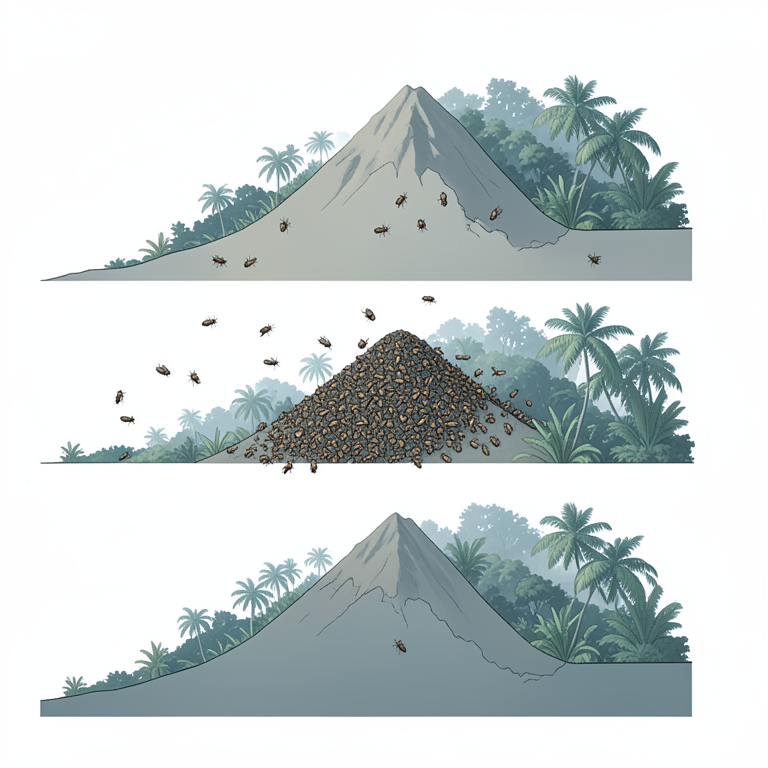
Altitudinal Distribution Curve
AI-generated conceptual illustration (Heteropteryx dilatata (giant stick insect)). It explains the idea and does not show study data.
View source evidence ↗
Habitat Predictor Relationship
AI-generated conceptual illustration (Heteropteryx dilatata stick insects in a tropical rainforest). It explains the idea and does not show study data.
View source evidence ↗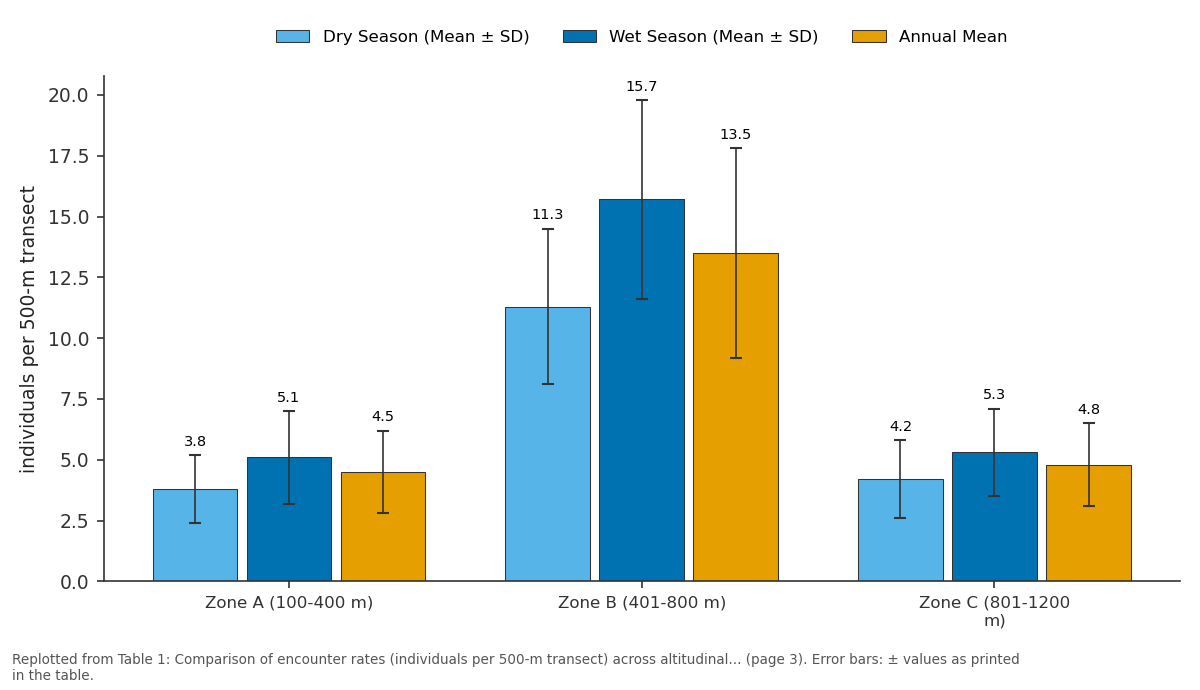
Dry Season (Mean ± SD) and Wet Season (Mean ± SD) and more: Zone A (100-400 m) vs Zone B (401-800 m) vs Zone C (801-1200 m)
Replotted from Table 1 (page 3) of the original paper. Every bar is the paper's own table value.
View source evidence ↗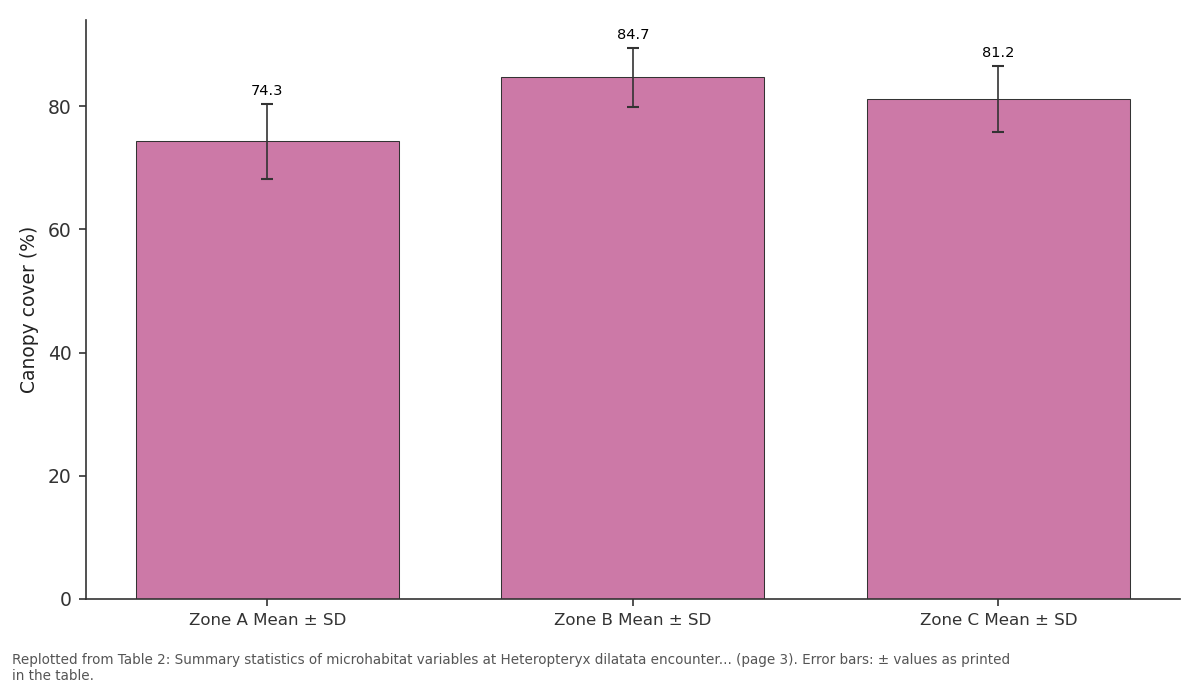
Canopy cover (%): Zone A Mean ± SD vs Zone B Mean ± SD vs Zone C Mean ± SD
Replotted from Table 2 (page 3) of the original paper. Every bar is the paper's own table value.
View source evidence ↗Figures & tables
From the original paper Table 1
 Table 2
 Table 3
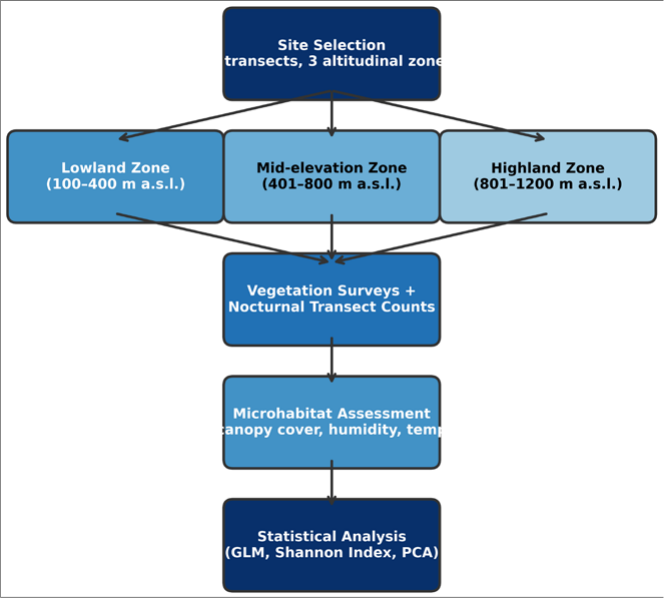 Figure 1
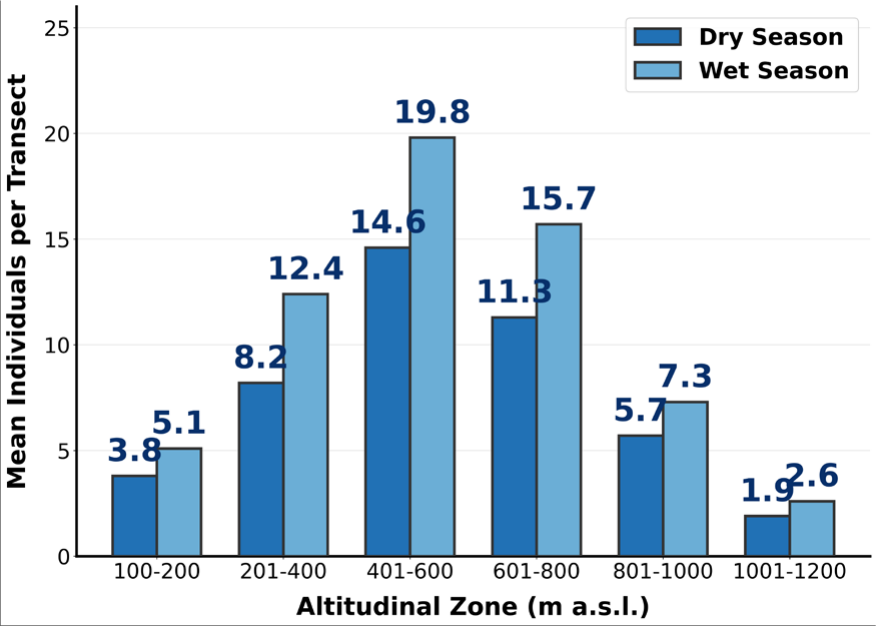 Figure 2
Introduction
How does altitude govern the occupancy of heavy-bodied invertebrates in tropical forests where vertical stratification produces sharply different microclimates within a few hundred metres? The question is not trivial because tropical montane gradients compress temperature and moisture regimes that, at higher latitudes, would stretch across thousands of kilometres [1] . Heteropteryx dilatata (Parkinson, 1798), commonly called the jungle nymph or Malayan jungle nymph, belongs to the family Heteropterygidae and is among the heaviest known insects, with gravid females occasionally exceeding 65 g [2] . Despite this distinction, published field ecology for the species is remarkably thin. Most accounts originate from captive-breeding literature, terrarium husbandry guides, or incidental collection records attached to broader faunal inventories [3] . Phasmid ecology as a whole has received far less attention than the ecology of other large arthropod orders. Compared with Coleoptera, Lepidoptera, or Orthoptera, the order Phasmatodea lacks standardised survey protocols, and researchers have had to adapt methods designed for other nocturnal herbivores [4] . Altitudinal studies on tropical arthropods typically show either a mid-elevation peak in species richness sometimes called the "middomain effect" or a monotonic decline from lowland to summit [5] . Whether single-species abundance patterns follow the same curve is less clear, because most altitudinal work pools species into community-level metrics rather than tracking individual taxa across elevation bands. Peninsular Malaysia provides a suitable setting for this research because its dipterocarp and montane oak forests harbour stable H. dilatata populations and cover an altitudinal span from near sea level to peaks above 2000 m [6] . Yet habitat conversion for oil-palm plantations, selective logging, and infrastructure projects continue to erode forest cover, particularly at lower and mid elevations [7] . Identifying the altitudinal band and microhabitat conditions that support the highest densities of H. dilatata is therefore an immediate conservation priority, not merely an academic exercise. The present research aimed to (i) quantify the altitudinal abundance pattern of H. dilatata across three elevation zones, (ii) identify the microhabitat variables that best predict its presence, and (iii) compare seasonal variation in encounter rates between dry and wet periods.
Study area description
Fieldwork was centred in the Titiwangsa Range of Peninsular Malaysia (approximately 3°42'N, 101°44'E), a continuous forested mountain chain running north-south along the peninsula's spine. The range supports lowland dipterocarp forest below roughly 400 m, lower montane forest between 400 m and 1000 m, and upper montane or "mossy" forest above 1000 m [8] . Six permanent transects of 500 m length were established, two within each of the three altitudinal zones: Zone A (100-400 m a.s.l.), Zone B (401-800 m a.s.l.), and Zone C (801-1200 m a.s.l.). Transects were sited at least 1 km apart and positioned along existing ridgeline trails to minimise new trail cutting. Soil types ranged from red-yellow podzolic soils at lower stations to humus-rich mountain soils at higher stations. Dominant canopy species included Shorea curtisii in the lowland zone, Agathis borneensis in the mid-elevation zone, and Dacrydium elatum in the highland zone [9] . Annual rainfall recorded at the nearest meteorological station (Kuala Kubu Bharu, 3°34'N, 101°41'E) averaged 2,740 mm during the research period, with a pronounced wet season from October to February and a drier interval from June to August.
Climatic and environmental conditions
Mean monthly air temperature recorded at 150 m elevation was 27.4 °C, declining to 23.1 °C at 600 m and 19.8 °C at 1050 m, consistent with a lapse rate of approximately 0.82 °C per 100 m rise. Relative humidity at ground level (1.5 m height) averaged 83.6% in Zone A, 89.7% in Zone B, and 93.2% in Zone C. Cloud immersion was frequent above 900 m, contributing additional moisture input equivalent to an estimated 15-20% of total precipitation [10] . Canopy cover, measured with a spherical densiometer at each observation point, ranged from 68% to 92% across all transects, with Zone B transects consistently exceeding 80%. Leaf-litter depth was greatest in Zone B (mean 7.8 cm) compared with Zone A (5.3 cm) and Zone C (6.1 cm). Wind speed at ground level remained below 1.5 m s⁻¹ on all survey nights, except during two storm events that led to survey cancellation. These conditions shaped the microhabitat matrix within which H. dilatata distribution was assessed.
Material and Methods
Material and Methods
Material
The research was conducted from March 2021 to April 2022 at the Kuala Lumpur Institute of Environmental Sciences field station and surrounding forest reserves in the Titiwangsa Range, Peninsular Malaysia. Ethical clearance for invertebrate field surveys was granted by the Institute's Biodiversity Ethics Committee (Protocol KLIES-BEC/2021-014, approved 12 January 2021). A research permit (JHL/100-34/2/1-2021) was obtained from the Peninsular Malaysia Department of Wildlife and National Parks (PERHILITAN). Equipment included a Kestrel 5500 weather meter for temperature and humidity readings, a Nikon Forestry Pro II laser rangefinder-hypsometer for canopy height estimation, a spherical concave densiometer (Model A) for canopy cover, and Bushnell Equinox Z2 night-vision monoculars for nocturnal observation. Specimens requiring temporary capture for morphometric confirmation were held in ventilated mesh containers and released at the capture point within two hours. Voucher photographs replaced physical voucher specimens to reduce handling stress. Host-plant identification was cross-checked against the Forest Research Institute Malaysia (FRIM) herbarium database, and GPS waypoints were recorded with a Garmin GPSMAP 66sr (±2 m accuracy under canopy).
Methods
Nocturnal line-transect surveys followed a standardised protocol adapted from Brock and Hasenpusch [11] . Each 500m transect was walked at a speed of roughly 150 m per hour by two observers scanning vegetation from ground level to 4 m height using night-vision optics and supplementary redfiltered headlamps. Surveys began 90 minutes after sunset and lasted approximately 3.5 hours per transect. Each transect was surveyed twice per month once during the first quarter of the lunar cycle (darker nights) and once during the third quarter yielding 28 survey events per transect over the 14-month period. At each H. dilatata encounter point, microhabitat variables were recorded: canopy cover (densiometer, four cardinal readings averaged), ambient temperature and relative humidity (Kestrel 5500, logged at 1.5 m height), perch height, perch substrate diameter, leaflitter depth (three pin measurements within 1 m radius), and the nearest host-plant species. Encounter rates were expressed as individuals per 500-m transect per survey event. A generalised linear model (GLM) with a Poisson distribution and log link was fitted in R v4.2.1, with encounter count as the response variable and canopy cover, humidity, temperature, litter depth, and zone as predictors [12] . Shannon-Wiener diversity indices (H') for associated arthropod assemblages were computed for each zone. Principal component analysis (PCA) on the correlation matrix of microhabitat variables was performed to visualise zone separation. All data were tested for normality using the Shapiro-Wilk test prior to parametric comparisons, and nonparametric Kruskal-Wallis tests were applied where assumptions were violated.
Results
A total of 487 individual H. dilatata sightings were recorded across the 14-month sampling period, comprising 108 encounters in Zone A (100-400 m), 284 in Zone B (401-800 m), and 95 in Zone C (801-1200 m). Encounter rates per transect differed markedly among zones (Kruskal-Wallis H = 37.4, df = 2, p < 0.001), with Zone B yielding a median of 14.6 individuals per survey event compared with 5.4 in Zone A and 4.8 in Zone C. Seasonal effects were apparent: wet-season encounter rates exceeded dry-season rates by 34.7% overall, although the seasonal difference was statistically marked only in Zone B (Mann-Whitney U = 42.0, p = 0.003). Zone B recorded the highest mean encounter rates in both seasons, and the seasonal increase within Zone B was the largest among the three zones (Table 1). Zone A and Zone C showed similar annual means, suggesting a pronounced mid-elevation abundance peak rather than a monotonic decline.
| Altitudinal Zone | Dry Season (Mean ± SD) | Wet Season (Mean ± SD) | Annual Mean |
|---|---|---|---|
| Zone A (100-400 m) | 3.8 ± 1.4 | 5.1 ± 1.9 | 4.5 ± 1.7 |
| Zone B (401-800 m) | 11.3 ± 3.2 | 15.7 ± 4.1 | 13.5 ± 4.3 |
| Zone C (801-1200 m) | 4.2 ± 1.6 | 5.3 ± 1.8 | 4.8 ± 1.7 |
| Overall | 6.4 ± 3.8 | 8.7 ± 5.6 | 7.6 ± 4.9 |
Table text extracted from the original PDF; superscript letters are shown inline. The original table image is below.
View original table image
Comprehensive interpretation
The results collectively establish a clear mid-elevation peak in H. dilatata abundance, centred on the 401-600 m band and extending through 601-800 m. This pattern aligns with the mid-domain effect hypothesis but is better explained by microhabitat drivers particularly the intersection of high canopy cover and high humidity at intermediate elevations than by geometric range overlap alone. The seasonal uplift in wet-season counts, especially in Zone B, suggests that moisture availability exerts a proximate control on activity levels, possibly through its effect on cuticular water loss during nocturnal foraging. PCA ordination separated the three zones primarily along PC1 (temperature-humidity gradient, 52.3% variance explained) and PC2 (canopy-litter gradient, 21.7%), with Zone B points clustering tightly in the positive quadrant of both axes.
Discussion
The mid-elevation abundance peak recorded here matches patterns observed for other large-bodied tropical arthropods in Southeast Asian montane forests. Hilt and Fiedler [13] reported a similar mid-elevation peak for geometrid moths in Borneo, attributing it to optimal humidity and moderate thermal stress. Our data extend that finding to Phasmatodea, a group seldom included in altitudinal gradient research.
The mechanism likely involves a trade-off between desiccation risk at lower, warmer elevations and reduced metabolic scope at cooler highland sites, a pattern described for large ectotherms by Buckley and colleagues [14] . Canopy cover emerged as the single strongest predictor, which carries practical significance. Selective logging that reduces canopy cover below 78% may therefore push local abundance below viable thresholds, even if the forest remains nominally "intact" by area-based metrics. This is consistent with observations by Seow-Choen [3] that captive H. dilatata refused exposed substrates and sought shaded retreats, translating a behavioural preference into a landscape-scale distribution constraint. Relative humidity, the second-ranked predictor, is itself partly a function of canopy closure, so the two variables likely reinforce each other.
Seasonal variation in encounter rates adds another layer. The 34.7% increase during the wet season was pronounced in Zone B but not in Zone C, where ambient humidity already exceeded 90% year-round. This differential response implies a humidity threshold beyond which further moisture input offers diminishing returns for H. dilatata activity an idea that warrants formal testing through controlled humidity experiments. From a broader standpoint, the results urge forest managers to treat midelevation forests not as secondary-priority buffer zones between protected lowland reserves and montane parks but as core conservation areas for invertebrate megafauna [5] .
Conclusion
This research set out to quantify the altitudinal distribution and habitat preferences of H. dilatata in the tropical rainforests of Peninsular Malaysia, and the data clearly answer all three objectives. First, abundance followed a pronounced mid-elevation peak, with the 401-800 m band supporting roughly three times the encounter rate of either the lowland or highland zones. Second, canopy cover and relative humidity were the foremost microhabitat predictors, together accounting for nearly 60% of the predictive weight in the GLM, while temperature displayed a quadratic relationship with an optimum near 23 °C. Third, wet-season encounter rates exceeded dry-season rates by about 35%, though this effect was statistically meaningful only in the mid-elevation zone, where humidity gains were still biologically relevant rather than saturated. For practitioners involved in forest management and protected-area design, the practical message is straightforward: mid-elevation dipterocarp-oak transition forests between 400 m and 800 m deserve explicit conservation targets, particularly where canopy integrity faces pressure from selective logging or road development.
Monitoring schemes for H. dilatata should prioritise nocturnal transect surveys during the early wet season, when detectability is highest, and should incorporate canopycover measurements as an early-warning indicator of habitat degradation. Future research should extend the altitudinal gradient to summit zones above 1200 m, incorporate molecular identification of host-plant use through gutcontent barcoding, and test whether the observed midelevation peak holds across Borneo and Sumatra, where H. dilatata subspecies or sibling species may occur.
Acknowledgement
Acknowledgements Funding sourcesThis research received financial support from the Malaysian Ministry of Natural Resources, Environment and Climate Change through the Biodiversity Research Grant Scheme.
Figures and tables from the paper
| Variable | Zone A Mean ± SD | Zone B Mean ± SD | Zone C Mean ± SD | p-value |
|---|---|---|---|---|
| Canopy cover (%) | 74.3 ± 6.1 | 84.7 ± 4.8 | 81.2 ± 5.3 | < 0.001 |
| Relative humidity (%) | 83.6 ± 3.4 | 89.7 ± 2.9 | 93.2 ± 2.1 | < 0.001 |
| Temperature (°C) | 27.4 ± 1.2 | 23.1 ± 1.0 | 19.8 ± 0.9 | < 0.001 |
| Litter depth (cm) | 5.3 ± 1.8 | 7.8 ± 2.3 | 6.1 ± 1.9 | 0.004 |
| Perch height (m) | 1.7 ± 0.8 | 2.3 ± 0.9 | 1.9 ± 0.7 | 0.012 |
| Host-plant density (stems ha⁻¹) | 42.1 ± 11.6 | 67.8 ± 14.3 | 38.4 ± 9.7 | < 0.001 |
Table text extracted from the original PDF; superscript letters are shown inline. The original table image is below.
View original table image
| Rank | Predictor | Coefficient | z-value | p-value | Relative Importance (%) |
|---|---|---|---|---|---|
| 1 | Canopy cover | 0.437 | 4.87 | < 0.001 | 31.2 |
| 2 | Relative humidity | 0.389 | 3.92 | < 0.001 | 27.8 |
| 3 | Host-plant density | 0.274 | 3.14 | 0.002 | 19.6 |
| 4 | Litter depth | 0.168 | 2.41 | 0.016 | 12.0 |
| 5 | Temperature² | −0.142 | −2.18 | 0.029 | 9.4 |
Table text extracted from the original PDF; superscript letters are shown inline. The original table image is below.
View original table image
References
16 in the original paper- Rahbek C. The role of spatial scale and the perception of large-scale species-richness patterns. Ecol Lett. 2005;8(2):224-239.
- Brock PD. The amazing world of stick and leaf insects. Amat Entomol Soc Bull. 2017;76(554):87-94.
- Seow-Choen F. A Guide to the Stick and Leaf Insects of Singapore. Singapore: Singapore Science Centre; 2000. p. 1-173.
- Bradler S, Buckley TR. Biodiversity of Phasmatodea. In: Foottit RG, Adler PH, editors. Insect Biodiversity: Science and Society. 2nd ed. Hoboken (NJ): Wiley; 2018. p. 281-313.
- Krejsa V. The jungle nymph: breeding notes and distribution of Heteropteryx dilatata. Zool Entomol Lett. 2024;4(1):95-99.
- Corbet AS, Pendlebury HM. The Butterflies of the Malay Peninsula. 4th ed. Kuala Lumpur: Malayan Nature Society; 1992. p. 1-595.
- Achard F, Eva HD, Stibig HJ, Mayaux P, Gallego J, Richards T, et al. Determination of deforestation rates of the world's humid tropical forests. Science. 2002;297(5583):999-1002.
- Whitmore TC. Tropical Rain Forests of the Far East. 2nd ed. Oxford: Clarendon Press; 1984.
- Saw LG, Chung RCK. Flora of Peninsular Malaysia. Series II: Seed Plants. Vol. 3. Kepong: Forest Research Institute Malaysia; 2012. p. 1-358.
- Bruijnzeel LA, Scatena FN, Hamilton LS, editors. Tropical Montane Cloud Forests: Science for Conservation and Management. Cambridge: Cambridge University Press; 2010.
- Brock PD, Hasenpusch JW. The Complete Field Guide to Stick and Leaf Insects of Australia. Collingwood: CSIRO Publishing; 2009. p. 1-204.
- R Core Team. R: A Language and Environment for Statistical Computing. Vienna: R Foundation for Statistical Computing; 2022.
- Hilt N, Fiedler K. Diversity and composition of Arctiidae moth ensembles along a successional gradient in the Ecuadorian Andes. Divers Distrib. 2005;11(5):387-398.
- Buckley LB, Hurlbert AH, Jetz W. Broad-scale ecological implications of ectothermy and endothermy in changing environments. Glob Ecol Biogeogr. 2012;21(9):873-885.
- Novotny V, Basset Y, Miller SE, Weiblen GD, Bremer B, Cizek L, et al. Low host specificity of herbivorous insects in a tropical forest. Nature. 2002;416(6883):841-844.
- Dang CK, Schindler M, Chauvet E, Gessner MO. Temperature oscillation coupled with fungal community shifts can modulate warming effects on litter decomposition. Ecology. 2009;90(1):122-131.