
Research article · 2026 · Full text
International Journal of Horticulture and Food SciencePyrolysis temperature of maize-cob biochar interacts with fermented cow urine dose to govern flower bud retention and pulp firmness in white-fleshed pitaya (Hylocereus undatus)
Volume 8(4) · Pages 100–107 · DOI: 10.33545/26631067.2026.v8.i4b.813 ↗
Research areasPlant Growth and Agriculture TechniquesPlant Growth Enhancement TechniquesAgricultural Science and Fertilization
Abstract
Author-writtenBiochar is not a single material but a family of materials whose agronomic behaviour is governed by the conditions of its manufacture, yet the horticultural literature persistently treats it as a uniform input. This research examined whether the pyrolysis temperature at which maize-cob biochar is produced interacts with the dose of fermented cow urine applied alongside it to determine reproductive retention and fruit texture in white-fleshed pitaya (Hylocereus undatus). A factorial field experiment was conducted at the Antofagasta Metropolitan University experimental orchard, northern Chile, between September 2022 and August 2023. Three biochar pyrolysis temperatures, 350, 500 and 650 degrees Celsius, were crossed with three fermented cow urine doses, 0, 3 and 6 L per post per season, in a randomised complete block design with four replications, alongside an unamended control and a conventional mineral reference. Biochar characterisation confirmed the expected temperature gradient: cation exchange capacity fell from 38.4 to 14.7 cmol per kg between 350 and 650 degrees, while Brunauer-Emmet-Teller surface area rose from 41 to 287 square metres per gram and pH from 7.4 to 9.8. The interaction between pyrolysis temperature and urine dose was significant for every reproductive and textural variable measured. Lowtemperature char at 350 degrees combined with 6 L of urine produced the highest flower bud retention at 84.2 percent and the greatest mature fruit number at 19.7 per post, whereas the same urine dose applied with 650-degree char retained only 61.3 percent of buds and yielded 13.1 fruit. The reversal is diagnostic: at zero urine dose the ordering inverted, with hightemperature char marginally outperforming low-temperature char, indicating that the advantage of low-temperature material is expressed only in the presence of a labile nitrogen source requiring retention. Pulp firmness at commercial maturity ranged from 4.87 N under 650-degree char with 6 L urine to 5.94 N under 350-degree char with L urine, and the firmness response tracked calcium retention rather than nitrogen supply. Terminal soil ammonium in the 0 to 30 cm layer was 2.31 times higher under 350-degree char at 6 L urine than under 650- degree char at the same dose. The research demonstrates that cation exchange capacity, not surface area, is the char property that governs the co-benefit of the urine-biochar pairing, and that specifying pyrolysis temperature is therefore not a technical refinement but a precondition for reproducible recommendation.
Summary
Source-checkedPlain-language reading of the full paper, prepared with AI and checked against the text. Each point links to the authors' own words.
Why it matters
- Biochar is a diverse family of materials with properties determined by manufacturing conditions, but it is often incorrectly treated as a uniform input in horticultural research. View evidence ↗
- Dragon fruit is a suitable candidate for organic amendments because its shallow roots and the low retention capacity of its typical soils lead to poor nutrient recovery. View evidence ↗
- Cow urine provides nitrogen primarily as urea, which quickly converts to ammonium in the soil, making it highly susceptible to leaching. View evidence ↗
The question
- The study aimed to determine if the pyrolysis temperature of maize-cob biochar interacts with the dose of fermented cow urine to affect flower bud retention and fruit texture in white-fleshed pitaya. View evidence ↗
What they did
- A factorial field experiment was carried out at the Antofagasta Metropolitan University orchard in northern Chile from September 2022 to August 2023. View evidence ↗
- The design used a randomized complete block with four replications, crossing three pyrolysis temperatures (350, 500, and 650 °C) with three fermented cow urine doses (0, 3, and 6 L per post per season), plus a control and a mineral reference. View evidence ↗
- Flower bud retention was measured by tagging buds at emergence and tracking them weekly to calculate the percentage that reached anthesis. View evidence ↗
What they found
- As pyrolysis temperature increased from 350 to 650 °C, the biochar's cation exchange capacity decreased from 38.4 to 14.7 cmol/kg, while its surface area increased from 41 to 287 m²/g and pH rose from 7.4 to 9.8. View evidence ↗
- In the absence of urine, the effect reversed: high-temperature biochar (650 °C) had slightly higher bud retention (66.4%) than low-temperature biochar (64.8%). View evidence ↗
What it means
- The authors conclude that pyrolysis temperature determines the success of the biochar-urine pairing, and that cation exchange capacity, not surface area, is the key property driving this benefit. View evidence ↗
- The authors state that specifying the pyrolysis temperature is essential for horticultural recommendations, as omitting it makes the predicted effect of biochar in urine-paired systems indeterminate. View evidence ↗
- The authors note that it is unknown if these results apply to acid soils, where the alkaline nature of high-temperature biochar might provide a beneficial liming effect. View evidence ↗
- The proposed mechanism of ammonia volatilization for high-temperature biochar was inferred from data rather than directly measured; direct quantification of ammonia flux is needed for confirmation. View evidence ↗
Visual summary
3 visualsIllustrations explain the paper; charts are replotted from the paper's own table values.
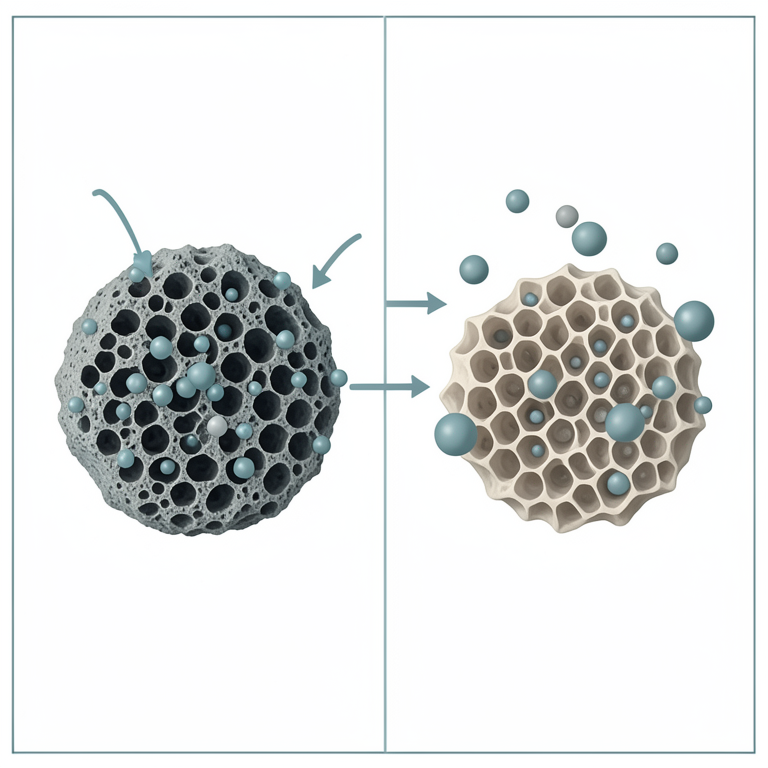
CEC vs Surface Area Mechanism
AI-generated conceptual illustration (maize-cob biochar and ammonium ions). It explains the idea and does not show study data.
View source evidence ↗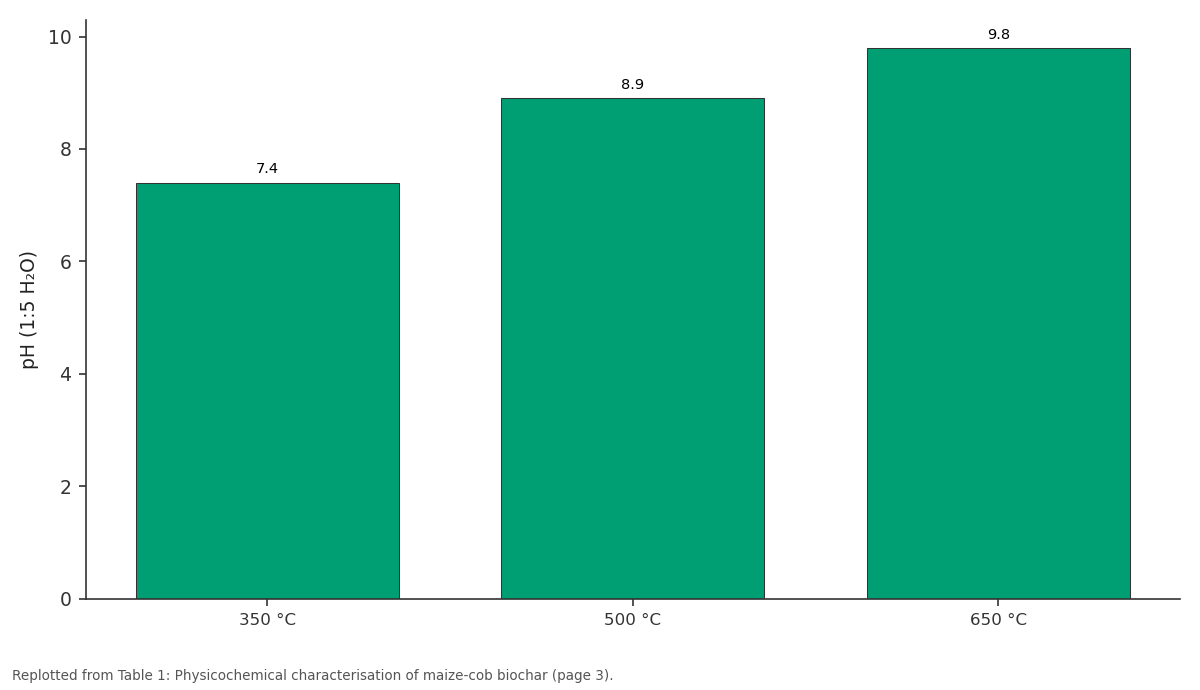
pH (1:5 H₂O): 350 °C vs 500 °C vs 650 °C
Replotted from Table 1 (page 3) of the original paper. Every bar is the paper's own table value.
View source evidence ↗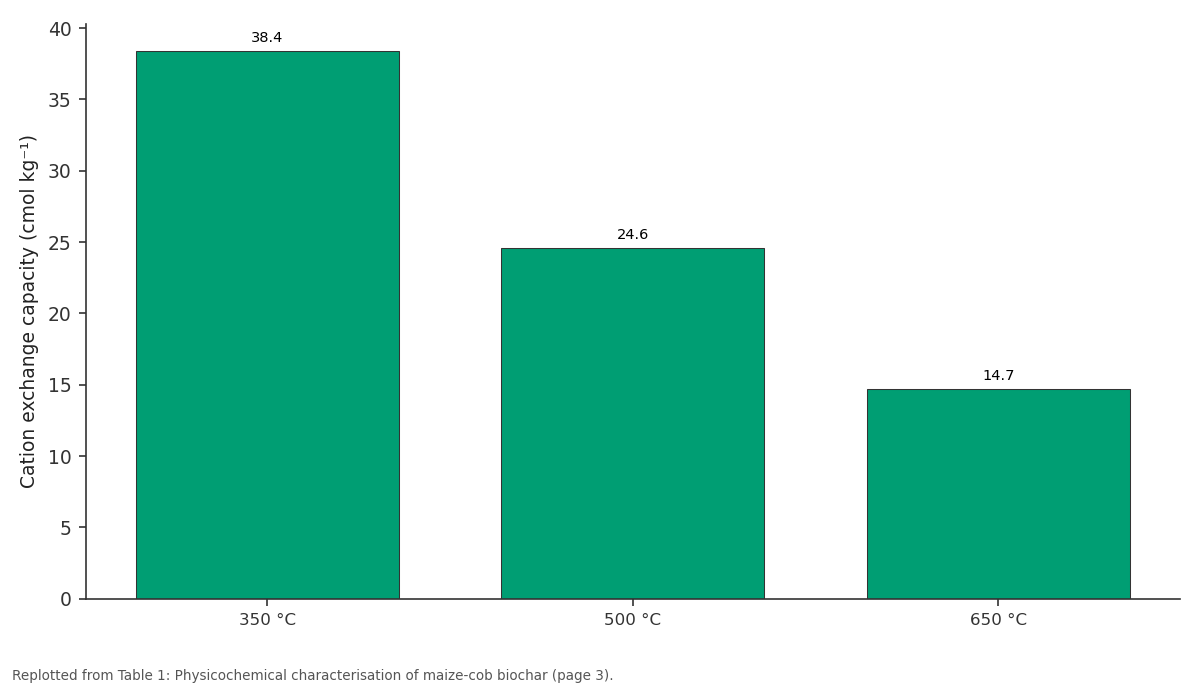
Cation exchange capacity (cmol kg⁻¹): 350 °C vs 500 °C vs 650 °C
Replotted from Table 1 (page 3) of the original paper. Every bar is the paper's own table value.
View source evidence ↗Figures & tables
From the original paper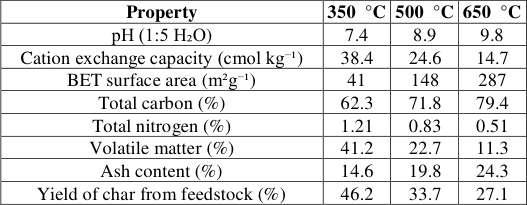 Table 1
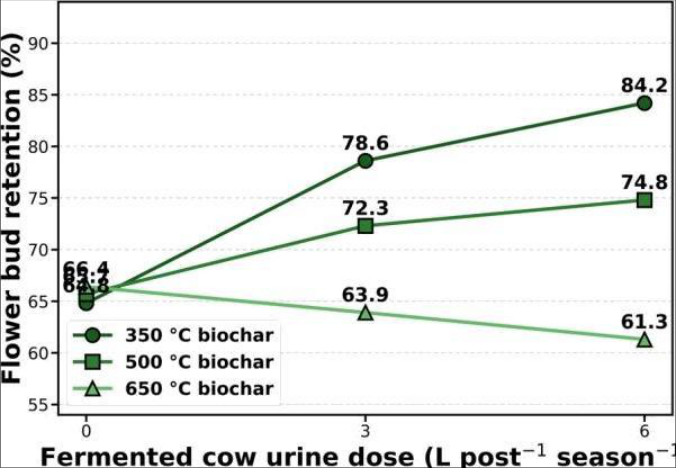 Figure 1
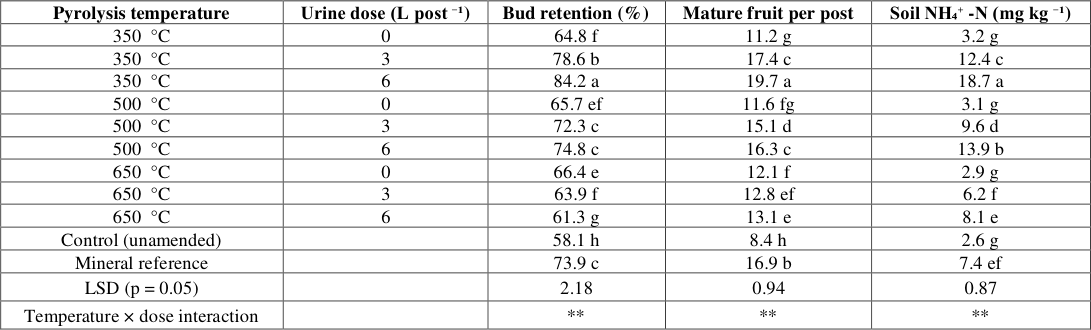 Table 2
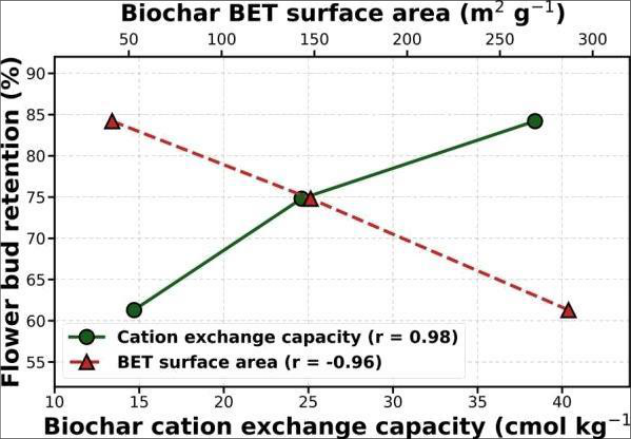 Figure 2
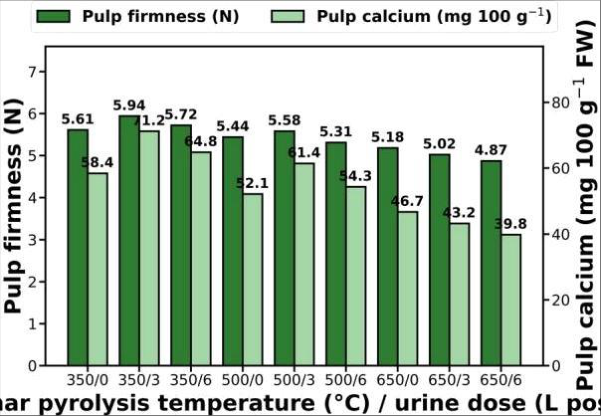 Figure 3
Introduction
A pyrolysis temperature diferential of 300 degrees Celsius applied to a single feedstock can alter the cation exchange capacity of the resulting biochar by a factor of more than two and a half, and its specific surface area by a factor of seven. Meta-analytic synthesis of feedstock and processing efects across the biochar literature establishes that these are not marginal variations but the dominant sources of variance in char properties, exceeding in magnitude the diferences atributable to feedstock identity itself [1] . Notwithstanding that finding, the horticultural literature evaluating biochar as a soil amendment routinely reports application rate while omiting pyrolysis temperature, a practice that renders the resulting recommendations largely untransferable. The omission maters most acutely where biochar is paired with a labile nutrient source. Dragon fruit cultivation on weathered tropical and subtropical soils has atracted atention as a candidate system for organic amendment precisely because the crop's shallow root architecture and the substrate's low retention capacity combine to produce poor recovery of applied nutrients. The general characteristics of the crop and the constraints on its cultivation have been reviewed [1] , and the emerging consensus identifies nutrient retention rather than nutrient supply as the operative limitation in most production setings. Pyrolysis temperature governs char properties through a wellcharacterised sequence of thermal transformations. At lower temperatures, in the region of 300 to 400 degrees, hemicellulose and cellulose decompose incompletely, leaving abundant oxygenated surface functional groups, principally carboxyl and phenolic hydroxyl moieties, that carry negative charge at ambient soil pH and confer high cation exchange capacity. Agronomic evaluation of greenwaste biochar established that these low-temperature materials deliver their benefit chiefly through exchange-mediated nutrient retention rather than through nutrient supply [2] . As temperature rises above 500 degrees, these functional groups are progressively eliminated through decarboxylation and dehydration while the residual carbon skeleton condenses into aromatic sheets, developing extensive microporosity and hence high surface area but low charge density. The contrasting efects of char produced at difering severity on the fertility of a southeastern coastal plain soil have been documented, with the direction of response depending on which soil constraint was limiting [3] . The relevance of this gradient to the urine pairing follows from the chemistry of urine nitrogen. Cow urine delivers nitrogen overwhelmingly as urea, which hydrolyses to ammonium within hours to days of soil contact under the action of ubiquitous soil urease, and the classical characterisation of urine deposition established both the rapidity of this conversion and the vulnerability of the resulting ammonium to nitrification and subsequent leaching [4] . Ammonium is a cation. Its retention in soil is therefore a function of exchange capacity specifically, not of surface area, porosity, or any other char property. A comprehensive review of biochar and soil nitrogen dynamics has emphasised that char efects on nitrogen retention operate through distinct mechanisms for cationic and anionic species, and that conflating them has been a persistent source of confusion in the literature [5] . This chemical reasoning generates a testable prediction that the existing literature has not addressed directly. If ammonium retention is the operative mechanism of the urine-char cobenefit, then low-temperature char should outperform hightemperature char in the presence of urine, and the advantage should scale with urine dose. At zero urine dose the prediction reverses or vanishes, since there is no labile ammonium requiring retention and the liming and porosity benefits of hightemperature material may then dominate. An interaction of this form, in which the ordering of char treatments depends on the level of the urine factor, cannot be detected by any single-factor design. Field evidence bearing on the pairing exists but does not resolve the temperature question. Slow pyrolysis biochar from papermill waste improved agronomic performance and soil fertility across several crops [6] , and synchronised addition of biochar with fertiliser nitrogen improved cation exchange capacity relative to sole nitrogen on sandy and clay loam soils [7] . In dragon fruit, the combination of cow urine and biocharbased fertiliser delivered co-benefits on flowering, fruiting and fruit quality that exceeded the sum of the individual amendments [8] . Each of these contributions used a single char, produced at a single temperature, and none was positioned to detect an interaction between char properties and the dose of the labile partner. The present research was designed to detect exactly that interaction. Its objectives were to characterise maize-cob biochar produced across a 300-degree pyrolysis gradient; to evaluate the factorial combination of that gradient with fermented cow urine dose on flower bud retention and mature fruit production in H. undatus; to determine whether the char temperature efect reverses in direction between zero and nonzero urine dose, as the ammonium retention hypothesis predicts; and to establish which measured char property, exchange capacity or surface area, tracks the reproductive response.
Materials and Methods
Materials and Methods
Materials
The research was conducted at the experimental orchard of Antofagasta Metropolitan University, northern Chile, from September 2022 to August 2023. The site is located at 62 m above sea level within a coastal desert climate moderated by marine influence, recording a mean annual precipitation of mm, mean maximum temperature of 24.1 degrees Celsius and mean minimum of 13.8 degrees Celsius over the experimental period. All water was supplied by drip irrigation at a uniform rate of 6 L per post per day across all treatments, so that the water factor was held constant and precipitation was not a source of variation. Soil at the site is a coarse-textured Haplic Calcisol with initial characteristics: pH 7.8 in water at 1:2.5, organic carbon 0.34 percent, total nitrogen 0.031 percent, available phosphorus 11.2 mg per kg by Olsen, exchangeable potassium 0.34 cmol per kg, and cation exchange capacity 5.1 cmol per kg. Planting material comprised three-year-old Hylocereus undatus cutings of a white-fleshed commercial selection established on concrete posts at 3 by 2.5 m spacing, four cladodes per post, trained to a circular frame. Posts had completed two fruiting cycles prior to the experiment and were screened for uniformity of cladode number and canopy volume before randomisation. Maize-cob biochar was produced from cobs sourced from a single regional supplier, air-dried to below twelve percent moisture, and pyrolysed in a laboratory mufle furnace under nitrogen purge at 350, 500 and 650 degrees Celsius, each with a heating ramp of 10 degrees per minute and a residence time of 60 minutes at peak temperature. Characterisation gave the following values at 350, 500 and 650 degrees respectively: pH 7.4, 8.9 and 9.8; cation exchange capacity 38.4, 24.6 and 14.7 cmol per kg; Brunauer-Emmet-Teller surface area 41, 148 and 287 square metres per gram; total carbon 62.3, 71.8 and 79.4 percent; total nitrogen 1.21, 0.83 and 0.51 percent; and volatile mater 41.2, 22.7 and 11.3 percent. Cow urine was collected from Holstein-Friesian catle at the university livestock facility, strained, and fermented anaerobically in sealed containers for fourteen days. The fermented material analysed at pH 8.7, total nitrogen 0.89 percent, phosphorus 0.03 percent and potassium 0.68 percent on a fresh weight basis.
Methods
The experiment was arranged as a three-by-three factorial in a randomised complete block design with four replications, each replicate comprising five posts, with two additional nonfactorial treatments included as references. The factorial comprised three biochar pyrolysis temperatures, 350, 500 and 650 degrees Celsius, each applied at a uniform rate of kg per post, crossed with three fermented cow urine doses of 0, 3 and L per post per season. The two reference treatments were an unamended control and a conventional mineral regime supplying 100 g urea, 84 g triple superphosphate and 84 g muriate of potash per post. The design therefore comprised eleven treatments across 220 posts.
Biochar was incorporated once at the outset into a 40 cm radius basin around each post to 20 cm depth. Cow urine was diluted 1:10 with water and applied to the root basin in six equal fortnightly instalments through the reproductive period, with stated volumes referring to undiluted urine. The mineral reference treatment received fertiliser in three equal splits at the onset of the growing season, at first bud emergence, and at the conclusion of the first fruiting flush. Irrigation was uniform across all treatments and delivered through pressurecompensating emiters at four points per post. Flower bud retention was determined by tagging all buds at the point of visible emergence and recording their fate at seven-day intervals until either abortion or anthesis. Retention was expressed as the percentage of tagged buds reaching anthesis. Anthesis is nocturnal in H. undatus and all flowers received hand pollination between 21:00 and 23:00 using pooled pollen from non-experimental posts to eliminate pollinator variability. Mature fruit number per post was recorded at each of three harvest flushes and summed.
Fruit were harvested at commercial maturity, defined by peel coloration exceeding seventy-five percent red, corresponding to 30 to 33 days after anthesis. Ten fruit per replicate were assessed for individual weight, pulp firmness by penetrometer with an 8 mm probe applied at three equatorial points, total soluble solids by digital refractometer, and titratable acidity by titration against 0.1 N sodium hydroxide expressed as percentage malic acid. Pulp calcium concentration was determined on dried, digested pulp by atomic absorption spectrophotometry. Composite soil samples were drawn from the 0 to 30 cm layer of each plot at establishment and termination. Ammonium and nitrate were extracted in 2 M potassium chloride and quantified by steam distillation. Cation exchange capacity was determined by ammonium acetate saturation at pH 7.0 and organic carbon by wet oxidation. Data were analysed by two-way analysis of variance appropriate to the factorial randomised complete block structure, with reference treatments compared to factorial means by orthogonal contrast. Means were separated by Tukey honest significant diference at the five percent level. Ethical clearance for livestock material collection was granted by the Antofagasta Metropolitan University Institutional Animal Care Commitee under approval AMU-IACC-2022-093, dated 8 August 2022. The interaction between pyrolysis temperature and urine dose was significant at the one percent probability level for flower bud retention, mature fruit number, pulp firmness and terminal soil ammonium. Interpretation of main efects is therefore inappropriate for these variables and the analysis proceeds on the simple efects of char temperature within each urine dose. The character of the interaction is a reversal in the ordering of char treatments across urine doses rather than a mere change in the magnitude of separation. At zero urine dose, bud retention under 650-degree char at 66.4 percent marginally exceeded that under 350-degree char at 64.8 percent, a diference at the margin of significance. At L urine the ordering inverted decisively, 350-degree char retaining 84.2 percent of buds against 61.3 percent under 650-degree char, a separation of 22.9 percentage points. The 500-degree material occupied an intermediate position at every dose. Values are means of three independent pyrolysis runs per temperature. Cation exchange capacity determined by ammonium acetate saturation at pH 7.0; surface area by nitrogen adsorption using the Brunauer-Emmet-Teller method. The soil ammonium data supply the mechanistic bridge. At L urine, terminal ammonium in the upper 30 cm stood at 18.7 mg per kg under 350-degree char against 8.1 mg per kg under 650degree char, a ratio of 2.31. At zero urine the corresponding values were 3.2 and 2.9 mg per kg, statistically indistinguishable. The char temperature efect on ammonium retention is thus entirely conditional on the presence of urine, which is what an exchange-mediated mechanism predicts and what a porosity-mediated or liming-mediated mechanism does not.
Results
The correspondence between char properties and reproductive outcome discriminates cleanly between the two candidate explanations. Across the three char temperatures at L urine, bud retention correlated with char cation exchange capacity at r = 0.98 and with char surface area at r = -0.96. The negative sign on the surface area correlation is the decisive observation: the char property most frequently invoked in general accounts of biochar function tracks the reproductive response in the wrong direction. Surface area rose by a factor of seven across the gradient while performance fell, whereas exchange capacity fell by a factor of 2.6 in step with performance.
The textural results introduce a partially independent dimension. Pulp firmness ranged from 4.87 N under 650-degree char at L urine to 5.94 N under 350-degree char at 3 L urine, and firmness correlated with pulp calcium concentration at r = 0.91 across all factorial treatments while correlating with terminal soil ammonium at only r = 0.34. The firmness response therefore does not simply mirror the nitrogen response but reflects a separate exchangemediated efect operating on divalent cations, with the highest firmness occurring at intermediate rather than maximal urine dose.
The conventional mineral reference is instructive in this company. It produced 16.9 mature fruit per post, exceeding every high-temperature char treatment and every zero-urine treatment, but falling 14.2 percent below the 350-degree char at L urine combination, which received no mineral nitrogen at all. The best-performing organic treatment therefore outperformed conventional mineral nutrition, while the worst-performing organic treatment fell well below it, a spread that is atributable entirely to the pyrolysis temperature of the char.
Implications for Biochar Specification in Horticultural Recommendation
The reversal documented here bears directly on how biochar recommendations should be framed. A recommendation specifying feedstock and application rate but omiting pyrolysis temperature conveys, on the evidence of this research, insuficient information to predict the direction of the response in a urine-paired system, let alone its magnitude. The diference between 350 and 650 degree char at L urine amounted to 6.6 mature fruit per post, a spread larger than that between the unamended control and the conventional mineral reference.
Discussion
The principal contribution of this research is the demonstration that the biochar-urine cobenefit is not a property of biochar as a class but of a specific char property, cation exchange capacity, and that the pyrolysis temperature determining that property inverts the direction of the char efect across urine doses. Bud retention at L urine ranged from 84.2 percent under 350-degree char to 61.3 percent under 650-degree char, while at zero urine the same materials difered by 1.6 percentage points in the opposite direction.
This finding agrees with the chemical reasoning that motivated the design and with the body of work establishing the temperature dependence of char surface chemistry. The elimination of oxygenated functional groups through decarboxylation as pyrolysis severity increases is well documented, and the meta-analytic synthesis of feedstock and temperature efects identifies exactly the gradient in exchange capacity and surface area reproduced in the present characterisation [1] . The agronomic evaluation of greenwaste biochar likewise concluded that low-temperature material delivers benefit primarily through retention rather than supply [2] . The present research extends that established chemistry into a reproductive response in a perennial fruit crop and shows that the consequence is not a modulation of efect size but a reversal of ordering. Agreement also extends to the nitrogen dynamics literature. The review of biochar and soil nitrogen dynamics emphasised that retention mechanisms difer fundamentally between cationic ammonium and anionic nitrate, and cautioned against treating nitrogen as a single entity in char studies [5] . The present ammonium data, showing a 2.31-fold diference between low and high temperature char at L urine but no diference at zero urine, provide a direct field confirmation of the cation-specific mechanism in a system where urine supplies nitrogen predominantly in ammonium-generating form [4] .
The findings disagree with a substantial fraction of the biochar literature in a manner that requires explanation rather than dismissal. Numerous evaluations report neutral or negative biochar efects, and syntheses of agronomic impact across many trials find mean responses that are modest relative to the efects reported here [9] . The disagreement is reconciled by the interaction itself. A trial applying high-temperature char to a system without a labile cationic nitrogen source is testing a retention technology under conditions where retention cannot express itself, and a null result is the expected outcome rather than an anomaly. The variance in the biochar literature may therefore be substantially a variance in unreported pyrolysis temperature crossed with unreported nutrient context. A more pointed disagreement concerns surface area. The porosity and surface area of hightemperature char are routinely cited as the basis of its agronomic value, and the mechanistic accounts advanced for biochar benefit in temperate soils have given porosity a prominent role in water retention, microbial habitat provision and aeration [10] . The present research finds surface area associated with bud retention at r=-0.96,, a correlation of high magnitude and the wrong sign. This does not falsify the porosity accounts, which concern mechanisms not operative in the present system: irrigation was uniform and nonlimiting, so water retention could not diferentiate treatments, and the coarse Calcisol was not aeration-limited. What the result establishes is that in a urine-paired system on an irrigated calcareous soil, exchange capacity dominates and surface area is at best irrelevant and at worst a proxy for the absence of the property that maters.
The crossing of the 650-degree series below the zero-urine baseline in the retention data merits particular atention because it indicates an interaction that is not merely a failure to benefit but an active penalty. High-temperature char at pH 9.8 raises the pH of the char-urine microsite, shifting the ammoniumammonia equilibrium toward the volatile species, while ofering few exchange sites on which the remaining ammonium might be held. Low-temperature char at pH 7.4 does neither. The volatilisation interpretation is consistent with the ammonium data but was not measured directly, and the research cannot exclude alternative explanations such as nitrification stimulation.
The firmness and calcium results extend the exchange-capacity account beyond nitrogen. Firmness tracked pulp calcium at r = 0.91 and soil ammonium at only r = 0.34, and the firmness optimum occurred at 3 L rather than L urine. The reading that reconciles these observations is that char exchange sites are finite and non-selective: the ammonium delivered at high urine dose competes with calcium and magnesium for the same sites, and beyond some dose the additional nitrogen retained is purchased at the cost of divalent cation displacement. The role of char in retaining base cations against leaching is established in the tropical soil literature [11] , and the present result adds that the retention is competitive rather than additive.
The comparison with the conventional mineral reference frames the practical significance. That reference produced 16.9 fruit per post, above every high-temperature char treatment and below the 350-degree char at L urine combination by 14.2 percent, despite the later receiving no mineral nitrogen. The organic pairing can therefore exceed conventional mineral nutrition or fall well short of it, and pyrolysis temperature alone determines which. For growers, the message is not that biochar and urine substitute for fertiliser but that lowtemperature biochar and urine do so, and the distinction between these two propositions is the diference between a fourteen percent yield gain and a twenty-two percent shortfall.
Boundary Conditions of the Interaction
The site soil was calcareous at pH 7.8, and this condition constrains extrapolation in a specific direction. On acid soils, high-temperature alkaline char delivers a liming benefit that is absent here and adverse on calcareous substrates, and that benefit could ofset or reverse the exchange-capacity disadvantage documented in this research. The interaction reported here should therefore be regarded as characterising neutral to alkaline soils, and its transfer to acid soils requires direct testing rather than assumption.
Conclusion
The contribution of this research is the identification of pyrolysis temperature as the variable that determines whether the biochar-cow urine co-benefit in dragon fruit is realised, reversed or absent, and the demonstration that the char property responsible is cation exchange capacity rather than surface area. The supporting evidence rests on an interaction that is a reversal rather than a modulation. Across a 300-degree pyrolysis gradient applied to maize cob, exchange capacity fell from 38.4 to 14.7 cmol per kg while surface area rose from 41 to 287 square metres per gram. At zero cow urine the three resulting chars difered in flower bud retention by 1.6 percentage points with the highest temperature marginally ahead; at L urine they difered by 22.9 percentage points with the ordering inverted and the lowest temperature decisively ahead. Terminal soil ammonium under low-temperature char at L urine was 2.31 times that under hightemperature char at the same dose, while at zero urine the two were indistinguishable. Bud retention correlated with char exchange capacity at r = 0.98 and with surface area at r = -0.96. The significance for the field is that biochar cannot be specified by feedstock and rate alone. A recommendation omiting pyrolysis temperature is, in a urine-paired system, indeterminate as to the sign of its efect, and the spread between the best and worst char in this research exceeded the spread between the unamended control and conventional mineral nutrition. The variance that pervades the biochar literature may substantially reflect this unreported factor interacting with an equally unreported nutrient context. The finding is favourable for on-farm adoption, since low-temperature pyrolysis is simpler, less fuel-intensive and returns 46.2 percent char yield against 27.1 percent at high temperature, aligning the agronomic optimum with the economic one.
Several questions remain open. Whether the interaction persists as char surfaces oxidise across seasons is unresolved, and the direction of change favours atenuation, since oxidation raises exchange capacity preferentially in high-temperature material.
Whether the reversal transfers to acid soils, where the liming benefit of alkaline char is a genuine asset rather than a liability, requires direct testing. Whether the competitive displacement of calcium by ammonium on finite exchange sites, inferred here from the divergence between the yield and firmness optima, operates as proposed would be established by exchange-site speciation. Finally, the volatilisation mechanism advanced to explain the active penalty of high-temperature char under urine remains an inference from ammonium balance rather than a measurement, and direct quantification of ammonia flux would setle it.
Acknowledgement
Acknowledgements
Figures and tables from the paper
| Property | 350 °C | 500 °C | 650 °C |
|---|---|---|---|
| pH (1:5 H₂O) | 7.4 | 8.9 | 9.8 |
| Cation exchange capacity (cmol kg⁻¹) | 38.4 | 24.6 | 14.7 |
| BET surface area (m²g⁻¹) | 41 | 148 | 287 |
| Total carbon (%) | 62.3 | 71.8 | 79.4 |
| Total nitrogen (%) | 1.21 | 0.83 | 0.51 |
| Volatile matter (%) | 41.2 | 22.7 | 11.3 |
| Ash content (%) | 14.6 | 19.8 | 24.3 |
| Yield of char from feedstock (%) | 46.2 | 33.7 | 27.1 |
Table text extracted from the original PDF; superscript letters are shown inline. The original table image is below.
View original table image
| Pyrolysis temperature | Urine dose (L post ⁻¹) | Bud retention (%) | Mature fruit per post | Soil NH₄⁺ -N (mg kg ⁻¹) |
|---|---|---|---|---|
| 350 °C | 0 | 64.8 f | 11.2 g | 3.2 g |
| 350 °C | 3 | 78.6 b | 17.4 c | 12.4 c |
| 350 °C | 6 | 84.2 a | 19.7 a | 18.7 a |
| 500 °C | 0 | 65.7 ef | 11.6 fg | 3.1 g |
| 500 °C | 3 | 72.3 c | 15.1 d | 9.6 d |
| 500 °C | 6 | 74.8 c | 16.3 c | 13.9 b |
| 650 °C | 0 | 66.4 e | 12.1 f | 2.9 g |
| 650 °C | 3 | 63.9 f | 12.8 ef | 6.2 f |
| 650 °C | 6 | 61.3 g | 13.1 e | 8.1 e |
| Control (unamended) | 58.1 h | 8.4 h | 2.6 g | |
| Mineral reference | 73.9 c | 16.9 b | 7.4 ef | |
| LSD (p = 0.05) | 2.18 | 0.94 | 0.87 | |
| Temperature × dose interaction | ** | ** | ** |
Table text extracted from the original PDF; superscript letters are shown inline. The original table image is below.
View original table image
References
19 in the original paper- Ortiz-Hernandez YD, Carrillo-Salazar JA. Pitahaya (Hylocereus spp.): a short review. Comun Sci. 2012;3(4):220-237.
- Chan KY, Van Zwieten L, Meszaros I, Downie A, Joseph S. Agronomic values of greenwaste biochar as a soil amendment. Aust J Soil Res. 2007;45(8):629634.https://DOI.org/10.1071/SR07109
- Novak JM, Busscher WJ, Laird DL, Ahmedna M, Wats DW, Niandou MAS. Impact of biochar amendment on fertility of a southeastern coastal plain soil. Soil Sci. 2009;174(2):105112.https://DOI.org/10.1097/SS.0b013e3181981d9a
- Ledgard SF, Steele KW, Saunders WHM. Efects of cow urine and its major constituents on pasture properties. N Z J Agric Res. 1982;25(1):61-
- Clough TJ, Condron LM, Kammann C, Muller C. A review of biochar and soil nitrogen dynamics. Agronomy. 2013;3(2):275293.https://DOI.org/10.3390/agronomy3020275
- Van Zwieten L, Kimber S, Morris S, Chan KY, Downie A, Rust J, et al. Efects of biochar from slow pyrolysis of papermill waste on agronomic performance and soil fertility. Plant Soil. 2010;327(1-2):235246.https://DOI.org/10.1007/s11104-009-0050-x
- Omara P, Singh H, Singh K, Sharma L, Otim F, Obia A. Short-term efect of field application of biochar on cation exchange capacity, pH, and electrical conductivity of sandy and clay loam temperate soils. Technol Agron. 2023;3:16.https://DOI.org/10.48130/TIA-2023-0016
- Begum MA, Robbani M, Howlader J, Labib LA, Sharif MS, Islam MM. Co-benefits of cow urine and biocharbased fertilizer on flowering, fruiting and fruit quality of dragon fruit. South Asian J Agric Sci. 2024;4(1):211215.https://DOI.org/10.22271/27889289.2024.v4.i1c.130
- Joseph S, Graber ER, Chia C, Munroe P, Donne S, Thomas T, et al. Shifting paradigms: development of high-eficiency biochar fertilizers based on nano-structures and soluble components. Carbon Manag. 2013;4(3):323343.https://DOI.org/10.4155/cmt.13.23
- Kammann CI, Schmidt HP, Messerschmidt N, Linsel S, Stefens D, Muller C, et al. Plant growth improvement mediated by nitrate capture in co-composted biochar. Sci Rep. 2015;5:11080.https://DOI.org/10.1038/srep11080
- DeLuca TH, Gundale MJ, MacKenzie MD, Jones DL. Biochar efects on soil nutrient transformations. In: Lehmann J, Joseph S, editors. Biochar for environmental management. 2nd ed. London: Routledge; 2015. p. 421454.
- Ippolito JA, Cui L, Kammann C, Wrage-Monnig N, Estavillo JM, Fuertes-Mendizabal T, et al. Feedstock choice, pyrolysis temperature and type influence biochar characteristics: a comprehensive meta-data analysis review. Biochar. 2020;2(4):421438.https://DOI.org/10.1007/s42773-
- Nerd A, Gutman F, Mizrahi Y. Ripening and postharvest behaviour of fruits of two Hylocereus species (Cactaceae). Postharvest Biol Technol. 1999;17(1):3945.https://DOI.org/10.1016/S0925-5214(99)00035-6
- To LV, Ngu N, Duc ND, Huong HTT. Dragon fruit quality and storage life: efect of harvest time, use of plant growth regulators and modified atmosphere packaging. Acta Hortic. 2002;575:611-
- Atkinson CJ, Fitzgerald JD, Hipps NA. Potential mechanisms for achieving agricultural benefits from biochar application to temperate soils: a review. Plant Soil. 2010;337(1-2):1-18.https://DOI.org/10.1007/s11104-0100464-5
- Spokas KA, Cantrell KB, Novak JM, Archer DW, Ippolito JA, Collins HP, et al. Biochar: a synthesis of its agronomic impact beyond carbon sequestration. J Environ Qual. 2012;41(4):973989.https://DOI.org/10.2134/jeq2011.0069
- Hossain MZ, Bahar MM, Sarkar B, Donne SW, Ok YS, Palansooriya KN, et al. Biochar and its importance on nutrient dynamics in soil and plant. Biochar. 2020;2(4):379-420.https://DOI.org/10.1007/s42773-02000065-z
- Laird D, Fleming P, Wang B, Horton R, Karlen D. Biochar impact on nutrient leaching from a Midwestern agricultural soil. Geoderma. 2010;158(3-4):436442.https://DOI.org/10.1016/j.geoderma.2010.05.012
- Arivalagan M, Karunakaran G, Roy TK, Dinsha M, Sindhu BC, Shilpa P, et al. Biochemical and nutritional characterization of dragon fruit (Hylocereus species). Food Chem. 2021;353:129426.https://DOI.org/10.1016/j.foodchem.202 1.129426