
Research article · 2026 · Full text
International Journal of Biology SciencesSeasonal incidence of major insect pests and natural enemies of cabbage
Volume 8(7) · Pages 100–104 · DOI: 10.33545/26649926.2026.v8.i7b.934 ↗
Research areasInsect-Plant Interactions and ControlInsect Pest Control StrategiesHemiptera Insect Studies
Abstract
Author-writtenVegetables play an important role in the balanced diet of human beings by providing not only energy-rich food, but also supplying vitamins and minerals. Among the vegetables, cabbage (Brassica oleracea var. capitata Linnaeus) is one of the most important winter vegetable grown on five continents. The investigation on “Seasonal incidence and comparative biology of diamondback moth on cabbage and its management through ecofriendly insecticides” were carried out at Sardarkrushinagar Dantiwada Agricultural University. The population dynamics of various insect pests of cabbage viz., P. xylostella, H. armigera, S. litura T. ni and L. erysimi and its natural enemies viz., (Chrysoperla, Ladybird beetle and Spiders) were observed during this period. S. litura appeared at a very low level during 47th standard week and remained up to 10th standard week, The population of H. armigera during H. armigera made its first appearance during 47th standard week and was active up to 9th standard week, P. xylostella first appeared during 48th standard week with a population of 2.04 larvae/plant and remain up to 9th standard week, chrysoperla was active on cabbage between fourth week of December to second week of March, ladybird beetle on cabbage from third week of December to second week of March. The correlation between aphid population and its natural enemies indicated that chrysoperla showed a highly significant positive correlation with aphids population during 2017-18. However, coccinellids beetle and spider showed a non-significant positive correlation with of aphid population.
Summary
Source-checkedPlain-language reading of the full paper, prepared with AI and checked against the text. Each point links to the authors' own words.
Why it matters
- Cabbage is a globally significant winter vegetable cultivated across five continents and more than 90 countries. View evidence ↗
- Insect pests are a major constraint to cabbage productivity, with reported yield losses ranging from 57% to 97%. View evidence ↗
- Over 37 different insect pests can attack cabbage crops from the vegetative stage through to harvest. View evidence ↗
The question
- The study aimed to determine the seasonal incidence of major cabbage pests, including S. litura, P. xylostella, H. armigera, T. ni, and aphids. View evidence ↗
What they did
- The research was conducted during 2017-18 at a Horticultural Instructional Farm using the cabbage variety 'Golden Acre'. View evidence ↗
- Standard statistical procedures were used to compute correlations between weather parameters, pest incidence, and natural enemy populations. View evidence ↗
What they found
- S. litura was present from the 47th standard week to the 10th standard week, with populations between 0.8 and 5.8 larvae/plant, peaking in the second week of January. View evidence ↗
- H. armigera appeared in the 47th standard week and remained active until the 9th standard week, with populations ranging from 1.2 to 6.2 larvae/plant and peaking in the third week of January. View evidence ↗
- P. xylostella appeared in the 48th standard week (2.04 larvae/plant) and lasted until the 9th standard week, with a population range of 2.4 to 6.8 larvae/plant and a peak in the third week of January. View evidence ↗
- T. ni was present from the 47th standard week to the 7th standard week, with populations between 0.6 and 3.6 larvae/plant, peaking in the third week of January. View evidence ↗
- L. erysimi (aphids) were active from the 47th standard week to the 11th standard week, with populations ranging from 2.6 to 69.0 aphids/plant and peaking in the second week of February. View evidence ↗
- Chrysoperla was active from the fourth week of December to the second week of March, reaching a peak of 1.8 adults/plant in the fourth week of February. View evidence ↗
- Ladybird beetles were active from the third week of December to the third week of March, with populations between 0.1 and 6.3 adults/plant, peaking in the third week of March. View evidence ↗
- Spiders were active from the third week of December to the second week of March, peaking at 1.3 spiders/plant in the first week of March. View evidence ↗
- Minimum temperature showed a significant negative correlation with the populations of S. litura, H. armigera, P. xylostella, and T. ni. View evidence ↗
- Chrysoperla had a highly significant positive correlation with aphid populations, while ladybird beetles and spiders showed non-significant positive correlations. View evidence ↗
What it means
- The authors conclude that their findings on pest and natural enemy incidence are generally consistent with previous research, despite minor regional variations. View evidence ↗
Visual summary
3 visualsIllustrations explain the paper; charts are replotted from the paper's own table values.
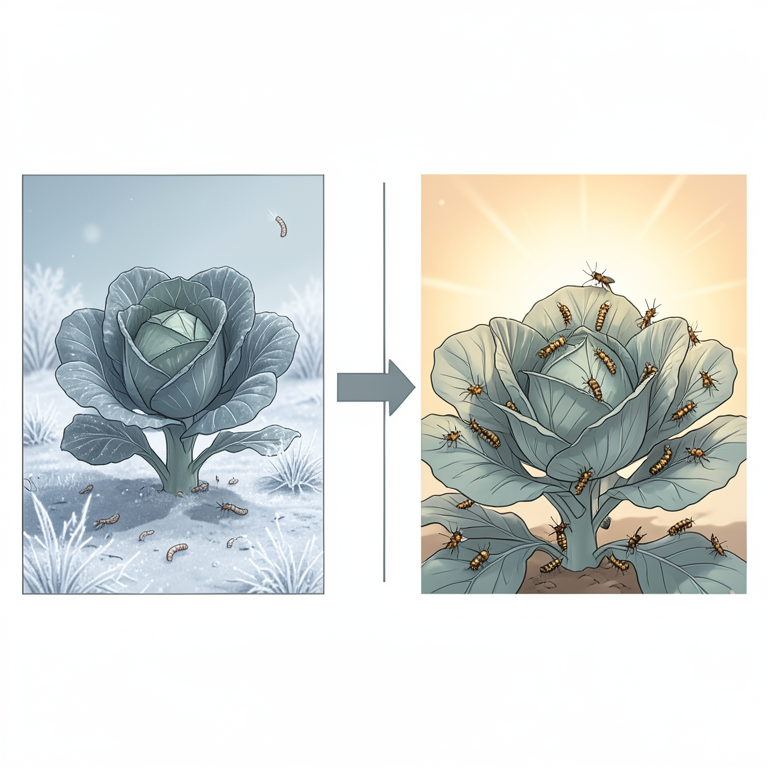
Temperature and Pest Correlation
AI-generated conceptual illustration (Cabbage plants with Spodoptera litura, Helicoverpa armigera, and Plutella xylostella larvae). It explains the idea and does not show study data.
View source evidence ↗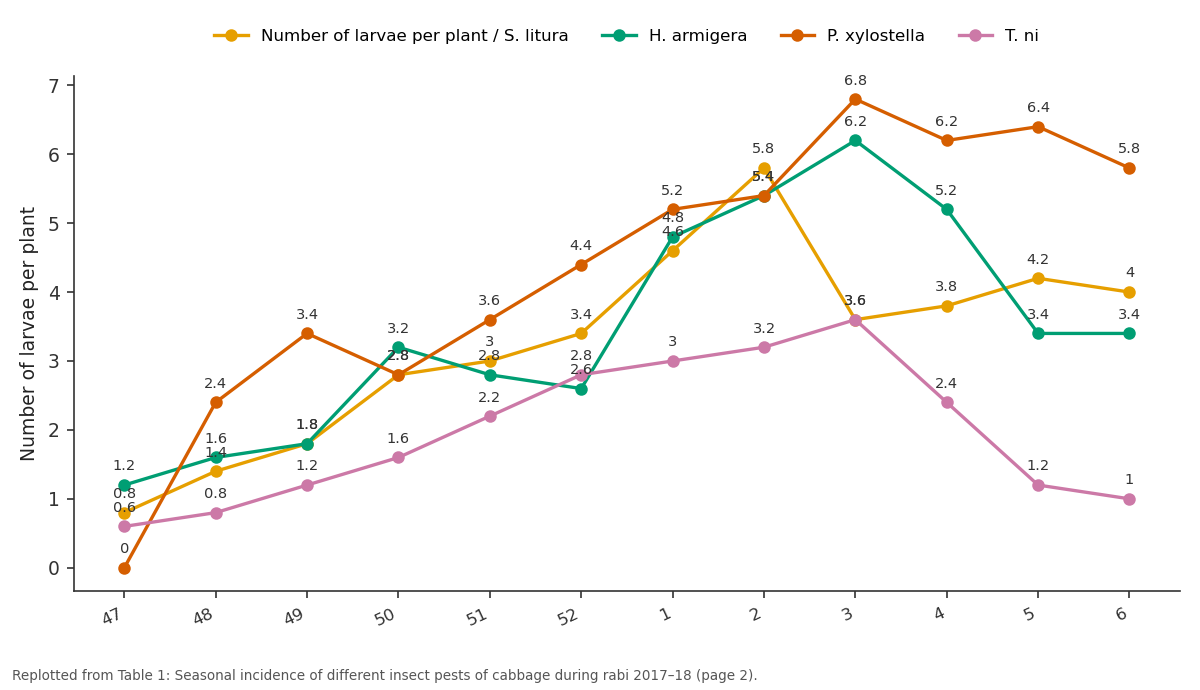
Number of larvae per plant / S. litura and H. armigera and more: 47 vs 48 vs 49 vs 50 vs 51
Replotted from Table 1 (page 2) of the original paper. Every bar is the paper's own table value.
View source evidence ↗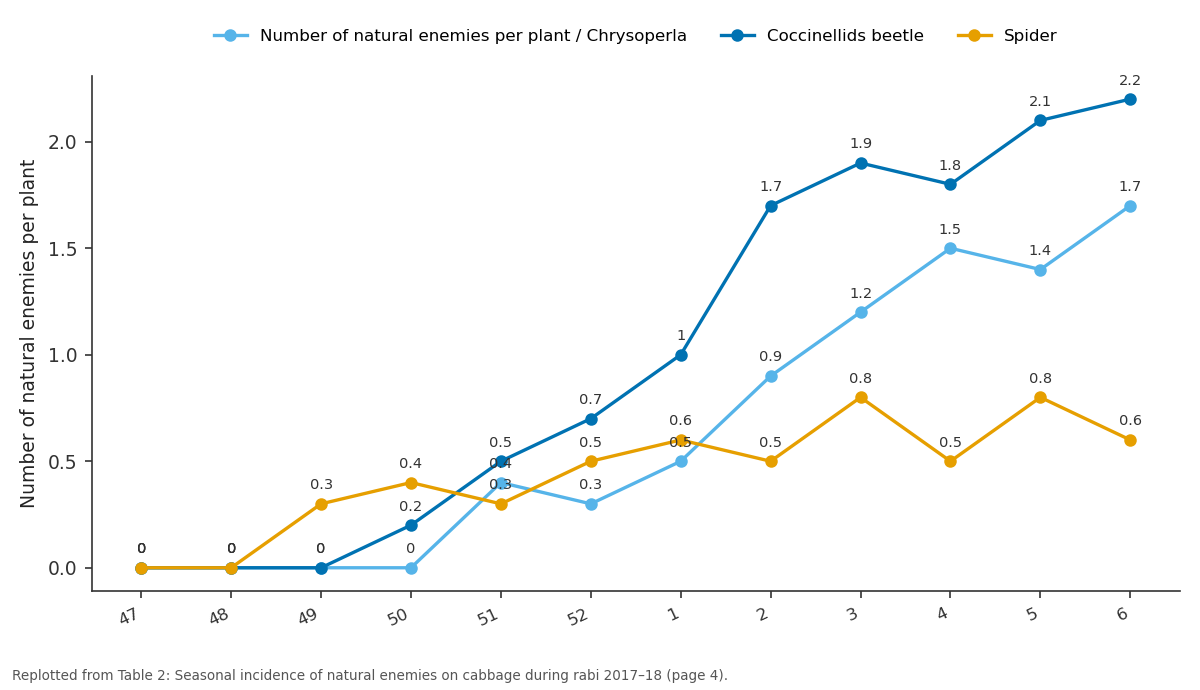
Number of natural enemies per plant /... and Coccinellids beetle and more: 47 vs 48 vs 49 vs 50 vs 51
Replotted from Table 2 (page 4) of the original paper. Every bar is the paper's own table value.
View source evidence ↗Figures & tables
From the original paper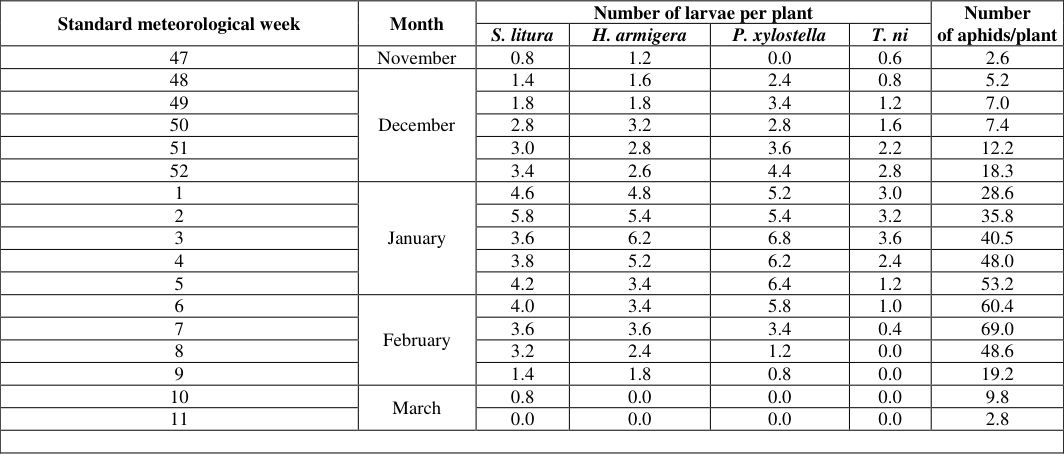 Table 1
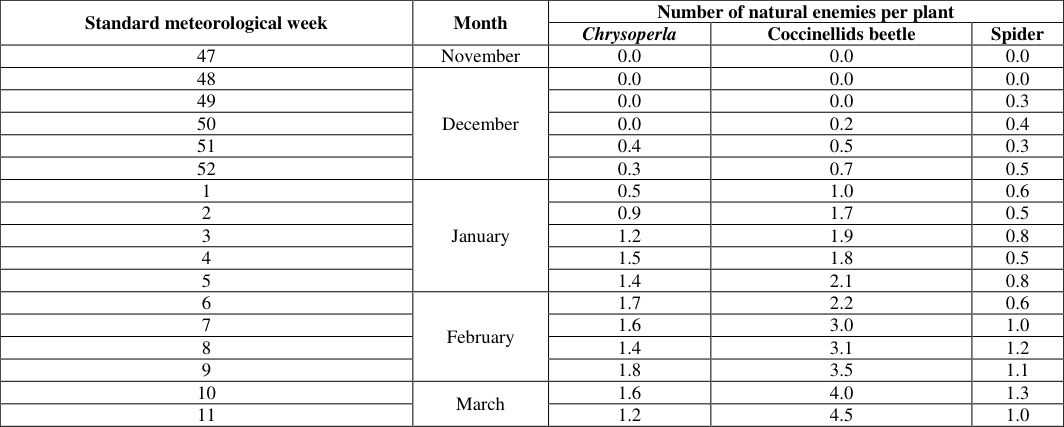 Table 2
 Table 3
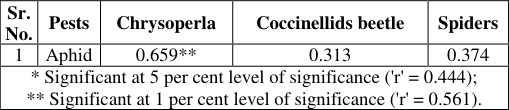 Table 4
Introduction
Vegetables play an important role in the balanced diet of human beings by providing not only energy-rich food, but also supplying vitamins and minerals. Comparatively, vegetables are one of the cheapest sources of natural nutritive foods. In developing countries like India, where the pressure of population on land is continuously increasing, vegetables may play a significant role in supplying balanced diet. Among the vegetables, cabbage (Brassica oleracea var. capitata Linnaeus) is one of the most important winter vegetable grown on five continents and in more than 90 countries throughout the world. It is a leafy vegetable belong to the family: Brassicaceae (formerly Cruciferae) sometime also referred to as Cole crops, is very closely related to kale, broccoli, cauliflower etc. Cabbage is one of the most nutritious vegetables having many medicinal values. It is an excellent source of vitamins 'C,' 'K,' 'B1' and 'B6' and also a very good source of minerals viz., Manganese, Potassium, Zinc, Copper, Phosphorus, Magnesium, Calcium, and Iron beside dietary fibres, cabbage is a unique source of several types of phytonutrients, with antioxidant activity due to high content of phenol, polyphenol and anthocyanin. Being rich in glucosinolates and isothiocynates, it also has anticancer properties (Mezencev, 2002 and Mehta and John, 2002) [4,5] . Among the various production constrains, biotic stress mainly by insect pests at various growth stages of the crop is a major concern for not attaining the highest yield. The productivity of cabbage is very low compared to other countries and losses in the yield have been reported to the extent of 57 to 97 per cent due to insect pests alone (Prasad, 1963) [7] . More than 37 insect pests have been reported attacking on cabbage right from the vegetative phase to harvest of the crop (Sachan and Gangwar, 1980) [9] . Among them, diamondback moth (Plutella xylostella Linnaeus), Cabbage butterfly (Pieris brassicae Linnaeus), Cabbage aphid (Brevicoryne brassicae Linnaeus), Cabbage borer (Hellula undalis Fabricius), Leaf eating caterpillar (Spodoptera litura Fabricius), Cabbage head borer (Helicoverpa armigera (Hubner) Hardwick), Painted bug (Bagrada hilaris Kirkaldy), Flea beetle (Phyllotreta cruciferae Goeze), Mustard sawfly (Athalia lugens proxima Klug.) are most serious causing economical damage (Prasad, 1963; Sachan and Srivastava, 1972 and Rao and Lal, 2005) [7,8,10] .
Materials and methods
The investigation on "Seasonal incidence and comparative biology of diamondback moth on cabbage and its management through ecofriendly insecticides" were carried out at Department of Entomology, Chimanbhai Patel College of Agriculture, Sardarkrushinagar Dantiwada Agricultural University, during 2017-18. The study covered seasonal incidence of major pests of cabbage (Spodoptera litura Fabricius, Plutella xylostella Linnaeus, Helicoverpa armigera Hubner, Trichoplusia ni Hubner and aphid). The seasonal incidence of major pests and its natural enemies on cabbage variety Golden Acre was recorded during 2017-18 and Horticultural Instructional Farm. The observations were taken from 20 randomly selected plants. Observation on number of larvae per plant, number of sucking pests per plant and number of predators (Chrysoperla, Coccinellids beetle and spiders) were recorded weekly from twenty randomly selected plants, during 2017-18. Correlation between weather parameters and pests incidence and pests population with natural enemies were computed to find out the abiotic influence on population if any, following the standard statistical procedure.
Results and Discussion
Studies on population dynamics of various insect pests of cabbage viz., P. xylostella, H. armigera, S. litura T. ni and L. erysimi and its natural enemies viz., (Chrysoperla, Ladybird beetle and Spiders) were carried out at Horticulture instructional farm, Chimanbhai Patel College of Agriculture, during 2017-18. Weekly observation during crop period on population of various insect pests and its natural enemies were carried out as per the detailed methodology described under section.
Cabbage leaf worm: S. litura
The young larvae of S. litura damaged by scrapping the lower surface of the cabbage leaves. The later instars were voracious feeder, generally feed on outer leaves of the cabbage (Plate I). The incidence of various insects pests appeared during 2017-18 is given in Table 1 and1. A perusal of the data, clearly indicated that the S. litura appeared at a very low level during 47 th standard week and remained up to 10 th standard week i.e. first week of March during 2017-18. Its population ranged from 0.8 to 5.8 larvae/plant and reached maximum population level during second week of January 2017-18. Patel (2002 b ) [6] observed the appearance of S. litura in third week of December (50 th SW) and its peak activity in 52 nd SW, thereafter, population start decreasing and disappeared in the month of January. Observation made by Jat et al. (2017) [2,3] revealed its peak activity in the fourth week of February (8 th SW). Mishra et al. (2008) reported highest population from 35 th to 47 th SW. The incidence of S. litura and its activity varied greatly as reported by earlier workers. Some area it appeared early and attains its peak population within a short span. In present study observed its activity from November to March. The variation may be due to different climate conditions prevailed in the different geographical region under study.
| Standard meteorological week | Month | Number of larvae per plant | — | — | — | Number of aphids/plant |
|---|---|---|---|---|---|---|
| S. litura | H. armigera | P. xylostella | T. ni | |||
| 47 | November | 0.8 | 1.2 | 0.0 | 0.6 | 2.6 |
| 48 | December | 1.4 | 1.6 | 2.4 | 0.8 | 5.2 |
| 49 | 1.8 | 1.8 | 3.4 | 1.2 | 7.0 | |
| 50 | 2.8 | 3.2 | 2.8 | 1.6 | 7.4 | |
| 51 | 3.0 | 2.8 | 3.6 | 2.2 | 12.2 | |
| 52 | 3.4 | 2.6 | 4.4 | 2.8 | 18.3 | |
| 1 | January | 4.6 | 4.8 | 5.2 | 3.0 | 28.6 |
| 2 | 5.8 | 5.4 | 5.4 | 3.2 | 35.8 | |
| 3 | 3.6 | 6.2 | 6.8 | 3.6 | 40.5 | |
| 4 | 3.8 | 5.2 | 6.2 | 2.4 | 48.0 | |
| 5 | 4.2 | 3.4 | 6.4 | 1.2 | 53.2 | |
| 6 | February | 4.0 | 3.4 | 5.8 | 1.0 | 60.4 |
| 7 | 3.6 | 3.6 | 3.4 | 0.4 | 69.0 | |
| 8 | 3.2 | 2.4 | 1.2 | 0.0 | 48.6 | |
| 9 | 1.4 | 1.8 | 0.8 | 0.0 | 19.2 | |
| 10 | March | 0.8 | 0.0 | 0.0 | 0.0 | 9.8 |
| 11 | 0.0 | 0.0 | 0.0 | 0.0 | 2.8 | |
Table text extracted from the original PDF; superscript letters are shown inline. The original table image is below.
View original table image
Cabbage head borer: H. armigera
The larvae are destructive and voracious feeder. Larvae generally feed on developing boll of the cabbage. Larvae consume three times of its weight of food material daily. Feeding sites are marked by accumulation of fecal material (Plate II). The population of H. armigera during 2017-18 is given in Table 1 and Fig. 1. A perusal of the data, clearly indicate that the H. armigera made its first appearance during 47 th standard week and was active up to 9 th standard week i.e. last week of February. Its population ranged from 1.2 to 6.2 larvae/plant and reached highest population level during third week of January during 2017-18. 1 revealed that H. armigera was active during 47 th standard week to 9 th standard week. Its population ranged from 0.6 to 5.5 larvae/plant and maximum incidence was observed during third week of January (5.5 larvae/plant). Patel (2002 b ) [6] observed the appearance of H. armigera in second week of December and its peak in 1 st SW. Thereafter population started decreasing and disappeared in the month of February. The present findings are in agreement with earlier reports.
Diamondback moth, P. xylostella
Diamondback moth larvae feed on leaf portion between large vein and midribs. The larvae generally feed on lower leaf surface, leaving the upper epidermis intact. In case of severe damage plant growth may be stunted (Plate I). The data, given in Table 1 and Fig. 1 ) reported its activity in the month of January. Tarivia (2011) also noticed its activity from 5 th to 14 th standard week at Junagadh. Bana et al. (2012) [1] recorded its peak activity in the month of January. In the present study also its peak activity, was observed in the month of January which corroborate the reports of earlier workers.
Cabbage Semilooper : Trichoplusia ni
Cabbage semilooper is a leaf feeder and first instar larvae feed on the lower surface of the leaves. The later instars chew and make large holes and usually do not feed on the leaf margin (Plate III). The population of T. ni recorded during 2017-18 is given in Table 1 and Fig. 1. A perusal of the data, revealed that the T. ni incidence started with a population of 0.6 larva/plant during 47 th standard week and remain up to 7 th standard week i.e. second week of February. Its population varied from 0.6 to 3.6 larvae/plant and highest population was observed during third week of January (3 rd SW). During 2017-18 (Table 1 and Fig. 1), the incidence of T. ni appeared in the first week of December (48 th SW) and active up to fourth week of February (9 th SW). The incidence of pest appeared late and also disappeared early as no incidence was observed after first week of March (10 th SW). Patel (2002 b ) observed the appearance of T. ni in second week of December and its peak activity in first week of January. In the present study the observation on its peak population in the month of January is in agreement with earlier report by Patel (2002 b ).
Cabbage aphid: L. erysimi
Aphids feed on the cabbage causes yellowing, wilting and stunted growth of the plants. Aphids produce a sugary waste material is called as honeydew, which encourage the development of shooty mould. In case of severe infestation entire plant covered with small mass of sticky aphids (Plate I). The seasonal incidence of aphids during 2017-18 is given in Table 1 and Fig. [6] observed the appearance of aphid in the month of December and its peak in January (5 th SW). Bana et al. (2012) [1] also observed its peak activity in January. In the present study it was also observed its activity from November to March. The variation may be attributed to the divergent climatic condition prevailed in the different agro-ecological locations.
Natural enemies Chrysoperla
Chrysoperla carnea (Stephens) commonly known as green lacewing is an insect in the chrysopidae family. The adults feed on nectar, pollen and honey dew and the larvae are active predators and feed on aphids and other small insects.
It has been used in the biological control of insect pests on crops. The results presented in Table 1 and graphically depicted in Fig. 1 on occurrence of chrysoperla on cabbage revealed that, chrysoperla was active on cabbage between fourth week of December to second week of March (2017-18). It first appeared during fourth week of December i.e. 51 st SW and its reached peak population level (1.8 adults/plant) on fourth week of February i.e. 9 th SW. Subsequently, its population declined during rest of the crop period. However, no scientific information is available to corroborate the present finding.
Coccinellids beetle
Coccinellids beetle are among the most visible and best known beneficial predatory insect. In India 400 species are found. Some are native and some have been introduced from other countries. They feed on small insect like aphids, thrips, mites and leafhopper (Plate X). The results presented in Table 1 and depicted in Fig. 1 on the occurrence of ladybird beetle on cabbage revealed its activity on cabbage from third week of December to second week of March (2017-18).
[1] observed that the ladybird beetle was active from last week of December to third week of February with a population of 0.04 to 0.24 adults/plant. In the present study we observed its activity from December to March and the difference in the incidence may be due to divergent agro climatic situations prevailed in the different locations.
Figures and tables from the paper
| Standard meteorological week | Month | Number of natural enemies per plant | — | — |
|---|---|---|---|---|
| Chrysoperla | Coccinellids beetle | Spider | ||
| 47 | November | 0.0 | 0.0 | 0.0 |
| 48 | December | 0.0 | 0.0 | 0.0 |
| 49 | 0.0 | 0.0 | 0.3 | |
| 50 | 0.0 | 0.2 | 0.4 | |
| 51 | 0.4 | 0.5 | 0.3 | |
| 52 | 0.3 | 0.7 | 0.5 | |
| 1 | January | 0.5 | 1.0 | 0.6 |
| 2 | 0.9 | 1.7 | 0.5 | |
| 3 | 1.2 | 1.9 | 0.8 | |
| 4 | 1.5 | 1.8 | 0.5 | |
| 5 | 1.4 | 2.1 | 0.8 | |
| 6 | February | 1.7 | 2.2 | 0.6 |
| 7 | 1.6 | 3.0 | 1.0 | |
| 8 | 1.4 | 3.1 | 1.2 | |
| 9 | 1.8 | 3.5 | 1.1 | |
| 10 | March | 1.6 | 4.0 | 1.3 |
| 11 | 1.2 | 4.5 | 1.0 |
Table text extracted from the original PDF; superscript letters are shown inline. The original table image is below.
View original table image
| Sr. No. | Pests | Chrysoperla | Coccinellids beetle | Spiders |
|---|---|---|---|---|
| 1 | Aphid | 0.659** | 0.313 | 0.374 |
| * Significant at 5 per cent level of significance ('r' = 0.444); ** Significant at 1 per cent level of significance ('r' = 0.561). |
Table text extracted from the original PDF; superscript letters are shown inline. The original table image is below.
View original table image
References
11 in the original paper- Bana JK, Jat BL, Bajya DR. Seasonal incidence of major pests of cabbage and their natural enemies. Indian J Entomol. 2012;74(3):236-240.
- Jat GC, Lekha SK, Jat SK, Yadav PC. Effect of weather parameters on the incidence of major insect pests of cabbage. Int J Agric Sci. 2017;16(9):4133-4135.
- Jat SL, Ahmad S, Yadav R, Chula MP, Nitharwal RS. Efficacy of eco-friendly pesticides on the management of diamondback moth, Plutella xylostella (L.), on cabbage, Brassica oleracea var. capitata (L.). Glob J Biosci Biotechnol. 2017;6(2):289-295.
- Mehta RG, John MP. Discovery of cancer preventive agents from natural products: from plants to prevention. Curr Oncol Rep. 2002;4(6):478-486.
- Mezencev R. Anti-proliferative and cancer chemopreventive activity of phytoalexins: focus on indole-phytoalexins from crucifers. Neoplasma. 2003;50(4):239-245.
- Prasad SK. Quantitative estimation of damage to cruciferous crops caused by cabbage worm, cabbage looper, diamondback moth and cabbage aphid. Indian J Entomol. 1963;25(3):242-259.
- Rao S, Lal OP. Seasonal incidence of mustard aphid, Lipaphis erysimi (Kaltenbach), and diamondback moth, Plutella xylostella (L.) on cabbage. J Insect Sci. 2005;18(2):106-110.
- Sachan JN, Gangwar SK. Vertical distribution of important pests of cole crops in Meghalaya as influenced by environmental factors. Indian J Entomol. 1980;42(3):414-421.
- Sachan JN, Srivastava BP. Studies on the seasonal incidence of insect pests of cabbage. Indian J Entomol. 1972;34(2):123-129.
- Shalini MV, Sharma K. Seasonal incidence of Brevicoryne brassicae and Plutella xylostella on Brassica oleracea in Rohtak district. Ann Plant Prot Sci. 2016;24(2):319-323.
- Tarivia AH. Biology, population dynamics and chemical control of diamondback moth (Plutella xylostella L.) on cauliflower [Thesis]. Junagadh: Junagadh Agricultural University; 2011. p. 160.