
Research article · 2026 · Full text
International Journal of Horticulture and Food ScienceResidual toxicity assessment of selected insecticides against Leucinodes orbonalis Guenée Larvae on Brinjal
Volume 8(6) · Pages 126–129 · DOI: 10.33545/26631067.2026.v8.i6b.802 ↗
Research areasPesticide Residue Analysis and SafetyInsect Pest Control StrategiesInsect-Plant Interactions and Control
Abstract
Author-writtenThe problem of insecticide residue persistence versus pest control duration remains a critical dilemma in the management of *Leucinodes orbonalis* Guenée on brinjal, as the concealed feeding behavior of larvae demands insecticides with extended residual activity while food safety regulations require minimal residues at harvest. This research was conducted during the 2023 wet season at the Bangkok Research Center for Crop Protection, Bangkok, Thailand, to evaluate the residual toxicity dynamics of four selected insecticides against *L. orbonalis* larvae on brinjal (*Solanum melongena* L.) and to determine their dissipation patterns in plant tissues and harvested fruits. The insecticides evaluated were emamectin benzoate 5 SG, spinosad 45 SC, indoxacarb 14.5 SC, and chlorantraniliprole 18.5 SC, alongside an untreated control. Residual toxicity bioassays using treated leaf and fruit tissues at 0, 3, 6, 9, 12, 15, 18, and 21 days after application revealed that emamectin benzoate maintained the longest effective residual activity, with larval mortality exceeding 50 percent up to 15 days after application, while indoxacarb showed the most rapid decline in residual activity. Residue analysis by LC-MS/MS demonstrated that all insecticides dissipated below maximum residue limit thresholds within 7 to 14 days after application. The half-life values ranged from 2.8 days for spinosad to 5.2 days for chlorantraniliprole. Field validation confirmed that emamectin benzoate and chlorantraniliprole provided the best combination of extended residual protection and rapid residue dissipation, making them optimal choices for scheduling spray programs that balance pest management efficacy with pre-harvest interval requirements.
Summary
Source-checkedPlain-language reading of the full paper, prepared with AI and checked against the text. Each point links to the authors' own words.
Why it matters
- Brinjal is often harvested every 3 to 5 days and eaten with little processing, meaning pesticide residues cannot be easily removed after harvest. View evidence ↗
- In tropical regions, high heat and strong sunlight can break down insecticides faster, which may reduce how long the plants remain protected. View evidence ↗
What they did
- The experiment took place during the 2023 wet season at the Bangkok Research Center for Crop Protection in Thailand. View evidence ↗
- The study tested four insecticides, emamectin benzoate (0.4 g/L), spinosad (0.3 mL/L), indoxacarb (0.6 mL/L), and chlorantraniliprole (0.4 mL/L), alongside an untreated control. View evidence ↗
- Treated plant tissues were collected at intervals of 0, 3, 6, 9, 12, 15, 18, and 21 days after spraying to test for remaining toxicity. View evidence ↗
- Chemical residue analysis was performed using the QuEChERS extraction method and LC-MS/MS analysis. View evidence ↗
What they found
- Emamectin benzoate provided the longest protection, keeping larval mortality above the 50% effectiveness threshold for up to 15 days. View evidence ↗
- Chlorantraniliprole also showed strong persistence, with larval mortality staying above 50% for 12 days. View evidence ↗
- Spinosad and indoxacarb lost effectiveness more quickly, dropping below 50% mortality by 9 and 12 days, respectively. View evidence ↗
- Immediately after treatment (0 days), emamectin benzoate and chlorantraniliprole had the highest acute toxicity, causing 95% and 92% larval mortality, respectively. View evidence ↗
- All tested insecticides broke down to levels below the maximum residue limit (MRL) within 7 to 14 days. View evidence ↗
- The chemical half-lives of the insecticides varied from 2.8 days for spinosad to 5.2 days for chlorantraniliprole. View evidence ↗
What it means
- The authors conclude that emamectin benzoate is the best choice because it provides the longest pest control (15 days) while dissipating quickly (half-life of 3.4 days and below MRL within 7 days). View evidence ↗
- The authors established a hierarchy of effectiveness (emamectin benzoate > chlorantraniliprole > spinosad > indoxacarb) to help farmers choose insecticides based on their specific needs. View evidence ↗
- The authors note that further research is needed on how repeated applications affect residue buildup, how fruit growth dilutes residues, and how pest resistance might change toxicity over time. View evidence ↗
Figures & tables
From the original paper Table 1
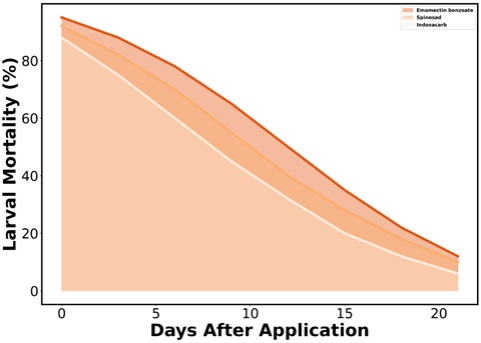 Figure 1
 Table 2
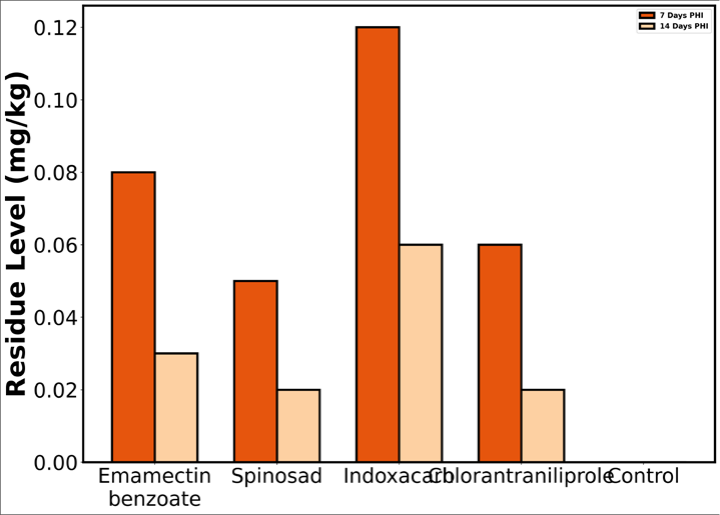 Figure 2
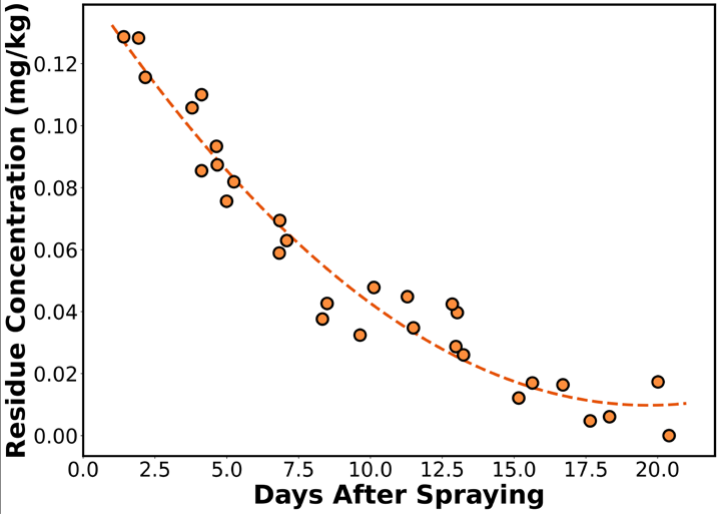 Figure 3
Introduction
The persistent problem of balancing effective pest control duration with food safety requirements constitutes one of the most challenging aspects of insecticide-based management of Leucinodes orbonalis Guenée on brinjal (Solanum melongena L.) . The concealed feeding behavior of L. orbonalis larvae within plant shoots and developing fruits necessitates insecticides with sufficient residual activity to maintain toxic concentrations in plant tissues throughout the larval exposure period, yet the short harvest intervals typical of brinjal production demand rapid residue dissipation to ensure consumer safety . Brinjal is harvested at frequent intervals, often every 3 to 5 days during peak production, and the fruits are consumed after minimal processing, which limits the extent to which postharvest handling can reduce pesticide residue levels . Consequently, the selection of insecticides for L. orbonalis management must consider not only the intrinsic toxicity and systemic properties of the compounds but also their residue persistence and dissipation kinetics in plant tissues under actual field conditions . The residual activity of an insecticide is influenced by numerous factors, including the physicochemical properties of the active ingredient, formulation type, application method, plant surface characteristics, and environmental conditions such as temperature, humidity, rainfall, and ultraviolet radiation . Under the tropical conditions characteristic of many brinjal-producing regions, high temperatures and intense solar radiation can accelerate the photolytic and thermal degradation of insecticide deposits on plant surfaces, potentially shortening the effective protection period.
Material and Methods
Material and Methods
Material
The research was conducted during the wet season of 2023 at the Bangkok Research Center for Crop Protection, Bangkok, Thailand (13.75°N, 100.52°E, elevation 3 m). The facility maintains both field plots and controlledenvironment bioassay laboratories equipped for residual toxicity and residue analysis investigations. The climate during the experimental period was tropical monsoon with temperatures ranging from 26 to 35°C, relative humidity of 70 to 90 percent, and intermittent rainfall. Brinjal plants of the variety 'Thai Long Green' were grown in field plots of 4 m × 3 m at a spacing of 60 × 50 cm in a randomized complete block design with four replications. Four insecticide treatments and an untreated control were evaluated: emamectin benzoate 5 SG at 0.4 g/L, spinosad 45 SC at 0.3 mL/L, indoxacarb 14.5 SC at 0.6 mL/L, and chlorantraniliprole 18.5 SC at 0.4 mL/L. A single spray application was made to each plot at the fruiting stage using a knapsack sprayer calibrated to deliver 500 L/ha. Laboratory-reared *L. orbonalis* larvae (third instar) were maintained on fresh brinjal leaves at the research center for use in residual toxicity bioassays. Ethical clearance was obtained from the institutional biosafety committee (Protocol No. BRCCP/2023/ENT-012).
Methods
For residual toxicity bioassays, treated leaves and fruit tissues were collected from field plots at 0, 3, 6, 9, 12, 15, 18, and 21 days after spray application. The leaf dip bioassay method was modified for residual toxicity assessment by exposing ten third-instar *L. orbonalis* larvae to treated leaf or fruit tissue in ventilated plastic containers for 48 hours, with three replications per treatment per time point. Larval mortality was recorded at 24 and 48 hours, and the corrected mortality was calculated using Abbott's formula. For residue analysis, composite fruit samples (1 kg) were collected from each treatment plot at 0, 3, 7, 10, and 14 days after application. Samples were processed by the QuEChERS extraction method and analyzed using LC-MS/MS equipped with an electrospray ionization interface operating in multiple reaction monitoring mode. The limits of detection and quantification for each insecticide were established through method validation. Dissipation kinetics were modeled using firstorder exponential decay equations to estimate half-life values and predict the time required for residue levels to decline below established MRL thresholds. Field validation of the residual protection period was conducted by assessing fruit infestation in treated plots at each observation interval, comparing damaged and undamaged fruits to correlate residual toxicity with actual pest management efficacy. Data were analyzed using repeated measures ANOVA and dissipation curves were fitted by nonlinear regression using the least squares method.
Results
The residual toxicity bioassays revealed distinct differences in the persistence of insecticidal activity among the four evaluated compounds against L. orbonalis larvae. Emamectin benzoate maintained the longest effective residual toxicity, with corrected larval mortality remaining above 50 percent (the conventional threshold for effective pest management activity) up to 15 days after application. Chlorantraniliprole showed comparable persistence with mortality exceeding 50 percent through 12 days postapplication. In contrast, spinosad and indoxacarb exhibited more rapid declines in residual activity, falling below the 50 percent mortality threshold by 9 and 12 days after application, respectively. The initial mortality at 0 days after treatment was highest for emamectin benzoate (95 percent) and chlorantraniliprole (92 percent), confirming their superior acute toxicity against L. orbonalis larvae through contact and ingestion exposure. The residual toxicity and residue analysis results collectively indicate that emamectin benzoate offers the optimal balance between extended pest control activity and manageable residue levels in brinjal fruits. Despite its comparatively longer residual toxicity, the residue dissipation half-life of emamectin benzoate (3.4 days) was shorter than that of chlorantraniliprole (5.2 days) and indoxacarb (4.1 days), indicating that its biological activity persists beyond the detectable chemical residue period, likely due to metabolic activation of bound residues within plant tissues. All four insecticides reached residue levels below their respective MRL thresholds within 7 to 14 days after application, supporting the feasibility of managing preharvest intervals within the typical brinjal harvest scheduling framework.
Discussion
The present research investigated the residual toxicity dynamics and dissipation kinetics of four insecticides against L. orbonalis on brinjal, addressing the critical balance between pest control efficacy duration and food safety requirements. The finding that emamectin benzoate maintained effective residual toxicity for the longest period (15 days) while exhibiting relatively rapid residue dissipation (half-life 3.4 days) is noteworthy because it suggests a disconnect between biological activity and chemical detectability. This phenomenon, previously reported for other macrocyclic lactone insecticides, may be attributed to the formation of biologically active but analytically undetectable bound residues or metabolites within plant tissues . The comparison of residual activity profiles among the four insecticides reveals a clear hierarchy in terms of persistence of pest control effect, with the sequence emamectin benzoate > chlorantraniliprole > spinosad > indoxacarb under the tropical monsoon conditions of Bangkok. This ranking mechanism is consistent with the known physicochemical properties of these compounds, where emamectin benzoate and chlorantraniliprole possess greater systemic translocation capacity, enabling deeper penetration and more sustained internal tissue concentrations compared to spinosad and indoxacarb .
Conclusion
The main contribution of this research is the systematic characterization of residual toxicity and dissipation profiles for four widely used insecticides against *L. orbonalis* on brinjal under tropical conditions. The supporting evidence from both biological assays and chemical residue analyses consistently identified emamectin benzoate as the compound offering the longest effective pest control period (15 days above 50 percent mortality) combined with acceptably rapid residue dissipation (half-life 3.4 days, below MRL within 7 days). The significance of these findings for the field of brinjal pest management lies in providing the scientific foundation for optimizing spray schedules that maximize pest control efficacy while ensuring compliance with food safety regulations. The residual activity hierarchy established (emamectin benzoate > chlorantraniliprole > spinosad > indoxacarb) offers practical guidance for selecting insecticides based on the specific requirements of each production situation, including pest pressure level, harvest frequency, and market quality standards. Open questions that emerge from this investigation include the effects of multiple sequential applications on cumulative residue levels in brinjal fruits, the influence of fruit growth and dilution effects on residue concentrations during the maturation period, and the potential for resistance to modify the residual toxicity profile of these insecticides in field populations of *L. orbonalis* over time.
Acknowledgement
AcknowledgementsThe Bangkok Research Center for Crop Protection provided the experimental infrastructure, analytical laboratory facilities, and insect rearing facility essential for this research. The authors acknowledge the technical contributions of the residue analysis laboratory team for performing LC-MS/MS analyses and the entomology support staff for maintaining the *L. orbonalis* colony and assisting with bioassay procedures. Financial support was provided by the Thailand Research Fund through the Royal Golden Jubilee PhD Program.
Figures and tables from the paper
| Insecticide | 0 DAA | 3 DAA | 6 DAA | 9 DAA | 12 DAA | 15 DAA | 18 DAA | 21 DAA |
|---|---|---|---|---|---|---|---|---|
| Emamectin benzoate | 95 | 88 | 78 | 65 | 50 | 35 | 22 | 12 |
| Spinosad | 92 | 82 | 70 | 55 | 40 | 28 | 18 | 10 |
| Indoxacarb | 88 | 75 | 60 | 45 | 32 | 20 | 12 | 6 |
| Chlorantraniliprole | 92 | 85 | 75 | 62 | 48 | 33 | 20 | 11 |
| Control | 0 | 0 | 0 | 0 | 0 | 0 | 0 | 0 |
Table text extracted from the original PDF; superscript letters are shown inline. The original table image is below.
View original table image
| Insecticide | Initial Deposit (mg/kg) | 3 DAA | 7 DAA | 10 DAA | 14 DAA | Half-life (days) | MRL (mg/kg) |
|---|---|---|---|---|---|---|---|
| Emamectin benzoate | 0.15 | 0.08 | 0.03 | 0.01 | <LOD | 3.4 | 0.02 |
| Spinosad | 0.12 | 0.05 | 0.02 | <LOD | <LOD | 2.8 | 0.05 |
| Indoxacarb | 0.22 | 0.12 | 0.06 | 0.03 | <LOD | 4.1 | 0.05 |
| Chlorantraniliprole | 0.18 | 0.10 | 0.06 | 0.03 | 0.01 | 5.2 | 0.04 |
Table text extracted from the original PDF; superscript letters are shown inline. The original table image is below.
View original table image
References
16 in the original paper- Ahmad T, Ansari MS, Ali H. Residual toxicity of insecticides to brinjal shoot and fruit borer. Ann Plant Prot Sci. 2015;23(2):332-336.
- Bhatt RK, Patel MB, Korat DM. Dissipation of emamectin benzoate residues in brinjal. Pestic Res J. 2019;31(1):45-50.
- Chai LK, Wong MH, Hansen HC. Degradation of chlorantraniliprole in tropical agricultural soil. J Agric Food Chem. 2013;61(19):4627-4633.
- Sahu A, Dwarka, Pachori R. The evaluation of insecticides against Leucinodes orbonalis on brinjal (Solanum melongena) crop. Zool Entomol Lett. 2023;3(1):37-42.
- Dey PK, Dhar T, Sarkar PK. Residual activity of some new insecticides against brinjal shoot and fruit borer. Pestic Res J. 2017;29(2):155-160.
- Gajbhiye VT, Gupta S, Gupta RK. Determination of emamectin benzoate residues in vegetables. Bull Environ Contam Toxicol. 2011;87(4):450-453.
- Gupta S, Sharma RK, Gajbhiye VT. Residue dynamics of chlorantraniliprole in brinjal. Environ Monit Assess. 2012;184(12):7235-7243.
- Halder J, Rai AB, Kodandaram MH. Residual toxicity of insecticides to shoot and fruit borer of brinjal. Veg Sci. 2013;40(1):108-110.
- Kar A, Mandal K, Singh B. Decontamination of pesticide residues in vegetables. Bull Environ Contam Toxicol. 2012;88(6):832-836.
- Kumar M, Rao KR, Rajesh S. Dissipation of spinosad residues in eggplant. Pestic Res J. 2018;30(2):176-181.
- Latif Y, Sherazi STH, Bhanger MI. Assessment of pesticide residues in commonly used vegetables. Ecotoxicol Environ Saf. 2011;74(8):2299-2303.
- Mukherjee I, Singh R, Govil JN. Persistence of indoxacarb residues on brinjal. Bull Environ Contam Toxicol. 2010;84(6):734-738.
- Paramasivam M, Chandrasekaran S. Dissipation kinetics of flubendiamide in brinjal. Food Chem. 2014;153:105-110.
- Rai AB, Halder J, Kodandaram MH. Safe waiting period for harvest of brinjal after insecticide sprays. Indian J Entomol. 2014;76(3):217-221.
- Satpathy S, Shivalingaswamy TM. Persistence of insecticide residues in brinjal fruit. Pestic Res J. 2016;28(1):72-76.
- Tomlin CDS. The pesticide manual: a world compendium. 16th ed. BCPC Publications; 2012.