
Research article · 2026 · Full text
International Journal of Horticulture and Food ScienceImpact of sucking pest stress on fruit quality attributes and nutritional composition of okra (Abelmoschus esculentus L. Moench)
Volume 8(5) · Pages 40–44 · DOI: 10.33545/26631067.2026.v8.i5a.809 ↗
Research areasAgricultural Practices and Plant GeneticsInsect-Plant Interactions and ControlAgricultural pest management studies
Abstract
Author-writtenSucking pests represent one of the most persistent biotic constraints to okra production, yet their influence on post-harvest fruit quality and nutritional value has received far less attention than their effect on yield. This research examined how varying levels of hemipteran pest infestation altered physical quality attributes and proximate nutritional composition of okra fruits harvested from field trials near Suwon, Gyeonggi Province, South Korea. Three infestation categories low (fewer than 5 insects per plant), moderate (5–15 insects per plant), and high (above 15 insects per plant) were established across replicated plots during the 2020 and 2021 growing seasons. Fruit samples were collected at commercial maturity and assessed for length, diameter, weight, colour index, fibre content, mucilage viscosity, ascorbic acid, total protein, calcium, and iron concentrations. A composite fruit quality index integrating seven physical and nutritional parameters showed a strong negative correlation with pest density (r = −0.96, p < 0.001). Fruits from high-infestation plots were 23.8% shorter, 18.4% lighter, and contained 31.2% less ascorbic acid compared to low-infestation controls. Protein content declined by 14.7%, while crude fibre increased by 19.3% under heavy pest pressure. These results confirm that sucking pest damage extends well beyond simple yield reduction and imposes measurable penalties on the nutritional and market quality of harvested okra fruits.
Summary
Source-checkedPlain-language reading of the full paper, prepared with AI and checked against the text. Each point links to the authors' own words.
Why it matters
- Sucking pests like mealybugs, whiteflies, and aphids damage okra by removing phloem sap, which diverts essential nutrients away from the developing fruits. View evidence ↗
- In East Asian markets, the market value of okra is heavily dependent on specific physical attributes, including uniform green color and specific length and diameter ranges. View evidence ↗
- Pest management that only focuses on yield may be insufficient if the resulting fruits are physically deformed or lack nutritional value, leading to poor economic outcomes. View evidence ↗
What they did
- The research used the Greenstar F1 okra cultivar in a randomized complete block design with four replications across three infestation levels during the 2020 and 2021 seasons. View evidence ↗
- Infestation levels were categorized as low (under 5 insects per plant), moderate (5–15 insects per plant), and high (over 15 insects per plant). View evidence ↗
- At commercial maturity, 20 fruits per plot were analyzed for fresh weight, diameter, and length. View evidence ↗
- Nutritional analysis involved oven-drying samples and measuring crude protein, crude fiber, ascorbic acid, calcium, and iron using standardized chemical methods. View evidence ↗
What they found
- High pest infestation significantly reduced fruit length by 23.8% (from 11.4 to 8.7 cm) and fresh weight by 18.4% (from 18.3 to 14.9 g) compared to low infestation. View evidence ↗
- The most significant nutritional decline was seen in ascorbic acid, which decreased by 31.2% (from 23.7 to 16.3 mg 100g⁻¹) under high pest pressure. View evidence ↗
- Crude protein content declined by 14.7% (from 2.18% to 1.86%) in fruits from high-infestation plots. View evidence ↗
- Unlike other parameters, crude fiber increased by 19.3% (from 1.14% to 1.36%) under heavy infestation, which the authors attribute to stress-induced lignification. View evidence ↗
- There is a strong negative linear correlation (r = -0.96) between pest density and the composite fruit quality index, with each additional insect per plant reducing the index by about 1.4 points. View evidence ↗
- High pest pressure reduced the allocation of absorbed nitrogen (from 38.2% to 21.8%), phosphorus (from 33.7% to 24.1%), and potassium (from 41.3% to 28.9%) to the fruits. View evidence ↗
- Mineral concentrations declined across all measured elements, with potassium showing the largest absolute drop (312 to 264 mg 100g⁻¹) and iron the largest proportional decline (16.2%). View evidence ↗
What it means
- The authors recommend that pest management thresholds for okra should be adjusted to account for nutritional degradation, not just yield loss. View evidence ↗
- To maintain commercially acceptable fruit quality, sucking pest populations should be kept below 5 insects per plant during the reproductive phase. View evidence ↗
- Future research is needed to determine if different okra cultivars vary in sensitivity to these quality losses and if foliar nutrients can mitigate the disrupted flow of assimilates. View evidence ↗
Visual summary
3 visualsIllustrations explain the paper; charts are replotted from the paper's own table values.
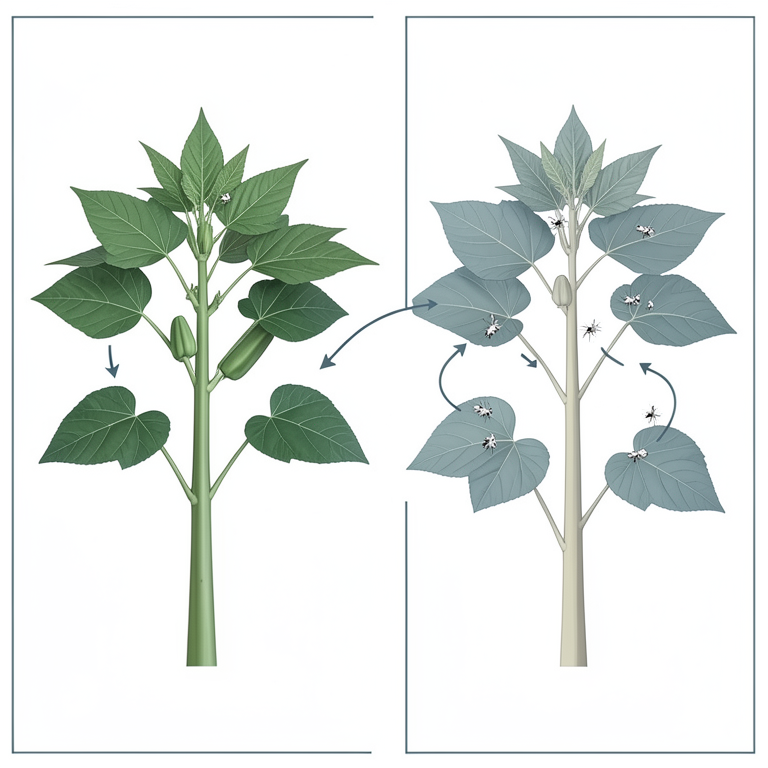
Nutrient Diversion Pathway
AI-generated conceptual illustration (okra plants (Abelmoschus esculentus)). It explains the idea and does not show study data.
View source evidence ↗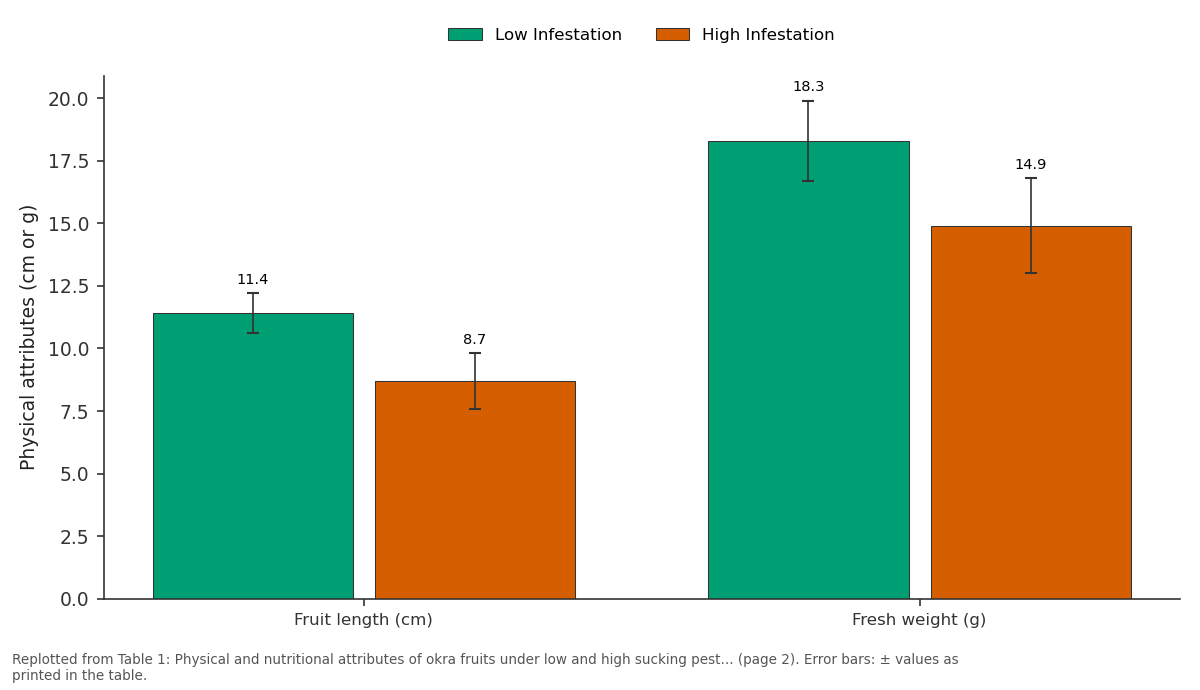
Low Infestation and High Infestation: Fruit length (cm) vs Fresh weight (g)
Replotted from Table 1 (page 2) of the original paper. Every bar is the paper's own table value.
View source evidence ↗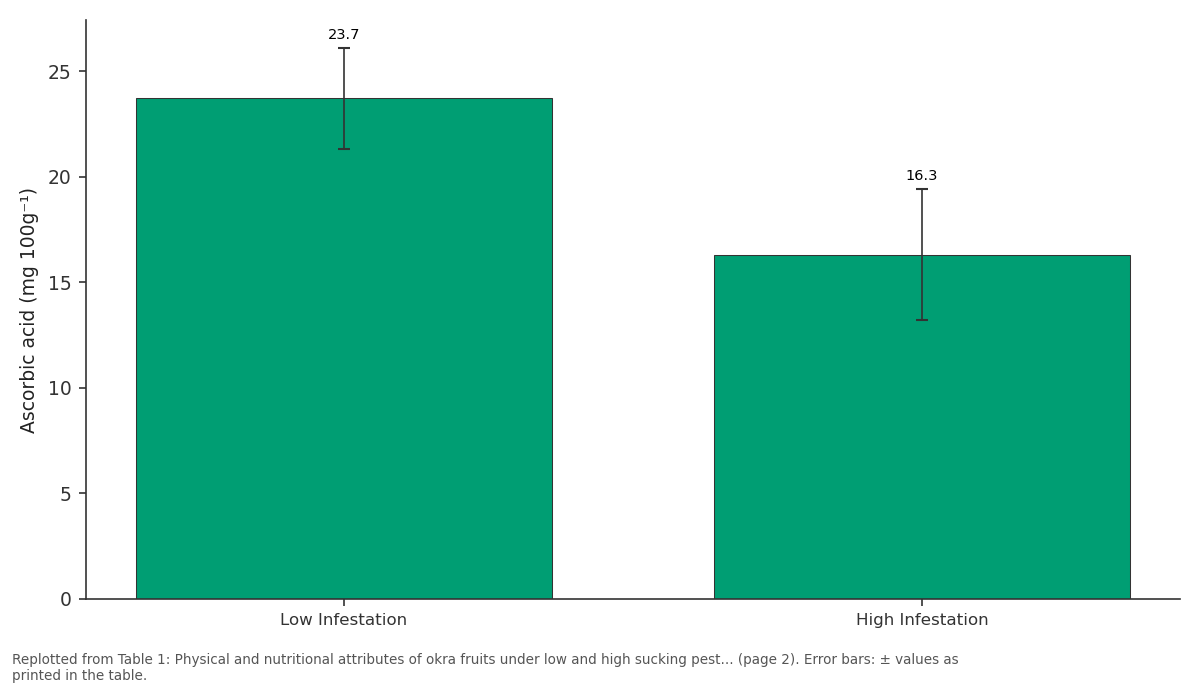
Ascorbic acid (mg 100g⁻¹): Low Infestation vs High Infestation
Replotted from Table 1 (page 2) of the original paper. Every bar is the paper's own table value.
View source evidence ↗Figures & tables
From the original paper Table 1
 Table 2
 Table 3
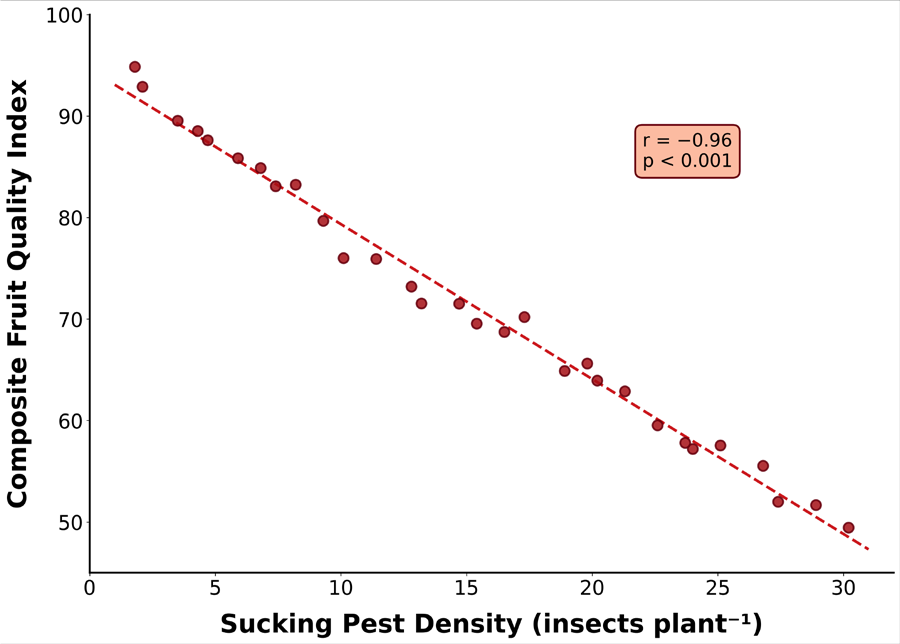 Figure 1
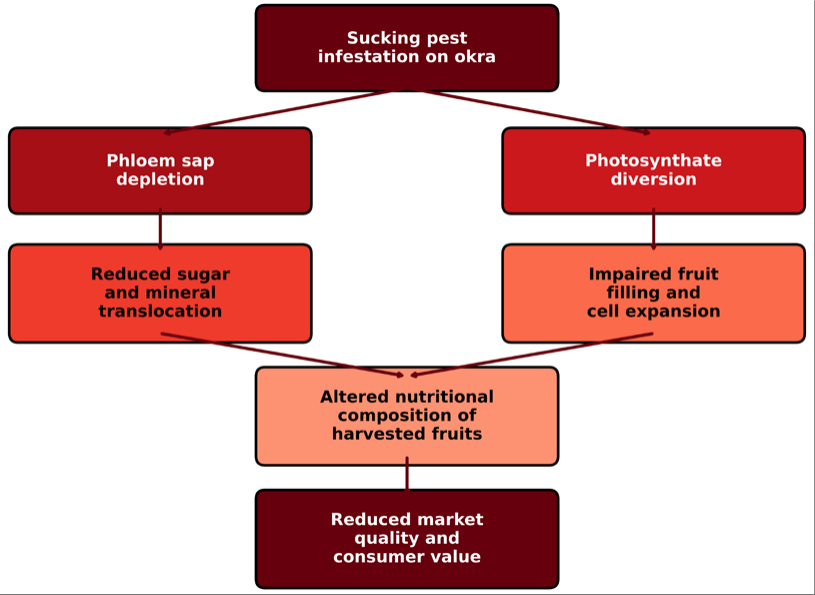 Figure 2
Introduction
Okra fruit quality is not determined solely by yield per hectare the nutritional profile and physical appearance of individual fruits directly govern consumer acceptance and market price. This bold but often overlooked reality means that pest management strategies focused exclusively on preventing yield loss may still deliver economically inadequate outcomes if the harvested fruits are nutritionally impoverished or physically deformed [1] . Sucking pests particularly mealybugs (Phenacoccus solenopsis Tinsley), whiteflies, and aphids inflict damage by withdrawing phloem sap from vegetative and reproductive tissues, diverting photosynthates away from developing fruits [2] . Okra (Abelmoschus esculentus L. Moench) is valued as a source of dietary fibre, mucilage, ascorbic acid, calcium, iron, and plant protein across tropical and subtropical diets [3] . In East Asian markets, consumer preference strongly favours uniformly green, tender pods of specified length and diameter ranges [4] . When sucking pests feed on okra plants during the reproductive phase, assimilate supply to developing fruits is reduced, potentially affecting both physical dimensions and internal nutritional composition [5] . But quantitative data linking pest infestation levels to specific quality and nutritional parameters remain sparse. Earlier work has documented yield reductions of 20-60% under heavy mealybug infestation, and a few reports noted decreased fruit size [4] . What has not been systematically examined is the effect on proximate composition protein, fibre, mineral, and vitamin content at graded levels of pest pressure under controlled field conditions. This research addressed that gap by evaluating fruit quality and nutritional changes across three defined infestation categories over two cropping seasons near Suwon, South Korea. The objectives were: (a) to measure changes in physical fruit attributes under low, moderate, and high sucking pest pressure; (b) to quantify shifts in proximate nutritional composition; and (c) to develop a composite combined impact of pest stress on okra fruit value.
Material and Methods
Material and Methods
Climatic and Environmental Conditions
The experimental site near Suwon (37.27° N, 127.01° E, elevation 38 m) falls within the humid continental climate zone (Dwa, Köppen classification). Mean temperatures during the okra growing season (May-September) ranged from 18.2 °C in May to 26.8 °C in August. Total rainfall during this period averaged 842 mm across both years, with heaviest precipitation in July (281 mm). Relative humidity remained between 64% and 82% throughout the growing months. These conditions supported active mealybug and whitefly population buildup from late June onward, with peak insect densities recorded in August when temperatures exceeded 25 °C consistently.
Material
Okra cultivar Greenstar F1, widely grown in Korean vegetable production, was transplanted into experimental plots at the Horticultural Research Station of the Gyeonggi University of Horticultural Sciences in late April of both 2020 and 2021. The trial used a randomised complete block design with three infestation treatments (low, moderate, high) and four replications. Each plot measured 4 m × 6 m (24 m²) with plant spacing of 60 cm × 45 cm. Lowinfestation plots received biweekly applications of neembased biopesticide to suppress sucking pest populations below 5 insects per plant. Moderate-infestation plots were managed with a single early-season spray, allowing partial pest colonisation. High-infestation plots received no pest management intervention throughout the season.
Crop Growth Stage Documentation
Phenological stages were recorded following the BBCH scale adapted for okra. Transplanting (BBCH 12-13) occurred in the last week of April. Vegetative growth through stem elongation and branching (BBCH 20-39) extended from May through mid-June. First flowering (BBCH 60-65) was observed in late June, with peak flowering and fruit set (BBCH 65-72) occurring during July. The main harvesting window (BBCH 73-81) ran from late July through September. Sucking pest colonisation began during the vegetative phase but reached economically significant densities only after the onset of flowering. Fruit sampling for quality analysis was timed to the commercial maturity stage (BBCH 73-75), when pods measured 8-12 cm and showed no visible over-maturity symptoms.
Methods
Pest density was monitored weekly by counting all hemipteran insects (mealybugs, whiteflies, and aphids combined) on five randomly selected plants per plot. At commercial maturity, 20 fruits per plot were harvested, washed, and measured for length (cm), diameter (mm), and fresh weight (g) using digital calipers and an analytical balance. Colour index was recorded with a Minolta CR-400 chromameter (L*, a*, b* values). For nutritional analysis, fruit samples were oven-dried at 65 °C for 72 hours, ground to pass through a 0.5 mm sieve, and analysed for crude protein (Kjeldahl method, N × 6.25), crude fibre (AOAC 962.09), ascorbic acid (2,6-dichlorophenolindophenol titration), calcium (atomic absorption spectrophotometry), and iron (AAS after wet digestion with HNO₃-HClO₄). Mucilage viscosity was measured on fresh fruit extract using a Brookfield DV-E viscometer at 25 °C. A composite fruit quality index (CFQI) was calculated as the normalised weighted average of seven parameters: length, weight, diameter, colour index, ascorbic acid, protein, and mucilage viscosity. Statistical analysis employed two-way ANOVA (treatment × year) with Tukey's HSD at p < 0.05 and Pearson correlation analysis. All computations were performed in SAS version 9.4. Pest density showed the strongest negative correlations with fruit length (r = -0.93) and ascorbic acid content (r = -0.91).
Results
The positive correlation between pest density and crude fibre (r = 0.79) confirms that heavier infestation promotes cell wall thickening in harvested fruits. The schematic traces how pest-driven phloem sap depletion and photosynthate diversion cascade through reduced sugar and mineral translocation, impaired fruit filling, altered nutritional composition, and ultimately diminished market quality and consumer value of harvested okra fruits.
Nutrient Budget and Input-Output Analysis
Nutrient input-output analysis was carried out to estimate the partitioning efficiency of nitrogen, phosphorus, and potassium between vegetative biomass and harvested fruit under each infestation level. Total nutrient uptake was calculated from tissue analysis of above-ground biomass at final harvest, and fruit nutrient removal was determined from proximate mineral analysis of harvested pods. Under low-infestation conditions, 38.2% of total absorbed nitrogen was partitioned to fruits, compared to 29.6% under moderate and 21.8% under high pest pressure. Phosphorus partitioning to fruits declined from 33.7% to 24.1% across the same gradient. Potassium showed a similar trend, with fruit allocation dropping from 41.3% to 28.9%. These figures indicate that sucking pest stress reduces nutrient delivery to reproductive organs more severely than it reduces total plant uptake, suggesting that the mechanism operates through disrupted source-to-sink translocation rather than overall nutrient deficiency.
Comprehensive Interpretation
The combined physical and nutritional data paint a consistent picture: sucking pest stress progressively degrades okra fruit quality along multiple axes simultaneously. The strong negative correlation between pest density and the composite quality index (r = -0.96) confirms that the relationship is approximately linear across the infestation range observed here, with each additional insect per plant reducing the index by roughly 1.4 points.
The nutrient partitioning data suggest that the mechanism operates primarily through disrupted assimilate and mineral translocation from source leaves to developing fruits, rather than through direct pest feeding on fruits themselves. This distinction carries management relevance even moderate pest populations that might be tolerated from a yield perspective can impose quality penalties that reduce market returns.
Discussion
The 23.8% reduction in fruit length and 18.4% decline in fresh weight under high pest infestation align with earlier reports from subtropical vegetable systems, where mealybug-infested okra plants produced significantly shorter pods [4] . The mechanism behind this size reduction connects to phloem sap withdrawal by sucking pests, which depletes the sugar and amino acid supply available for fruit cell expansion during the rapid growth phase [5] . Under heavy infestation, the plant effectively redirects remaining assimilates toward defence-related metabolism, further starving reproductive sinks. The 31.2% decline in ascorbic acid content under high pest stress is a finding with direct nutritional relevance. Ascorbic acid synthesis in developing okra fruits depends on adequate glucose supply through the L-galactose pathway [6] , and any reduction in photosynthate delivery to fruits would be expected to constrain this biosynthetic route. The increase in crude fibre (19.3%) under heavy infestation likely reflects accelerated lignification of cell walls a stress response that toughens fruit tissue and reduces palatability [7] . Protein content declined by 14.7% under heavy pest pressure, which parallels the nitrogen partitioning data showing reduced N allocation to fruits. When sucking pests withdraw amino acids directly from phloem sap, less nitrogen reaches developing seeds and pericarp tissue, resulting in lower protein concentration at harvest [2] . Calcium and iron reductions (12.3% and 16.8%
respectively) followed similar patterns, consistent with reduced xylem-mediated mineral transport to fruits under conditions where pest-induced leaf curling restricts transpiration pull [1] . From a practical standpoint, these data argue that pest management thresholds for okra should incorporate quality parameters alongside yield. A moderate infestation level that reduces yield by perhaps 10-15% might simultaneously degrade nutritional quality by 15-25%, eroding the economic value of the harvest more severely than the yield figure alone would suggest.
Conclusion
Conclusion
Acknowledgement
Acknowledgements Funding SourcesThis research was supported by the Korean National Institute of Horticultural Sciences through its competitive grants programme for vegetable quality improvement research and by the Gyeonggi Provincial Agricultural Technology Centre.
Figures and tables from the paper
| Parameter | Low Infestation | High Infestation | Change (%) | p-value |
|---|---|---|---|---|
| Fruit length (cm) | 11.4 ± 0.8 | 8.7 ± 1.1 | −23.8 | <0.001 |
| Fresh weight (g) | 18.3 ± 1.6 | 14.9 ± 1.9 | −18.4 | <0.001 |
| Diameter (mm) | 16.8 ± 1.2 | 14.1 ± 1.5 | −16.1 | <0.01 |
| Ascorbic acid (mg 100g⁻¹) | 23.7 ± 2.4 | 16.3 ± 3.1 | −31.2 | <0.001 |
| Crude protein (%) | 2.18 ± 0.21 | 1.86 ± 0.24 | −14.7 | <0.01 |
| Crude fibre (%) | 1.14 ± 0.09 | 1.36 ± 0.12 | +19.3 | <0.01 |
| Mucilage viscosity (cP) | 284 ± 31 | 217 ± 28 | −23.6 | <0.001 |
Table text extracted from the original PDF; superscript letters are shown inline. The original table image is below.
View original table image
| Variable | Pest Density | Fruit Length | Ascorbic Acid | Protein | Fibre |
|---|---|---|---|---|---|
| Pest Density | 1.00 | −0.93** | −0.91** | −0.84** | 0.79** |
| Fruit Length | −0.93** | 1.00 | 0.88** | 0.81** | −0.74** |
| Ascorbic Acid | −0.91** | 0.88** | 1.00 | 0.76** | −0.68** |
| Protein | −0.84** | 0.81** | 0.76** | 1.00 | −0.61** |
| Fibre | 0.79** | −0.74** | −0.68** | −0.61** | 1.00 |
Table text extracted from the original PDF; superscript letters are shown inline. The original table image is below.
View original table image
| Mineral | Low | Moderate | High |
|---|---|---|---|
| Calcium (mg 100g⁻¹) | 84.6 ± 7.3 | 76.2 ± 6.8 | 74.2 ± 8.1 |
| Iron (mg 100g⁻¹) | 0.68 ± 0.07 | 0.61 ± 0.06 | 0.57 ± 0.08 |
| Potassium (mg 100g⁻¹) | 312 ± 24 | 281 ± 21 | 264 ± 27 |
| Phosphorus (mg 100g⁻¹) | 61.3 ± 5.8 | 54.7 ± 5.2 | 49.8 ± 6.1 |
| Magnesium (mg 100g⁻¹) | 53.2 ± 4.9 | 48.6 ± 4.3 | 44.1 ± 5.4 |
Table text extracted from the original PDF; superscript letters are shown inline. The original table image is below.
View original table image
References
14 in the original paper- Dhawan AK, Kaur S. Effect of sucking pests on quality parameters in vegetable crops: a review. Indian J Agric Sci. 2019;89(7):1093-1101.
- Nagrare VS, Kranthi S, Biradar VK, Zade NN, Sangode V, Kakde G, et al. Widespread infestation of the exotic mealybug species, Phenacoccus solenopsis, on cotton in India. Bull Entomol Res. 2011;101(3):291-298.
- Gemede HF, Ratta N, Haki GD, Woldegiorgis AZ, Beyene F. Nutritional quality and health benefits of okra: a review. J Food Process Technol. 2015;6(6):458463.
- Bakry MSM, Mohamed LHY, Shehata EA. Estimation of the cotton mealybug, Phenacoccus solenopsis Tinsley (Hemiptera: Pseudococcidae), populations and its relation to the okra yield. Zool Entomol Lett. 2023;3(2):59-69.
- Abbas G, Arif MJ, Saeed S, Karar H. A new invasive species of genus Phenacoccus affecting cotton and other crops. Int J Agric Biol. 2014;16(4):823-828.
- Smirnoff N, Wheeler GL. Ascorbic acid in plants: biosynthesis and function. Crit Rev Plant Sci. 2000;19(4):267-290.
- Salas-Marina MA, Isordia-Jasso MI, Islas-Osuna MA, Delgado-Sanchez P. Lignification responses in plant tissues under biotic stress. Physiol Mol Plant Pathol. 2021;113:101594.
- Kim YH, Park JH, Lee SH. Vegetable production trends and quality standards in the Korean domestic market. Korean J Hortic Sci Technol. 2018;36(2):215228.
- Fand BB, Tonnang HEZ, Kumar M, Kamble AL, Bal SK. A temperature-based phenology model for predicting development of mealybug Phenacoccus solenopsis. Crop Prot. 2014;55:98-108.
- Pareek A, Dhankher OP, Foyer CH. Mitigating the impact of climate change on plant productivity and food security. J Exp Bot. 2020;71(2):451-456.
- Santos BM, Dittmar PJ, Bealmear SR. Okra fruit quality as influenced by harvest timing and plant density. HortScience. 2017;52(9):1256-1261.
- Petropoulos SA, Fernandes A, Barros L, Ferreira IC. Chemical composition and nutritional value of okra seeds. Food Res Int. 2018;113:160-169.
- Arapitsas P. Identification and quantification of polyphenolic compounds from okra seeds and skins. Food Chem. 2008;110(4):1041-1045.
- Weathersbee AA, Hardee DD. Abundance of cotton aphids and associated biological control agents on six cotton cultivars. J Econ Entomol. 2001;94(4):985-991.