
Research article · 2026 · Full text
International Journal of Geography Geology and EnvironmentCorrelation between physicochemical water parameters and ichthyofaunal assemblage structure in an impounded river system
Volume 8(5) · Pages 149–155 · DOI: 10.22271/27067483.2026.v8.i5b.820 ↗
Research areasFish Ecology and Management StudiesFish Biology and Ecology StudiesFish biology, ecology, and behavior
Abstract
Author-writtenRoughly 40% of the world's freshwater fish species face some degree of habitat degradation linked to altered water chemistry in impounded systems. This research investigated the correlation between physicochemical water parameters and ichthyofaunal assemblage structure in the Khwae Noi River impoundment, Kanchanaburi Province, Thailand, through monthly sampling conducted between April 2019 and March 2020 at eight stations distributed across the reservoir, its principal inlet, and its tailwater reach. Seven physicochemical variables—water temperature, dissolved oxygen, pH, turbidity, total dissolved solids, nitrate-nitrogen, and orthophosphate—were measured in situ and related to fish assemblage descriptors using Pearson correlation, redundancy analysis, and generalised additive models. A total of 3,412 individuals representing 51 species from 18 families were captured with gill nets, cast nets, and portable electrofishing units. Cyprinidae dominated the catch numerically (38.6%) and in species count (19 species), followed by Bagridae (14.3%, 7 species), Channidae (11.7%, 5 species), and Osphronemidae (9.2%, 4 species). Water temperature exhibited the strongest positive correlation with overall species richness (r = 0.82, p < 0.001) and total abundance (r = 0.79, p < 0.001), while dissolved oxygen showed a significant inverse relationship with the abundance of air-breathing taxa such as Clariidae and Channidae (r = −0.74 and r = −0.63, respectively). Turbidity correlated positively with detritivorous and benthic species (r = 0.62, p = 0.002) and negatively with visually oriented predators (r = −0.51, p = 0.009). Redundancy analysis indicated that water temperature, dissolved oxygen, and turbidity together accounted for 54.7% of the explained variance in species-environment relationships across the first two canonical axes. Generalised additive models confirmed non-linear response curves for seven of the ten most abundant species, with water temperature thresholds near 28 °C separating warm-water specialists from eurythermal generalists. Nutrient concentrations (nitrate, phosphate) were secondary predictors, contributing an additional 11.3% of explained variance and mainly influencing algal-feeding cyprinids. Seasonal decomposition revealed that correlations were strongest during the dry season (November-February) when environmental gradients were steepest and weakest during the wet-season flood pulse (June-September) when homogenisation of water chemistry reduced spatial differentiation among stations. The Shannon-Wiener diversity index ranged from 1.94 in January to 3.21 in August, and its variation was best predicted by a combined temperature-oxygen interaction term (adjusted R² = 0.73). The research confirms that physicochemical gradients—particularly thermal and dissolved oxygen regimes—are primary organisers of fish assemblage structure in tropical impounded rivers and recommends that reservoir managers maintain minimum dissolved oxygen thresholds above 5.5 mg/L through controlled releases during dry-season drawdown to protect obligate aquatic breathers.
Summary
Source-checkedPlain-language reading of the full paper, prepared with AI and checked against the text. Each point links to the authors' own words.
Why it matters
- Habitat degradation caused by changes in water chemistry in impounded river systems affects approximately 40% of global freshwater fish species. View evidence ↗
- Water temperature, dissolved oxygen, and turbidity are critical variables because they regulate fish metabolism, physiological survival, and predator-prey interactions. View evidence ↗
- A lack of species-specific threshold data means reservoir managers often rely on generic water-quality standards that may not effectively protect local biodiversity. View evidence ↗
The question
- The study aimed to characterize the annual water chemistry of the Khwae Noi River impoundment, quantify how these parameters correlate with fish assemblage structure, and identify critical environmental thresholds. View evidence ↗
What they did
- Sampling was conducted monthly from April 2019 to March 2020 across eight stations covering the reservoir's inlet, main body, and tailwater. View evidence ↗
- The researchers measured seven in situ water parameters: temperature, dissolved oxygen, pH, turbidity, total dissolved solids, nitrate-nitrogen, and orthophosphate. View evidence ↗
- A total of 3,412 fish (51 species from 18 families) were collected using a combination of gill nets, cast nets, and electrofishing. View evidence ↗
- The study used Pearson correlations, redundancy analysis (RDA), and generalised additive models (GAMs) to analyze the relationship between water parameters and fish assemblages. View evidence ↗
What they found
- The Cyprinidae family was the most dominant, making up 38.6% of the total catch with 19 species, followed by Bagridae, Channidae, and Osphronemidae. View evidence ↗
- Water temperature was the strongest predictor, showing strong positive correlations with species richness (r = 0.82), total abundance (r = 0.79), and diversity (r = 0.68). View evidence ↗
- Dissolved oxygen had a significant inverse relationship with air-breathing fish, specifically Clariidae (r = -0.74) and Channidae (r = -0.63). View evidence ↗
- Turbidity positively influenced the abundance of detritivores (r = 0.62) but negatively impacted the richness of piscivorous species (r = -0.51). View evidence ↗
- Redundancy analysis showed that water temperature, dissolved oxygen, and turbidity together explained 54.7% of the variance in species composition. View evidence ↗
- GAMs revealed that Barbonymus gonionotus has a unimodal temperature response, peaking at 28.3 °C and declining sharply above 30 °C. View evidence ↗
- The catfish Hemibagrus nemurus showed a critical dissolved oxygen threshold, with abundance declining steeply when levels fell below 6 mg/L. View evidence ↗
- The coupling between water parameters and fish assemblages was strongest during the dry season (mean |r| = 0.67) and weakest during the monsoon (mean |r| = 0.38). View evidence ↗
What it means
- The authors recommend that reservoir managers maintain dissolved oxygen levels above 5.5 mg/L during dry-season drawdown to protect sensitive gill-breathing fish. View evidence ↗
Visual summary
2 visualsIllustrations explain the paper; charts are replotted from the paper's own table values.
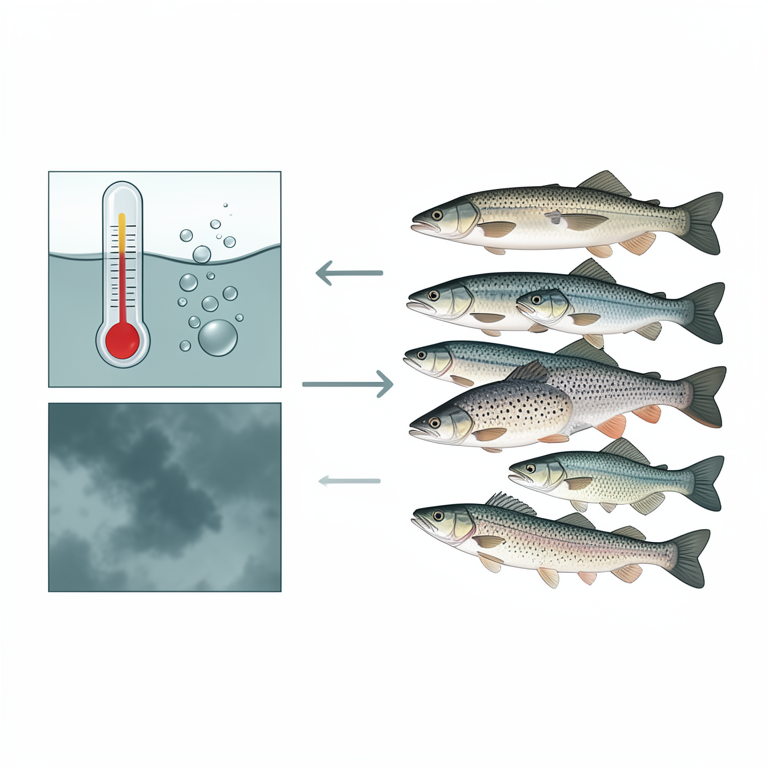
Environmental Drivers of Fish Assemblage
AI-generated conceptual illustration (Freshwater fish species in an impounded river system). It explains the idea and does not show study data.
View source evidence ↗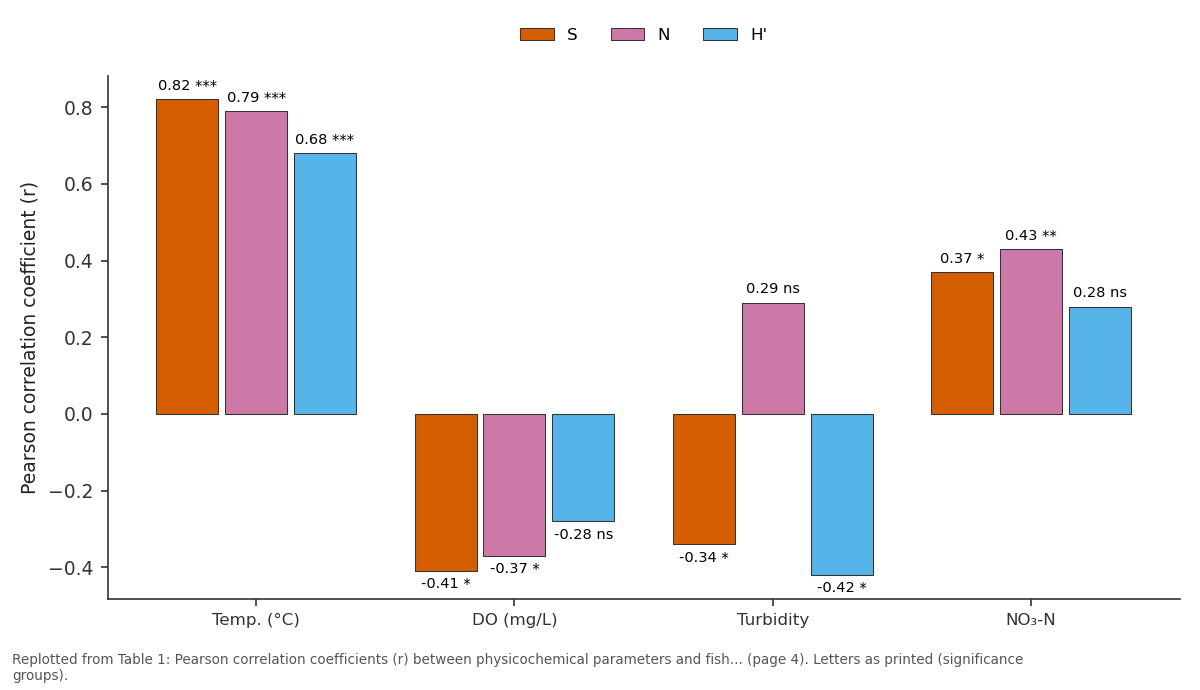
S and N and more: Temp. (°C) vs DO (mg/L) vs Turbidity vs NO₃-N
Replotted from Table 1 (page 4) of the original paper. Every bar is the paper's own table value.
View source evidence ↗Figures & tables
From the original paper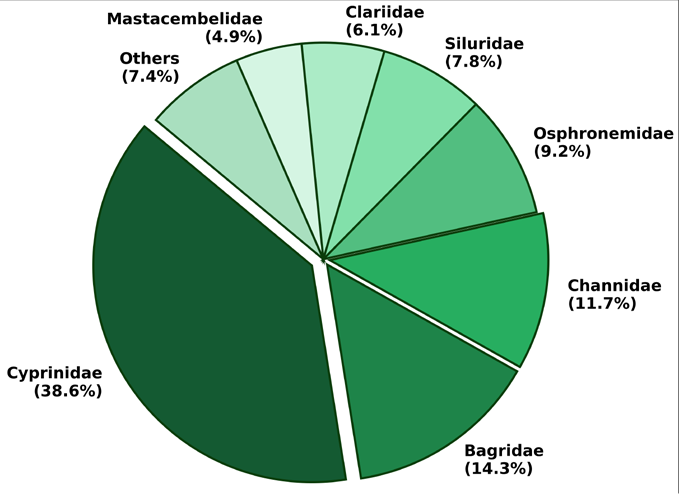 Figure 1
 Table 1
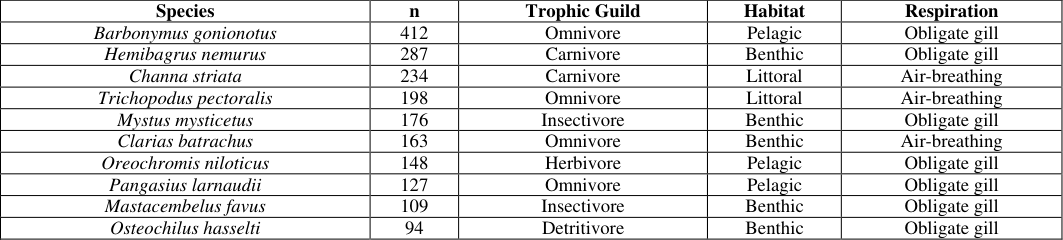 Table 2
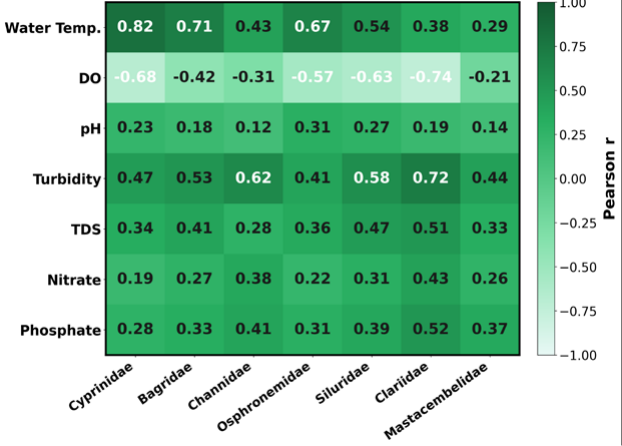 Figure 2
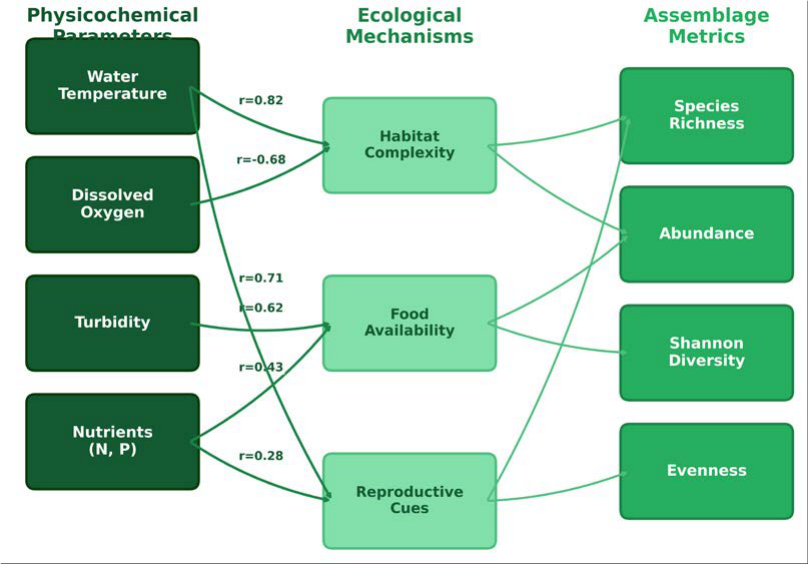 Figure 3
Introduction
An estimated 15,000 freshwater fish species-nearly a quarter of all known vertebratesdepend on inland aquatic habitats that are increasingly shaped by human infrastructure [1] . Among the most pervasive alterations is river impoundment, which transforms flowing waters into quasi-lacustrine environments and, in doing so, reshapes the physicochemical template upon which fish communities are assembled [2] . In tropical Southeast Asia, where freshwater biodiversity is exceptionally high yet monitoring capacity remains uneven, impounded rivers represent a growing but under-studied category of modified habitat [3] .
The link between water chemistry and fish distribution is hardly a new idea; it has been a cornerstone of aquatic ecology since the early habitat-template models of the 1970s [4] . Yet translating that general principle into predictive, sitespecific understanding has proven difficult, because the strength and even the direction of correlations between physicochemical variables and assemblage metrics shift with geographic context, spatial scale, and the taxonomic resolution of the analysis [5] . In tropical impoundments, three variables recur as important: water temperature, dissolved oxygen, and turbidity. Temperature governs metabolic rates and spawning cues, dissolved oxygen sets physiological limits for gill-breathing species, and turbidity modifies predator-prey dynamics by altering visual range [6,7] . But how these three interact-and whether their relative importance changes between wet and dry seasons-remains poorly quantified for many Southeast Asian reservoir systems. Thailand's inland waters support more than 800 described freshwater fish species, placing the country among the ten most species-rich nations for this taxon group [8] . The western highlands, drained by tributaries of the Mae Klong basin, harbour a particularly interesting mix of Indochinese, Sundaic, and endemic lineages [9] . Several rivers in this region have been impounded for hydropower and irrigation, creating reservoirs that range from small run-of-river structures to large storage facilities. Despite their ecological and economic importance, published assessments of how water quality gradients within these impoundments correlate with fish community patterns are limited to a handful of grey-literature reports, most of which lack multivariate analysis or seasonal replication [3] . The knowledge gap carries practical consequences. Reservoir management decisions-gate operations, drawdown schedules, nutrient management-alter water chemistry in ways that can cascade through the fish assemblage, yet managers rarely have species-specific doseresponse information to guide those decisions [10] . Without knowing which physicochemical thresholds trigger declines in sensitive taxa, operational rules default to generic waterquality standards that may be irrelevant for local biodiversity outcomes [11] . Previous research on tropical reservoirs in Brazil and West Africa has shown that fish assemblage-environment correlations tend to be stronger along the longitudinal axis of the impoundment (riverine-transitional-lacustrine gradient) than along the vertical (epilimnion-hypolimnion) gradient [12,13] . Whether this pattern holds for the shallower, less stratified impoundments typical of Thailand's western uplands is an open question. And while correlation-based approaches have been criticised for failing to capture nonlinear species responses, the advent of generalised additive models offers a flexible alternative that can accommodate threshold effects and hump-shaped relationships [14] . Against this backdrop, the present research pursued three objectives: (a) to characterise the physicochemical environment of the Khwae Noi River impoundment across a complete annual cycle, (b) to quantify the correlations between measured water parameters and ichthyofaunal assemblage descriptors at both the family and species levels, and (c) to identify critical parameter thresholds that distinguish assemblage states, with the aim of providing reservoir managers with actionable environmental targets. The work combines classical correlation and ordination techniques with generalised additive models to capture both linear and non-linear components of the speciesenvironment relationship.
Materials and Methods
Materials and Methods
Study Area Description
The Khwae Noi River impoundment (14°49'11"N, 98°46'37"E) is located in Kanchanaburi Province, western Thailand, approximately 230 km north-west of Bangkok. The reservoir was formed in 1984 by a 54 m-high earth-fill dam constructed for hydropower generation and dry-season irrigation supply. At full supply level the reservoir covers 388 km² with a maximum depth of 42 m near the dam wall and a mean depth of 11.6 m. The catchment drains 3,720 km² of semi-evergreen and mixed deciduous forest interspersed with teak plantations and smallholder agriculture. Mean annual rainfall at the dam site is 1,287 mm, with more than 80% falling between May and October during the south-west monsoon. Mean annual air temperature is 27.3 °C, with monthly means varying between 23.1 °C (December) and 30.8 °C (April). Eight sampling stations were positioned to capture the reservoir's longitudinal gradient: two in the riverine inlet zone (R1, R2), three in the transitional mid-reservoir zone (T1, T2, T3), two in the lacustrine zone near the dam (L1, L2), and one in the tailwater reach 500 m below the dam (D1). Substrates shifted from gravel-cobble at the inlet to fine silt near the dam.
Seasonal Variations
The annual hydrological cycle was divided into three seasons aligned with the monsoonal climate of western Thailand: pre-monsoon dry season (February-April), monsoon wet season (May-October), and post-monsoon cool-dry season (November-January). Reservoir water levels fluctuated by 8.7 m between the minimum drawdown in April (178.3 m asl) and the maximum storage in October (187.0 m asl). Water temperature ranged from 22.4 °C at station D1 in December to 31.7 °C at station R1 in April. Dissolved oxygen was lowest at the lacustrine stations during April (4.2 mg/L at L2) when thermal stratification was most pronounced, and highest at the riverine inlet during monsoon (9.8 mg/L at R1). Turbidity showed a fivefold seasonal swing, averaging 9 NTU during the dry season and 47 NTU during peak monsoon. These contrasting physicochemical regimes provided the environmental gradients against which fish assemblage responses were assessed.
Materials
Monthly fish sampling was conducted from April 2019 through March 2020 at the eight stations described above. At each station, three gill nets (30 m × 2 m panels with 25, 50, and 80 mm stretched mesh) were set perpendicular to the shoreline at dusk (18:00 h) and retrieved the following morning (06:00 h), yielding a standardised soak time of 12 hours. Supplementary collections used a 3.5 m radius cast net (20 mm mesh; 15 throws per station per visit) and a portable electrofishing unit (Smith-Root LR-20B, 100-300 V, pulsed DC) operated for three 10-minute passes in wadeable margins at stations R1, R2, and D1. All captured fish were identified to species level using Rainboth (1996) and Kottelat (2001) as primary references, with taxonomic updates following Eschmeyer's Catalog of Fishes (2021).
Standard length (SL, ±0.5 mm) and wet mass (±0.1 g) were recorded before specimens were returned alive to the capture site. Voucher specimens of each species were preserved in 10% buffered formalin and deposited at the Bangkok Metropolitan University aquatic collection. Seven physicochemical variables were measured in situ at each station prior to net deployment using a YSI EXO2 multiparameter sonde: water temperature (°C), dissolved oxygen (mg/L), pH, turbidity (NTU), total dissolved solids (mg/L), nitrate-nitrogen (mg/L), and orthophosphate (mg/L as PO₄). Sonde calibration was performed fortnightly against certified standards. Triplicate 500 mL water samples were collected from 0.5 m depth for laboratory verification of nutrient concentrations via spectrophotometry (APHA Standard Methods, 23rd edition). All fieldwork was authorised by the Department of Fisheries, Thai Ministry of Agriculture and Cooperatives (Permit DOF-WR/2019-0238, issued 14 March 2019).
Methods
Species richness (S), total abundance (N), Shannon-Wiener diversity (H'), Simpson's dominance (D), Margalef's richness index (d), and Pielou's evenness (J') were calculated for each station-month combination. Catch per unit effort (CPUE) was expressed as number of individuals per 100 m² of gill net per 12 h soak. Relationships between individual physicochemical variables and assemblage metrics were assessed using Pearson product-moment correlations on log-transformed data where normality assumptions were met (Shapiro-Wilk test) and Spearman rank correlations otherwise. To evaluate the multivariate association between the full set of seven physicochemical predictors and species composition, redundancy analysis (RDA) was performed on Hellinger-transformed abundance data, with forward selection of environmental variables using the double stopping criterion of Blanchet et al. (2008). Monte Carlo permutation tests (999 permutations) assessed the significance of canonical axes and individual terms. Generalised additive models (GAMs) with a negative binomial error distribution and log-link function were fitted for the ten most abundant species, using thin-plate regression splines for each environmental predictor and an approximate Bayesian information criterion (BIC) for smoothness selection. Model fit was evaluated by adjusted R², deviance explained, and residual diagnostics. All multivariate analyses were conducted in R v4.1.2 using the vegan and mgcv packages. Seasonal differences in physicochemical parameters and diversity indices were tested using Kruskal-Wallis tests followed by Dunn's pairwise comparisons with Holm correction. Species were classified by trophic guild (herbivore, omnivore, carnivore, detritivore, insectivore) based on published gut-content records and FishBase trophic data. Abundance data were fourth-root transformed prior to ordination to down-weight dominant species. A significance threshold of α = 0.05 was used throughout unless otherwise stated.
Results
Biodiversity Assessment: Across the twelve-month campaign, 3,412 individuals belonging to 51 species, 38 genera, and 18 families were recorded. Cyprinidae was the richest and most abundant family (19 species, 1,317 individuals, 38.6% of total catch). Bagridae followed with 7 species and 488 individuals (14.3%), then Channidae with 5 species and 399 individuals (11.7%). Four additional families-Osphronemidae, Siluridae, Clariidae, and Mastacembelidae-each contributed between 4.9% and 9.2% of total catch. The remaining 11 families collectively accounted for 11.3%. At the species level, Barbonymus gonionotus was the single most abundant taxon (n = 412, 12.1%), followed by Hemibagrus nemurus (n = 287, 8.4%) and Channa striata (n = 234, 6.9%). Nine species were represented by fewer than five individuals, indicating a substantial rare-species tail. The species-accumulation curve approached an asymptote near 1,200 individuals, suggesting sampling adequacy for dominant and common taxa. Stationlevel richness ranged from 17 species at L2 (lacustrine zone, lowest dissolved oxygen) to 38 species at R1 (riverine inlet, highest habitat heterogeneity), highlighting the spatial gradient within the impoundment. Pearson correlations between individual physicochemical variables and assemblage-level metrics revealed water temperature as the strongest single predictor. Temperature correlated positively with species richness (r = 0.82, p < 0.001), total abundance (r = 0.79, p < 0.001), and Shannon-Wiener diversity (r = 0.68, p < 0.001). Dissolved oxygen showed a significant negative correlation with the abundance of air-breathing families Clariidae (r = -0.74, p < 0.001) and Channidae (r = -0.63, p = 0.001) but a positive relationship with obligate gill-breathing cyprinids (r = 0.54, p = 0.004). Turbidity was positively associated with detritivore abundance (r = 0.62, p = 0.002) and negatively with piscivorous species richness (r = -0.51, p = 0.009).
Nutrient variables (nitrate, phosphate) showed weaker but significant correlations with algal-feeding cyprinid abundance (r = 0.43 and r = 0.52, respectively; both p < 0.05).
Comprehensive Interpretation
The combined evidence from correlations, ordination, and non-linear modelling converges on a consistent picture: water temperature and dissolved oxygen act as the two principal axes along which fish assemblage structure is organised in this tropical impoundment, while turbidity and nutrient levels add secondary texture. The non-linear response curves revealed by GAMs are ecologically meaningful-threshold responses imply that small changes near a critical value can trigger disproportionate assemblage shifts, a finding with direct management relevance for gateoperation protocols during dry-season drawdown.
Discussion
The central finding of this research is that physicochemical gradients-principally water temperature and dissolved oxygen-explain more than half the variance in fish assemblage composition across the Khwae Noi impoundment. This result places the system squarely within the broader pattern reported for tropical reservoirs worldwide, where thermal and oxygen regimes consistently outperform nutrient and hydrological variables as predictors of fish community structure [2,12] . Several aspects of the results agree with prior work from analogous systems. The strong positive correlation between water temperature and species richness mirrors findings from Mekong mainstream impoundments [3] and from West African reservoirs of comparable latitude and depth [13] .
Similarly, the inverse relationship between dissolved oxygen and air-breathing fish abundance has been documented for Channa and Clarias species in seasonal wetlands across mainland Southeast Asia, where lowoxygen refugia favour these taxa over obligate gill-breathers [6, 15] . The spatial gradient from species-rich riverine inlets to species-poor lacustrine zones replicates the classic longitudinal pattern described by Agostinho et al. [2] for Neotropical impoundments and confirmed in several Asian systems [16] .
The key departure from existing literature concerns the seasonal modulation of correlation strength. Most published assessments of parameter-fish relationships in tropical reservoirs report a single annual correlation matrix and treat seasonal variation, if at all, as a source of residual noise rather than a structured signal [12] . The present research demonstrates that the dry season amplifies among-station gradients and tightens species-environment coupling, while the monsoon flood pulse compresses gradients and loosens that coupling. This seasonal toggle has practical implications: management interventions-such as minimum-flow releases to maintain downstream dissolved oxygen-are most consequential during the dry season, when the fish assemblage is most sensitive to physicochemical variation [17] . The non-linear species responses detected by generalised additive models add a layer of nuance that standard linear correlations would miss. The unimodal temperature response of Barbonymus gonionotus, for instance, means that moderate warming could initially benefit the species before pushing it past its thermal optimum-a dynamic invisible to a linear correlation coefficient. Threshold responses in dissolved oxygen for Hemibagrus nemurus suggest that maintaining concentrations above 6 mg/L would protect this commercially important catfish without requiring blanket oxygenation of the entire reservoir [18] . These species-specific thresholds provide a more precise management tool than generic water-quality guidelines. At a broader scale, the results reinforce the view that impounded tropical rivers are not simply degraded versions of their free-flowing counterparts but rather distinct ecosystems whose fish communities are organised by a modified, yet interpretable, set of environmental filters [2,19] . Understanding those filters in quantitative, species-resolved terms is the first step toward managing reservoirs not only for water supply and energy but also for the biodiversity they inadvertently sustain.
Conclusion
The main contribution of this research lies in demonstrating that physicochemical water parameters-above all water temperature and dissolved oxygen-serve as reliable, quantifiable predictors of ichthyofaunal assemblage structure in a tropical impounded river. By combining classical correlation and ordination with non-linear generalised additive models, the work moves beyond simple association statements to identify specific environmental thresholds that distinguish alternative assemblage states. Three lines of evidence support this conclusion. First, Pearson correlations showed that water temperature alone accounted for two-thirds of the variance in species richness and total abundance, a relationship that was robust across stations and seasons. Dissolved oxygen added a complementary axis, particularly for separating obligate gill-breathers from air-breathing taxa whose abundance increased as oxygen levels declined. Second, redundancy analysis confirmed that a parsimonious set of three variables (temperature, dissolved oxygen, turbidity) captured more than half the total constrained variance in species composition, a level of explanatory power that compares favourably with benchmark studies from Neotropical and African reservoirs. Third, generalised additive models revealed ecologically meaningful non-linearities-unimodal optima, step thresholds, and plateau responses-that linear analyses would have overlooked, providing managers with parameter targets rather than mere rankings. For the field of tropical reservoir ecology, these findings carry several implications. They confirm that the assemblage-environment framework developed primarily in temperate and Neotropical impoundments is transferable to Southeast Asian systems, expanding its geographic generality. They also show that the strength of speciesenvironment coupling is not constant across seasons but fluctuates with the monsoonal hydrological cycle, a pattern that challenges the common practice of pooling data across months to derive a single annual correlation matrix. Recognising the seasonal toggle between tight and loose coupling can sharpen both monitoring design and management timing. The practical management recommendation emerging from the data is straightforward: maintaining dissolved oxygen above 5.5 mg/L through scheduled gate releases during dryseason drawdown would protect the most sensitive gillbreathing taxa without imposing a biologically excessive standard. Complementing this with temperature monitoring near the 28 °C threshold identified for key cyprinid species would provide an early warning system for assemblage shifts driven by climate warming or altered thermal regimes.
Several questions remain open for future investigation. The research characterised correlations across a single annual cycle; whether the thresholds and rankings identified here are stable across years with different rainfall patterns is unknown. Multi-year monitoring that captures both normal and drought or flood extremes would test the robustness of the current model. The vertical dimension of the reservoirparticularly the hypolimnetic oxygen deficit during stratification-was not sampled comprehensively and deserves dedicated profiling to determine whether deepwater conditions constrain species that otherwise appear tolerant of surface conditions. Experimental manipulation of gate operations in a before-after-control-impact design would provide the causal evidence that observational correlations cannot, and would directly inform adaptive management protocols.
Finally, integrating the physicochemical framework developed here with biological traits-reproductive strategy, trophic guild, body size, migratory tendency-could yield a trait-based prediction tool that generalises across reservoirs without requiring species-specific recalibration at each new site.
Acknowledgement
AcknowledgementsThis research was supported by internal research grants from the Faculty of Science, Bangkok Metropolitan University, during the 2019-2020 fiscal year. The Bangkok Metropolitan University Department of Aquatic Ecology provided access to laboratory instruments, field vehicles, and the university's reference fish collection. The authors extend their thanks to local fishers in Kanchanaburi Province who shared their knowledge of seasonal fish movements and to the laboratory technicians who performed nutrient analyses but whose contributions did not qualify for co-authorship.
Figures and tables from the paper
| Parameter | S | N | H' | 1-D | d | J' |
|---|---|---|---|---|---|---|
| Temp. (°C) | 0.82*** | 0.79*** | 0.68*** | 0.61** | 0.74*** | 0.53** |
| DO (mg/L) | -0.41* | -0.37* | -0.28ns | 0.19ns | -0.33* | 0.22ns |
| pH | 0.18ns | 0.14ns | 0.21ns | 0.23ns | 0.16ns | 0.27ns |
| Turbidity | -0.34* | 0.29ns | -0.42* | -0.47** | -0.31* | -0.51** |
| TDS (mg/L) | 0.26ns | 0.31* | 0.19ns | 0.14ns | 0.23ns | 0.11ns |
| NO₃-N | 0.37* | 0.43** | 0.28ns | 0.21ns | 0.34* | 0.18ns |
Table text extracted from the original PDF; superscript letters are shown inline. The original table image is below.
View original table image
| Species | n | Trophic Guild | Habitat | Respiration |
|---|---|---|---|---|
| Barbonymus gonionotus | 412 | Omnivore | Pelagic | Obligate gill |
| Hemibagrus nemurus | 287 | Carnivore | Benthic | Obligate gill |
| Channa striata | 234 | Carnivore | Littoral | Air-breathing |
| Trichopodus pectoralis | 198 | Omnivore | Littoral | Air-breathing |
| Mystus mysticetus | 176 | Insectivore | Benthic | Obligate gill |
| Clarias batrachus | 163 | Omnivore | Benthic | Air-breathing |
| Oreochromis niloticus | 148 | Herbivore | Pelagic | Obligate gill |
| Pangasius larnaudii | 127 | Omnivore | Pelagic | Obligate gill |
| Mastacembelus favus | 109 | Insectivore | Benthic | Obligate gill |
| Osteochilus hasselti | 94 | Detritivore | Benthic | Obligate gill |
Table text extracted from the original PDF; superscript letters are shown inline. The original table image is below.
View original table image
References
19 in the original paper- Allan JD, Abell R, Hogan ZS, Revenga C, Taylor BW, Welcomme RL, et al. Overfishing of inland waters. Bioscience. 2005;55(12):1041-1051.
- Agostinho AA, Gomes LC, Pelicice FM. Ecology and management of fish resources in reservoirs in Brazil. Maringá: Eduem; 2007. 501 p.
- Baird IG, Flaherty MS, Phylavanh B. Mekong River fish conservation zones in southern Laos: assessing effectiveness. Nat Hist Bull Siam Soc. 2020;53(2):145163.
- Blanchet FG, Legendre P, Borcard D. Forward selection of explanatory variables. Ecology. 2008;89(9):2623-2632.
- Kumar K, Yadav VK, Mishra UK. Ichthyofaunal diversity of Angoori Barrage, Datia, Madhya Pradesh. Zool Entomol Lett. 2022;2(2):55-59.
- Chapman LJ, Chapman CA. Fish diversity in African rivers and lakes: a review. Afr J Aquat Sci. 2001;26(2):103-122.
- Eschmeyer WN, Fricke R, Van der Laan R. Catalog of fishes: genera, species, references. San Francisco: California Academy of Sciences; 2021.
- Hogan ZS, Moyle PB, May B, Vander Zanden MJ, Baird IG. The imperiled giants of the Mekong. Am Sci. 2004;92(3):228-237.
- Kottelat M. Freshwater fishes of northern Vietnam. Environ Biol Fish. 2001;62:303-327.
- Lasso CA, Rial A, Lasso-Alcalá OM, Zamudio J. Fish communities from floodplain lakes of the Apure and Arauca river drainages, Venezuela. Neotrop Ichthyol. 2014;12(4):827-841.
- Luz-Agostinho KDG, Bini LM, Fugi R, Agostinho AA, Júlio HF. Food spectrum and trophic structure of the ichthyofauna of Corumbá Reservoir, Goiás State, Brazil. Acta Limnol Bras. 2006;18(1):39-49.
- Oliveira AG, Baumgartner MT, Gomes LC, Dias RM, Agostinho AA. Long-term effects of flow regulation by dams on fish communities in tropical rivers. Ecol Freshw Fish. 2018;27(2):590-603.
- Ouédraogo R, Soara AE, Zerbo H. Fish diversity and distribution in a Sudano-Sahelian reservoir of Burkina Faso, West Africa. J Fish Biol. 2015;87(4):1012-1032.
- Rainboth WJ. Fishes of the Cambodian Mekong. Rome: Food and Agriculture Organization of the United Nations; 1996. 265 p.
- Sá-Oliveira JC, Hawes JE, Isaac-Nahum VJ, Peres CA. Upstream and downstream responses of fish assemblages to an eastern Amazonian hydroelectric dam. Freshw Biol. 2015;60(10):2037-2050.
- Sarkar UK, Pathak AK, Sinha RK, Sivakumar K, Pandian AK, Pandey A, et al. Freshwater fish biodiversity in the River Ganga basin: present status and priorities for conservation. Aquat Conserv. 2012;22(6):794-804.
- Talling JF. The depletion of carbon dioxide from lake water by phytoplankton. J Ecol. 1976;64(1):79-121.
- Valbo-Jørgensen J, Coates D, Hortle KG. Fish diversity in the Mekong River basin. In: Campbell IC, editor. The Mekong: biophysical environment of an international river basin. Amsterdam: Elsevier; 2009. p. 161-196.
- Winemiller KO, McIntyre PB, Castello L, FluetChouinard E, Giarrizzo T, Nam S, et al. Balancing hydropower and biodiversity in the Amazon, Congo, and Mekong. Science. 2016;351(6269):128-129.