
Research article · 2026 · Full text
International Journal of Agriculture and NutritionEvaluation of rice (Oryza sativa L.) yield parameters, productivity and economic viability under different planting techniques and weed control strategies
Volume 8(7) · Pages 121–125 · DOI: 10.33545/26646064.2026.v8.i7b.711 ↗
Research areasRice Cultivation and Yield ImprovementWeed Control and Herbicide ApplicationsAgricultural Science and Fertilization
Abstract
Author-writtenA field investigation carried out over the kharif seasons of 2022 and 2023 examined how alternative planting techniques and weed control strategies influenced the yield attributes, productivity and economic returns of rice (Oryza sativa). The study assessed sixteen treatment combinations derived from four planting techniques crossed with four weed control strategies, arranged in a split-plot layout with three replications. Planting techniques—namely transplanting at 20 × 10 cm, direct-seeded rice sown in rows 20 cm apart, drum-seeded rice at 20 × 10 cm and the system of rice intensification (SRI) at 20 × 20 cm—formed the main-plot treatments, whereas the weed control strategies occupied the sub-plots. These weed treatments included: Nominee Gold (bispyribac-sodium) at 25 g a.i. ha−1 applied 25 days after sowing or transplanting; the same herbicide supplemented with a single hand weeding at 40 days; two hand weedings performed at 20 and 40 days; and an unweeded control. Across the planting techniques, SRI delivered the highest grain yield (32.09 and 34.46 q ha−1), net income and benefit-cost ratio, whereas transplanting recorded the highest harvest index (46.74 and 47.63%). Among the weed control treatments, two hand weedings performed at 20 and 40 days—followed closely by the herbicide plus a single hand weeding at 40 days—proved most successful in lowering weed density and dry weight while boosting grain yield (34.29 and 36.73 q ha−1), harvest index (48.30 and 48.82%) and net return. Both treatments emerged as the most productive and economically sound options for rice cultivation under the conditions of the study area.
Summary
Source-checkedPlain-language reading of the full paper, prepared with AI and checked against the text. Each point links to the authors' own words.
Why it matters
- Rice is one of the most critical cereal crops globally, providing the primary food source for more than 60% of the world's population. View evidence ↗
- While transplanting is the most common way to establish rice in India, it is expensive and demanding in terms of labor and time. View evidence ↗
- In Uttar Pradesh, rice productivity is hindered by factors such as poor weed control, suboptimal fertilizer use, and limited access to high-yielding cultivars. View evidence ↗
The question
- The study aimed to evaluate how different weed control strategies and planting techniques affect the productivity, yield attributes, and economic returns of rice. View evidence ↗
What they did
- The research was conducted at the Swami Vivekanand Subharti University Agriculture Farm in Meerut, Uttar Pradesh, during the 2022 and 2023 kharif seasons. View evidence ↗
- The experiment used a split-plot design with three replications, testing sixteen combinations of four planting techniques and four weed control strategies. View evidence ↗
- The four planting techniques tested were transplanting (20 × 10 cm), direct-seeded rice (rows 20 cm apart), drum-seeded rice (20 × 10 cm), and the system of rice intensification (SRI, 20 × 20 cm). View evidence ↗
- Weed control strategies included an unweeded control, two hand weedings (20 and 40 days), Nominee Gold herbicide (25 g a.i. ha−1 at 25 days), and Nominee Gold combined with one hand weeding (40 days). View evidence ↗
What they found
- Transplanting resulted in the highest harvest index, recorded at 46.74% and 47.63% across the two years. View evidence ↗
- Two hand weedings (at 20 and 40 days) were the most effective weed control strategy, producing grain yields of 34.29 and 36.73 q ha−1 and harvest indices of 48.30% and 48.82%. View evidence ↗
- The most economically efficient combination was drum-seeded rice paired with Nominee Gold and one hand weeding at 40 days, yielding a benefit-cost ratio of 1.19 and 1.43. View evidence ↗
What it means
- The authors conclude that the most promising weed control methods are either two hand weedings (20 and 40 DAS) or the use of Nominee Gold combined with one hand weeding at 40 DAS. View evidence ↗
- From an economic perspective, the authors recommend drum seeding combined with Nominee Gold and one hand weeding at 40 DAS/T as the most remunerative option. View evidence ↗
Figures & tables
From the original paper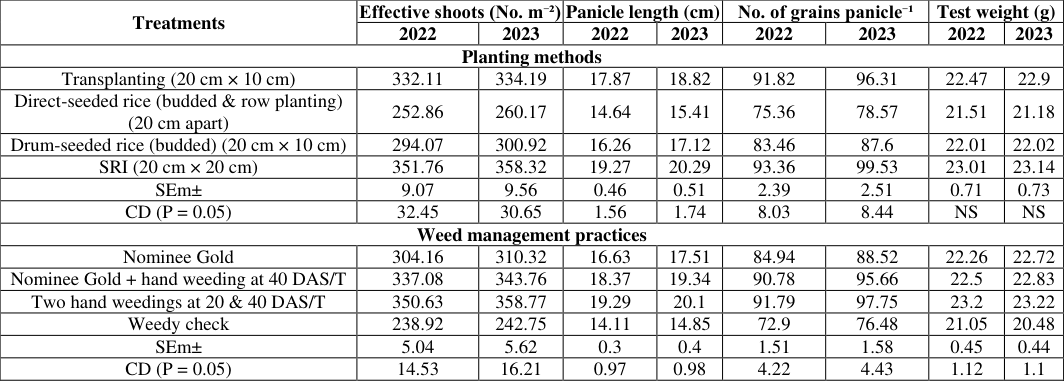 Table 1
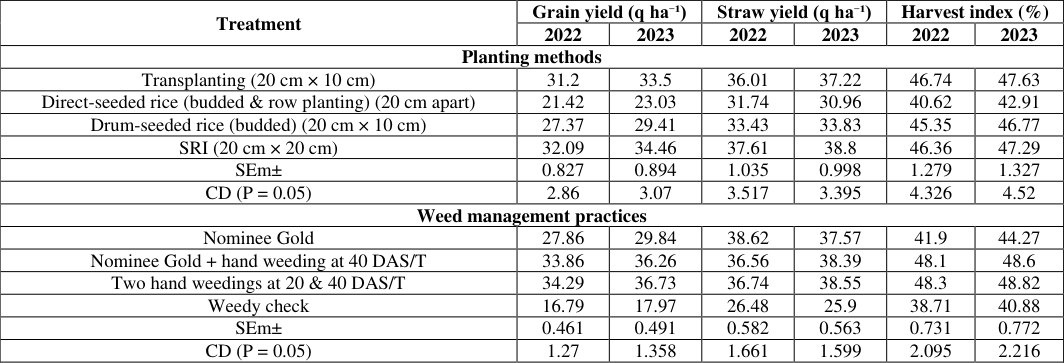 Table 2
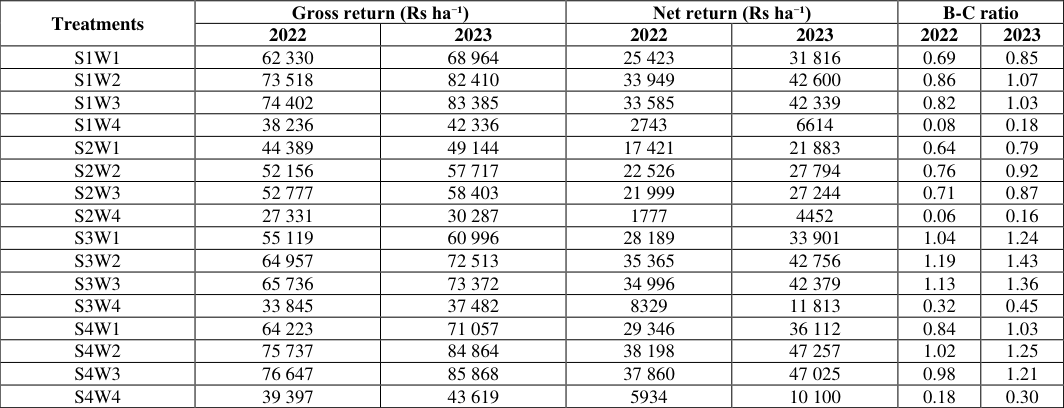 Table 3
Introduction
Rice (Oryza sativa L.), a member of the Poaceae (Gramineae) family, ranks among the most vital cereal crops worldwide. It serves as the principal food for over 60% of the global population, with wheat occupying the next position. Nearly 90% of global rice production and consumption occurs within Asia. Within India, rice occupies 43.79 million ha with an annual output of 116.42 million tonnes and average productivity of 2659 kg ha -1 (Anonymous, 2023) [1] . Uttar Pradesh ranks as a major rice-producing state, second only to West Bengal, cultivating rice across 5.75 million ha to yield 15.54 million tonnes annually at an average productivity of 2703 kg ha -1 . This productivity, however, remains below the levels achieved in Punjab, Haryana and Tamil Nadu. Several factors contribute to this yield gap in Uttar Pradesh, including the limited availability and slow uptake of high-yielding cultivars, suboptimal fertiliser use, insufficient irrigation infrastructure and inadequate weed control practices. Transplanting remains the dominant establishment method for rice in India, despite being tedious, labour-and time-intensive, and costly on account of nursery raising, uprooting and transplanting operations (Tuong et al.) [2] . Limited water availability, labour shortages and elevated wages during peak farm operations frequently push transplanting beyond the optimum window. In response, growers are increasingly adopting direct seeding under puddled soil conditions. This method markedly cuts the labour demand for rice cultivation and advances harvesting by roughly 8-10 days relative to transplanted crops. Direct seeding does away with seedlings altogether, thereby eliminating steps such as nursery establishment, seedling maintenance, uprooting, bundling, transport and transplanting. Weed communities differ across seasons and vary with climatic and soil conditions. In direct-seeded rice, a wide range of weed species commonly emerges: grasses such as Echinochloa colona and Echinochloa crus-galli; sedges including Cyperus iria and Cyperus difformis; and broadleaved species like Eclipta prostrata, Sphenoclea zeylanica and Ludwigia hyssopifolia. Pre-emergence herbicides-thiobencarb, pendimethalin, butachlor, oxadiazon and nitrofen among them-have shown effective weed suppression in direct-seeded rice.
Post-emergence options such as ethoxysulfuron, cyhalofopbutyl, pretilachlor, chlorimuron, metsulfuron, Nominee Gold (bispyribac-sodium) and penoxsulam have likewise delivered effective weed control in direct-seeded rice (Mahajan et al.) [3] .
Materials and Methods
The In total, the trial included sixteen treatment combinations formed by pairing four planting methods with four weed control strategies. Treatments were arranged in a split-plot design, with planting methods allocated to the main plots and weed control practices to the sub-plots, and were replicated thrice. The planting methods comprised the system of rice intensification (SRI), transplanting, drum seeding and direct-seeded rice under puddled conditions. The weed control treatments were: Nominee Gold (bispyribac-sodium) at 25 g a.i. ha -1 applied 25 DAS/T; Nominee Gold at the same rate followed by hand weeding at 40 DAS/T; two hand weedings at 20 and 40 DAS/T; and an unweeded check.
Variety NDR-97, characterised by short-pointed grains and a white stigma, is resistant to a range of diseases, moderately resistant to blast and sheath blight, and reaches maturity within 90-95 days. The cultivar is largely free from major pest damage under natural field conditions. Phosphorus and potassium were supplied at their recommended rates of 60 and 40 kg ha -1 through single super phosphate and muriate of potash, respectively, applied as basal doses during puddling and mixed into the surface soil. Nitrogen was delivered as urea at 120 kg ha -1 , split into three doses-half applied basally, one-fourth top-dressed at the early-tillering stage and the final quarter given seven days before panicle initiation.
Seed rates of 100 and 20 kg ha -1 were adopted for broadcast direct seeding and drum seeding, respectively. In the directseeding plots, sowing was carried out either by broadcasting or by drum seeder, depending on the treatment. Seeds were first steeped in water for 12 hours, then heaped and kept beneath a moist gunny bag for another 24 hours to encourage sprouting. Immediately before sowing in the drum-seeding plots, puddling involved two cross-ploughings with a desi plough and subsequent planking in standing water; sprouted seeds were then sown in rows 20 cm apart using a drum seeder. Nurseries for the transplanting and SRI treatments were raised using seed rates of 45 kg ha -1 and 7 kg ha -1 , respectively. Broadcasting of sprouted seeds was practised in the direct-seeding treatments, while the remaining treatments were planted in rows spaced 20 cm apart. Drum-seeded plots followed a 20 × 10 cm geometry. Nursery and main-field sowings were carried out on the same dates each year-28 June 2022 and 30 June 2023. Manual harvesting with sickles was performed once the upper spikelets had turned straw-coloured and the grains had hardened to a moisture level of 15-18%. Before recording yield, two border rows were removed on all sides of each plot to isolate the net harvest area; a 50 cm strip was clipped from either width side. For broadcast plots, borders of 40 cm along the length and 50 cm along the width were harvested.
Effective shoots per square metre were recorded at maturity by placing a 50 × 50 cm (0.25 m 2 ) quadrat at three random spots within each plot. Five panicles per plot were randomly sampled, and their lengths, measured from base to tip, were averaged. The grain count of five randomly selected panicles per plot was averaged to determine grains per panicle. Test weight was determined by weighing a random sample of 1000 grains from each plot after drying to 14% moisture. Grain yield from each net plot was threshed, weighed in kilograms and expressed as q ha -1 for statistical evaluation. Straw yield per plot was calculated by deducting grain yield from the total biological yield of the net plot and was similarly reported as q ha -1 . The harvest index was computed as the ratio of grain (economic) yield to biological yield and expressed as a percentage, using the formula:
Harvest index (%) = Economic yield (grain yield) / Biological yield (grain + straw) × 100
Results and Discussion
Yield attributes of rice Yield-attributing characters develop through the accumulation and translocation of dry matter by the plant and show a direct relationship with the grain yield of rice. During both experimental years, the yield attributeseffective shoots per m 2 , panicle length (cm), grains per panicle and 1000-grain weight-responded to the different planting methods and weed control practices (Table 1). Planting method significantly influenced effective shoots per m 2 , panicle length and grains per panicle in both years, whereas differences in 1000-grain weight remained nonsignificant; weed management practices, in contrast, significantly influenced all four attributes. SRI produced the highest values for these parameters, with transplanting following closely behind, particularly for effective shoots per m 2 , panicle length, grains per panicle and 1000-grain weight. This outcome likely reflects the superior growth and development achieved by plants facing lower weed density and, therefore, reduced competition for growth resources. Under such conditions, the crop had access to sufficient moisture, light, nutrients and space, which likely improved the source-to-sink translocation of photosynthates and nutrient uptake. In contrast, direct seeding produced the lowest values for these attributes, since heightened intraplant competition for growth resources restricted the performance of individual plants within the community. Comparable observations were made by Yadav et al. (2005) [9] , who found that transplanting following puddling delivered significantly higher rice grain yields-18.6%, 59.1% and 35.4% greater than drum seeding-over three successive years. Jai et al. (2010) [12] attributed the superior grain and straw yields under these treatments to a stronger expression of yield attributes, which in turn stemmed from refined management practices and diminished crop-weed competition that markedly cut weed dry weight and population. Across the weed control strategies, two hand weedings scheduled at 20 and 40 DAS/T yielded significantly higher effective shoots per m 2 , panicle length, grains per panicle and 1000-grain weight than the remaining treatments, and were statistically comparable to Nominee Gold at 25 g ha -1 combined with hand weeding at 40 DAS/T in both years (Table 1). The unweeded check, however, registered significantly lower yield attributes than any of the other weed-control treatments. The improved response most likely reflects reduced crop-weed competition under the effective treatments, which permitted better expression of yield attributes and yield. Similar trends have been reported by Khattak et [4,5,6,7] .
| Treatments | Effective shoots (No. m⁻²) | — | Panicle length (cm) | — | No. of grains panicle⁻¹ | — | Test weight (g) | — |
|---|---|---|---|---|---|---|---|---|
| 2022 | 2023 | 2022 | 2023 | 2022 | 2023 | 2022 | 2023 | |
| Planting methods | ||||||||
| Transplanting (20 cm × 10 cm) | 332.11 | 334.19 | 17.87 | 18.82 | 91.82 | 96.31 | 22.47 | 22.9 |
| Direct-seeded rice (budded & row planting) (20 cm apart) | 252.86 | 260.17 | 14.64 | 15.41 | 75.36 | 78.57 | 21.51 | 21.18 |
| Drum-seeded rice (budded) (20 cm × 10 cm) | 294.07 | 300.92 | 16.26 | 17.12 | 83.46 | 87.6 | 22.01 | 22.02 |
| SRI (20 cm × 20 cm) | 351.76 | 358.32 | 19.27 | 20.29 | 93.36 | 99.53 | 23.01 | 23.14 |
| SEm± | 9.07 | 9.56 | 0.46 | 0.51 | 2.39 | 2.51 | 0.71 | 0.73 |
| CD (P = 0.05) | 32.45 | 30.65 | 1.56 | 1.74 | 8.03 | 8.44 | NS | NS |
| Weed management practices | ||||||||
| Nominee Gold | 304.16 | 310.32 | 16.63 | 17.51 | 84.94 | 88.52 | 22.26 | 22.72 |
| Nominee Gold + hand weeding at 40 DAS/T | 337.08 | 343.76 | 18.37 | 19.34 | 90.78 | 95.66 | 22.5 | 22.83 |
| Two hand weedings at 20 & 40 DAS/T | 350.63 | 358.77 | 19.29 | 20.1 | 91.79 | 97.75 | 23.2 | 23.22 |
| Weedy check | 238.92 | 242.75 | 14.11 | 14.85 | 72.9 | 76.48 | 21.05 | 20.48 |
| SEm± | 5.04 | 5.62 | 0.3 | 0.4 | 1.51 | 1.58 | 0.45 | 0.44 |
| CD (P = 0.05) | 14.53 | 16.21 | 0.97 | 0.98 | 4.22 | 4.43 | 1.12 | 1.1 |
Table text extracted from the original PDF; superscript letters are shown inline. The original table image is below.
View original table image
Grain yield, straw yield and harvest index of rice
The final yield reflects the coordinated interaction of growth parameters and yield-contributing attributes. Both grain and straw yields of paddy varied significantly with planting method in the 2022 and 2023 seasons (Table 2). SRI, statistically comparable to transplanting, delivered significantly higher grain and straw yields than the other establishment techniques. The elevated grain yield under SRI can be linked to enhanced crop growth and development, which improved yield attributes; the higher straw yield most likely arose from increased dry-matter accumulation per unit area, driven by more efficient nutrient uptake, faster metabolic activity, greater light interception and photosynthesis, and a larger leaf population. Transplanting produced a significantly greater harvest index than the other methods and was on par statistically with both SRI and drum-seeded rice, presumably because grain and straw yields rose in similar proportions under these three treatments. Singh et al. [8] noted that SRI and transplanting produced statistically similar grain yields, though transplanting recorded significantly higher straw yield, while seed quality was superior in SRI. Yadav and Singh (2006) recorded the maximum grain yield (55 q ha -1 ) under transplanting, exceeding direct seeding and drum seeding by 45.5% and 4.5%, respectively. Regarding the weed control treatments, two hand weedings (20 and 40 DAS/T)-on par with Nominee Gold at 25 g ha -1 plus hand weeding at 40 DAS/T-yielded significantly greater grain and straw than the sole application of Nominee Gold at 25 g ha -1 or the weedy check. Nominee Gold at 25 g ha -1 used alone still gave significantly higher grain and straw yields than the untreated check. The weedy check consistently produced the lowest grain and straw yields relative to all other treatments across both experimental years. These findings align with those reported by Yadav et al. [9] .
| Treatment | Grain yield (q ha⁻¹) | — | Straw yield (q ha⁻¹) | — | Harvest index (%) | — |
|---|---|---|---|---|---|---|
| 2022 | 2023 | 2022 | 2023 | 2022 | 2023 | |
| Planting methods | ||||||
| Transplanting (20 cm × 10 cm) | 31.2 | 33.5 | 36.01 | 37.22 | 46.74 | 47.63 |
| Direct-seeded rice (budded & row planting) (20 cm apart) | 21.42 | 23.03 | 31.74 | 30.96 | 40.62 | 42.91 |
| Drum-seeded rice (budded) (20 cm × 10 cm) | 27.37 | 29.41 | 33.43 | 33.83 | 45.35 | 46.77 |
| SRI (20 cm × 20 cm) | 32.09 | 34.46 | 37.61 | 38.8 | 46.36 | 47.29 |
| SEm± | 0.827 | 0.894 | 1.035 | 0.998 | 1.279 | 1.327 |
| CD (P = 0.05) | 2.86 | 3.07 | 3.517 | 3.395 | 4.326 | 4.52 |
| Weed management practices | ||||||
| Nominee Gold | 27.86 | 29.84 | 38.62 | 37.57 | 41.9 | 44.27 |
| Nominee Gold + hand weeding at 40 DAS/T | 33.86 | 36.26 | 36.56 | 38.39 | 48.1 | 48.6 |
| Two hand weedings at 20 & 40 DAS/T | 34.29 | 36.73 | 36.74 | 38.55 | 48.3 | 48.82 |
| Weedy check | 16.79 | 17.97 | 26.48 | 25.9 | 38.71 | 40.88 |
| SEm± | 0.461 | 0.491 | 0.582 | 0.563 | 0.731 | 0.772 |
| CD (P = 0.05) | 1.27 | 1.358 | 1.661 | 1.599 | 2.095 | 2.216 |
Table text extracted from the original PDF; superscript letters are shown inline. The original table image is below.
View original table image
Economics of rice
Farmer acceptance of any modern agricultural technology hinges largely on its economic feasibility. Such viability depends on gains and losses expressed through gross income, net income and the benefit-cost ratio-key parameters for assessing treatment effects (Table 3). The maximum gross return (Rs 76 647 ha -1 and Rs 85 868 ha -1 ) was obtained from SRI paired with two hand weedings at 20 and 40 DAS/T, followed by SRI combined with Nominee Gold plus one hand weeding, and by transplanting with two hand weedings at 20 and 40 DAS/T-outcomes attributable to the higher rice yields. The lowest gross return (Rs 27 331 ha -1 and Rs 30 287 ha -1 ) came from direct-seeded rice under the weedy-check treatment, a consequence of the low grain yield produced. The greatest net return (Rs 38 198 ha -1 and Rs 47 257 ha -1 ) was achieved under SRI with Nominee Gold plus one hand weeding, followed by SRI with two hand weedings at 20 and 40 DAS/T and drum-seeded rice with Nominee Gold plus one hand weeding. The minimum net return was observed in direct-seeded rice with the weedy check. The highest benefit-cost ratio (1.19 and 1.43) was registered under drum-seeded rice with Nominee Gold followed by hand weeding at 40 DAS/T, closely followed by drumseeded rice with two hand weedings at 20 and 40 DAS/T and drum-seeded rice with Nominee Gold alone; the lowest benefit-cost ratio (0.06 and 0.16) came from direct-seeded rice with the weedy check. Comparable findings have been reported by Prasad et al. [10] , Shivaramu and Krishnamurthy 11 , Gaire et al. 6 and Dubey et al. [7] .
| Treatments | Gross return (Rs ha⁻¹) | — | Net return (Rs ha⁻¹) | — | B-C ratio | — |
|---|---|---|---|---|---|---|
| 2022 | 2023 | 2022 | 2023 | 2022 | 2023 | |
| S1W1 | 62 330 | 68 964 | 25 423 | 31 816 | 0.69 | 0.85 |
| S1W2 | 73 518 | 82 410 | 33 949 | 42 600 | 0.86 | 1.07 |
| S1W3 | 74 402 | 83 385 | 33 585 | 42 339 | 0.82 | 1.03 |
| S1W4 | 38 236 | 42 336 | 2743 | 6614 | 0.08 | 0.18 |
| S2W1 | 44 389 | 49 144 | 17 421 | 21 883 | 0.64 | 0.79 |
| S2W2 | 52 156 | 57 717 | 22 526 | 27 794 | 0.76 | 0.92 |
| S2W3 | 52 777 | 58 403 | 21 999 | 27 244 | 0.71 | 0.87 |
| S2W4 | 27 331 | 30 287 | 1777 | 4452 | 0.06 | 0.16 |
| S3W1 | 55 119 | 60 996 | 28 189 | 33 901 | 1.04 | 1.24 |
| S3W2 | 64 957 | 72 513 | 35 365 | 42 756 | 1.19 | 1.43 |
| S3W3 | 65 736 | 73 372 | 34 996 | 42 379 | 1.13 | 1.36 |
| S3W4 | 33 845 | 37 482 | 8329 | 11 813 | 0.32 | 0.45 |
| S4W1 | 64 223 | 71 057 | 29 346 | 36 112 | 0.84 | 1.03 |
| S4W2 | 75 737 | 84 864 | 38 198 | 47 257 | 1.02 | 1.25 |
| S4W3 | 76 647 | 85 868 | 37 860 | 47 025 | 0.98 | 1.21 |
| S4W4 | 39 397 | 43 619 | 5934 | 10 100 | 0.18 | 0.30 |
Table text extracted from the original PDF; superscript letters are shown inline. The original table image is below.
View original table image
Conclusion
SRI and transplanting proved more effective in suppressing weed infestation and limiting nitrogen removal by weeds, thereby improving yield attributes and yield. Among the weed control treatments, hand weeding at 20 and 40 DAS and the post-emergence use of Nominee Gold at 25 g a.i. ha -1 at 25 DAS combined with one hand weeding at 40 DAS emerged as the most promising, sharply lowering weed infestation and consequently boosting yield attributes and paddy yield. From an economic standpoint, drum seeding combined with the post-emergence application of Nominee Gold at 25 g a.i. ha -1 at 25 DAS followed by one hand weeding at 40 DAS/T proved most remunerative, yielding net incomes of Rs 1.19 and Rs 1.43 per rupee invested; the next most profitable option was drum seeding paired with hand weeding at 20 and 40 DAS, returning Rs 1.13 and Rs 1.36 per rupee invested in the first and second years, respectively.
Acknowledgement
AcknowledgmentsThe authors sincerely thank the Head of the Department and the authorities of Swami Vivekanand Subharti University, Meerut, for extending the facilities and support required to complete this research. No conflict of interest is declared by the authors in connection with this study.
References
12 in the original paper- SEm = standard error of the mean; CD = critical difference; NS = non-significant; DAS/T = days after sowing/transplanting; SRI = system of rice intensification; Nominee Gold = bispyribac-sodium. References 1. Anonymous. Agricultural statistics at a glance. New Delhi: Department of Agriculture and Co-operation, Government of India; 2023.
- Tuong TP, Bouman BAM, Mortimer M. More rice, less water: integrated approaches for increasing water productivity in irrigated rice-based systems in Asia. Plant Prod Sci. 2005;8(3):231-241.
- Mahajan G, Chauhan BS, Gill MS. Dry-seeded rice culture in Punjab state of India: lessons learned from farmers. Field Crops Res. 2013;144:89-99.
- Khattak SI, Khalid U, Khan Q, Qayyum A. Impact of various planting techniques on yield and yield components of rice. Indus J Plant Sci. 2007;5(1):753756.
- Aslam M, Hussain S, Ramzan M, Akhter M. Effect of different stand establishment techniques on rice yields and its attributes. J Anim Plant Sci. 2008;18(2-3):80-82.
- Gaire R, Dahal KR, Amgain LP. Effect of different mulching materials on weed dynamics and yield of International Journal of Agriculture and Nutrition https://www.agriculturejournal.net direct-seeded rice in Chitwan, Nepal. Agron J Nepal. 2013;3:73-81.
- Dubey R, Singh D, Mishra A. Effect of weed management practices and establishment methods on growth, productivity and economics of rice. Int J Curr Microbiol Appl Sci. 2017;6(3):65-72.
- Singh YV, Singh KK, Sharma SK. Influence of crop nutrition on grain yield, seed quality and water productivity under two rice cultivation systems. Rice Sci. 2013;20(2):129-138.
- Yadav V, Singh LR, Singh R, Mishra DN. Effect of crop establishment methods and weed management practices on nutrient uptake, yield and quality of rice (Oryza sativa L.). Environ Ecol. 2009;27(1):238-241.
- Prasad SM, Mishra SS, Singh SJ. Effect of establishment methods, fertility levels and weed management practices on rice (Oryza sativa L.). Indian J Agron. 2001;46(2):216-221.
- Shivaramu K, Krishnamurthy B. Economics and adoption of SRI technology by paddy growers. Mysore J Agric Sci. 2011;45(3):648-654.
- Jaiswal JP, Arya M, Kumar A, Rawat S. Assessing genetic diversity for yield and quality traits in indigenous bread wheat germplasm. Electron J Plant Breed. 2010;1(4):370-378.