
Research article · 2026 · Full text
International Journal of Agriculture and NutritionInfluence of planting density and fertilizer management on growth, productivity and quality parameters of upland cotton (Gossypium hirsutum) in Central U.P., India
Volume 8(7) · Pages 116–120 · DOI: 10.33545/26646064.2026.v8.i7b.710 ↗
Research areasAgricultural Science and FertilizationResearch in Cotton CultivationCrop Yield and Soil Fertility
Abstract
Author-writtenGlobally, cotton ranks among the most economically significant crops, making substantial contributions to the economies of numerous nations. Its cultivation extends across approximately 100 countries, with China, India, the United States, Pakistan, and Brazil collectively accounting for the largest share of world production; the crop underpins the textile sector by supplying raw fibrous lint. A field experiment was therefore conducted with hirsutum cotton genotype H-1300 during the Kharif season of 2024 at the Agriculture Farm of Swami Vivekanand Subharti University, Meerut, with the objective of evaluating the influence of plant spacing and fertilizer regimes on growth performance, yield attributes, total yield, fibre quality, and economic returns of hirsutum cotton. Seven treatment combinations were imposed, as follows: T1 - control without fertilizer + normal spacing (67.5 × 30 cm); T2 - 100% RDF + normal spacing; T3 - 100% RDF + 25% less than normal spacing; T4 - 125% RDF + 25% less than normal spacing; T5 - 125% RDF + 25% less than normal spacing + soil application of ZnSO4; T6 - 125% RDF + 25% less than normal spacing + foliar spray of 2% urea and 2% DAP; and T7 - 125% RDF + 25% less than normal spacing + foliar spray of MgSO4 and ZnSO4. All treatments were laid out in a randomised block design replicated three times, with a standard inter-row spacing of 67.5 cm and an intra-row plant-to-plant distance of 30 cm. Treatment T6 (125% RDF + 25% below standard spacing + foliar spray of 2% urea and 2% DAP) recorded the greatest improvements in all growth indices — plant height at 30, 60, 90, 120, and 150 DAS, monopodial and sympodial branch counts, and fresh as well as dry weight per plant — along with the highest yield attributes (boll number per plant, bolls per m², and individual boll weight), economic yields (seed cotton, lint, seed, and stick), and superior fibre quality scores (ginning out-turn and micronaire value). Fibre strength was highest under T4 (125% RDF + 25% reduced spacing), while uniformity ratio did not differ significantly across treatments. The second-best performance was consistently delivered by T7 (125% RDF + 25% below standard spacing + MgSO₄ + ZnSO₄ foliar spray). On the basis of these findings, it can be concluded that hirsutum cotton genotype H-1300 cultivated under an input combination of 125% RDF (60:30:20 kg NPK ha⁻¹), 25% reduced inter-plant spacing, and foliar application of 2% urea plus 2% DAP proved to be the most productive and economically rewarding option for cotton production in the Central Plain Zone of Uttar Pradesh.
Summary
Source-checkedPlain-language reading of the full paper, prepared with AI and checked against the text. Each point links to the authors' own words.
Why it matters
- Cotton is one of the most economically important crops worldwide, contributing significantly to many national economies. View evidence ↗
- The market value of cotton is primarily determined by fibre quality, which depends on factors like length, fineness, maturity, and tensile strength. View evidence ↗
- In India, cotton productivity is limited by soil fertility decline, monoculture systems, pests, diseases, and planting delays. View evidence ↗
The question
- The study aimed to evaluate how different plant spacing and fertilizer regimes affect the growth, yield, fibre quality, and economic returns of hirsutum cotton. View evidence ↗
What they did
- The experiment used hirsutum cotton genotype H-1300 during the 2024 Kharif season at Swami Vivekanand Subharti University in Meerut. View evidence ↗
- The study used a randomized block design with three replications, using standard spacing of 67.5 cm between rows and 30 cm between plants. View evidence ↗
What they found
- Treatment T6 (125% RDF, 25% reduced spacing, and foliar urea/DAP) resulted in the best growth indices, including plant height across all measurement dates and branch counts. View evidence ↗
- The highest number of monopodial branches per plant was achieved under T5, which included soil ZnSO₄ application. View evidence ↗
- T6 produced significantly higher boll numbers per plant, boll density per square meter, and individual boll weight compared to lower fertilizer doses or standard spacing. View evidence ↗
- T6 achieved the highest seed cotton yield, which was 86.38% higher than the unfertilized control with standard spacing. View evidence ↗
- The highest ginning out-turn was recorded under T6 at 35.63%, followed closely by T7 at 35.60%. View evidence ↗
- Fibre strength peaked under T4 (28.30 g/tex), while T6 ranked fifth (26.37 g/tex), indicating that very high fertilizer and foliar nitrogen do not necessarily optimize tensile properties. View evidence ↗
What it means
- The authors conclude that for genotype H-1300, the combination of 125% RDF, 25% reduced spacing, and foliar urea/DAP is the most productive and economically rewarding. View evidence ↗
- The study recommends the T6 treatment combination for cotton growers in the Central Plain Zone of Uttar Pradesh. View evidence ↗
Visual summary
1 visualsIllustrations explain the paper; charts are replotted from the paper's own table values.
Seed cotton yield (kg/ha) and Lint yield (kg/ha) and more: T1 - Control (no... vs T2 - 100% RDF + normal... vs T3 - 100% RDF + 25%... vs T4 - 125% RDF + 25%... vs T5 - 125% RDF + 25%...
Replotted from Table 3 (page 4) of the original paper. Every bar is the paper's own table value.
View source evidence ↗Figures & tables
From the original paper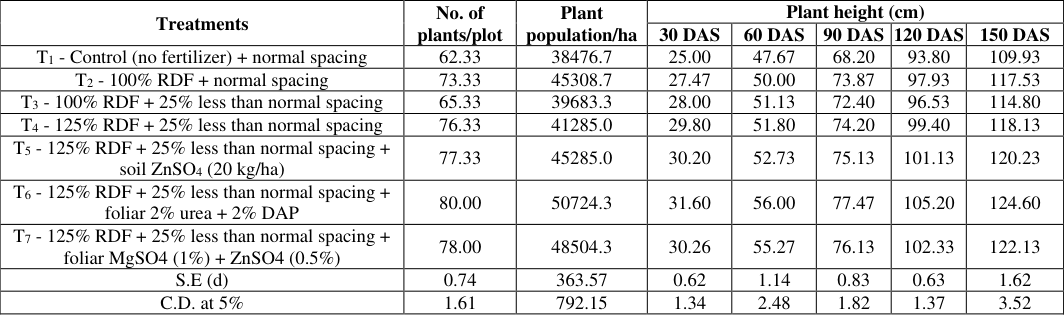 Table 1A
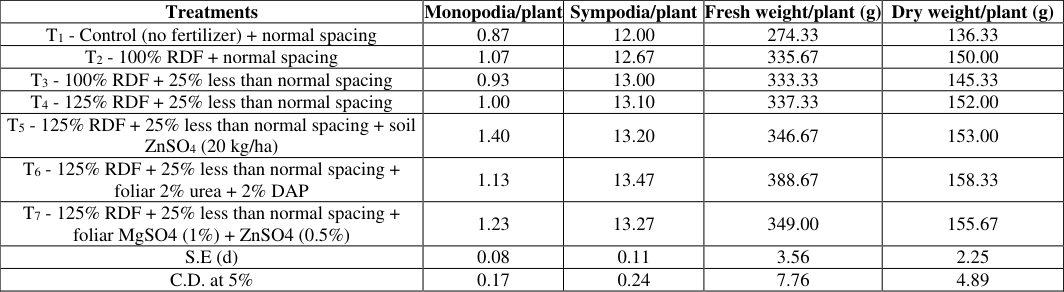 Table 1B
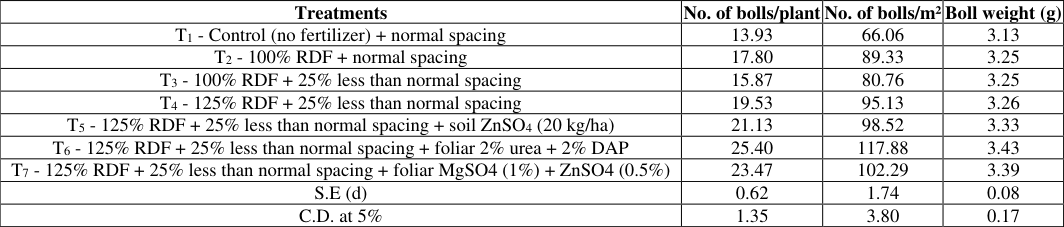 Table 2
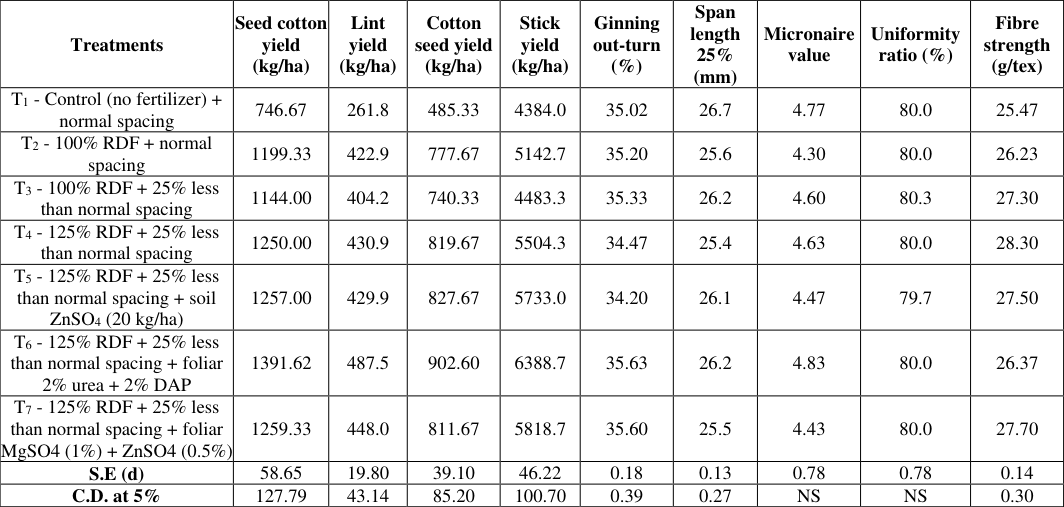 Table 3
Introduction
Among major field crops worldwide, cotton holds a position of outstanding economic relevance, supporting the livelihoods and trade balances of many developing and developed nations alike. The crop thrives in around 100 countries spanning tropical and subtropical belts; China, India, the United States, Pakistan, and Brazil are the dominant producers. As the primary source of natural textile fibre in the form of lint, cotton forms the backbone of the global textile and apparel industry; it is commercially cultivated across more than 80 countries. Domesticated cotton species used for commercial purposes fall into two broad categories -New World and Old World cottonwith the New World group further subdivided according to fibre characteristics. Among the Old World diploid species, G. arboreum enjoys the widest cultivation, particularly in India, Pakistan, and several South-East Asian nations where it occupies the comparatively arid and less fertile tracts of Bangladesh, Myanmar, China, Sri Lanka, and Vietnam (Singh and Narayanan, 1991). Archaeological evidence from Mohenjodaro indicates that cotton textile production in the Indian subcontinent has a history spanning approximately five millennia.
Cotton occupies a pivotal position in India's agricultural and industrial economy. Fibre qualitythe central determinant of market valueis a complex trait governed by the interplay of mean fibre length, fineness, maturity, and tensile strength, together with physical attributes such as colour and ash content. These parameters collectively dictate downstream processing characteristics including yarn spinnability, dye uptake, yarn tensile strength, fabric lustre, and suitability for blending with synthetic fibres. Environmental and management stressesdrought, nutritional imbalances, seasonal variation, harvest timing, and pest and disease pressureare well-recognised modulators of fibre fineness, maturity, and strength (Nanjundayya, 1960) [14] . Cotton productivity in India remains constrained by a cluster of agronomic and edaphic factors, including the prevalence of monoculture systems, progressive soil-fertility decline, delayed planting, and the burden of pests and diseases. Long-term continuous cropping combined with imbalanced fertilisation accelerates soil-fertility depletion (Mathur, 1997) [13] . Integrated use of organic manures alongside inorganic fertilisers has been shown to arrest this decline and sustain productive capacity.
Bt cotton hybrids offer considerable potential for wider adoption in India, yet a reassessment of their fertilisation strategies is warranted to match their yield potential (Venugopal, 2004) [24] . Since its commercial introduction in 2002, Bt technology has been embraced across the country. Adequate nutritional management is a key lever for enhancing cotton productivity, since meeting the crop's nutritional demands is prerequisite to realising high yields and superior fibre quality (Kalaichelvi, 2009; Kumar et al., 2011) [8,12]. Cotton's response to applied nutrients is mediated by a combination of environmental conditions and cultural practices; of all production inputs, fertilisation has shown the most consistent positive impact on yield. However, the ideal fertiliser dose is not universalit is shaped by local soil characteristics and the prevailing agroclimatic regime. Simultaneous deployment of improved high-yielding genotypes and sound agronomic management optimal plant populations, appropriately calibrated fertiliser doses, timely pest management, and efficient water and weed controlcollectively drive productivity gains. Micronutrient delivery through foliar application has been recognised as an efficient route to better nutrient use efficiency and enhanced crop performance (Rathinavel et al., 1999) [19] ; such sprays also stimulate seed-level biochemical activity, contributing to higher yields (Chaudhary et al., 2001) [4] . The peak nutritional requirement of cotton occurs during squaring, blooming, and boll development, and supplementing nutrient supply through foliar sprays at these critical windows can translate directly into yield improvement (Bhatt and Nathu, 1986) [2] . Accordingly, the present investigation was undertaken to optimise plant spacing and nutrient management for growth, yield components, total yield, and fibre quality in upland cotton.
Materials and Methods
The experiment was carried out with hirsutum cotton genotype H-1300 during the Kharif 2024 cropping season at the Agriculture Farm, Swami Vivekanand Subharti University, Meerut. Total annual precipitation at the site amounted to 650.6 mm, predominantly received from mid-June through the second week of September via the southwest monsoon, with intermittent off-season showers. The experimental soil was characterised as sandy loam with moderate inherent fertility, a pH of 7.8, low organic carbon content (0.48%), and medium availability of both phosphorus (16 kg ha⁻¹) and potash (183 kg ha⁻¹).
The seven treatment combinations were T 1 -unfertilised control at standard spacing (67.5 × 30 cm); T 2 -100% RDF + normal spacing; T 3 -100% RDF + 25% less than normal spacing; T 4 -125% RDF + 25% less than normal spacing; T 5 -125% RDF + 25% less than normal spacing + soil application of ZnSO4; T 6 -125% RDF + 25% less than normal spacing + foliar spray of 2% urea and 2% DAP; and T 7 -125% RDF + 25% less than normal spacing + foliar spray of MgSO4 and ZnSO4. The treatments were evaluated in a randomised block design with three replications. The normal spacing was maintained at 67.5 cm (row to row) and 30 cm (plant to plant). Sowing was completed on 28 May 2024, and the crop was harvested in two picking operations on 25 October 2024 and 10 November 2024. Fertiliser application followed the treatment schedule: at sowing, 50% of the nitrogen dose together with the full complement of phosphorus and potassium was incorporated into the soil; the remaining nitrogen was split equally and top-dressed at 30 and 60 DAS. Appropriate crop-protection measures were enforced, with insecticide applications timed to actual pest pressure. Data on growth parameters, yield components, economic yield, and fibre quality traits were systematically recorded throughout the crop season, and bolls were picked selectively at full maturity. The data were analysed statistically using the methods and tests of significance appropriate to the design (Cochran and Cox, 1950) [5] . Wherever the 'F' test in the analysis of variance revealed significant effects, summary tables giving treatment means with their standard errors were prepared, and appropriate critical differences (CD) were computed to test the significance between two treatments. Critical difference values at P = 0.05 were used to determine the significance of differences between means.
Results and Discussion
All measured vegetative parametersplant stand count, plant height at 30, 60, 90, 120, and 150 DAS, monopodial and sympodial branch number per plant, and biomass (fresh and dry weight)responded significantly to the imposed spacing and nutrient management regimes, with values trending upward as fertiliser rates increased (Table 1A). Among all treatments, T 6 (125% RDF + 25% reduced spacing + foliar 2% urea + 2% DAP) produced the tallest plants across every measurement date, surpassing all other treatments at each crop growth stage. A positive association between plant height and combined spacing-nutrition management has been similarly documented by Kaur et al.
(2010) [9] and Sharma et al. (2004) [21] . The comparatively taller stature observed under closer plant spacing is attributed to inter-plant competition, which promotes upward elongation; conversely, wider spacing allows lateral spread and curtails vertical extension (Reddy and Kumar, 2010) [20] . The maximum monopodial branch count per plant was recorded under T 5 (125% RDF + 25% reduced spacing + soil ZnSO₄ application), which differed significantly from all other treatments (Table 1B). T 6 and T 7 ranked second and third, respectively, for monopodia per plant. An upward trend in sympodial branch number accompanied rising fertiliser doses at reduced spacing, with T 6 recording the highest sympodial count (13.47), though differences between treatments were not always statistically significant.
The enhancement in both monopodia and sympodia under optimum nutritional conditions is likely attributable to the stimulatory effect of adequate mineral nutrition on meristematic activity, promoting cell division and elongation and, consequently, greater lateral branching. These observations align with earlier findings reported by Ram and Giri (2006) [16] and Kaur et al. (2010) [9] .
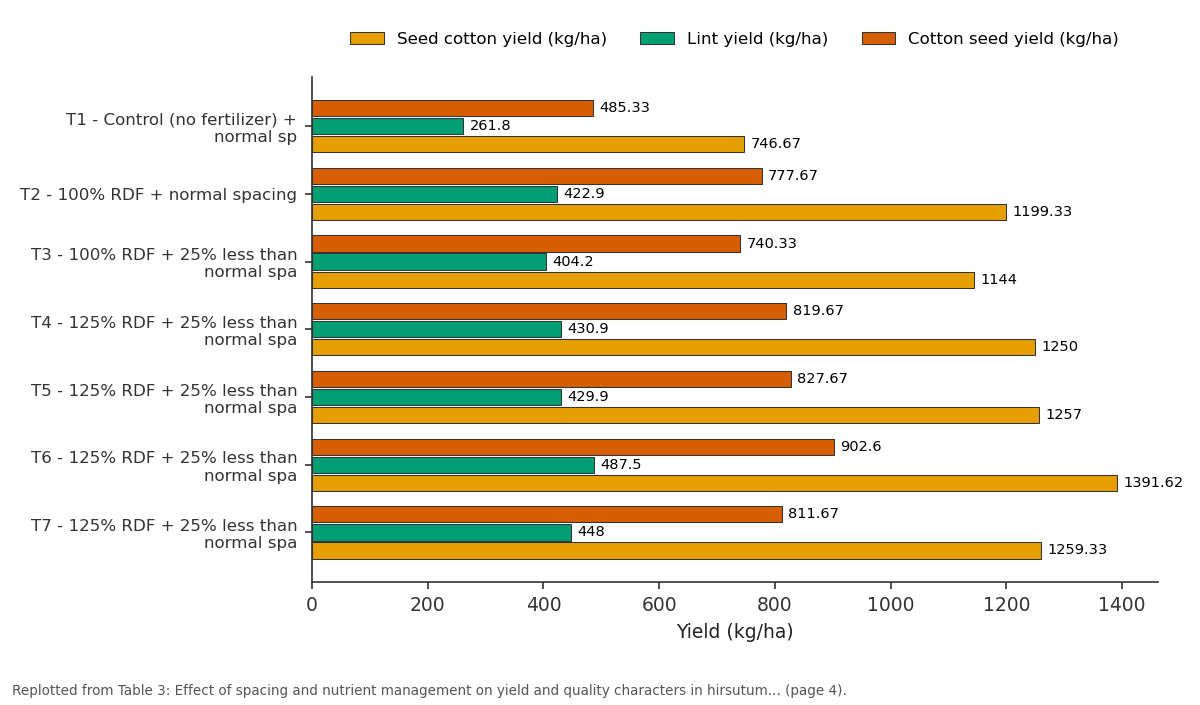
Biomass accumulation per plant, both in terms of fresh and dry weight, was markedly influenced by fertiliser level in combination with plant spacing. The highest fresh and dry weight was registered under T 6 , followed closely by T 7 (MgSO₄ + ZnSO₄ foliar spray). The observed biomass gains are attributable to heightened meristematic activity driven by optimal nutritional supply. Comparable trends have been documented by Jadhav et al. (2012) [7] . Treatment T 6 (125% RDF + 25% reduced spacing + foliar 2% urea + 2% DAP) registered significantly higher boll number per plant, boll density per m², and individual boll weight relative to treatments receiving lower fertiliser doses or standard spacing (Table 2). The second-highest yield attributes were associated with T 7 (MgSO₄ + ZnSO₄ foliar spray). The improvement in these yield components is a downstream consequence of the superior vegetative growth enhanced plant height, greater branch production, and higher biomassachieved under T 6 . These findings are consistent with the results reported by Jadhav et al. (2012) [7] . Seed cotton yield under T 6 (125% RDF + 25% reduced spacing + foliar 2% urea + 2% DAP) was significantly the highest, representing an 86.38% advantage over the unfertilised control at standard spacing (Table 3). The MgSO₄ + ZnSO₄ foliar treatment (T 7 ) also produced a significantly elevated seed cotton yield. Lint yield followed the same pattern, with the highest value recorded under the urea + DAP foliar spray. Cotton-seed and stick yields were likewise augmented by elevated fertiliser doses, while all yield fractions were at their nadir in the unfertilised control. The yield increments with higher fertilisation levels are largely a reflection of improved vegetative vigour and better-expressed yield components. Consistent results have been reported by Bhattoo et al. (2012) [3] . Raskar (2004) [18] documented that escalating fertilisation from 50% to 100% RDF produced progressively greater seed cotton yields, with 100% RDF outperforming 50% and 75% RDF by 31.71% and 10.16%, respectively. The superiority of 100% RDF over reduced rates (75% and 50%) for seed cotton and cotton-seed yield was further corroborated by Kote et al. (2005) [10] , in agreement with Bhaskar (1993) [1] . At the spacing management level, significantly higher seed cotton output under wider inter-plant distances has also been noted by Kumar et al. (2010) [11] . Fibre and processing quality traitsginning out-turn, span length, fibre strength, micronaire value, and uniformity ratio were all significantly modulated by the fertilisation and spacing regimes evaluated (Table 3). Among treatments, T 6 (125% RDF + 25% reduced spacing + foliar 2% urea + 2% DAP) achieved the highest ginning out-turn (35.63%), closely followed by T 7 (35.60%), with T 3 , T 2 , and T 1 occupying the intermediate positions and T 4 and T 5 recording the lowest values (34.47% and 34.20%, respectively). In contrast, span length was greatest under the unfertilised control at standard spacing, declining with increasing fertilisation. Micronaire value was highest under T 6 (4.83), followed by the control T 1 (4.77). Uniformity ratio did not differ significantly across treatments (CD = NS), with values ranging narrowly from 79.7% (T 5 ) to 80.3% (T 3 ). The lowest overall fibre quality expression, particularly for micronaire and fibre strength, was associated with the unfertilised control. Fibre strength was highest under T 4 (28.30 g/tex), followed by T 7 (27.70 g/tex) and T 5 (27.50 g/tex); T 6 ranked fifth (26.37 g/tex), suggesting that very high fertiliser doses with foliar nitrogen supplementation do not necessarily optimise fibre tensile properties. These outcomes concur with observations reported by Srinivasula et al. (2007) [23] . Rao and Janawade (2009) [17] similarly recorded progressive increases in ginning out-turn and lint index as RDF application rose from 50% through 75% to 100%.
| Treatments | No. of bolls/plant | No. of bolls/m² | Boll weight (g) |
|---|---|---|---|
| T1 - Control (no fertilizer) + normal spacing | 13.93 | 66.06 | 3.13 |
| T2 - 100% RDF + normal spacing | 17.80 | 89.33 | 3.25 |
| T3 - 100% RDF + 25% less than normal spacing | 15.87 | 80.76 | 3.25 |
| T4 - 125% RDF + 25% less than normal spacing | 19.53 | 95.13 | 3.26 |
| T5 - 125% RDF + 25% less than normal spacing + soil ZnSO4 (20 kg/ha) | 21.13 | 98.52 | 3.33 |
| T6 - 125% RDF + 25% less than normal spacing + foliar 2% urea + 2% DAP | 25.40 | 117.88 | 3.43 |
| T7 - 125% RDF + 25% less than normal spacing + foliar MgSO4 (1%) + ZnSO4 (0.5%) | 23.47 | 102.29 | 3.39 |
| S.E (d) | 0.62 | 1.74 | 0.08 |
| C.D. at 5% | 1.35 | 3.80 | 0.17 |
Table text extracted from the original PDF; superscript letters are shown inline. The original table image is below.
View original table image
Conclusion
The results of the present study collectively demonstrate that hirsutum cotton genotype H-1300, when grown under an input regime comprising 125% RDF (60:30:20 kg NPK ha⁻¹) combined with 25% below-standard plant spacing and foliar supplementation of 2% urea plus 2% DAP, consistently delivered the highest productivity and the best economic returns among all treatment combinations evaluated in the Central Plain Zone of Uttar Pradesh. This treatment combination is therefore recommended for adoption by cotton growers in this agro-climatic region.
Figures and tables from the paper
| Treatments | No. of plants/plot | Plant population/ha | Plant height (cm) | — | — | — | — |
|---|---|---|---|---|---|---|---|
| 30 DAS | 60 DAS | 90 DAS | 120 DAS | 150 DAS | |||
| T1 - Control (no fertilizer) + normal spacing | 62.33 | 38476.7 | 25.00 | 47.67 | 68.20 | 93.80 | 109.93 |
| T2 - 100% RDF + normal spacing | 73.33 | 45308.7 | 27.47 | 50.00 | 73.87 | 97.93 | 117.53 |
| T3 - 100% RDF + 25% less than normal spacing | 65.33 | 39683.3 | 28.00 | 51.13 | 72.40 | 96.53 | 114.80 |
| T4 - 125% RDF + 25% less than normal spacing | 76.33 | 41285.0 | 29.80 | 51.80 | 74.20 | 99.40 | 118.13 |
| T5 - 125% RDF + 25% less than normal spacing + soil ZnSO4 (20 kg/ha) | 77.33 | 45285.0 | 30.20 | 52.73 | 75.13 | 101.13 | 120.23 |
| T6 - 125% RDF + 25% less than normal spacing + foliar 2% urea + 2% DAP | 80.00 | 50724.3 | 31.60 | 56.00 | 77.47 | 105.20 | 124.60 |
| T7 - 125% RDF + 25% less than normal spacing + foliar MgSO4 (1%) + ZnSO4 (0.5%) | 78.00 | 48504.3 | 30.26 | 55.27 | 76.13 | 102.33 | 122.13 |
| S.E (d) | 0.74 | 363.57 | 0.62 | 1.14 | 0.83 | 0.63 | 1.62 |
| C.D. at 5% | 1.61 | 792.15 | 1.34 | 2.48 | 1.82 | 1.37 | 3.52 |
Table text extracted from the original PDF; superscript letters are shown inline. The original table image is below.
View original table image
| Treatments | Monopodia/plant | Sympodia/plant | Fresh weight/plant (g) | Dry weight/plant (g) |
|---|---|---|---|---|
| T1 - Control (no fertilizer) + normal spacing | 0.87 | 12.00 | 274.33 | 136.33 |
| T2 - 100% RDF + normal spacing | 1.07 | 12.67 | 335.67 | 150.00 |
| T3 - 100% RDF + 25% less than normal spacing | 0.93 | 13.00 | 333.33 | 145.33 |
| T4 - 125% RDF + 25% less than normal spacing | 1.00 | 13.10 | 337.33 | 152.00 |
| T5 - 125% RDF + 25% less than normal spacing + soil ZnSO4 (20 kg/ha) | 1.40 | 13.20 | 346.67 | 153.00 |
| T6 - 125% RDF + 25% less than normal spacing + foliar 2% urea + 2% DAP | 1.13 | 13.47 | 388.67 | 158.33 |
| T7 - 125% RDF + 25% less than normal spacing + foliar MgSO4 (1%) + ZnSO4 (0.5%) | 1.23 | 13.27 | 349.00 | 155.67 |
| S.E (d) | 0.08 | 0.11 | 3.56 | 2.25 |
| C.D. at 5% | 0.17 | 0.24 | 7.76 | 4.89 |
Table text extracted from the original PDF; superscript letters are shown inline. The original table image is below.
View original table image
References
24 in the original paper- Bhaskar KS, Gaikwad ST, Kumari PA. Response of upland cotton (Gossypium hirsutum L.) to the levels of fertilizers in shallow soils of a watershed near Nagpur. Indian J Agron. 1993;38(1):89-92.
- Bhatt JG, Nathu ARS. Simple measures of reducing losses of buds and bolls in cotton. J Cotton Res Dev. 1986;16:18-20.
- Bhattoo MS, Mehta A, Kumar M, Yadav NK, Nirania KS, Sethi GS. Influence of high-density plant population and fertilizer levels on seed cotton yield of American cotton. In: Proceedings; 2012. p. 39.
- Chaudhary CS, Pawar WS, Mendhe SN, Nikkam RR, Ingole AS. Effect of land configuration and nutrient International Journal of Agriculture and Nutrition https://www.agriculturejournal.net management on yield of rainfed cotton. J Soil Crops. 2001;11:125-127.
- Cochran WG, Cox GM. Experimental designs. 1st ed. New York: John Wiley & Sons; 1950.
- Devraj, Bhattoo MS, Duhan BS, Kumari P, Jain PP. Effect of crop geometry and fertilizer levels on seed cotton yield and nutrient uptake of Bt cotton under nitrogen condition. J Cotton Res Dev. 2011;25(2):176180.
- Jadhav SG, Chavan DA, Gokhale DN, Dadgale PR. Response of Bt cotton to different spacing, growth regulator and nutrient management. In: Proceedings of the International Symposium on Global Cotton Production Technologies vis-à-vis Climate Change; 2012. p. 45.
- Kalaichelvi K. Bt cotton response to plant geometry and fertilizer levels. J Cotton Res Dev. 2009;23(1):96-99.
- Kaur P, Kaur M, Gill MS, Buttar GS. Response of Bt cotton hybrid RCH 134 to varied spacing and fertility levels under Punjab conditions. J Cotton Res Dev. 2010;24(2):189-192.
- Kote GM, Giri AM, Kawsale SP. Nutrient concentration and uptake of different cotton (Gossypium hirsutum) genotypes as influenced by intercrops and fertilizer levels under rainfed conditions. J Cotton Res Dev. 2005;19(2):188-190.
- Kumar J, Yadav MP, Kushwaha SP, Kumar N. Effect of different spacing and potassium levels on yield attributes, yield and economics of hirsutum cotton. J Cotton Res Dev. 2010;24(2):208-209.
- Kumar M, Pannu RK, Nehra DS, Dhaka AK. Effect of spacing and fertilizer on growth, yield and quality of different cotton genotypes. J Cotton Res Dev. 2011;25(2):236-239.
- Mathur GM. Effect of long-term application of fertilizers and manures on soil properties and yield under cotton-wheat rotation in north-west Rajasthan. J Indian Soc Soil Sci. 1997;45:288-292.
- Nanjundayya C. Technology in cotton in India. Mumbai: Indian Central Cotton Committee; 1960. p. 45-70.
- Pendharkar AB, Solunke SS, Lambade BM, Nawale SS, Dalvi ND. Response of Bt cotton hybrids to different plant spacing under rainfed conditions. J Cotton Res Dev. 2010;24(2):216-218.
- Ram M, Giri AN. Response of newly released cotton (Gossypium hirsutum) varieties to plant densities and fertilizer levels. J Cotton Res Dev. 2006;20:85-86.
- Rao S, Janawade AD. Nutrient uptake and fibre quality parameters as influenced by integrated nutrient management practices in irrigated hybrid cotton. J Cotton Res Dev. 2009;23(1):237-239.
- Raskar BS. Effect of irrigation methods, fertilizer levels and green manuring on yield and nutrient balance in summer cotton. J Cotton Res Dev. 2004;18(2):180-183.
- Rathinavel K, Dharanelingam S, Paneerselvam S. Effects of micronutrients on productivity and quality of cotton and cotton seed. Madras Agric J. 1999;86:313316.
- Reddy PR, Kumar BD. Spacing studies in genetically modified cotton. J Cotton Res Dev. 2010;24(2):219220.
- Sharma RK. Production potential of cotton as affected by various spacing and fertility levels. J Cotton Res Dev. 2004;18:187-188.
- Solunke PS, Fatak SU. Effect of organic manures, inorganic fertilizers and plant protection on quality and economics of desi cotton. J Cotton Res Dev. 2010;24(2):174-181.
- Srinivasula K, Hema K, Narayan E, Prasad NVVSD, Rao NHP. Agronomic evaluation of Bt hybrids (NCS 207 Bt) in Vertisols of Andhra Pradesh under rainfed conditions. J Cotton Res Dev. 2007;21:191-193.
- Venugopal K. Changing paradigms in cotton production technology for improving productivity and fibre quality of cotton. In: International Symposium on Strategies for Sustainable Crop Production-A Global Vision; 2004 Nov 23-25; University of Agricultural Sciences, Dharwad, Karnataka, India. p. 1-6.