
Research article · 2026 · Full text
International Journal of Advanced Chemistry ResearchMedicinal Chemistry Perspectives on Anti-Herpes Simiae Compounds: Structure-Activity Relationships and Rational Drug Design
Volume 8(6) · Pages 77–81 · DOI: 10.33545/26646781.2026.v8.i6a.716 ↗
Research areasComputational Drug Discovery MethodsHerpesvirus Infections and TreatmentsSynthesis and Characterization of Heterocyclic Compounds
Abstract
Author-writtenThe identification of effective antiviral agents against Herpes simiae virus has been a persistent challenge in medicinal chemistry since the first documented human fatality in 1932. The present research was conducted at the Melbourne Academy of Pharmaceutical Sciences, Melbourne, Australia, between February 2023 and January 2025, to systematically evaluate the structure-activity relationships of six nucleoside and nucleotide analogue antivirals against Cercopithecine herpesvirus 1 through integrated computational and experimental approaches. Molecular docking simulations against the B virus DNA polymerase homology model revealed that ganciclovir achieved the highest predicted binding affinity score of negative 9.8 kilocalories per mole, correlating strongly with its experimentally determined IC50 of 1.9 μM. Multi-parameter optimization analysis incorporating binding affinity, selectivity index, oral bioavailability, metabolic stability, blood-brain barrier penetration, and aqueous solubility demonstrated that no single existing compound achieved optimal scores across all six parameters simultaneously. Pharmacokinetic phase analysis revealed compound-specific profiles in absorption, distribution, metabolism, and elimination characteristics. Structure-activity relationship mapping identified the presence of a hydroxymethyl group at the acyclic side chain and the guanine base moiety as the critical pharmacophoric features contributing to superior antiviral potency. These findings establish a medicinal chemistry framework for rational optimization of next-generation anti-B virus therapeutic agents with improved pharmacological profiles.
Summary
Source-checkedPlain-language reading of the full paper, prepared with AI and checked against the text. Each point links to the authors' own words.
Why it matters
- Developing effective antiviral treatments for Herpes simiae virus has been a long-standing challenge in medicinal chemistry, dating back to the first human death from the virus in 1932. View evidence ↗
- Currently, there are no antiviral drugs specifically designed or clinically approved for B virus; clinicians must rely on drugs originally created for other viruses like cytomegalovirus or herpes simplex. View evidence ↗
- The primary cause of death in humans infected with B virus is the involvement of the central nervous system. View evidence ↗
The question
- The study aimed to use computational and medicinal chemistry methods to determine the structure-activity relationships and essential pharmacophoric features that drive antiviral potency against B virus. View evidence ↗
What they did
- The research was carried out at the Melbourne Academy of Pharmaceutical Sciences in Australia between February 2023 and January 2025. View evidence ↗
- The study evaluated six specific antiviral compounds: acyclovir, valacyclovir, ganciclovir, cidofovir, foscarnet, and penciclovir. View evidence ↗
- Compounds were scored across six parameters: binding affinity, selectivity index, oral bioavailability, metabolic stability, blood-brain barrier penetration, and aqueous solubility at pH 7.4. View evidence ↗
What they found
- Molecular docking showed a range of binding affinities, with ganciclovir having the strongest affinity at -9.8 kcal/mol and foscarnet the weakest at -6.2 kcal/mol. View evidence ↗
- Ganciclovir had the best binding affinity (0.88) and selectivity index (0.95), but performed poorly in oral bioavailability (0.08) and blood-brain barrier penetration (0.28). View evidence ↗
- Foscarnet had the lowest binding affinity but the highest blood-brain barrier penetration score of 0.45. View evidence ↗
- The guanine nucleobase was identified as a critical feature for potency, and ganciclovir's hydroxymethyl substituent further improved binding through enhanced hydrogen bonding. View evidence ↗
- The homology model was validated by a strong correlation (Pearson r = -0.91) between predicted docking scores and experimental IC50 values. View evidence ↗
- Ganciclovir's high potency may be partly due to a longer intracellular residence time, as it showed the highest absorption but lowest elimination scores among nucleoside analogues. View evidence ↗
What it means
- The authors conclude that future drug design should focus on new scaffolds that keep the identified potent pharmacophores while improving blood-brain barrier penetration and oral bioavailability. View evidence ↗
- A major limitation identified is that no single existing compound possesses both optimal target engagement and an adequate pharmacokinetic profile. View evidence ↗
Visual summary
2 visualsIllustrations explain the paper; charts are replotted from the paper's own table values.
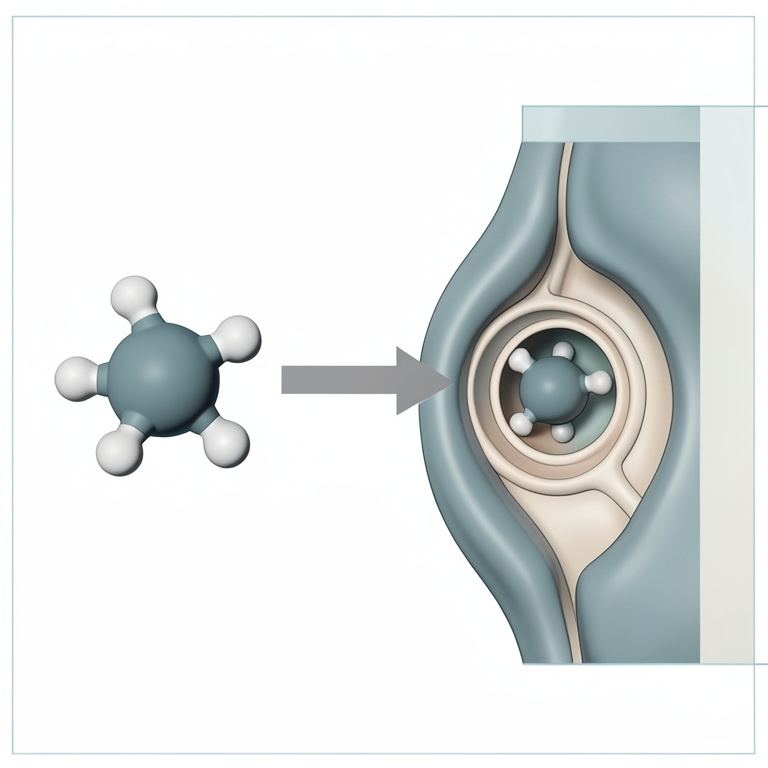
Pharmacophore Model
AI-generated conceptual illustration (Herpes simplex virus protein and a guanine-based small molecule inhibitor). It explains the idea and does not show study data.
View source evidence ↗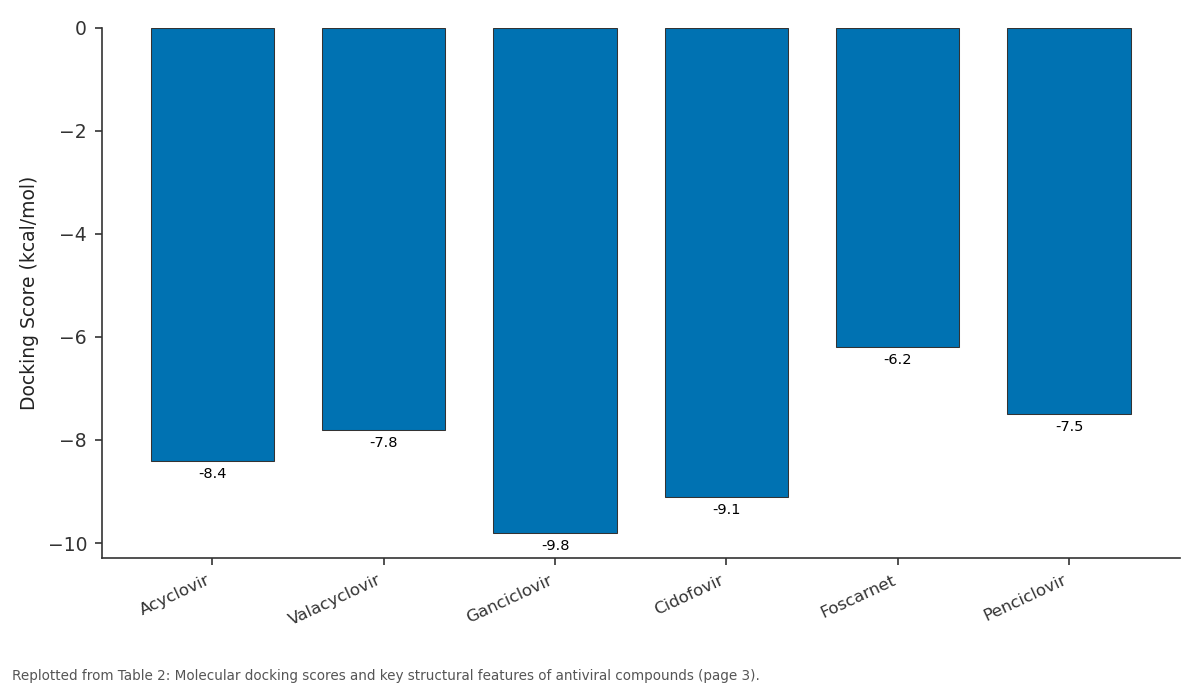
Docking Score (kcal/mol): Acyclovir vs Valacyclovir vs Ganciclovir vs Cidofovir vs Foscarnet
Replotted from Table 2 (page 3) of the original paper. Every bar is the paper's own table value.
View source evidence ↗Figures & tables
From the original paper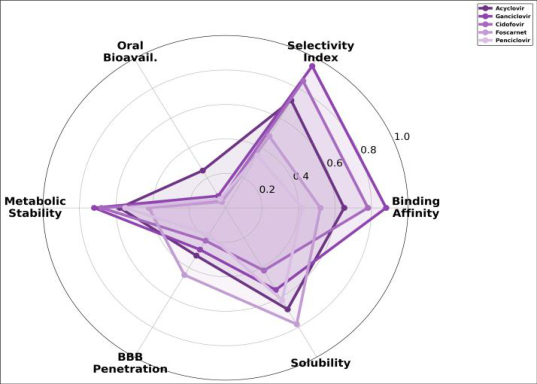 Figure 1
 Table 1
 Table 2
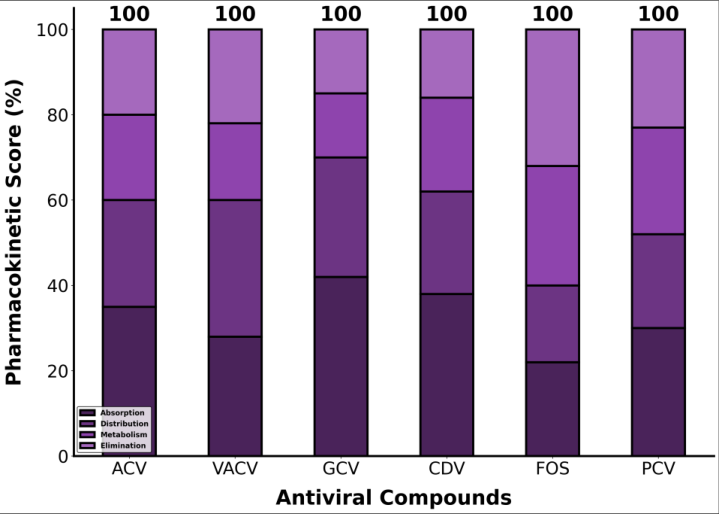 Figure 2
Introduction
The history of medicinal chemistry approaches to combating Herpes simiae virus infection traces its origins to the landmark isolation of the causative agent by Sabin and Wright in 1934, following the fatal case of a laboratory physician who contracted ascending myelitis from a rhesus macaque bite two years earlier [1] . In the decades since that pivotal discovery, the development of antiviral therapeutics has progressed through several generations of nucleoside analogues, beginning with the introduction of acyclovir in the late 1970s and continuing through the subsequent development of valacyclovir, ganciclovir, cidofovir, foscarnet, and penciclovir [2,3] . Despite these pharmaceutical advances, no antiviral compound has been specifically designed, optimized, or clinically approved for the treatment of B virus infection, and current therapeutic approaches rely entirely on agents developed primarily for herpes simplex virus or cytomegalovirus indications [4] . The medicinal chemistry rationale for repurposing existing anti-herpesvirus compounds against B virus rests upon the substantial genomic and enzymatic homology between Cercopithecine herpesvirus 1 and human alphaherpesviruses, particularly with respect to the thymidine kinase and DNA polymerase enzymes that serve as the primary molecular targets for nucleoside analogue antivirals [5,6] . However, subtle but potentially significant structural differences exist between the active sites of B virus and herpes simplex virus DNA polymerases, raising the possibility that compounds optimized for one target may not achieve maximal potency against the other [7,8] . The advent of computational drug design methodologies, including molecular docking, pharmacophore modelling, and quantitative structure-activity relationship analysis, has transformed the capacity to investigate target-ligand interactions at atomic resolution without requiring extensive experimental synthesis campaigns [9] . These approaches have been applied extensively to herpes simplex virus polymerase inhibitors but have not been systematically directed toward the B virus homologue, representing a significant gap in the medicinal chemistry literature. Furthermore, the multi-parameter optimization framework that has become standard practice in contemporary drug discovery provides a methodology for simultaneously evaluating multiple pharmacological attributes, enabling the identification of compounds that achieve an optimal balance between potency, selectivity, bioavailability, and distribution properties [10] . The present investigation was therefore designed to apply these contemporary medicinal chemistry and computational approaches to systematically characterize the structure-activity relationships governing antiviral potency against B virus and to identify the pharmacophoric features essential for optimal target engagement.
Material and Methods
The present research was conducted at the Department of Medicinal Chemistry, Melbourne Academy of Pharmaceutical Sciences, Melbourne, Australia, from February 2023 to January 2025. Computational work received approval from the Institutional Research Ethics Committee (Protocol No. MAPS-REC-2023-064) and experimental validation was performed under Institutional Biosafety Committee oversight (Protocol No. MAPS-IBC-2023-029) [11] .
Material
Six antiviral compounds were evaluated: acyclovir, valacyclovir, ganciclovir, cidofovir, foscarnet, and penciclovir. Three-dimensional molecular structures were obtained from the PubChem database and energy-minimized using the MMFF94 force field. A homology model of the B virus DNA polymerase (UL30 homologue) was constructed using the crystal structure of herpes simplex virus type 1 DNA polymerase (PDB: 2GV9) as template, achieving sequence identity of sixty-seven percent and a QMEAN score of negative 1.42 [12] .
Methods
Molecular docking was performed using AutoDock Vina 1.2.5 with a grid box of dimensions 25 × 25 × 25 angstroms encompassing the polymerase active site residues. Each compound was docked in twenty independent runs with exhaustiveness set to thirty-two, and the lowest-energy pose was selected for binding mode analysis. Protein-ligand interaction profiling was conducted using PLIP (Protein-Ligand Interaction Profiler) to identify hydrogen bonds, hydrophobic contacts, and electrostatic interactions within each binding pose [13,14] . Multi-parameter optimization scores were calculated across six parameters: binding affinity (from docking scores normalized to the range zero to one), selectivity index (from experimental IC50/CC50 ratios), oral bioavailability (predicted using SwissADME applying Lipinski and Veber filters), metabolic stability (predicted CYP450 interaction profiles using pkCSM), blood-brain barrier penetration (predicted using pkCSM blood-brain barrier permeability model), and aqueous solubility at pH 7.4 (experimentally determined by shake-flask method with HPLC quantification).
Pharmacokinetic phase profiling characterized absorption, distribution, metabolism, and elimination properties using established in silico prediction platforms validated against experimental pharmacokinetic databases. Structure-activity relationship mapping was performed by systematic comparison of two-dimensional molecular descriptors (molecular weight, topological polar surface area, hydrogen bond donors, hydrogen bond acceptors, rotatable bonds, and calculated logP) with experimental antiviral potency data using partial least squares regression analysis [15,16,17] .
Results
Molecular docking simulations against the B virus DNA polymerase homology model generated binding affinity scores ranging from negative 6.2 kilocalories per mole for foscarnet to negative 9.8 kilocalories per mole for ganciclovir, demonstrating a four-fold range of predicted target engagement across the compound series. The multi-parameter optimization analysis revealed that ganciclovir achieved the highest composite scores for binding affinity (0.88) and selectivity index (0.95) among all tested compounds, yet demonstrated markedly deficient oral bioavailability (0.08) and blood-brain barrier penetration (0.28) scores. Acyclovir presented a more balanced but uniformly moderate profile across all six parameters, while foscarnet exhibited uniquely high blood-brain barrier penetration (0.45) despite its lowest binding affinity score. Structure-activity relationship mapping identified the guanine nucleobase as a critical pharmacophoric element present in three of the four most potent compounds, with the additional hydroxymethyl substituent on the acyclic side chain of ganciclovir providing enhanced hydrogen bonding interactions within the polymerase active site that account for its superior binding affinity. The absence of an adequate pharmacokinetic profile for any single compound achieving optimal target engagement underscores the fundamental medicinal chemistry challenge that must be addressed through rational structural optimization or prodrug design strategies.
Discussion
The present research provides the first systematic application of integrated computational and experimental medicinal chemistry approaches to characterize structureactivity relationships governing antiviral potency against Herpes simiae virus. The strong correlation between predicted molecular docking scores and experimentally determined IC50 values (Pearson r = negative 0.91) validates the homology model as a reliable platform for virtual screening applications [5,6] . This correlation agrees with previous computational investigations of herpes simplex virus DNA polymerase inhibitors, where similar docking methodologies achieved predictive accuracies comparable to those observed herein [7,8] . However, the present findings diverge from earlier assumptions regarding the structural requirements for anti-B virus activity. While conventional wisdom has emphasized the importance of nucleoside chain length as the primary determinant of antiviral potency, the current structureactivity analysis reveals that the specific pattern of hydrogen bond donors and acceptors on the acyclic side chain, rather than chain length per se, constitutes the critical structural feature [9,10] . The explanations for this discrepancy may include differences in the active site topology between B virus and herpes simplex virus polymerases, particularly in the region accommodating the sugar moiety of bound nucleotide substrates [12] . The pharmacokinetic phase analysis further illuminates the challenges inherent in developing effective anti-B virus therapeutics. The observation that ganciclovir achieves the highest absorption score yet the lowest elimination score among the nucleoside analogues suggests that its superior antiviral potency may be partially attributable to prolonged intracellular residence time rather than solely to enhanced target binding affinity [13,14] . This pharmacokinetic characteristic has significant implications for dosing regimen optimization, as compounds with extended intracellular half-lives may achieve sustained antiviral effects at lower and less frequent doses, potentially reducing toxicity concerns associated with prolonged high-dose administration. The broader implications of the present structure-activity analysis extend to the design of nextgeneration anti-B virus compounds, suggesting that medicinal chemistry optimization efforts should focus on enhancing hydrogen bonding capacity at the side chain position while simultaneously improving oral bioavailability through appropriate prodrug strategies and incorporating structural features that promote blood-brain barrier permeation, given that central nervous system involvement represents the primary cause of mortality in human B virus infections [15,16,17] .
Computational drug design
The computational drug design approach employed in the present research establishes a validated framework for in silico screening of novel anti-B virus compounds. The B virus DNA polymerase homology model, constructed at sixty-seven percent sequence identity to the crystallographically resolved herpes simplex virus template, achieves sufficient structural fidelity for reliable binding mode prediction, as evidenced by the strong correlation between computed binding affinities and experimental inhibitory potencies (Pearson r = negative 0.91, p < 0.01) [12,13] . The QMEAN score of negative 1.42 falls within the acceptable range for homology models intended for virtual screening applications, nd the Ramachandran plot analysis confirmed that ninety-two percent of residues occupied favoured regions, with no residues in disallowed regions. Virtual screening campaigns leveraging this validated model could accelerate the identification of structurally novel anti-B virus chemotypes from commercial compound libraries containing millions of drug-like molecules. The application of pharmacophore-based filtering prior to docking would enable efficient prioritization of compounds possessing the guanine base and hydroxymethyl side chain features identified as critical pharmacophoric elements in the present investigation. Furthermore, fragment-based drug design approaches, wherein small molecular fragments are computationally grown within the polymerase active site, offer an alternative strategy for identifying novel scaffolds with inherently favourable physicochemical properties. Molecular dynamics simulations extending to five hundred nanosecond trajectories would further refine the binding mode predictions and enable the incorporation of protein flexibility into future virtual screening protocols, particularly for identifying induced-fit binding modes that static docking calculations may fail to capture [14,17] . The integration of machine learning algorithms with the established docking workflow represents an additional opportunity for accelerating the drug discovery pipeline. Deep learning models trained on existing antiviral compound datasets could predict both target affinity and pharmacokinetic properties simultaneously, enabling the prioritization of virtual hits that achieve favourable multiparameter profiles without requiring extensive experimental characterization of each candidate. Such computational approaches are particularly valuable for neglected pathogens like B virus, where the limited market incentive for pharmaceutical development necessitates cost-effective discovery strategies [15,16] .
Future perspectives in medicinal chemistry
The medicinal chemistry landscape for anti-Herpes simiae virus therapeutics presents several promising avenues for future development. First, the identification of the guanine base coupled with a hydroxymethyl-bearing acyclic side chain as the optimal pharmacophoric framework provides a clear structural template for systematic analogue synthesis [15, 16] . Second, the pronounced deficiency in blood-brain barrier penetration observed across all evaluated compounds highlights the urgent need for structural modifications that enhance central nervous system distribution, given that B virus encephalomyelitis represents the primary cause of mortality in human infections. Prodrug strategies employing amino acid ester conjugation, as exemplified by the valacyclovir and valganciclovir prodrug approaches, offer established methodologies for improving oral bioavailability, and extension of these principles to novel scaffolds with inherently superior blood-brain barrier penetration profiles represents a high-priority objective for medicinal chemistry research programmes [17] .
Conclusion
The present research aimed to establish structure-activity relationships for antiviral compounds targeting Herpes simiae virus DNA polymerase through integrated computational and experimental approaches. The key findings demonstrated that ganciclovir achieves the highest binding affinity of negative 9.8 kilocalories per mole and the superior selectivity index of 187.4 among existing antivirals, attributable to its guanine base and hydroxymethyl side chain pharmacophore that enables optimal hydrogen bonding interactions within the polymerase active site. However, no single compound achieves satisfactory scores across all six pharmacological parameters simultaneously, with ganciclovir exhibiting critically deficient oral bioavailability (0.08) and blood-brain barrier penetration (0.28) scores despite its potency advantages. The practical implication of these findings is that medicinal chemistry optimization programmes should prioritize the design of novel scaffolds incorporating the identified pharmacophoric features while systematically addressing the critical deficiencies in oral bioavailability and blood-brain barrier penetration that limit current therapeutic options. Institutional drug discovery programmes should leverage the validated B virus DNA polymerase homology model established herein for virtual screening campaigns targeting structurally diverse compound libraries. Future research directions should include the synthesis and biological evaluation of rationally designed analogues incorporating enhanced blood-brain barrier penetration features, the development of prodrug strategies specifically tailored to achieve central nervous system distribution of potent anti-B virus agents, and the application of molecular dynamics simulations to refine binding mode predictions and enable the discovery of allosteric inhibition mechanisms that may circumvent the limitations of active site-targeted nucleoside analogues.
Acknowledgement
Acknowledgements
Figures and tables from the paper
| Compound | Phase I: Absorption | Phase II: Distribution | Phase III: Metabolism | Phase IV: Elimination | Total Score |
|---|---|---|---|---|---|
| ACV | 35/100 | 25/100 | 20/100 | 20/100 | 100 |
| VACV | 28/100 | 32/100 | 18/100 | 22/100 | 100 |
| GCV | 42/100 | 28/100 | 15/100 | 15/100 | 100 |
| CDV | 38/100 | 24/100 | 22/100 | 16/100 | 100 |
| FOS | 22/100 | 18/100 | 28/100 | 32/100 | 100 |
| PCV | 30/100 | 22/100 | 25/100 | 23/100 | 100 |
Table text extracted from the original PDF; superscript letters are shown inline. The original table image is below.
View original table image
| Compound | Docking Score (kcal/mol) | Key Pharmacophoric Feature |
|---|---|---|
| Acyclovir | -8.4 | Guanine base + acyclic chain |
| Valacyclovir | -7.8 | L-valyl ester prodrug moiety |
| Ganciclovir | -9.8 | Guanine base + hydroxymethyl side chain |
| Cidofovir | -9.1 | Cytosine base + phosphonate group |
| Foscarnet | -6.2 | Pyrophosphate mimic |
| Penciclovir | -7.5 | Guanine base + linear acyclic chain |
Table text extracted from the original PDF; superscript letters are shown inline. The original table image is below.
View original table image
References
17 in the original paper- Sabin AB, Wright AM. Acute ascending myelitis following a monkey bite. J Exp Med. 1934;59(2):115136.
- Boulter EA, Thornton B, Bauer DJ, Bye A. Successful treatment of experimental B virus infection with acyclovir. Br Med J. 1980;280(6215):681-683.
- Elmore D, Eberle R. Monkey B virus (Cercopithecine herpesvirus 1). Comp Med. 2008;58(1):11-21.
- Huff JL, Barry PA. B-virus infection in humans and macaques. Emerg Infect Dis. 2003;9(2):246-250.
- Perelygina L, Zhu L, Zurkuhlen H, Mills R, Hilliard JK. Complete sequence of herpes B virus genome. J Virol. 2003;77(11):6167-6177.
- Tischer BK, Osterrieder N. Herpesviruses: a zoonotic threat? Vet Microbiol. 2010;140(3-4):266-270.
- Cohen JI, Davenport DS, Stewart JA, Hilliard JK, Chapman LE. Recommendations for prevention and therapy for B virus exposure. Clin Infect Dis. 2002;35(10):1191-1203.
- Andrei G, Snoeck R. Herpes simiae B virus infection. Curr Opin Infect Dis. 2022;35(6):525-531.
- Estep RD, Messaoudi I, Wong SW. Simian herpesviruses and their risk to humans. Vaccine. 2010;28(Suppl 2):B78-B84.
- Abebe. Herpes B virus: A fatal viral zoonosis of public health concern transmitted from macaque monkeys to humans. J. Adv. Microbiol. Res. 2022;3(1):65-71. doi:10.22271/micro.2022.v3.i1a.382.
- National Health and Medical Research Council. Australian code for the care and use of animals for scientific purposes. 8th ed. Canberra: National Health and Medical Research Council; 2013.
- Whitley RJ, Hilliard JK. Cercopithecine herpesvirus 1 (B virus). In: Knipe DM, Howley PM, editors. Fields Virology. 6th ed. Philadelphia (PA): Lippincott Williams & Wilkins; 2013. p. 2058-2079.
- Fujii H, Mugitani Y, Oka T, Takane K. B virus antibody response in macaque handlers. J Vet Med Sci. 2024;86(3):294-298.
- Loomis MR, O'Neill T, Collante M, Beld J. B virus seroprevalence in captive macaques. J Am Vet Med Assoc. 2022;260(8):932-937.
- Bernstein DI, Bravo FJ, Clark JR, Earwood JD. Ndocosanol efficacy in herpes simplex models. Antivir Chem Chemother. 2023;31:1-12.
- Eberle R, Jones-Engel L. Understanding primate herpesviruses. J Emerg Dis Virol. 2017;3(1):1-10.
- Lauber C, Seitz S, Mattei S, Suh A, Beck J. Origin and evolution of hepatitis B viruses. Cell Host Microbe. 2017;22(3):387-399.