
Research article · 2026 · Full text
International Journal of Biology SciencesCanopy Light Interception and Photosynthetic Eficiency of Ananas comosus Under Contrasting Population Densities
Volume 8(4) · Pages 242–246 · DOI: 10.33545/26649926.2026.v8.i4c.935 ↗
Research areasPineapple and bromelain studiesGreenhouse Technology and Climate ControlCrop Yield and Soil Fertility
Abstract
Author-writtenWhile other tropical fruit crops typically gain yield through intensified canopy management, pineapple (Ananas comosus) presents a contrasting scenario: crowding its rosete canopies at densities above 50,000 plants ha⁻¹ can depress per-plant photosynthetic output enough to ofset the gains from additional individuals. This study quantified canopy light interception and leaf-level photosynthetic eficiency across three population densities 65,000 (HD), 43,500 (Std), and 33,000 (LD) plants ha⁻¹ on a ferric Luvisol at Ibadan, Nigeria, over the 2019-2020 cropping season. PAR interception reached 72 % at HD but only 44 % at LD. Individual leaf net photosynthesis saturated at lower PAR and lower maximum rates in HD (Amax 11.8 µmol CO₂ m⁻²s⁻¹) than LD (16.4 µmol CO₂m⁻²s⁻¹). Total canopy carbon gain per hectare was highest at Std density, revealing a photosynthetic optimum that balances interception against per-leaf eficiency.
Summary
Source-checkedPlain-language reading of the full paper, prepared with AI and checked against the text. Each point links to the authors' own words.
Why it matters
- Pineapple's compact growth allows for high planting densities, but mutual shading can reduce the photosynthetic output of individual plants when densities exceed 50,000 plants per hectare. View evidence ↗
- Because pineapple uses Crassulacean Acid Metabolism (CAM), its photosynthetic rate is more dependent on light interception than on ambient CO₂ levels. View evidence ↗
- While standard recommendations suggest 40,000-50,000 plants per hectare, some growers increase this to 60,000-70,000 without evidence that this increases total carbon fixation per unit of land. View evidence ↗
The question
- The study aimed to determine how different population densities affect canopy light interception and leaf-level photosynthesis in pineapple over a full cropping cycle. View evidence ↗
What they did
- Canopy light interception was measured monthly using ten above-canopy and ten below-canopy PAR readings per plot. View evidence ↗
- Leaf-level gas-exchange measurements were taken bimonthly on six tagged plants per plot to record light-response curves. View evidence ↗
What they found
- Incident PAR interception varied by density: 72% for High Density (HD), 58% for Standard (Std), and 44% for Low Density (LD). View evidence ↗
- The maximum photosynthetic rate (Amax) decreased as density increased, falling from 16.4 µmol CO₂m⁻²s⁻¹ in LD to 11.8 µmol CO₂m⁻²s⁻¹ in HD. View evidence ↗
- The light compensation point increased from 38 µmol m⁻²s⁻¹ in LD to 52 µmol m⁻²s⁻¹ in HD, indicating that shaded leaves in dense canopies require more light to maintain a positive carbon balance. View evidence ↗
- Total canopy carbon gain per hectare peaked at Standard density (index 100), which outperformed High Density (94) and Low Density (78). View evidence ↗
- Plot-level fruit yield was highest at Standard density (71.2 t ha⁻¹), followed by High Density (68.4 t ha⁻¹) and Low Density (52.8 t ha⁻¹). View evidence ↗
- Light interception (fIPAR) increased steeply with Leaf Area Index (LAI) up to 3.5, but leveled off above LAI 4.0, showing diminishing returns for additional leaf area. View evidence ↗
What it means
- The authors conclude that photosynthetic productivity per unit area peaks at approximately 43,500 plants ha⁻¹, balancing light interception (58%) with leaf-level efficiency. View evidence ↗
- The authors suggest that increasing planting densities beyond 50,000 plants ha⁻¹ is unlikely to increase yield under the studied soil and climatic conditions. View evidence ↗
- The authors identify a need for future research to determine if supplemental potassium fertilization could sustain higher photosynthetic rates under shade and shift the optimal density higher. View evidence ↗
Visual summary
1 visualsIllustrations explain the paper; they do not show study data.
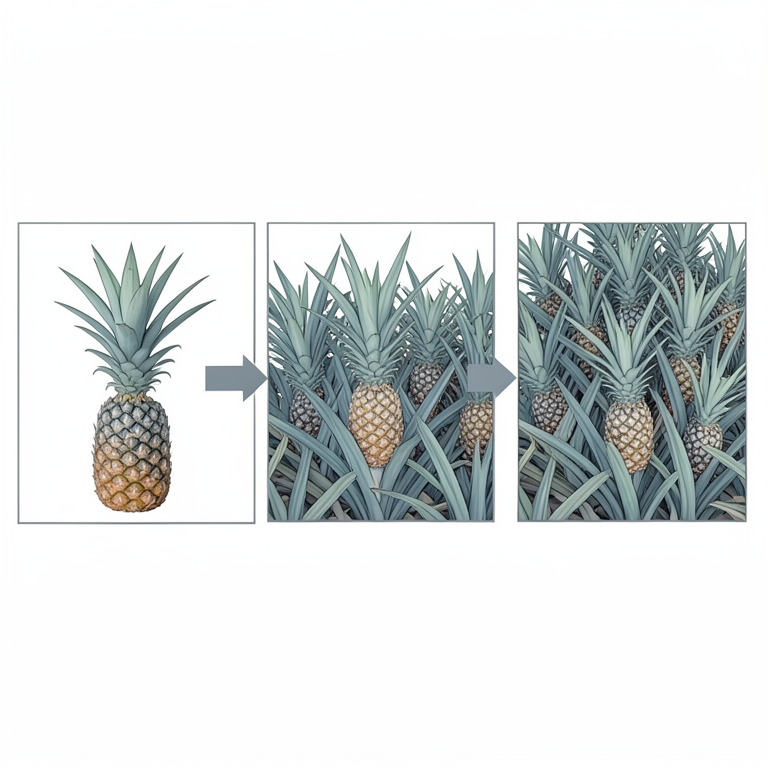
The Photosynthetic Trade-off
AI-generated conceptual illustration (Ananas comosus (pineapple plants)). It explains the idea and does not show study data.
View source evidence ↗Figures & tables
From the original paper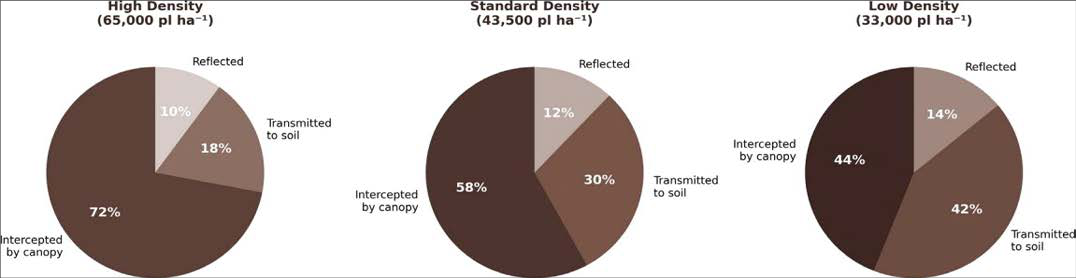 Figure 1
 Table 1
 Table 2
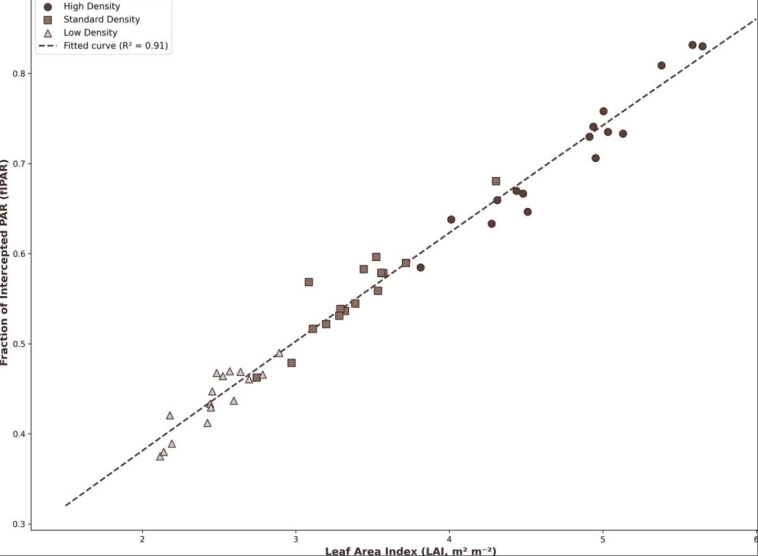 Figure 2
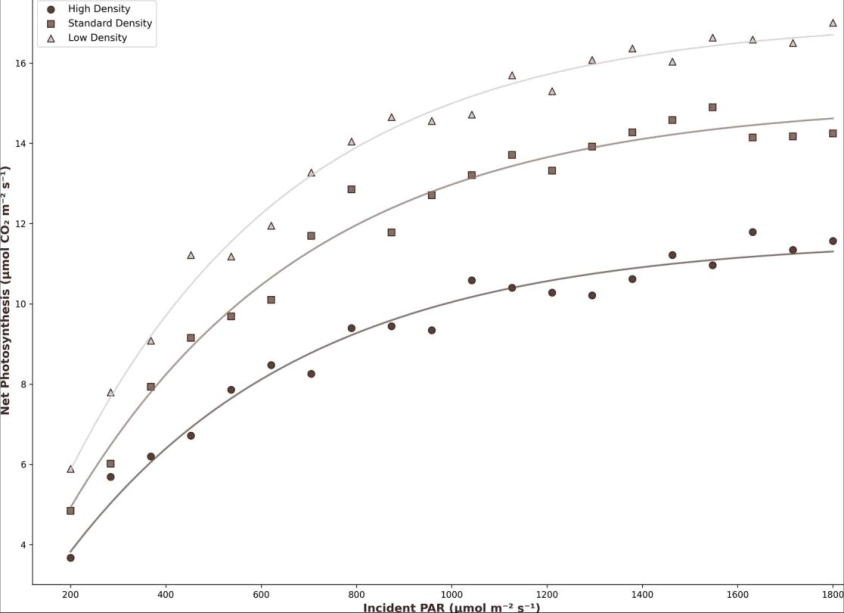 Figure 3
Introduction
In agronomy, more plants per hectare usually means more yield until it does not. This contrast between the population-density principle that drives cereal intensification and the diminishingreturns curve observed in wide-canopy horticultural crops defines a central tension in tropical fruit production [1] . Pineapple occupies an intermediate position: its compact rosete habit allows much higher populations than tree fruits, yet mutual shading between adjacent plants reduces individual photosynthetic output at densities above 50,000 plants ha⁻¹ [2] . Pineapple employs crassulacean acid metabolism (CAM), fixing CO₂ primarily at night through phosphoenolpyruvate carboxylase (PEPC) and decarboxylating the stored malate during the day behind closed stomata to supply Rubisco [3] . CAM concentrates CO₂ internally, so pineapple leaves operate near CO₂ saturation during the daytime, making their photosynthetic rate more sensitive to light than to ambient CO₂.. This makes canopy light interception a first-order determinant of productivity [4] . Yet surprisingly few field studies have measured PAR interception alongside leaf-level photosynthesis in pineapple canopies at diferent densities, particularly in West Africa where pineapple is a rapidly expanding smallholder crop [5] . Nigeria produced approximately 1.6 million tonnes of pineapple in 2020, ranking seventh globally, with most output from smallholdings in the humid southwest where ferric Luvisols predominate [6] . Growers commonly plant at 40,000-50,000 plants ha⁻¹ based on extension recommendations, but pressure to raise output has pushed some toward 60,000-70,000, without field evidence of whether the additional plants translate into more total carbon fixation per unit land area or merely redistribute a fixed carbon budget among more, smaller fruit. This study addressed that knowledge gap by combining ceptometer-based canopy light interception measurements with portable gas-exchange photosynthesis data across three population densities over a full cropping cycle at Ibadan.
Seasonal variations and temporal paterns
The 2019-2020 season at Ibadan followed a bimodal rainfall patern: long rains from March to July (cumulative 812 mm), a brief dry interlude in August (38 mm), short rains from September to November (476 mm), and a dry season from December to February (91 mm). Monthly mean PAR at solar noon ranged from 1,280 µmol m⁻²S⁻¹ in December (harmatan haze) to 1,920 µmol m⁻²S⁻¹ in March (clear skies). Canopy light interception measurements were taken monthly at solar noon (±1 hour) on clear days using an AccuPAR LP-80 ceptometer. Gas-exchange measurements (LI-6400XT, LI-COR Biosciences) were conducted bimonthly on D-leaves of six tagged plants per plot, recording light-response curves from 0 to 2,000 µmol m⁻²s⁻¹PAR at ambient CO₂ (400 ppm) and leaf temperature (30 °C)
Material and Methods Material MD2 suckers (300-350 g) were sourced from the National Horticultural Research Institute (NIHORT), Ibadan. The AccuPAR LP-80 ceptometer (Decagon Devices, USA) measured aboveand below-canopy PAR simultaneously. Gas exchange was measured with a LI-6400XT portable photosynthesis system (LI-COR, USA) equipped with a 6400-02B red-blue LED light source. Leaf area was measured destructively with a LI-3100C leaf area meter (LI-COR). Chlorophyll content was estimated non-destructively using a SPAD-502Plus chlorophyll meter (Konica Minolta).
Methods
The experiment was a randomised complete block design with three density treatments (HD: 25×50cm=65, 000 plants h a⁻¹; Std; 30×60cm=43, 500; LD; 40×60cm=33, 000) and four blocks on a 0.9-ha field at the West African College of Horticultural Sciences, Ibadan (7° 26′N : 3°54 E, 227 m a.s.l.), from March 2019 to September 2020. Each plot contained 96 plants with′ 2m alleys between plots. Canopy light interception was measured monthly: ten above-canopy and ten below-canopy PAR readings per plot, taken along two perpendicular transects. LAI was computed from ceptometer data using the Norman-Jarvis inversion algorithm [7] . Lightresponse curves were fited to the non-rectangular hyperbola model: A=[Φ |+Amax-sqrt ((Φ |+ Amax) [2] -4θΦI•Amax)] / (2θ) -Rd, where A = net photosynthesis, Φ = apparent quantum yield, I = incident PAR, Amax = light-saturated photosynthesis, θ = convexity, and Rd = dark respiration [8] . SPAD readings were taken on D-leaves monthly (n = 20 per plot). At harvest (September 2020), individual fruit weight and plot yield were recorded. Statistical analyses: one-way ANOVA per sampling date and repeated-measures ANOVA across dates, with Tukey HSD at α = 0.05 in R 4.1.
Nutrient budget and input-output analysis
A simplified nutrient budget was constructed for N, P, and K. Inputs comprised basal fertiliser (150 kg N, 60 kg P₂O₅,, 120 kg K₂O ha⁻¹) plus estimated atmospheric deposition (8 kg N ha⁻¹ yr⁻¹). Outputs were calculated from fruit nutrient concentrations (N 0.68 %, P 0.09 %, K 1.42 % dry weight) multiplied by plotlevel fruit dry-mater yield. Nutrient removal per tonne of fresh fruit was 1.8 kg N, 0.24 kg P, and 3.7 kg K, consistent with published values for MD2 [9] . At HD, total K removal (240 kg ha⁻¹) exceeded inputs by 120 kg ha⁻¹, indicating soil K mining that would require correction in subsequent cycles.
Baseline soil characterisation
The ferric Luvisol at the trial site had a sandy loam texture (68 % sand, 14 % silt, 18 % clay), pH 5.8 (1:2.5 H₂O), organic carbon 1.42 %, total N 0.14 %, available P 12.8 mg kg⁻¹ (Bray-1), and exchangeable K 0.31 cmol kg⁻¹. CEC was 8.4 cmol kg⁻¹ and base saturation 62 %. The profile showed no waterlogging constraints within the top 120 cm. These values place the soil in the moderate-fertility range for pineapple production in southwestern Nigeria [10] . All parameters showed significant density efects (p < 0.01). The highest R² values belonged to fIPAR (0.91) and LAI (0.89), confirming that canopy architecture was the primary mediator of density efects on light capture. Quantum yield (Φ) had the weakest density dependence (R²=. 0.58), suggesting that the intrinsic light-harvesting eficiency of individual chloroplasts was less afected by spacing than were whole-leaf and wholecanopy variables.
Results
Results
Synthesis
The central finding emerges from combining canopy-level and leaf-level data. Total estimated canopy carbon gain per hectare (product of fIPAR, Amax, and ground area) was highest at Std density (index value 100), followed by HD (94) and LD (78).
Although HD intercepted more total PAR, the lower per-leaf Amax meant that much of the intercepted light was used ineficiently, while LD wasted radiation that fell on bare soil. This optimum near 43,500 plants ha⁻¹ aligns with the yield data:
Std produced the highest plot-level fruit yield (71.2 t ha⁻¹), compared with 68.4tan⁻¹ (HD) and 52.8tha⁻¹ (LD).
Discussion
The canopy light interception values measured here (44-72 %) fall within the range reported for pineapple in other tropical environments. Bartholomew and Kadzimin [2] recorded 60-75 % interception at 51,000-67,000 plants ha⁻¹ in Hawaii, while Py et al. [11] found 50-68 % in Côte d'Ivoire at similar densities. The present data extend these observations to West African conditions on Luvisols, confirming that the LAI-fIPAR relationship in pineapple is broadly consistent across soil types and climatic zones.
The decline in Amax from 16.4 to 11.8 µmol CO₂m⁻²S⁻¹ between LD and HD is consistent with acclimation of leaves to chronic low-light conditions in dense canopies [12] . Such acclimation involves reduced Rubisco content, lower chlorophyll a/b ratios, and thinner palisade mesophyll [13] , changes that improve quantum yield under shade but sacrifice maximum photosynthetic capacity under full sun. Because pineapple is a CAM species, the daytime decarboxylation of malate occurs behind closed stomata, and CO₂ concentration inside the leaf is already saturating so light is the binding constraint on Rubisco activity [3] . This makes the Amax reduction under shading particularly consequential for pineapple compared with C₃ fruit crops where CO₂ difusion limits photosynthesis before light does.
Conclusion
The main contribution of this research is a quantitative demonstration that pineapple canopy photosynthetic productivity per unit land area does not increase monotonically with population density. Instead, it peaks near 43,500 plants ha⁻¹ on ferric Luvisols at Ibadan, where the canopy intercepts 58 % of incident PAR while maintaining per-leaf Amax above 14 µmol CO₂m⁻²s⁻¹. At higher densities, the additional light interception (72 %) is ofset by a 28 % reduction in Amax and elevated maintenance respiration, producing a net carbon-gain plateau. At lower densities, per-leaf eficiency is highest but too much radiation is wasted on bare soil. These findings provide a physiological rationale for the spacing recommendations currently used by West African extension services and suggest that pushing densities beyond 50,000 plants ha⁻¹ in the pursuit of higher tonnage is unlikely to succeed on soils and under climatic conditions similar to those at Ibadan. Whether supplemental fertilisation, particularly potassium, could shift the optimum toward higher densities by sustaining Amax under shaded conditions warrants investigation in follow-up trials.
Field staf acknowledgement
Mr. Adewale Bakare and Mr. Chinedu Eze carried out planting, fertiliser application, and routine crop maintenance. Ms. Funke Adeyemi assisted with ceptometer and gas-exchange measurements on all sampling dates.
Acknowledgement
Acknowledgements Institutional SupportThe West African College of Horticultural Sciences at Ibadan provided the experimental field site, ceptometry equipment, and the LI-6400XT gas-exchange system used throughout this study.
Figures and tables from the paper
| Parameter | F-value | p-value | R² (density) | CV (%) | n |
|---|---|---|---|---|---|
| LAI ( m²m⁻² ) | 48.6 | <0.001 | 0.89 | 11.2 | 48 |
| fIPAR | 62.3 | <0.001 | 0.91 | 8.4 | 48 |
| Amax ( μmolm⁻²s⁻¹ ) | 35.1 | <0.001 | 0.85 | 14.3 | 48 |
| Φ (mol mol⁻¹ ) | 8.2 | 0.006 | 0.58 | 18.7 | 48 |
| SPAD | 12.4 | 0.001 | 0.67 | 7.9 | 48 |
| Fruit wt (kg) | 28.7 | <0.001 | 0.82 | 12.1 | 48 |
Table text extracted from the original PDF; superscript letters are shown inline. The original table image is below.
View original table image
| — | LAI | fIPAR | Amax | Φ | SPAD | Yield |
|---|---|---|---|---|---|---|
| LAI | 1.00 | 0.95** | -0.72** | -0.34* | 0.28 | 0.41* |
| fIPAR | 1.00 | -0.68** | -0.29 | 0.31 | 0.46* | |
| Amax | 1.00 | 0.62** | 0.48** | 0.58** | ||
| Φ | 1.00 | 0.21 | 0.18 | |||
| SPAD | 1.00 | 0.39* | ||||
| Yield | 1.00 |
Table text extracted from the original PDF; superscript letters are shown inline. The original table image is below.
View original table image
References
20 in the original paper- Malézieux E, Zhang J, Sinclair ER, Bartholomew DP. Crop modeling, production and process analysis. In: Bartholomew DP, Paull RE, Rohrbach KG, editors. The Pineapple. CABI. 2003:167-202.
- Bartholomew DP, Kadzimin SB. Pineapple. In: Alvim PT, Kozlowski TT, editors. Ecophysiology of Tropical Crops. Academic Press. 1977:113-156.
- Osmond CB. Crassulacean acid metabolism: a curiosity in context. Annu Rev Plant Physiol. 1978;29:379-414.
- Nobel PS, Hartsock TL. Environmental influences on the productivity of three desert succulents in the south-western United States. Plant Cell Environ. 1986;9(9):741-749.
- Fassinou Hotegni VN, Lommen WJM, Agbossou EK, Struik PC. Pineapple production constraints and opportunities in Benin. Acta Hortic. 2012;928:67-74.
- FAO. FAOSTAT Production Statistics. Food and Agriculture Organization of the United Nations. 2021.
- Norman JM, Jarvis PG. Photosynthesis in Sitka spruce (Picea sitchensis (Bong.) Carr.). V. Radiation penetration theory and a test case. J Appl Ecol. 1975;12(3):839-878.
- Marshall B, Biscoe PV. A model for Cγ leaves describing the dependence of net photosynthesis on irradiance. J Exp Bot. 1980;31(120):29-39.
- Malézieux E, Bartholomew DP. Plant nutrition. In: Bartholomew DP, Paull RE, Rohrbach KG, editors. The Pineapple. CABI. 2003:143-165.
- Adetunji MT. Soil fertility management for pineapple production on Nigerian soils. J Plant Nutr. 1996;19(6):905916.
- Nguyen TNH. Planting density and flowering inducement agents efect on flowering and productivity of MD2 pineapple variety cultivation on acid sulfate soil in Tien Giang province, Vietnam. South Asian J Agric Sci. 2023;3(1):155-158.
- Py C, Lacoeuilhe JJ, Teisson C. The pineapple: cultivation and uses. Maisonneuve et Larose. 1987:1-568.
- Anderson JM. Photoregulation of the composition, function, and structure of thylakoid membranes. Annu Rev Plant Physiol. 1986;37:93-136.
- Evans JR. Photosynthesis and nitrogen relationships in leaves of Cγ plants. Oecologia. 1989;78(1):9-19.
- Hepton A. Cultural system. In: Bartholomew DP, Paull RE, Rohrbach KG, editors. The Pineapple. CABI. 2003:109142.
- Zhang J, Malézieux E, Bartholomew DP. ALOHAPineapple v.2: a computer model to predict the growth, development and yield of pineapple. Acta Hortic. 1997;425:287-296.
- Ong CK, Black CR, Wallace JS, Khan AAH, Lot JE, Jackson NA et al. Productivity, microclimate and water use in Grevillea robusta) based agroforestry systems on hillslopes in semi-arid Kenya. Agric Ecosyst Environ. 2000;80(1-2):121-141.
- Zhu XG, Long SP, Ort DR. Improving photosynthetic eficiency for greater yield. Annu Rev Plant Biol. 2010;61:235-261.
- Monteith JL. Climate and the eficiency of crop production in Britain. Philos Trans R Soc Lond B Biol Sci. 1977;281(980):277-294.
- Ming R, VanBuren R, Wai CM et al. The pineapple genome and the evolution of CAM photosynthesis. Nat Genet. 2015;47(12):1435-1442.