
Research article · 2026 · Full text
International Journal of Horticulture and Food ScienceEnhancing productivity, quality, and profitability of spring-planted sugarcane (Saccharum officinarum L.) through integrated nutrient and weed management
Volume 8(7) · Pages 45–48 · DOI: 10.33545/26631067.2026.v8.i7a.796 ↗
Research areasWeed Control and Herbicide ApplicationsSugarcane Cultivation and ProcessingAgricultural Science and Fertilization
Abstract
Author-writtenA field experiment was conducted during the spring season of 2024-25 at GSDN College, Parikshitgarh, Meerut, Uttar Pradesh, to evaluate the interactive effects of fertilizer levels and weed-control options on the growth, yield, juice quality, and economics of spring-planted sugarcane. The trial was executed using a Factorial Randomized Block Design replicated thrice, testing three fertility doses (75%, 100%, and 125% of RDF) against seven weed-management strategies. The application of 125% RDF (F3) registered the highest cane yield (109.29 t/ha) and CCS yield (13.99 t/ha), over 75% RDF (F1) (80.26 t/ha; 8.83 t/ha). Among weed-control regimes, the weed-free check (W6) achieved maximum cane yield (116.88 t/ha) and sugar output (14.70 t/ha). However, the integrated approach consisting of directed post-emergence application of glyphosate @ 1.0 kg a.i./ha using shielded/hooded sprayer at 25 DAP followed by one hand weeding at 60 DAP (W4) produced statistically comparable cane yield (110.98 t/ha) and CCS yield (13.78 t/ha). Weedy check (W7) caused 41.6% yield decline compared to weed-free plots. Combining 125% RDF with directed glyphosate + hand weeding (F3 + W4) is recommended as most productive and remunerative option.
Summary
Source-checkedPlain-language reading of the full paper, prepared with AI and checked against the text. Each point links to the authors' own words.
Why it matters
- Sugarcane is a vital part of India's agricultural economy, supporting millions of rural households and providing raw materials for sugar, jaggery, and biofuels. View evidence ↗
- The gap between actual and potential sugarcane yields is largely caused by poor nutrient management and insufficient weed control during early growth. View evidence ↗
- Spring-planted sugarcane is particularly vulnerable because it germinates slowly and has wide row spacing, leaving the field open to stresses. View evidence ↗
The question
- The study aimed to evaluate how various fertilizer levels and weed-control methods interact to affect the growth, yield, sugar quality, and profit of spring-planted sugarcane. View evidence ↗
What they did
- The research was a field experiment conducted during the 2024-25 spring season in Meerut, Uttar Pradesh. View evidence ↗
- One of the key weed management strategies (W4) involved applying 1.0 kg a.i./ha of glyphosate at 25 days after planting, followed by hand weeding at 60 days. View evidence ↗
What they found
- The 125% RDF treatment produced the highest commercial cane sugar (CCS) yield at 13.99 t/ha, compared to 8.83 t/ha for the 75% RDF treatment. View evidence ↗
- The highest absolute cane yield of 116.88 t/ha was achieved in the weed-free check (W6) plots. View evidence ↗
- The integrated glyphosate and hand-weeding approach (W4) yielded 110.98 t/ha, which was statistically similar to the weed-free check. View evidence ↗
- Uncontrolled weeds (W7) caused a 41.6% reduction in cane yield compared to weed-free plots, with yields dropping to 68.23 t/ha. View evidence ↗
- The 125% RDF treatment maximized growth metrics, including cane length (297.4 cm), girth (2.60 cm), internodes (23.20), and single cane weight (1020.5 g). View evidence ↗
What it means
- The authors recommend combining 125% RDF with the integrated glyphosate and hand-weeding strategy (F3 + W4) as the most practical and profitable option. View evidence ↗
- While weed-free plots had the highest yield, the high cost of manual labor makes this approach less financially viable than integrated methods. View evidence ↗
Visual summary
3 visualsIllustrations explain the paper; charts are replotted from the paper's own table values.
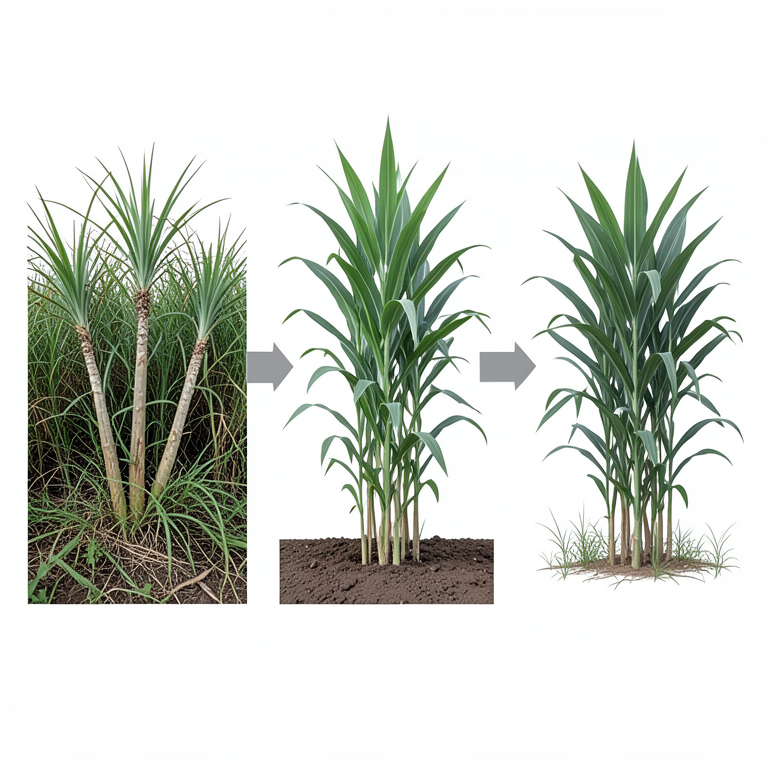
Comparison of Weed Management Strategies
AI-generated conceptual illustration (spring-planted sugarcane (Saccharum officinarum L.)). It explains the idea and does not show study data.
View source evidence ↗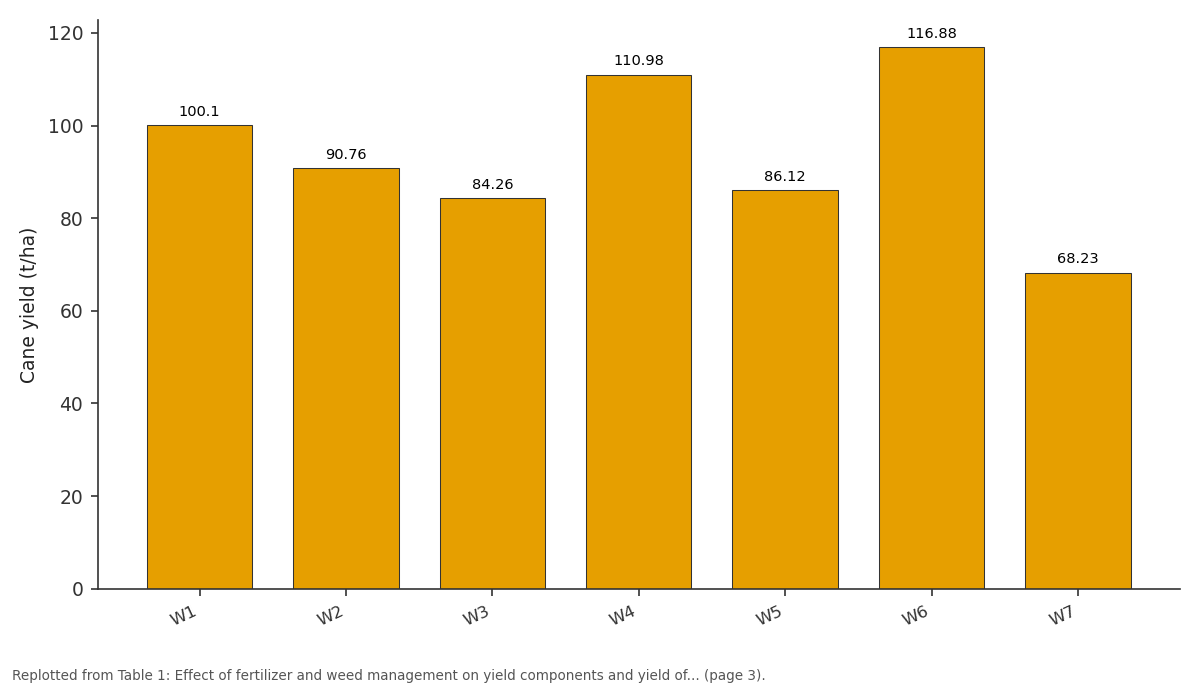
Cane yield (t/ha): W1 vs W2 vs W3 vs W4 vs W5
Replotted from Table 1 (page 3) of the original paper. Every bar is the paper's own table value.
View source evidence ↗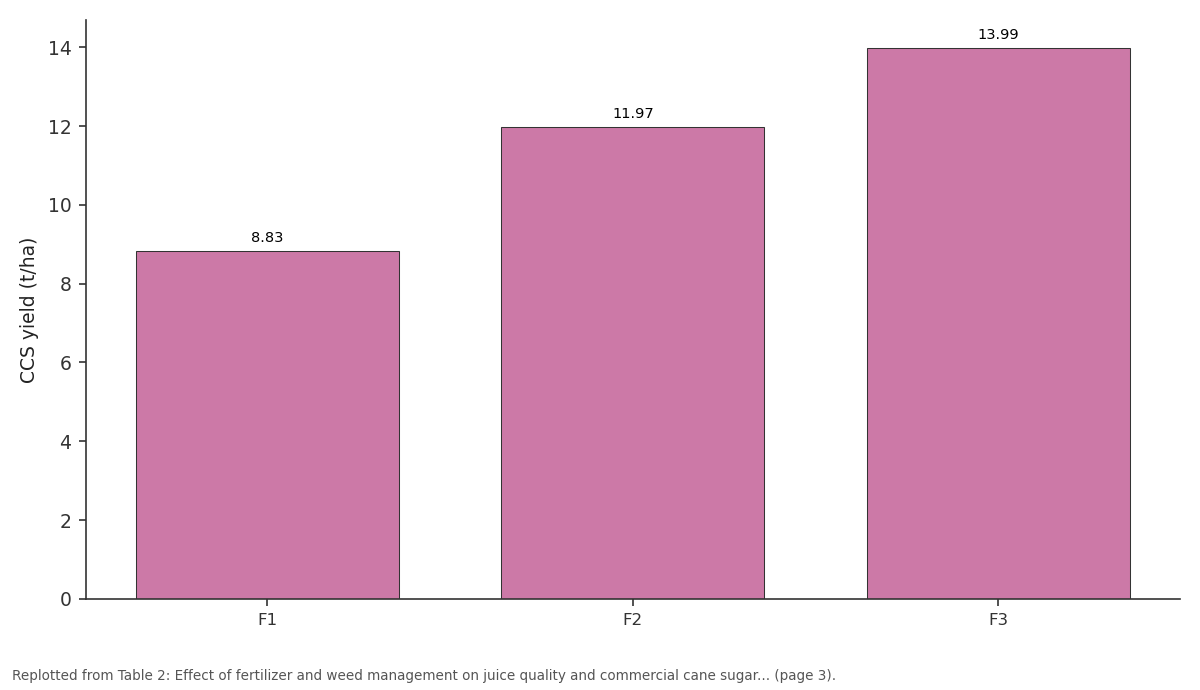
CCS yield (t/ha): F1 vs F2 vs F3
Replotted from Table 2 (page 3) of the original paper. Every bar is the paper's own table value.
View source evidence ↗Figures & tables
From the original paper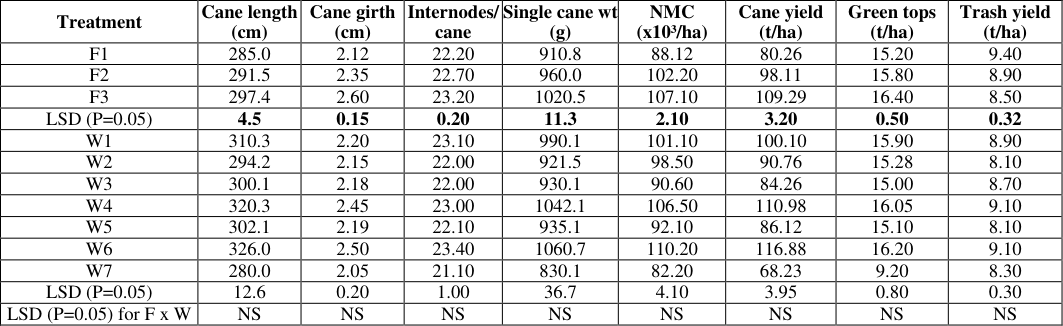 Table 1
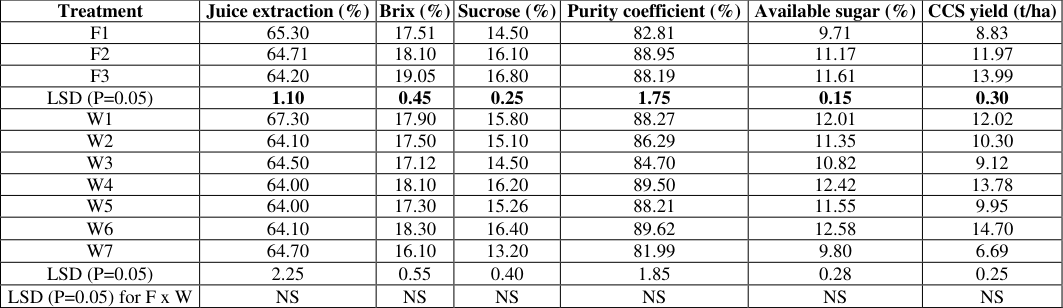 Table 2
Introduction
Sugarcane (Saccharum officinarum L.) stands as a cornerstone of India's agro-economy, anchoring the rural livelihoods of millions of households and supplying essential raw materials for sugar, jaggery, khandsari, and emerging biofuel industries. Despite its high industrial value, the average national productivity of sugarcane remains substantially below its biological threshold. This persistent yield gap is heavily driven by dual field-level constraints: unbalanced, suboptimal crop nutrition and inadequate weed management during the formative phases of crop establishment (Srivastava et al., 2002) [11] . The agronomic dynamics of spring-planted sugarcane (typically sown between February and March) expose it to severe external stresses. Unlike autumn-planted crops, spring sugarcane experiences an extended field duration characterized by wide inter-row spacing and slow initial germination due to transitional ambient temperatures (Kumar et al. 2014) [5] . Achieving high yields is further complicated by conventional fertilization practices. Manimaran et al, 2009 shown that Maximizing sugarcane yield through efficient planting methods and nutrient management practices. Heavy biomass accumulation over a long growth cycle makes sugarcane an inherently nutrient-exhaustive crop (Bokhtiar and Sakurai, 2005) [2] . However, continuous and unscientific reliance on standalone chemical inputs without considering crop growth habits has plateaued yields and reduced output quality across major sugarcane belts (Kumar et al., 2013) [10] . While standalone research into fertilizer optimization or specific herbicidal efficacy is abundant, comprehensive evaluations mapping the intersection of integrated nutrient levels and multi-tier weed-control configurations remain sparse for regional spring-planting windows. Manual weeding remains reliable but is increasingly restricted by spiking agricultural wages and labor shortages during peak operational seasons. Conversely, exclusive reliance on chemical herbicides raises concerns regarding weed resistance and chemical carryover. An integrated strategy combining targeted pre-or post-emergence chemical applications with timed manual intervention provides a balanced path forward.
Driven by these challenges, this investigation was designed to systematically assess how different fertility gradients and diverse weed-control models interactively shape the growth variables, final tonnage, sucrose attributes, and ultimate profitability of spring-planted sugarcane. The objective is to identify an agronomically sound and financially superior management matrix that local farmers can adopt to sustainably maximize their economic returns.
Materials and Methods
Materials and Methods
Experimental Site and Agro-Climatic Conditions
The field investigation was conducted during the spring season of 2024-25 at the research farm of GSDN College, Parikshitgarh, Meerut, Uttar Pradesh, India. Geographically, the experimental station is situated at 29.02° N latitude and 78.01° E longitude. The soil of the experimental plot was characterized as sandy loam belonging to Indo-Gangetic alluvial origin, exhibiting deep (>2 m), well-drained, and topographically flat attributes, technically classified as a non-calcareous, mixed, hyperthermic Udic Ustochrept. Initial soil chemical analysis revealed a slightly alkaline reaction (pH 7.5), low organic carbon content (0.48%), low available nitrogen (155.40 kg/ha), medium available phosphorus (14.20 kg/ha), and medium available potassium (203.90 kg/ha).
Experimental Design and Treatment Combinations
The field trial was laid out in a Factorial Randomized Block Design (FRBD) with three replications. The experiment involved twenty-one treatment combinations, comprising three distinct fertility levels and seven independent weedcontrol measures. The fertility treatment configurations were: F1: 75% of the recommended dose of fertilizer (RDF) F2: 100% RDF (equivalent to 150:60:60 kg N:P2O5:K2O /ha) F3: 125% RDF The weed management modules evaluated were: W1: Three manual hand weedings scheduled at 30, 60, and 90 days after planting (DAP) W2: One manual hand weeding at 30 DAP supplemented by post-emergence application of atrazine at 2.0 kg/ha W3: Pre-emergence application of atrazine at 2.0 kg/ha followed by post-emergence spray of 2,4-D at 1.0 kg/ha at 60 DAP W4: Directed post-emergence application of glyphosate @ 1.0 kg a.i./ha using shielded / hooded sprayer at 25 DAP followed by one hand weeding at 60 DAP W5: Sesbania (dhaincha) as brown manure / smother crop sown in inter-rows and incorporated at 45 DAP fb 2,4-D @ 1.0 kg/ha for broadleaf weed control W6: Weed-free check (season-long weed suppression) W7: Weedy check (uncontrolled weed competition)
Crop Management and Chemical Applications
Urea, diammonium phosphate, and muriate of potash were utilized as the chemical sources for delivering nitrogen, phosphorus, and potassium, respectively. Fertilizer allocations and herbicidal quantities were calculated precisely based on individual gross plot dimensions. The baseline dose, consisting of the total calculated phosphorus and potassium along with 50% of the aggregate nitrogen, was applied uniformly as a basal dressing at the time of sowing. The remaining 50% nitrogen split was top-dressed in two identical shares: the first following the initial irrigation event and the second synchronized with the mechanical earthing-up operation. Herbicides were discharged using a manually operated knapsack sprayer configured with a flat-fan nozzle, calibrated to supply a spray volume of 600 liters of water per hectare. The early maturing sugarcane cultivar Co 0238 was planted during the optimal window of 23-24 March, 2024. Sowing was completed in furrows made at a depth of 15 cm with a standardized inter-row spacing of 75 cm over a leveled land surface. All standard agro-techniques and cultural maintenance packages recommended for sugarcane cultivation in the region were systematically executed across all treatments throughout the life cycle. The crop was successfully harvested on 20-21 February, 2025.
Assessment of Yield and Juice Quality Parameters
At the final harvest stage, representative whole-cane samples were gathered from each treatment plot to evaluate biophysical growth components and qualitative juice characteristics. Yield attributes, including final cane length (cm), cane girth (cm), number of internodes per cane, single cane weight (g), and number of millable canes (NMC, x10^3 /ha), were recorded carefully. Net plot harvests were converted into total cane yield, green-top yield, and trash yield, expressed uniformly in tonnes per hectare (t/ha). Juice quality indices, including juice extraction percentage, Brix (%), sucrose content (%), and purity coefficient (%), were estimated utilizing established laboratory protocols. The commercial cane sugar (CCS) yield (t/ha) was derived accordingly (Gomez and Gomez 1984) [4] . The total percentage of available sugar in the extracted cane juice was computed using the following standard relationship:
Where, S represents the sucrose percentage and B denotes the Brix percentage determined from the extracted cane juice.
Results and Discussion
Results and Discussion
Effect of Fertilizer Levels on Yield Attributes and Crop Tonnage:
The experimental findings revealed a strong positive response in the biometric components and ultimate tonnage of spring-planted sugarcane when chemical fertilizer doses were increased (Table 1). The application of 125% of the recommended dose of fertilizer (125% RDF, F3) promoted robust vegetative expansion, recording the maximum average cane length (297.4 cm), highest stalk girth (2.60 cm), maximum number of internodes per cane (23.20), and superior single cane weight (1020.5 g). These metric attributes advanced significantly past the standard 100% RDF (F2) and sub-optimal 75% RDF (F1) treatments. The lowest biometric indices were recorded under F1, where stalks reached an average length of only 285.0 cm and a single cane weight of 910.8 g. This steady biometric improvement directly impacted the final crop weight. Total cane yield increased significantly with expanding fertility loads, climbing from 80.26 t/ha under F1 to 98.11 t/ha under F2, and peaking at a maximum of 109.29 t/ha under F3. This reflects a substantial 36.1% improvement in crop yield from the lowest to the highest fertility levels, which significantly exceeded the critical difference threshold (LSD = 3.20 t/ha). The number of millable canes (NMC) followed an identical pattern, increasing from 88.12 x10^3 /ha (F1) to 107.10 x10^3 /ha (F3). This confirms that high input availability prevents tillers from dying early. Conversely, green-top accumulation increased with higher fertility (peaking at 16.40 t/ha under F3), while trash yield dropped from 9.40 t/ha (F1) to 8.50 t/ha (F3). This shift shows that active crop nutrition helps keep leaves green and functional for a longer duration, slowing down early leaf aging. These positive growth patterns under elevated nutrition can be attributed to a continuous supply of primary macronutrients during peak growth windows. This accelerates cell division, improves root area expansion, and optimizes internode elongation. These observations match the crop principles documented by Banerjee et al. (2018) and Bokhtiar and Sakurai (2005), who noted that sugarcane yield components improve when plants receive full fertilizer support compared to nutrientrestricted setups.
| Treatment | Cane length (cm) | Cane girth (cm) | Internodes/ cane | Single cane wt (g) | NMC (x10³/ha) | Cane yield (t/ha) | Green tops (t/ha) | Trash yield (t/ha) |
|---|---|---|---|---|---|---|---|---|
| F1 | 285.0 | 2.12 | 22.20 | 910.8 | 88.12 | 80.26 | 15.20 | 9.40 |
| F2 | 291.5 | 2.35 | 22.70 | 960.0 | 102.20 | 98.11 | 15.80 | 8.90 |
| F3 | 297.4 | 2.60 | 23.20 | 1020.5 | 107.10 | 109.29 | 16.40 | 8.50 |
| LSD (P=0.05) | 4.5 | 0.15 | 0.20 | 11.3 | 2.10 | 3.20 | 0.50 | 0.32 |
| W1 | 310.3 | 2.20 | 23.10 | 990.1 | 101.10 | 100.10 | 15.90 | 8.90 |
| W2 | 294.2 | 2.15 | 22.00 | 921.5 | 98.50 | 90.76 | 15.28 | 8.10 |
| W3 | 300.1 | 2.18 | 22.00 | 930.1 | 90.60 | 84.26 | 15.00 | 8.70 |
| W4 | 320.3 | 2.45 | 23.00 | 1042.1 | 106.50 | 110.98 | 16.05 | 9.10 |
| W5 | 302.1 | 2.19 | 22.10 | 935.1 | 92.10 | 86.12 | 15.10 | 8.10 |
| W6 | 326.0 | 2.50 | 23.40 | 1060.7 | 110.20 | 116.88 | 16.20 | 9.10 |
| W7 | 280.0 | 2.05 | 21.10 | 830.1 | 82.20 | 68.23 | 9.20 | 8.30 |
| LSD (P=0.05) | 12.6 | 0.20 | 1.00 | 36.7 | 4.10 | 3.95 | 0.80 | 0.30 |
| LSD (P=0.05) for F x W | NS | NS | NS | NS | NS | NS | NS | NS |
Table text extracted from the original PDF; superscript letters are shown inline. The original table image is below.
View original table image
Impact of Weed Control Modules on Biophysical Growth and Cane Yield
The varying weed-control strategies exerted a highly significant influence growth traits, millable cane counts, and final crop tonnage (Table 1). The season-long weed-free check (W6) achieved the highest overall vegetative growth, leading across all biophysical variables with a maximum cane length of 326.0 cm, peak girth of 2.50 cm, maximum single cane weight of 1060.7 g, and a top cane count of 110.20 x10^3 /ha. These combined attributes resulted in a maximum absolute cane yield of 116.88 t/ha. Crucially, the integrated treatment combining a post-emergence glyphosate spray at 1.0 kg/ha at 25 days after planting with one manual hand weeding at 60 days after planting (W4) delivered a highly competitive cane yield of 110.98 t/ha. This performance proved statistically equivalent to the labor-intensive weed-free check, making it a viable field alternative. Intermediate cane yields were recorded under treatments W1 (100.10 t/ha), W2 (90.76 t/ha), and W5 (86.12 t/ha). Ramesh et al. (2002) illustrated that phosphorus is important for growth of sugarcane. The preemergence atrazine application followed by a 2,4-D split (W3) recorded a lower yield profile of 84.26 t/ha. In sharp contrast, the unmitigated weedy check (W7) resulted in severe yield suppression, dropping to a minimum of 68.23 t/ha. This decline represents a massive 41.6% loss in total crop weight compared to the clean weed-free plots (W6), which significantly exceeded the critical difference limit (LSD = 3.95 t/ha). This heavy reduction highlights the intense crop-weed competition typical of spring sowing cycles. Because spring-sown sugarcane grows slowly and features wide row spaces during its early phases, unchecked weed flushes quickly take over the empty soil surface. These weeds capture shared moisture, soil nutrients, and sunlight, which limits early stalk development and suppresses final yield components, as documented by Srivastava et al. (2002). Potassium is important factor for growth of plants (Dang et al, 1995). Furthermore, the strong performance of the integrated W4 strategy validates the efficiency of sequencing an early chemical knockdown with a timely manual weeding. This combination controls early weed flushes and manages late-emerging weeds after the chemical breaks down, matching the conclusions of Rathika et al. (2023) [9] and Kundu et al. (2020) [6] .
Conclusion
The results of this field investigation demonstrate that both nutritional status and weed management strategies are critical factors shaping the overall productivity, processing quality, and financial feasibility of spring-planted sugarcane in the western region of Uttar Pradesh. Elevated fertilization up to 125% of the recommended dose (125% RDF, F3) significantly improves essential biometric parameters including stalk length, thickness, and single cane weight which directly leads to maximum crop tonnage (109.29 t/ha) and superior commercial cane sugar output (13.99 t/ha). In terms of weed control, unchecked weed growth causes a severe yield drop of approximately 41.6%, confirming that season-long weed management is essential for successful cultivation. Although keeping fields completely weed-free (W6) achieves the maximum absolute cane yield (116.88 t/ha), it requires high manual labor expenses that reduce its overall financial return. Consequently, combining 125% RDF with the integrated herbicide-mechanical weed control schedule (F3 + W4) can be recommended as a highly effective, practical, and highly profitable management model for sugarcane farmers looking to optimize their spring cropping returns.
Acknowledgement
Acknowledgements]The authors are grateful to the authorities of GSDN College, Parikshitgarh, Meerut, Uttar Pradesh, for providing necessary facilities and support for conducting the research work. The authors also sincerely thank the local farming community for their valuable assistance during the field experimentation
Figures and tables from the paper
| Treatment | Juice extraction (%) | Brix (%) | Sucrose (%) | Purity coefficient (%) | Available sugar (%) | CCS yield (t/ha) |
|---|---|---|---|---|---|---|
| F1 | 65.30 | 17.51 | 14.50 | 82.81 | 9.71 | 8.83 |
| F2 | 64.71 | 18.10 | 16.10 | 88.95 | 11.17 | 11.97 |
| F3 | 64.20 | 19.05 | 16.80 | 88.19 | 11.61 | 13.99 |
| LSD (P=0.05) | 1.10 | 0.45 | 0.25 | 1.75 | 0.15 | 0.30 |
| W1 | 67.30 | 17.90 | 15.80 | 88.27 | 12.01 | 12.02 |
| W2 | 64.10 | 17.50 | 15.10 | 86.29 | 11.35 | 10.30 |
| W3 | 64.50 | 17.12 | 14.50 | 84.70 | 10.82 | 9.12 |
| W4 | 64.00 | 18.10 | 16.20 | 89.50 | 12.42 | 13.78 |
| W5 | 64.00 | 17.30 | 15.26 | 88.21 | 11.55 | 9.95 |
| W6 | 64.10 | 18.30 | 16.40 | 89.62 | 12.58 | 14.70 |
| W7 | 64.70 | 16.10 | 13.20 | 81.99 | 9.80 | 6.69 |
| LSD (P=0.05) | 2.25 | 0.55 | 0.40 | 1.85 | 0.28 | 0.25 |
| LSD (P=0.05) for F x W | NS | NS | NS | NS | NS | NS |
Table text extracted from the original PDF; superscript letters are shown inline. The original table image is below.
View original table image
References
11 in the original paper- Banerjee K, Puste AM, Gunri SK, Jana K, Barman M. Effect of integrated nutrient management on growth, yield, quality and soil health of spring planted sugarcane (Saccharum officinarum) in West Bengal. Indian Journal of Agronomy. 2018;63(4):499-505.
- Bokhtiar SM, Sakurai K. Effect of application of inorganic and organic fertilizers on growth, yield and quality of sugarcane. Sugar Tech. 2005;7(1):33-37.
- Dang YP, Varma KS, Pannu BS. Need for potassium fertilization in sugarcane. Indian Sugar. 1995;45:229235.
- Gomez KA, Gomez AA. Statistical Procedures for Agricultural Research. 2nd ed. New York: John Wiley and Sons; 1984.
- Kumar R, Singh J, Uppal SK. Weed management in sugarcane ratoon crop. Indian Journal of Weed Science. 2014;46(4):346-349.
- Kundu R, Mondal M, Garai S, Poddar R, Banerjee S. Efficacy of herbicides against broad-spectrum weed floras and their effect on non-target soil microorganisms and productivity in sugarcane (Saccharum sp.). Current Journal of Applied Science and Technology. 2020;39(2):23-32.
- Manimaran S, Kalyanasundaram D, Ramesh S, Sivakumar K. Maximizing sugarcane yield through efficient planting methods and nutrient management practices. Sugar Tech. 2009;11(4):395-397.
- Ramesh T, Chinnusamy C, Jayanthi C. Integrated nitrogen and phosphorus management on productivity and profitability of early planted sugarcane (cv. Co 86032). Indian Sugar. 2002;52(2):99-104.
- Rathika S, Ramesh T, Jagadeesan R. Weed management in sugarcane: A review. The Pharma Innovation Journal. 2023;12(6):3883-3887.
- Kumar S, Kumar V, Kumar A, Kumar S, Kumar N. Yield and quality analysis of spring-planted sugarcane as influenced by nutrient and weed management practices. Indian Journal of Weed Science. 2013;45(2):120-125.
- Srivastava TK, Singh AK, Srivastava SN. Critical period of crop-weed competition in sugarcane ratoon. Indian Journal of Weed Science. 2002;34:320-321.