
Research article · 2026 · Full text
International Journal of Biology SciencesAssessment of Green Manuring Crops for Improving Soil Carbon Stocks: A Review
Volume 8(7) · Pages 92–95 · DOI: 10.33545/26649926.2026.v8.i7b.930 ↗
Research areasSoil Carbon and Nitrogen DynamicsAgricultural Science and FertilizationSoil Management and Crop Yield
Abstract
Author-writtenGreen manuring is a simple and sustainable farming practice that helps improve soil fertility and increase soil organic carbon (SOC). Soil organic carbon is important for maintaining soil health, improving soil structure, increasing water-holding capacity, and supporting better crop growth. When green manure crops are grown and incorporated into the soil, they add organic matter that increases carbon storage in the soil. Green manuring also encourages the growth of beneficial soil microorganisms, improves soil aggregation, and reduces soil erosion. As a result, more carbon is stored in the soil and less is released into the atmosphere. Studies conducted in different parts of the world and in India have shown that green manure crops can effectively increase soil carbon levels and improve soil quality. Among the commonly used crops, Dhaincha (Sesbania aculeata), Sunhemp (Crotalaria juncea), and Greengram (Vigna radiata) are particularly effective in enhancing soil carbon storage. Therefore, green manuring is an environmentally friendly practice that not only improves crop productivity and soil health but also helps reduce the impacts of climate change by storing carbon in the soil.
Summary
Source-checkedPlain-language reading of the full paper, prepared with AI and checked against the text. Each point links to the authors' own words.
Why it matters
- Soil organic carbon (SOC) is critical for maintaining soil fertility, structure, and water-holding capacity, while also supporting nutrient cycling. View evidence ↗
- Increasing carbon storage in agricultural soils is a key strategy for reducing atmospheric carbon dioxide to combat global warming. View evidence ↗
- Green manuring is considered one of the most eco-friendly and effective methods for increasing soil organic carbon. View evidence ↗
The question
- The review aims to assess the effectiveness of various green manuring crops in improving soil carbon stocks. View evidence ↗
What they did
- The review categorizes green manure crops into three main groups: leguminous, non-leguminous, and green leaf manure crops. View evidence ↗
- The assessment is based on a review of numerous global studies and specific research conducted in India. View evidence ↗
What they found
- Carbon sequestration occurs as plant biomass decomposes and soil microorganisms convert residues into stable forms of organic carbon, such as humus. View evidence ↗
- Green manuring improves soil aggregation, which protects organic matter from rapid decomposition and extends carbon storage. View evidence ↗
- Green manure crops reduce soil erosion by covering the surface and developing strong roots, thereby preventing the loss of carbon-rich topsoil. View evidence ↗
- In rice-based systems with Inceptisols, Sesbania aculeata (Dhaincha) increased SOC by 0.35–0.40 Mg C ha⁻¹ yr⁻¹. View evidence ↗
- In rainfed systems with Vertisols, Crotalaria juncea (Sunhemp) increased SOC by 0.28–0.32 Mg C ha⁻¹ yr⁻¹. View evidence ↗
- In rice-greengram systems with Mollisols, Vigna radiata (Greengram) increased SOC by 0.30 Mg C ha⁻¹ yr⁻¹. View evidence ↗
- In agroforestry systems with Alfisols, Pongamia pinnata (Karanj) increased SOC by 0.25 Mg C ha⁻¹ yr⁻¹. View evidence ↗
- A rice-greengram cropping system in Cuttack achieved a Soil Quality Index (SQI) score of 2.26, indicating improved physical and biological soil properties. View evidence ↗
What it means
- The authors conclude that green manuring is a simple, effective practice for enhancing soil health and crop production while mitigating climate change. View evidence ↗
- The practice is limited by a lack of standardized carbon measurement protocols and inadequate long-term monitoring of carbon sequestration. View evidence ↗
Figures & tables
From the original paper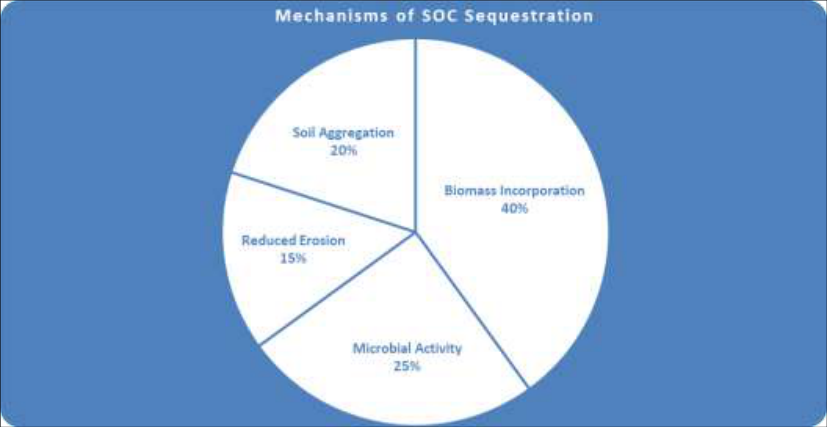 Figure 1
 Table 1
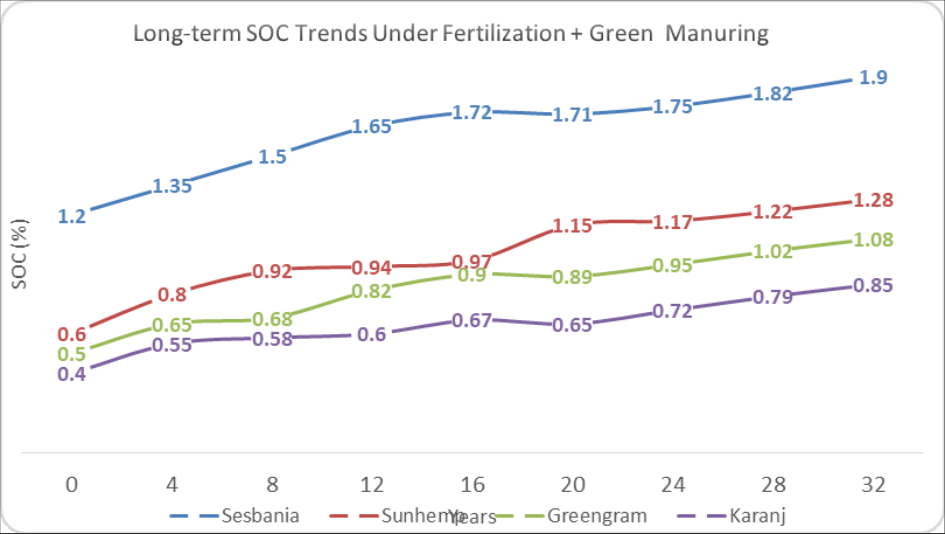 Figure 2
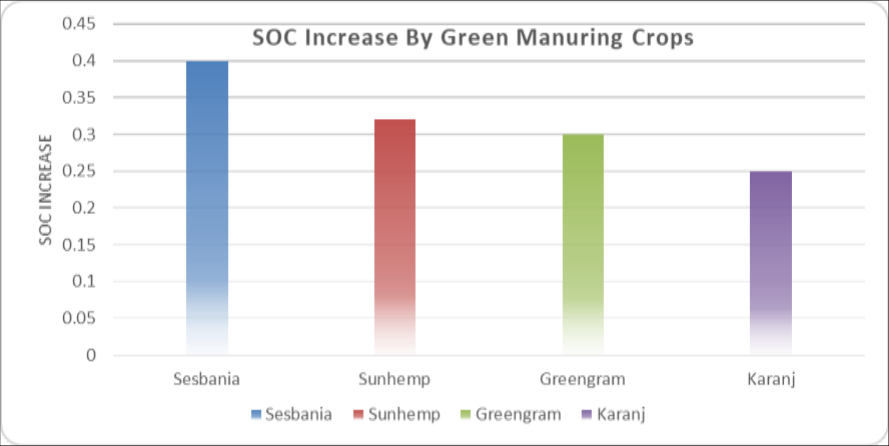 Figure 3
Introduction Soil Carbon Sequestration through Green Manuring
Soil organic carbon (SOC) is an important part of soil that helps maintain soil fertility, improves soil structure, increases water-holding capacity, and supports nutrient cycling. It also plays a significant role in reducing climate change by storing carbon in the soil. As concerns about global warming increase, enhancing carbon storage in agricultural soils has become an important strategy for reducing atmospheric carbon dioxide (CO₂). Green manuring is one of the most effective and eco-friendly methods for increasing soil organic carbon. It involves growing crops specifically for incorporation into the soil while they are still green. These crops add organic matter to the soil, improve nutrient availability, stimulate beneficial microbial activity, and reduce soil degradation. Studies conducted in India and around the world have shown that green manuring can increase soil carbon storage, improve soil health, and enhance crop productivity. Green manure crops are generally grouped into three categories: leguminous green manure crops, non-leguminous green manure crops, and green leaf manure crops. Leguminous crops such as dhaincha (Sesbania aculeata), sunhemp (Crotalaria juncea), greengram (Vigna radiata), blackgram (Vigna mungo), and cowpea (Vigna unguiculata) are widely used because they can fix atmospheric nitrogen through their association with Rhizobium bacteria. These crops enrich the soil with nitrogen and add large amounts of biomass, which increases soil organic matter and carbon content. Their incorporation improves soil structure, microbial activity, and overall soil fertility. Non-leguminous green manure crops, including mustard, karanj (Pongamia pinnata), sorghum, and maize, mainly contribute organic matter to the soil. Although they do not fix nitrogen, they improve soil aeration, moisture retention, and soil structure while suppressing weed growth. The decomposition of their biomass adds carbon to the soil and supports longterm soil productivity. Green leaf manuring involves incorporating leaves and tender branches collected from trees and shrubs such as Gliricidia sepium, Pongamia pinnata (Karanj), Leucaena leucocephala (Subabul), and Sesbania grandiflora (Agathi). These materials decompose quickly after incorporation, releasing nutrients and organic compounds into the soil. Green leaf manures improve nutrient recycling, increase soil organic carbon, stimulate microbial activity, and enhance soil fertility. Due to their rapid decomposition and easy availability, they are an effective source of organic matter for maintaining soil health and promoting sustainable agricultural production.
Mechanisms of Soil Carbon Stock Enhancement through
Green Manuring: Green manuring contributes to soil carbon sequestration through several interconnected mechanisms.
Biomass Incorporation: Green manure crops add a large amount of plant material, such as leaves, stems, and roots, to the soil. When these plant parts decompose, they increase soil organic matter and add carbon to the soil. Root exudates also provide food for soil microorganisms, helping to build up soil carbon.
Enhancement of Microbial Activity:
Soil microorganisms break down green manure residues and convert them into stable forms of soil organic carbon. During this process, organic matter is transformed into humus, which can remain in the soil for a long time. This increases microbial biomass and helps store more carbon in the soil.
Improvement of Soil Aggregation
Green manuring helps soil particles stick together and form stable aggregates. Microorganisms and fungal hyphae produce substances that bind soil particles together. These aggregates protect organic matter from rapid decomposition, helping carbon remain stored in the soil for a longer period.
Reduction of Soil Erosion
Green manure crops cover the soil surface and develop strong root systems that reduce runoff and soil loss. This protection prevents the removal of carbon-rich topsoil and helps maintain soil structure. As a result, more carbon is retained in the soil and soil health is improved. These benefits contribute to the long-term sustainability and environmental resilience of farming systems worldwide. Furthermore, a mechanistic review published through ScienceDirect (2026) emphasized the importance of diversified planting systems, cover crop integration, and green manure incorporation in enhancing soil carbon sequestration. The review explained that these practices promote carbon accumulation through biological processes such as increased biomass production and microbial activity, as well as physical mechanisms including improved soil aggregation and protection of organic matter within soil aggregates. Together, these mechanisms contribute to the stabilization and long-term storage of carbon in agricultural soils.
Indian Evidence on Green Manuring and Soil Carbon Stock
India has generated substantial evidence regarding the effectiveness of green manuring under diverse agro-climatic conditions.
Long-Term Fertilization Study (ICAR-IARI, New Delhi, 2021)
Long-term agricultural experiments conducted by the Indian Agricultural Research Institute (ICAR-IARI) in New Delhi revealed significant increases in critical soil parameters through targeted green manuring. The application of these crops led to a measurable expansion in mineralizable carbon pools and enhanced aggregate-associated carbon throughout the soil profile. Ultimately, these structural changes resulted in a substantial rise in total soil organic carbon (SOC) stocks. Among the evaluated species, green manure crops such as Sesbania (dhaincha) and sunhemp (Crotalaria juncea) proved particularly effective at accumulating and stabilizing these carbon fractions over extended periods.
Climate-Resilient Agriculture Study (ICAR-IARI, Pusa, Bihar, 2024)
A 2024 field assessment evaluating climate-resilient farming practices at ICAR-IARI in Pusa, Bihar, demonstrated that integrating green manuring into local crop rotations yields multi-faceted environmental benefits. The practices consistently improved overall crop productivity while boosting core soil health indicators, such as microbial biomass and nutrient availability. Furthermore, the inclusion of green manures markedly enhanced the climate resilience of regional farming systems, allowing crops to sustain steady growth even under severe environmental stress conditions like drought and shifting precipitation patterns.
Rice-Greengram Cropping System (ICAR-NRRI, Cuttack, 2023)
Research led by the National Rice Research Institute (ICAR-NRRI) in Cuttack highlighted the distinct structural and environmental advantages of utilizing a rice-greengram (Vigna radiata) cropping system. This sustainable rotation recorded a high Soil Quality Index (SQI) score of 2.26, reflecting major improvements across a variety of soil physical and biological properties. By maintaining active root systems and regular biomass return, the rice-greengram system enhanced the field's overall carbon sequestration potential, establishing an efficient pathway for long-term carbon storage in lowland agricultural soils
Comparative Performance of Green Manuring Crops in Carbon Sequestration
Comparative Performance of Green Manuring Crops in Carbon Sequestration
Conclusion
Green manuring is an eco-friendly farming practice that helps improve soil fertility and increase the amount of carbon stored in the soil. When green manure crops are grown and mixed into the soil, they add organic matter, which improves soil health and increases soil organic carbon (SOC). These crops also encourage the growth of beneficial microorganisms, improve soil structure, and reduce soil erosion. As a result, more carbon is stored in the soil and soil productivity is improved. Studies from India and other countries have shown that green manuring is an effective way to increase soil carbon levels and support sustainable agriculture. Crops such as Dhaincha (Sesbania aculeata) and Sunhemp (Crotalaria juncea) are especially useful because they produce large amounts of biomass and improve soil fertility. Therefore, green manuring is a simple and effective practice for improving soil health, increasing crop production, and helping to reduce the effects of climate change.
Figures and tables from the paper
References
6 in the original paper- Green manuring and crop residue management: effect on soil organic carbon stock, aggregation, and system productivity in the foothills of Eastern Himalaya (India). Soil Tillage Res. 2022.
- Green manure reduces global agricultural carbon footprint by enhancing soil organic carbon stocks: evidence from global meta-analysis and machine learning assessment. J Clean Prod. 2026.
- Mechanisms underlying soil carbon sequestration and enhancement strategies via diversified planting and green manure integration. Sci Direct Rev. 2026.
- ICAR-Indian Agricultural Research Institute. Longterm effect of fertilization and manuring on soil aggregate carbon mineralization. New Delhi: ICARIndian Agricultural Research Institute; 2021.
- ICAR-IARI Regional Station, Pusa. Green manuring for optimal yield and soil health management under changing climate. Pusa, Bihar: ICAR-IARI Regional Station; 2024.
- ICAR-National Rice Research Institute. Soil quality as affected by resource conserving technologies in ricegreen gram cropping system in Eastern India. Cuttack: ICAR-National Rice Research Institute; 2023.