
Research article · 2026 · Full text
International Journal of Horticulture and Food ScienceImpact of intercrops on diamondback moth (Plutella xylostella L.) larval population on cabbage
Volume 8(7) · Pages 87–90 · DOI: 10.33545/26631067.2026.v8.i7b.800 ↗
Research areasInsect-Plant Interactions and ControlAgronomic Practices and Intercropping SystemsInsect Pest Control Strategies
Abstract
Author-writtenThe present investigation entitled “Performance of the Intercropping Systems on the Incidence of the Diamondback Moth (Plutella xylostella L.) and its Natural Enemies in Cabbage Ecosystem” was conducted during Rabi 2025-26 to evaluate the influence of habitat manipulation through intercropping on the incidence of diamondback moth (DBM), the abundance of its natural enemies, crop productivity, and economics in cabbage. The population of DBM larvae first appeared during the 4th Standard Meteorological Week (SMW) with a mean population of 0.68 larvae per plant and gradually increased to a peak of 1.84 larvae per plant during the 9th SMW, followed by a decline towards crop maturity. Correlation analysis revealed that DBM incidence was significantly and positively associated with maximum temperature (r = 0.544), minimum temperature (r = 0.728), sunshine hours (r = 0.559), and evaporation (r = 0.501), while morning and evening relative humidity, wind velocity, and rainfall exhibited non-significant relationships. Among the habitat manipulation treatments, cabbage + coriander (1:1) proved to be the most effective in suppressing DBM, recording the lowest mean larval population (0.83 larvae per plant), followed by cabbage + fenugreek (2:1) (1.07 larvae per plant) and cabbage + mustard (2:2) (1.18 larvae per plant). The highest infestation (2.17 larvae per plant) was observed in the sole cabbage crop. Intercropping significantly improved crop productivity, with the highest cabbage equivalent yield (205.40 q ha⁻¹) recorded in cabbage + tomato (2:1), followed by cabbage + coriander (1:1) (204.75 q ha⁻¹) and cabbage + marigold (2:1) (201.40 q ha⁻¹). However, the highest benefit-cost ratio (4.63) was obtained with cabbage + marigold (2:1), closely followed by cabbage + coriander (1:1) (4.61), while the sole cabbage crop recorded the lowest yield (140.80 q ha⁻¹) and benefit-cost ratio (3.02). Habitat diversification markedly enhanced the abundance of natural enemies. Cabbage + marigold (2:1) supported the highest populations of Coccinella septempunctata (9.60), green lacewings (8.94), spiders (6.98), and the larval parasitoid Cotesia plutellae (8.94) per ten plants, with an overall mean predator population of 8.51 per ten plants. The relative abundance of natural enemies was also highest in the marigold intercropping system (21.39%), followed by mustard (16.42%) and coriander (13.78%), whereas the sole cabbage crop recorded the lowest abundance (6.48%). Laboratory studies further revealed that C. plutellae caused an average parasitism of 31.35%, confirming its important role in the biological regulation of DBM populations. The study demonstrated that habitat manipulation through intercropping is an effective and eco-friendly strategy for reducing DBM infestation, enhancing natural biological control, and improving cabbage productivity and profitability. Among the evaluated systems, cabbage + marigold (2:1) emerged as the most promising treatment due to its superior economic returns and conservation of natural enemies, while cabbage + coriander (1:1) was the most effective in suppressing DBM infestation.
Summary
Source-checkedPlain-language reading of the full paper, prepared with AI and checked against the text. Each point links to the authors' own words.
Why it matters
- Cabbage is a highly important leafy vegetable in India because of its market demand, adaptability, and nutritional value. View evidence ↗
- The Diamondback moth (DBM) is considered the most persistent and destructive pest for cruciferous crops globally. View evidence ↗
- DBM infestations can lead to yield losses ranging from 30% to 80%, and may even cause total crop failure. View evidence ↗
The question
- The study aimed to evaluate how intercropping as a habitat manipulation strategy affects DBM incidence, natural enemy abundance, cabbage productivity, and economic returns. View evidence ↗
What they did
- The experiment was conducted during the Rabi 2025 season at the Instructional Agronomy Farm of the Rajasthan College of Agriculture in Udaipur. View evidence ↗
- The researchers used a Randomized Block Design with three replications to evaluate six different crop combinations, including a sole cabbage control. View evidence ↗
- DBM larval populations were measured using direct visual counts from five randomly selected plants per plot. View evidence ↗
What they found
- DBM larvae first appeared in the 4th Standard Meteorological Week (SMW) at 0.68 larvae per plant, peaking at 1.84 larvae per plant in the 9th SMW. View evidence ↗
- Intercropping cabbage with coriander (1:1) was the most effective at suppressing DBM, with the lowest mean population of 0.83 larvae per plant. View evidence ↗
- The highest DBM infestation, at 2.17 larvae per plant, occurred in the sole cabbage crop. View evidence ↗
- Intercropping increased productivity, with the cabbage + tomato (2:1) system achieving the highest equivalent yield of 205.40 q ha⁻¹. View evidence ↗
- Cabbage + marigold (2:1) provided the highest benefit-cost ratio (4.63), whereas the sole cabbage crop had the lowest yield (140.80 q ha⁻¹) and benefit-cost ratio (3.02). View evidence ↗
- The cabbage + marigold (2:1) system supported the highest populations of natural enemies, including C. septempunctata (9.60), green lacewings (8.94), spiders (6.98), and C. plutellae (8.94) per ten plants. View evidence ↗
- The relative abundance of natural enemies was highest in marigold (21.39%) and lowest in the sole cabbage crop (6.48%). View evidence ↗
- Laboratory tests showed that the parasitoid C. plutellae achieved an average parasitism rate of 31.35%. View evidence ↗
- DBM incidence was significantly and positively correlated with minimum temperature (r = 0.728), sunshine hours (r = 0.559), maximum temperature (r = 0.544), and evaporation (r = 0.501). View evidence ↗
What it means
- The authors conclude that cabbage + marigold (2:1) is the most promising system for economic returns and natural enemy conservation, while cabbage + coriander (1:1) is best for suppressing DBM. View evidence ↗
Visual summary
1 visualsIllustrations explain the paper; they do not show study data.
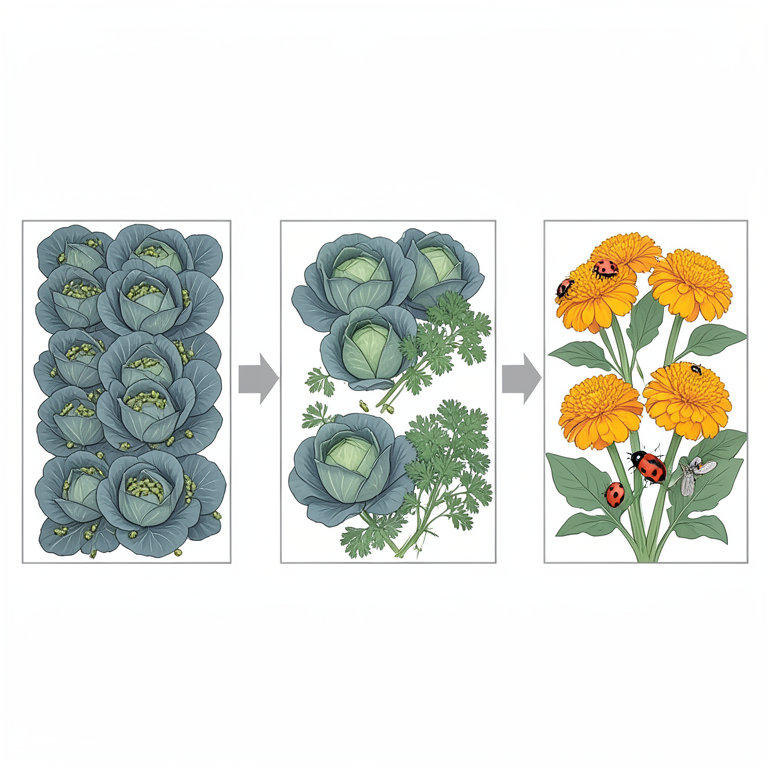
Intercropping Strategy Comparison
AI-generated conceptual illustration (Cabbage plants, coriander plants, marigold flowers, diamondback moth larvae, and ladybugs). It explains the idea and does not show study data.
View source evidence ↗Figures & tables
From the original paper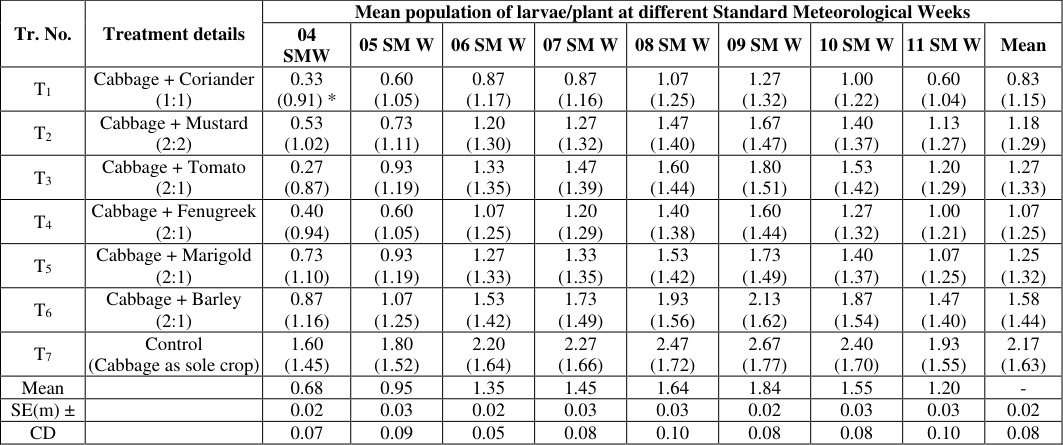 Table 1
Introduction
Cabbage (Brassica oleracea var. capitata L.) is one of the most economically important leafy vegetables cultivated widely in India due to its high nutritional value, adaptability, and market demand. It is a rich source of vitamins A, C, and K, along with essential minerals and dietary fiber. As per recent estimates, India produces over 8.5 million tonnes of cabbage from about 0.37 million hectares, making it the second-largest producer after China (NHB, 2023). In Rajasthan, cabbage cultivation is spreading gradually, covering 346 hectares with a production of approximately 7,588 tonnes, mainly in districts such as Kota, Jaipur, and Alwar (Horticulture Statistics, Govt. of Rajasthan, 2023).
The crop also plays a significant role in improving farmers' income due to its short duration and high market value. Despite its economic importance, cabbage cultivation is heavily constrained by insect pest infestations. Among these, the Diamondback moth (DBM), Plutella xylostella (L.), is regarded as the most destructive and persistent pest of cruciferous crops worldwide. The larvae feed on leaf tissues, scraping the green matter and leaving behind a thin epidermal layer, which results in the characteristic "window-paning" symptoms. Severe infestation leads to skeletonization of leaves, reduced photosynthetic capacity, and ultimately significant yield loss. Reports indicate that DBM alone can cause 30-80% yield losses, and in extreme cases, even complete crop failure under favorable conditions (Kant et al., 2023) [7] . Habitat manipulation is one such promising ecological strategy that involves modifying the cropping system to enhance biodiversity, promote natural enemies, and reduce pest colonization. Practices such as intercropping cabbage with companion crops like marigold, coriander, garlic, or mustard, use of trap crops, and establishment of flowering borders can significantly influence pest behavior and natural enemy abundance. These intercrops act as repellents, attractants, or refuges for predators and parasitoids, thereby strengthening biological control (Sharma and Mahla, 2021; Jeevan, 2022; Gurr et al., 2023) [10,6,3] . In Rajasthan conditions, studies have shown that cabbage intercropped with marigold or coriander reduced DBM infestation by 25-40% and increased the population of key natural enemies such as Coccinella septempunctata, Chrysoperla zastrowi sillemi, and syrphid flies (Syrphus spp.) (Sharma et al., 2021) [10] . These natural enemies play a vital role in suppressing pest populations by predation and parasitism, contributing to sustainable pest regulation. In addition to habitat manipulation, the use of biorational insecticides has emerged as an effective alternative to conventional chemicals. These include neem-based formulations (azadirachtin), microbial insecticides like Bacillus thuringiensis var. kurstaki (Bt), and entomopathogenic fungi such as Lecanicillium lecanii and Beauveria bassiana. These agents are target-specific, biodegradable, environmentally safe, and compatible with natural enemies, thus fitting well into IPM programs (Kant et al., 2023; Singh et al., 2024) [7,12] .
Materials and Methods
Materials and Methods
Site and location of the experiment
The present investigation was carried out at the Instructional Agronomy Farm, Rajasthan College of Agriculture, Udaipur, during Rabi 2025. Udaipur is located at 23.40° N longitudes and 750° E latitude at an elevation of 579.5 MSL (Mean Sea Level) in the state of Rajasthan.
Climatic conditions of the study area
The zone experiences a typical sub-tropical climate characterized by cool winters and mild temperatures, with relatively low humidity during the Rabi season (November to April). Occasional cold waves and frost may occur during peak winter months, influencing crop growth and development. The average rainfall during the Rabi season is very low (around 0-4.8 mm), as this period mainly depends on occasional winter showers rather than the Southwest monsoon, which contributes rainfall during July to September. During winter, the temperatures may go as high as °C, while in winter it may fall to as low as 4.5°C. This region provides a safe and long growing season for most of the crops.
Field preparation and crop management
After the harvest of the previous crop, weeds and stubble were removed from the field. The experimental field was prepared first week of November by ploughing. Timely hoeing and weeding were performed as per the package of practices. Recommended doses of nitrogen and phosphorous were applied to the crop. The crop was irrigated as and when needed during the entire crop period.
Experimental design and treatment
The experiment was conducted to observe Diamond back Moth (Plutella xylostella L.) infestation in cabbage intercropped with different companion crops. Six crop combinations, including sole cabbage, were evaluated. The experiment was laid out in a Randomized Block Design (RBD) with three replications.
Observations recorded
Diamondback moth: The larval population of the DBM was recorded from five randomly selected plants per plot by direct visual count method. (Devi et al., 2017). All the observations of DBM were recorded once in a standard week from experimental field.
Result and Discussion Larval Population Dynamics of
Result and Discussion Larval Population Dynamics of
Plutella xylostella
The data presented in Table 4.1 revealed that different habitat adjustment treatments significantly influenced the larval population of diamondback moth (Plutella xylostella) on cabbage during Rabi 2025-26. The larval population first appeared during the 4 th Standard Meteorological Week (SMW) with a mean population of 0.68 larvae per plant. The infestation gradually increased from the 5 th SMW onwards and reached its peak (1.84 larvae per plant) during the 9 th SMW. Thereafter, the population declined gradually to 1.55 larvae per plant during the 10 th SMW and further to 1.20 larvae per plant during the 11 th SMW. Among the habitat manipulation treatments, cabbage intercropped with coriander (1:1) recorded the lowest mean larval population (0.83 larvae per plant) and was significantly superior to all other treatments. This was followed by cabbage + fenugreek (2:1) with 1.07 larvae per plant, cabbage + mustard (2:2) with 1.18 larvae per plant, cabbage + marigold (2:1) with 1.25 larvae per plant, and cabbage + tomato (2:1) with 1.27 larvae per plant. The highest larval population among the intercrops was recorded in cabbage + barley (2:1) (1.58 larvae per plant), whereas the sole cabbage crop (control) recorded the highest overall infestation (2.17 larvae per plant) throughout the observation period.
Conclusion
The present investigation entitled "Performance of the Intercropping Systems on the Incidence of the Diamondback Moth (Plutella xylostella L.) and its Natural Enemies in Cabbage Ecosystem" during Rabi 2025-26 clearly demonstrated that habitat manipulation through intercropping significantly influenced the incidence of diamondback moth (DBM), crop productivity and the abundance of natural enemies. The population of DBM larvae first appeared during the 4 th Standard Meteorological Week (SMW) with an average population of 0.68 larvae per plant. The infestation gradually increased throughout the season and reached its peak (1.84 larvae per plant) during the 9 th SMW, after which the population declined towards crop maturity. Correlation analysis indicated that DBM incidence exhibited a significant positive association with maximum temperature (r = 0.544), minimum temperature (r = 0.728), sunshine hours (r = 0.559), and evaporation (r = 0.501), whereas morning relative humidity, evening relative humidity, wind velocity, and rainfall showed non-significant relationships with pest incidence. Among the different habitat adjustment treatments, cabbage intercropped with coriander (1:1) proved to be the most effective in suppressing DBM infestation, recording the lowest mean larval population (0.83 larvae per plant) throughout the cropping season. This was followed by cabbage + fenugreek (1.07 larvae per plant) and cabbage + mustard (1.18 larvae per plant). The highest infestation (2.17 larvae per plant) was observed in the sole cabbage crop (control), confirming that monocropping favoured greater pest multiplication. Intercropping also had a significant influence on crop productivity. The highest cabbage equivalent yield (205.40 q ha⁻¹) was obtained from cabbage + tomato (2:1), closely followed by cabbage + coriander (204.75 q ha⁻¹) and cabbage + marigold (201.40 q ha⁻¹). Although tomato intercropping produced the highest equivalent yield, the highest benefit-cost ratio (4.63) was recorded in cabbage + marigold (2:1), followed by cabbage + coriander (4.61), indicating superior economic returns from these habitat manipulation practices. The lowest yield (140.80 q ha⁻¹) and benefit-cost ratio (3.02) were recorded under the sole cabbage crop. Habitat diversification considerably enhanced the abundance of natural enemies of DBM. Among the intercrops, cabbage + marigold supported the highest populations of predators, recording 9.60 Coccinella septempunctata, 8.94 green lacewings and 6.98 spiders per ten plants, with an overall mean predator population of 8.51 per ten plants. The same treatment also recorded the highest population of the larval parasitoid Cotesia plutellae (8.94 parasitoids per ten plants). Likewise, the relative abundance of natural enemies was highest in the marigold intercropping system (21.39%), followed by mustard (16.42%) and coriander (13.78%), whereas the lowest abundance was observed in the sole cabbage crop (6.48%).
Figures and tables from the paper
| Tr. No. | Treatment details | Mean population of larvae/plant at different Standard Meteorological Weeks | — | — | — | — | — | — | — | — |
|---|---|---|---|---|---|---|---|---|---|---|
| 04 SMW | 05 SM W | 06 SM W | 07 SM W | 08 SM W | 09 SM W | 10 SM W | 11 SM W | Mean | ||
| T1 | Cabbage + Coriander (1:1) | 0.33 (0.91) * | 0.60 (1.05) | 0.87 (1.17) | 0.87 (1.16) | 1.07 (1.25) | 1.27 (1.32) | 1.00 (1.22) | 0.60 (1.04) | 0.83 (1.15) |
| T2 | Cabbage + Mustard (2:2) | 0.53 (1.02) | 0.73 (1.11) | 1.20 (1.30) | 1.27 (1.32) | 1.47 (1.40) | 1.67 (1.47) | 1.40 (1.37) | 1.13 (1.27) | 1.18 (1.29) |
| T3 | Cabbage + Tomato (2:1) | 0.27 (0.87) | 0.93 (1.19) | 1.33 (1.35) | 1.47 (1.39) | 1.60 (1.44) | 1.80 (1.51) | 1.53 (1.42) | 1.20 (1.29) | 1.27 (1.33) |
| T4 | Cabbage + Fenugreek (2:1) | 0.40 (0.94) | 0.60 (1.05) | 1.07 (1.25) | 1.20 (1.29) | 1.40 (1.38) | 1.60 (1.44) | 1.27 (1.32) | 1.00 (1.21) | 1.07 (1.25) |
| T5 | Cabbage + Marigold (2:1) | 0.73 (1.10) | 0.93 (1.19) | 1.27 (1.33) | 1.33 (1.35) | 1.53 (1.42) | 1.73 (1.49) | 1.40 (1.37) | 1.07 (1.25) | 1.25 (1.32) |
| T6 | Cabbage + Barley (2:1) | 0.87 (1.16) | 1.07 (1.25) | 1.53 (1.42) | 1.73 (1.49) | 1.93 (1.56) | 2.13 (1.62) | 1.87 (1.54) | 1.47 (1.40) | 1.58 (1.44) |
| T7 | Control (Cabbage as sole crop) | 1.60 (1.45) | 1.80 (1.52) | 2.20 (1.64) | 2.27 (1.66) | 2.47 (1.72) | 2.67 (1.77) | 2.40 (1.70) | 1.93 (1.55) | 2.17 (1.63) |
| Mean | 0.68 | 0.95 | 1.35 | 1.45 | 1.64 | 1.84 | 1.55 | 1.20 | - | |
| SE(m) ± | 0.02 | 0.03 | 0.02 | 0.03 | 0.03 | 0.02 | 0.03 | 0.03 | 0.02 | |
| CD | 0.07 | 0.09 | 0.05 | 0.08 | 0.10 | 0.08 | 0.08 | 0.10 | 0.08 |
Table text extracted from the original PDF; superscript letters are shown inline. The original table image is below.
View original table image
References
12 in the original paper- Devi N, Singh TK, Singh NB. Bio-efficacy of biopesticides against major insect pests of cabbage (Brassica oleracea var. capitata L.). Journal of Entomology and Zoology Studies. 2017;5(3):943-946.
- Gurr GM, Albrecht M, Nicol HI, Johnson AC. Habitat management to suppress pest populations: Progress and prospects. Annual Review of Entomology. 2021;66:91109.
- Gurr GM, Wratten SD, Turchin P. Ecological engineering for pest management: Advances and prospects. Annual Review of Entomology. 2023;68:111-133.
- Gurr GM, Wratten SD, Landis DA, You M. Habitat management to suppress pest populations: Progress and prospects. Annual Review of Entomology. 2017;62:91109.
- Horticulture Statistics Rajasthan. Department of Horticulture, Government of Rajasthan; 2023.
- Jeevan BG. Impact of border cropping and biorationals on DBM in cabbage under field conditions. M.Sc. Thesis. CCS Haryana Agricultural University, Hisar; 2022.
- Kant S, Singh R, Bhatt A. Bio-efficacy of new insecticides and biopesticides against diamondback moth (Plutella xylostella) on cabbage. International Journal of Environment and Climate Change. 2023;13(3):239-245.
- Landis DA, Wratten SD, Gurr GM. Habitat management to conserve natural enemies of arthropod pests in agriculture. Annual Review of Entomology. 2000;45:175-201.
- National Horticulture Board. Area and Production of Horticultural Crops in India. Ministry of Agriculture and Farmers Welfare, Government of India; 2023.
- Sharma K, Mahla MK, Babu SR, Ahir KC, Kumar A, Singh B, et al. Potentiality of intercropping in managing diamondback moth (Plutella xylostella). Indian Journal of Agricultural Sciences. 2022;92(8):1010-1014.
- Singh S, Singh V, Kumar S, Singh H, Gangwar S, Gupta HK. Study on the population dynamics and management of diamondback moth (Plutella xylostella) on cabbage. The Pharma Innovation Journal. 2023;12(6):6274-6277.
- Singh V, Patel R, Chauhan D. Comparative efficacy of biorationals against DBM in field-grown cabbage. Journal of Biocontrol Science and Technology. 2024;34(2):165-172.