
Research article · 2026 · Full text
International Journal of Geography Geology and EnvironmentReport of a new fossil capsular fruit Lufocarpon intertrappea from the Deccan intertrappean beds of Maraipatan, Chandrapur District, Maharashtra, India
Volume 8(7) · Pages 148–151 · DOI: 10.22271/27067483.2026.v8.i7b.815 ↗
Research areasPlant Diversity and EvolutionPaleontology and Stratigraphy of FossilsPaleontology and Evolutionary Biology
Abstract
Author-writtenThe present paper deals with the description of a new genus of petrified capsular fruit from the Deccan Intertrappean beds of Marai Patan, Tahsil-Jiwati, Dist.-Chandrapur, Maharashtra, India. The fruit is simple elongated oval in shape, unilocular, stalked, single seeded, capsular fruit. The pericarp shows lines of dehiscence and is differentiated in to epicarp, mesocarp and endocarp. Seed coat is single layered and is not differentiated into testa and tegmen. Embryo is not preserved while endospermic cells are well preserved. A hook like apical beak with two cavities is present at the apex of the fruit. It measures about 7 mm in length and is 5 mm in width. Pericarp is well preserved and moderately thick. It measures about 500 µm in thickness, epicarp is 2 to 3 layers of thick walled sclerenchymatous cells measure about 95 µm in thickness. Mesocarp is single layer of thick walled sclerenchymatous cells and measures about 200 um in thickness. Endocarp is measures about 200 µm in thickness. It is made up of 8-10 layers of thin walled elongated cells. Finally summing up the comparison and discussion on the described fossil fruit it can be concluded that the present specimen under investigation does not resemble any of the living capsular fruits as well as recorded fossil flora. Hence it is named as Lufocarpon intertrappea gen. et sp. nov.The generic name is being after the Latin name for hooked fruit whereas specific name indicates the Deccan Intertappean locality from where the material was collected.
Summary
Source-checkedPlain-language reading of the full paper, prepared with AI and checked against the text. Each point links to the authors' own words.
Why it matters
- The Deccan Intertrappean beds are a known source of various unilocular fossil fruits, including species like Kremocarpon and Ceratocarpon. View evidence ↗
The question
- The study aims to describe a new genus of petrified capsular fruit discovered in the Deccan Intertrappean beds of Maraipatan, India. View evidence ↗
What they did
- Fossil material was collected from the Maraipatan locality within the Deccan Intertrappean beds of Maharashtra, India. View evidence ↗
- The researchers used hydrofluoric acid for etching, performed serial peeling along the longitudinal plane, and used Canada balsam as a mountant to reveal anatomical details. View evidence ↗
- Measurements and photography of the fossil material were conducted using Capture Pro 4.6 exe software. View evidence ↗
What they found
- The fossil fruit is elongated and oval in shape, measuring approximately 7 mm in length and 5 mm in width. View evidence ↗
- The fruit's pericarp is well-preserved, measuring about 500 µm in thickness and consisting of an epicarp, mesocarp, and endocarp. View evidence ↗
- The epicarp, the outermost layer, is about 95 µm thick and contains 2 to 3 layers of thick-walled sclerenchymatous cells. View evidence ↗
- The mesocarp is the middle layer, measuring about 200 µm in thickness and containing 10-12 layers of thick-walled sclerenchymatous cells. View evidence ↗
- The endocarp is the innermost layer, measuring about 200 µm in thickness and composed of 8-10 layers of thin-walled elongated cells. View evidence ↗
- The fruit contains a single seed measuring approximately 6.5 x 4.5 mm, which occupies the width of the locule. View evidence ↗
- The fruit features a long, hook-like apical beak at its apex, which is broader at the base and contains two cavities. View evidence ↗
- The fruit has a single stalk measuring approximately 300-400 µm in length and 500-600 µm in width. View evidence ↗
- The specimen differs significantly in multiple characteristics from previously described unilocular fossil fruits from the same region. View evidence ↗
- Comparison with modern dicot and monocot families revealed no resemblance between this fossil fruit and any living families. View evidence ↗
What it means
- Due to its unique characteristics, the authors named the specimen Lufocarpon intertrappea gen. et sp. nov., with the name referring to its hooked fruit and its locality. View evidence ↗
- The exact age of the specimen is uncertain, though it is tentatively associated with the Uppermost Cretaceous. View evidence ↗
Visual summary
1 visualsIllustrations explain the paper; they do not show study data.
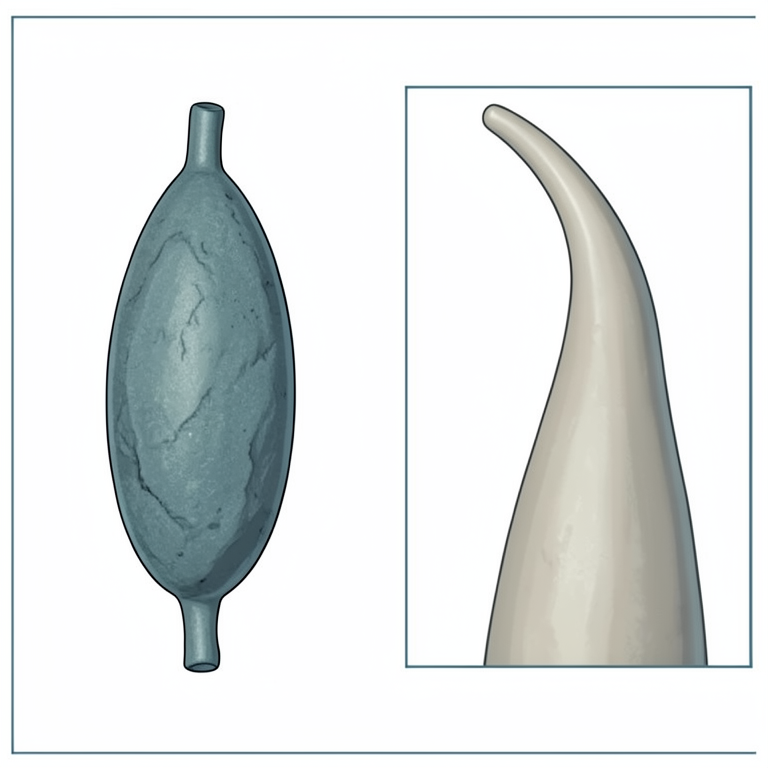
Morphology of Lufocarpon intertrappea
AI-generated conceptual illustration (Lufocarpon intertrappea fossil capsular fruit). It explains the idea and does not show study data.
View source evidence ↗Introduction
From the Deccan Intertrappean beds many unilocular fruits have been reported, such as kremocarpon aquatica, Kremocarpon indicum (upadhye, 1979) [14] , Juglandiocarpon agashii (Adhao, 1986) [1] , Ceratocarpon spinosa (Adhao, 1986) [1] , Wingospermocarpon mohgaonse (Sheikh & Kapgate, 1984) [13] , Mahabaleocarpon deccanii (Chawhan, 1987) [2] , Paradkarocarpon indicum (Wazalwar, 1990), Uniloculocarpon singhpurii (Qureshi S Parveen, 2016) [12] , Unispermospinocarpon keriensis (Kapgate D.K. and Paliwal Pratibha A., 2017). The Present fruit is the new finding of the unilocular fruit from Maraipatan a locality of the Deccan Intertappean beds of Chandrapur District, Maharashtra state, India
Material and Method
The material was collected from Maraipatan, a locality of the Deccan Intertappean beds of Chandrapur District, Maharashtra state, India. In longitudinal section I got the material in part and counterpart when it was broken. A hydrofluoric acid is used for eatching and after washing with water elongated, oval in shape, stalked fruit with central cavity was seen. A serial peeling was taken along longitudinal plane. The Canada balsam was used as a mountant. Thus the fruit shows all the morphological and anatomical details. Capture Pro 4.6 exe software was used for measurement and photography of material.
Description General Description:
The fruit is elongated, oval in shape, stalked and measures 7 mm in length and 5 mm in width. It is single seeded, unilocular, capsular fruit. In it embryo is not preserved and endospermic cells are seen.
The pericarp is well preserved and showing epicarp, mesocarp and endocarp (plate I, photo 2). A hook like long apical beak is present at the apex of fruit. At the base the beak is some broad with two cavities. The following anatomical details are seen in the above fruit.
Pericarp:
The pericarp is well preserved and measures about 500 µm in thickness. It is differentiated into epicarp, mesocarp and endocarp. The pricarp shows lines of dehiscence (Plate I, photo 2, 3).
Epicarp: It is the outermost layer of the fruit wall and measures about 95 µm in thickness containing 2 to 3 layers of thick walled sclerenchymatous cells (Plate I, photo 2).
Mesocarp: It is the middle layer of the fruit wall and measures about 200 µm in thickness containing 10-12 layers of thick walled sclerenchymatous cells (Plate I, photo 2).
Endocarp: It is the innermost layer of the fruit wall and measures about 200 µm in thickness containing 8-10 layers of thin walled elongated cells (Plate I, photo 2).
Locule: A single locule with well preserved single seed is seen in longitudinal section. The diameter of locule is 6.5 X 4.5 mm in size (Plate I, photo 1).
Seed: A single seed of this fossil material measures about 6.5 X 4.5 mm as broad as locule. The seed is large with seed coat. The seed coat is fused with fruit wall and is not differentiated into testa and tegmen. The embryo is not preserved while endospermic cells are well preserved (Plate I, photo 1).
Seed Coat:
The seed coat is single layer thick and fused with fruit wall. It is not differentiated into testa and tegmen (Plate I, photo 1).
Stalk:
A fruit with single stalk is seen which is measures about 300-400 µm in length 500-600 µm in width (Plate I, photo 4).
Apical Beak: A hook like long apical beak is present at the apex of fruit. At the base the beak, it is somewhat broad with two cavities (Plate I, photo 5).
Discussion and Identification
The above described specimen is identified with help of following important details. 1. The fruit is unilocular, capsular, and single seeded with hook like apical beak. 2. It is elongated oval in shape and stalked. 3. The pericarp shows lines of dehiscence with epicarp, mesocarp and endocarp differentiation. 4. The seed coat is single layered without differntiation. 5. The embryo is not preserved while endospermic cells are well preserved. 6. At the apex of the fruit the hook like apical beak with two cavities is present at it base. All these characters described in the fruit shows that it was formed from unilocular, unicarpellary, apocarpous ovary. This fruit is found to be capsular because of its dehisced fruit wall.
Comparison with fossil fruit
This fossils fruit shows great variation from the previously described unilocular fossil fruits in number of characters. The Kremocarpon indicum (Upadhye, 1979) [14] Kremocarpon aquatica (Kate, 1974) [3] are unilocular, fibrous berries with papillate projections on the tough epicarp while the present fruit is capsular with apical hook and stalked. Ceratocarpon spinosa (Adhao, 1986) [1] is achenial with one locular, one seeded with spines all over the surface of the fruit while the present fruit is capsular with apical hook and stalked. Juglandiocarpon agashii (Adhao, 1986) [1] is unilocular, single seeded fruit with feathery wings. The fruit wall shows epicarp with air chamber, fibrous mesocarp and stony endocarp while the present fruit is capsular with apical hook and stalked. Wingospermocarpon mohgaonse (Sheikh & Kapgate, 1984) [13] is unilocular, capsular, winged seed, with free central placentation of the seeds while the present fruit is capsular with apical hook and stalked. Mahabaleocarpon deccanii (Chawhan, 1987) [2] is unilocular, single seeded, pulpy, indehiscent, baccate type of fruit while the present fruit is capsular with apical hook and stalked. Paradkarocarpon indicum (Wazalwar, 1990) is unilocular, seed coat soft with arenchyma and made up of parenchymatous cell while the present fruit is capsular with apical hook and stalked. Uniloculocarpon singhpurii (Qureshi S Parveen, 2016) [12] is simple elongated, oval in shape, sessile, unilocular, one seeded capsular fruit with loculicidal dehiscence while the present fruit is stalked with apical hook and stalked. Unispermospinocarpon keriensis (Kapgate D.K. and Paliwal Pratibha A., 2016) [10] is small, elliptical, unilocular, single seeded, dehiscent, capsular and stalked with spines are found all over the fruit wall while the present fruit capsular with only apical hook and stalked.
Comparison with modern taxa
For assigning this fossil fruit to proper family, it was also compared with living genera of modern dicot and monocot families. For this reason it is compared with the modern families having presence of unilocular, single seeded, spiny fruit to trace its affinities with nearest living families like Rubiaceae, Ceratophyllaceae, Elaeocarpaceae, Caprifoliaceae, Asteraceae, Zygophyllaceae, Phytolaccaceae, Cyperaceae. In family Rubiaceae (Cephalanthus occidentals) and family Ceratophyllaceae (Ceratophyllum); are having moderately long spine and so many in number while present fruit shows single apical spine with two cavities at its base. In family Elaeocarpaceae (Sloanea) is having many seeds with spiny fruit while present fruit have single seed with single apical spine with two cavities at its base. Family Caprifoliaceae (Kolkwitzia) is having fruit with persistent calyx and spines are long and many in number while present fruit is without persistent calyx and single spine at its apex. A family Asteraceae (Glagenophora) show spiny fruit, the fruit is differs in having unequal size of spines while present fruit shows single spines with two cavities at the base of spine. In family Zygophyllaceae (Seetzenia) is having the seeds, thick testa with three skins, the outer membranous, the middle one cellular and mucous while the inner coriaceous while such structures are absent in present fruit. In (Tribulus cistoides) is having the long spines and hairs are present on the fruit wall while in present fruit the spines are long with cavities and hairs are absent on the pericarp. In Phytolaccaceae (Petiveria alliacea L.) a gynoecium is monocarpellary, laterally compressed, tomentose with four or six apical bristles. The fruit is achene type with a coriaceous pericarp adhered to the seed and is erect, linear and laterally compressed, with a membranous coat while present fruit shows single seed and single apical spine with two cavities at its base. In Cyperaceae (Cyperus eragrostis) fruit has three-sided shape with single apical beak and short stalk but our fruit is not have three-sided shape; in (Carex) The perigynium often terminates in a beak, which can be short or long, straight or curved, and may have one or two teeth at the tip such type of teeth are absent in our fruit; in (Fimbristylis) The two-branched style, which is part of the gynoecium, may remain attached to the apex of the fruit but our fruit contain single beak. This fossil fruit is very though to compare with the modern dicotylednous monocot families because it is differs in many aspects.
From is above discussion it is concluded that there is no resemblance of this fossil fruit with any of the living families and reported fossils. Hence this fossil fruit is named as Lufocarpon intertrappea gen. et sp. nov. The generic name is according to the latin name for hooked fruit and specific name indicates the Deccan Intertappean locality from where this fossil material was collected.
Diagnosis
Diagnosis
Lufocarpon intertrappea gen. nov.
The fruit is capsular, unilocular, stalked and single seeded. A hook like long apical beak is present at the apex of fruit. At the base the beak, it is somewhat broad with two cavities.
Lufocarpon intertrappea gen. et sp. nov.
The fruit elongated, oval in shape, stalked, unilocular, single seeded and capsular. The pricarp shows lines of dehiscence and is differentiated in to epicarp, mesocarp and endocarp. The seed coat is single layered and is not differentiated. The embryo is not preserved while the endospermic cells are well preserved. At the apex of the fruit, a hook like apical beak with two cavities is present at its base. It measures about 7 mm in length and is 5 mm in width. Pericarp is well preserved and moderately thick. It measures about 500 µm in thickness, epicarp is 2 to 3 layers of thick walled sclerenchymatous celled and measure about 95 µm in thickness. Mesocarp is single layered of thick walled with sclerenchymatous cells and measures about 200 um in thickness. The endocarp is measures about 200 µm in thickness. It is made up of 8-10 layers of thin walled elongated cells.
References
14 in the original paper- Adhao TS. Plant fossil from the Deccan Intertrappean localities of Central India [PhD thesis]. Nagpur: Nagpur University; 1986.
- Chawan NJ. Contributions towards paleocene flora from the Intertrappean series of India [PhD thesis]. Nagpur: Nagpur University; 1987.
- Chitaley SD, Kate VR. Enigmocarpon sahnii sp. nov. from the Deccan Intertrappean beds of Mohgaonkalan, India. Review of Palaeobotany and Palynology. 1977;23(5):389-398. DOI:10.1016/0034-6667(77)90004-9.
- & 3. Calcutta: Botanical Survey of India; 1958 (Reprint 1967).
- Corner EJH. The seeds of Dicotyledons. Vols. 1 & 2. London: Cambridge University Press; 1976.
- Dahegaonkar R. Investigation of fossil flora from the Deccan Intertrappean Beds of Chhindwara (M.P.) and Yavatmal (M.S.) Districts [PhD thesis]. Nagpur: Nagpur University; 2002.
- Darrah HC. A peel method in palaeobotany. Harvard University Botanical Museum Leaflets. 1936;4(4):6985.
- Hooker JD. The Flora of British India. Vols. 2 & 3. London: L. Reeve & Co; 1961.
- Joy KW, Willis AJ, Lacey WS. A rapid cellulose peel technique in Palaeobotany. Annals of Botany. 1956;20(4):635-637. doi:10.1093/oxfordjournals.aob.a083547.
- keriensis gen. et sp. nov., a permineralized spiny fruit from the Deccan Intertrappean Beds of Keria, Madhya Pradesh, India. International Journal of Life Sciences. 2016;4(4):589-594.
- Patil S. Investigation of fossil flowers and fruits from the Deccan Intertrappean Beds of Maharashtra and Madhya Pradesh [PhD thesis]. Gadchiroli: Gondwana University; 2022.
- Qureshi SP. A new petrified monocot capsular fruit from Deccan Intertrappean Beds of Singhpur, Chhindwara District, M.P., India. International Journal of Life Sciences. 2016;A6:157-160.
- Sheikh MT, Kapgate DK. A fossil capsule with winged seeds from the Deccan Intertrappean of India. Current Science. 1984;53(12):657-658.
- Upadhye EV. Morphological study of Deccan Intertrappean flora of Mohgaonkalan, India [PhD thesis]. Nagpur: Nagpur University; 1979.
Cited by 1
From OpenAlex, OpenCitations and reference lists read by Scinovex
- Fossil Drupe Fruit Revealing Angiosperm Diversity from the Deccan Intertrappean Beds of Singhpur, Madhya Pradesh, India ↗
Kapgate Ashwini V. and Meshram Sanjay M. · International Journal of Advanced Research in Science Communication and Technology · 2026
A well-preserved dicot fruit was collected from Singhpur (Lat 21.616095° N and Long 78.730775° E) in Chhindwara District, M.P. The fruit is elongated to ovoid or ellipsoidal with a distinct basal long stalk. The fossil fruit is unilocular and is characterized by the presence of bitegmic seed. The fruit is a drupe and dehiscent, not clearly seen. The fruit, though,…
❝ 0PDF