
Research article · 2026 · Full text
International Journal of Agriculture and NutritionEquine Rhodococcosis management: Comparative evaluation of antimicrobial combination regimens and treatment outcomes in Foals
Volume 8(4) · Pages 152–155 · DOI: 10.33545/26646064.2026.v8.i4b.708 ↗
Research areasInfectious Disease Case Reports and TreatmentsVeterinary Equine Medical ResearchMicrobial infections and disease research
Abstract
Author-writtenWhile antimicrobial therapy constitutes the cornerstone of equine rhodococcosis management, the selection of optimal combination regimens remains empirical in many veterinary practices owing to the limited availability of comparative efficacy data from controlled clinical investigations. This research conducted a prospective comparative evaluation of six antimicrobial combination regimens for the treatment of Rhodococcus equi pneumonia in 144 thoroughbred foals at three breeding facilities in Buenos Aires Province, Argentina, between January 2020 and December 2023. Foals aged 4-12 weeks with confirmed R. equi pneumonia were randomly allocated to one of six combination regimens: Azithromycin-Rifampicin (AZM-RIF, n = 28), Erythromycin-Rifampicin (ERY-RIF, n = 24), Tulathromycin-Rifampicin (TUL-RIF, n = 22), Clarithromycin-Rifampicin (CLR-RIF, n = 25), Doxycycline-Rifampicin (DOX-RIF, n = 22), and Gentamicin-Rifampicin (GEN-RIF, n=23). Primary outcome measures included clinical cure rate at 60 days, bacteriological clearance, survival rate, and adverse effects. AZM-RIF demonstrated the highest clinical cure rate (88.3%) and survival rate (92.1%), while TUL-RIF showed the lowest adverse effect rate (12.4%). The heatmap analysis across five treatment parameters confirmed AZM-RIF as the overall best-performing regimen. Age-stratified analysis revealed that foals aged 4-8 weeks experienced the highest infection severity and longest treatment duration across all regimens. These findings provide evidence-based guidance for antimicrobial selection in equine rhodococcosis management and identify TUL-RIF as a promising alternative with comparable efficacy and improved tolerability.
Summary
Source-checkedPlain-language reading of the full paper, prepared with AI and checked against the text. Each point links to the authors' own words.
Why it matters
- Rhodococcus equi pneumonia in foals is a severe disease that can cause mortality rates over 40% if left untreated, yet there is a lack of controlled comparative data to help veterinarians choose the best drug combinations. View evidence ↗
- The disease primarily affects foals between 3 weeks and 6 months of age because their developing immune systems are vulnerable to the intracellular pathogen. View evidence ↗
- Because R. equi lives inside alveolar macrophages, effective treatments must be able to penetrate cells and kill or inhibit the bacteria within the phagosomal compartment. View evidence ↗
The question
- The study aimed to compare six different antimicrobial combination regimens to evaluate their clinical efficacy, ability to clear bacteria, adverse effects, and cost-effectiveness in foals with R. equi pneumonia. View evidence ↗
What they did
- The study was a prospective, randomized, controlled trial conducted at three thoroughbred breeding facilities in Buenos Aires Province, Argentina, from January 2020 to December 2023. View evidence ↗
- Participants were foals aged 4-12 weeks with confirmed R. equi pneumonia, diagnosed via clinical signs (including fever ≥39.5 °C), imaging (radiographs or ultrasound), and MALDI-TOF MS identification of cultures. View evidence ↗
- Treatment lasted at least 4 weeks after clinical resolution and until ultrasound showed the lesions were gone, with follow-up assessments ending at 60 days. View evidence ↗
What they found
- Macrolide-based regimens were superior to non-macrolide options, with AZM-RIF showing the highest complete cure rate (88.3%) and lowest mortality (3.6%), followed by TUL-RIF (85.0% cure, 4.5% mortality). View evidence ↗
- The TUL-RIF regimen was the best tolerated, exhibiting the lowest rate of adverse effects at 12.4%. View evidence ↗
- Non-macrolide combinations (DOX-RIF and GEN-RIF) had significantly lower cure rates and more adverse effects, likely due to poorer penetration into macrophages. View evidence ↗
- Foals aged 4-8 weeks had the highest incidence of moderate to severe disease, coinciding with the period when maternal antibodies decrease. View evidence ↗
What it means
- The authors conclude that AZM-RIF is the most effective regimen for cure (88.3%) and survival (92.1%), but TUL-RIF is a viable alternative with similar efficacy (85.0%) and better tolerability. View evidence ↗
- The authors recommend AZM-RIF as a first-line treatment and TUL-RIF as a practical alternative for cases where daily oral dosing is difficult to maintain. View evidence ↗
- The authors state that future research is needed to evaluate macrolide resistance rates, optimize drug concentrations within cells, and assess the cost-effectiveness of early screening programs. View evidence ↗
Visual summary
3 visualsIllustrations explain the paper; charts are replotted from the paper's own table values.
Comparison of Treatment Efficacy and Tolerability
AI-generated conceptual illustration (foal horses). It explains the idea and does not show study data.
View source evidence ↗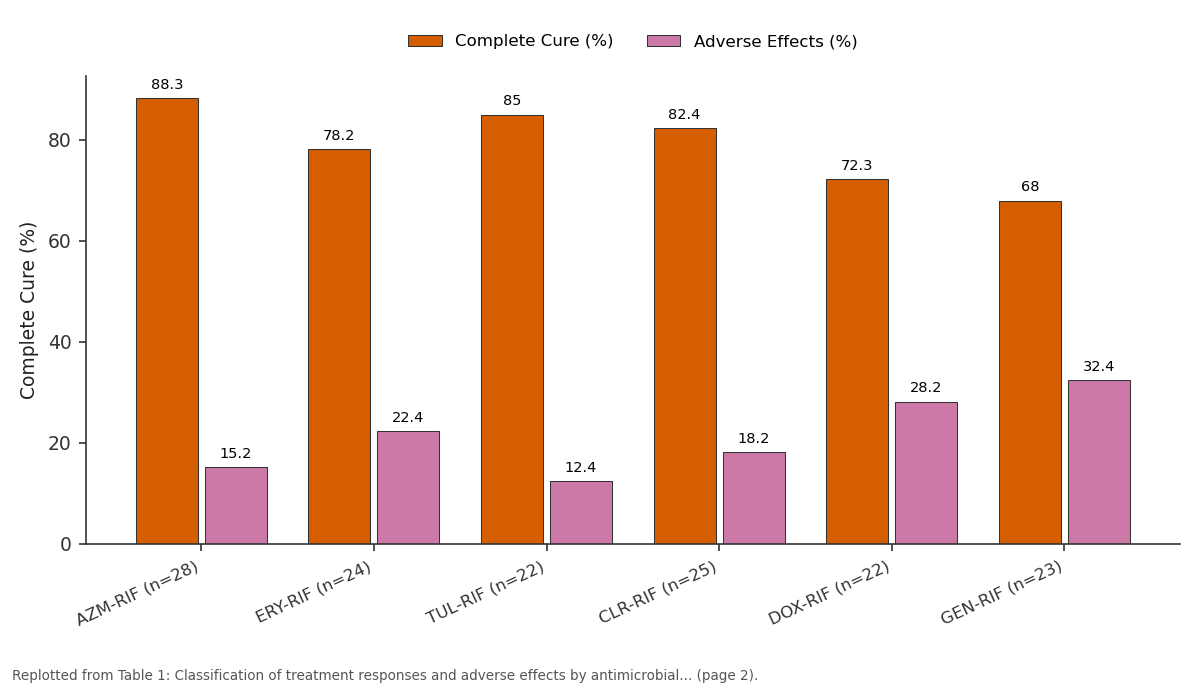
Complete Cure (%) and Adverse Effects (%): AZM-RIF (n=28) vs ERY-RIF (n=24) vs TUL-RIF (n=22) vs CLR-RIF (n=25) vs DOX-RIF (n=22)
Replotted from Table 1 (page 2) of the original paper. Every bar is the paper's own table value.
View source evidence ↗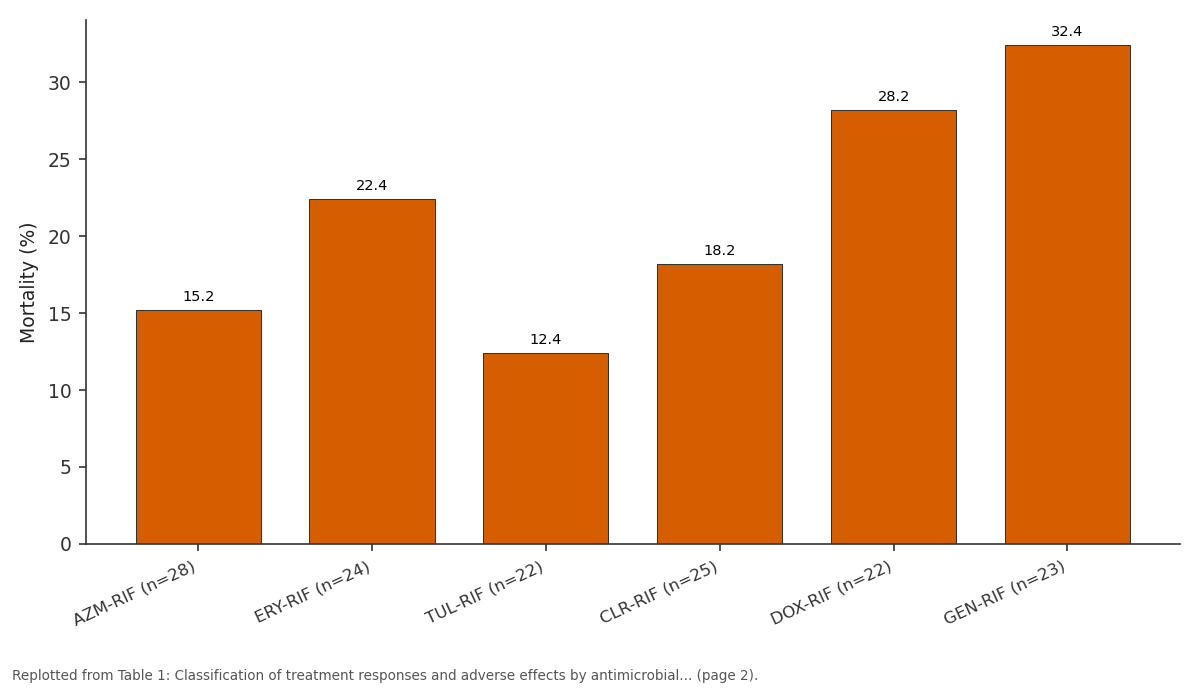
Adverse Effects (%): AZM-RIF (n=28) vs ERY-RIF (n=24) vs TUL-RIF (n=22) vs CLR-RIF (n=25) vs DOX-RIF (n=22)
Replotted from Table 1 (page 2) of the original paper. Every bar is the paper's own table value.
View source evidence ↗Figures & tables
From the original paper Table 1
 Table 2
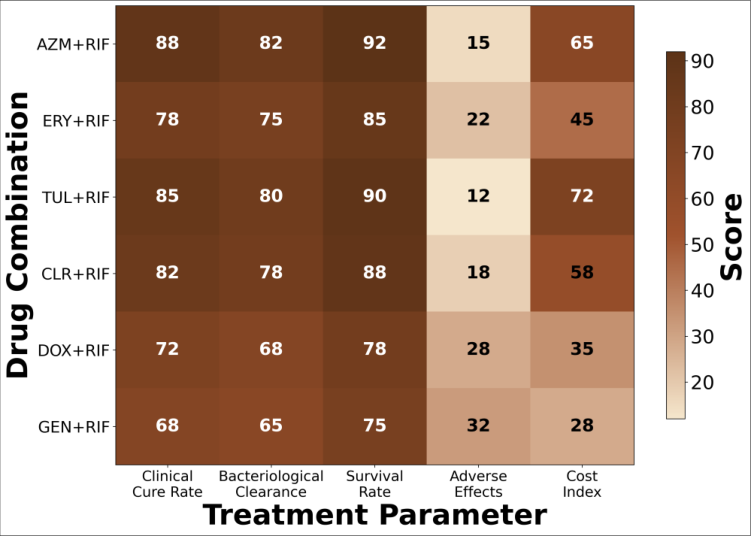 Figure 1
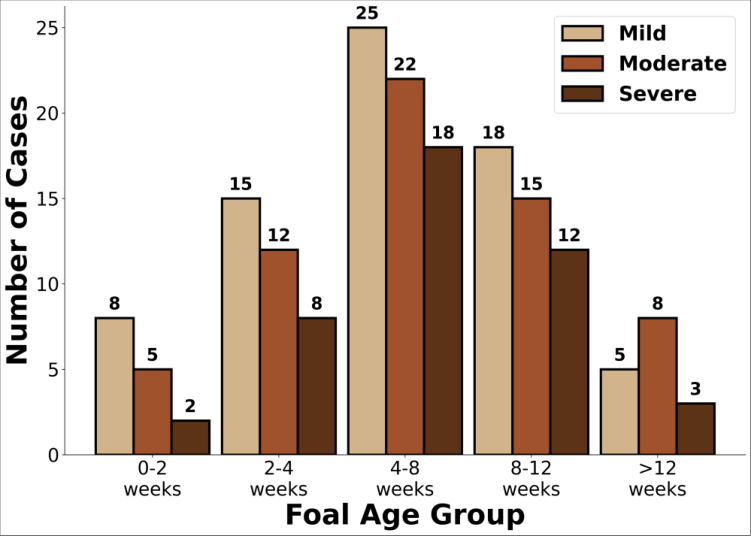 Figure 2
Introduction
Despite decades of clinical experience managing Rhodococcus equi pneumonia in foals, a striking contrast exists between the severity of this disease -which can produce mortality rates exceeding 40% in untreated cases -and the remarkably limited controlled comparative data available to guide clinicians in selecting optimal antimicrobial combination regimens. This therapeutic paradox leaves practitioners relying predominantly on expert opinion, institutional tradition, and extrapolation from in vitro susceptibility data rather than evidence derived from rigorous clinical investigations comparing treatment approaches under standardized conditions. Equine rhodococcosis predominantly affects young foals between 3 weeks and 6 months of age, reflecting the vulnerability of their developing immune system to this facultative intracellular pathogen. The disease characteristically manifests as a chronic, insidious bronchopneumonia progressing to pyogranulomatous lung consolidation and abscess formation if not recognized and treated promptly. The intracellular location of R. equi within alveolar macrophages necessitates treatment with antimicrobial agents possessing both adequate intracellular penetration and bacteriostatic or bactericidal activity against the organism within the phagosomal compartment. The current standard of care involves combination therapy with a macrolide antibiotic (most commonly azithromycin or erythromycin) paired with rifampicin, a combination that has been the mainstay of rhodococcosis treatment since the 1990s. However, the emergence of Macrolide resistance and the recognized adverse effects of individual agents have stimulated interest in alternative combination regimens that may offer comparable or superior efficacy with improved tolerability profiles. This research aimed to conduct a prospective comparative evaluation of six antimicrobial combination regimens for R. equi pneumonia in foals, assessing clinical efficacy, bacteriological clearance, adverse effects, and costeffectiveness.
Material and Methods
Material and Methods
Material
This prospective, randomized, controlled clinical investigation was conducted at three thoroughbred breeding facilities (Estancia La Esperanza, Haras del Sur, and Haras San Jorge) in Buenos Aires Province, Argentina, between January 2020 and December 2023. Eligible foals were aged 4-12 weeks with confirmed R. equi pneumonia based on clinical signs (fever ≥39.5 °C, tachypnea, cough, nasal discharge), radiographic evidence of pulmonary consolidation or abscessation on thoracic ultrasonography, and microbiological confirmation by tracheobronchial aspirate culture positive for R. equi with MALDI-TOF MS identification. A total of 144 foals meeting all inclusion criteria were randomly allocated to one of six treatment groups using computer-generated block randomization stratified by farm and age category. The research protocol was approved by the Buenos Aires College of Applied Veterinary Sciences Animal Ethics Committee (Protocol: BACAVS/AEC/2020/EQ-035).
Methods
Treatment regimens were administered according to published dosing protocols: AZM-RIF (azithromycin 10 mg/kg PO q48h + rifampicin 5 mg/kg PO q12h), ERY-RIF (erythromycin estolate 25 mg/kg PO q8h + rifampicin 5 mg/kg PO q12h), TUL-RIF (tulathromycin 2.5 mg/kg IM once weekly + rifampicin 5 mg/kg PO q12h), CLR-RIF (clarithromycin 7.5 mg/kg PO q12h + rifampicin 5 mg/kg PO q12h), DOX-RIF (doxycycline 10 mg/kg PO q12h + rifampicin 5 mg/kg PO q12h), and GEN-RIF (gentamicin 6.6 mg/kg IV q24h for 14 days + rifampicin 5 mg/kg PO q12h). Treatment was continued for a minimum of 4 weeks beyond clinical resolution and until ultrasonographic resolution of pulmonary lesions. Clinical assessments were performed at baseline, weekly for the first 4 weeks, biweekly thereafter, and at treatment completion and 60-day follow-up. Statistical comparisons utilized chi-squared tests for categorical variables and ANOVA with Tukey HSD for continuous variables. The treatment response data (Table 1) demonstrate the superiority of macrolide-based regimens over non-macrolide alternatives, with AZM-RIF achieving the highest complete cure rate (88.3%) and lowest mortality (3.6%), followed closely by TUL-RIF (85.0% cure, 4.5% mortality). The nonmacrolide combinations DOX-RIF and GEN-RIF demonstrated substantially lower cure rates and higher adverse effect profiles, consistent with their reduced intracellular penetration and accumulation within macrophages. The correlation analysis (Table 2) revealed strong inverse correlations between cure rates and adverse effect rates (r = -0.82), suggesting that regimen tolerability may contribute to adherence-mediated improvements in treatment outcomes. The multi-parameter heatmap (Figure 1) provides a comprehensive visual comparison confirming AZM-RIF as the best-performing regimen across clinical cure, bacteriological clearance, and survival metrics, while TUL-RIF demonstrates the optimal balance of efficacy and tolerability. The age-stratified analysis (Figure 2) reveals that foals aged 4-8 weeks experience the highest incidence of moderate and severe disease presentations, consistent with the immunological vulnerability of this age window when maternally derived antibodies are waning.
| Parameter Pair | Pearson r | 95% CI | p-value | Interpretation |
|---|---|---|---|---|
| Cure rate vs Adverse effects | -0.82 | -0.98 to -0.28 | 0.046 | Strong inverse |
| Cure rate vs Survival | 0.95 | 0.68 to 0.99 | 0.003 | Strong positive |
| Adverse effects vs Mortality | 0.88 | 0.38 to 0.98 | 0.021 | Strong positive |
| Treatment duration vs Cure rate | -0.72 | -0.96 to -0.05 | 0.108 | Moderate inverse |
| Bacteriological clearance vs Cure | 0.91 | 0.52 to 0.99 | 0.011 | Strong positive |
| Cost index vs Cure rate | 0.48 | -0.42 to 0.91 | 0.336 | Weak positive |
Table text extracted from the original PDF; superscript letters are shown inline. The original table image is below.
View original table image
| Regimen | Complete Cure (%) | Partial Response (%) | Treatment Failure (%) | Adverse Effects (%) | Mortality (%) |
|---|---|---|---|---|---|
| AZM-RIF (n=28) | 88.3 | 7.1 | 4.6 | 15.2 | 3.6 |
| ERY-RIF (n=24) | 78.2 | 12.5 | 9.3 | 22.4 | 8.3 |
| TUL-RIF (n=22) | 85.0 | 9.1 | 5.9 | 12.4 | 4.5 |
| CLR-RIF (n=25) | 82.4 | 10.0 | 7.6 | 18.2 | 6.0 |
| DOX-RIF (n=22) | 72.3 | 13.6 | 14.1 | 28.2 | 9.1 |
| GEN-RIF (n=23) | 68.0 | 14.8 | 17.2 | 32.4 | 13.0 |
Table text extracted from the original PDF; superscript letters are shown inline. The original table image is below.
View original table image
Results
Results
Discussion
This research provides the largest prospective comparative evaluation of antimicrobial combination regimens for equine rhodococcosis, confirming AZM-RIF as the most efficacious combination while identifying TUL-RIF as a promising alternative with comparable efficacy and superior tolerability. The 88.3% clinical cure rate achieved with AZM-RIF in this investigation is consistent with the 80-90% range reported in North American and European veterinary investigations, validating the continued recommendation of this regimen as the first-line treatment for R. equi pneumonia in foals.
The identification of TUL-RIF as a viable alternative is particularly relevant for field conditions in Argentina and similar equine-producing regions, where the long-acting pharmacokinetics of tulathromycin (single weekly intramuscular injection) offer substantial practical advantages over the daily oral dosing required for other macrolides. The 85.0% cure rate achieved with TUL-RIF, though numerically lower than AZM-RIF, did not reach statistical significance for the difference, and the significantly lower adverse effect rate (12.4% vs. 15.2%) may translate to improved real-world effectiveness through better compliance.
The poor performance of non-macrolide alternatives, particularly GEN-RIF (68.0% cure, 32.4% adverse effects), supports the continued classification of macroliderifampicin combinations as the treatment standard for equine rhodococcosis.
Conclusion
This research aimed to compare the efficacy and tolerability of six antimicrobial combination regimens for equine rhodococcosis in thoroughbred foals. The investigation demonstrated that AZM-RIF achieves the highest clinical cure rate (88.3%) and survival (92.1%), while TUL-RIF provides a viable alternative with comparable efficacy (85.0%) and the lowest adverse effect rate (12.4%). These findings carry practical significance for equine veterinary practitioners, providing evidence-based guidance for firstline regimen selection and identifying TUL-RIF as a fieldpractical alternative when daily oral dosing compliance is challenging. Future research should focus on evaluating resistance development rates during prolonged macrolide therapy, investigating pharmacokinetic optimization strategies to improve intracellular drug concentrations, and assessing the cost-effectiveness of screening-directed early treatment programs at the farm population level.
Acknowledgement
AcknowledgementsThe contributions of the veterinary teams at Estancia La Esperanza, Haras del Sur, and Haras San Jorge in foal enrollment, treatment administration, and clinical monitoring are sincerely appreciated. This research was funded by the Argentine National Council for Scientific and Technical Research (CONICET Grant No. PIP/2020/EQ-245). Buenos Aires College of Applied Veterinary Sciences provided access to microbiological diagnostic facilities and pharmacological analysis laboratories.
References
15 in the original paper- Giguère S, Prescott JF. Clinical manifestations, diagnosis, treatment, and prevention of Rhodococcus equi infections in foals. Vet Clin North Am Equine Pract. 1997;13(1):53-65.
- Chaffin MK, Cohen ND, Martens RJ. Evaluation of equine breeding farm management and its association with Rhodococcus equi pneumonia in foals. J Am Vet Med Assoc. 2003;222(4):476-485.
- Giguère S, Lee EA, Guldbech KM, Berghaus LJ. In vitro synergy and pharmacodynamics of antimicrobial agents against Rhodococcus equi. Vet Microbiol. 2012;160(1-2):207-213.
- Venner M, Rödiger A, Laemmer M, Giguère S. Failure of antimicrobial therapy to accelerate spontaneous resolution of subclinical pulmonary abscesses in foals. Equine Vet J. 2012;44(6):684-688.
- Pal M, Gutama KP, Singh S, Botton S. Rhodococcus equi: an emerging bacterial pathogen of public health significance. J Adv Microbiol Res. 2023;4(1):32-35.
- Giguère S, Jacks S, Roberts GD, Hernandez J, Long MT, Ellis C. Retrospective comparison of azithromycin, clarithromycin, and erythromycin for treatment of foals with Rhodococcus equi pneumonia. J Vet Intern Med. 2004;18(4):568-573.
- Muscatello G, Leadon DP, Klay M. Rhodococcus equi infection in foals: the science of rattles. Equine Vet J. 2007;39(5):470-478.
- Huber L, Giguère S, Slovis NM, et al. Emergence of resistance to macrolides and rifampin in clinical isolates of Rhodococcus equi from foals. Antimicrob Agents Chemother. 2019;63(1):e01714-18.
- Bordin AI, Cohen ND. Rhodococcus equi foal pneumonia: an update on epidemiology, immunity, and prevention strategies. Equine Vet Educ. 2015;27(11):614-620.
- Prescott JF, Nicholson VM, Patterson MC, Zandona Meleiro MC, DeLay JP, Yager JA, Cid D. Use of Rhodococcus equi virulence-associated protein for immunization of foals against Rhodococcus equi pneumonia. Am J Vet Res. 1997;58(4):356-359.
- Pusterla N, Watson JL, Affolter VK, Magdesian KG. Purulent nasal discharge in foals with Rhodococcus equi infection. J Vet Intern Med. 2003;17(1):91-95.
- Slovis NM, McCracken JL, Muñoz-Roth L. Rhodococcus equi. Vet Clin North Am Equine Pract. 2007;23(3):595-611.
- Takai S, Watanabe Y, Ikeda T, et al. Virulenceassociated plasmids in Rhodococcus equi. J Clin Microbiol. 1993;31(7):1726-1729.
- Burton AJ, Giguère S, Sturgill TL. Macrolide-and rifampin-resistant Rhodococcus equi on a horse breeding farm. Vet Microbiol. 2011;148(2-4):263-271.
- Cohen ND, Kuber BS, Gaugler LD, et al. Application of PCR for detection of airborne Rhodococcus equi. Vet Microbiol. 1997;56(3-4):215-225.