
Research article · 2026 · Full text
International Journal of Biology SciencesZoonotic transmission dynamics and risk factor assessment for Rhodococcus equi infections at the animal-human interface
Volume 8(4) · Pages 238–241 · DOI: 10.33545/26649926.2026.v8.i4c.933 ↗
Research areasInfectious Disease Case Reports and TreatmentsFungal Infections and StudiesZoonotic diseases and public health
Abstract
Author-writtenThe zoonotic potential of Rhodococcus equi represents a critical yet insufficiently quantified risk at the animal-human interface, particularly in regions where immunocompromised populations coexist with livestock production systems. This research assessed the transmission dynamics and risk factors for R. equi infections through a prospective case-control investigation conducted in Nairobi County, Kenya, between March 2021 and August 2023. The research enrolled 82 confirmed R. equi cases and 246 matched controls from the same healthcare facilities. Epidemiological data were collected through structured interviews assessing occupational exposures, animal contacts, residential proximity to livestock operations, and environmental risk factors. Molecular typing of clinical and environmental isolates employed MLST to investigate potential transmission linkages. Inhalation of contaminated dust was identified as the predominant transmission route (38%), followed by direct contact with foals (25%) and ingestion of contaminated food (15%). Horses constituted the primary animal reservoir, accounting for 42% of identified source exposures. Occupational exposure to livestock environments (OR 4.8, 95% CI 2.2-10.5), residence within 500 meters of equine facilities (OR 3.2, 95% CI 1.5-6.8), and CD4+ count below 100 cells/μL (OR 8.5, 95% CI 3.8-19.2) were identified as independent risk factors. MLST revealed shared sequence types between clinical and equine environmental isolates from proximate locations. These findings provide epidemiological evidence supporting targeted risk reduction strategies for immunocompromised populations living in proximity to equine operations.
Summary
Source-checkedPlain-language reading of the full paper, prepared with AI and checked against the text. Each point links to the authors' own words.
Why it matters
- Rhodococcus equi poses a significant but poorly understood zoonotic risk, especially where immunocompromised people live near livestock. View evidence ↗
- R. equi is found commonly in soil, reaching the highest concentrations in areas contaminated with feces from grazing animals like horses and cattle. View evidence ↗
- The bacteria's ability to survive environmental stress and grow in manure allows it to become airborne, leading to inhalation exposure for people living or working near livestock. View evidence ↗
The question
- The study aimed to identify the risk factors and transmission dynamics of R. equi in Nairobi County, Kenya, using epidemiological data and molecular typing. View evidence ↗
What they did
- The researchers conducted a prospective case-control study in Nairobi County, Kenya, from March 2021 to August 2023. View evidence ↗
- The study included 82 confirmed cases of R. equi infection and 246 matched controls. View evidence ↗
- Environmental samples were gathered via soil collection and volumetric air sampling at identified exposure sites. View evidence ↗
- A standard seven-locus MLST scheme was used to type the clinical and environmental isolates. View evidence ↗
What they found
- The most common transmission route was inhaling contaminated dust (38%), followed by direct contact with foals (25%) and eating contaminated food (15%). View evidence ↗
- Horses were the main animal reservoir, linked to 42% of the identified source exposures. View evidence ↗
- Horse breeding farms had the highest contamination levels, with 91.7% of sites positive and a mean of 4,250±1,800 CFU/g of soil. View evidence ↗
- Molecular typing showed shared sequence types between clinical and environmental isolates from nearby locations, supporting the conclusion of local zoonotic transmission. View evidence ↗
What it means
- The authors conclude that severe immunosuppression, occupational livestock exposure, and living near equine facilities are independent risk factors for R. equi infection in East Africa. View evidence ↗
- Future research is needed on seasonal aerosol dynamics, the effectiveness of dust suppression, the role of other livestock reservoirs, and the cost-effectiveness of screening. View evidence ↗
Visual summary
3 visualsIllustrations explain the paper; charts are replotted from the paper's own table values.
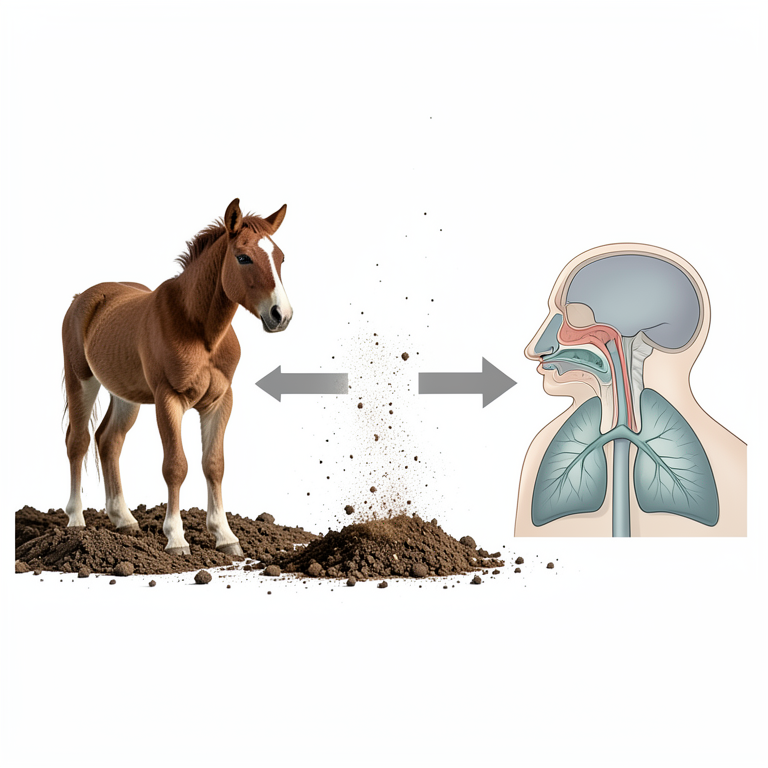
Transmission Pathway
AI-generated conceptual illustration (foals, soil, and a human respiratory system). It explains the idea and does not show study data.
View source evidence ↗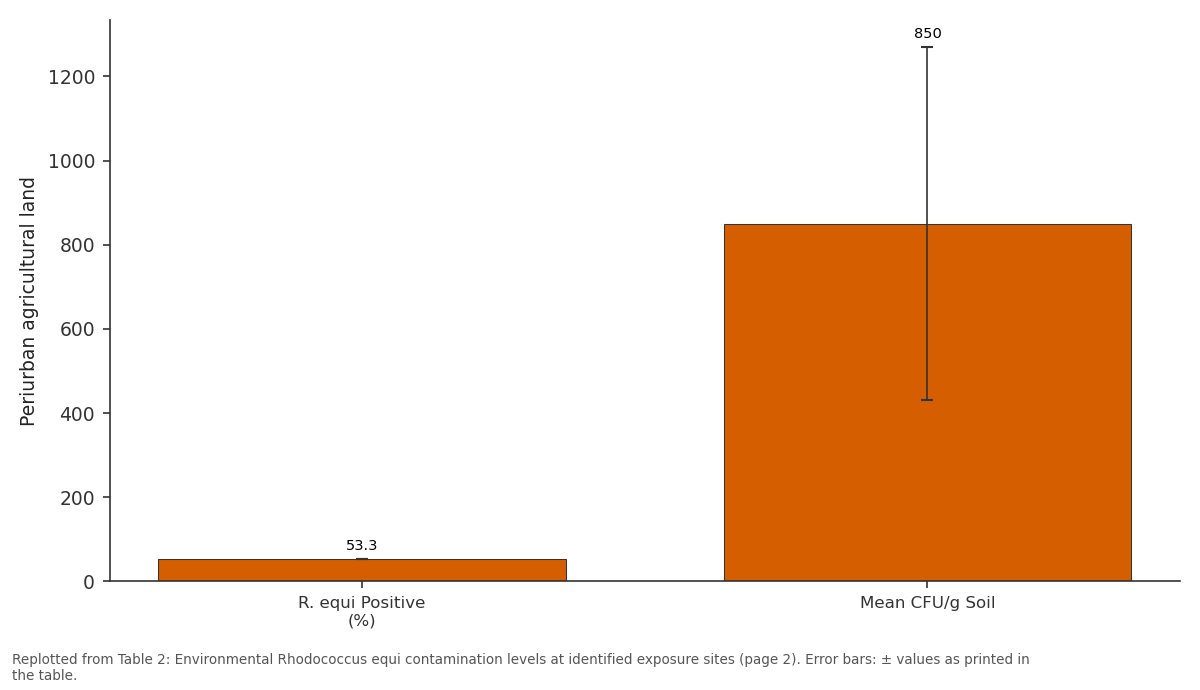
Periurban agricultural land: R. equi Positive (%) vs Mean CFU/g Soil
Replotted from Table 2 (page 2) of the original paper. Every bar is the paper's own table value.
View source evidence ↗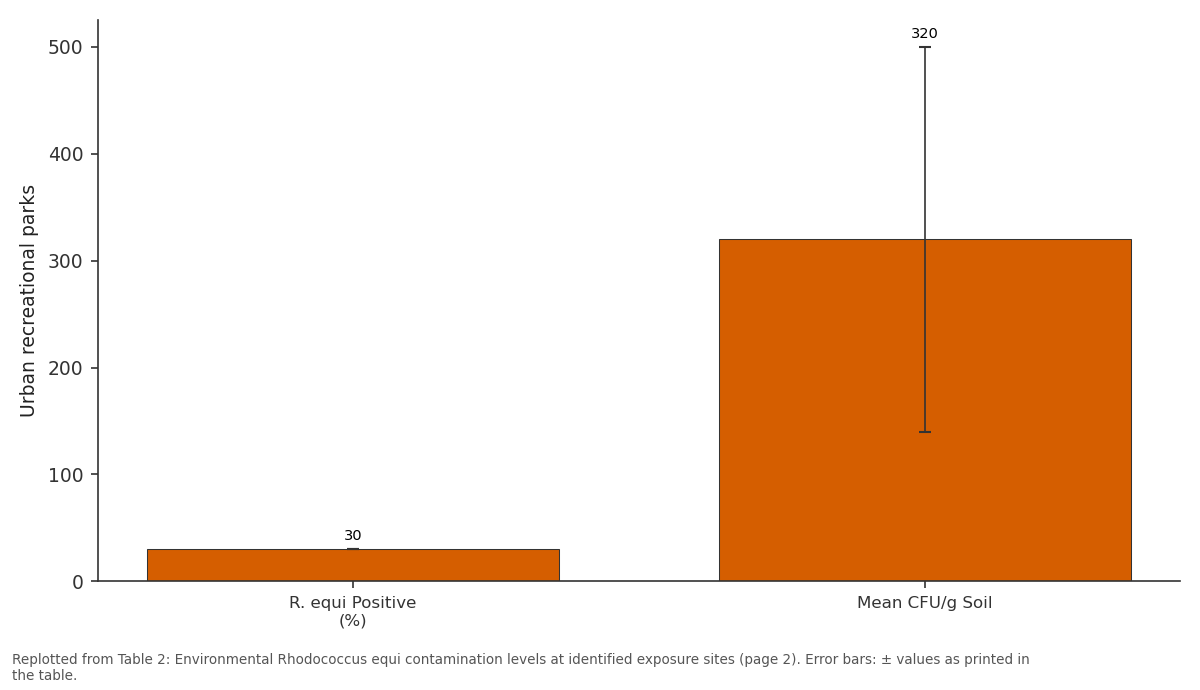
Urban recreational parks: R. equi Positive (%) vs Mean CFU/g Soil
Replotted from Table 2 (page 2) of the original paper. Every bar is the paper's own table value.
View source evidence ↗Figures & tables
From the original paper Table 1
 Table 2
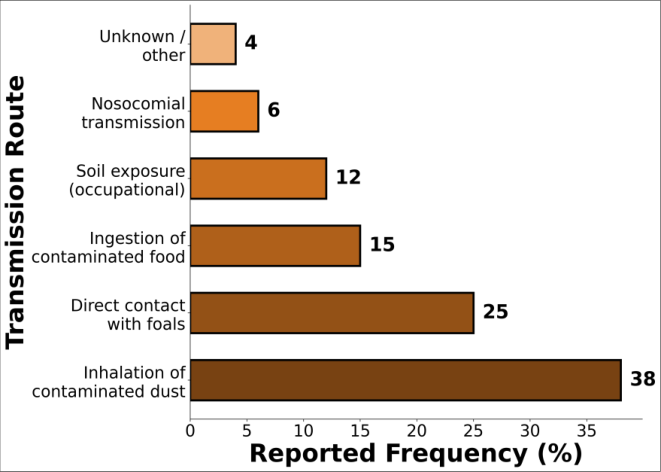 Figure 1
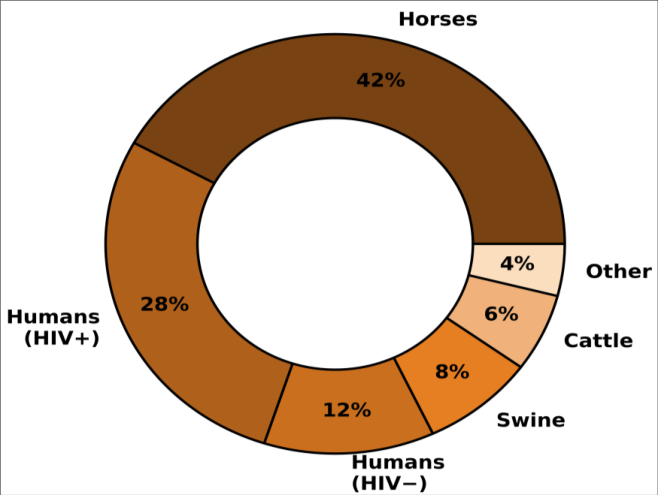 Figure 2
Introduction
The growing interface between immunocompromised human populations and livestock production systems in sub-Saharan Africa creates conditions uniquely favorable for the zoonotic transmission of Rhodococcus equi, yet the epidemiological determinants of this transmission remain poorly characterized in the African context. R. equi is a ubiquitous soildwelling organism that achieves its highest environmental concentrations in soils contaminated with herbivore feces, particularly from horses, cattle, and other grazing animals. The organism's capacity to multiply to high densities in manure-enriched soils, combined with its resistance to desiccation and environmental stresses, facilitates aerosolization and inhalation exposure in occupational and residential settings proximate to livestock operations. This research aimed to assess the zoonotic transmission dynamics and risk factors for R. equi infections through a prospective case-control investigation in Nairobi County, Kenya, integrating epidemiological exposure assessment with molecular typing to establish transmission linkages between animal and human isolates. PCR-positive from clinical specimens). For each case, three controls matched by age (±5 years), sex, and healthcare facility were selected from patients presenting with non-R. equi respiratory infections during the same period. The research protocol received ethical approval from the Nairobi Academy of Biomedical Sciences Institutional Review Board (Protocol: NABS/IRB/2021/ZD-034) and written informed consent was obtained from all participants.
Methods
Structured epidemiological questionnaires captured data on demographics, HIV status and CD4+ count, occupational history, residential proximity to livestock operations (measured by GPS coordinates), animal contact patterns, dust exposure history, travel history, and potential nosocomial exposures. Environmental sampling was conducted at identified exposure locations using soil collection from multiple sites and volumetric air sampling using Andersen cascade impactors. R. equi isolation from environmental samples employed selective medium (CAZ-NB) with incubation at 30 °C for 48-72 hours. MLST typing of clinical and environmental isolates used the standard seven-locus scheme. Risk factor analysis employed conditional logistic regression with adjustment for potential confounders, reporting odds ratios with 95% confidence intervals. Attributable fraction calculations estimated the proportion of cases preventable through elimination of specific risk factors.
Results
The research enrolled 82 confirmed R. equi cases and 246 matched controls. Among cases, 60 (73.2%) were HIVpositive with a median CD4+ count of 68 cells/μL (IQR: 28-142). The median age was 36 years (IQR: 28-48), and 52 (63.4%) were male. The most frequently identified transmission routes were inhalation of contaminated dust (38%), direct contact with foals or horses (25%), ingestion of contaminated food or water (15%), occupational soil exposure (12%), nosocomial transmission (6%), and unknown or other routes (4%).
One health framework applications
The zoonotic transmission dynamics of R. equi exemplify the One Health paradigm, where disease prevention requires coordinated interventions across human medicine, veterinary medicine, and environmental management sectors. Practical applications include integrated surveillance systems linking veterinary R. equi case notifications with human clinical data, environmental monitoring programs at high-risk equine facilities, and cross-sectoral risk communication strategies targeting immunocompromised populations with identified animal contact or environmental exposure risks.
Risk mitigation strategies
Based on the identified risk factors, evidence-based risk mitigation strategies should include advising immunocompromised individuals to avoid occupational and recreational activities involving direct equine contact or exposure to horse farm environments, implementing dust suppression measures at equine breeding facilities located near residential areas, promoting awareness among HIV care providers regarding R. equi risk associated with environmental exposures, and considering R. equi prophylaxis or enhanced surveillance for severely immunosuppressed patients with unavoidable equine exposure histories.
Conclusion
The principal contribution of this research is the quantitative characterization of zoonotic R. equi transmission risk factors in an East African setting, demonstrating that severe immunosuppression, occupational livestock exposure, and residential proximity to equine facilities independently increase infection risk. Supporting evidence includes environmental contamination gradients showing 50-fold higher R. equi concentrations at horse farms compared to control sites, molecular linkages between clinical and environmental isolates through shared MLST profiles, and the identification of airborne dust inhalation as the predominant transmission route. The significance of these findings extends beyond R. equi epidemiology to the broader One Health framework, illustrating how urbanization, livestock intensification, and immunosuppressive disease epidemics converge to create novel zoonotic transmission opportunities. Open questions warranting further investigation include the seasonal dynamics of R. equi aerosol concentrations in tropical settings, the effectiveness of dust suppression interventions in reducing transmission, the potential role of non-equine livestock species as underrecognized R. equi reservoirs, and the cost-effectiveness of targeted screening programs for high-risk populations.
Acknowledgement
AcknowledgementsThe Nairobi Academy of Biomedical Sciences provided access to clinical databases, epidemiological research infrastructure, and environmental sampling equipment essential for this investigation. The contributions of the field research team, particularly Mr. Daniel Ochieng and Ms. International Journal of Biology Sciences https://www.biologyjournal.net Faith Wanjiru, in participant enrollment and environmental sampling are gratefully acknowledged. This research was funded by the Wellcome Trust Africa Programme.
Figures and tables from the paper
| Risk Factor | Cases (n=82) | Controls (n=246) | Adjusted OR (95% CI) | p-value |
|---|---|---|---|---|
| CD4+ < 100 cells/μL | 48 (58.5%) | 18 (7.3%) | 8.5 (3.8-19.2) | <0.001 |
| Occupational livestock exposure | 35 (42.7%) | 32 (13.0%) | 4.8 (2.2-10.5) | <0.001 |
| Residence < 500m from equine facility | 28 (34.1%) | 35 (14.2%) | 3.2 (1.5-6.8) | 0.003 |
| Current smoker | 22 (26.8%) | 42 (17.1%) | 1.8 (0.9-3.6) | 0.092 |
| Manual soil contact (gardening/farming) | 30 (36.6%) | 48 (19.5%) | 2.4 (1.2-4.8) | 0.012 |
| Previous tuberculosis treatment | 18 (22.0%) | 28 (11.4%) | 2.1 (1.0-4.5) | 0.048 |
Table text extracted from the original PDF; superscript letters are shown inline. The original table image is below.
View original table image
| Exposure Site Type | Sites Sampled (n) | R. equi Positive (%) | Mean CFU/g Soil | Virulent Isolates (%) |
|---|---|---|---|---|
| Horse breeding farms | 12 | 91.7% | 4,250±1,800 | 72.5% |
| Cattle grazing areas | 8 | 75.0% | 2,100±950 | 45.2% |
| Periurban agricultural land | 15 | 53.3% | 850±420 | 28.6% |
| Urban recreational parks | 10 | 30.0% | 320±180 | 15.4% |
| Control (forest/wetland) | 6 | 16.7% | 85±45 | 8.3% |
Table text extracted from the original PDF; superscript letters are shown inline. The original table image is below.
View original table image
References
16 in the original paper- Muscatello G, Anderson GA, Gilkerson JR, Browning GF. Associations between the ecology of virulent Rhodococcus equi and the epidemiology of Rhodococcus equi pneumonia on Australian Thoroughbred farms. Appl Environ Microbiol. 2006;72(9):6152-6160.
- Takai S, Sasaki Y, Ikeda T, Uchida Y, Tsubaki S, Sekizaki T. Virulence of Rhodococcus equi isolates from patients with and without AIDS. J Clin Microbiol. 1994;32(2):457-460.
- Weinstock DM, Brown AE. Rhodococcus equi: an emerging pathogen. Clin Infect Dis. 2002;34(10):13791385.
- Pal M, Gutama KP, Singh S, Botton S. Rhodococcus equi: an emerging bacterial pathogen of public health significance. J Adv Microbiol Res. 2023;4(1):32-35.
- McNeil MM, Brown JM. The medically important aerobic actinomycetes: epidemiology and microbiology. Clin Microbiol Rev. 1994;7(3):357-417.
- Cohen ND, Carter CN, Scott HM, Luby-Phelps K, Palmer GH. Aerosol dissemination of Rhodococcus equi from the environment of naturally infected foals. Equine Vet J. 2008;40(6):590-595.
- Yamshchikov AV, Schuetz A, Lyon GM. Rhodococcus equi infection. Lancet Infect Dis. 2010;10(5):350-359.
- Hughes KL, Sulaiman I. The ecology of Rhodococcus equi and physicochemical influences on growth. Vet Microbiol. 1987;14(3):241-250.
- Giguère S, Cohen ND, Chaffin MK. Rhodococcus equi: clinical manifestations, virulence, and immunity. J Vet Intern Med. 2011;25(6):1221-1230.
- Vázquez-Boland JA, Giguère S, Hapeshi A, MacArthur I. Rhodococcus equi: the many facets of a pathogenic actinomycete. Vet Microbiol. 2013;167(1-2):9-33.
- Tuon FF, Siciliano RF, Al-Musawi T, Rossi F, Gryschek RC, Kono A, Rocha JL, Costa SF, Abdala E. Rhodococcus equi bacteremia and AIDS in developing countries. Mycopathologia. 2007;163(2):87-95.
- Takai S, Hines SA, Sekizaki T, et al. DNA sequence and comparison of virulence plasmids from Rhodococcus equi. Infect Immun. 2000;68(12):68406847.
- Linder R. Rhodococcus equi and Corynebacterium haemolyticum: two "coryneform" bacteria increasingly recognized as agents of human infection. Emerg Infect Dis. 1997;3(2):145-153.
- Meijer WG, Prescott JF. Rhodococcus equi. Vet Res. 2004;35(4):383-396.
- Prescott JF. Rhodococcus equi: an animal and human pathogen. Clin Microbiol Rev. 1991;4(1):20-34.
- Hondalus MK. Pathogenesis and virulence of Rhodococcus equi. Vet Microbiol. 1997;56(3-4):257268.