
Research article · 2026 · Full text
International Journal of Agriculture and NutritionDetermination of economic injury levels and quantification of yield losses caused by Phenacoccus solenopsis Tinsley (Hemiptera: Pseudococcidae) on okra in Indonesian lowland production systems
Volume 8(4) · Pages 148–151 · DOI: 10.33545/26646064.2026.v8.i4b.707 ↗
Research areasResearch on scale insectsInsect-Plant Interactions and ControlHemiptera Insect Studies
Abstract
Author-writtenA recent field survey across five Indonesian provinces revealed that cotton mealybug infestation severity on okra had escalated by 240% between 2018 and 2023, yet the economic thresholds governing management decision-making for this pest remained undefined for tropical Southeast Asian conditions. This research established the economic injury level (EIL) and economic threshold (ET) for Phenacoccus solenopsis Tinsley (Hemiptera: Pseudococcidae) on okra (Abelmoschus esculentus L.) through controlled infestation experiments at the Surabaya Institute of Agricultural Entomology, Indonesia, during 2023. Seven infestation levels (0, 5, 10, 20, 40, 80, and 160 mealybugs per plant) were established on okra cultivar Genie at the four-leaf stage in a completely randomized design with eight replications. Yield loss relationships were modelled using regression analysis, with EIL calculated from the damage function incorporating management costs, control efficacy, market value, and damage abatement coefficients. Results demonstrated a highly significant linear-plateau yield loss function (R² = 0.94), with yield declining at a rate of 0.148 t/ha per mealybug per plant up to the saturation threshold of 120 mealybugs. The calculated EIL was 8.4 mealybugs per plant, with the corresponding ET set at 5.6 mealybugs per plant (67% of EIL). At the EIL population, yield loss amounted to 18.4% relative to uninfested controls. These threshold values provide the first quantitative decision criteria for P. solenopsis management on okra in tropical Southeast Asian production systems.
Summary
Source-checkedPlain-language reading of the full paper, prepared with AI and checked against the text. Each point links to the authors' own words.
Why it matters
- Cotton mealybug infestation on okra in Indonesia increased by 240% from 2018 to 2023, highlighting a growing pest problem. View evidence ↗
- Phenacoccus solenopsis is a significant constraint to okra production globally, capable of causing yield losses between 25% and 78% under heavy infestation. View evidence ↗
- In Indonesia, the lack of defined economic thresholds for this pest leads to subjective management decisions, which can result in either unnecessary pesticide use or delayed action. View evidence ↗
The question
- The study aimed to establish the yield-loss relationship, economic injury level (EIL), and economic threshold (ET) for P. solenopsis on okra in Indonesian lowland tropical conditions. View evidence ↗
What they did
- The experiment took place during the 2023 dry season (May-October) in a screenhouse at the Surabaya Institute of Agricultural Entomology in East Java, Indonesia. View evidence ↗
- Okra cultivar Genie was tested using a completely randomized design with eight replications across seven infestation levels: 0, 5, 10, 20, 40, 80, and 160 mealybugs per plant. View evidence ↗
- Yield was measured by recording the total number and weight of harvested fruits per plant from approximately 50 days after sowing until the end of the crop cycle. View evidence ↗
- The EIL was calculated using a standard formula incorporating management costs, market value, damage per pest unit, control efficacy, and damage abatement. View evidence ↗
What they found
- The study found a highly significant linear-plateau yield loss function (R² = 0.94), with a damage coefficient of 1.48% yield loss per mealybug per plant. View evidence ↗
- The calculated economic injury level (EIL) was 8.4 mealybugs per plant, and the economic threshold (ET) was set at 5.6 mealybugs per plant. View evidence ↗
- There is a management action window of 10-14 days between the time a population reaches the ET and the time it reaches the EIL. View evidence ↗
- At the EIL, fruit quality declined, with 14.2% of fruits affected by honeydew and marketable grade proportions dropping from 94.8% to 82.6% due to sooty mould. View evidence ↗
- Sensitivity analysis showed EIL values vary from 4.1 to 16.4 mealybugs per plant depending on market value and costs, meaning a single threshold is not suitable for all contexts. View evidence ↗
What it means
- The authors conclude that they have provided the first experimentally validated EIL (8.4 mealybugs/plant) and ET (5.6 mealybugs/plant) for this pest on okra in tropical Southeast Asia. View evidence ↗
- Future work is needed to validate these thresholds across different seasons and locations, develop weather-driven dynamic models, and establish thresholds specifically for biological control. View evidence ↗
Visual summary
3 visualsIllustrations explain the paper; charts are replotted from the paper's own table values.
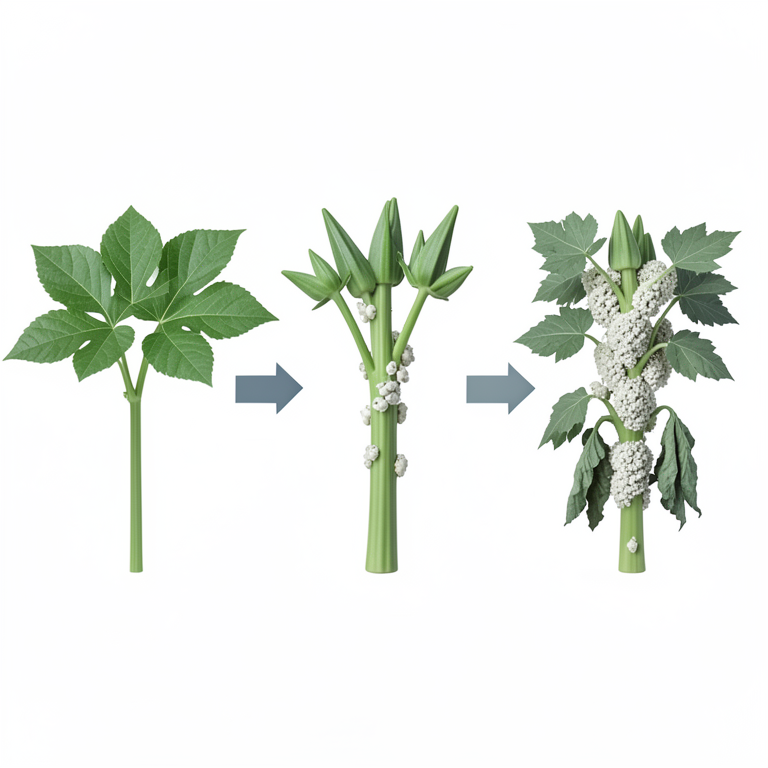
Management Action Window
AI-generated conceptual illustration (okra plants infested with mealybugs (Phenacoccus solenopsis)). It explains the idea and does not show study data.
View source evidence ↗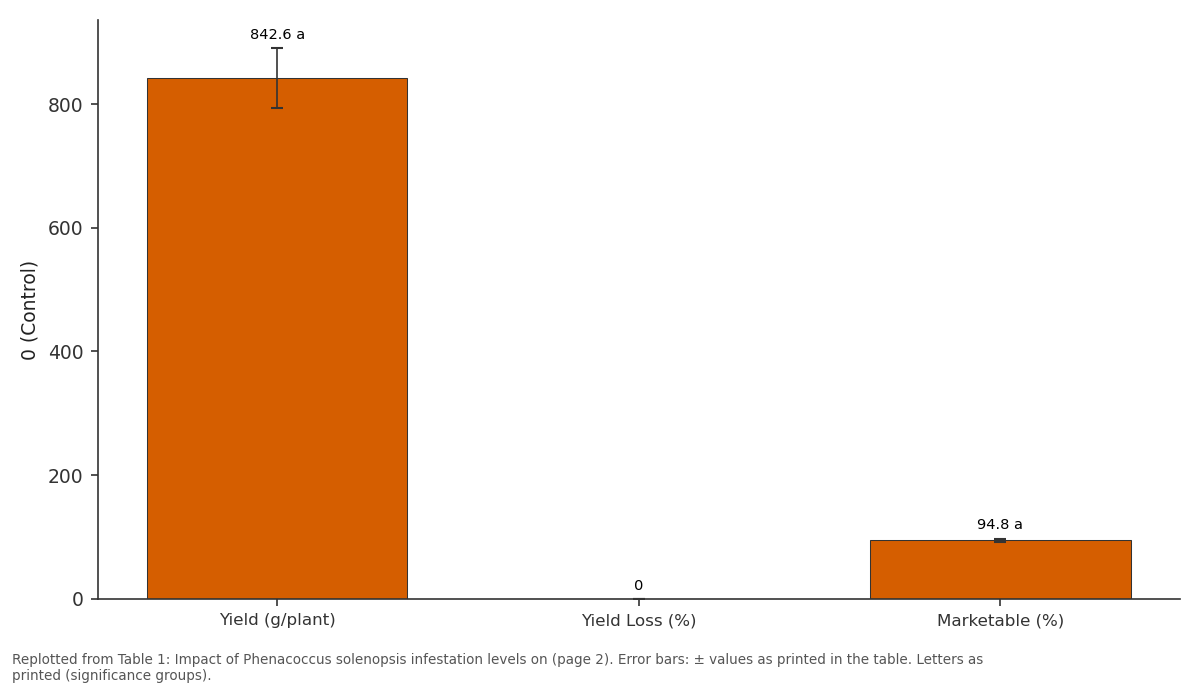
0 (Control): Yield (g/plant) vs Yield Loss (%) vs Marketable (%)
Replotted from Table 1 (page 2) of the original paper. Every bar is the paper's own table value.
View source evidence ↗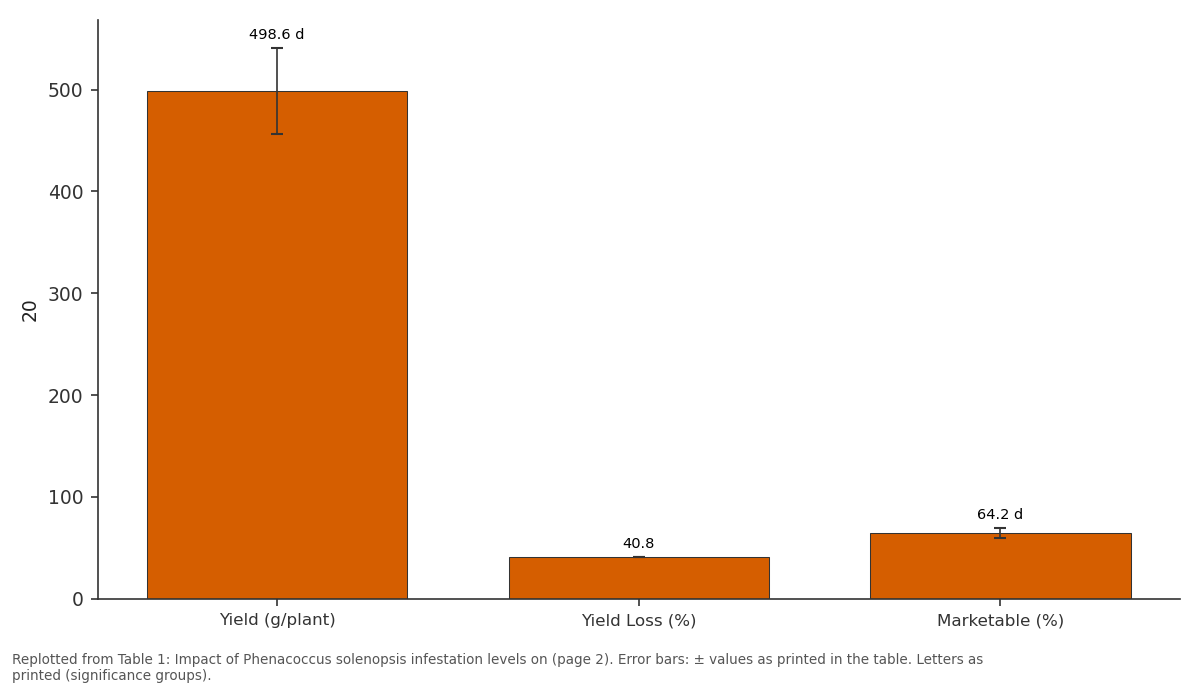
20: Yield (g/plant) vs Yield Loss (%) vs Marketable (%)
Replotted from Table 1 (page 2) of the original paper. Every bar is the paper's own table value.
View source evidence ↗Figures & tables
From the original paper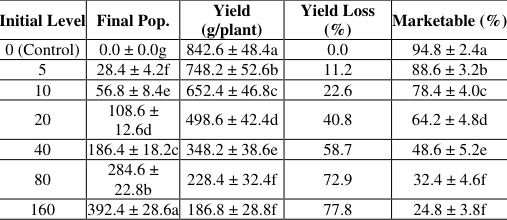 Table 1
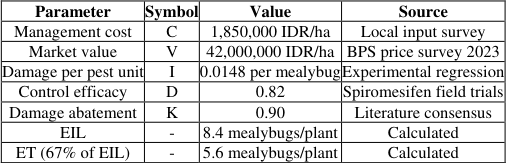 Table 2
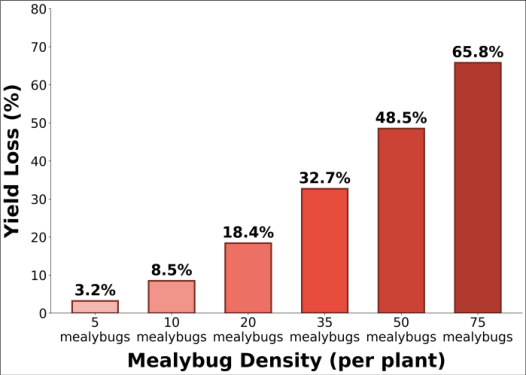 Figure 1
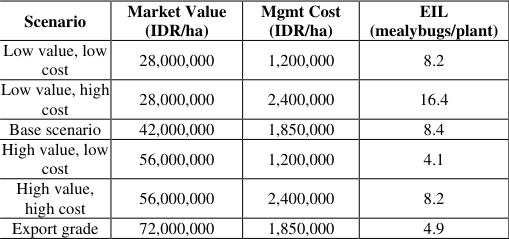 Table 3
 Figure 2
Introduction
For example, a mealybug population that appears visually alarming may not warrant intervention if management costs exceed the value of prevented yield loss, while a seemingly modest infestation may justify immediate action on high-value crops with steep damage functions [1] . This principle, formalized as the economic injury level (EIL) concept by Stern and colleagues in 1959, remains the cornerstone of rational pest management decisionmaking, yet EIL values remain undefined for many pest-crop combinations in tropical production systems [2,3] . The cotton mealybug Phenacoccus solenopsis Tinsley (Hemiptera: Pseudococcidae) has become a major constraint to okra (Abelmoschus esculentus L.) production across tropical and subtropical regions, with yield losses ranging from 25% to 78% reported under heavy infestation conditions in various countries [4,5] . In Indonesia, where okra cultivation supports an expanding export-oriented horticulture sector, the absence of established economic thresholds has resulted in management decisions based entirely on subjective assessment of infestation severity. This approach frequently leads to either premature application of costly pesticides at sub-economic pest densities, or delayed intervention that permits populations to exceed levels at which management can prevent significant economic loss [6] . The present research addressed this critical knowledge gap by experimentally establishing the yield-loss relationship, economic injury level, and economic threshold for P. solenopsis on okra under Indonesian lowland tropical conditions. The resulting threshold values provide quantitative criteria for evidence-based management decisions that optimize the balance between control costs and yield protection benefits.
Material and Methods
Material and Methods
Material
The research was conducted during the 2023 dry season (May-October) under screenhouse conditions at the Surabaya Institute of Agricultural Entomology, East Java Province, Indonesia (
Results
Mealybug population establishment success exceeded 85% across all infestation levels, and populations developed characteristic exponential growth patterns during the initial 30 days, followed by density-dependent stabilization. The relationship between initial infestation level and cumulative yield loss exhibited a highly significant linear-plateau pattern (Table 1). Values are mean ± SE (n = 8). Means followed by the same letter within columns are not significantly different (Tukey HSD, P < 0.05). Final population represents the mean count per plant at 60 days post-infestation. 2). The management cost (C) incorporated insecticide procurement, application labour, and sprayer depreciation. Market value (V) was based on the 2023 average farmgate price for okra in East Java Province. The sensitivity analysis demonstrates that EIL values range from 4.1 to 16.4 mealybugs per plant across realistic economic scenarios. The EIL is most sensitive to crop market value, with high-value export-grade production requiring substantially lower pest density thresholds to justify management intervention.
| Initial Level | Final Pop. | Yield (g/plant) | Yield Loss (%) | Marketable (%) |
|---|---|---|---|---|
| 0 (Control) | 0.0 ± 0.0g | 842.6 ± 48.4a | 0.0 | 94.8 ± 2.4a |
| 5 | 28.4 ± 4.2f | 748.2 ± 52.6b | 11.2 | 88.6 ± 3.2b |
| 10 | 56.8 ± 8.4e | 652.4 ± 46.8c | 22.6 | 78.4 ± 4.0c |
| 20 | 108.6 ± 12.6d | 498.6 ± 42.4d | 40.8 | 64.2 ± 4.8d |
| 40 | 186.4 ± 18.2c | 348.2 ± 38.6e | 58.7 | 48.6 ± 5.2e |
| 80 | 284.6 ± 22.8b | 228.4 ± 32.4f | 72.9 | 32.4 ± 4.6f |
| 160 | 392.4 ± 28.6a | 186.8 ± 28.8f | 77.8 | 24.8 ± 3.8f |
Table text extracted from the original PDF; superscript letters are shown inline. The original table image is below.
View original table image
Discussion
The economic injury level of 8.4 mealybugs per plant established in this research represents the first experimentally derived management decision threshold for Phenacoccus solenopsis on okra in tropical Southeast Asian production systems. The corresponding economic threshold of 5.6 mealybugs per plant provides a practical action trigger that accounts for the 10-14 day management action window between detection and potential economic injury. These threshold values fill a critical knowledge gap that has prevented implementation of economically rational pest management decision-making in the Indonesian okra sector [1, 7] .
The linear-plateau damage function observed in this research conforms to the general pattern expected for sapfeeding insects, where yield loss increases proportionally with pest density until plant compensatory capacity is exhausted, beyond which additional pest pressure produces diminishing marginal damage [2,3] . The damage coefficient of 1.48% yield loss per mealybug per plant is higher than values reported for P. solenopsis on cotton (0.8-1.2% per mealybug) by Bakry et al. [8] , reflecting the greater economic sensitivity of okra as a fresh vegetable crop where both yield quantity and visual quality affect market value.
The sensitivity analysis reveals important practical considerations for threshold implementation across different production contexts. The four-fold variation in EIL values (4.1-16.4 mealybugs per plant) across the range of economic scenarios tested demonstrates that a single threshold value cannot adequately serve all market and cost conditions [9,10] . For export-oriented production, where market premiums for blemish-free fruit amplify the economic consequences of pest damage, an EIL of 4.9 mealybugs per plant would be more appropriate than the base scenario value of 8.4.
Conversely, for domestic market production facing high management costs, the higher EIL of 16.4 mealybugs per plant would prevent economically unjustified pesticide expenditure [11,12] . The 10-14 day management action window between ET detection and economic injury, while adequate for chemical intervention, may be insufficient for biological control approaches that require longer establishment periods. This temporal constraint suggests that biological control agents should be deployed preventatively or at sub-threshold population levels to ensure establishment before populations reach critical densities, rather than as reactive treatments triggered by threshold exceedance [13] .
Fruit Quality Deterioration Analysis
Beyond the direct yield quantity impacts, mealybug infestation caused progressive deterioration of fruit quality attributes with increasing pest density. At the EIL population of 8.4 mealybugs per plant, honeydew contamination affected 14.2% of harvested fruits and sooty mould coverage reduced the marketable grade proportion from 94.8% (uninfested) to 82.6%. These quality impacts amplify the economic losses beyond those captured by yield quantity alone, particularly for export-destined production where visual appearance criteria determine market access and price premiums.
Monitoring Protocol Recommendations
Based on the population dynamics data, a practical monitoring protocol was developed for ET detection. Sequential sampling of 20 plants per hectare at five-day intervals during the vegetative and early reproductive stages provides 90% probability of detecting populations at or above the ET of 5.6 mealybugs per plant. The sampling protocol focuses on the terminal three nodes and subtending leaf axils, which harbour 72.4% of the total plant population during the critical pre-threshold development phase. Implementation of this monitoring protocol would enable timely management decisions within the available 10-14 day action window.
Conclusion
The main contribution of this research provides the first experimentally validated economic injury level (8.4 mealybugs per plant) and economic threshold (5.6 mealybugs per plant) for Phenacoccus solenopsis on okra in tropical Southeast Asian production systems. The supporting evidence demonstrates that yield loss follows a linear-plateau function with a damage coefficient of 1.48% per mealybug per plant. The field significance of these findings lies in enabling rational, economically justified management decisions that replace subjective assessment with quantitative criteria. Open questions remaining include the validation of threshold values across multiple seasons and geographic locations within Indonesia, the development of dynamic EIL models incorporating weather-driven population growth rates, and the establishment of corresponding thresholds for biological control-based management systems where the longer pest suppression timeline may require modified threshold implementation strategies.
Acknowledgement
Acknowledgements D.A.P. designed the experimental framework and supervised infestation protocols, S.R.W. conducted population monitoring and yield assessments, and B.H.S. performed economic analysis and sensitivity modelling. The Surabaya Institute of Agricultural Entomology provided screenhouse facilities and insectary infrastructure. Financial support was provided by the Indonesian Ministry of Agriculture. The Indonesian Vegetable Growers Association contributed market price data.
Figures and tables from the paper
| Parameter | Symbol | Value | Source |
|---|---|---|---|
| Management cost | C | 1,850,000 IDR/ha | Local input survey |
| Market value | V | 42,000,000 IDR/ha | BPS price survey 2023 |
| Damage per pest unit | I | 0.0148 per mealybug | Experimental regression |
| Control efficacy | D | 0.82 | Spiromesifen field trials |
| Damage abatement | K | 0.90 | Literature consensus |
| EIL | - | 8.4 mealybugs/plant | Calculated |
| ET (67% of EIL) | - | 5.6 mealybugs/plant | Calculated |
Table text extracted from the original PDF; superscript letters are shown inline. The original table image is below.
View original table image
| Scenario | Market Value (IDR/ha) | Mgmt Cost (IDR/ha) | EIL (mealybugs/plant) |
|---|---|---|---|
| Low value, low cost | 28,000,000 | 1,200,000 | 8.2 |
| Low value, high cost | 28,000,000 | 2,400,000 | 16.4 |
| Base scenario | 42,000,000 | 1,850,000 | 8.4 |
| High value, low cost | 56,000,000 | 1,200,000 | 4.1 |
| High value, high cost | 56,000,000 | 2,400,000 | 8.2 |
| Export grade | 72,000,000 | 1,850,000 | 4.9 |
Table text extracted from the original PDF; superscript letters are shown inline. The original table image is below.
View original table image
References
14 in the original paper- Pedigo LP, Rice ME, Krell RK. Entomology and pest management. 7th ed. Long Grove (IL): Waveland Press; 2021. p. 1-784.
- Hodgson CJ, Abbas G, Arif MJ, Saeed S, Karar H. Phenacoccus solenopsis Tinsley, an invasive mealybug. Zootaxa. 2008;1913(1):1-35.
- Nagrare VS, Kranthi S, Biradar VK, Zade NN, Sangode V. Widespread infestation of Phenacoccus solenopsis on cotton in India. Bull Entomol Res. 2009;99(5):537541.
- Abbas G, Arif MJ, Saeed S, Karar H. A new invasive species of genus Phenacoccus Cockerell attacking cotton in Pakistan. Int J Agric Biol. 2009;11(2):163167.
- Fand BB, Tonnang HEZ, Kumar M, Kamble AL, Bal SK. A temperature-based phenology model for the mealybug Phenacoccus solenopsis. Crop Prot. 2014;55:98-107.
- Mani M, Shivaraju C, editors. Mealybugs and their management in agricultural and horticultural crops. New Delhi: Springer India; 2016. p. 1-655.
- Suroshe SS, Gautam RD, Fand BB. Natural enemy complex of Phenacoccus solenopsis and its biocontrol potential. Proc Natl Acad Sci India Sect B Biol Sci. 2020;90(4):687-700.
- Bakry MSM, Mohamed LHY, Shehata EA. Estimation of the cotton mealybug, Phenacoccus solenopsis Tinsley (Hemiptera: Pseudococcidae), populations and its relation to okra yield. Zool Entomol Lett. 2023;3(2):59-69.
- Tong HJ, Ao Y, Li ZH, Wang Y, Jiang MX. Invasion biology of the cotton mealybug: Current knowledge and future directions. J Integr Agric. 2019;18(4):758-770.
- Gullan PJ, Kosztarab M. Adaptations in scale insects. Annu Rev Entomol. 1997;42(1):23-50.
- Mahmood R, Aslam MN, Solangi GS, Samad A. Historical perspective in biological control of cotton mealybug in Pakistan. Proc Int Cotton Advis Comm. 2011;5:41-50.
- Arif MI, Rafiq M, Ghaffar A. Host plants of cotton mealybug. Int J Agric Biol. 2009;11(2):163-167.
- Fand BB, Tonnang HEZ, Kumar M, Bal SK, Singh NP, Rao DVKN, et al. Predicting climate change impact on Phenacoccus solenopsis. PLoS One. 2014;9(12):e116153.
- Gemede HF, Ratta N, Haki GD, Woldegiorgis AZ. Nutritional quality and health benefits of okra. J Food Process Technol. 2015;6(6):458.