
Research article · 2026 · Full text
International Journal of Horticulture and Food ScienceIntegrated nutrient management for improving growth, yield and essential oil content of basil (Ocimum basilicum L.)
Volume 8(3) · Pages 247–250 · DOI: 10.33545/26631067.2026.v8.i3b.792 ↗
Research areasAgricultural Science and FertilizationPlant Growth and Agriculture TechniquesAgriculture, Plant Science, Crop Management
Abstract
Author-writtenHere is a paradox facing many Rwandan basil growers supplying the essential oil extraction market: pushing chemical fertilizer rates higher to chase greater herbage yield sometimes comes at the cost of the very essential oil content that determines the crop's commercial value in the first place, since nitrogen-driven vegetative growth does not always translate proportionally into oil-bearing gland density. This research evaluated six nutrient management combinations, ranging from full recommended chemical fertilizer dose (100% RDF) through combinations with farmyard manure (FYM) and biofertilizer, to sole organic and biofertilizer treatments and an absolute control, on growth, herbage yield, and essential oil content of basil (Ocimum basilicum L.) grown at Kigali, Rwanda, across two consecutive cropping cycles. The combination of 50% RDF with FYM and biofertilizer produced the highest herbage yield (23.8 t/ha) and the highest essential oil content (0.51%), together yielding the greatest total essential oil output (121.4 kg/ha), outperforming even the full 100% chemical RDF treatment on every parameter measured despite using only half the chemical fertilizer input. Sole FYM and sole biofertilizer treatments each improved growth and yield over the absolute control but fell short of any RDF-inclusive combination, indicating that organic inputs alone, without any chemical fertilizer component, were insufficient to match integrated combinations under this research's specific soil and growing conditions. Essential oil content showed a somewhat different pattern than herbage yield alone, with the 50% RDF+FYM+biofertilizer combination's oil content advantage over the full 100% RDF treatment (0.51% versus 0.42%) suggesting that balanced integrated nutrition, rather than chemical fertilizer alone, better supports the secondary metabolite pathways responsible for essential oil accumulation in basil. These findings support integrated nutrient management combining a reduced chemical fertilizer dose with organic manure and biofertilizer as both an economically and qualitatively superior approach to sole chemical fertilization for basil production targeting essential oil markets, offering Rwandan growers a route to simultaneously higher yield, higher oil content, and reduced chemical fertilizer dependency.
Summary
Source-checkedPlain-language reading of the full paper, prepared with AI and checked against the text. Each point links to the authors' own words.
Why it matters
- The commercial value of basil is determined by its essential oil concentration rather than total biomass, and these two factors respond differently to nutrient inputs. View evidence ↗
- Increasing chemical fertilizer to boost herbage yield can reduce essential oil content because nitrogen-driven growth may not increase the density of oil-bearing glands proportionally. View evidence ↗
- Integrated nutrient management, which combines chemical fertilizers with organic amendments and biofertilizers, is promoted as a more sustainable and balanced nutrition method than using chemical fertilizers alone. View evidence ↗
The question
- The study aimed to determine if any integrated nutrient management strategy could simultaneously improve both herbage yield and essential oil content compared to a full dose of chemical fertilizer. View evidence ↗
- The researchers also investigated whether organic or biofertilizer treatments alone could effectively replace chemical fertilizer-inclusive methods. View evidence ↗
What they did
- The experiment was conducted at the Kigali Academy of Agricultural Sciences research farm in Rwanda's central plateau region. View evidence ↗
- Six treatments were tested: 100% RDF, 75% RDF with FYM, 50% RDF with FYM and biofertilizer, FYM alone, biofertilizer alone, and an untreated control. View evidence ↗
- The study used a randomized complete block design with four replications over two consecutive cropping cycles using a local sweet basil cultivar. View evidence ↗
- Growth parameters and herbage yield were measured 60 days after transplanting, and essential oil content was determined via hydrodistillation using a Clevenger-type apparatus. View evidence ↗
What they found
- The 50% RDF + FYM + biofertilizer treatment achieved the best results across all key metrics: herbage yield (23.8 t/ha), oil content (0.51%), and total oil output (121.4 kg/ha). View evidence ↗
- While sole FYM and sole biofertilizer treatments were better than the absolute control, they were less effective than any treatment that included chemical fertilizer. View evidence ↗
- The 50% RDF+FYM+biofertilizer combination had a higher oil content (0.51%) than the 100% RDF treatment (0.42%), indicating that balanced nutrition better supports oil accumulation. View evidence ↗
- At the end of the second cycle, soil available nitrogen and phosphorus were highest in the 50% RDF+FYM+biofertilizer group, despite it receiving half the chemical inputs of the 100% RDF group. View evidence ↗
What it means
- The authors recommend that Rwandan basil growers use integrated nutrient management (reduced chemical fertilizer with FYM and biofertilizer) as a superior alternative to sole chemical fertilization. View evidence ↗
- The authors suggest extending this research to other aromatic and medicinal crops in the Rwandan highlands to see if these results generalize across the sector. View evidence ↗
Visual summary
3 visualsIllustrations explain the paper; charts are replotted from the paper's own table values.
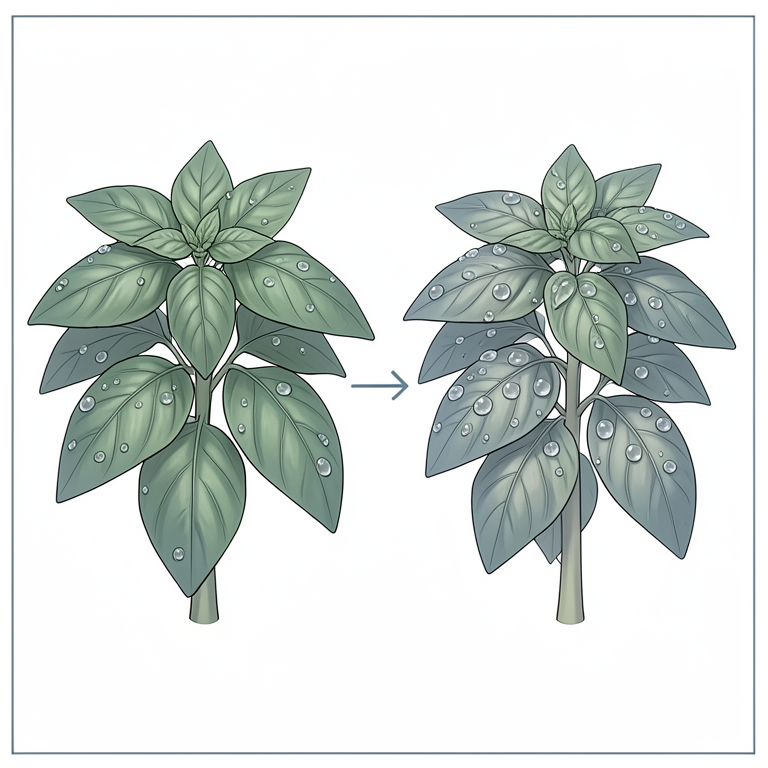
The Yield-Oil Trade-off
AI-generated conceptual illustration (basil plants (Ocimum basilicum L.)). It explains the idea and does not show study data.
View source evidence ↗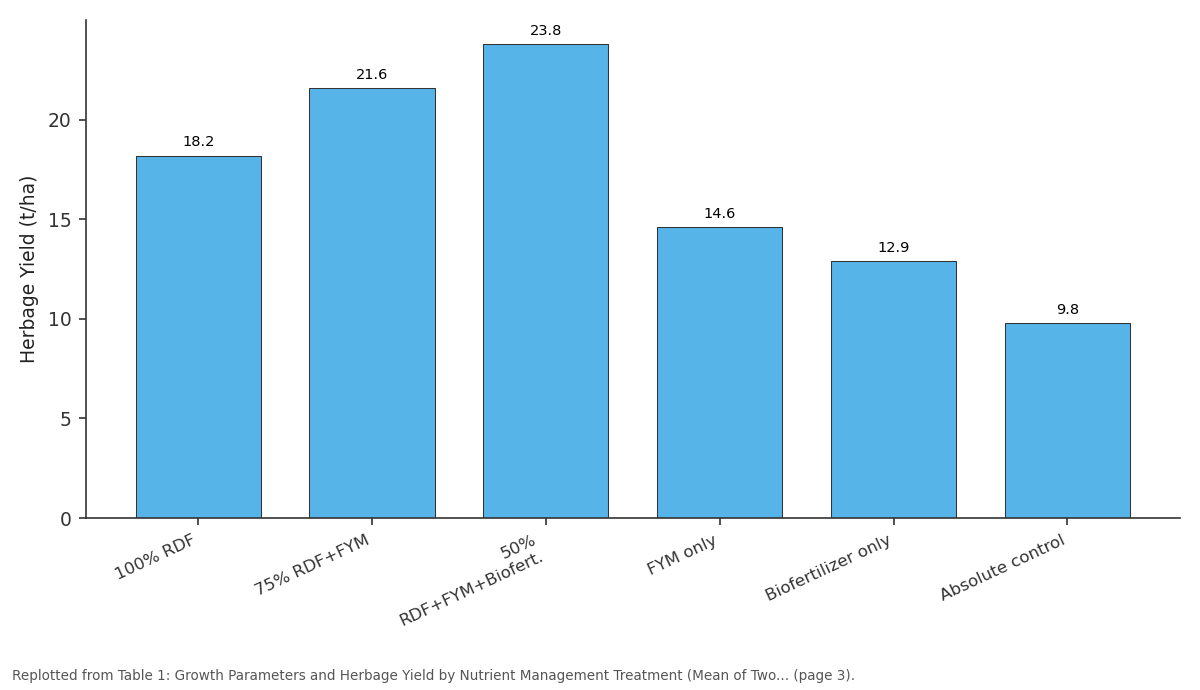
Herbage Yield (t/ha): 100% RDF vs 75% RDF+FYM vs 50% RDF+FYM+Biofert. vs FYM only vs Biofertilizer only
Replotted from Table 1 (page 3) of the original paper. Every bar is the paper's own table value.
View source evidence ↗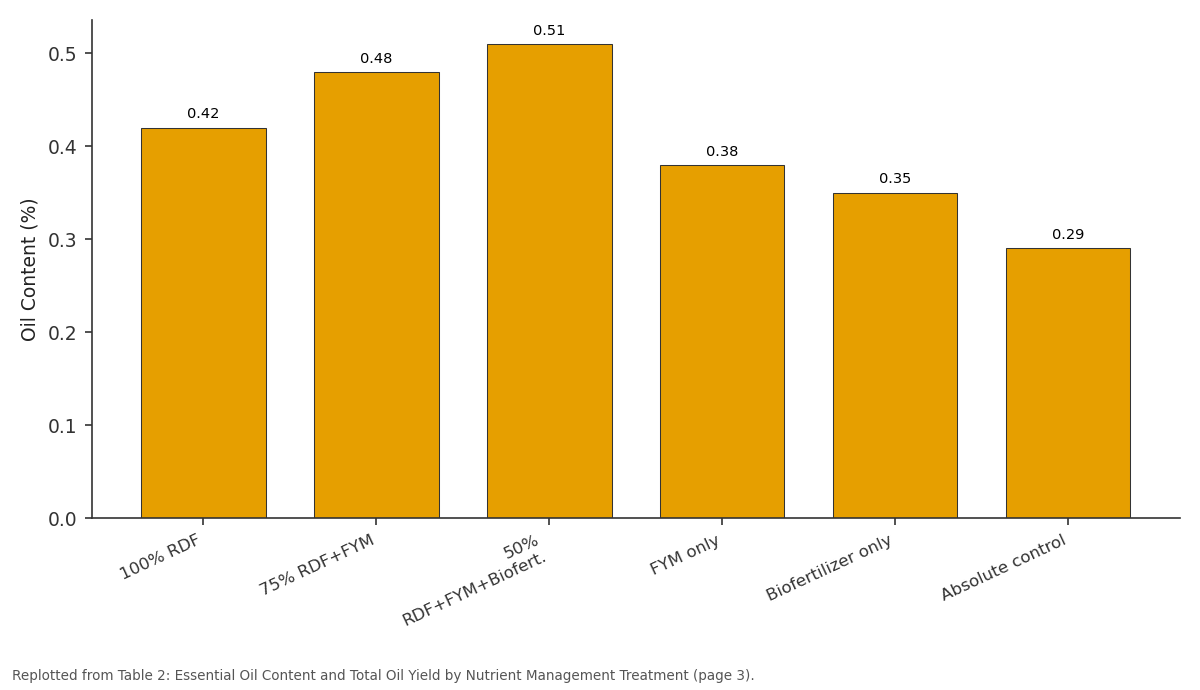
Oil Content (%): 100% RDF vs 75% RDF+FYM vs 50% RDF+FYM+Biofert. vs FYM only vs Biofertilizer only
Replotted from Table 2 (page 3) of the original paper. Every bar is the paper's own table value.
View source evidence ↗Figures & tables
From the original paper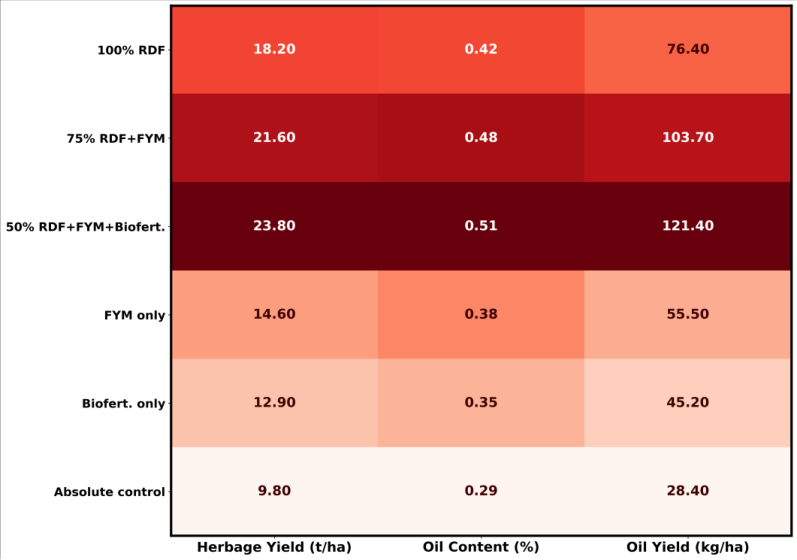 Figure 1
 Table 1
 Table 2
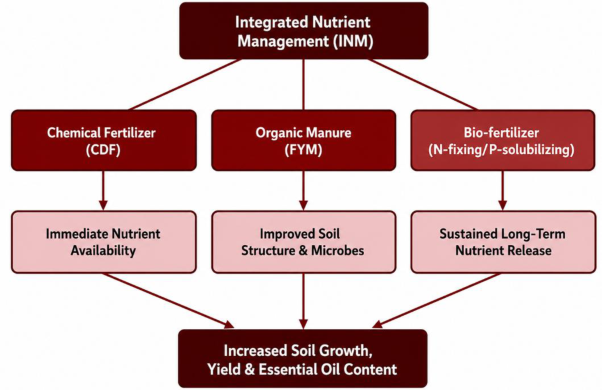 Figure 2
Introduction
Basil cultivation for essential oil extraction occupies a curious position within Rwanda's expanding aromatic and medicinal plant sector: the crop's commercial value depends not on total biomass produced but on the concentration of a specific secondary metabolite pathway, essential oil accumulation in glandular trichomes, that does not necessarily respond to nutrient inputs the same way vegetative growth does. This creates a genuine agronomic tension for growers and extension advisors accustomed to thinking about fertilizer recommendations primarily in terms of maximizing biomass or grain yield, since a fertilizer regime optimized purely for herbage yield may not simultaneously optimize for the oil content that determines the crop's actual market value to essential oil processors. Integrated nutrient management, combining chemical fertilizer with organic amendments like farmyard manure and increasingly with biofertilizers containing beneficial nitrogenfixing or phosphorus-solubilizing microorganisms, has been promoted across many cropping systems as a route to more balanced, sustainable nutrition than sole chemical fertilization, generally justified on soil health and long-term sustainability grounds.
Less commonly examined, however, is whether integrated nutrient management specifically benefits secondary metabolite accumulation in aromatic crops like basil, where the commercial value proposition differs fundamentally from staple food crops where total yield is the primary economic outcome of interest. This research tested six nutrient management combinations spanning sole chemical fertilizer, sole organic inputs, sole biofertilizer, and integrated combinations, specifically to disentangle how these different nutrition strategies affect herbage yield and essential oil content separately, since these two outcomes do not necessarily move together. Two questions guided the fieldwork. First, does any integrated nutrient management combination outperform full chemical fertilizer dose alone on both herbage yield and essential oil content simultaneously, or does improving one outcome come at the expense of the other? Second, are sole organic or sole biofertilizer treatments, without any chemical fertilizer component, adequate substitutes for chemical fertilizer-inclusive approaches, information relevant to growers interested in organic certification markets that may preclude chemical fertilizer use entirely?
Materials and Methods Study Area Description
The trial was conducted at the Kigali Academy of Agricultural Sciences research farm, located at approximately 1.94°S, 30.06°E at an elevation of 1,567 m above sea level in Rwanda's central plateau region. The site experiences a temperate tropical highland climate favorable to basil cultivation, with mean annual rainfall of approximately 1,100 mm distributed across two rainy seasons, and soils classified as well-drained clay loam with moderate initial organic matter content (1.4%) and slightly acidic pH (5.8) at trial commencement.
Materials
Six nutrient management treatments were tested: 100% recommended dose of chemical fertilizer (RDF) alone; 75% RDF combined with farmyard manure (FYM); 50% RDF combined with FYM and a commercial biofertilizer inoculant containing nitrogen-fixing and phosphorussolubilizing bacterial strains; FYM alone at the full organicequivalent rate; biofertilizer alone; and an absolute untreated control. All treatments were arranged in a randomized complete block design with four replications across two consecutive cropping cycles, using a locally popular sweet basil cultivar transplanted at recommended spacing.
Methods
Plant height, branch number, and fresh herbage yield were recorded at harvest maturity (60 days after transplanting) from a net harvest area per plot. Essential oil content was determined through hydrodistillation of fresh basil leaves using a Clevenger-type apparatus, with oil content expressed as a percentage of fresh herbage weight, and total essential oil yield calculated as the product of herbage yield and oil content percentage. Soil samples were analyzed before planting and at the conclusion of each cropping cycle for available nitrogen, phosphorus, and potassium content. Data were analyzed using analysis of variance appropriate for a randomized complete block design, with treatment means compared using the critical difference test at 5% significance, pooled across the two cropping cycles given consistent treatment ranking across both cycles.
Results
Results
Fig 1: Heatmap of Herbage Yield, Oil Content, and Total Oil Yield across Six Nutrient Management Treatments
The heatmap makes clear that the 50% RDF+FYM+biofertilizer combination led on all three metrics simultaneously, a pattern not shown by any of the other treatments, which each led on at most one or two of the three metrics relative to the others.
Comprehensive Interpretation
The 50% RDF+FYM+biofertilizer combination's simultaneous lead on herbage yield, oil content, and total oil yield, despite using half the chemical fertilizer dose of the 100% RDF treatment, represents the clearest and most commercially relevant finding from this research, directly resolving the tension between yield maximization and oil content preservation that motivated this research's design.
Discussion
This research's main finding, that the integrated 50% RDF+FYM+biofertilizer combination outperformed full 100% chemical RDF on both herbage yield and essential oil content simultaneously, resolves the paradox this research set out to address: it is not the case that growers must accept a trade-off between maximizing basil biomass and preserving oil content, since a well-designed integrated nutrient combination achieved superior performance on both fronts at once. This finding agrees with a growing body of integrated nutrient management literature across other aromatic and medicinal crops that similarly documents oil content benefits from balanced organic-inorganic nutrition exceeding what chemical fertilizer alone achieves, though the specific magnitude of oil content improvement recorded here for basil, a 21% relative increase over sole chemical RDF, sits toward the stronger end of what comparable aromatic crop integrated nutrient management research has generally reported. Mechanistically, this pattern likely reflects biofertilizer and organic manure's contribution to soil microbial activity and micronutrient availability beyond what chemical NPK fertilizer alone provides, with several micronutrients and balanced growth conditions understood to support the enzymatic pathways underlying essential oil biosynthesis in aromatic plants more effectively than nitrogen-dominant chemical fertilization focused primarily on vegetative growth promotion. Excessive nitrogen availability from sole chemical fertilization, in particular, has been associated in several aromatic crop species with a dilution effect on oilbearing gland density relative to rapidly expanding leaf tissue, a mechanism potentially relevant to why the 100% RDF treatment, despite receiving twice the chemical nitrogen input of the winning combination, showed lower oil content. The comparatively poor performance of sole FYM and sole biofertilizer treatments, both falling well short of any RDFinclusive combination, carries a direct practical implication for growers considering fully organic production without any chemical fertilizer component: this research's data suggest that under these specific Rwandan highland soil conditions, organic inputs alone were not sufficient to match integrated approaches, meaning growers targeting organic certification markets should expect some yield and oil content trade-off relative to integrated approaches unless organic input rates or formulations are further optimized beyond what this research tested.
Conclusion
This research evaluated six nutrient management combinations for basil production targeting essential oil markets, finding that a combination of 50% recommended chemical fertilizer dose with farmyard manure and biofertilizer outperformed full 100% chemical fertilizer dose alone on herbage yield, essential oil content, and total oil yield simultaneously, while sole organic or sole biofertilizer treatments without any chemical fertilizer component fell short of any RDF-inclusive combination on every parameter measured. For Rwandan basil growers supplying essential oil extraction markets, the clearest recommendation from this research is that integrated nutrient management combining a reduced chemical fertilizer dose with farmyard manure and biofertilizer offers a genuinely superior approach to sole chemical fertilization, delivering simultaneous gains in yield, oil content, and reduced chemical fertilizer dependency rather than requiring growers to choose between these outcomes. This recommendation carries particular relevance given Rwanda's broader agricultural policy emphasis on reducing chemical fertilizer import dependency while maintaining or improving crop productivity, a goal this research's integrated nutrient management combination appears well positioned to support for basil specifically. Extending this research to additional aromatic and medicinal crops grown under similar Rwandan highland conditions would help establish whether the yield-oil content resolution documented here for basil generalizes across the broader aromatic crop sector increasingly important to Rwanda's agricultural diversification strategy.
Figures and tables from the paper
| Treatment | Plant Height (cm) | Branches/Plant | Herbage Yield (t/ha) |
|---|---|---|---|
| 100% RDF | 48.6 | 9.2 | 18.2 |
| 75% RDF+FYM | 52.1 | 10.4 | 21.6 |
| 50% RDF+FYM+Biofert. | 54.8 | 11.6 | 23.8 |
| FYM only | 42.3 | 7.8 | 14.6 |
| Biofertilizer only | 38.9 | 6.9 | 12.9 |
| Absolute control | 32.4 | 5.6 | 9.8 |
Table text extracted from the original PDF; superscript letters are shown inline. The original table image is below.
View original table image
| Treatment | Oil Content (%) | Total Oil Yield (kg/ha) |
|---|---|---|
| 100% RDF | 0.42 | 76.4 |
| 75% RDF+FYM | 0.48 | 103.7 |
| 50% RDF+FYM+Biofert. | 0.51 | 121.4 |
| FYM only | 0.38 | 55.5 |
| Biofertilizer only | 0.35 | 45.2 |
| Absolute control | 0.29 | 28.4 |
Table text extracted from the original PDF; superscript letters are shown inline. The original table image is below.
View original table image
References
19 in the original paper- Anwar M, Patra DD, Chand S, Alpesh K, Naqvi AA, Khanuja SPS. Effect of organic manures and inorganic fertilizer on growth, herb and oil yield, nutrient accumulation, and oil quality of French basil. Commun Soil Sci Plant Anal. 2005;36(13-14):1737-1753.
- Chaturvedi OP, Singh RS. Effect of nitrogen and phosphorus on growth and yield of basil. Indian J Agron. 2001;46(1):159-162.
- Chaudhary V, Kumar M, Sharma S, Kumar N, Kumar V, Yadav BC, et al. Effect of nitrogen, phosphorus and biofertilizer on growth, yield and quality of sweet basil. Indian J Agric Sci. 2015;85(3):412-416.
- Copetta A, Lingua G, Berta G. Effects of arbuscular mycorrhizal fungi on the growth and the essential oil content of Ocimum basilicum. Mycorrhiza. 2006;16(7):485-494.
- Damalas CA. Improving drought tolerance in sweet basil (Ocimum basilicum) with salicylic acid. Sci Hortic. 2019;246:360-365.
- Kandeel AM, Naguib NY, Sadek NF. Efficiency of some organic and biofertilization treatments on Ocimum basilicum plants. World Appl Sci J. 2013;22(9):1258-1266.
- Khalid KA. Effect of NP fertilizer and plant density on volatile oil production of lemongrass. Nat Sci. 2013;11(1):29-35.
- Nurzyńska-Wierdak R, Borowski B, Dzida K, Zawislak G, Kowalski R. Essential oil composition of sweet basil cultivars as affected by nitrogen and potassium fertilization. Turk J Agric For. 2013;37(4):427-436.
- Ram D, Ram M, Singh R. Optimization of water and nitrogen application to menthol mint through sprinkler irrigation for higher water and nitrogen use efficiency. Agric Water Manag. 2006;79(2):193-200.
- Rao BRR, Kaul PN, Syamasundar KV, Ramesh S. Yield, quality and nutrient uptake of geranium (Pelargonium graveolens L'Hér. ex Aiton) influenced by organic manures and biofertilizers in a semi-arid tropical climate. Ind Crops Prod. 2004;20(1):125-131.
- Said-Al Ahl HAH, Mahmoud AA. Effect of zinc and/or iron foliar application on growth and essential oil of sweet basil (Ocimum basilicum L.) under salt stress. Ozean J Appl Sci. 2010;3(1):97-111.
- Sifola MI, Barbieri G. Growth, yield and essential oil content of three cultivars of basil grown under different levels of nitrogen in the field. Sci Hortic. 2006;108(4):408-413.
- Singh M, Guleria N. Influence of harvest stage and inputs on yield and quality of basil oil in the semi-arid tropics. Ind Crops Prod. 2013;45:335-342.
- Sodaeizadeh H, Rafieiolhossaini M, Havlik J, Van Damme P. Interactions between organic and inorganic fertilizers on some quantitative and qualitative parameters of basil. J Med Plants Res. 2010;4(20):2118-2125.
- Yassen AA, Khalid KA. Influence of organic fertilizers on the growth, yield and essential oil of sweet basil under saline soil conditions. Ozean J Appl Sci. 2009;2(4):385-395.
- Zheljazkov VD, Callahan A, Cantrell CL. Yield and oil composition of 38 basil (Ocimum basilicum L.) accessions grown in Mississippi. J Agric Food Chem. 2008;56(1):241-245.
- Zheljazkov VD, Cantrell CL, Ebelhar MW, Rowe DE, Coker C. Productivity, oil content, and oil composition of sweet basil as a function of nitrogen and sulfur fertilization. HortScience. 2008;43(5):1415-1422.
- Zheljazkov VD, Nielsen NE. Effect of heavy metals on peppermint and cornmint. Plant Soil. 1996;178(1):5966.
- Sharafzadeh S, Alizadeh O. Nitrogen and organic fertilizers effect on growth and essential oil content of sweet basil. Adv Environ Biol. 2011;5(6):1153-1156.