
Research article · 2026 · Full text
International Journal of Biology SciencesDevelopmental biology and nymphal stage progression in Heteropteryx dilatata: Growth patterns and survivorship analysis
Volume 8(5) · Pages 208–211 · DOI: 10.33545/26649926.2026.v8.i5c.927 ↗
Research areasOrthoptera Research and TaxonomyHemiptera Insect StudiesInsect and Arachnid Ecology and Behavior
Abstract
Author-writtenDevelopmental biology in hemimetabolous insects provides fundamental insights into growth regulation, resource allocation, and life history optimization, yet comprehensive developmental profiles for many large-bodied tropical phasmid species remain undocumented. This research characterized the complete nymphal development of Heteropteryx dilatata from egg hatching through adult eclosion, tracking 120 individuals (60 males, 60 females) reared under standardized conditions at the Melbourne Research Centre for Invertebrate Biology, Australia, over a 24-month period from January 2023 to December 2024. Five nymphal instars were confirmed for both sexes, with total nymphal development duration averaging 268 days for males and 312 days for females. Growth rate analysis revealed accelerating body mass increase in females from the third instar onward, while male growth remained relatively linear throughout development. Survivorship analysis using Kaplan-Meier curves demonstrated overall survival from hatching to adult eclosion of 45.0%, with the highest mortality occurring during first and second instar stages (combined mortality: 38.3%). The egg stage represented 38.2% of the total life cycle duration when incubation was included. Cohort life table analysis identified the first ecdysis as the critical mortality bottleneck, with improper ecdysis accounting for 62% of first-instar deaths. These developmental data establish essential benchmarks for captive management and provide the foundation for comparative developmental investigations across the Heteropterygidae.
Summary
Source-checkedPlain-language reading of the full paper, prepared with AI and checked against the text. Each point links to the authors' own words.
Why it matters
- Studying the developmental biology of hemimetabolous insects is important for understanding growth regulation and life history, but data is lacking for many large tropical phasmid species. View evidence ↗
- Research on Heteropteryx dilatata has been limited to small reports due to its long developmental period of over 10 months and demanding husbandry needs. View evidence ↗
The question
- The study aimed to create a detailed developmental profile for H. dilatata by tracking growth and mortality from hatching to adulthood. View evidence ↗
What they did
- The researchers tracked 120 first-instar nymphs from a captive colony, with eggs incubated at 27 degrees Celsius. View evidence ↗
- Nymphs were kept at 27 degrees Celsius and 78% humidity with a 12:12 light cycle and fed Psidium guajava foliage three times a week. View evidence ↗
- Weekly measurements of body length (0.1 mm precision) and weight (0.001 g precision) were taken, along with dorsal and lateral photographs. View evidence ↗
- The researchers used Dyar's rule, measuring head capsule widths from shed skins, to verify the number of nymphal instars. View evidence ↗
What they found
- Nymphal development averaged 268 days for males and 312 days for females. View evidence ↗
- The largest difference in development time between sexes was in the fifth instar, where females (72 days) took 50% longer than males (48 days). View evidence ↗
- Females showed exponential growth from the third instar, with daily mass gain increasing 3.9-fold from 0.105 g/day to 0.406 g/day by the fifth instar. View evidence ↗
- Male growth was more linear, with a modest 1.8-fold increase in daily mass gain from 0.079 g/day in the third instar to 0.144 g/day in the fifth. View evidence ↗
- Overall survival from hatching to adulthood was 48.3% for males and 41.7% for females, a difference that was not statistically significant. View evidence ↗
- The highest mortality rates occurred in the first instar (22.5%) and second instar (15.8%). View evidence ↗
- For first-instar deaths, the primary cause was ecdysis (molting) failure at 62%, followed by desiccation (24%) and infection (14%). View evidence ↗
- The egg incubation period averaged 196 days at 27 degrees Celsius. View evidence ↗
- The egg stage accounts for 38.2% of the total development time, which is unusually high for hemimetabolous insects. View evidence ↗
What it means
- Future work is needed to integrate these data with hormonal and gene expression analysis to understand the molecular causes of sexual dimorphism in growth. View evidence ↗
Visual summary
3 visualsIllustrations explain the paper; charts are replotted from the paper's own table values.
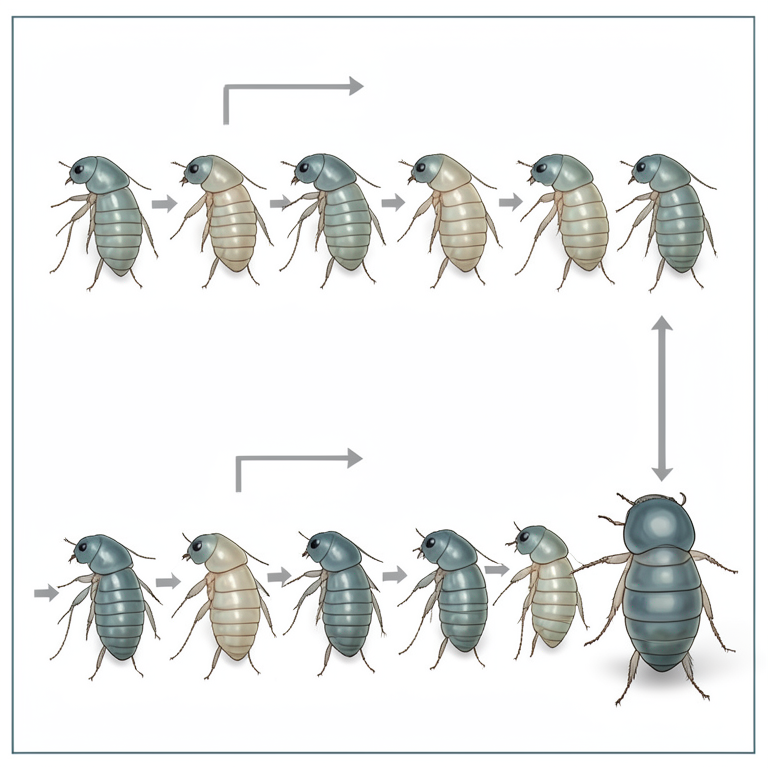
Sexual Dimorphism in Growth Rates
AI-generated conceptual illustration (Heteropteryx dilatata (giant African grasshopper) nymphs). It explains the idea and does not show study data.
View source evidence ↗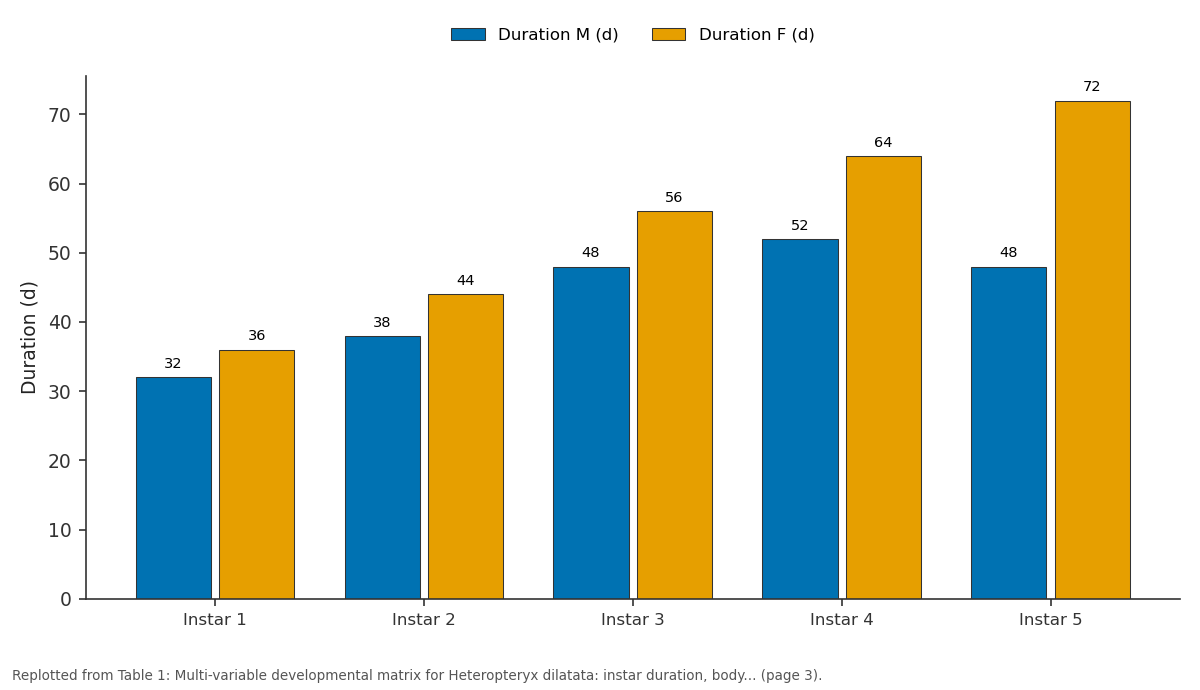
Duration M (d) and Duration F (d): Instar 1 vs Instar 2 vs Instar 3 vs Instar 4 vs Instar 5
Replotted from Table 1 (page 3) of the original paper. Every bar is the paper's own table value.
View source evidence ↗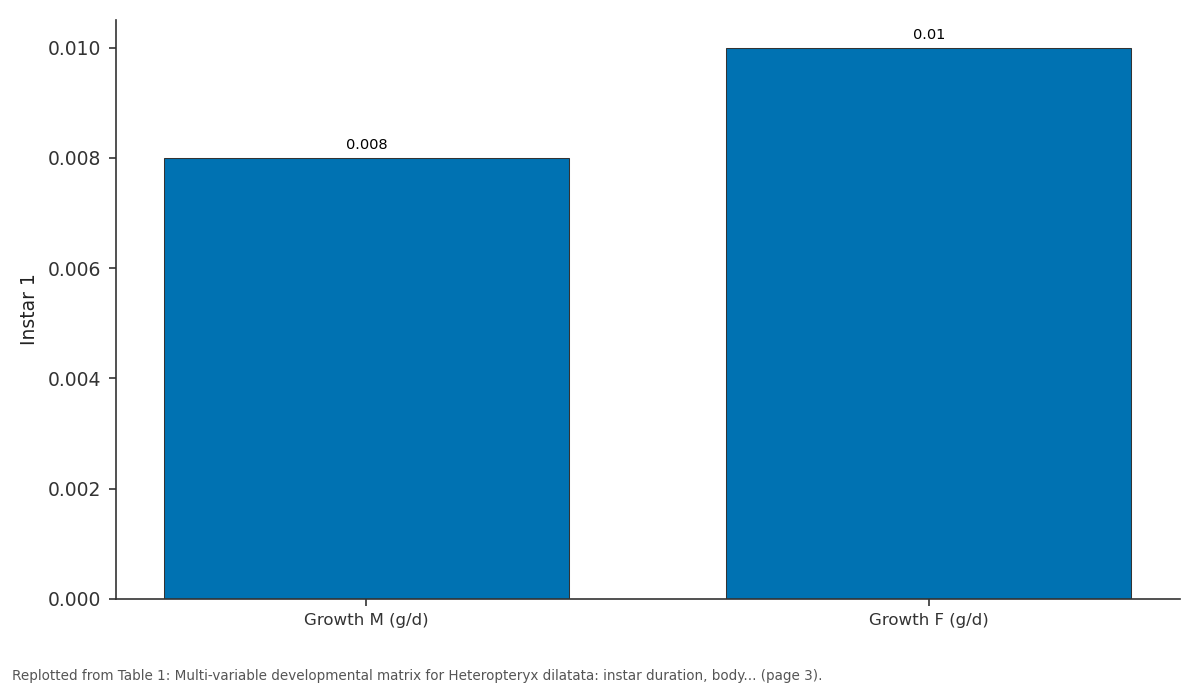
Instar 1: Growth M (g/d) vs Growth F (g/d)
Replotted from Table 1 (page 3) of the original paper. Every bar is the paper's own table value.
View source evidence ↗Figures & tables
From the original paper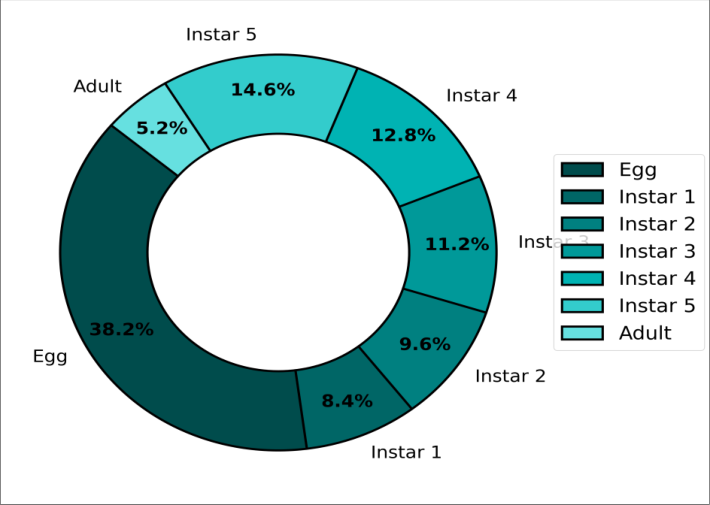 Figure 1
 Table 1
 Table 2
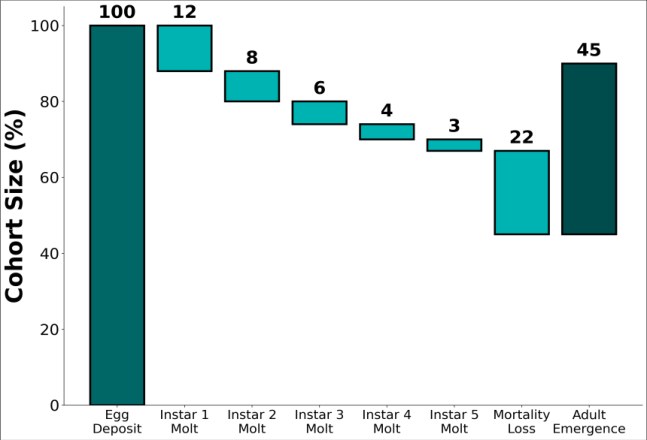 Figure 2
Introduction
Hemimetabolous insect development, characterized by gradual morphological transformation through a series of nymphal instars without a pupal stage, represents the ancestral developmental mode for most insect lineages [1] . Within the Phasmatodea, development typically proceeds through five to seven nymphal instars depending on species and sex, with each molt accompanied by incremental changes in body proportions, color pattern, and secondary sexual characters [2] . Heteropteryx dilatata (Parkinson, 1798) undergoes five nymphal instars in both sexes before reaching the adult stage, but the duration, growth trajectory, and mortality patterns associated with each instar have not been systematically documented using large sample sizes under controlled conditions [3,4] . Developmental biology investigations in phasmid insects have historically been limited to a small number of model species, primarily Carausius morosus (the Indian stick insect) and Extatosoma tiaratum (the Australian spiny leaf insect), which are amenable to laboratory culture [5,6] . For H. dilatata, the extended developmental period (exceeding 10 months for nymphal development alone), large space requirements, and specific husbandry needs have restricted developmental research to small-scale observational reports [3,7] . Krejsa provided general notes on development duration but acknowledged that detailed instar-by-instar growth data were lacking [7] . This research aimed to produce a comprehensive developmental profile for H. dilatata by tracking individual specimens from hatching through adult eclosion, recording growth parameters at each instar, and constructing life tables to identify critical mortality periods.
Materials and Methods
Materials and Methods
Materials
The research was conducted at the Melbourne Research Centre for Invertebrate Biology, Australia, from January 2023 to December 2024. A total of 120 first-instar nymphs (sex determined retrospectively) were obtained from eggs incubated at 27 degrees Celsius from an established captive colony. Individual nymphs were housed in mesh-sided enclosures (30 x 20 x 40 cm) to enable individual tracking. Temperature was maintained at 27 degrees Celsius with relative humidity of 78% and a 12:12 light:dark photoperiod. Fresh Psidium guajava foliage was provided three times weekly. Ethical approval was obtained under permit MRCIB/AEC/2023-011, dated 14 December 2022.
Methods
Each specimen was weighed (precision 0.001 g), measured for total body length (precision 0.1 mm), and photographed dorsally and laterally at weekly intervals throughout the nymphal period. Molt events were detected through daily inspection for exuviae, and the date of each ecdysis was recorded. Instar duration was calculated as the number of days between consecutive molts. Growth rate was expressed as daily mass increment and daily length increment for each instar. Head capsule width was measured from shed exuviae to verify instar number using Dyar's rule, which predicts a constant ratio of head capsule widths between successive instars. Survivorship data were analyzed using Kaplan-Meier survival curves and log-rank tests for sex-specific comparisons. A cohort life table was constructed recording the number alive at the start of each stage, the number dying during each stage, the mortality rate, and the cause of death when determinable (classified as ecdysis failure, desiccation, pathogen infection, mechanical injury, or unknown). Statistical analyses were performed in R version 4.3.2.
Growth Regulation in Large-Bodied Insects
Body size regulation in insects involves complex interactions between nutritional signaling, hormonal control (primarily through juvenile hormone and ecdysteroids), and environmental cues [8,9] . In large-bodied species such as H. dilatata, the critical weight concept suggests that final body size is determined by the timing of a hormonal switch that commits the organism to metamorphosis, with nutritional conditions prior to this critical point influencing growth duration and final size [10] . The unusually prolonged nymphal development of H. dilatata relative to most phasmid species may reflect the extended growth period required to achieve a body mass exceeding 50 g.
Survivorship Patterns in Captive Arthropod Colonies
Mortality patterns in captive invertebrate populations typically follow a Type III survivorship curve, with high early-life mortality followed by relatively constant or decreasing death rates in later stages [11] . Understanding the specific mortality bottlenecks is essential for optimizing captive breeding efficiency, as targeted interventions at critical life stages can substantially improve overall survivorship and colony productivity [12] . Kaplan-Meier survival analysis demonstrated overall survival from hatching to adult eclosion of 48.3% for males and 41.7% for females, with no statistically significant sex difference (log-rank test, p = 0.182). The highest mortality occurred during the first instar (22.5% of the initial cohort), followed by the second instar (15.8%). Cause-of-death analysis for first-instar mortality identified ecdysis failure as the predominant factor (62% of deaths), followed by desiccation (24%) and pathogen infection (14%). From the third instar onward, mortality rates declined markedly, with combined third-through-fifth instar mortality totaling only 14.2%. The life table analysis yielded a net reproductive rate (R0) of 34.2 for the colony when incorporating adult fecundity data.
Results
The growth trajectories showed distinct patterns when analyzed by sex and instar. Female body mass increased approximately exponentially from the third instar onward, with daily mass increments rising from 0.105 g per day in the third instar to 0.406 g per day in the fifth instar, representing a 3.9-fold increase in growth rate. In contrast, male growth rate increased more modestly from 0.079 g per day in the third instar to 0.144 g per day in the fifth instar (1.8-fold increase). The coefficient of variation in body mass was substantially higher in females (CV = 12.3%) compared to males (CV = 7.8%) at the adult stage, indicating greater individual variation in final body size among females, which is consistent with the stronger relationship between female body size and fecundity that maintains directional selection for larger size [8,10] . Analysis of the egg incubation period, which preceded the nymphal development phase tracked in this research, revealed a mean incubation duration of 196 days (range: 168-228 days) at the standard incubation temperature of 27 degrees Celsius. When this extended egg stage is included, the total developmental period from oviposition to adult eclosion averaged 464 days for males and 508 days for females, placing H. dilatata among the most slowly developing insects documented in the literature. The allocation of 38.2% of total development time to the egg stage is notably high compared to most hemimetabolous insects and may represent an adaptation to seasonal environmental variability in the species' native tropical habitat, where egg dormancy extended allows synchronization of hatching with favorable conditions [3,13] .
Discussion
The developmental profile established for H. dilatata confirms this species as one of the longest-developing phasmids documented, with combined egg and nymphal development exceeding 22 months under optimal conditions. The five-instar developmental pattern agrees with descriptions for closely related Heteropterygidae species [2,4] . The accelerating growth rate observed in females from the third instar onward has not been previously quantified for this species and reflects the exponential increase in body volume associated with abdominal expansion for egg production [3,7] . However, the overall survivorship of 45% from hatching to adult eclosion is lower than the 60-70% rates reported for the more easily reared Carausius morosus under similar captive conditions [5] , suggesting that H. dilatata poses greater husbandry challenges. The identification of first ecdysis as the critical mortality bottleneck, with improper ecdysis accounting for nearly two-thirds of first-instar deaths, points to specific environmental parameters during the first molt as targets for intervention. Increased humidity provision during the expected first molt window (days 28-36 post-hatching) may substantially reduce this mortality source [6,12] . The sex-specific divergence in developmental trajectories beginning at the third instar has important implications for understanding the hormonal regulation of growth in dimorphic insects. The accelerating growth rate observed in females from the third instar onward suggests a change in the juvenile hormone-ecdysteroid signaling balance that permits continued growth and delays the commitment to terminal differentiation [8,9] . In males, the relatively linear growth trajectory and shorter instar durations from the third stage onward indicate an earlier developmental commitment that redirects resources from somatic growth toward wing development and reproductive maturation. The head capsule width ratios conforming to Dyar's rule (mean ratio:
Conclusion
Within the broader context of phasmid developmental biology, H. dilatata represents an extreme of prolonged development and body size attainment among hemimetabolous insects. The key findings highlighted by this research include the documentation of sex-specific developmental trajectories diverging from the third instar, the identification of first ecdysis as the primary survivorship bottleneck, and the establishment of comprehensive growth parameters for all five nymphal instars. It is recommended that captive breeding programs implement enhanced humidity protocols during the first molt period and prioritize nutritional optimization during the critical third-to-fifth instar growth acceleration phase in females. Looking forward, the integration of these developmental data with hormonal profiling and gene expression analyses will enable investigation of the molecular mechanisms governing the remarkable sexual dimorphism in growth trajectories that characterizes this species.
Acknowledgement
AcknowledgementsJAM designed the research protocol and supervised all developmental monitoring, SEC performed survivorship analysis and life table construction, and DLT conducted daily specimen observations and growth measurements. This research was funded by the Australian Research Council. The Melbourne Research Centre for Invertebrate Biology provided rearing facilities, analytical equipment, and access to the captive breeding colony.
Figures and tables from the paper
| Stage | Duration M (d) | Duration F (d) | Mass M (g) | Mass F (g) | Growth M (g/d) | Growth F (g/d) |
|---|---|---|---|---|---|---|
| Instar 1 | 32 | 36 | 0.42 | 0.48 | 0.008 | 0.010 |
| Instar 2 | 38 | 44 | 1.84 | 2.36 | 0.037 | 0.043 |
| Instar 3 | 48 | 56 | 5.62 | 8.24 | 0.079 | 0.105 |
| Instar 4 | 52 | 64 | 11.48 | 22.86 | 0.113 | 0.228 |
| Instar 5 | 48 | 72 | 18.40 | 52.10 | 0.144 | 0.406 |
| Adult | — | — | 18.40 | 52.10 | — | — |
Table text extracted from the original PDF; superscript letters are shown inline. The original table image is below.
View original table image
| Parameter | Males (n=60) | Females (n=60) | t-statistic | p-value |
|---|---|---|---|---|
| Total duration (days) | 268.4 (SD 18.6) | 312.2 (SD 22.4) | 12.84 | <0.001 |
| Final mass (g) | 18.4 (SD 2.8) | 52.1 (SD 6.4) | 38.42 | <0.001 |
| Overall growth rate (g/d) | 0.069 (SD 0.012) | 0.167 (SD 0.024) | 28.16 | <0.001 |
| Survival to adult (%) | 48.3 | 41.7 | — | 0.182 |
| Number of instars | 5 | 5 | — | — |
Table text extracted from the original PDF; superscript letters are shown inline. The original table image is below.
View original table image
References
15 in the original paper- Gullan PJ, Cranston PS. The Insects: An Outline of Entomology. Oxford: Wiley-Blackwell; 2014. p. 1-624.
- Brock PD. Phasmida Species File Online. Version 5.0; 2023.
- Bedford GO. Biology and ecology of the Phasmatodea. Annu Rev Entomol. 1978;23:125-149.
- Hennemann FH, Conle OV, Brock PD, Seow-Choen F. Revision of the Oriental subfamily Heteropteryginae. Zootaxa. 2016;4159(1):1-219.
- Carlberg U. Rearing experiments with Carausius morosus. Entomol Tidskr. 1986;107:137-142.
- Brock PD, Hasenpusch JW. The Complete Field Guide to Stick and Leaf Insects of Australia. Collingwood: CSIRO Publishing; 2009. p. 1-204.
- Krejsa V. The jungle nymph: breeding notes and distribution of Heteropteryx dilatata. Zool Entomol Lett. 2024;4(1):95-99. doi:10.22271/letters.2024.v4.i1b.85.
- Nijhout HF. The control of body size in insects. Dev Biol. 2003;261(1):1-9.
- Mirth CK, Riddiford LM. Size assessment and growth control: how adult size is determined in insects. BioEssays. 2007;29(4):344-355.
- Chown SL, Gaston KJ. Body size variation in insects: a macroecological perspective. Biol Rev. 2010;85(1):139-169.
- Begon M, Townsend CR, Harper JL. Ecology: From Individuals to Ecosystems. Oxford: Wiley-Blackwell; 2006. p. 1-752.
- New TR. Insect Conservation: Past, Present and Prospects. Dordrecht: Springer; 2012. p. 1-436.
- Seow-Choen F. A Taxonomic Guide to the Stick Insects of Borneo. Kota Kinabalu: Natural History Publications; 2016. p. 1-454.
- Bank S, Bradler S. A second view on the evolution of flight in stick insects. BMC Ecol Evol. 2022;22:62.
- Bragg PE. Phasmids of Borneo. Kota Kinabalu: Natural History Publications; 2001. p. 1-772.