
Research article · 2026 · Full text
International Journal of Geography Geology and EnvironmentThe dynamics of domestic water in Gurugram: An assessment of water supply, urban economics, and sanitation ecosystems
Volume 8(5) · Pages 70–75 · DOI: 10.22271/27067483.2026.v8.i5a.816 ↗
Research areasWater Governance and InfrastructureWater resources management and optimizationWater management and technologies
Abstract
Author-writtenGurugram is located in the National Capital Region (NCR) of India. It has transitioned from a modest agricultural town into a global 'Millennium City' and also the economic engine of Haryana. This staggering demographic and economic expansion in this region where the population has grown nearly five times over three decades. Along with this, it has placed unparalleled and often critical strain on its civic utilities (Sharma et al., 2023). The study discusses Gurugram’s municipal water management system from a citywide perspective. Water supply in Gurugram is the joint responsibility of the Municipal Corporation of Gurugram (MCG), Gurugram Metropolitan Development Authority (GMDA), and Haryana Shehri Vikas Pradhikaran (HSVP). The paper uses secondary data from municipal engineering reports, water tariff audits, sanitation surveys, and pertinent literature to evaluate the state of water supply in the city and analyse the implications of the findings. The research findings reveal that the city is majorly dependent on surface water from the Yamuna river basin as a water source, which meets about 94% of the municipal water requirements in Gurugram. However, the water distribution system faces a lot of challenges, including aging pipeline networks, rising demand, and declining groundwater levels. The Central Ground Water Board reports that the groundwater levels have dropped below 30 meters in several parts of the city, signaling an impending water crisis (CGWB, 2023). The paper also highlights the proliferation of an informal shadow water market in the city, alongside a huge revenue shortfall in the municipal budget as revealed by the 2023-2024 audit. About fifty percent of the municipal water demands in the city are in arrears, indicating a huge deficit in the collection of water charges (MCG, 2025). In addition, the study discusses the Shit Flow Diagram of the city waste management system, with 38% of the city’s faecal sludge recorded as poorly managed, thus threatening groundwater contamination (Dey Sarkar et al., 2021). The paper finally assesses the proposed 24x7 water supply scheme, including the transition in engineering development towards District Metered Areas (DMA), Variable Frequency Drive (VFD) pump installations, and SCADA system inclusion and discusses the reuse of agricultural wastewater in Tauru and Nuh (GMDA, 2024).
Summary
Source-checkedPlain-language reading of the full paper, prepared with AI and checked against the text. Each point links to the authors' own words.
Why it matters
- Gurugram, located in India's National Capital Region, has evolved from a small agricultural town into a major global economic hub known as the 'Millennium City'. View evidence ↗
- Water management in Gurugram is hindered by groundwater depletion, sporadic supply, significant water losses, and complex administrative oversight. View evidence ↗
The question
- The study aims to assess gaps in water infrastructure, treatment capacity, and the depletion of localized groundwater. View evidence ↗
- The research seeks to analyze municipal financial losses, informal water markets, and inequalities in water access. View evidence ↗
- The study evaluates sanitation systems and the impact of technical upgrades such as SCADA and wastewater reuse. View evidence ↗
What they did
- The researchers used a quantitative descriptive and diagnostic geographical design based on secondary institutional data for a macro-level systems analysis. View evidence ↗
- Data sources included engineering and tubewell status from MCG and GMDA, water billing records from 2021-2024, and sanitation data from the SFD Lite report. View evidence ↗
What they found
- Gurugram relies heavily on surface water from the Yamuna river basin, which provides approximately 94% of its municipal water requirements. View evidence ↗
- Groundwater levels in several parts of the city have fallen below 30 meters, indicating a looming water crisis. View evidence ↗
- Local infrastructure is failing, exemplified by Ward 2 where 61.9% of municipal tubewells (13 out of 21) are complete failures. View evidence ↗
- The city's sanitation level is moderate at 62%, meaning nearly 38% of waste is managed unsafely. View evidence ↗
- Physical water losses, largely caused by rusty pipes, account for 35% of the total supplied water. View evidence ↗
- Financial recovery is low; for the 2021-22 period, the utility collected only 38.8% of the demanded INR 94.13 Crores. View evidence ↗
What it means
- The authors conclude that the rapid implementation of the 24x7 water project, utilizing SCADA, smart meters, and wastewater recycling, is the only viable way to meet the city's growing water needs. View evidence ↗
- The authors recommend aggressive licensing and GPS tracking of private water tankers to prevent illegal groundwater extraction. View evidence ↗
Visual summary
1 visualsIllustrations explain the paper; they do not show study data.
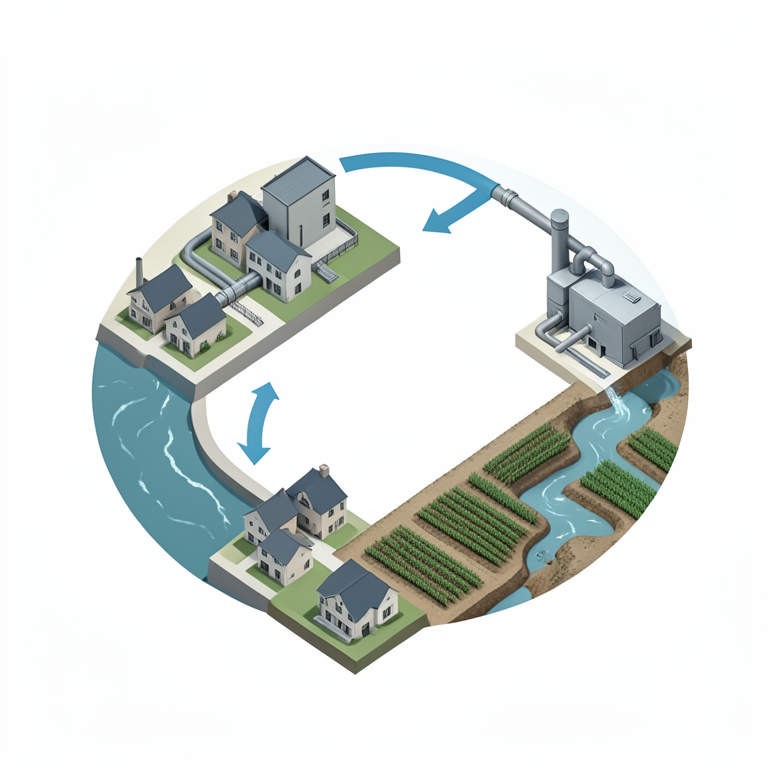
Circular Water Economy Concept
AI-generated conceptual illustration (Urban water infrastructure in a city). It explains the idea and does not show study data.
View source evidence ↗Figures & tables
From the original paper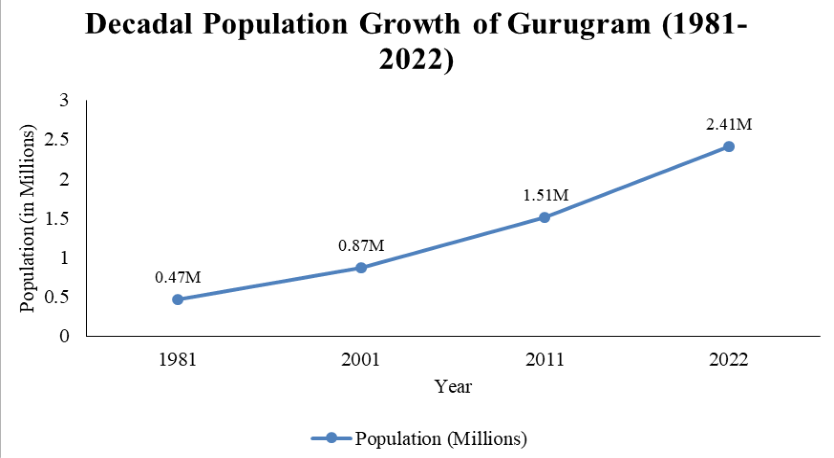 Figure 1
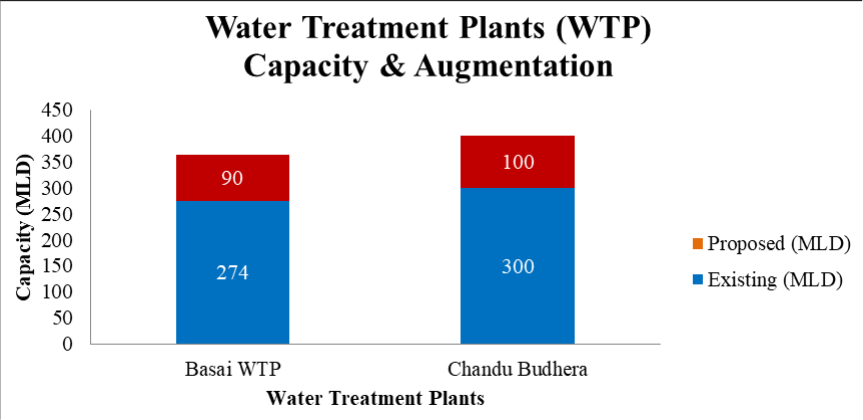 Figure 2
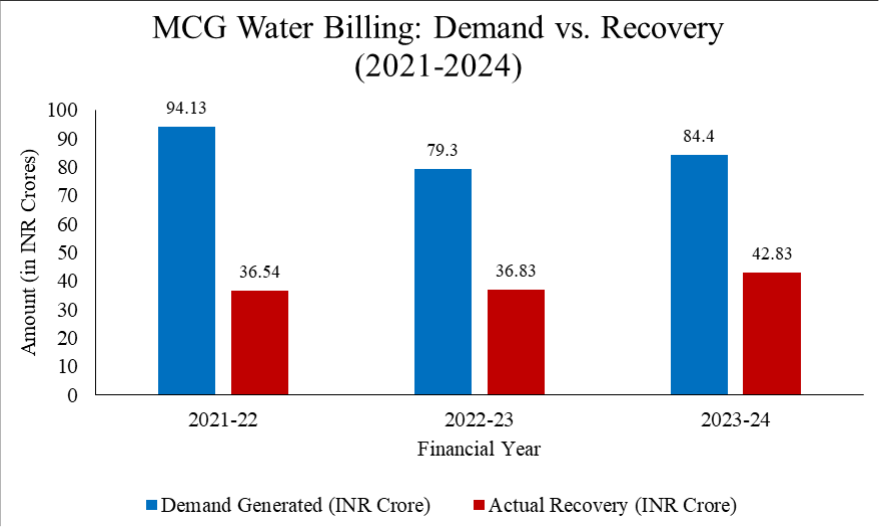 Figure 3
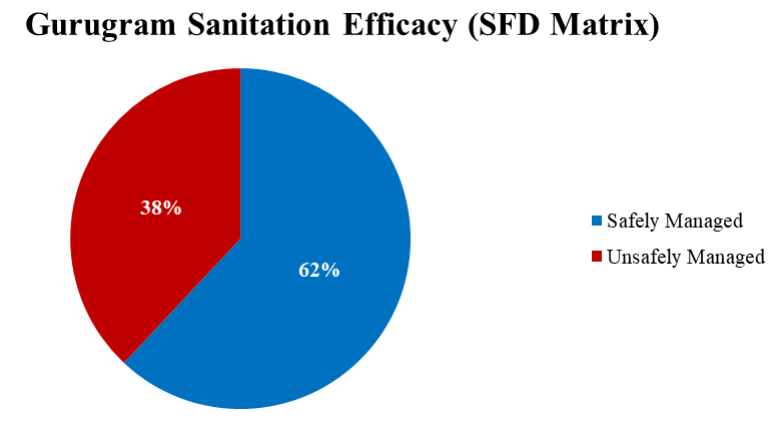 Figure 4
Introduction
Urban sprawl, the growth of cities and towns towards less developed areas, is one of the outstanding phenomena of contemporary geopolitics. In emerging economies in South Asia, this trend often takes the form of 'hyper growth,' as the population increases at a phenomenal rate, overwhelming existing urban infrastructure. Gurugram is one of the prototypical examples of such a city. This erstwhile cluster of semi-arid villages around Delhi has turned into a financial and IT hub hosting hundreds of industries. However, the rapidity and scale of this development have come at a steep price -the local water management system is now under severe stress due to surging demand. Multiple problems plague water management in Gurugram, from sporadic water supply interruptions to groundwater depletion, extensive Non-Revenue Water losses, and overlapping administrative control. Notably, water supply in the city is only available for two hours a day in the outer wards. At the same time, the number one concern for the local administration is the depletion of groundwater resources. Physical water losses account for 35% of supplied water, with rusty pipes being a major cause. Water management in Gurugram is complicated by the fact that it is the responsibility of several local authorities.
Thus, MCG is in charge of local water distribution, while GMDA is responsible for treatment works and trunk sewers. In addition, there are other authorities, such as HSVP and HSIIDC, that are responsible for water distribution within particular developmental jurisdictions. As per NITI Aayog Composite Water Management Index (CWMI) report of 2018, twenty-one Indian cities, including several metropolises from the National Capital Region (NCR), were at risk of reaching Day Zero, defined as the point when reservoirs reach the lowest level before drying up completely (NITI Aayog, 2018). To quench the thirst of 3,500 MLD water at the time of peak saturation, the authorities need to adopt a paradigm shift from the current practice of random groundwater tapping to science-based circular water economies through engineered precision and economic viability (TERI, 2021) [11] .
Objectives of the Study
To rigorously align with the macro-level engineering, financial, and sanitation data available from municipal authorities and central environmental agencies, the scope of this research has been strictly focused on the following three comprehensive objectives: To assess gaps in water infrastructure, treatment capacity, and localized groundwater depletion. To analyze unequal water access, informal water markets, and municipal financial losses (tariffs and NRW). To evaluate sanitation systems using SFDs, alongside technical upgrades like DMA, SCADA, and wastewater reuse.
Theoretical Framework and Literature Review Urban Water Metabolism and Politics of Access
This research is based on the theory of 'Urban Water Metabolism.' The said theory was developed within the framework of urban ecology and defines a city as a metabolic entity that ingests huge amounts of matter and energy and subsequently excretes a considerable amount of waste (Kennedy et al., 2011) [5] . In the past, Gurugram has demonstrated a severe linear metabolism and has focused on the consumption of local groundwater and its subsequent treatment and disposal with little regard for the amounts used (TERI, 2021) [11] . Sustainable urbanism now requires a transition to a circular metabolism. In this paradigm, Treated Water Waste (TWW) is reintroduced into the economy (Kennedy et al., 2011) [5] . In addition, this study also employs the concept of Political Ecology of Water, which is used to understand how water is distributed based on power relations. This is particularly relevant to the situation in Gurugram, where master-planned areas can access subsidized surface water, whereas informal settlements have to rely on private and costly water tankers.
Climate Change and Environmental Stressors (UHI Effect)
A critical external factor affecting the water security of Gurugram is global climate change as well as local climatic variations. According to recent meteorological studies, the South-West Monsoon, a vital rainfall pattern with regard to the region, is demonstrating new trends related to a shorter period of rainfall with more intensity. Added to this the Urban Heat Island (UHI) effect has caused an increase in evapotranspiration due to the loss of green cover in the form of the Aravalli hills and an extensive number of glass facades, which in turn has led to an exponential rise in water demand during peak summer as well as lower replenishment of the underlying geological formations (TERI, 2021) [11] .
The Groundwater Depletion Crisis
The city of Gurugram is underlain by Pleistocene alluvium of the plains and quartzite of the Aravallis belt; previously, the municipal piped water could not meet the increased demand of the periphery, and the exploitation of groundwater at greater depths has become widespread. The study determined the block-wise distribution pattern of groundwater in the Gurugram district for the period of rapid infrastructure development during the last two decades. In 2000, the static water level was mostly in the range of 10-25 meters below ground level (mbgl) (Sharma et al., 2023) [10] . However, due to its severe exploitation, it dropped significantly to below 30-40 mbgl in 2020, with several blocks reporting even lower levels. Thus, the CGWB categorized the district as a dark zone because of the overuse of groundwater with its withdrawal nearly double its annual recharge, being 195% higher than the same in the current year (CGWB, 2023).
Study Area Profile and Demographics
Gurugram is a city located 30 km from Delhi to the south. According to the Köppen-Geiger classification system, the climate of Gurugram falls under tropical steppe, hot, and semi-arid (BSh). The average amount of rainfall obtained by Gurugram is relatively low, only 505.4 per year, with the majority falling during the two hottest months -July and August, which makes this territory especially vulnerable to water shortages (Sharma et al., 2023) [10] . Currently, MCG states the total number of administrative wards constitutes 36 covering an area of 298.25 square kilometers. Between 1981 (0.47 million) and 2022 (2.41 million), there has been a significant increase in the population growth rate, putting high pressure on the water supply infrastructure, namely, the pipeline distribution system (Sharma et al., 2023) [10] .
Source: Compiled by the researcher based on Census data.
Research Methodology
This study utilizes a quantitative descriptive and diagnostic geographical research design. This is done while employing hard secondary institutional data to conduct a macro level systems analysis. This information was collected from civic, engineering and environmental sources. Information on engineering data including storage capacities and tubewell status was obtained from the MCG and GMDA (MCG, 2024) [7] . Water billing data from 2021 to 2024 was retrieved from the MCG Revenue Department (MCG, 2021-2025). Sanitation data was evaluated from the SFD Lite report developed by TRCSS-JNU and CSE (Dey Sarkar et al., 2021).
Spatial Infrastructure and Water Treatment Capacity Raw Water Importation and WTP Augmentation
As of now, municipal water supply in Gurugram amounts to 520 MLD. Due to a significant decline in aquifer levels, the city is forced to depend on external sources for 94% of its municipal water. Water is sourced from distant surface water bodies in the Yamuna River basin and treated at two Water Treatment Plants, namely, Basai and Chandu Budhera. There is an upgrade proposal for the Basai Water Treatment Plant to treat an additional 90 MLD of water on top of the current 274 MLD. Similarly, the Chandu Budhera Water Treatment Plant will see an increase in its current 300 MLD by 100 MLD (GMDA, 2024) [3,4] . Thus, the total water grid in Gurugram will be able to provide a municipal water supply of 764 MLD once the upgrades have been completed.
Source:
Compiled by the researcher based on data from GMDA and MCG. In this regard, the MCG reports that the city has 81 underground reservoirs (UGRs) and local boosting stations that provide water supply with sufficient pressure for the entire metropolis. At the same time, there is an apparent variation in the reservoir sizes as illustrated by the Chakkarpur UGR with an overall capacity of more than 2.8 million liters, whereas the old Carterpuri villages have only 1.2 million liters reserves (MCG, 2024) [7] .
Micro-Spatial Analysis of Tubewell Mortality
While the macro-grid is reliant on the imported water resources, the periphery remains dependent on the municipal tubewell ecosystem. A micro-spatial forensic assessment highlights the localized incidence of infrastructural deficit. In Ward 2, for instance, out of the 21 municipal tubewells, 13 are complete failures recording the highest proportion of 61.9% failed tubewells. Other wards that record significant proportions of failed tubewells include Wards 21 and 22 reporting 66.6% and 25% of total municipal tubewells (MCG, 2024) [7] . The tubewell pumps that have been utilized in the area are appropriate for static water levels below 30 mbgl and record high instances of cavitation and burning at depths beyond this threshold.
The Rise of the Informal Water Economy (Tanker Shadow Markets)
The enormous failure of local tubewells and the erratic availability of piped water have created a black market for water supplied by private tanker operators. When municipal water supplies ran out, people turned to black-market water dealers who tapped into deep boreholes. Water prices spiked by up to 300% per 5,000-liter tanker during summer. This exploits the poor and depletes groundwater at a phenomenal rate.
Economic Recovery and Tariff Matrix
Water supply system in Gurugram wastes a lot of water. In fact, it has one of the shares of wasted water in the country. The way people pay for water has an impact on the water sectors economy. The current billing policy focuses on who owns a house over how water they actually use.
Sanitation Efficacy and Wastewater Management (SFD)
The sustainable urban water supply is inseparable from the sewage management system. The SFD Lite Report demonstrates the flow of human waste in Gurugram. Overall, the city has a sanitation level of 62%, which is a moderate level, leaving nearly 38% of waste 'Unsafely Managed' (Dey Sarkar et al., 2021). The offsite sewerage system category accounts for the largest percentage of the city's sanitation system, amounting to 78%. Nonetheless, about 14% of the waste is lost before it reaches Sewage Treatment Plants (STPs). At the same time, onsite systems accommodate 14% of the total faecal waste in the city, of which only 3% was safely emptied. The rest was illegally dumped by private entities into the municipality's gutters. The GMDA realises the gravity of the sanitation crisis and explores ways to exploit the potential of a circular economy to devise Treated Waste Water (TWW) recycling schemes. The largest TWW recycling scheme currently utilises the 200 MLD of water from the Behrampur STP for use in drip irrigation in the agricultural lands in Tauru and Nuh districts. By using the TWW instead of freshwater drawn out from the groundwater for irrigation, Gurugram is not only recycling the waste but also helping to recharge the groundwater (GMDA, 2024) [3,4] .
Advanced Engineering Interventions: The 24x7 Supply Project
The MCG and GMDA want to fix the problems with money and physical things. So, they are working together on a plan to change the way they supply water. Now, they do not give water all the time. The MCG and GMDA want to give water all the time. To do this they are dividing the water area into parts called District Metered Areas. The MCG and GMDA are putting machines in these areas that can measure how much water is flowing. The MCG and GMDA are also using computers that can watch what is happening with the water. This helps the people, in charge see how much water is being wasted. The MCG and GMDA can see this on their computers. Fix the problems right away. The MCG and GMDA are also putting in pumps. These pumps are special because they can change how fast they work based on how much water people need. The MCG and GMDA are doing this so that the old pipes do not break under much pressure. The MCG and GMDA are putting in 319 of these pumps. This will help keep the water clean and safe to drink. The MCG and GMDA are working hard to make sure people have water all the time.
Comprehensive Policy Recommendations
Comprehensive Policy Recommendations
Conclusion
Gurugram is trying to develop its infrastructure quickly to keep up with the fast economic growth in the area. The city is increasing its water treatment capacities. However, a lot of the tubewells in most areas are not working properly with more than 60 percent of them failing, which is a big threat to the groundwater in the region. This information is based on a report by the Central Ground Water Board in 2023. The municipal water supply system is also facing problems because it cannot recover a lot of the money it costs to build and maintain the system over its lifetime. This is according to the Municipal Corporation of Gurugram from 2021 to 2025. Furthermore, a lot of the wastewater is not safe to use which is bad for the environment. This is stated in a study by Dey Sarkar and others in 2021 which found that 38 percent of the wastewater is not safe. The only way to provide water for the people living in Gurugram, which is growing very quickly is to quickly put into action the 24x7 water project. This project uses technologies like DMAs, SCADA, smart meters and TWW to recycle water and make sure it is used efficiently. The 24x7 water project is very important, for the city of Gurugram and its water supply system. The 24x7 water project will help Gurugram to have a water supply system.
Figures and tables from the paper
References
9 in the original paper- Central Ground Water Board. National compilation on dynamic ground water resources of India, 2023. New Delhi: Ministry of Jal Shakti, Government of India; 2023.
- Dey Sarkar U, TRCSS-JNU, Centre for Science and Environment. SFD Lite report: Gurugram, Haryana, India. New Delhi: CSE; 2021.
- Gurugram Metropolitan Development Authority. Annual administrative overview and infrastructure updates. Gurugram: GMDA; 2024.
- Gurugram Metropolitan Development Authority. Utilization of treated waste water (TWW) through Dhanwapur STP and Behrampur STP. Gurugram: GMDA; 2024.
- Kennedy C, Pincetl S, Bunje P. The study of urban metabolism and its applications to urban planning and design. Environmental Pollution. 2011;159(8-9):19651973. doi:10.1016/j.envpol.2010.10.022.
- Miglani AS. Assessment of RO wastewater management and reuse: Concerning households in Gurugram, Haryana, India. International Journal of Applied Engineering and Sustainability. 2024;11(5):4249.
- Municipal Corporation of Gurugram, Engineering Depa rtment. List of boosting stations and tubewell list of MCG area. Gurugram: MCG; 2024.
- Municipal Corporation of Gurugram. Water billing details ledger (2021-2025). Gurugram: MCG; 2025.
- NITI Aayog. Composite water management index: A tool for water management. New Delhi: Government of India; 2018.