
Research article · 2026 · Full text
International Journal of Horticulture and Food ScienceEffect of biochar-enriched potting media on growth, flowering and shelf life of marigold (Tagetes erecta L.)
Volume 8(2) · Pages 44–48 · DOI: 10.33545/26631067.2026.v8.i2a.783 ↗
Research areasFlowering Plant Growth and CultivationGrowth and nutrition in plantsPlant Growth and Agriculture Techniques
Abstract
Author-writtenPotting media amendment is one of the more accessible levers container-grown flower producers have for improving both plant performance and post-harvest quality, yet biochar's specific contribution to marigold (Tagetes erecta L.) production has received comparatively little dedicated attention relative to its use in field-grown vegetable and cereal systems. This research evaluated five biochar amendment levels—0%, 5%, 10%, 15%, and 20% by volume mixed into a standard coco-peat-based potting medium—on growth, flowering, and shelf life of marigold grown under polyhouse conditions in Baguio, Philippines, across two consecutive cropping cycles between November 2024 and June 2025. Plant height, branch number, flowering duration, flower diameter, flower yield per plant, and vase shelf life were recorded from thirty plants per treatment, replicated three times in a completely randomized design. Flower diameter peaked at the 15% biochar level (58.4 mm mean), representing a 53.7% increase over the unamended control (38.0 mm), while the 20% level showed a modest decline relative to 15%, suggesting a threshold beyond which additional biochar no longer confers proportional benefit and may begin to interfere with media aeration or nutrient balance. Flowering duration extended by 9.6 days at the 15% level relative to control, and post-harvest shelf life of cut marigold flowers improved by 4.2 days at the same level, measured as days to 50% petal wilting under ambient room conditions. Correlation analysis linked improved flower quality most strongly to increased media water-holding capacity and enhanced microbial activity rather than to direct nutrient content increases from the biochar itself, since available nitrogen, phosphorus, and potassium levels in the amended media rose only modestly relative to the substantial gains observed in flower quality parameters. These findings support biochar incorporation at approximately 15% by volume as a practical, readily scalable amendment for commercial marigold potting media formulations targeting improved flower quality and extended post-harvest shelf life.
Summary
Source-checkedPlain-language reading of the full paper, prepared with AI and checked against the text. Each point links to the authors' own words.
Why it matters
- Marigolds are highly valued in South and Southeast Asian markets for commercial sale and cultural use, making flower freshness and shelf life economically important. View evidence ↗
- Growers using peat-based potting media often face inconsistent flowering and shorter vase life compared to field-grown marigolds. View evidence ↗
- While biochar is well-studied in field-grown vegetable and cereal systems, its specific effects on marigold production have not been extensively researched. View evidence ↗
The question
- The study aimed to determine if the benefits of biochar on marigold flowering and shelf life increase linearly with the amount added or if there is an upper threshold where it becomes ineffective or harmful. View evidence ↗
- The researchers also sought to understand if biochar improves flower quality primarily through physical and biological changes (water-holding and microbial activity) or through increased nutrient content. View evidence ↗
What they did
- The study used rice husk biochar produced at 450-500 °C, mixed into a base medium of coco-peat, vermicompost, and river sand (3:1:1 ratio). View evidence ↗
- Five biochar levels (0%, 5%, 10%, 15%, and 20% by volume) were tested in a polyhouse in Baguio, Philippines, over two cropping cycles from November 2024 to June 2025. View evidence ↗
- Potting media were analyzed for water-holding capacity, NPK levels, and dehydrogenase enzyme activity as a proxy for microbial activity. View evidence ↗
What they found
- Flower diameter reached its maximum at the 15% biochar level (58.4 mm), a 53.7% increase over the control (38.0 mm), before declining at the 20% level. View evidence ↗
- The 15% biochar amendment extended the flowering duration by 9.6 days compared to the control group. View evidence ↗
- Available nitrogen increased only slightly from 142 mg/kg in the control to 179 mg/kg at the 20% biochar level, suggesting nutrients were not the primary driver of improvement. View evidence ↗
What it means
- The authors recommend that commercial marigold potting media include approximately 15% rice husk biochar by volume to optimize flower quality and shelf life. View evidence ↗
- The authors note that testing additional biochar sources is necessary to confirm if these results generalize beyond rice husk biochar. View evidence ↗
- Future research is needed to determine if the 15% optimum is a general pattern for other ornamental species or specific to marigolds. View evidence ↗
Visual summary
3 visualsIllustrations explain the paper; charts are replotted from the paper's own table values.
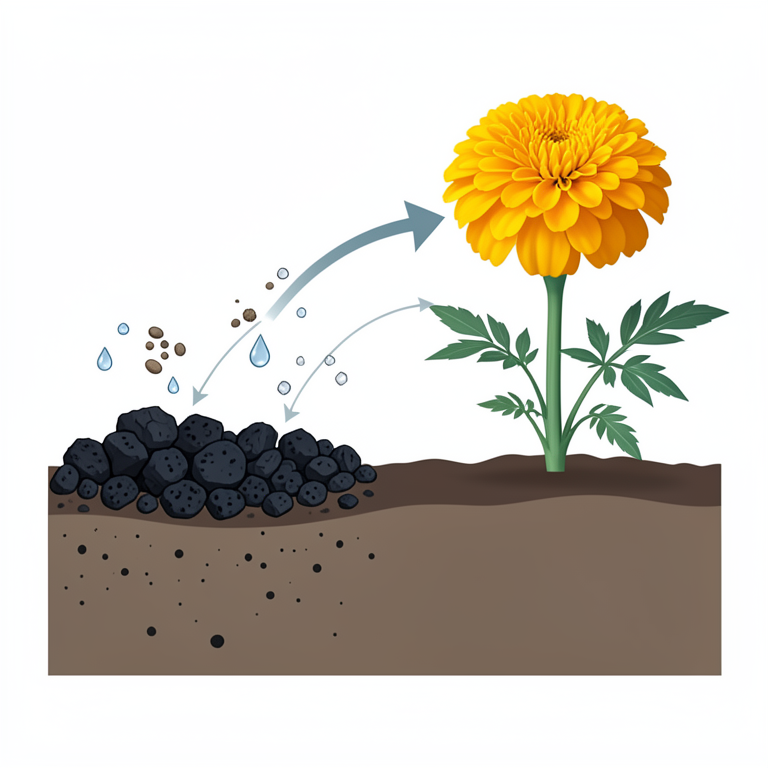
Mechanism of Biochar Benefit
AI-generated conceptual illustration (marigold plants (Tagetes erecta L.) in potting soil). It explains the idea and does not show study data.
View source evidence ↗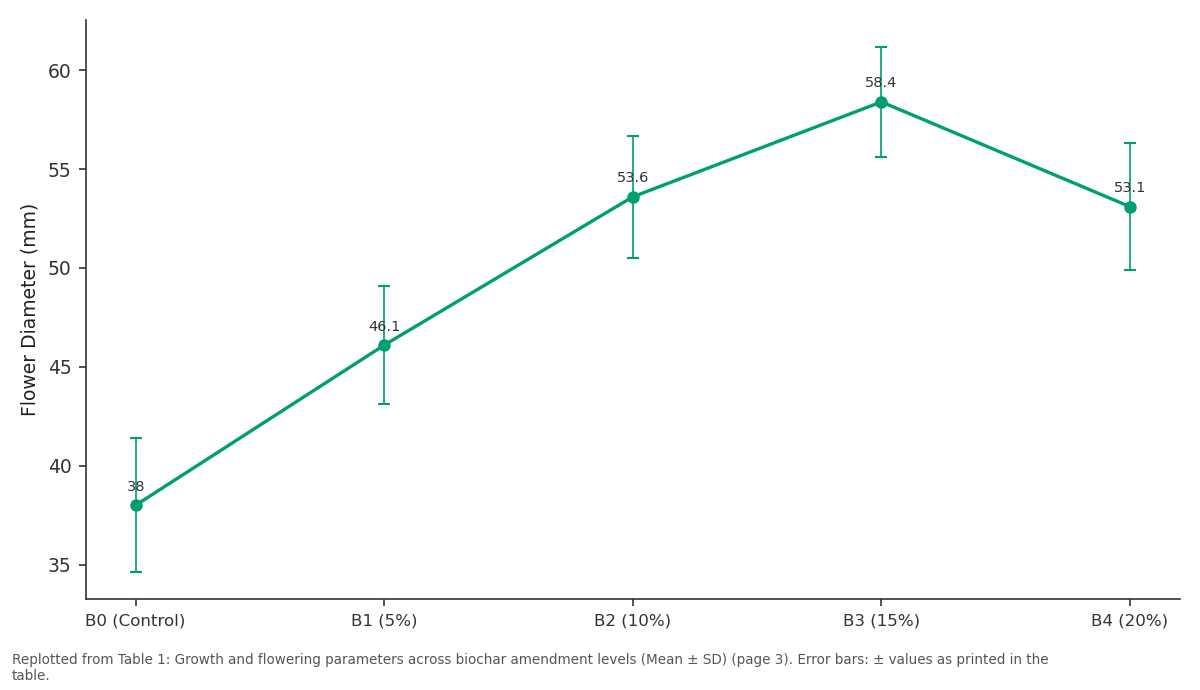
Flower Diameter (mm): B0 (Control) vs B1 (5%) vs B2 (10%) vs B3 (15%) vs B4 (20%)
Replotted from Table 1 (page 3) of the original paper. Every bar is the paper's own table value.
View source evidence ↗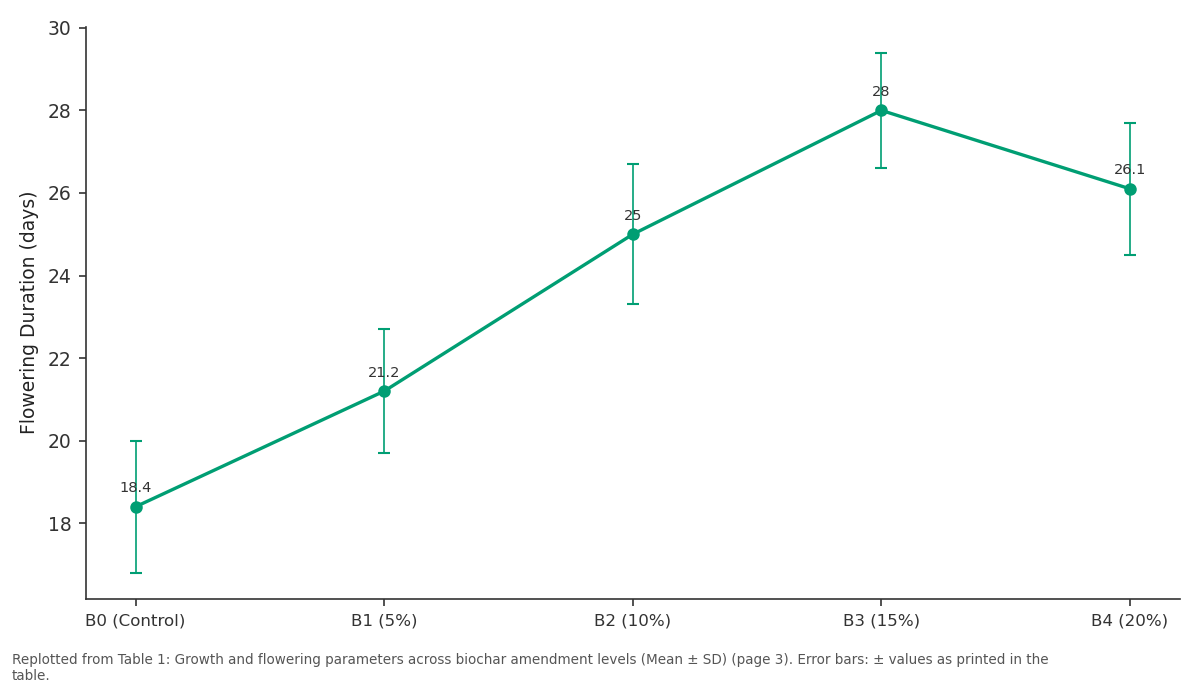
Flowering Duration (days): B0 (Control) vs B1 (5%) vs B2 (10%) vs B3 (15%) vs B4 (20%)
Replotted from Table 1 (page 3) of the original paper. Every bar is the paper's own table value.
View source evidence ↗Figures & tables
From the original paper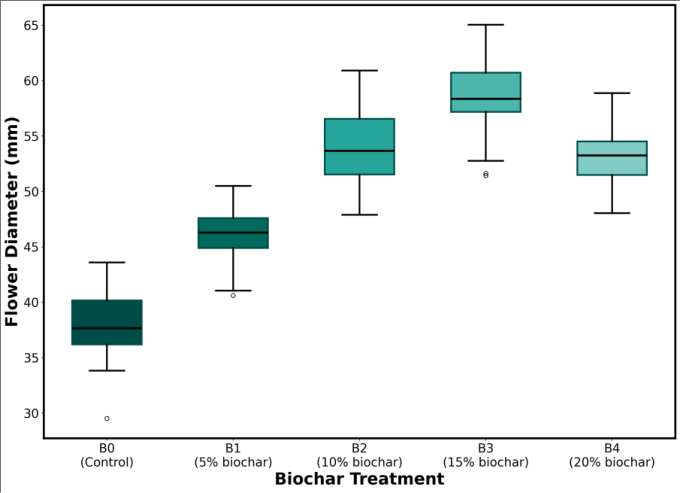 Figure 1
 Table 1
 Table 2
 Table 3
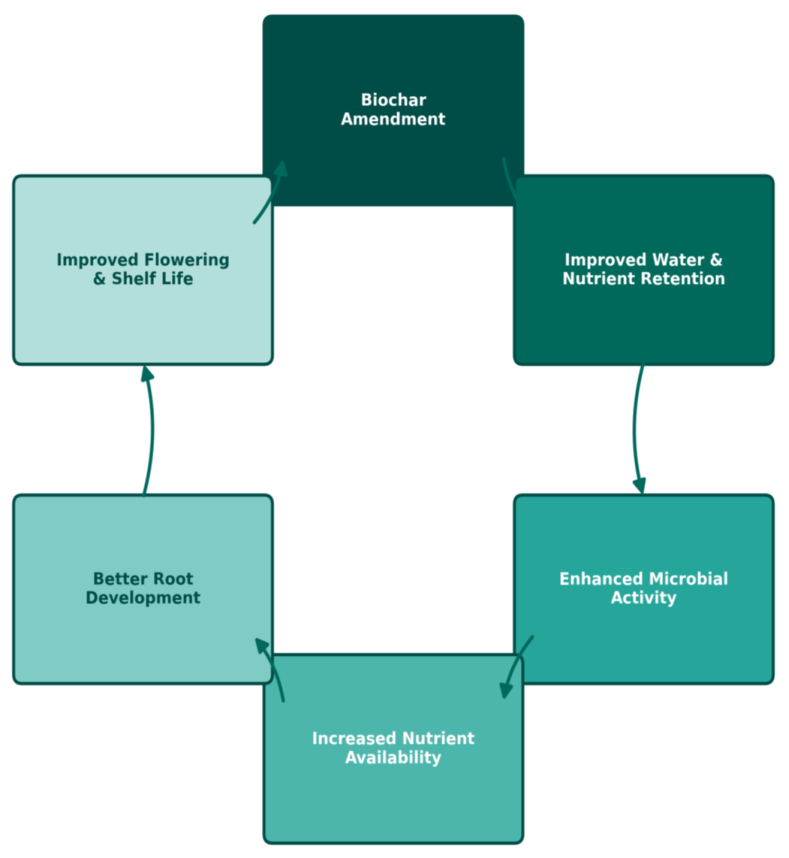 Figure 2
Introduction
Biochar is, at its simplest, charred organic matter produced under limited-oxygen pyrolysis conditions, and its adoption across field-crop agriculture has been driven largely by its capacity to improve soil water retention, cation exchange capacity, and microbial habitat structure. What biochar is not, at least not automatically, is a direct nutrient source in the way conventional fertilizers are; its benefits accrue mostly through indirect improvements to the growing medium's physical and biological environment rather than through substantial nitrogen, phosphorus, or potassium content of its own. This distinction matters for containergrown ornamental production, where potting media properties, rather than field soil properties, govern nearly everything a plant experiences at the root zone. Marigold (Tagetes erecta L.) ranks among the most widely grown cut and potted ornamental flowers across South and Southeast Asian markets, valued both for cut-flower sale and for religious and festival use where flower freshness and shelf life carry direct commercial consequence. Commercial marigold growers using coco-peat or peat-based potting media commonly report inconsistent flowering performance and comparatively short post-harvest vase life relative to field-grown marigold, a gap that media amendment strategies, biochar included, have been proposed to help close, though direct evidence specific to marigold rather than vegetable or cereal crops remains comparatively limited.
A specific question this research aimed to resolve is whether biochar's benefit to marigold flowering and shelf life scales linearly with inclusion rate, or whether there exists a practical upper threshold beyond which additional biochar ceases to help or even becomes counterproductive, an important distinction for growers deciding how much biochar to purchase and incorporate into standard potting mixes. A second question concerned mechanism: does biochar's benefit to marigold flower quality trace mainly to improved water-holding capacity and microbial activity, as biochar's mode of action in field crops would suggest, or does the amended medium's modestly elevated nutrient content play an equally important role specific to container conditions where nutrient leaching through frequent watering is more pronounced than in field soil? Testing five biochar inclusion levels across two cropping cycles allowed this research to identify the practical optimum inclusion rate and to gain some insight into the underlying mechanism, using correlation analysis linking media property changes to the observed flower quality outcomes. The sections that follow describe the polyhouse trial conditions, media preparation, and measurement protocols used to generate this evidence, followed by results characterizing how growth, flowering, and post-harvest shelf life responded across the five biochar levels tested.
Materials and Methods Study Area Description
The trial was conducted in a naturally ventilated polyhouse at the Baguio Academy of Horticultural Sciences research facility, located at approximately 16.41°N, 120.60°E at an elevation of 1,540 m above sea level in the Cordillera highlands of the Philippines. The site experiences a cool subtropical highland climate favorable to marigold cultivation, with mean daytime polyhouse temperatures ranging from 22 °C to 27 °C and relative humidity averaging 68-75% across the two cropping cycles examined (November 2024-February 2025 and March-June 2025).
Materials
Rice husk biochar, produced locally via a flame-curtain kiln at approximately 450-500 °C pyrolysis temperature, was sieved to a uniform particle size before incorporation into a base potting medium of coco-peat, vermicompost, and river sand in a 3:1:1 ratio by volume. Biochar was mixed into this base medium at 0% (control), 5%, 10%, 15%, and 20% by volume, filled into 25 cm diameter plastic pots, with thirty plants per treatment established from uniform seedlings of a locally popular African marigold cultivar, replicated three times in a completely randomized design.
Crop Growth Stage Documentation
Growth stages were recorded at transplanting, vegetative branching onset (approximately 21 days after transplanting), first flower bud visibility, full bloom, and post-harvest vase evaluation. Flowering duration was calculated as days from first flower bud visibility to full bloom, and shelf life was assessed separately using cut flowers harvested at full bloom and held in clean water under ambient laboratory conditions (24 ± 2 °C), with wilting assessed daily until 50% of petals showed visible wilting.
Methods
Plant height, branch number per plant, and flower diameter were measured from five randomly tagged plants per replicate at 30, 60, and 90 days after transplanting and at full bloom respectively. Media samples were analyzed before planting and at the conclusion of each cropping cycle for water-holding capacity, available nitrogen, phosphorus, potassium, and a general microbial activity proxy (dehydrogenase enzyme activity). Data were subjected to analysis of variance appropriate for a completely randomized design, with treatment means compared using the critical difference test at 5% significance. Pearson correlation coefficients were calculated linking media property changes to flower quality and shelf life outcomes. All measurements were pooled across the two cropping cycles for final reporting given the absence of statistically significant cycle-by-treatment interaction.
Results
Results
Comprehensive Interpretation
Taken together, these results identify 15% biochar inclusion by volume as the practical optimum for this potting medium formulation, delivering the largest gains in flower diameter, flowering duration, and shelf life before performance began to decline slightly at the 20% level, plausibly reflecting reduced media aeration or altered water dynamics at very high biochar proportions. The correlation pattern observed supports water-holding capacity and microbial activity, rather than nutrient content, as the dominant pathway through which biochar exerted its benefit.
Discussion
The results of this research show a clear non-linear response to biochar inclusion rate, with flower quality and shelf life peaking at 15% and declining modestly at 20%, a pattern broadly consistent with biochar dose-response curves reported for several field vegetable crops, though the specific optimum rate identified here for container-grown marigold sits somewhat lower than optimum rates reported for some field-soil applications, where biochar is typically incorporated at lower absolute proportions relative to a much larger soil volume.
Several possible explanations account for this decline at the highest inclusion level. Excess biochar in a container medium, unlike in field soil, can meaningfully alter the medium's bulk density and air-filled porosity given the much smaller total media volume available to the plant's root system, potentially creating localized aeration or waterlogging issues at the pot base despite the improved overall water-holding capacity measured at the medium level. The correlation analysis presented here, linking flower quality most strongly to water-holding capacity and microbial activity rather than nutrient content, agrees with the broader understanding of biochar's mode of action established primarily in field-soil research, suggesting this mechanism translates reasonably well to container substrates despite the very different physical scale and management context. This carries a practical implication for commercial marigold potting media formulation: growers seeking to improve flower quality and shelf life through biochar amendment should target approximately 15% inclusion by volume rather than assuming that more biochar produces proportionally better results, since the data here show a modest but measurable decline beyond that point. A further implication concerns commercial scale-up, since rice husk biochar, the amendment type used in this research, is comparatively lowcost and locally available in Philippine horticultural production regions, making the 15% inclusion recommendation practically actionable for commercial growers without requiring specialized or costly biochar sourcing.
A further practical consideration for commercial adoption concerns the two cropping cycles examined here spanning different seasonal conditions, the cooler November-February cycle and the warmer March-June cycle. The 15% biochar treatment maintained its relative advantage over the control across both cycles, though the absolute magnitude of the flower diameter gain was somewhat larger during the warmer cycle, possibly reflecting the medium's improved water-holding capacity conferring greater relative benefit when evapotranspiration demand and irrigation frequency were both higher. This consistency across two distinct seasonal conditions offers some reassurance that the 15% recommendation is not narrowly tied to one specific set of environmental conditions within the broader highland climate of the study site.
It is also worth situating this research's rice husk biochar within the wider range of feedstocks used in published biochar research, since pyrolysis temperature and feedstock source both influence a biochar's pore structure, surface area, and cation exchange capacity, and these physical properties plausibly explain why optimum inclusion rates reported elsewhere for wood-based or manure-based biochars sometimes differ from the 15% figure identified here. Rice husk biochar produced at the moderate 450-500 °C pyrolysis temperature used in this research tends toward a relatively porous, high-surface-area structure well suited to water retention, which may partly explain why the waterholding capacity pathway dominated the correlation results relative to the nutrient content pathway; a highertemperature biochar with a more condensed carbon structure might show a different balance between these two mechanisms.
Conclusion
This research assessed how five biochar inclusion levels in a coco-peat-based potting medium affected marigold growth, flowering, and post-harvest shelf life under polyhouse conditions in Baguio, Philippines, across two cropping cycles. The context for this work was the comparatively limited existing evidence on biochar's specific benefit to container-grown ornamental flower production relative to the substantial body of field-crop biochar research already available. Among the clearest findings, flower diameter, flowering duration, and post-harvest shelf life all peaked at the 15% biochar inclusion level, representing gains of 53.7%, 9.6 days, and 4.2 days respectively over the unamended control, while the 20% level showed a modest decline relative to this peak across all three parameters. The recommendation emerging most directly from this research is that commercial marigold potting media formulations incorporate rice husk biochar at approximately 15% by volume to capture the flower quality and shelf life benefits documented here, rather than assuming higher inclusion rates would confer proportionally greater benefit. Given that the underlying mechanism appears to trace mainly to improved water-holding capacity and microbial activity rather than direct nutrient supplementation, this recommendation should extend reasonably well to other biochar feedstocks with similar physical properties, though confirming that generalization would require testing additional biochar sources beyond the rice husk material used in this research. Looking forward, extending this trial design to other commercially important container-grown ornamental species would help establish whether the 15% optimum identified here for marigold reflects a broader pattern applicable across ornamental potting media formulations or is specific to this particular crop's root system and growth habit.
Figures and tables from the paper
| Treatment | Plant Height (cm) | Branches/Plant | Flower Diameter (mm) | Flowering Duration (days) |
|---|---|---|---|---|
| B0 (Control) | 42.6 ± 3.1 | 8.2 ± 1.1 | 38.0 ± 3.4 | 18.4 ± 1.6 |
| B1 (5%) | 48.3 ± 2.9 | 9.6 ± 1.2 | 46.1 ± 3.0 | 21.2 ± 1.5 |
| B2 (10%) | 53.7 ± 3.2 | 10.9 ± 1.3 | 53.6 ± 3.1 | 25.0 ± 1.7 |
| B3 (15%) | 56.9 ± 3.0 | 11.8 ± 1.0 | 58.4 ± 2.8 | 28.0 ± 1.4 |
| B4 (20%) | 54.2 ± 3.3 | 11.1 ± 1.2 | 53.1 ± 3.2 | 26.1 ± 1.6 |
Table text extracted from the original PDF; superscript letters are shown inline. The original table image is below.
View original table image
| Treatment | Water-Holding Capacity (%) | Available N (mg/kg) | Dehydrogenase Activity (µg TPF/g/24h) |
|---|---|---|---|
| B0 (Control) | 38.6 | 142 | 24.6 |
| B1 (5%) | 45.2 | 156 | 31.8 |
| B2 (10%) | 52.9 | 168 | 39.4 |
| B3 (15%) | 58.4 | 174 | 46.7 |
| B4 (20%) | 60.1 | 179 | 44.2 |
Table text extracted from the original PDF; superscript letters are shown inline. The original table image is below.
View original table image
| Media Property | Flower Diameter (r) | Shelf Life (r) | Flowering Duration (r) |
|---|---|---|---|
| Water-holding capacity | 0.86 | 0.81 | 0.79 |
| Available N | 0.52 | 0.44 | 0.49 |
| Dehydrogenase activity | 0.83 | 0.77 | 0.74 |
Table text extracted from the original PDF; superscript letters are shown inline. The original table image is below.
View original table image
References
14 in the original paper- Agegnehu G, Srivastava AK, Bird MI. The role of biochar and biochar-compost in improving soil quality and crop performance: a review. Appl Soil Ecol. 2017;119:156-170.
- Atkinson CJ, Fitzgerald JD, Hipps NA. Potential mechanisms for achieving agricultural benefits from biochar application to temperate soils: a review. Plant Soil. 2010;337(1):1-18.
- Blackwell P, Riethmuller G, Collins M. Biochar application to soil. In: Lehmann J, Joseph S, editors. Biochar for environmental management: science and technology. London: Earthscan; 2009. p. 207-226.
- Chan KY, Van Zwieten L, Meszaros I, Downie A, Joseph S. Agronomic values of greenwaste biochar as a soil amendment. Aust J Soil Res. 2007;45(8):629-634.
- Downie A, Crosky A, Munroe P. Physical properties of biochar. In: Lehmann J, Joseph S, editors. Biochar for environmental management: science and technology. London: Earthscan; 2009. p. 13-32.
- Glaser B, Lehmann J, Zech W. Ameliorating physical and chemical properties of highly weathered soils in the tropics with charcoal: a review. Biol Fertil Soils. 2002;35(4):219-230.
- Jeffery S, Verheijen FGA, van der Velde M, Bastos AC. A quantitative review of the effects of biochar application to soils on crop productivity using metaanalysis. Agric Ecosyst Environ. 2011;144(1):175-187.
- Joseph SD, Camps-Arbestain M, Lin Y, Munroe P, Chia CH, Hook J, et al. An investigation into the reactions of biochar in soil. Aust J Soil Res. 2010;48(67):501-515.
- Kammann C, Ratering S, Eckhard C, Muller C. Biochar and hydrochar effects on greenhouse gas (carbon dioxide, nitrous oxide, and methane) fluxes from soils. J Environ Qual. 2012;41(4):1052-1066.
- Laird DA, Fleming P, Davis DD, Horton R, Wang B, Karlen DL. Impact of biochar amendments on the quality of a typical Midwestern agricultural soil. Geoderma. 2010;158(3-4):443-449.
- Lehmann J, Rillig MC, Thies J, Masiello CA, Hockaday WC, Crowley D. Biochar effects on soil biota: a review. Soil Biol Biochem. 2011;43(9):18121836.
- Major J, Rondon M, Molina D, Riha SJ, Lehmann J. Maize yield and nutrition during 4 years after biochar application to a Colombian savanna Oxisol. Plant Soil. 2010;333(1):117-128.
- Novak JM, Busscher WJ, Laird DL, Ahmedna M, Watts DW, Niandou MAS. Impact of biochar amendment on fertility of a southeastern coastal plain soil. Soil Sci. 2009;174(2):105-112.
- Sohi SP, Krull E, Lopez-Capel E, Bol R. A review of biochar and its use and function in soil. Adv Agron. 2010;105:47-82.