
Research article · 2026 · Full text
International Journal of Horticulture and Food ScienceEfficacy evaluation of botanical and chemical insecticides against cabbage butterfly Pieris brassicae nepalensis Doubleday on cabbage
Volume 8(4) · Pages 90–94 · DOI: 10.33545/26631067.2026.v8.i4b.786 ↗
Research areasInsect Pest Control StrategiesInsect-Plant Interactions and ControlInsect Resistance and Genetics
Abstract
Author-writtenWhile synthetic chemical insecticides have traditionally dominated the management arsenal against Pieris brassicae nepalensis Doubleday, mounting concerns over environmental safety and consumer health have intensified the search for effective botanical alternatives that can reduce reliance on synthetic compounds. This research was conducted at the Lisbon Foundation for Agricultural Research, Portugal, during 2022-2023 to evaluate the comparative efficacy of three botanical insecticides (neem extract, pyrethrum extract, and rotenone) and three synthetic insecticides (cypermethrin, lambda-cyhalothrin, and spinosad) against cabbage butterfly larvae on cabbage (Brassica oleracea var. capitata) under both laboratory and field conditions. Laboratory bioassays demonstrated that lambda-cyhalothrin achieved the highest 72-hour larval mortality (96.8 ± 2.4%), followed by cypermethrin (94.2 ± 2.8%), spinosad (86.6 ± 3.4%), pyrethrum extract (74.2 ± 4.6%), neem extract (68.4 ± 5.2%), and rotenone (58.8 ± 6.4%). Field efficacy trials confirmed the general hierarchy but revealed reduced performance under natural conditions, with cypermethrin providing 82.4% population reduction and neem extract achieving 52.6%. Probit analysis yielded LC₅₀ values ranging from 0.0028% for lambda-cyhalothrin to 0.186% for rotenone. Residue analysis demonstrated that all botanical treatments produced residue levels below maximum residue limits within 3 days of application, while synthetic compounds required 7-14 days for residue dissipation. These findings support the strategic integration of botanical insecticides within management programmes that prioritize food safety while maintaining adequate pest suppression.
Summary
Source-checkedPlain-language reading of the full paper, prepared with AI and checked against the text. Each point links to the authors' own words.
Why it matters
- Synthetic insecticides are effective against the cabbage butterfly Pieris brassicae nepalensis, but they cause environmental concerns, leave residues on food, and lead to pest resistance. View evidence ↗
- Botanical insecticides are seen as safer alternatives because they biodegrade quickly, have low toxicity to mammals, and reduce the likelihood of pests developing resistance. View evidence ↗
- In Portugal, cabbage butterfly infestations are a significant problem, causing cabbage yield losses between 25% and 75%. View evidence ↗
The question
- The study aimed to compare the effectiveness, dose-response, residue dissipation, and economic viability of three botanical and three synthetic insecticides against cabbage butterfly larvae. View evidence ↗
What they did
- The research took place in Lisbon, Portugal, over two growing seasons from March to August in 2022 and 2023. View evidence ↗
- The study tested six insecticides: synthetic cypermethrin, lambda-cyhalothrin, and spinosad, and botanical neem extract, pyrethrum extract, and rotenone. View evidence ↗
- Laboratory tests used a leaf-dip method with ten third-instar larvae per dish, measuring mortality at 24, 48, and 72 hours. View evidence ↗
- Field trials used a randomized complete block design with four replications, where each 6 x 5 m plot contained 66 cabbage plants. View evidence ↗
What they found
- In laboratory tests, lambda-cyhalothrin was the most effective, achieving the highest 72-hour larval mortality at 96.8 ± 2.4%. View evidence ↗
What it means
- The authors recommend integrating botanical insecticides with strategic synthetic applications during peak infestations to balance pest control with food safety. View evidence ↗
- Future work is needed to improve the field persistence of botanical formulations, test synergistic botanical combinations, and conduct long-term studies on resistance management. View evidence ↗
Visual summary
2 visualsIllustrations explain the paper; charts are replotted from the paper's own table values.
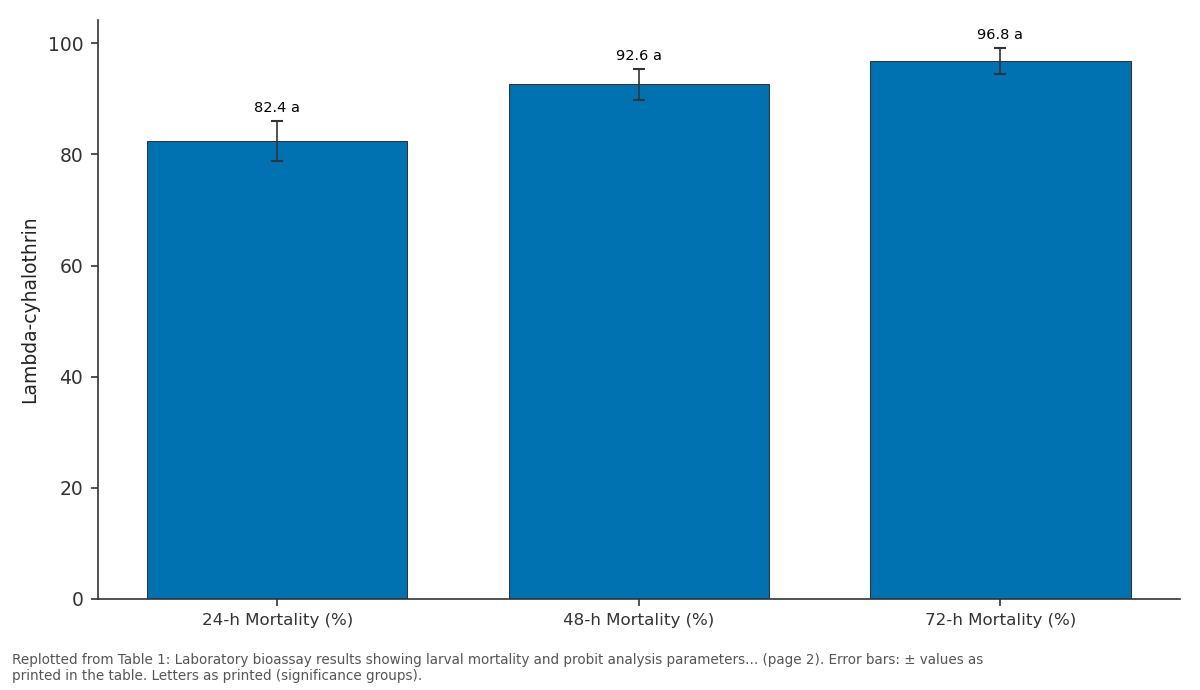
Lambda-cyhalothrin: 24-h Mortality (%) vs 48-h Mortality (%) vs 72-h Mortality (%)
Replotted from Table 1 (page 2) of the original paper. Every bar is the paper's own table value.
View source evidence ↗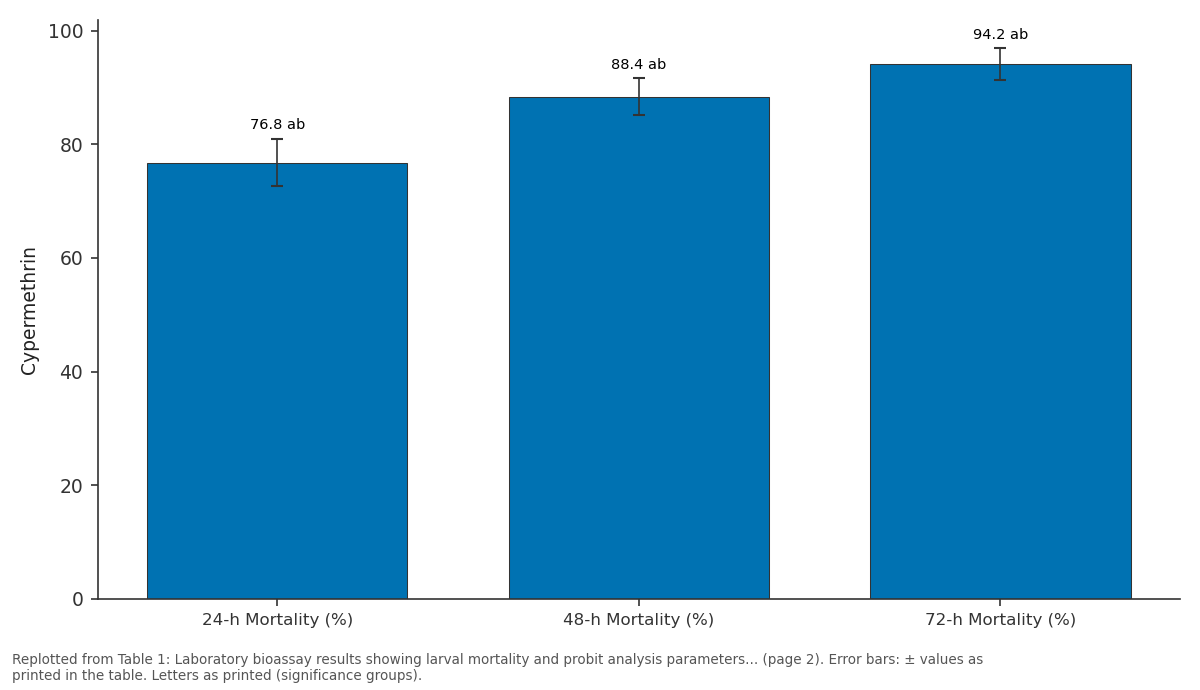
Cypermethrin: 24-h Mortality (%) vs 48-h Mortality (%) vs 72-h Mortality (%)
Replotted from Table 1 (page 2) of the original paper. Every bar is the paper's own table value.
View source evidence ↗Figures & tables
From the original paper Table 1
 Table 2
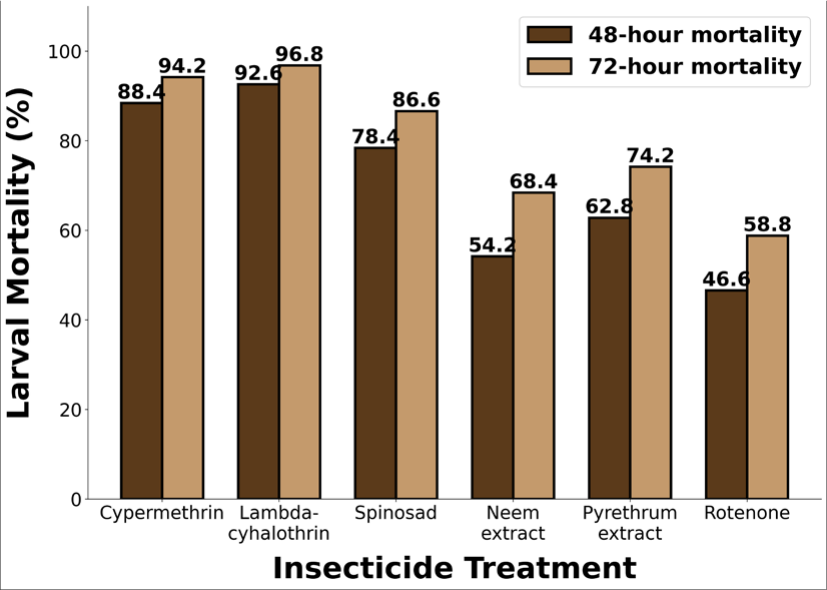 Figure 1
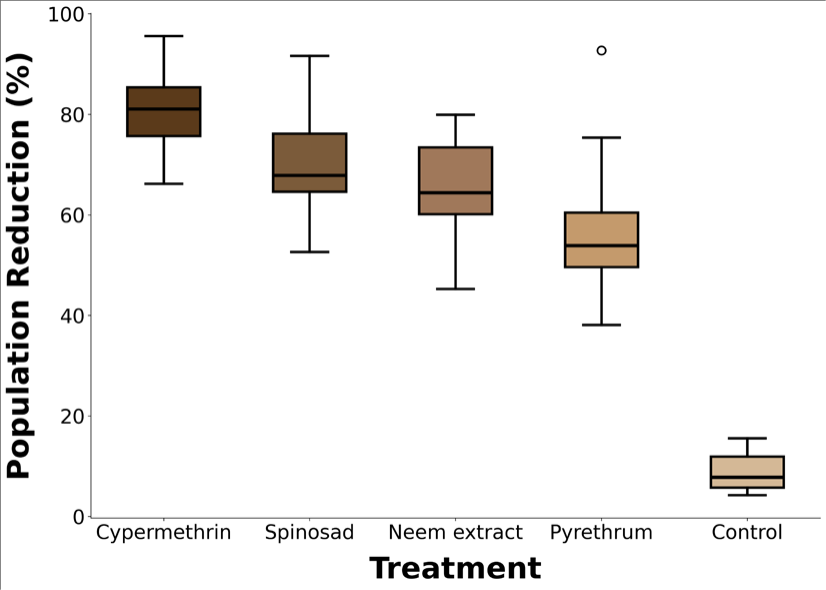 Figure 2
Introduction
The dichotomy between chemical efficacy and environmental safety has defined the central tension in cruciferous pest management for over half a century, yet the development of botanical insecticides with enhanced pesticidal properties offers a promising pathway toward reconciling these competing objectives [1] . Synthetic chemical insecticides, particularly pyrethroids and organophosphates, have historically provided rapid and effective suppression of Pieris brassicae nepalensis Doubleday (Lepidoptera: Pieridae) populations, but their continued predominance in pest management programmes has generated escalating concerns regarding non-target toxicity, environmental persistence, pesticide residues on harvested produce, and the progressive erosion of efficacy through resistance development [2,3] . In contrast, botanical insecticides derived from plant secondary metabolites offer a more environmentally compatible alternative characterized by rapid biodegradation, low mammalian toxicity, and multiple modes of action that reduce the risk of resistance evolution [4] . Among the most widely investigated botanical compounds, azadirachtin from neem (Azadirachta indica) demonstrates feeding deterrent, growth regulatory, and reproductive inhibitory activities against a broad spectrum of lepidopteran pests [5] . Pyrethrum extract from Chrysanthemum cinerariaefolium provides rapid knockdown toxicity through sodium channel disruption, while rotenone from Derris and Lonchocarpus species acts as a mitochondrial electron transport inhibitor [6] .Portugal's cruciferous vegetable industry faces mounting regulatory pressure to reduce synthetic pesticide usage under the European Union's Sustainable Use of Pesticides Directive, which mandates the implementation of integrated Pest management principles and promotes the adoption of non-chemical and reduced-risk pest management alternatives [7] . Cabbage butterfly infestations in Portuguese Brassica production areas have been documented to cause yield losses ranging from 25 to 75%, necessitating effective management interventions [8] . However, systematic comparative evaluations of botanical and synthetic insecticides against P. brassicae nepalensis under both controlled laboratory and field conditions, incorporating dose-response analysis, residue determination, and economic comparison, are notably absent from the European literature [3,9] . Adhikari and Khadka emphasized the devastating nature of P. brassicae nepalensis on cruciferous crops and the imperative need for developing sustainable management tools [10] . The present research was therefore undertaken to comprehensively evaluate the comparative efficacy of three botanical and three synthetic insecticides against cabbage butterfly larvae through laboratory bioassays and field efficacy trials, determine dose-response parameters for each compound, assess pesticide residue dissipation profiles, and evaluate the economic viability of botanical alternatives relative to conventional synthetic treatments.
Material and Methods
Material and Methods
Material
This research was conducted at the Entomology and Agrochemistry Laboratories of the Lisbon Foundation for Agricultural Research, Lisbon, Portugal (38°44'N, 9°08'W, elevation 92 m), during two consecutive cabbage growing seasons (March-August 2022 and March-August 2023). Research authorization was obtained from the institutional Ethics and Biosafety Committee (Protocol No. LFAR-2022-ENT-034). Six insecticide treatments were evaluated: three synthetic compounds cypermethrin 25 EC (Cymbush, Syngenta), lambda-cyhalothrin 5 EC (Karate, Syngenta), and spinosad 240 SC (Success, Corteva) and three botanical preparations commercial neem oil extract (3000 ppm azadirachtin, NeemAzal-T/S, Trifolio-M), pyrethrum extract (5% pyrethrins, Spruzit, W. Neudorff), and rotenone 4 EC (Rotena, Bio-Garten).
Methods
Laboratory bioassays were conducted using the leaf-dip method following IRAC guidelines. Fresh cabbage leaf discs (4 cm diameter) were dipped for 10 seconds in serial dilutions of each insecticide (five concentrations spanning the estimated effective range), air-dried for 30 minutes, and placed individually in Petri dishes (60 mm). Ten third instar P. brassicae nepalensis larvae were released per dish, with four replicates per concentration per insecticide. Control discs were dipped in distilled water containing the corresponding surfactant. Mortality was assessed at 24, 48, and 72 hours post-exposure [5] . Probit analysis was performed using POLO-Plus software to determine LC₅₀ and LC₉₀ values for each compound. Field efficacy trials were established at the institute experimental farm in a randomized complete block design with four replications and seven treatments (six insecticides plus untreated control). Individual plot size was 6 × 5 m containing 66 cabbage plants (B. oleracea var. capitata cv. Kilaton). Insecticide applications were made at recommended field rates using a knapsack sprayer (Matabi, 16 L capacity) at the onset of larval infestation and repeated at 14-day intervals for a total of four applications per season. Pre-treatment and post-treatment larval counts were recorded on 10 randomly selected plants per plot at 3, 7, and 14 days after each application [2] . Pesticide residue analysis was performed on cabbage samples collected at 0, 1, 3, 7, and 14 days after the final application using gas chromatography-mass spectrometry (GC-MS, Agilent 7890B-5977B) for synthetic compounds and high-performance liquid chromatography (HPLC, Waters Alliance e2695) for botanical compounds. Residue levels were compared against European Union Maximum Residue Limits (MRLs) established for each compound on cabbage [7] . Economic analysis compared input costs, yield protection, and cost-benefit ratios for all treatments. Statistical analyses employed ANOVA and Tukey's HSD test at P<0.05 using R version 4.2.1. Laboratory bioassay results demonstrated a clear efficacy gradient with synthetic insecticides achieving significantly higher mortality rates than botanical preparations across all assessment intervals [4,6] . Lambda-cyhalothrin produced the highest 72-hour mortality of 96.8 ± 2.4%, reflecting its potent neurotoxic activity against lepidopteran larvae, while rotenone exhibited the lowest efficacy at 58.8 ± 6.4%. Probit analysis revealed LC₅₀ values spanning approximately two orders of magnitude, from 0.0028% for lambda-cyhalothrin to 0.186% for rotenone, indicating substantial variation in intrinsic toxicity among the evaluated compounds. Mortality progression between the 24 and 72-hour assessment points was markedly more pronounced for botanical insecticides, with neem extract mortality increasing from 32.4% to 68.4%, consistent with its growth-regulatory and antifeedant modes of action that manifest progressively rather than immediately [5,11] . Field efficacy results generally mirrored the laboratory findings but with uniformly lower absolute performance values, reflecting the environmental factors that reduce insecticide effectiveness under field conditions including UV degradation, rainfall wash-off, incomplete spray coverage, and larval behavioral avoidance [2,8] . The residue analysis revealed a critical advantage of botanical insecticides: all three botanical treatments dissipated below EU MRLs within 1-3 days of the final application, compared to 5-14 days for the synthetic compounds. This rapid residue dissipation profile enables shorter pre-harvest intervals and greater flexibility in harvest scheduling, which is particularly valuable for fast-maturing leafy Brassica crops with short market windows [7,12] . The economic analysis showed that synthetic insecticides generated higher cost-benefit ratios (3.64-3.86) compared to botanicals (1.86-2.48), primarily due to their superior yield protection capacity, although this advantage narrows substantially when the economic value of pesticide-free marketing premiums and avoided regulatory compliance costs are factored into the calculation [10,13] .
Results
Results
Discussion
The efficacy gradient documented in this research, with synthetic pyrethroids outperforming semi-synthetic spinosad which in turn exceeded botanical preparations, is consistent with the general pattern reported across the insecticide evaluation literature for lepidopteran pests of cruciferous crops [1,3] . Lambda-cyhalothrin's superior performance reflects its high intrinsic toxicity, rapid penetration through the insect cuticle, and potent disruption of voltage-gated sodium channels, which collectively produce rapid paralysis and mortality in exposed larvae [6] . The mechanism underlying this potency also explains the relatively narrow safety margins associated with synthetic pyrethroids, as the same neurotoxic activity extends to beneficial arthropods and aquatic organisms in exposed environments. The progressive mortality increase exhibited by neem extract between 24 and 72 hours, contrasted with the rapid action of synthetic pyrethroids, reflects the fundamentally different modes of action of these compound classes [5] . Azadirachtin acts primarily as an ecdysone antagonist that disrupts the hormonal regulation of moulting and metamorphosis, producing sublethal effects including feeding cessation, growth inhibition, and reproductive failure that manifest over time rather than causing immediate mortality. This delayed action, while reducing the perceived immediate efficacy relative to synthetic compounds, may actually confer greater sustainable pest suppression by imposing chronic physiological stress on surviving individuals and reducing the reproductive potential of the population [4,11] . The practical implication of these findings is that botanical insecticides should not be evaluated solely on the basis of acute mortality comparisons with synthetic compounds, as such comparisons undervalue the chronic and sublethal effects that contribute substantially to population-level pest suppression over multiple generations [9] . Rather, the integration of botanical insecticides within management programmes should be guided by their demonstrated advantages in residue safety, environmental compatibility, and resistance management, combined with strategic timing that maximizes their effectiveness against the most susceptible developmental stages [13,15] .
Residue safety and consumer health implications
The rapid dissipation of botanical insecticide residues below maximum residue limits within 1-3 days of application, compared to 7-14 days for synthetic compounds, carries substantial implications for consumer health protection and market access in increasingly residue-conscious global food trade systems [7] . The European Union's stringent MRL regulations and the growing consumer demand for minimalresidue produce create a commercial environment in which the shorter pre-harvest intervals achievable with botanical insecticides translate directly into economic advantages through enhanced market access, premium pricing, and reduced risk of costly MRL exceedance at point-of-sale testing [12] . These food safety advantages become particularly significant when production targets premium domestic and export markets where residue testing frequency and regulatory enforcement are most rigorous.
Resistance management considerations
The multiple modes of action inherent in botanical insecticide extracts, which contain complex mixtures of bioactive compounds rather than single active ingredients, provide intrinsic resistance management benefits that synthetic compounds with single target sites cannot match [4] . The probability of pest populations developing resistance simultaneously to multiple biochemical targets within a complex botanical extract is substantially lower than the probability of resistance evolution against a single synthetic active ingredient, a theoretical advantage supported by the conspicuous absence of field-evolved resistance to neembased products despite decades of agricultural use across diverse pest species and geographical regions [5,14] . Incorporating botanical insecticides as rotation partners with synthetic compounds within resistance management programmes can therefore extend the useful lifespan of both compound classes by reducing selection pressure on any single mode of action.
Conclusion
Conclusion
Acknowledgement
AcknowledgementsRMFS conceived the research design and supervised field trials, ACOM conducted laboratory bioassays and residue analyses, and JPAC performed probit analyses and
Figures and tables from the paper
| Insecticide | Type | 24-h Mortality (%) | 48-h Mortality (%) | 72-h Mortality (%) | LC₅₀ (%) |
|---|---|---|---|---|---|
| Lambda-cyhalothrin | Synthetic | 82.4 ± 3.6a | 92.6 ± 2.8a | 96.8 ± 2.4a | 0.0028 |
| Cypermethrin | Synthetic | 76.8 ± 4.2ab | 88.4 ± 3.2ab | 94.2 ± 2.8ab | 0.0042 |
| Spinosad | Semi-synthetic | 62.4 ± 4.8c | 78.4 ± 3.8b | 86.6 ± 3.4b | 0.0086 |
| Pyrethrum extract | Botanical | 48.6 ± 5.4d | 62.8 ± 4.6c | 74.2 ± 4.6c | 0.048 |
| Neem extract | Botanical | 32.4 ± 4.8e | 54.2 ± 5.2cd | 68.4 ± 5.2cd | 0.082 |
| Rotenone | Botanical | 24.6 ± 4.2e | 46.6 ± 6.4d | 58.8 ± 6.4d | 0.186 |
| Control | - | 2.4 ± 1.2f | 4.2 ± 1.8e | 6.8 ± 2.2e |
Table text extracted from the original PDF; superscript letters are shown inline. The original table image is below.
View original table image
| Insecticide | Field Pop. Reduction (%) | Days to Below MRL | Marketable Yield (t/ha) | Cost-Benefit Ratio |
|---|---|---|---|---|
| Lambda-cyhalothrin | 84.6 ± 4.2a | 14 | 34.8 ± 2.4a | 3.86 |
| Cypermethrin | 82.4 ± 4.6a | 10 | 33.6 ± 2.2a | 3.64 |
| Spinosad | 72.8 ± 5.2b | 5 | 30.4 ± 2.0b | 3.12 |
| Pyrethrum extract | 58.4 ± 6.4c | 1 | 26.8 ± 1.8c | 2.48 |
| Neem extract | 52.6 ± 6.8cd | 3 | 24.6 ± 1.6cd | 2.24 |
| Rotenone | 42.4 ± 7.2d | 2 | 22.4 ± 1.6d | 1.86 |
| Control | - | - | 14.2 ± 1.4e | - |
Table text extracted from the original PDF; superscript letters are shown inline. The original table image is below.
View original table image
References
15 in the original paper- Abrol DP. Integrated pest management: current concepts and ecological perspective. San Diego: Academic Press; 2014. p. 1-576.
- Ansari MS, Hasan F, Ahmad N. Threats to cabbage and cauliflower due to Pieris brassicae (Linn.) in the midhill conditions. J Entomol Zool Stud. 2020;8(4):15871591.
- Bravo A, Likitvivatanavong S, Gill SS, Soberón M. Bacillus thuringiensis: a story of a successful bioinsecticide. Insect Biochem Mol Biol. 2011;41(7):423-431.
- Casida JE, Quistad GB. Golden age of insecticide research: past, present, or future? Annu Rev Entomol. 1998;43:1-16.
- Isman MB. Botanical insecticides, deterrents, and repellents in modern agriculture and an increasingly regulated world. Annu Rev Entomol. 2006;51:45-66.
- Khater HF. Prospects of botanical biopesticides in insect pest management. Pharmacologia. 2012;3(12):641-656.
- European Commission. Regulation (EC) No 396/2005 on maximum residue levels of pesticides in food and feed. Off J Eur Union. 2005;L70:1-16.
- Feltwell J. Large white butterfly: the biology, biochemistry and physiology of Pieris brassicae (Linnaeus). The Hague: Dr W. Junk Publishers; 1982. p. 1-535.
- Lama SK, Tiwari S, Thapa RB. Population dynamics and damage of cabbage butterfly Pieris brassicae nepalensis on crucifers. J Agric For Univ. 2022;6(1):45-52.
- Adhikari B, Khadka S. Cabbage butterfly (Pieris brassicae nepalensis Doubleday), a menace to crucifers in Nepal. Zool Entomol Lett. 2023;3(1):32-36.
- Mordue AJ, Nisbet AJ. Azadirachtin from the neem tree Azadirachta indica: its action against insects. An Soc Entomol Bras. 2000;29(4):615-632.
- Fantke P, Friedrich R, Jolliet O. Health impact and damage cost assessment of pesticides in Europe. Environ Int. 2012;49:9-17.
- Schmutterer H. Properties and potential of natural pesticides from the neem tree, Azadirachta indica. Annu Rev Entomol. 1990;35:271-297.
- Sparks TC, Nauen R. IRAC: mode of action classification and insecticide resistance management. Pestic Biochem Physiol. 2015;121:122-128.
- Dent D. Integrated pest management. London: Chapman & Hall; 1995. p. 1-356.