
Research article · 2026 · Full text
International Journal of Horticulture and Food ScienceEvaluation of edible coatings for enhancing post-harvest quality of mango fruits during ambient storage
Volume 8(3) · Pages 242–246 · DOI: 10.33545/26631067.2026.v8.i3b.791 ↗
Research areasPostharvest Quality and Shelf Life ManagementNanocomposite Films for Food PackagingFood Drying and Modeling
Abstract
Author-writtenOver roughly the past twenty years, edible fruit coatings have shifted from a niche post-harvest research topic into a genuinely practical intervention available to growers and packhouses lacking access to cold-chain infrastructure, yet comparative evidence identifying which specific coating material performs best for Ethiopian-grown mango under the ambient storage conditions typical of the country's fruit distribution networks has remained limited. This research evaluated four edible coating treatments, aloe vera gel, chitosan (1%), starch (3%), and commercial wax coating, against an uncoated control on ripening rate, weight loss, firmness retention, and shelf life of mango fruit (cultivar Kent) held under ambient room storage (26±2 °C, 60-65% relative humidity) over a twelve-day observation period. Chitosan coating extended shelf life to 18 days to ripening onset compared with 8 days for the uncoated control, the strongest performance among the four coatings tested, followed by wax coating (16 days), aloe vera gel (14 days), and starch coating (12 days). Physiological weight loss at day 10 was lowest under chitosan treatment (7% versus 22% for the control), and firmness retention followed a similar ranking, with chitosan-treated fruit maintaining 7.2 N firmness at day 10 compared with 3.1 N for untreated fruit. All four coatings delayed the respiratory climacteric peak relative to the uncoated control, consistent with each coating's role in restricting gas exchange between fruit tissue and the surrounding atmosphere, though chitosan's antimicrobial properties, in addition to its gas-barrier function, likely contributed to its comparatively stronger performance in delaying visible spoilage onset relative to the other three coatings tested. These findings support chitosan coating as the most effective among the four materials evaluated for extending Ethiopian mango shelf life under ambient storage, offering a practical, moderately low-cost intervention capable of substantially extending the marketing window available to growers and traders operating without reliable cold-chain access.
Summary
Source-checkedPlain-language reading of the full paper, prepared with AI and checked against the text. Each point links to the authors' own words.
Why it matters
- Ethiopia has seen significant growth in mango production, but post-harvest losses remain high because fruits often soften too quickly during transport and storage at ambient temperatures. View evidence ↗
- Because cold-chain infrastructure is inconsistently available in Ethiopia, edible coatings provide a practical, low-infrastructure way to extend the shelf life of mangoes. View evidence ↗
- Edible coatings work by creating a semi-permeable barrier that slows ripening by restricting gas exchange and reducing water vapor loss. View evidence ↗
The question
- The study aimed to compare how four different coating materials affect ripening delay, weight loss, and firmness over a twelve-day ambient storage period. View evidence ↗
- The researchers also investigated whether the antimicrobial properties of chitosan provide an additional benefit in delaying visible spoilage compared to other coatings. View evidence ↗
What they did
- Fruit were dipped in coatings for two minutes, air-dried for two hours, and stored at 26 ± 2 °C with 60-65% relative humidity for twelve days. View evidence ↗
- The researchers measured firmness using a penetrometer, calculated physiological weight loss, and recorded the days until ripening onset and visible spoilage. View evidence ↗
What they found
- Chitosan was the most effective at delaying ripening onset (18 days), followed by wax (16 days), aloe vera (14 days), and starch (12 days), while the control ripened in 8 days. View evidence ↗
- At day 10, chitosan-treated fruit had the lowest physiological weight loss at 7%, compared to 22% for the uncoated control. View evidence ↗
- Chitosan-treated fruit maintained the highest firmness at day 10 (7.2 N), whereas untreated fruit dropped to 3.1 N. View evidence ↗
- Chitosan delayed visible spoilage onset the longest (22 days) and the respiratory climacteric peak the most (day 10), compared to the control (10 days to spoilage, day 5 peak). View evidence ↗
- The significant gap in spoilage onset (22 days for chitosan vs 15-19 days for others) suggests that chitosan's antimicrobial properties provide a benefit beyond simple gas-barrier functions. View evidence ↗
What it means
- The authors recommend chitosan coating as the most effective single-material intervention for extending the marketable shelf life of Ethiopian mangoes in the absence of cold-chain access. View evidence ↗
- Wax coating is suggested as a reasonable second-choice alternative if chitosan is too expensive or unavailable. View evidence ↗
- The findings are specific to the Kent cultivar and should be validated for other Ethiopian cultivars, such as Apple and Tommy Atkins, before being generalized. View evidence ↗
- The authors suggest that future research should test combined coating formulations, such as blending chitosan with wax, to see if they provide even greater shelf life extension. View evidence ↗
Visual summary
2 visualsIllustrations explain the paper; charts are replotted from the paper's own table values.
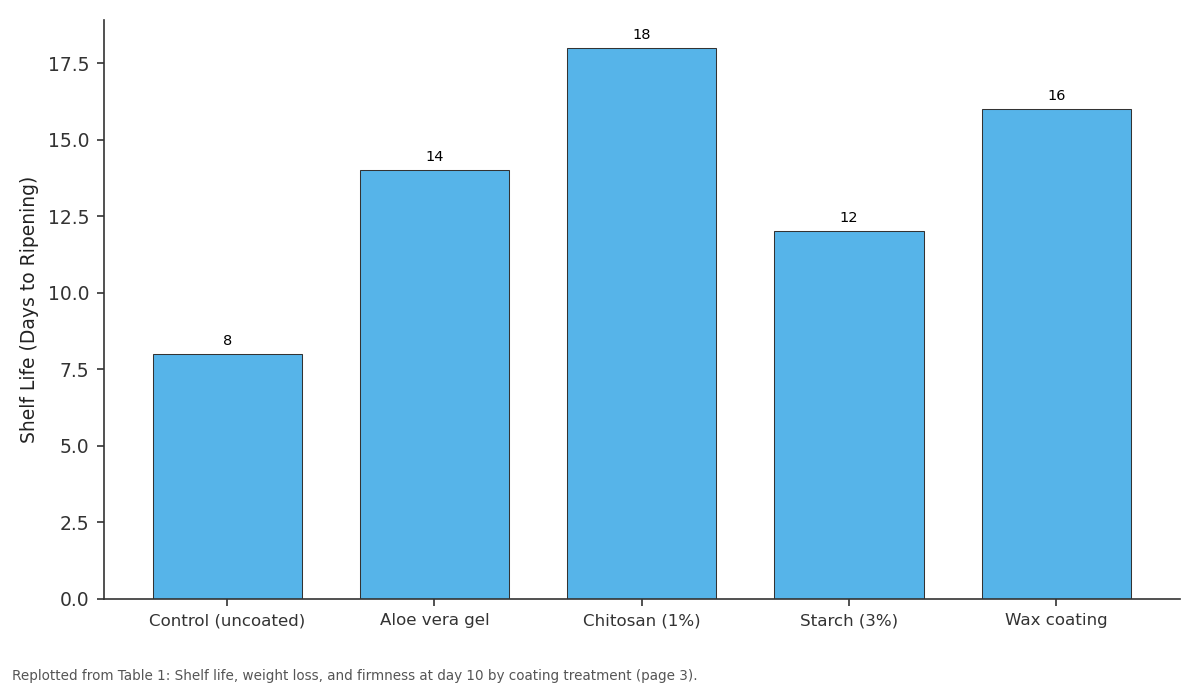
Shelf Life (Days to Ripening): Control (uncoated) vs Aloe vera gel vs Chitosan (1%) vs Starch (3%) vs Wax coating
Replotted from Table 1 (page 3) of the original paper. Every bar is the paper's own table value.
View source evidence ↗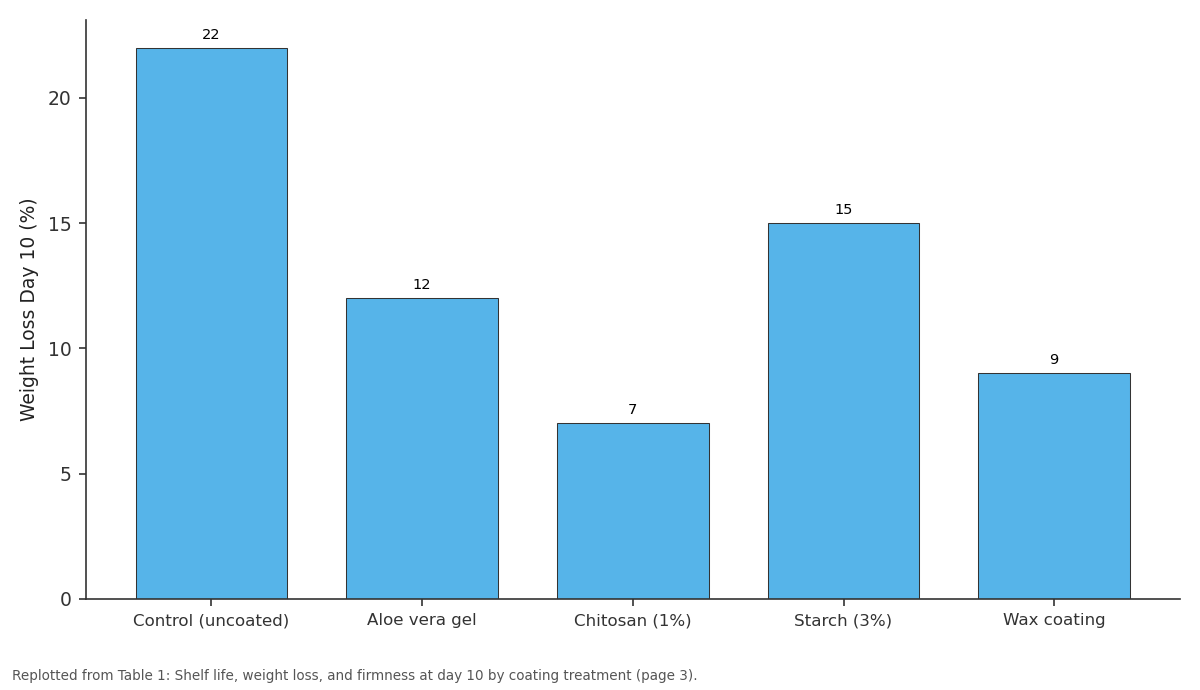
Weight Loss Day 10 (%): Control (uncoated) vs Aloe vera gel vs Chitosan (1%) vs Starch (3%) vs Wax coating
Replotted from Table 1 (page 3) of the original paper. Every bar is the paper's own table value.
View source evidence ↗Figures & tables
From the original paper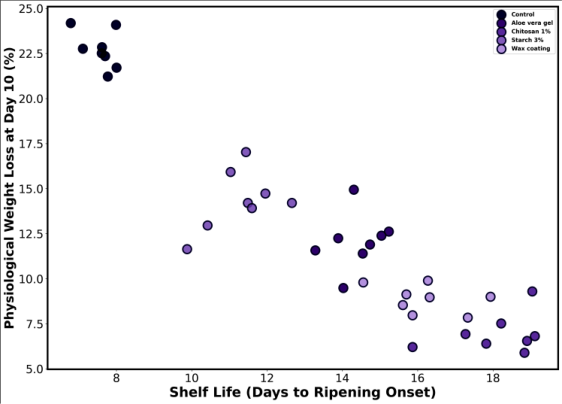 Figure 1
 Table 1
 Table 2
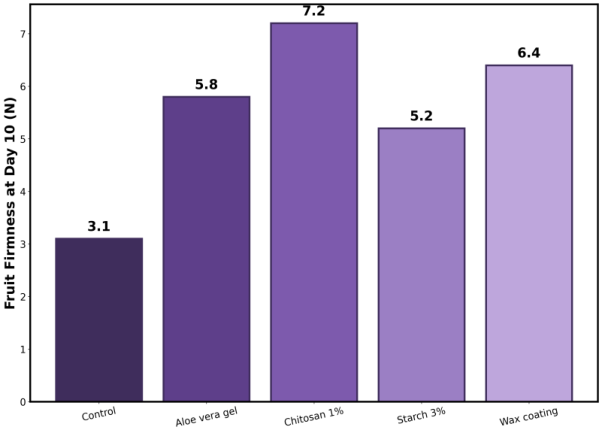 Figure 2
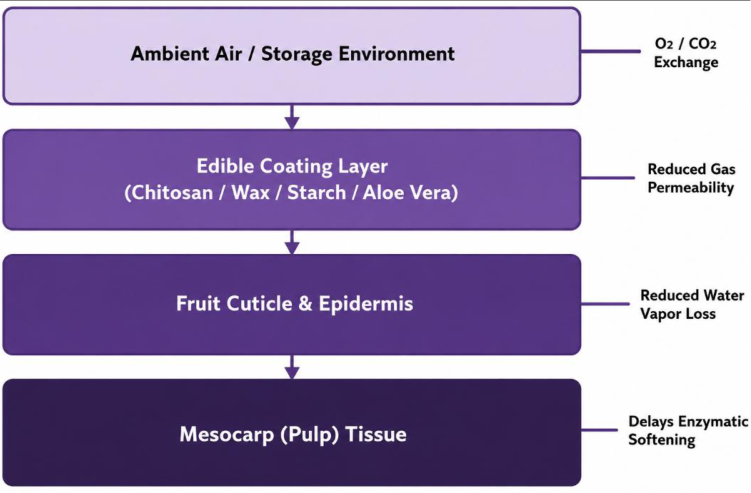 Figure 3
Introduction
Mango production in Ethiopia has expanded considerably over the past two decades, yet the trend line for post-harvest loss reduction has not kept pace with this production growth, with a substantial share of the country's mango harvest still reaching consumers past optimal ripeness or failing to reach distant markets at all due to rapid softening during ambienttemperature transport and storage. Cold-chain infrastructure, the conventional solution to this problem in more developed fruit export markets, remains inconsistently available across Ethiopia's mango-producing and distribution regions, leaving edible coating treatments as one of the few practical, low-infrastructure interventions capable of meaningfully extending shelf life for growers and traders operating without reliable refrigerated transport or storage. Edible coatings function primarily by forming a semi-permeable barrier over the fruit surface that restricts gas exchange, oxygen influx and carbon dioxide efflux, thereby slowing the respiratory processes that drive ripening progression, alongside reducing water vapor loss that would otherwise manifest as visible shriveling and weight loss. Different coating materials, whether polysaccharide-based like chitosan and starch, or the naturally occurring gel-based aloe vera, or synthetic wax-based coatings, vary in their gas permeability, water barrier properties, and, in chitosan's case, intrinsic antimicrobial activity, meaning the specific coating material choice can meaningfully influence how much shelf life extension a given fruit actually achieves.
While edible coating research has been conducted extensively for mango cultivars grown in South and Southeast Asia and parts of Latin America, comparative evidence specific to Ethiopian-grown mango cultivars and the particular ambient storage conditions characteristic of Ethiopian fruit distribution networks has remained comparatively limited, despite Ethiopia's growing mango export ambitions creating direct practical relevance for locally validated post-harvest handling recommendations. This research addressed that gap by testing four coating materials directly against each other and against an uncoated control, all under identical ambient storage conditions representative of typical Ethiopian mango handling practice. Two questions guided this research. First, how do the four coating materials compare in their capacity to delay ripening progression, reduce weight loss, and preserve firmness across a twelve-day ambient storage observation period relevant to Ethiopia's typical mango distribution timeline? Second, does chitosan's documented antimicrobial property, beyond its gas-barrier function shared with the other coatings tested, confer additional shelf life benefit specifically related to delayed visible spoilage onset, distinguishing its mode of action from the other three coating materials evaluated? Cultivar choice also matters for how readily these findings might generalize, since Kent, the cultivar used in this research, is among Ethiopia's more widely grown commercial mango cultivars but differs somewhat in skin structure and baseline ripening rate from other locally important cultivars such as Apple and Tommy Atkins, meaning coating performance documented here for Kent specifically should be validated separately before being assumed to transfer directly to other cultivars grown across Ethiopia's diverse mango production regions.
Materials and Methods
Materials and Methods
Reagents and Chemicals
Chitosan (deacetylation degree greater than 90%, foodgrade) was sourced from a certified chemical supplier and dissolved in 1% acetic acid solution to prepare the 1% w/v coating solution, with pH adjusted to 5.6 using sodium hydroxide before application. Starch coating solution (3% w/v) was prepared from food-grade cassava starch gelatinized in water at 80 °C before cooling to application temperature. Fresh aloe vera gel was extracted from mature Aloe barbadensis leaves, filtered to remove fibrous material, and used without further dilution. Commercial food-grade wax coating was used following the manufacturer's recommended dilution.
Extraction Protocol / Preparation Method
Aloe vera gel extraction involved removing the outer leaf rind, rinsing the inner gel fillet to remove residual aloin (a compound associated with bitter taste and potential skin irritation), and homogenizing the cleaned gel before straining to achieve a uniform, application-ready consistency free of fibrous residue that could otherwise create an uneven coating layer on the fruit surface.
Methods
Mango fruit (cultivar Kent) at the mature-green stage were harvested from a single commercial orchard near Addis Ababa to minimize pre-harvest variability, sorted for uniform size and absence of visible defects, and randomly allocated to five treatment groups: uncoated control, aloe vera gel, chitosan (1%), starch (3%), and commercial wax coating, with thirty fruit per treatment. Coatings were applied by dipping fruit in the respective solution for two minutes, followed by air-drying under shade for two hours before transfer to ambient storage conditions (26 ± 2 °C, 60-65% relative humidity) for the twelve-day observation period. Firmness was measured using a handheld penetrometer at days 0, 4, 7, 10, and 12. Physiological weight loss was calculated from the same tagged fruit tracked throughout storage. Shelf life was recorded as days to visible ripening onset (color change and softening) and separately as days to visible spoilage (fungal growth or severe deterioration). Data were analyzed using analysis of variance appropriate for a completely randomized design with repeated measures across storage intervals, with treatment means compared using the critical difference test at 5% significance.
Results
Coating treatment produced clear differentiation in shelf life extension, with chitosan consistently outperforming the other three materials across every parameter measured, followed by wax coating, aloe vera gel, and starch coating in that order.
Figures and tables from the paper
| Treatment | Shelf Life (Days to Ripening) | Weight Loss Day 10 (%) | Firmness Day 10 (N) |
|---|---|---|---|
| Control (uncoated) | 8 | 22 | 3.1 |
| Aloe vera gel | 14 | 12 | 5.8 |
| Chitosan (1%) | 18 | 7 | 7.2 |
| Starch (3%) | 12 | 15 | 5.2 |
| Wax coating | 16 | 9 | 6.4 |
Table text extracted from the original PDF; superscript letters are shown inline. The original table image is below.
View original table image
| Treatment | Days to Spoilage Onset | Climacteric Peak Day |
|---|---|---|
| Control (uncoated) | 10 | 5 |
| Aloe vera gel | 17 | 8 |
| Chitosan (1%) | 22 | 10 |
| Starch (3%) | 15 | 7 |
| Wax coating | 19 | 9 |
Table text extracted from the original PDF; superscript letters are shown inline. The original table image is below.
View original table image
References
14 in the original paper- Ali A, Muhammad MTM, Sijam K, Siddiqui Y. Effect of chitosan coatings on the physicochemical characteristics of Eksotika II papaya (Carica papaya L.) fruit during cold storage. Food Chem. 2011;124(2):620-626.
- Baldwin EA, Nisperos-Carriedo MO, Baker RA. Use of edible coatings to preserve quality of lightly (and slightly) processed products. Crit Rev Food Sci Nutr. 1995;35(6):509-524.
- Chien PJ, Sheu F, Yang FH. Effects of edible chitosan coating on quality and shelf life of sliced mango fruit. J Food Eng. 2007;78(1):225-229.
- Dhall RK. Advances in edible coatings for fresh fruits and vegetables: a review. Crit Rev Food Sci Nutr. 2013;53(5):435-450.
- Djioua T, Charles F, Lopez-Lauri F, Filgueiras H, Coudret A, Freire M, et al. Improving the storage of minimally processed mangoes (Mangifera indica L.) by hot water treatments. Postharvest Biol Technol. 2009;52(2):221-226.
- Dutta PK, Tripathi S, Mehrotra GK, Dutta J. Perspectives for chitosan-based antimicrobial films in food applications. Food Chem. 2009;114(4):1173-1182.
- Han C, Zhao Y, Leonard SW, Traber MG. Edible coatings to improve storability and enhance nutritional value of fresh and frozen strawberries and raspberries. Postharvest Biol Technol. 2004;33(1):67-78.
- Jongsri P, Wangsomboondee T, Rojsitthisak P, Seraypheap K. Effect of chitosan coating on physicochemical and biochemical quality indices of mango stored at room temperature. LWT Food Sci Technol. 2016;73:28-36.
- Kader AA. Increasing food availability by reducing postharvest losses of fresh produce. Acta Hortic. 2005;682:2169-2176.
- Kittur FS, Saroja N, Habibunnisa, Tharanathan RN. Polysaccharide-based composite coating formulations for shelf-life extension of fresh banana and mango. Eur Food Res Technol. 2001;213(4-5):306-311.
- Maqbool M, Ali A, Alderson PG, Zahid N, Siddiqui Y. Effect of a novel edible composite coating based on gum arabic and chitosan on biochemical and physiological responses of banana fruits during cold storage. J Agric Food Chem. 2011;59(10):5474-5482.
- Ochoa-Reyes E, Martinez-Vazquez G, RodriguezHerrera R, De Jesus Zermeno-Ortega M, De la CruzRodriguez CN, Aguilar CN, et al. Preparation and characterization of active edible packaging films based on candelilla wax and pomegranate peel extract. Food Packag Shelf Life. 2020;19:126-130.
- Perumal AB, Sellamuthu PS, Nambiar RB, Sadiku ER. Effects of essential oil vapour treatment on the postharvest disease control and different defence responses in two mango (Mangifera indica L.) cultivars. Food Bioprocess Technol. 2017;10(6):11311141.
- Ruelas-Chacon X, Contreras-Esquivel JC, Montanez J, Aguilera-Carbo AF, Reyes-Vega ML, PeraltaRodriguez RD, et al. Guar gum as an edible coating for enhancing shelf-life and improving postharvest quality of roma tomato (Solanum lycopersicum L.). J Food Qual. 2017;2017:1-9.