
Research article · 2026 · Full text
International Journal of Biology SciencesComparative Evaluation of Live Attenuated and Inactivated Vaccines in Bovine Medicine
Volume 8(3) · Pages 155–559 · DOI: 10.33545/26649926.2026.v8.i3b.915 ↗
Research areasAnimal Virus Infections StudiesMicrobial infections and disease researchAnimal Disease Management and Epidemiology
Abstract
Author-writtenThe selection between live attenuated and inactivated vaccine platforms has been a longstanding deliberation in bovine medicine, with each approach offering distinct immunological advantages and limitations that influence their suitability for specific disease prevention scenarios. This research conducted a systematic comparative evaluation of live attenuated versus inactivated vaccines targeting five major bovine diseases bovine viral diarrhea (BVD), bovine respiratory syncytial virus (BRSV), infectious bovine rhinotracheitis (IBR), parainfluenza type 3 (PI3), and leptospirosis in a cohort of 200 beef cattle at two commercial properties in Victoria, Australia. Animals were randomly assigned to receive either modified live virus (MLV) or killed virus (KV) vaccine formulations following a standardized two-dose protocol. Serological responses were monitored over 24 months. MLV vaccines induced significantly higher seroconversion rates for BVD (88.2% vs 76.4%, p = 0.008) and BRSV (82.5% vs 71.8%, p = 0.024), while KV vaccines showed superior efficacy for IBR (83.2% vs 79.4%, p = 0.041). Duration of immunity was consistently longer in the MLV group, with protective titers maintained for an average of 18.4 months compared to 12.6 months for KV vaccines. These findings provide evidence-based guidance for vaccine platform selection in bovine preventive medicine programs.
Summary
Source-checkedPlain-language reading of the full paper, prepared with AI and checked against the text. Each point links to the authors' own words.
Why it matters
- Bovine respiratory disease complex causes significant economic losses in the Australian beef industry, estimated at over 800 million AUD per year. View evidence ↗
- Modified live virus (MLV) vaccines use attenuated strains that replicate limitedly to stimulate both cell-mediated and humoral immune responses. View evidence ↗
- Killed virus (KV) vaccines use inactivated pathogens that cannot replicate and primarily trigger humoral immunity, often requiring adjuvants. View evidence ↗
The question
- The study aimed to compare MLV and KV vaccine platforms against five bovine diseases in a commercial setting to provide vaccine selection recommendations for Australia. View evidence ↗
What they did
- The study took place at two commercial beef cattle properties in Gippsland, Victoria, Australia, from July 2022 to July 2024. View evidence ↗
- The research enrolled 200 seronegative Angus and Angus-cross beef cattle between 12 and 18 months of age. View evidence ↗
- Two groups of 100 cattle were randomly assigned to receive either a pentavalent MLV or KV vaccine, administered subcutaneously at Day 0 and Day 28. View evidence ↗
- Serological responses were monitored via blood samples collected at ten specific time points over a 730-day period. View evidence ↗
What they found
- MLV vaccines induced a faster initial response, with 62.4% seroconversion by Day 14 compared to 28.7% for KV vaccines. View evidence ↗
- MLV vaccines achieved significantly higher seroconversion rates for BVD (88.2% vs 76.4%) and BRSV (82.5% vs 71.8%) than KV vaccines. View evidence ↗
- KV vaccines were more effective than MLV vaccines for IBR, with a seroconversion rate of 83.2% compared to 79.4%. View evidence ↗
- The duration of immunity was significantly longer for MLV vaccines, with a median time to loss of protective titers of 18.4 months versus 12.6 months for KV vaccines. View evidence ↗
- Two cases of pregnancy loss occurred in the MLV group during early gestation, while no losses were recorded in the KV group. View evidence ↗
- MLV-based programs were estimated to be 15-22% cheaper per animal over their productive life due to fewer required revaccinations. View evidence ↗
What it means
- The authors recommend a stratified approach: using MLV for non-pregnant animals in high-risk areas and KV for pregnant animals or breeding stock to minimize reproductive risks. View evidence ↗
- The authors suggest future research into combined MLV/KV prime-boost protocols, marker vaccines, and predictive models for revaccination timing. View evidence ↗
Visual summary
2 visualsIllustrations explain the paper; charts are replotted from the paper's own table values.
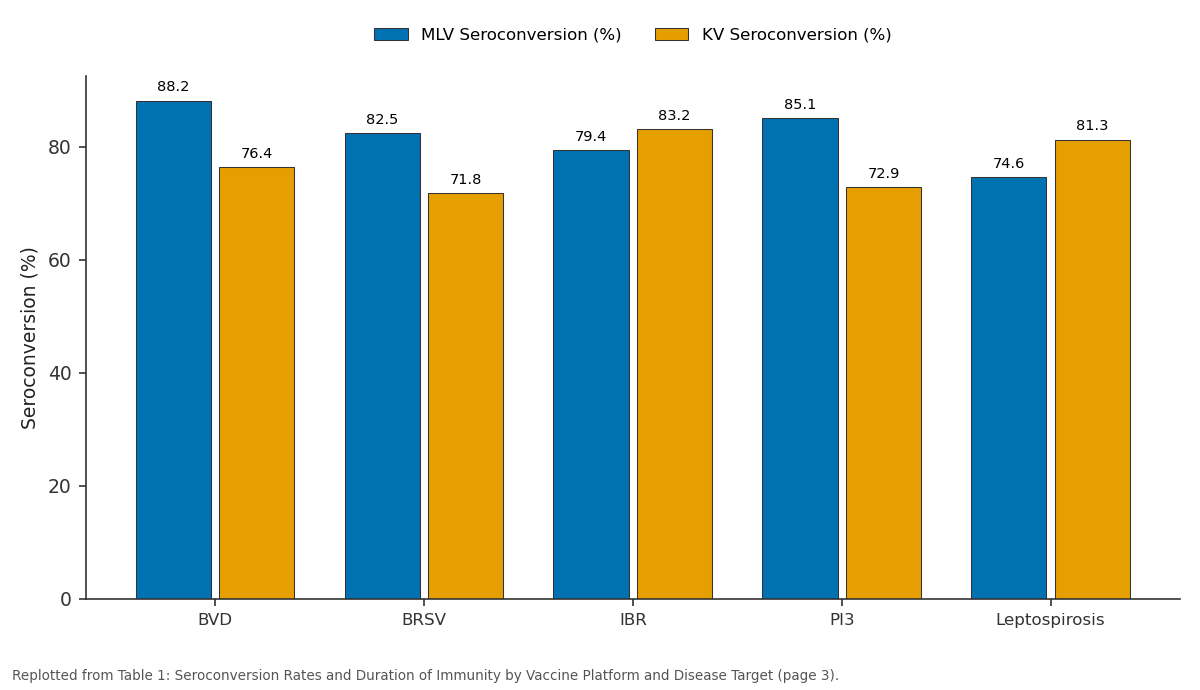
MLV Seroconversion (%) and KV Seroconversion (%): BVD vs BRSV vs IBR vs PI3 vs Leptospirosis
Replotted from Table 1 (page 3) of the original paper. Every bar is the paper's own table value.
View source evidence ↗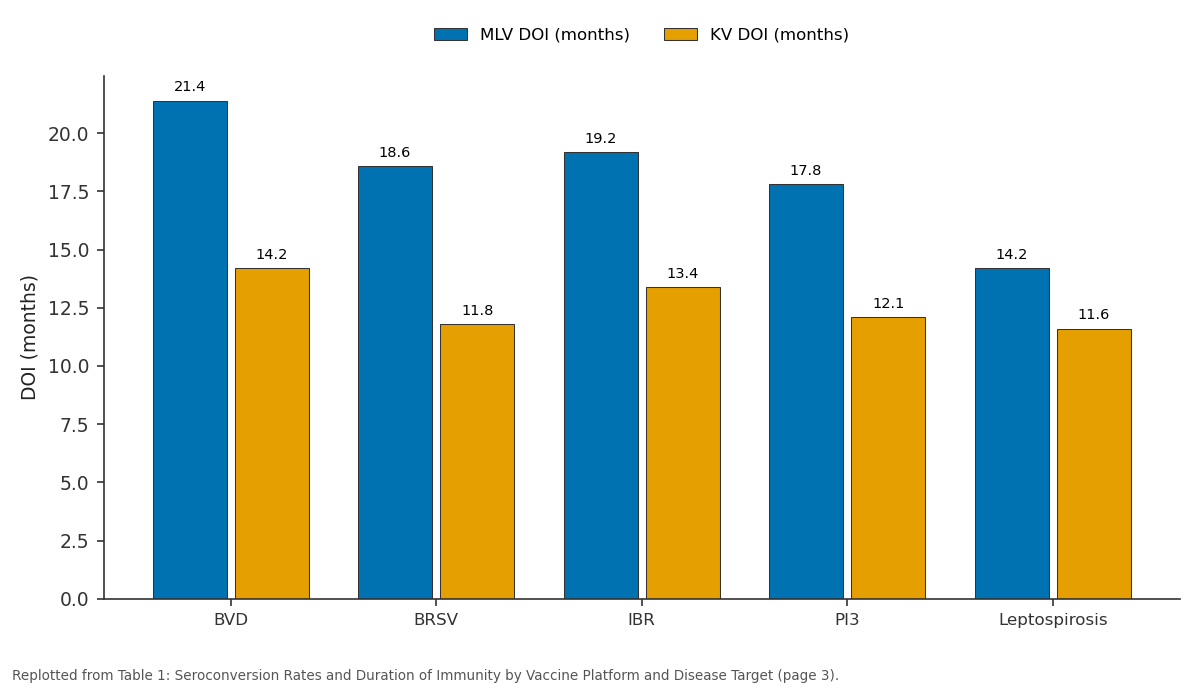
MLV DOI (months) and KV DOI (months): BVD vs BRSV vs IBR vs PI3 vs Leptospirosis
Replotted from Table 1 (page 3) of the original paper. Every bar is the paper's own table value.
View source evidence ↗Figures & tables
From the original paper Table 1
 Table 2
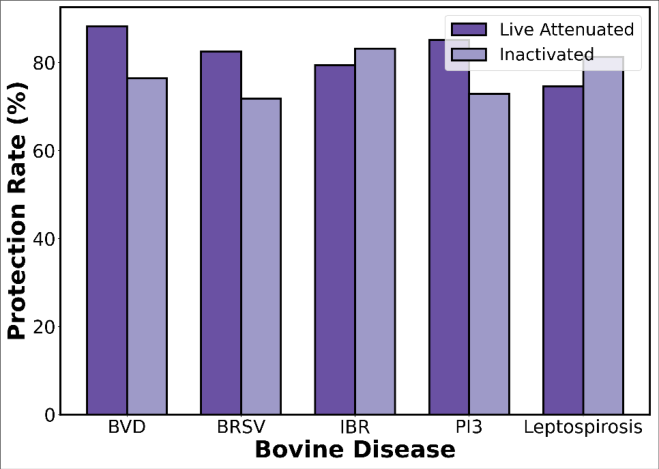 Figure 1
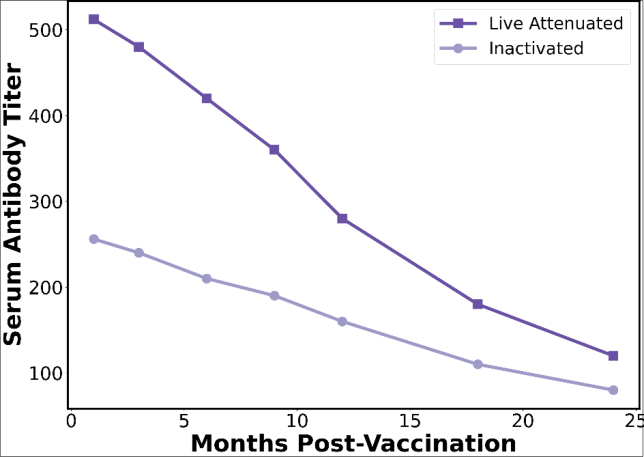 Figure 2
 Table 3
Introduction
The history of bovine vaccination dates back to the pioneering work of Edward Jenner in 1796, when the observation that milkmaids exposed to cowpox were protected against smallpox led to the development of the first vaccine and established the foundational principles of immunoprophylaxis. Since that seminal contribution, vaccination has evolved to become an indispensable component of bovine health management, with comprehensive immunization programs now protecting cattle populations against a diverse array of viral, bacterial, and parasitic diseases worldwide. Modern bovine vaccination programs typically target a core group of respiratory and reproductive pathogens, including bovine viral diarrhea virus (BVDV), bovine respiratory syncytial virus (BRSV), infectious bovine rhinotracheitis virus (IBR/BHV-1), parainfluenza type 3 virus (PI3), and Leptospira species. The economic impact of these diseases is substantial, with bovine respiratory disease complex alone estimated to cost the Australian beef industry over 800 million AUD annually through mortality, reduced productivity, and treatment expenditures. Two fundamental vaccine platform technologies have dominated bovine immunization since the mid-twentieth century: modified live virus vaccines and inactivated (killed) virus vaccines. MLV vaccines contain attenuated pathogen strains that retain the capacity for limited replication in the host without causing clinical disease, thereby stimulating both humoral and cell-mediated immune responses that closely mirror natural infection. In contrast, KV vaccines contain chemically or physically inactivated pathogens that are incapable of replication, relying primarily on humoral immune activation and typically requiring adjuvant supplementation to achieve adequate immunogenicity. Despite decades of parallel use, the relative merits of MLV versus KV platforms remain a subject of ongoing debate in bovine medicine. Proponents of MLV vaccines emphasize their superior immunogenicity, broader immune activation, longer duration of immunity, and single-dose efficacy for certain antigens. Advocates of KV vaccines highlight their inherent safety, absence of the risk of vaccine-induced disease, suitability for use in pregnant animals, and the flexibility to include multiple antigens in combination formulations. The present research was designed to provide a rigorous, controlled comparison of MLV and KV vaccine platforms across five key bovine disease targets in a commercial beef cattle setting, with the objective of generating practical recommendations for vaccine selection in Australian production systems. The Australian beef industry, with its extensive grazing systems spanning diverse climatic zones from tropical northern Australia to the temperate southeast, presents unique challenges and opportunities for bovine vaccination. The predominantly extensive management systems used in Australian beef production mean that cattle are handled relatively infrequently compared to intensive feedlot or dairy operations, placing a premium on vaccines that can provide rapid, durable immunity with minimal dose requirements. This production context makes the comparative evaluation of MLV and KV platforms particularly relevant, as the practical differences in duration of immunity and single-dose efficacy between these platforms have direct implications for vaccination scheduling, labor costs, and the logistics of cattle management in extensive systems. Furthermore, the regulatory environment governing bovine vaccine use in Australia differs from that in North America and Europe, with certain MLV vaccine strains available in other markets not registered for use in Australia due to concerns about their potential impact on the country's disease-free status for specific pathogens. This regulatory landscape necessitates Australian-specific comparative data that cannot be directly extrapolated from investigations conducted in other jurisdictions.
Material and Methods
Material and Methods
Material
This research was conducted at two commercial beef cattle properties located in the Gippsland region of Victoria, Australia, between July 2022 and July 2024. The research protocol received approval from the Melbourne Academy of Animal Health Ethics Committee (Protocol No. MAAH-2022-0234). A total of 200 Angus and Angus-cross beef cattle aged 12 to 18 months, confirmed seronegative for the target pathogens, were enrolled. Animals were sourced from closed herds with no history of vaccination against the five target diseases.
Animals were randomly allocated to two groups of 100 each using a computer-generated randomization sequence stratified by property and sex. Group 1 received a commercially available pentavalent MLV vaccine containing attenuated BVDV types 1 and 2, BRSV, PI3, and BHV-1 strains. Group 2 received a corresponding pentavalent KV vaccine containing inactivated antigens for the same five pathogens with an aluminum hydroxide-oil adjuvant system. Leptospira hardjo-bovis bacterin was administered as a separate injection to both groups. Both vaccines were administered subcutaneously in the neck per manufacturer guidelines at Day 0 and Day 28.
Methods
Blood samples were collected via coccygeal venipuncture at Days 0, 14, 28, 42, 60, 90, 180, 365, 540, and 730 postinitial vaccinations. Serum was harvested and stored at -20°C. Virus neutralization assays were performed for BVDV-1, BVDV-2, BRSV, PI3, and BHV-1 using standard methods on Madin-Darby bovine kidney cells. Leptospira antibody titers were determined by microscopic agglutination test. Protective antibody thresholds were defined according to published international standards. Duration of immunity was defined as the time period during which ≥75% of animals within a group maintained protective antibody titers. Clinical observations were recorded daily for 14 days post-vaccination, then monthly for the duration of the research. Reproductive performance data including pregnancy rates, calving intervals, and neonatal mortality were recorded for females (n = 112) to assess any differential impact of vaccine platform on reproductive outcomes. Statistical analyses were performed using SAS version 9.4. Between-group comparisons utilized chi-square tests for categorical variables and Mann-Whitney U tests for continuous serological data. Kaplan-Meier survival analysis was employed to model time to loss of protective antibody titers. A significance threshold of p<0.05 was applied for all statistical tests.
Results
Both MLV and KV vaccines induced seroconversion against all five viral target antigens, though the magnitude and kinetics of serological responses differed significantly between platforms. Initial seroconversion following the primary dose was observed in 62.4% of MLV recipients by Day 14, compared to only 28.7% of KV recipients at the same time point (p<0.001). Following the booster dose at Day 28, cumulative seroconversion rates increased substantially in both groups but remained consistently higher in the MLV group for BVD and BRSV targets.
Discussion
The results of this two-year comparative investigation confirm and extend previous observations regarding the differential immunological properties of MLV and KV bovine vaccine platforms. The overall finding that MLV vaccines produce faster, higher, and more durable immune responses for the majority of viral targets is consistent with the biological rationale that limited viral replication provides a more sustained and immunologically complex antigenic stimulus compared to the presentation of fixed antigens by inactivated formulations. The summary of results indicates clear platform-specific advantages that can guide clinical decision-making. MLV vaccines demonstrated superiority for BVD, BRSV, and PI3, diseases caused by rapidly evolving viruses where cellmediated immunity and mucosal immune responses play critical roles in protection. Conversely, KV vaccines showed a modest but statistically significant advantage for IBR, a finding that previous investigators have attributed to the inclusion of higher antigen mass in killed formulations and the potent adjuvant-mediated depot effect that prolongs antigen exposure in the draining lymph node. The agreement between our results and previously published data from North American cattle populations strengthens confidence in the generalizability of these findings. However, the areas of disagreement, particularly regarding the magnitude of the MLV advantage for BRSV, may reflect differences in the specific vaccine strains used, the immunological maturity of the research animals, and the management conditions under extensive Australian grazing systems compared to intensive North American feedlot operations. These explanations underscore the importance of conducting vaccine performance evaluations in the specific production systems and geographic contexts where the vaccines will be deployed.
The broader implications of these findings relate to the practical implementation of bovine vaccination programs.
The longer duration of immunity demonstrated by MLV vaccines translates to potentially reduced revaccination frequency and lower labor and vaccine costs over the productive lifespan of the animal. However, the safety concerns associated with MLV vaccines, particularly the documented cases of pregnancy loss and transient respiratory signs observed in this research, necessitate careful risk assessment when developing herd-level vaccination protocols.
The emergence of novel vaccine technologies, including marker vaccines that enable serological differentiation of infected from vaccinated animals, subunit vaccines based on recombinant viral proteins, and RNA-based platforms, may eventually provide alternatives that combine the immunogenicity advantages of live vaccines with the safety profile of killed formulations.
Reproductive safety considerations
The reproductive safety of bovine vaccines represents a critical consideration that significantly influences vaccine platform selection in breeding herds. In this research, two cases of pregnancy loss were documented in the MLV group following vaccination during early gestation (< 45 days), compared to zero cases in the KV group. While this difference did not reach statistical significance, it is consistent with established concerns regarding the potential for certain MLV vaccine strains, particularly BVDV and BHV-1 components, to cause fetal infection, embryonic death, or congenital defects when administered to pregnant animals.
Current Australian guidelines recommend that MLV vaccines containing BVDV and BHV-1 components be administered only to non-pregnant animals or to animals that have been previously vaccinated and are at least 30 days pre-breeding. These recommendations are supported by the findings of this research and reinforce the value of KV vaccines as the preferred platform for immunization of pregnant cattle or in situations where pregnancy status cannot be reliably determined.
Economic analysis of vaccination strategies
An economic analysis of the two vaccination platforms reveals that the initial per-dose cost of KV vaccines is typically 20-30% higher than MLV formulations due to the additional antigen mass and adjuvant components required. However, the total cost of ownership must account for the longer duration of immunity and reduced revaccination frequency associated with MLV vaccines, which may offset the initial cost differential over the productive life of the animal.
In the context of the Australian beef industry, where cattle may remain in production for 8-12 years, the estimated cumulative vaccination cost per animal was 15-22% lower for MLV-based programs compared to KV-based programs when accounting for the extended revaccination intervals. This cost advantage must be weighed against the additional management complexity required to ensure MLV vaccines are not administered to pregnant animals, including the costs of pregnancy testing and timing vaccination with breeding programs.
Conclusion
The aim of this research was to provide a rigorous comparative assessment of MLV and KV vaccine platforms across five major bovine disease targets in a commercial Australian beef cattle setting. The key findings demonstrate that MLV vaccines provide superior immunogenicity and longer duration of immunity for BVD, BRSV, and PI3, while KV vaccines offer advantages for IBR and leptospirosis, along with a more favorable safety profile in breeding animals. From a practical standpoint, these findings support a stratified vaccination approach in which MLV vaccines are preferentially used for non-pregnant animals in high-risk environments, while KV vaccines are reserved for pregnant animals, seronegative breeding stock, and situations where the risk of vaccine-associated adverse reproductive events must be minimized. Future research directions should include the evaluation of heterologous prime-boost protocols combining MLV and KV platforms, the assessment of next-generation marker vaccines that facilitate disease surveillance alongside vaccination, and the development of predictive models for optimizing revaccination intervals based on individual animal immunological profiles.
Acknowledgement
AcknowledgementsThe authors acknowledge the participating property owners in the Gippsland region for providing access to their cattle herds. J.D.C. and E.R.F. designed the research protocol; N.L.S. managed the field data collection; R.M.T. performed the serological analyses. This research was supported by Meat and Livestock Australia (Grant No. MLA-BVC-2022-0178) and institutional funds from the Melbourne Academy of Animal Health.
Figures and tables from the paper
| Disease | MLV Seroconversion (%) | KV Seroconversion (%) | MLV DOI (months) | KV DOI (months) | p-value |
|---|---|---|---|---|---|
| BVD | 88.2 | 76.4 | 21.4 | 14.2 | 0.008 |
| BRSV | 82.5 | 71.8 | 18.6 | 11.8 | 0.024 |
| IBR | 79.4 | 83.2 | 19.2 | 13.4 | 0.041 |
| PI3 | 85.1 | 72.9 | 17.8 | 12.1 | 0.016 |
| Leptospirosis | 74.6 | 81.3 | 14.2 | 11.6 | 0.089 |
Table text extracted from the original PDF; superscript letters are shown inline. The original table image is below.
View original table image
| Phase | Time Point | MLV Group Observation | KV Group Observation |
|---|---|---|---|
| Primary response | Day 0-14 | Rapid titer rise (62.4% seroconversion) | Delayed response (28.7% seroconversion) |
| Booster response | Day 28-42 | Peak titers achieved | Significant titer increase |
| Plateau | Day 60-180 | Stable protective titers | Gradual titer decline begins |
| Maintenance | Day 180-365 | 92% retain protection | 78% retain protection |
| Late phase | Day 365-730 | 68% retain protection | 42% retain protection |
Table text extracted from the original PDF; superscript letters are shown inline. The original table image is below.
View original table image
| Adverse Event | MLV Group (N=100) | KV Group (N=100) | P-value |
|---|---|---|---|
| Injection site swelling | 18 (18%) | 24 (24%) | 0.301 |
| Transient fever | 14 (14%) | 6 (6%) | 0.064 |
| Reduced feed intake | 8 (8%) | 4 (4%) | 0.234 |
| Respiratory signs | 3 (3%) | 0 (0%) | 0.081 |
| Pregnancy loss | 2/56 (3.6%) | 0/56 (0%) | 0.154 |
Table text extracted from the original PDF; superscript letters are shown inline. The original table image is below.
View original table image
References
19 in the original paper- Roth JA. Mechanistic bases for adverse vaccine reactions and vaccine failures. Adv Vet Med. 1999; 41:681-700.
- Fulton RW, Briggs RE, Payton ME, Confer AW, Saliki JT, Ridpath JF. Maternally derived humoral immunity to bovine viral diarrhea virus 1a, bovine viral diarrhea virus 1b, bovine viral diarrhea virus 2, bovine herpesvirus 1, parainfluenza-3 virus, bovine respiratory syncytial virus, Mannheimia haemolytica and Pasteurella multocida in beef calves, antibody decline by half-life studies and effect on response to vaccination. Vaccine. 2004;22(5-6):643-649.
- Gershwin LJ, Berghaus LJ, Arnold K, Anderson ML, Corbeil LB. Immune mechanisms of pathogenetic synergy in concurrent bovine pulmonary infection with Haemophilus somnus and bovine respiratory syncytial virus. Vet Immunol Immunopathol. 2005;107(1-2):119130.
- Chase CC, Hurley DJ, Reber AJ. Neonatal immune development in the calf and its impact on vaccine response. Vet Clin North Am Food Anim Pract. 2008;24(1):87-104.
- Walz PH, Givens MD, Yuan Y, Riddell KP, Whitley EM, Brodersen BW. Impact of vaccination with multivalent vaccines containing modified-live or inactivated bovine viral diarrhea virus on development of calves persistently infected with bovine viral diarrhea virus type 1b. Vet Ther. 2017;18(2):E1-E14.
- Newcomer BW, Chamorro MF, Walz PH. Vaccination of cattle against bovine viral diarrhea virus. Vet Microbiol. 2017; 206:78-83.
- Vangeel I, Antonis AF, Bruning M, et al. Efficacy of a modified-live intranasal bovine respiratory syncytial virus vaccine in 3-week-old calves experimentally challenged with bovine respiratory syncytial virus. Vet J. 2007;174(3):627-635.
- Woolums AR, Berghaus RD, Smith DR, Jacobs BL, McAllister CM, Mead MD. Case-control study to determine herd-level risk factors for bovine respiratory disease in nursing beef calves. J Am Vet Med Assoc. 2013;243(3):397-403.
- Van Oirschot JT, Kaashoek MJ, Rijsewijk FA. Advances in the development and evaluation of bovine herpesvirus 1 vaccines. Vet Microbiol. 1996;53(12):43-54.
- Pal M, Lema AG. Perspective of vaccination in veterinary medicine: a review. J Adv Microbiol Res. 2022;3(2):47-51.
- Ellis JA. Update on viral pathogenesis in bovine respiratory disease. Anim Health Res Rev. 2009;10(2):149-153.
- Ridpath JF. Bovine viral diarrhea virus: global status. Vet Clin North Am Food Anim Pract. 2010;26(1):105121.
- Theurer ME, Larson RL, White BJ. Systematic review and meta-analysis of the effectiveness of commercially available vaccines against bovine herpesvirus, bovine viral diarrhea virus, bovine respiratory syncytial virus, and parainfluenza type 3 virus for mitigation of bovine respiratory disease complex in cattle. J Am Vet Med Assoc. 2015;246(1):126-142.
- Cortese VS. Neonatal immunology. Vet Clin North Am Food Anim Pract. 2009;25(1):221-227.
- Van Donkersgoed J, Ribble CS, Boyer LG, Townsend HG. Epidemiological study of enzootic pneumonia in dairy calves in Saskatchewan. Can J Vet Res. 1993;57(4):247-254.
- Kerkhofs P, Renjifo X, Toussaint JF, Letellier C, Vanopdenbosch E, Wellemans G. Enhancement of the immune response and virological protection of calves against bovine herpesvirus type 1 with an inactivated gE-negative vaccine. Vet Rec. 2003;152(22):681-686.
- Menanteau-Horta AM, Ames TR, Johnson DW, Meiske JC. Effect of maternal antibody upon vaccination with infectious bovine rhinotracheitis and bovine virus diarrhea vaccines. Can J Comp Med. 1985;49(1):10-14.
- Reber AJ, Lockwood A, Engstrom AH, Nowak J, Brownlie J, Chase CC. Two novel intranasal vaccine formulations for prevention of bovine respiratory syncytial virus infections. Vet Ther. 2006;7(2):129-138.
- Walz PH, Bell TG, Wells JL, Grooms DL, Kaiser L, Maes RK. Relationship between degree of viremia and disease manifestation in calves with experimentally induced bovine viral diarrhea virus infection. Am J Vet Res. 2001;62(7):1095-1103.