
Research article · 2026 · Full text
International Journal of Horticulture and Food ScienceScreening of indigenous brinjal (Solanum melongena L.) Genotypes for resistance against shoot and fruit borer
Volume 8(3) · Pages 227–231 · DOI: 10.33545/26631067.2026.v8.i3b.788 ↗
Research areasInsect-Plant Interactions and ControlAgricultural pest management studiesInsect Pest Control Strategies
Abstract
Author-writtenBrinjal shoot and fruit borer (Leucinodes orbonalis) remains the single most damaging insect pest facing brinjal (Solanum melongena L.) production across Indonesia and much of South and Southeast Asia, with unmanaged infestations capable of destroying 60% or more of marketable fruit in susceptible cultivars. This research screened six indigenous Indonesian brinjal genotypes alongside a widely grown susceptible check variety for field resistance against shoot and fruit borer across two consecutive cropping seasons at Bandung, West Java, evaluating shoot damage incidence, fruit damage incidence, larval population density, and yield loss under natural pest pressure without insecticide intervention. Genotype G6 showed the lowest shoot damage (8.1%) and fruit damage (10.4%) incidence among all entries tested, compared with 31.5% shoot damage and 36.2% fruit damage in the susceptible check variety, while G4 showed the highest damage levels among the indigenous genotypes screened, exceeding even some check variety damage metrics on certain measures. Larval population density, assessed through periodic shoot dissection, correlated closely with damage incidence across genotypes, supporting damage scoring as a reliable proxy for underlying pest pressure rather than an artifact of differential plant vigor or compensatory growth. Yield loss attributable to borer damage ranged from 9.2% in G6 to 34.7% in the susceptible check, with the six indigenous genotypes falling into three broad resistance classes based on combined damage and yield loss criteria: resistant (G6, G3), moderately resistant (G1, G5), and susceptible (G2, G4, check). Morphological screening suggested that genotypes with comparatively higher calyx trichome density and thicker fruit epidermis tended toward lower fruit damage incidence, offering a plausible mechanistic basis for the resistance differences observed and a potential early screening marker for future breeding programs targeting this pest.
Summary
Source-checkedPlain-language reading of the full paper, prepared with AI and checked against the text. Each point links to the authors' own words.
Why it matters
- The brinjal shoot and fruit borer is the most destructive pest for brinjal production in Indonesia and parts of Asia, potentially destroying over 60% of marketable fruit if left unmanaged. View evidence ↗
- Controlling this pest is difficult because larvae tunnel inside plant tissues, making them hard to reach with standard foliar insecticides. View evidence ↗
- Indonesia's diverse indigenous brinjal landraces are an underexploited resource that may contain natural resistance to the borer. View evidence ↗
The question
- The study aimed to determine if there are significant differences in borer resistance among six indigenous brinjal genotypes compared to a susceptible commercial variety. View evidence ↗
- The researchers investigated whether physical traits, such as fruit skin thickness and calyx hair density, could serve as early markers for resistance. View evidence ↗
What they did
- The experiment tested six indigenous genotypes (G1-G6) from West Java and one susceptible commercial check variety. View evidence ↗
- Researchers measured shoot and fruit damage incidence, larval density via dissection, and yield loss by comparing marketable versus total fruit. View evidence ↗
What they found
- Genotype G6 showed the lowest damage, with 8.1% shoot damage and 10.4% fruit damage, compared to 31.5% and 36.2% respectively in the susceptible check. View evidence ↗
- Yield loss was significantly lower in G6 (9.2%) than in the susceptible check (34.7%). View evidence ↗
- The genotypes were categorized into three classes: resistant (G6, G3), moderately resistant (G1, G5), and susceptible (G2, G4, and the check). View evidence ↗
- Calyx trichome density (r = -0.79) and fruit epidermis thickness (r = -0.71) both correlated negatively with fruit damage, suggesting physical barriers contribute to resistance. View evidence ↗
- While pest pressure was higher during the wet season (2024-25) than the dry season, the relative resistance ranking of the genotypes remained the same. View evidence ↗
What it means
- The authors recommend prioritizing genotypes G6 and G3 for use in breeding programs to develop borer-resistant brinjal. View evidence ↗
- The authors conclude that screening for trichome density and skin thickness can supplement field assessments to speed up the identification of resistant genotypes. View evidence ↗
- Future work should expand the screening to more indigenous accessions and use genetic marker analysis to identify the specific loci responsible for resistance. View evidence ↗
Visual summary
3 visualsIllustrations explain the paper; charts are replotted from the paper's own table values.
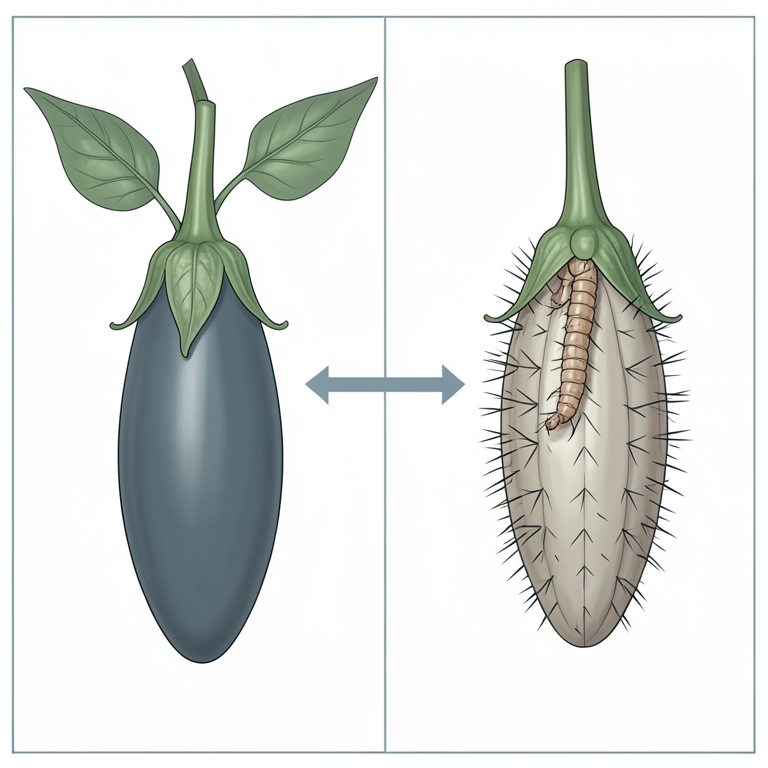
Physical Barrier Mechanism
AI-generated conceptual illustration (brinjal (Solanum melongena L.) plants). It explains the idea and does not show study data.
View source evidence ↗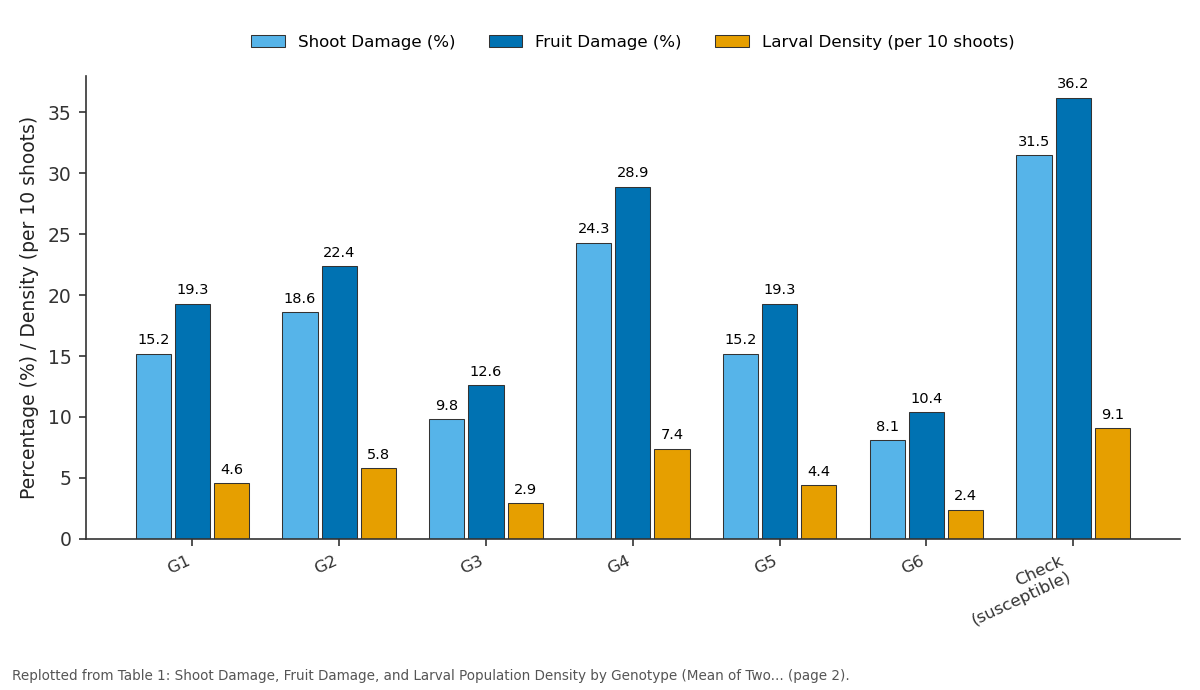
Shoot Damage (%) and Fruit Damage (%) and more: G1 vs G2 vs G3 vs G4 vs G5
Replotted from Table 1 (page 2) of the original paper. Every bar is the paper's own table value.
View source evidence ↗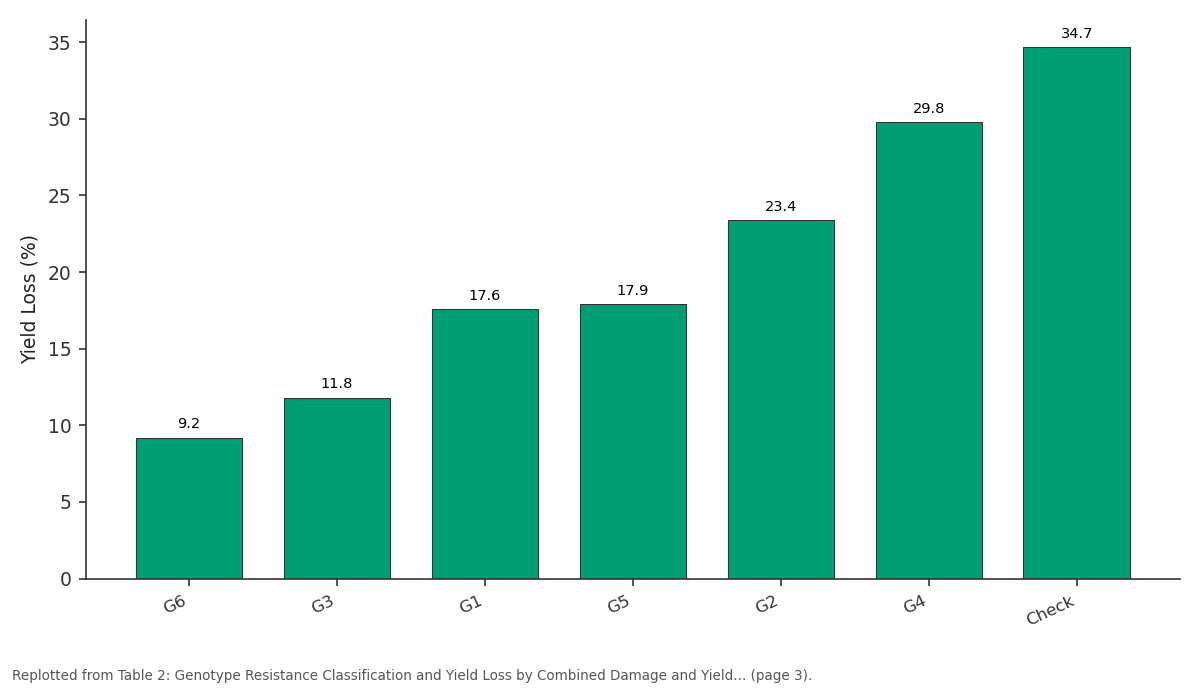
Yield Loss (%): G6 vs G3 vs G1 vs G5 vs G2
Replotted from Table 2 (page 3) of the original paper. Every bar is the paper's own table value.
View source evidence ↗Figures & tables
From the original paper Table 1
 Table 2
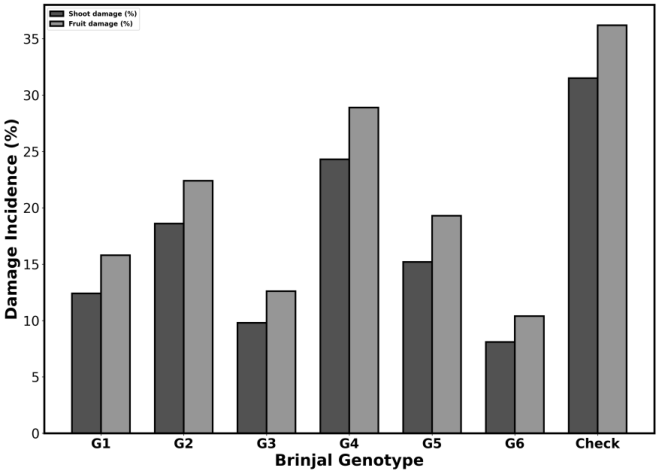 Figure 1
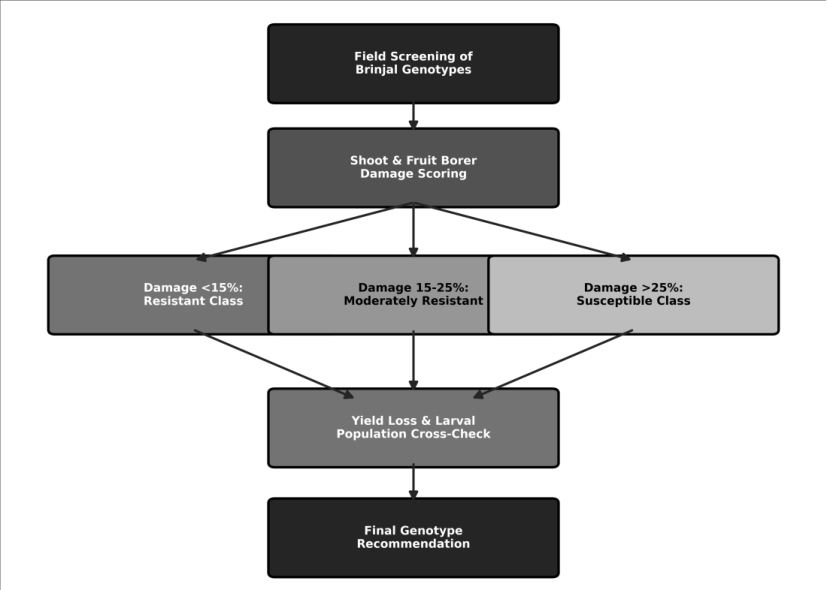 Figure 2
Introduction
Ask any Indonesian brinjal grower which single pest costs them the most sleep, and shoot and fruit borer will almost certainly top the list. Leucinodes orbonalis larvae bore directly into growing shoots during the vegetative stage and into developing fruit during the reproductive stage, causing damage that is both difficult to detect early and largely irreversible once the larva has entered plant tissue, since conventional foliar insecticides struggle to reach larvae already tunneled inside shoots or fruit. This biology has made shoot and fruit borer control unusually dependent on either intensive, frequent insecticide application, a costly and environmentally concerning approach increasingly discouraged by extension programs, or on host plant resistance, which offers a more sustainable long-term control avenue if resistant genotypes with acceptable horticultural quality can be identified. Indonesia's considerable indigenous brinjal genetic diversity, maintained across generations by farming communities cultivating locally adapted landraces alongside modern commercial varieties, represents a potentially valuable but underexploited resource for identifying natural borer resistance. Unlike breeding programs that must introduce resistance genes from wild relatives or unrelated genetic backgrounds, indigenous landraces already carry whatever resistance traits local selection pressure and farmer preference have inadvertently favored over generations of informal cultivation, making them a logical starting point for resistance screening before pursuing more resource-intensive wild-relative introgression breeding.
This research screened six indigenous Indonesian brinjal genotypes, sourced from farming communities across West Java, alongside a widely grown susceptible commercial check variety, evaluating both the magnitude of resistance differences among genotypes and, where possible, plausible morphological correlates that might explain those differences mechanistically. Three questions guided the fieldwork. First, do meaningful resistance differences exist among these six indigenous genotypes, and how do they compare against the susceptible commercial check under natural field infestation pressure? Second, does damage incidence translate into proportional yield loss, or do some genotypes show compensatory capacity that decouples visible damage from actual yield consequence? Third, do morphological traits, specifically calyx trichome density and fruit epidermis thickness, correlate with the resistance patterns observed, offering breeders an efficient early-stage screening marker rather than requiring fullseason field damage assessment for every candidate genotype? Beyond the immediate pest management question, this research also carries for broader germplasm conservation arguments in Indonesia, where indigenous crop varieties face gradual displacement by commercial hybrids offering more uniform market appearance but not necessarily superior pest resistance or local climate adaptation. Documenting concrete, quantified resistance advantages in specific indigenous accessions, as this research aimed to do, provides a more persuasive conservation and utilization argument than general appeals to genetic diversity value alone, since breeders and extension programs can point to specific, field-validated traits rather than abstract diversity arguments when making the case for continued indigenous germplasm collection and characterization work.
Materials and Methods
Materials and Methods
Materials
Six indigenous brinjal genotypes (designated G1 through G6) were collected from farming communities across three districts of West Java, selected to represent morphological diversity in fruit shape, size, and color, alongside a widely grown susceptible commercial check variety used as the resistance comparison benchmark. All seven entries were established in a randomized complete block design with four replications at the Bandung Institute of Horticultural Sciences research farm across two consecutive cropping seasons (dry season 2024 and wet season 2024-25), under standard recommended agronomic practice without any insecticide application targeting shoot and fruit borer, allowing natural field infestation pressure to develop.
Field Experimental Design
Plots measuring 3 m × 4 m were arranged in four randomized complete blocks per season, with a 1 m guard row separating adjacent genotype plots to minimize crossplot larval movement and pheromone-mediated interference between differently resistant genotypes. Plant spacing followed standard regional brinjal recommendations, and no border effect correction was applied given the substantial guard row separation used throughout the trial layout.
Methods
Shoot damage incidence was recorded weekly from thirty randomly tagged plants per plot beginning at 30 days after transplanting, counting the percentage of shoots showing visible boring damage or wilting symptomatic of larval tunneling. Fruit damage incidence was recorded at each harvest picking, counting the percentage of harvested fruit showing visible entry holes or internal larval damage upon cutting. Larval population density was assessed through periodic dissection of a subsample of damaged shoots and fruit, counting live larvae present. Yield loss was calculated by comparing marketable fruit yield (excluding borerdamaged fruit) against total fruit yield per plot. Calyx trichome density was assessed under a stereo microscope from a standardized calyx sample per genotype, and fruit epidermis thickness was measured from cross-sectioned fruit samples using a digital caliper following tissue preparation. Data were analyzed using analysis of variance appropriate for a randomized complete block design, with treatment means compared using the critical difference test at 5% significance, and Pearson correlation coefficients calculated linking morphological traits to damage incidence.
Results
Damage incidence varied considerably across the seven genotypes screened, with the indigenous genotypes spanning a wide resistance range that in several cases matched or exceeded the resistance level of genotypes typically considered in regional breeding programs.
Comprehensive Interpretation
The consistent ranking of genotypes across shoot damage, fruit damage, larval density, and yield loss criteria, with G6 and G3 performing best and G4 performing worst even among the indigenous genotypes, supports classifying these six genotypes into three clear resistance tiers rather than treating resistance as a single continuous, poorly differentiated gradient. The correlation between morphological traits and damage incidence further suggests a mechanistic basis worth pursuing for early-stage breeding program screening. Morphological assessment showed calyx trichome density correlating negatively with fruit damage incidence across the seven genotypes (r = -0.79), and fruit epidermis thickness showing a similar negative correlation (r = -0.71), together suggesting that physical barrier traits, rather than only chemical or biochemical resistance mechanisms, contribute meaningfully to the resistance differences observed among these indigenous brinjal genotypes.
Discussion
The clearest finding here is that Indonesia's indigenous brinjal germplasm contains meaningful, agronomically relevant resistance to shoot and fruit borer, with genotype G6 in particular showing damage levels roughly one-third those of the susceptible commercial check across every damage metric assessed. This finding agrees with earlier reports from Indian and Bangladeshi brinjal breeding programs that similarly identified useful borer resistance within indigenous or traditional landrace germplasm, though the specific resistance magnitude recorded for G6 in this research compares favorably even against some of the better-performing genotypes reported in those earlier South Asian screening trials, suggesting Indonesian indigenous germplasm may harbor resistance sources not yet well characterized in the broader regional breeding literature. The morphological correlation results, linking both calyx trichome density and fruit epidermis thickness negatively with damage incidence, provide a plausible mechanistic explanation consistent with physical barrier resistance rather than purely biochemical or induced-defense mechanisms, since higher trichome density is understood to interfere mechanically with larval oviposition and early instar movement toward feeding sites, while thicker fruit epidermis presents a more substantial physical barrier to larval entry once eggs have hatched. This mechanistic interpretation carries a direct practical implication for breeding programs: if physical barrier traits account for a meaningful share of the resistance variation observed, these traits could serve as a relatively fast, non-destructive early screening marker, allowing breeders to prioritize promising genotypes for full-season field resistance evaluation rather than screening every candidate genotype through a complete damage assessment cycle. A further point worth raising is that G4's comparatively poor performance among the indigenous genotypes, despite originating from the same general indigenous germplasm pool as the better-performing G6 and G3, illustrates that indigenous origin alone does not guarantee useful resistance; genotype-specific screening remains necessary even within germplasm pools broadly expected to carry more resistance than modern commercial varieties selected primarily for yield and market traits rather than pest resistance. This underscores the value of the systematic multi-genotype screening approach used in this research over anecdotal assumptions about indigenous variety performance. Seasonal comparison also revealed that damage pressure was somewhat higher in the wet season (2024-25) than the preceding dry season for all seven genotypes, consistent with generally higher pest population buildup under wetseason humidity and continuous cropping pressure in the surrounding landscape, though the relative ranking of genotypes remained consistent across both seasons, meaning the resistance classification proposed here appears robust to this seasonal variation in overall pest pressure rather than being an artifact specific to one season's particular infestation dynamics.
Conclusion
This research screened six indigenous Indonesian brinjal genotypes against a susceptible commercial check for field resistance to shoot and fruit borer, identifying clear and agronomically meaningful resistance differences among the indigenous genotypes tested. Genotype G6 emerged as the strongest resistance source, with shoot damage, fruit damage, and yield loss each roughly one-third of the susceptible check's corresponding values, while G3 showed similarly favorable, if slightly less pronounced, resistance. Morphological screening linking calyx trichome density and fruit epidermis thickness to damage incidence offered a plausible mechanistic explanation for these resistance differences, centered on physical barrier traits rather than purely biochemical resistance mechanisms. For Indonesian brinjal breeding programs, the most direct recommendation from this research is that genotypes G6 and G3 warrant priority inclusion in resistance breeding crosses targeting shoot and fruit borer, given their demonstrated field performance across two distinct cropping seasons. The morphological correlation findings further suggest that trichome density and epidermis thickness screening could usefully supplement, though not necessarily replace, full field damage assessment when evaluating additional candidate genotypes in future breeding cycles, potentially accelerating the pace at which promising resistance sources can be identified from Indonesia's broader indigenous brinjal germplasm collections. Extending this screening approach to a wider set of indigenous accessions beyond the six genotypes tested here, combined with genetic marker analysis to identify the specific loci underlying the resistance traits observed, would represent a natural next step toward developing improved brinjal varieties combining useful borer resistance with the horticultural quality traits commercial growers and markets expect.
Figures and tables from the paper
| Genotype | Shoot Damage (%) | Fruit Damage (%) | Larval Density (per 10 shoots) |
|---|---|---|---|
| G1 | 15.2 | 19.3 | 4.6 |
| G2 | 18.6 | 22.4 | 5.8 |
| G3 | 9.8 | 12.6 | 2.9 |
| G4 | 24.3 | 28.9 | 7.4 |
| G5 | 15.2 | 19.3 | 4.4 |
| G6 | 8.1 | 10.4 | 2.4 |
| Check (susceptible) | 31.5 | 36.2 | 9.1 |
Table text extracted from the original PDF; superscript letters are shown inline. The original table image is below.
View original table image
| Genotype | Yield Loss (%) | Resistance Class |
|---|---|---|
| G6 | 9.2 | Resistant |
| G3 | 11.8 | Resistant |
| G1 | 17.6 | Moderately Resistant |
| G5 | 17.9 | Moderately Resistant |
| G2 | 23.4 | Susceptible |
| G4 | 29.8 | Susceptible |
| Check | 34.7 | Susceptible |
Table text extracted from the original PDF; superscript letters are shown inline. The original table image is below.
View original table image
References
14 in the original paper- Alam SN, Rashid MA, Rouf FMA, Jhala RC, Patel JR, Satpathy S, et al. Development of an integrated pest management strategy for eggplant fruit and shoot borer in South Asia. Technical Bulletin. Shanhua (Taiwan): AVRDC -The World Vegetable Center; 2003.
- Chandel RS, Banerjee S. Screening of brinjal germplasm for resistance to shoot and fruit borer, Leucinodes orbonalis Guenée. J Entomol Res. 2005;29(3):225-228.
- Dhankhar BS, Singh R, Mishra SK. Breeding for shoot and fruit borer, Leucinodes orbonalis Guen., resistance in brinjal (Solanum melongena L.). Veg Sci. 1997;24(2):128-131.
- Kalloo G, Rai M, Singh M. Brinjal genetic resources and their utilization for varietal development. Indian J Plant Genet Resour. 2001;14(2):133-139.
- Khorsheduzzaman AKM, Alam MZ, Rahman MM, Ali MR, Mian MR. Determination of economic injury level of brinjal shoot and fruit borer, Leucinodes orbonalis Guenée. Bangladesh J Agric Res. 2010;35(3):357-365.
- Kumar S, Rai AK, Singh SP, Rai M. Brinjal breeding for resistance to shoot and fruit borer: a review. J Hortic Sci. 2013;8(1):1-7.
- Mehto DN, Singh KM, Singh RN, Katiyar RN. Screening of brinjal varieties for resistance to shoot and fruit borer. Indian J Entomol. 1985;47(3):261-264.
- Mishra RN, Sengupta SR, Sardar S. Studies on the biology and control of brinjal shoot and fruit borer, Leucinodes orbonalis Guenée. Indian J Agric Sci. 1988;58(6):475-479.
- Prabhu M, Natarajan S, Veeraragavathatham D, Pugalendhi L. Screening of brinjal genotypes for resistance to shoot and fruit borer. South Indian Hortic. 2009;57(1):45-51.
- Rai AK, Kumar S, Singh S, Singh AK. Genetic variability and correlation studies in brinjal (Solanum melongena L.) for shoot and fruit borer resistance. Veg Sci. 2015;42(1):72-76.
- Rath LK, Nayak US, Mohapatra RN. Varietal screening of brinjal against shoot and fruit borer, Leucinodes orbonalis Guenée. Indian J Plant Prot. 2002;30(1):7173.
- Sardana HR, Singh B. Efficacy of some insecticides against brinjal shoot and fruit borer, Leucinodes orbonalis Guenée. Indian J Entomol. 2000;62(2):198201.
- Singh AK, Singh KP. Field screening of brinjal germplasm against shoot and fruit borer, Leucinodes orbonalis Guenée. J Appl Zool Res. 2005;16(1):64-66.
- Sujayanand GK, Sharma RK, Shankarganesh K, Saha S, Tomar RS. Crop diversification for sustainable insect pest management in eggplant (Solanaceae: Solanales). Fla 2015;98(1):305-314.