
Research article · 2026 · Full text
International Journal of Horticulture and Food ScienceComparative performance of hydroponic and soil-based lettuce production under low-cost greenhouse conditions
Volume 8(3) · Pages 237–241 · DOI: 10.33545/26631067.2026.v8.i3b.790 ↗
Research areasInnovations in Aquaponics and Hydroponics SystemsPlant Growth and Agriculture TechniquesGrowth and nutrition in plants
Abstract
Author-writtenNotice how much faster a hydroponically grown lettuce plant seems to bulk up compared to its soil-grown counterpart, even under otherwise similar greenhouse conditions; this research set out to quantify that observation and establish whether the apparent growth advantage translates into commercially meaningful gains once resource costs are factored in. This research compared nutrient film technique (NFT) hydroponic lettuce production against conventional soil-based production under identical low-cost greenhouse conditions at Cameron Highlands, Malaysia, tracking biomass accumulation, days to harvest maturity, water-use efficiency, and total production cost across three consecutive production cycles between August 2024 and March 2025. Hydroponic lettuce reached harvestable size in 35 days compared with 45 days for soil-based production, and shoot fresh biomass at harvest averaged 312 g/plant under hydroponics versus 214 g/plant under soil-based cultivation, a 45.8% yield advantage. Water-use efficiency was markedly higher under hydroponics (58.2 g biomass/L water) than under soil-based cultivation (21.4 g biomass/L water), reflecting hydroponics' closed-loop water recirculation compared with the substantial water losses to soil percolation and evaporation inherent to conventional cultivation. However, total production cost per kilogram of marketable lettuce was only marginally lower under hydroponics once infrastructure amortization and electricity costs for nutrient pumps were included, since these fixed and energy costs offset a meaningful share of the water, labor, and faster-cycle-time savings hydroponics otherwise delivered. Break-even analysis indicated that hydroponic systems became more cost-competitive than soil-based production only once production scale exceeded approximately 800 plants per cycle, below which the fixed infrastructure cost was not fully amortized across enough harvest cycles to offset the higher upfront investment. These findings suggest that hydroponic lettuce production's agronomic advantages are clear and substantial, but that its economic advantage over well-managed soil-based production depends considerably on production scale and electricity cost context, information relevant for smallholder growers in Malaysia's Cameron Highlands weighing the investment required to transition to hydroponic systems.
Summary
Source-checkedPlain-language reading of the full paper, prepared with AI and checked against the text. Each point links to the authors' own words.
Why it matters
- Cameron Highlands is the main hub for temperate vegetable production in Malaysia because its cool climate supports crops like lettuce that cannot grow in lowland tropical heat. View evidence ↗
- Hydroponic systems are generally known to provide faster growth and better water efficiency than soil-based methods due to precise nutrient delivery and water recirculation. View evidence ↗
- It is unclear if the growth advantages of hydroponics translate into economic benefits for small-scale growers in Southeast Asia when all infrastructure and energy costs are considered. View evidence ↗
The question
- The study aimed to quantify the biomass and harvest-time advantages of hydroponics, determine if these lead to lower total production costs, and identify the production scale where hydroponics becomes more cost-effective than soil-based methods. View evidence ↗
What they did
- The study compared Nutrient Film Technique (NFT) hydroponics with conventional soil-based lettuce production in low-cost greenhouses in Cameron Highlands, Malaysia. View evidence ↗
- The experiment tracked three production cycles from August 2024 to March 2025, using 100 plants per system in each cycle. View evidence ↗
- Shoot fresh biomass was measured by destructively sampling ten random plants per system at six different time intervals between 7 and 42 days after transplanting. View evidence ↗
- Total production costs were calculated based on a five-year infrastructure lifespan, electricity for pumps, nutrients/fertilizer, water, and local labor wages. View evidence ↗
What they found
- Hydroponic production achieved a 45.8% yield advantage, with an average shoot fresh biomass of 312 g/plant compared to 214 g/plant for soil-based cultivation. View evidence ↗
- Water-use efficiency was significantly higher in the hydroponic system (58.2 g biomass/L) than in the soil-based system (21.4 g biomass/L). View evidence ↗
- At a scale of 100 plants, soil-based production was cheaper at RM 1.37/kg compared to RM 2.03/kg for hydroponics. View evidence ↗
- Break-even analysis indicates that hydroponics only becomes more cost-competitive than soil-based production when the scale exceeds approximately 800 plants per cycle. View evidence ↗
What it means
- The authors conclude that the decision to switch to hydroponics should depend on production scale, as soil-based methods are more cost-effective for growers producing fewer than 800 plants per cycle. View evidence ↗
- The authors suggest that future work should extend the cost comparison to other vegetable crops and investigate how solar-powered pumps might lower the break-even threshold. View evidence ↗
Visual summary
3 visualsIllustrations explain the paper; charts are replotted from the paper's own table values.
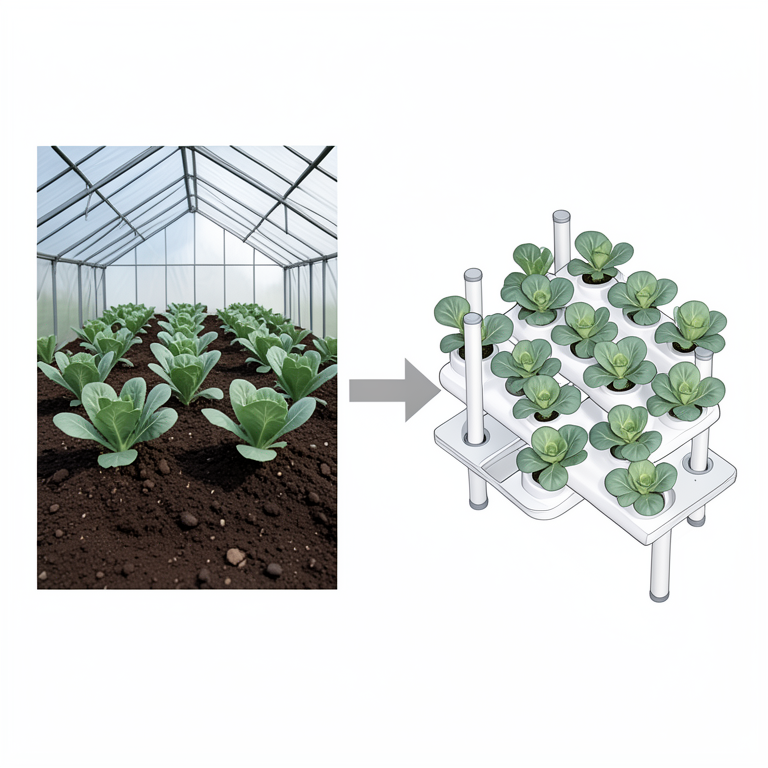
Cost Crossover Concept
AI-generated conceptual illustration (lettuce plants in soil and hydroponic systems). It explains the idea and does not show study data.
View source evidence ↗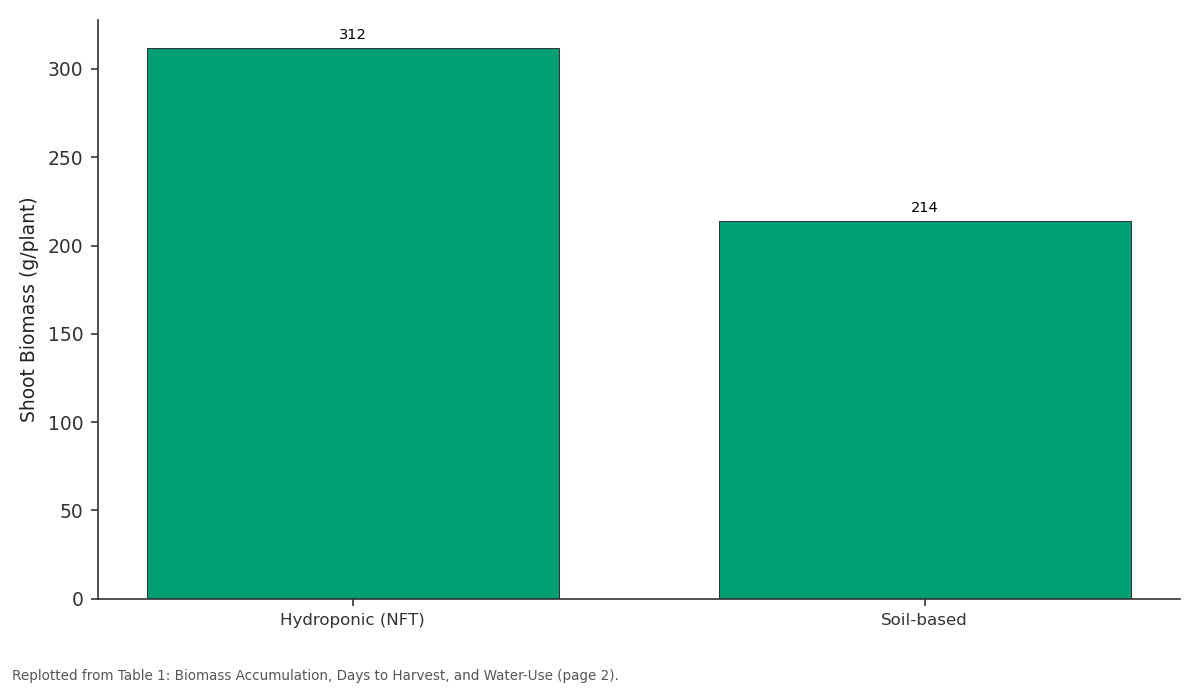
Shoot Biomass (g/plant): Hydroponic (NFT) vs Soil-based
Replotted from Table 1 (page 2) of the original paper. Every bar is the paper's own table value.
View source evidence ↗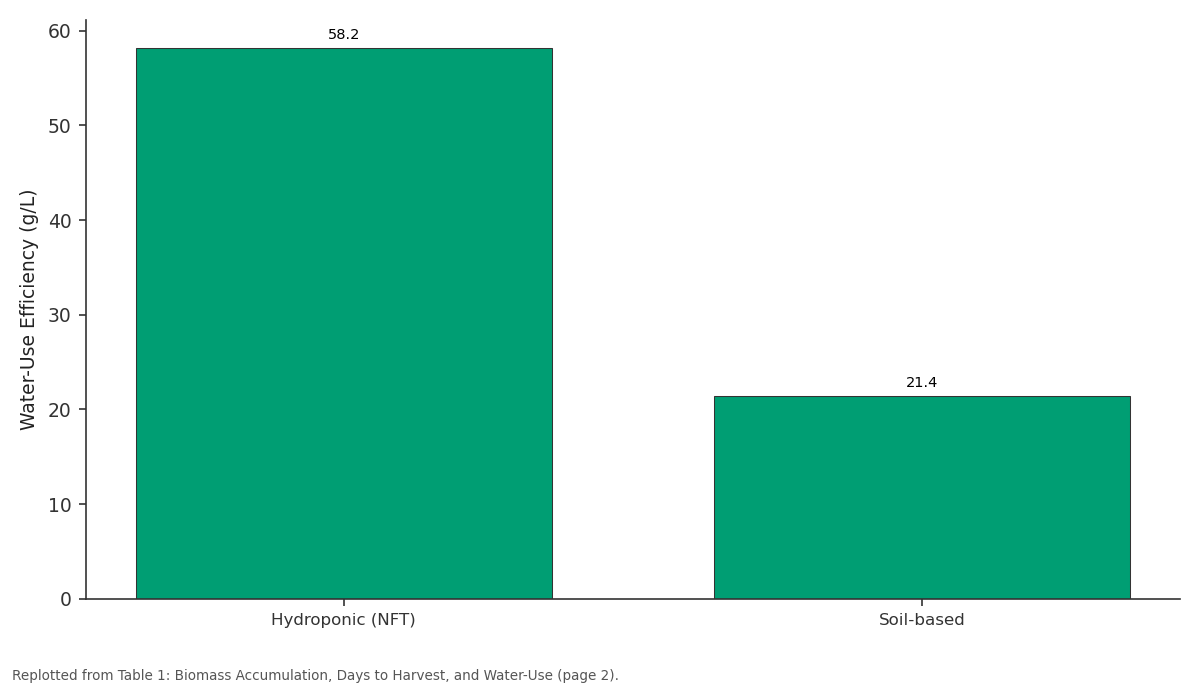
Water-Use Efficiency (g/L): Hydroponic (NFT) vs Soil-based
Replotted from Table 1 (page 2) of the original paper. Every bar is the paper's own table value.
View source evidence ↗Figures & tables
From the original paper Table 1
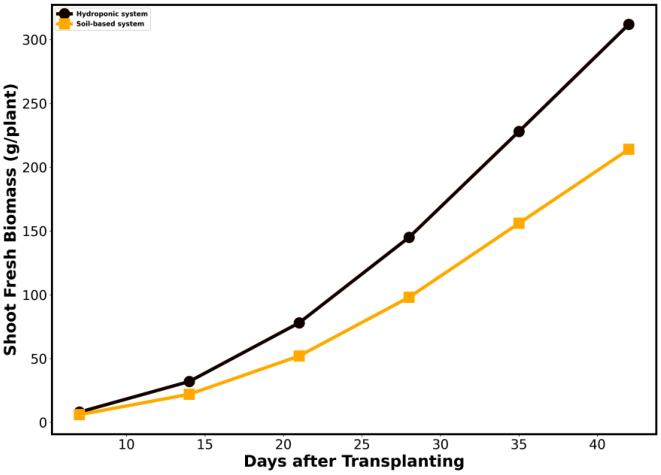 Figure 1
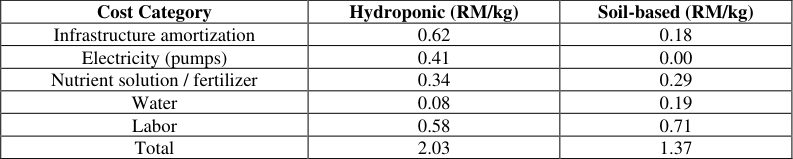 Table 2
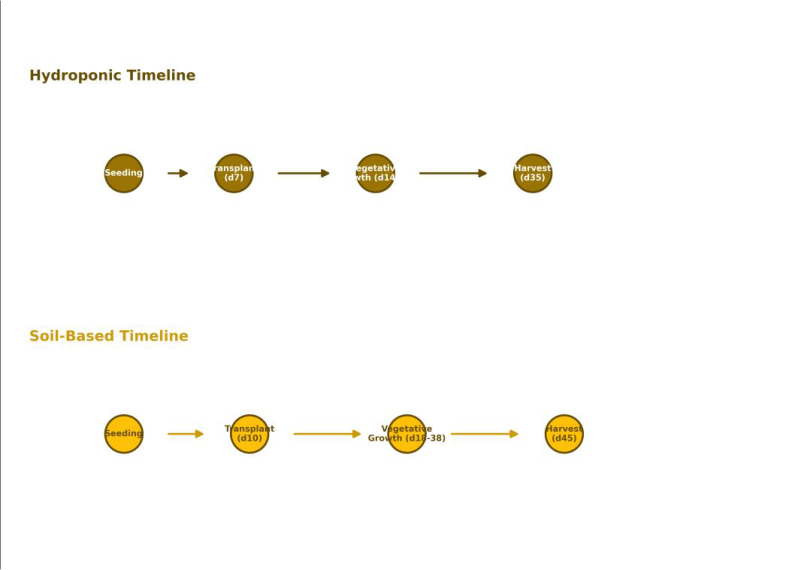 Figure 2
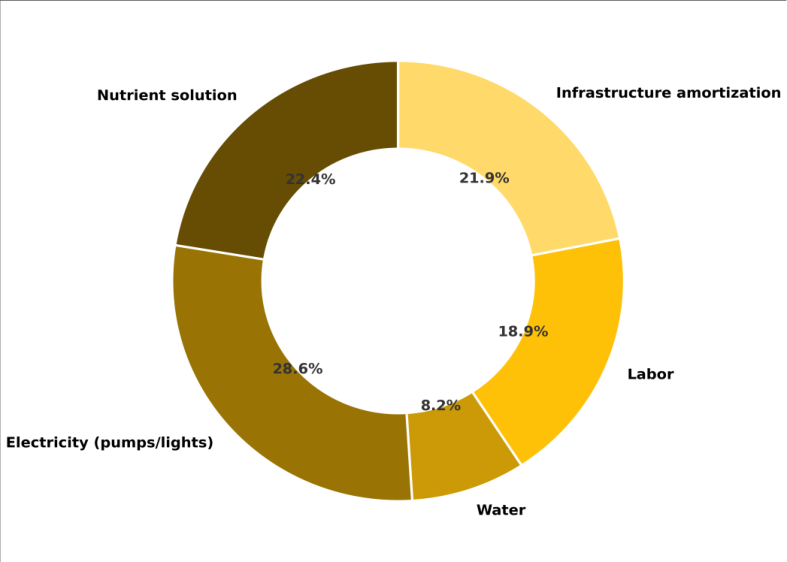 Figure 3
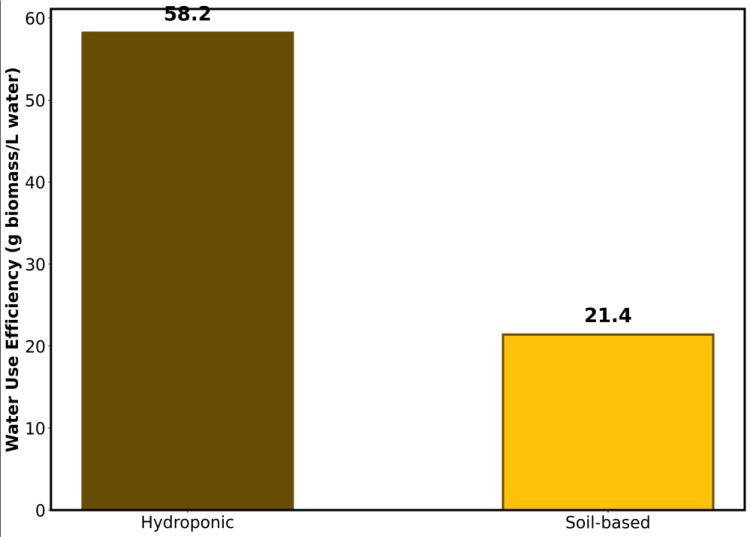 Figure 4
Introduction
Cameron Highlands has functioned as Malaysia's primary temperate vegetable production hub for decades, its cool highland climate suited to lettuce, cabbage, and related crops that struggle in the country's lowland tropical heat. Within this region, growers increasingly face a genuine choice between continuing conventional soil-based greenhouse cultivation and investing in hydroponic Nutrient Film Technique (NFT) systems, a choice complicated by the fact that most locally available comparative evidence addresses either agronomic performance or economic viability in isolation, rather than jointly quantifying both dimensions under directly comparable low-cost greenhouse conditions representative of what a smallholder Cameron Highlands grower might realistically adopt. Hydroponic systems are widely understood to offer faster growth cycles and superior water-use efficiency relative to soil-based cultivation, benefits that trace to precise, continuously available nutrient delivery and closed-loop water recirculation that eliminates the percolation and evaporation losses inherent to soil-based irrigation.
What remains less clear, particularly for smallholder-scale Southeast Asian production contexts rather than the large commercial hydroponic operations more commonly represented in published research, is whether these agronomic advantages translate into genuine economic advantage once the full cost structure, including infrastructure investment, electricity for nutrient pumps, and ongoing system maintenance, is compared directly against well-managed conventional soil-based production at comparable low-cost greenhouse scale. This research addressed that gap by comparing NFT hydroponic and soilbased lettuce production side by side under identical lowcost greenhouse infrastructure, tracking both agronomic performance and a full production cost accounting across three consecutive production cycles. Three questions guided this comparison. First, how large is the biomass accumulation and time-to-harvest advantage hydroponic production delivers under these specific low-cost greenhouse conditions? Second, does hydroponics' wateruse efficiency advantage translate into an overall lower total production cost once all cost categories, not water alone, are accounted for? Third, at what production scale, if any, does hydroponic production's cost structure become more favorable than that of soil-based production, information directly relevant to smallholder growers deciding whether their intended production scale justifies the hydroponic infrastructure investment?
Materials and Methods
System Design / System Architecture The hydroponic system used a standard Nutrient Film Technique (NFT) configuration with PVC channels arranged on a gentle slope, nutrient solution recirculated continuously via a submersible pump through a central reservoir, and electrical conductivity and pH monitored and adjusted daily to maintain target ranges appropriate for lettuce (EC 1.2-1.8 mS/cm, pH 5.5-6.5). The soil-based comparison system used raised beds within the same greenhouse structure, amended with compost and standard NPK fertilizer application following regional lettuce production recommendations, with drip irrigation delivering water on a schedule calibrated to maintain adequate soil moisture without the precision recirculation the hydroponic system offered.
Materials
Both systems used the same lettuce variety, a locally popular loose-leaf cultivar, with seedlings transplanted at a uniform four-leaf stage into either the NFT channels or the soil-based raised beds, at matched plant density between systems to allow direct biomass comparison. Three consecutive production cycles were tracked between August 2024 and March 2025, each cycle comprising 100 plants per system.
Methods
Shoot fresh biomass was recorded destructively from ten randomly selected plants per system at 7, 14, 21, 28, 35, and 42 days after transplanting. Days to harvest maturity was recorded as the point at which plants reached the target commercial harvest weight for the variety used. Water applied was metered separately for each system across the full production cycle, and water-use efficiency was calculated as total harvested biomass divided by total water applied. Production cost accounting included infrastructure amortization (calculated over an assumed five-year system lifespan), electricity for nutrient pumps (hydroponic system only), nutrient solution or fertilizer cost, water cost, and labor hours costed at prevailing local agricultural wage rates. Break-even analysis compared total cost per kilogram of marketable lettuce across a range of assumed production scales to identify the crossover point at which hydroponic production became more cost-competitive than soil-based production. Data were analyzed using paired comparison statistics appropriate for the two-system experimental design, pooling data across the three production cycles given consistent patterns across cycles.
Results
Results
Discussion
The clear agronomic advantage hydroponic NFT production showed over soil-based cultivation in this research, a 45.8% biomass gain achieved in 22% less time, is broadly consistent with the substantial existing hydroponic lettuce literature documenting faster growth and higher yield relative to soil-based systems, generally attributed to hydroponics' more precise and continuously available nutrient delivery relative to the more variable nutrient availability soil-based systems provide even under good fertilizer management. Where this research's contribution differs from much of the existing literature is in explicitly quantifying the full cost picture at smallholder scale, showing that this clear agronomic advantage did not translate into an economic advantage at the modest 100plant production scale examined in the primary comparison, a finding that receives less attention in hydroponic research generally conducted at larger commercial scale where fixed costs are already well amortized across substantial production volume. This divergence between agronomic and economic outcomes at smallholder scale carries a direct practical implication for extension advice given to Cameron Highlands growers considering hydroponic conversion: the recommendation to adopt hydroponic systems should be scale-contingent rather than universal, since this research's break-even analysis suggests smallholder growers producing below roughly 800 plants per cycle would likely find soilbased production more cost-effective despite hydroponics' clear agronomic superiority, while growers operating at or above that scale, or those able to secure lower-cost electricity or shared infrastructure arrangements that reduce the fixed cost burden per plant, would find hydroponic conversion increasingly justified. The electricity cost component deserves particular attention, since it represented the second-largest cost category for the hydroponic system after infrastructure amortization, and Cameron Highlands' electricity pricing, higher than in some other Malaysian regions given its distance from major grid infrastructure, may make the break-even scale threshold identified here somewhat specific to this particular location's cost structure. Growers in regions with lower electricity costs, or those able to incorporate solar-powered pump systems to reduce this cost category, would likely see a lower break-even scale threshold than the approximately 800-plant figure identified in this research's specific cost environment.
Conclusion
This research compared hydroponic NFT and soil-based lettuce production under identical low-cost greenhouse conditions at Cameron Highlands, Malaysia, finding a clear agronomic advantage for hydroponic production, faster time to harvest and 45.8% higher biomass yield, alongside markedly superior water-use efficiency. Despite this clear agronomic superiority, full production cost accounting at the 100-plant scale examined showed soil-based production remained the lower-cost option overall, driven by infrastructure amortization and electricity costs that offset hydroponics' water and labor savings at this modest production scale, with break-even analysis indicating hydroponic production would become more costcompetitive only above approximately 800 plants per production cycle. For Cameron Highlands smallholder growers and the extension services advising them, this research's central message is that hydroponic conversion decisions should weigh intended production scale carefully rather than assuming hydroponics' agronomic advantages automatically translate into superior economic returns at any scale. Growers producing below the identified break-even threshold may find continued investment in well-managed soil-based production, rather than hydroponic conversion, the more financially sound near-term choice, while growers planning to scale up production, or those able to access lower electricity costs through solar power or cooperative infrastructure sharing arrangements, would find the case for hydroponic conversion considerably stronger. Extending this cost comparison across a wider range of vegetable crops beyond lettuce, and testing how solar-powered pump systems might shift the break-even threshold identified here, would provide additional practical guidance for Cameron Highlands growers navigating this increasingly common production system choice.
Figures and tables from the paper
| Cost Category | Hydroponic (RM/kg) | Soil-based (RM/kg) |
|---|---|---|
| Infrastructure amortization | 0.62 | 0.18 |
| Electricity (pumps) | 0.41 | 0.00 |
| Nutrient solution / fertilizer | 0.34 | 0.29 |
| Water | 0.08 | 0.19 |
| Labor | 0.58 | 0.71 |
| Total | 2.03 | 1.37 |
Table text extracted from the original PDF; superscript letters are shown inline. The original table image is below.
View original table image
References
18 in the original paper- Barbosa GL, Gadelha FDA, Kublik N, Proctor A, Reichelm L, Weissinger E, et al. Comparison of land, water, and energy requirements of lettuce grown using hydroponic vs. conventional agricultural methods. Int J Environ Res Public Health. 2015;12(6):6879-6891.
- Buckseth T, Sharma AK, Pandey KK, Singh BP, Muthuraj R. Methods of pre-basic seed potato production with special reference to aeroponics: a review. Sci Hortic. 2016;204:79-87.
- Domingues DS, Takahashi HW, Camara CAP, Nixdorf SL. Automated system developed to control pH and concentration of nutrient solution evaluated in hydroponic lettuce production. Comput Electron Agric. 2012;84:53-61.
- Fussy A, Papenbrock J. An overview of soil and soilless cultivation techniques: chances, challenges and the neglected question of sustainability. Plants. 2022;11(9):1153.
- Genuncio GDC, Gomes M, Ferreira DDS, Majerowicz N, Zonta E. Hydroponic lettuce production in different concentrations and flow rates of nutrient solution. Hortic Bras. 2012;30(3):526-530.
- Jensen MH. Hydroponics worldwide. Acta Hortic. 1999;481:719-730.
- Lakhiar IA, Gao J, Syed TN, Chandio FA, Buttar NA. Modern plant cultivation technologies in agriculture under controlled environment: a review on aeroponics. J Plant Interact. 2018;13(1):338-352.
- Manzocco L, Foschia M, Tomasi N, Maifreni M, Costa LD, Marino M, et al. Influence of hydroponic and soil cultivation on quality and shelf life of ready-to-eat lamb's lettuce (Valerianella locusta L. Laterr.). J Sci Food Agric. 2011;91(8):1373-1380.
- Nichols M, Savidov N. Aquaponics: a nutrient and water efficient production system. Acta Hortic. 2012;947:129-132.
- Resh HM. Hydroponic food production: a definitive guidebook for the advanced home gardener and the commercial hydroponic grower. 7th ed. Boca Raton (FL): CRC Press; 2013.
- Sace CF, Natividad EMC. Economic analysis of smallscale hydroponic and soil-based vegetable production systems. Int J Environ Agric Res. 2015;1(2):1-14.
- Sardare MD, Admane SV. A review on plant without soil -hydroponics. Int J Res Eng Technol. 2013;2(3):299-304.
- Savvas D, Gruda N. Application of soilless culture technologies in the modern greenhouse industry: a review. Eur J Hortic Sci. 2018;83(5):280-293.
- Sharma N, Acharya S, Kumar K, Singh N, Chaurasia OP. Hydroponics as an advanced technique for vegetable production: an overview. J Soil Water Conserv. 2018;17(4):364-371.
- Signore A, Serio F, Santamaria P. A targeted management of the nutrient solution in a soilless tomato crop according to plant needs. Front Plant Sci. 2016;7:391.
- Son JE, Kim HJ, Ahn TI. Hydroponic systems. In: Kozai T, Niu G, Takagaki M, editors. Plant factory: an indoor vertical farming system for efficient quality food production. 2nd ed. London: Academic Press; 2020. p. 273-283.
- Treftz C, Omaye ST. Nutrient analysis of soil and soilless strawberries and raspberries grown in a greenhouse. Food Nutr Sci. 2015;6(9):805-815.
- Velazquez-Gonzalez RS, Garcia-Garcia AL, VenturaZapata E, Barcelo-Quintal ID, Solano E. A review on hydroponics and the technologies associated for medium-and small-scale operations. Agriculture. 2022;12(5):646.