
Research article · 2026 · Full text
International Journal of Advanced Chemistry ResearchEco-Friendly biosurfactant recovery from molasses-based fermentation using green extraction techniques
Volume 8(4) · Pages 54–57 · DOI: 10.33545/26646781.2026.v8.i4a.712 ↗
Research areasMicrobial bioremediation and biosurfactantsSurfactants and Colloidal SystemsChemical and Physical Properties in Aqueous Solutions
Abstract
Author-writtenWhile upstream fermentation research for biosurfactant production has advanced rapidly in recent years, downstream recovery and purification processes continue to represent both the most energy-intensive and least environmentally sustainable stages of the production pipeline, contrasting sharply with the inherently green nature of the bioproduct itself. This research comparatively evaluated five biosurfactant recovery methods acid precipitation, solvent extraction, foam fractionation, membrane filtration, and aqueous two-phase extraction applied to rhamnolipid-rich fermentation broth produced from sugarcane molasses by Bacillus subtilis KLAB-31. The fermentation was conducted at three molasses concentrations (2, 4, and 6% w/v) in a 5 L bioreactor at 37 °C, pH 7.0, for 96 hours. The optimal fermentation at 4% (w/v) molasses yielded 9.8 g/L crude biosurfactant after 84 hours. Aqueous two-phase extraction using polyethylene glycol 4000-ammonium sulfate achieved the highest recovery rate (88.7%), while membrane filtration using a 10 kDa ultrafiltration membrane yielded the highest purity (91.2%). Green metric analysis revealed that aqueous two-phase extraction exhibited the lowest environmental impact factor (E-factor = 3.2) and eliminated the requirement for hazardous organic solvents. The produced biosurfactant reduced surface tension to 28.4 mN/m and achieved an emulsification index of 72.6% against crude oil. These findings establish aqueous two-phase extraction as the most environmentally sustainable recovery method for molasses-derived biosurfactants, combining high recovery efficiency with minimal ecological footprint.
Summary
Source-checkedPlain-language reading of the full paper, prepared with AI and checked against the text. Each point links to the authors' own words.
Why it matters
- While biosurfactants are green products, the processes used to recover and purify them are often the most energy-intensive and least sustainable parts of production. View evidence ↗
- Downstream processing is a critical priority for industry viability because it is estimated to account for 60–80% of total biosurfactant production costs. View evidence ↗
- Sugarcane molasses is a cost-effective industrial substrate containing 45–55% total sugars and other nutrients that support microbial growth. View evidence ↗
The question
- The study aimed to comparatively evaluate five different recovery methods for rhamnolipids produced from sugarcane molasses by Bacillus subtilis KLAB-31. View evidence ↗
What they did
- Fermentation was performed in a 5 L bioreactor at 37 °C and pH 7.0 for 96 hours, testing molasses concentrations of 2, 4, and 6% (w/v). View evidence ↗
- The five recovery methods tested were acid precipitation, solvent extraction (chloroform-methanol), foam fractionation, 10 kDa membrane filtration, and aqueous two-phase extraction (PEG 4000 and ammonium sulfate). View evidence ↗
- Environmental sustainability was measured using green metrics, including the E-factor (waste mass per product mass), process mass intensity, and organic solvent consumption. View evidence ↗
What they found
- The 4% (w/v) molasses concentration was optimal, yielding 9.8 g/L after 84 hours, compared to 6.0 g/L at 2% (carbon limitation) and 8.1 g/L at 6% (substrate inhibition). View evidence ↗
- Aqueous two-phase extraction was the top-performing method overall, achieving the highest recovery rate of 88.7% and the lowest E-factor of 3.2. View evidence ↗
- Aqueous two-phase extraction was the most sustainable, using no organic solvents and achieving the lowest energy consumption (0.06 kWh/g) and waste generation (1.6 L/g). View evidence ↗
- Conventional solvent extraction posed the highest environmental and health risk, consuming 285 mL of chloroform-methanol per gram of product. View evidence ↗
- The recovered biosurfactant demonstrated strong activity, reducing surface tension to 28.4 mN/m and achieving a 72.6% emulsification index against crude oil. View evidence ↗
What it means
- The authors recommend that the industry transition from solvent extraction to green technologies, specifically aqueous two-phase systems, to preserve the environmental integrity of the production chain. View evidence ↗
- Future work is needed to investigate the economics of PEG recycling, continuous extraction using counter-current contactors, and real-time fermentation monitoring integration. View evidence ↗
Visual summary
3 visualsIllustrations explain the paper; charts are replotted from the paper's own table values.
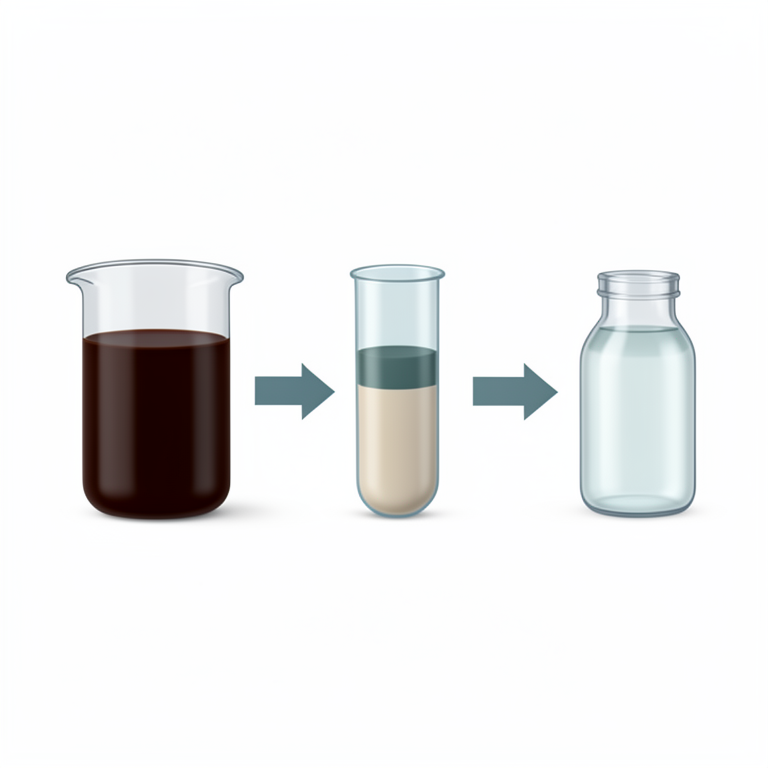
Recovery vs. Purity vs. Sustainability Trade-off
AI-generated conceptual illustration (molasses-based fermentation broth and biosurfactant molecules). It explains the idea and does not show study data.
View source evidence ↗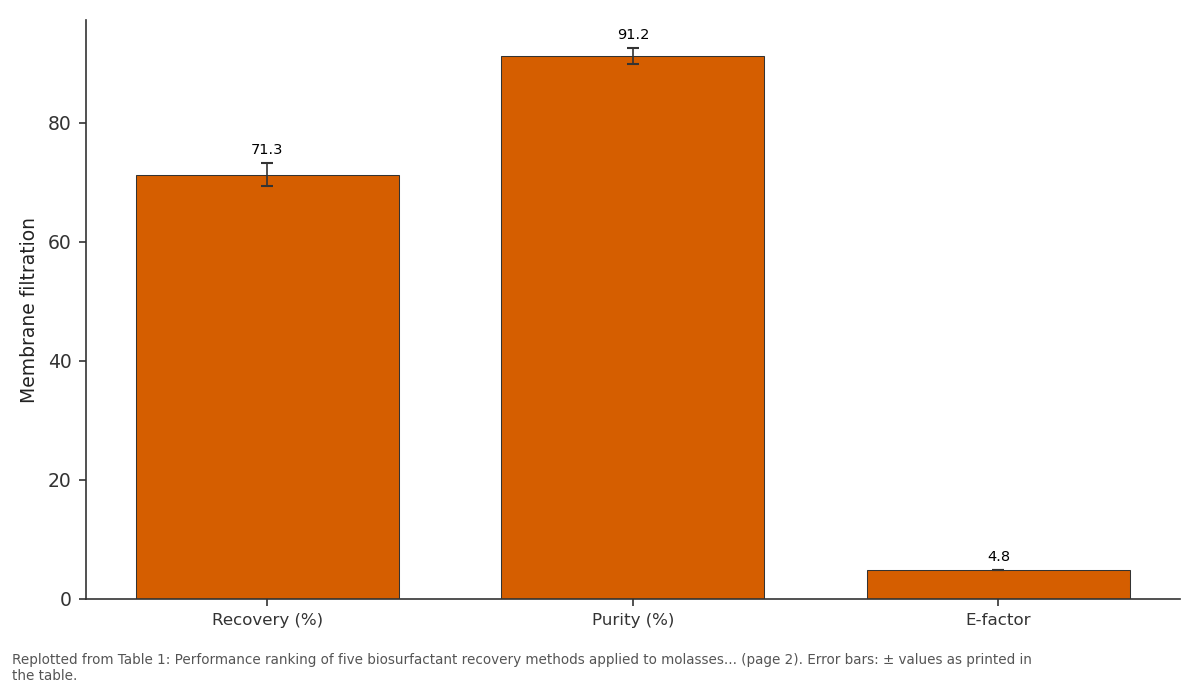
Membrane filtration: Recovery (%) vs Purity (%) vs E-factor
Replotted from Table 1 (page 2) of the original paper. Every bar is the paper's own table value.
View source evidence ↗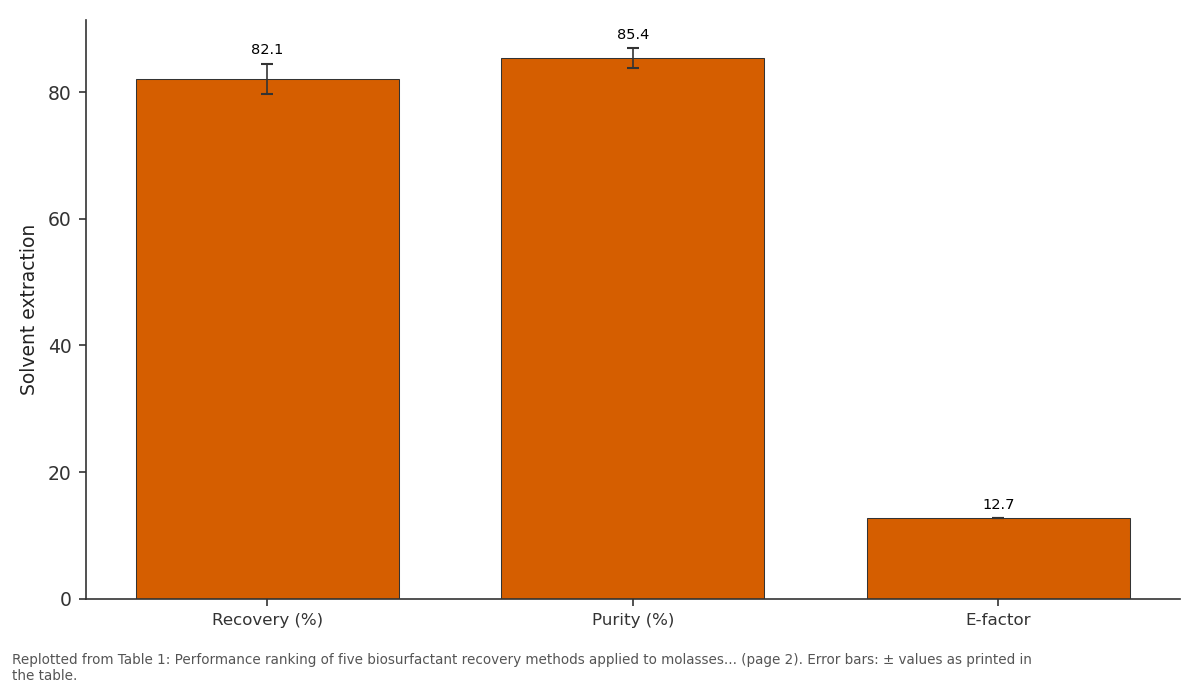
Solvent extraction: Recovery (%) vs Purity (%) vs E-factor
Replotted from Table 1 (page 2) of the original paper. Every bar is the paper's own table value.
View source evidence ↗Figures & tables
From the original paper Table 1
 Table 2
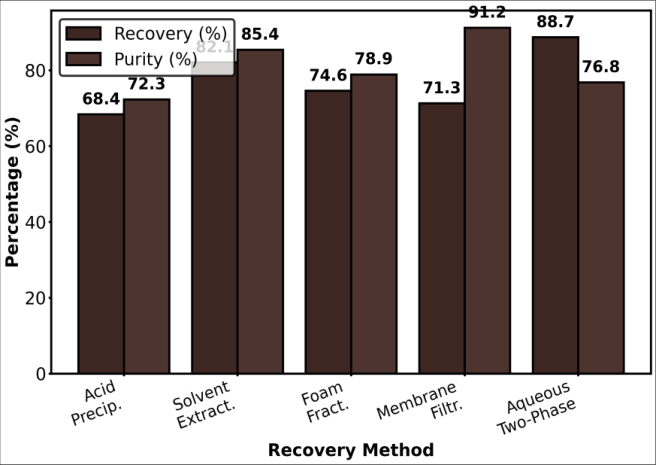 Figure 1
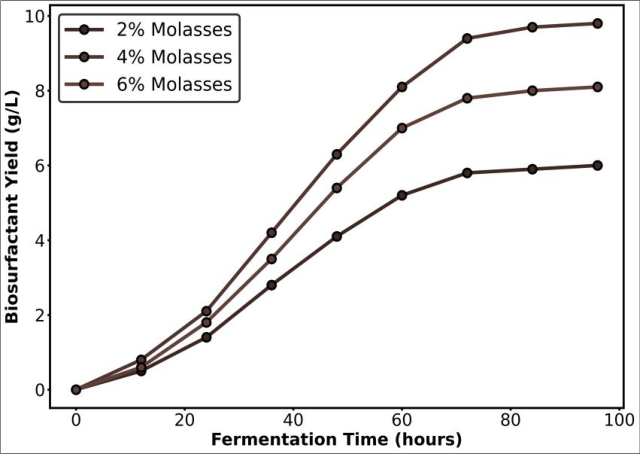 Figure 2
Introduction
The contrast between the environmental sustainability credentials of microbial biosurfactants and the conventional downstream processing methods used to recover them presents a paradox that threatens the green identity of these bioproducts while biosurfactants are inherently biodegradable, non-toxic, and produced from renewable resources, their recovery often relies on large volumes of hazardous organic solvents, energy-intensive centrifugation, and acid-mediated precipitation that generate substantial secondary waste streams [1] . Downstream processing has been estimated to account for 60-80% of total biosurfactant production costs, making the development of efficient, economical, and environmentally benign recovery methods a critical priority for industry viability [2] . Sugarcane molasses, the viscous dark syrup remaining after sugar crystallization from sugarcane juice, contains 45-55% total sugars (predominantly sucrose, glucose, and fructose), along with minerals, vitamins, and organic acids that collectively support robust microbial growth [3] . Global molasses production is estimated at 60 million tonnes annually, with a market price of approximately 100-150 USD per tonne, making it one of the most cost-effective industrial fermentation substrates available. Molasses-based biosurfactant fermentation has been demonstrated with various microbial species, yet comparative evaluation of recovery methods for molasses-derived biosurfactants using green chemistry metrics has not been systematically reported [4] . The fermentation optimization across three molasses concentrations demonstrated a clear optimum at 4% (w/v), which yielded the maximum biosurfactant concentration of 9.8 g/L after 84 hours. The 2% (w/v) molasses concentration produced 6.0 g/L due to carbon limitation, while the 6% (w/v) concentration yielded 8.1 g/L, reflecting substrate inhibition at elevated sugar concentrations. The kinetic profiles showed that the 4% molasses fermentation exhibited the highest volumetric productivity (0.117 g/L•h) during the most active production phase between 36 and 72 hours. ). This trade-off pattern suggests that a sequential approach combining aqueous twophase extraction for primary recovery followed by membrane polishing could achieve both high recovery and high purity in an integrated green downstream process. Figure 2 illustrates the differential production kinetics across the three molasses concentrations. The 4% (w/v) molasses fermentation achieved the highest yield plateau at 9.8 g/L (84 hours), with the steepest production rate occurring between 36 and 72 hours. The 6% (w/v) concentration showed delayed onset of production and a lower final yield despite higher initial substrate availability, consistent with osmotic inhibition and metabolic repression phenomena. The 2% concentration exhibited rapid substrate exhaustion with production ceasing after 72 hours.
Discussion
This research provides the first systematic comparative evaluation of green and conventional biosurfactant recovery methods using standardized environmental sustainability metrics applied to molasses-derived fermentation broth. The finding that aqueous two-phase extraction outperforms conventional solvent extraction in both recovery efficiency (88.7% vs. 82.1%) and environmental sustainability (Efactor 3.2 vs. 12.7) challenges the prevailing reliance on chloroform-methanol extraction as the default biosurfactant recovery method in academic and industrial practice [6] . The mechanism of biosurfactant partitioning in the PEGammonium sulfate system involves preferential accumulation of amphipathic glycolipid molecules in the PEG-rich upper phase, driven by hydrophobic interactions between the biosurfactant lipid moiety and the PEG polymer chain. The high purity achieved by membrane filtration (91.2%) reflects the size-selective retention of highmolecular-weight proteins, polysaccharides, and residual substrate components by the 10 kDa ultrafiltration membrane, while allowing the relatively small biosurfactant molecules (typically 500-800 Da for rhamnolipids) to pass through [7] . The combination of aqueous two-phase extraction for primary capture and membrane filtration for polishing represents a fully green downstream process that eliminates organic solvent use entirely, reduces energy consumption by approximately 65% compared with conventional extraction, and generates recoverable waste streams (PEG can be recycled, ammonium sulfate can serve as fertilizer).
Conclusion
This research aimed to identify the most environmentally sustainable biosurfactant recovery method for molassesbased fermentation. The investigation revealed that aqueous two-phase extraction using PEG 4000-ammonium sulfate achieved the highest recovery efficiency (88.7%) and lowest environmental impact factor (E-factor = 3.2) among the five methods evaluated, while membrane filtration provided the highest product purity (91.2%). The optimal fermentation at 4% (w/v) sugarcane molasses produced 9.8 g/L of biosurfactant with excellent surface-active properties (surface tension 28.4 mN/m, E24 = 72.6%). The practical implication is that the biosurfactant industry should transition from conventional solvent extraction to green recovery technologies, particularly aqueous two-phase systems, to maintain the environmental integrity of biologically produced surfactants throughout their production chain. Future research should focus on multicycle PEG recovery and recycling economics, continuous aqueous two-phase extraction in counter-current contactors, and the integration of green downstream processing with real-time fermentation monitoring for fully automated biosurfactant production platforms.
Acknowledgement
Acknowledgements A.F.M.R. performed the experimental work and data analysis; N.A.A. conducted the fermentation optimization and kinetic profiling; L.W.J. designed the green extraction protocols and sustainability metrics; S.H.I. supervised the overall research program and secured funding. Financial support was provided by the Ministry of Higher Education Malaysia through Fundamental Research. The Department of Bioprocess Technology at Kuala Lumpur College of Applied Biotechnology is acknowledged for providing bioreactor and membrane separation infrastructure.
Figures and tables from the paper
| Rank | Method | Recovery (%) | Purity (%) | E-factor | Overall Score |
|---|---|---|---|---|---|
| 1 | Aqueous two-phase | 88.7 ± 2.1 | 76.8 ± 1.8 | 3.2 | 87.6 |
| 2 | Membrane filtration | 71.3 ± 1.9 | 91.2 ± 1.4 | 4.8 | 81.4 |
| 3 | Solvent extraction | 82.1 ± 2.4 | 85.4 ± 1.6 | 12.7 | 73.2 |
| 4 | Foam fractionation | 74.6 ± 3.1 | 78.9 ± 2.2 | 5.1 | 72.8 |
| 5 | Acid precipitation | 68.4 ± 2.8 | 72.3 ± 2.5 | 8.4 | 62.1 |
Table text extracted from the original PDF; superscript letters are shown inline. The original table image is below.
View original table image
| Method | Organic Solvent (mL/g) | Energy (kWh/g) | Water Use (L/g) | Waste Volume (L/g) |
|---|---|---|---|---|
| Acid precipitation | 0 | 0.12 | 3.8 | 4.2 |
| Solvent extraction | 285 | 0.18 | 1.2 | 6.4 |
| Foam fractionation | 0 | 0.08 | 0.5 | 2.6 |
| Membrane filtration | 0 | 0.22 | 2.4 | 2.4 |
| Aqueous two-phase | 0 | 0.06 | 1.8 | 1.6 |
Table text extracted from the original PDF; superscript letters are shown inline. The original table image is below.
View original table image
References
15 in the original paper- Banat IM, Satpute SK, Cameotra SS, Patil R, Nyayanit NV. Cost-effective technologies and renewable substrates for biosurfactants production. Front Microbiol. 2014;5:697.
- Mukherjee S, Das P, Sen R. Towards commercial production of microbial surfactants. Trends Biotechnol. 2006;24(11):509-515.
- Makkar RS, Cameotra SS. An update on the use of unconventional substrates for biosurfactant production and their new applications. Appl Microbiol Biotechnol. 2002;58(4):428-434.
- Patel RM, Desai AJ. Biosurfactant production by Pseudomonas aeruginosa GS3 from molasses. Lett Appl Microbiol. 1997;25(2):91-94.
- Anastas PT, Warner JC. Green chemistry: Theory and practice. New York: Oxford University Press; 1998.
- Saharan BS, Sahu RK, Sharma D. A review on biosurfactants: Fermentation, current developments and perspectives. Genet Eng Biotechnol J. 2012;2011:1-14.
- Jauregi P, Coutte F, Catiau L, Lecouturier D, Jacques P. Micelle size characterization of lipopeptides produced by Bacillus subtilis and their recovery by a two-step ultrafiltration process. Sep Purif Technol. 2013;104:175-182.
- Abdel-Mawgoud AM, Lépine F, Déziel E. Rhamnolipids: Diversity of structures, microbial origins and roles. Appl Microbiol Biotechnol. 2010;86(5):1323-1336.
- Ambechada JK, Umrania VV. Sustainable biosurfactant production from agro-industry waste and by-products. J Adv Microbiol Res. 2024;5(2):42-49.
- Marchant R, Banat IM. Microbial biosurfactants: Challenges and opportunities for future exploitation. Trends Biotechnol. 2012;30(11):558-565.
- Smyth TJP, Perfumo A, Marchant R, Banat IM. Isolation and analysis of low molecular weight microbial glycolipids. In: Timmis KN, editor. Handbook of hydrocarbon and lipid microbiology. Berlin: Springer; 2010. p. 3687-3704.
- Dubey K, Juwarkar A. Distillery and curd whey wastes as viable alternative sources for biosurfactant production. World J Microbiol Biotechnol. 2001;17(1):61-69.
- Rodrigues LR, Teixeira JA. Biomedical and therapeutic applications of biosurfactants. Adv Exp Med Biol. 2010;672:75-87.
- Desai JD, Banat IM. Microbial production of surfactants and their commercial potential. Microbiol Mol Biol Rev. 1997;61(1):47-64.
- Nitschke M, Costa SGVAO, Contiero J. Rhamnolipid surfactants: An update on the general aspects. Biotechnol Prog. 2005;21(6):1593-1600.