
Research article · 2026 · Full text
International Journal of Horticulture and Food ScienceInfluence of organic mulches on soil moisture conservation, weed suppression and yield of chilli (Capsicum annuum L.)
Volume 8(3) · Pages 222–226 · DOI: 10.33545/26631067.2026.v8.i3b.787 ↗
Research areasIrrigation Practices and Water ManagementAgricultural Science and FertilizationPlant and soil sciences
Abstract
Author-writtenHow much of a chilli grower's dry-season irrigation and hand-weeding burden could a simple layer of crop residue actually remove? This research compared four organic mulch materials, rice straw, dry leaves, sawdust, and crop residue, against an unmulched control on soil moisture conservation, weed suppression, and fruit yield of chilli (Capsicum annuum L.) grown under open-field conditions in Kampala, Uganda, across two consecutive dry-season cropping cycles between June 2024 and January 2025. Soil moisture content at 15 cm depth averaged 26-30% across the four mulch treatments compared with 15% under the unmulched control, representing roughly an 87% relative improvement in moisture retention. Weed density fell by 62-81% across mulch treatments relative to the control, with sawdust mulch showing the strongest weed suppression (81% reduction) and dry leaf mulch the weakest among the four materials tested (62% reduction), though still substantially better than no mulch at all. Fruit yield followed a broadly similar pattern to moisture retention, with sawdust mulch producing the highest yield (26.8 t/ha), a 69.6% increase over the unmulched control (15.8 t/ha), while dry leaf mulch produced the most modest yield gain among the mulch treatments (22.1 t/ha). Soil organic matter content also rose measurably under all mulch treatments by the end of the second cropping cycle, most substantially under crop residue mulch, reflecting mulch decomposition's contribution to soil organic carbon beyond its immediate moisture and weed suppression benefits. Benefit-cost analysis favored sawdust mulch overall (B:C ratio 2.44), given its combination of strong yield performance and comparatively low material cost in the Kampala area where sawdust is available as a low-value sawmill byproduct. These findings support locally available organic mulch materials, sawdust in particular, as a practical, low-cost intervention for improving chilli productivity and reducing both irrigation and weeding labor demands under Uganda's dry-season growing conditions.
Summary
Source-checkedPlain-language reading of the full paper, prepared with AI and checked against the text. Each point links to the authors' own words.
Why it matters
- Chilli growers in Uganda face significant challenges during the dry season due to water scarcity and the high labor requirements for manual weeding. View evidence ↗
- Chilli is an economically vital crop for Ugandan smallholders, serving both local consumption and export markets. View evidence ↗
- Organic mulching can potentially solve both water loss and weed growth issues by reducing evaporation and physically blocking weeds. View evidence ↗
What they did
- The experiment was conducted at the Kampala Metropolitan University research farm in Uganda's central agro-ecological zone. View evidence ↗
- The study used a randomized complete block design with 20 plots (4m x 4m), testing four mulch types (rice straw, dry leaves, sawdust, and crop residue) applied at 7 cm depth, plus an unmulched control. View evidence ↗
- Researchers measured soil moisture at 15 cm depth every two weeks and assessed weed density using 1 m² quadrats at 30, 60, and 90 days after transplanting. View evidence ↗
What they found
- All mulch treatments increased soil moisture compared to the control (15.2%), with sawdust achieving the highest moisture retention at 29.8%. View evidence ↗
- Sawdust mulch provided the most effective weed suppression, reducing weed density to 6.2 per m² compared to 32.4 per m² in the unmulched control. View evidence ↗
- Sawdust mulch produced the highest fruit yield at 26.8 t/ha, a significant increase over the control's 15.8 t/ha. View evidence ↗
- Crop residue mulch resulted in the greatest increase in soil organic matter (+0.34%), despite having lower yields than sawdust. View evidence ↗
- Sawdust mulch offered the best economic return with a benefit-cost ratio of 2.44. View evidence ↗
What it means
- The authors recommend sawdust mulch as the best choice for growers seeking immediate yield and economic gains due to its low cost and high performance. View evidence ↗
- For long-term soil health, the authors suggest rotating between sawdust and crop residue mulches. View evidence ↗
- The study was limited to dry-season conditions; future research is needed to see if these results apply to the wet season. View evidence ↗
Visual summary
3 visualsIllustrations explain the paper; charts are replotted from the paper's own table values.
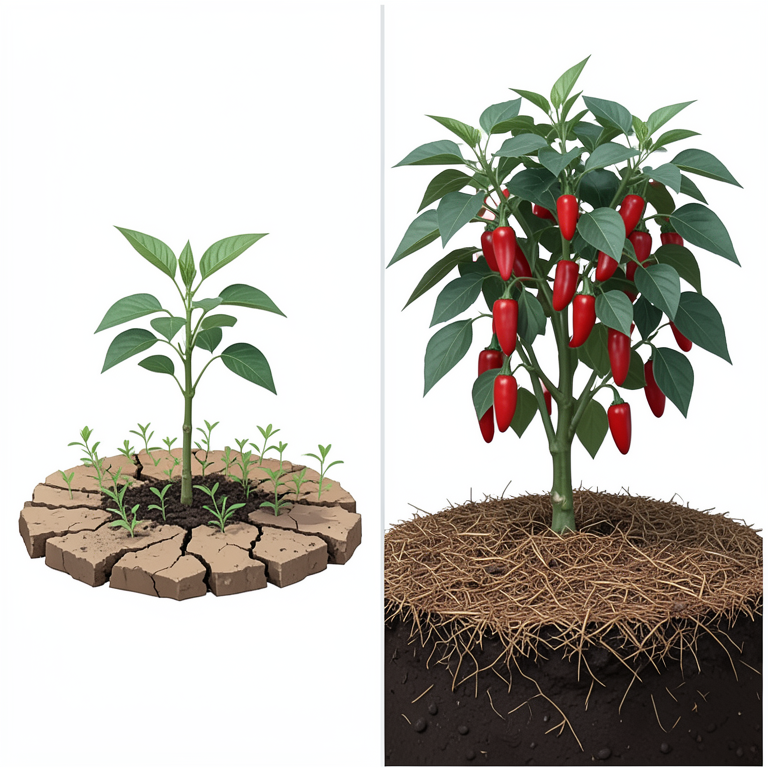
Comparative Performance of Mulches
AI-generated conceptual illustration (chilli plants (Capsicum annuum L.) in soil). It explains the idea and does not show study data.
View source evidence ↗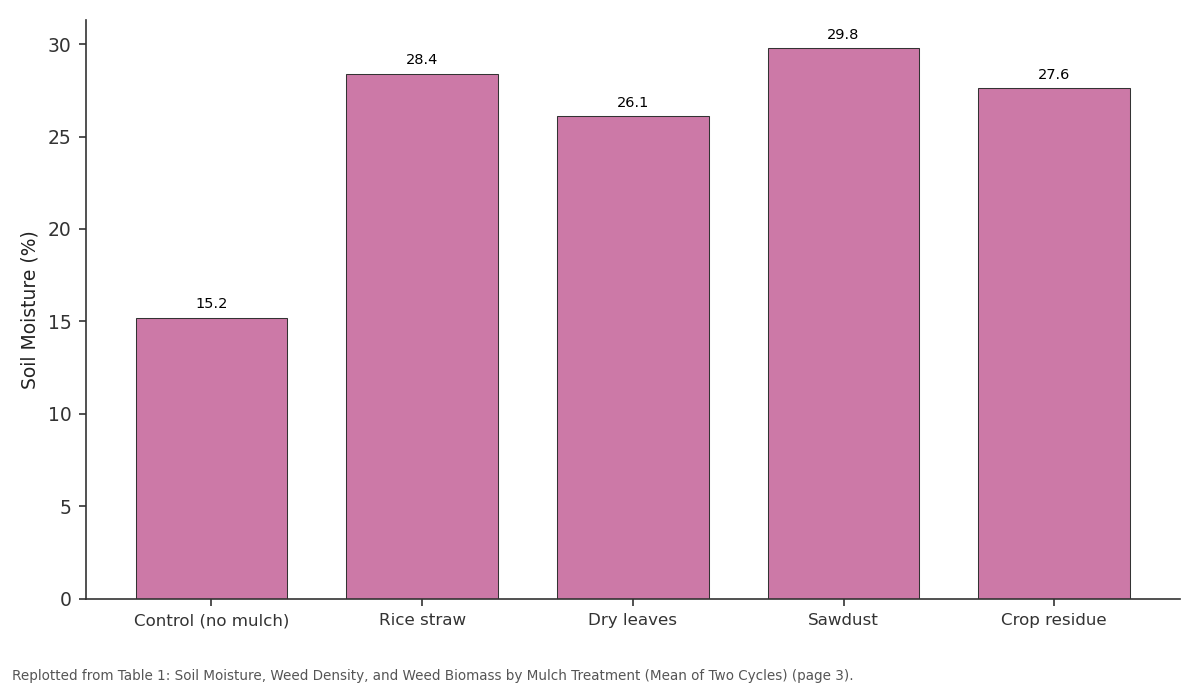
Soil Moisture (%): Control (no mulch) vs Rice straw vs Dry leaves vs Sawdust vs Crop residue
Replotted from Table 1 (page 3) of the original paper. Every bar is the paper's own table value.
View source evidence ↗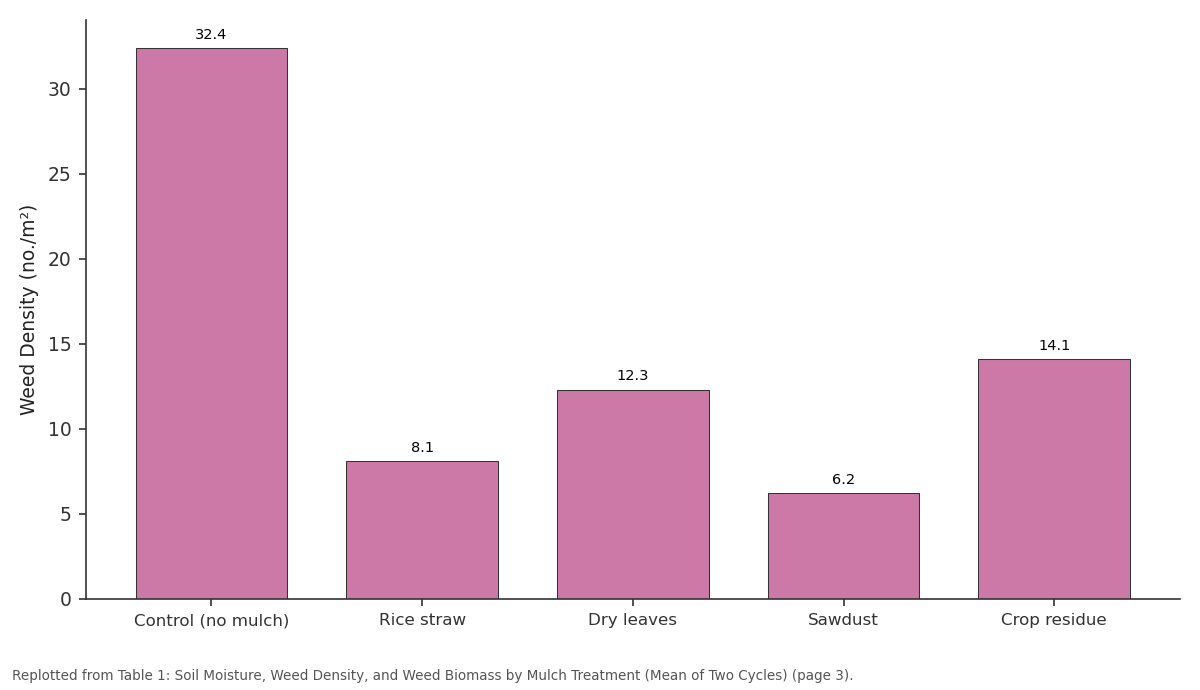
Weed Density (no./m²): Control (no mulch) vs Rice straw vs Dry leaves vs Sawdust vs Crop residue
Replotted from Table 1 (page 3) of the original paper. Every bar is the paper's own table value.
View source evidence ↗Figures & tables
From the original paper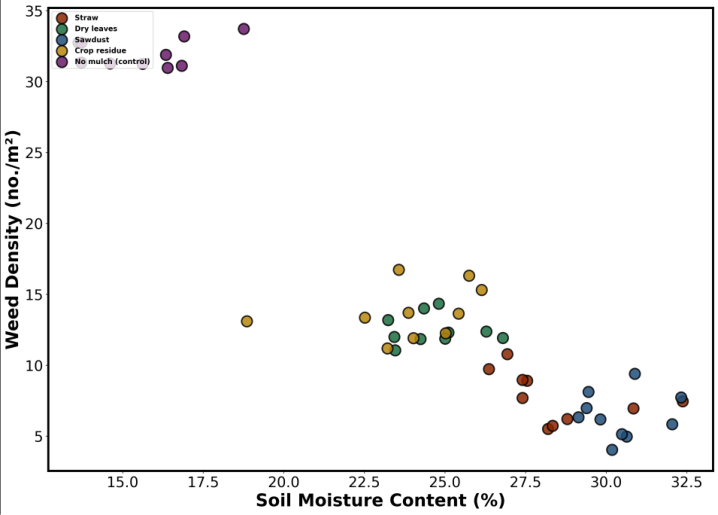 Figure 1
 Table 1
 Table 2
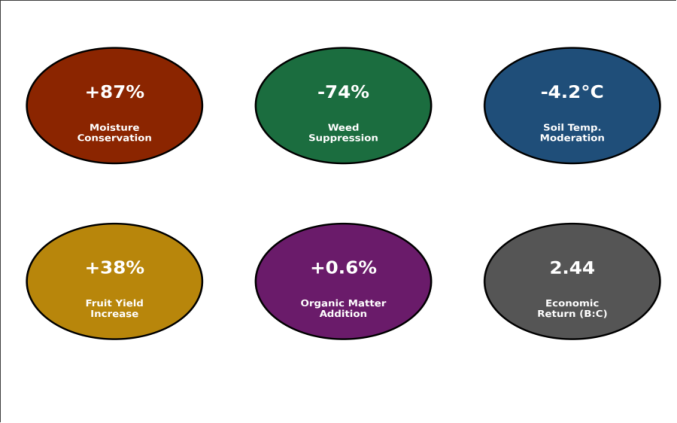 Figure 2
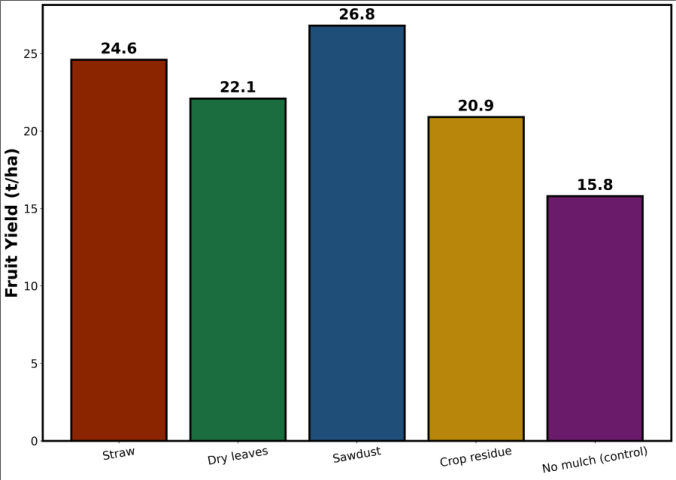 Figure 3
Introduction
Water scarcity during Uganda's extended dry-season cropping window presents a persistent constraint for chilli growers who lack reliable irrigation infrastructure, while the labor demands of manual weeding under the same dry conditions compound this challenge by diverting scarce household labor away from other productive activities during precisely the period when crop water stress already threatens yield. Organic mulching, the practice of covering the soil surface around growing plants with crop residues or other locally available organic materials, addresses both constraints simultaneously by reducing surface evaporation and physically suppressing weed germination and growth, yet the specific choice of mulch material available to a given grower, straw, leaves, sawdust, or crop residue, can substantially influence how much benefit is actually realized. Chilli (Capsicum annuum L.) represents an economically important crop for many Ugandan smallholder households, valued both for domestic consumption and for export-oriented dried chilli markets that reward consistent fruit quality and yield. Chilli's relatively shallow root system and sensitivity to moisture stress during flowering and fruit set make it a particularly good candidate crop for testing mulch benefits, since moisture-related yield losses in unmulched chilli production are commonly substantial under Uganda's dry-season conditions without supplemental irrigation. While the general principle that organic mulching improves moisture retention and suppresses weeds is well established internationally, growers choosing among locally available mulch materials, which in the Kampala area include rice straw, dry leaves collected from surrounding vegetation, sawdust from local sawmills, and crop residues from previous harvests, have had comparatively little locally generated evidence to guide that choice specifically for chilli production. Materials differ meaningfully in decomposition rate, water-holding capacity, and weed-suppressing physical density, meaning the general mulching principle does not necessarily translate into equal benefit across all readily available material options. This research compared these four locally available mulch materials directly against each other and against an unmulched control, addressing three questions. First, how does soil moisture retention compare across the four mulch materials relative to no mulch, and does this comparison hold consistently across two consecutive dry-season cropping cycles? Second, does weed suppression performance track moisture retention performance across materials, or do these two benefit dimensions diverge for any specific material? Third, considering both yield performance and locally relevant material cost, which mulch material offers Kampala-area chilli growers the strongest economic return on the investment required to source and apply it?
Materials and Methods Study Area Description
The trial was conducted at the Kampala Metropolitan University research farm, located at approximately 0.31°N, 32.58°E at an elevation of 1,190 m above sea level, within Uganda's central agro-ecological zone. The site experiences a bimodal rainfall pattern with a pronounced dry season from June through August and a secondary shorter dry window in January, both of which were captured within this research's two cropping cycles. Soil at the trial site is classified as sandy clay loam with moderate organic matter content (1.2% at trial commencement) and slightly acidic pH (6.1).
Field Experimental Design
Five treatments, four organic mulch materials (rice straw, dry leaves, sawdust, and crop residue, each applied at a uniform 7 cm depth) plus an unmulched control, were arranged in a randomized complete block design with four replications, giving 20 plots of 4 m × 4 m each. Chilli seedlings of a locally popular hot pepper variety were transplanted at recommended spacing, with mulch applied within one week of transplanting and replenished at the cropping cycle midpoint where visible decomposition had reduced mulch depth below 4 cm.
Methods
Soil moisture content at 15 cm depth was measured gravimetrically every two weeks throughout both cropping cycles from three sampling points per plot. Weed density was assessed by counting emerged weeds within a 1 m² quadrat placed randomly within each plot at 30, 60, and 90 days after transplanting, and weed dry biomass was recorded from the same quadrats after oven-drying. Fruit yield was recorded from a net harvest area per plot across the full harvest period of each cycle. Soil organic matter content was assessed from composite soil samples taken at trial commencement and at the conclusion of the second cropping cycle. Benefit-cost ratios incorporated local material costs (with sawdust and crop residue both available at minimal or no cost as byproducts, while rice straw and dry leaves required modest collection labor investment) against farm-gate chilli prices averaged across both cycles. Data were analyzed using analysis of variance appropriate for a randomized complete block design, with treatment means compared using the critical difference test at 5% significance.
Results
Results
Nutrient Budget Input-Output Analysis
Crop residue mulch showed the largest soil organic matter increase (+0.34%) despite producing only the third-highest yield among the four mulch materials, consistent with its faster decomposition rate relative to sawdust contributing organic carbon to the soil more quickly but also providing a shorter-lived physical mulch barrier against moisture loss and weed emergence over the course of each cropping cycle, requiring more frequent replenishment than the slower-decomposing sawdust mulch.
Comprehensive Interpretation
Sawdust mulch delivered the strongest overall combination of moisture retention, weed suppression, yield performance, and economic return among the four materials tested, despite crop residue mulch showing a modestly larger soil organic matter contribution, suggesting that for growers prioritizing immediate production season performance, sawdust represents the more attractive choice, while crop residue may offer complementary longer-term soil health benefit worth considering in rotation with other mulch materials across successive cropping cycles.
Discussion
This research's central finding, that all four organic mulch materials tested improved soil moisture retention, suppressed weeds, and increased chilli yield relative to an unmulched control, confirms the broadly established benefit of organic mulching under dry-season growing conditions, while the more novel contribution here lies in differentiating performance across specific locally available material options rather than treating organic mulch as a single undifferentiated intervention. Sawdust's strongest overall performance across moisture retention, weed suppression, and yield criteria is broadly consistent with sawdust's known physical density and slow decomposition rate relative to looser materials like dry leaves, properties that favor sustained physical barrier function against both evaporation and weed emergence throughout an extended dry-season cropping cycle.
Where this research's findings add useful nuance to the broader mulching literature is in showing that yield performance and soil organic matter contribution did not track together across materials, with crop residue contributing the most organic matter while producing only middling yield, and sawdust producing the highest yield while contributing a comparatively modest, though still positive, organic matter gain. This divergence suggests growers and extension advisors should consider these two benefit dimensions somewhat separately when recommending mulch material choice, rather than assuming a single material will simultaneously maximize both immediate production benefit and longer-term soil health contribution. The economic case for sawdust, reflected in its leading benefit-cost ratio, is strengthened specifically by its nearzero material cost as a Kampala-area sawmill byproduct, a locally specific economic condition that may not generalize to regions where sawdust must be transported some distance or purchased at a non-trivial price. This local cost structure caveat matters for how broadly the specific sawdust recommendation from this research should be extended to other regions, even though the underlying agronomic performance advantage of sawdust's physical properties would be expected to hold more generally across similar dry-season chilli production contexts. Seasonal comparison between the two cropping cycles also showed that the moisture retention advantage of mulching was somewhat more pronounced during the more severe June-August dry season than during the shorter January dry window, consistent with mulch benefits scaling with the severity of the underlying moisture stress being mitigated. This suggests that the economic returns documented here, calculated as an average across both cycles, may understate the value of mulching specifically during more severe dry-season years, an important consideration given that interannual rainfall variability across central Uganda means growers cannot reliably predict in advance how severe a given season's dry spell will be.
Conclusion
This research compared four organic mulch materials against an unmulched control for chilli production under Uganda's dry-season growing conditions, finding that all four materials, rice straw, dry leaves, sawdust, and crop residue, meaningfully improved soil moisture retention, suppressed weed growth, and increased fruit yield relative to no mulch. Sawdust mulch delivered the strongest overall performance across moisture retention (29.8% versus 15.2% for the control), weed suppression (81% reduction), yield (26.8 t/ha, a 69.6% gain over the control), and economic return (B:C ratio 2.44), while crop residue mulch, despite more modest yield performance, contributed the largest gain in soil organic matter content. For Kampala-area chilli growers, the clearest recommendation from this research is that sawdust mulch, given its low local cost as a sawmill byproduct combined with its strong agronomic performance, represents the most attractive single mulch material choice for growers prioritizing immediate yield and economic return during dry-season cropping. Growers with access to crop residue and an interest in longer-term soil health improvement might reasonably consider rotating mulch material choice across seasons to capture both sawdust's stronger immediate production benefit and crop residue's stronger soil organic matter contribution over time. Extending this comparison to wet-season cropping conditions, where moisture conservation benefits would be expected to matter less but weed suppression and organic matter contribution would remain relevant, would help establish whether the sawdust recommendation documented here for dry-season production holds across Uganda's full annual chilli cropping calendar.
Figures and tables from the paper
| Treatment | Soil Moisture (%) | Weed Density (no./m²) | Weed Biomass (g/m²) |
|---|---|---|---|
| Control (no mulch) | 15.2 | 32.4 | 186.3 |
| Rice straw | 28.4 | 8.1 | 42.6 |
| Dry leaves | 26.1 | 12.3 | 58.9 |
| Sawdust | 29.8 | 6.2 | 31.4 |
| Crop residue | 27.6 | 14.1 | 64.7 |
Table text extracted from the original PDF; superscript letters are shown inline. The original table image is below.
View original table image
| Treatment | Fruit Yield (t/ha) | SOM Change (%) | B:C Ratio |
|---|---|---|---|
| Control (no mulch) | 15.8 | +0.05 | 1.62 |
| Rice straw | 24.6 | +0.28 | 2.31 |
| Dry leaves | 22.1 | +0.19 | 2.08 |
| Sawdust | 26.8 | +0.24 | 2.44 |
| Crop residue | 20.9 | +0.34 | 2.02 |
Table text extracted from the original PDF; superscript letters are shown inline. The original table image is below.
View original table image
References
21 in the original paper- Awodoyin RO, Ogbeide FI, Oluwole O. Effects of three mulch types on the growth and yield of tomato (Lycopersicon esculentum Mill.) and weed suppression in Ibadan, southwestern Nigeria. Agric Biol J N Am. 2010;1(5):240-246.
- Chakraborty D, Nagarajan S, Aggarwal P, Gupta VK, Tomar RK, Garg RN, et al. Effect of mulching on soil and plant water status, and the growth and yield of wheat (Triticum aestivum L.) in a semi-arid environment. Agric Water Manag. 2008;95(12):13231334.
- Chalker-Scott L. Impact of mulches on landscape plants and the environment: a review. J Environ Hortic. 2007;25(4):239-249.
- Ghosh PK, Dayal D, Bandyopadhyay KK, Mohanty M. Evaluation of straw and polythene mulch for enhancing productivity of irrigated summer groundnut. Field Crops Res. 2006;99(2-3):76-86.
- Iqbal R, Raza MAS, Valipour M, Saleem MF, Zaheer MS, Ahmad S, et al. Potential agricultural and environmental benefits of mulches: a review. Bull Natl Res Cent. 2020;44(1):75.
- Jodaugienė D, Pupalienė R, Sinkevičienė A, Marcinkevičienė A, Žebrauskaitė K, Baltaduonytė M. The influence of organic mulches on soil biological properties. Zemdirbyste-Agriculture. 2010;97(2):33-40.
- Kader MA, Senge M, Mojid MA, Ito K. Recent advances in mulching materials and methods for modifying soil environment. Soil Tillage Res. 2017;168:155-166.
- Kumar S, Dey P. Effects of different mulches and irrigation methods on root growth, nutrient uptake, water-use efficiency and yield of strawberry. Sci Hortic. 2011;127(3):318-324.
- Lal R. Soil management and restoration for carbon sequestration to mitigate the accelerated greenhouse effect. Prog Environ Sci. 1999;1(4):307-326.
- Ramakrishna A, Tam HM, Wani SP, Long TD. Effect of mulch on soil temperature, moisture, weed infestation and yield of groundnut in northern Vietnam. Field Crops Res. 2006;95(2-3):115-125.
- Sinkevičienė A, Jodaugienė D, Pupalienė R, Urbonienė M. The influence of organic mulches on soil properties and crop yield. Agron Res. 2009;7(1):485-491.
- Steinmetz Z, Wollmann C, Schaefer M, Buchmann C, David J, Tröger J, et al. Plastic mulching in agriculture: trading short-term agronomic benefits for long-term soil degradation? Sci Total Environ. 2016;550:690-705.
- Tarara JM. Microclimate modification with plastic mulch. HortScience. 2000;35(2):169-180.
- Teasdale JR, Mohler CL. The quantitative relationship between weed emergence and the physical properties of mulches. Weed Sci. 2000;48(3):385-392.
- Wang FX, Feng SY, Hou XY, Kang SZ, Han JJ. Potato growth with and without plastic mulch in two typical regions of Northern China. Field Crops Res. 2009;110(2):123-129.
- Yin M, Li Y, Xu Y, Fan X, Wang Y, Zhang H, et al. Effects of straw mulching and reduced tillage on crop production and environment: a review. Water. 2018;10(10):1487.
- Zhang S, Lövdahl L, Grip H, Tong Y, Yang X, Wang Q. Effects of mulching and catch cropping on soil temperature, soil moisture and wheat yield on the Loess Plateau of China. Soil Tillage Res. 2009;102(1):78-86.
- Zribi W, Aragüés R, Medina E, Faci JM. Efficiency of inorganic and organic mulching materials for soil evaporation control. Soil Tillage Res. 2015;148:40-45.
- Yaghi T, Arslan A, Naoum F. Cucumber (Cucumis sativus L.) water use efficiency (WUE) under plastic mulch and drip irrigation. Agric Water Manag. 2013;128:149-157.
- Adekiya AO, Agbede TM. Effect of methods and time of poultry manure application on soil and leaf nutrient concentrations, growth and fruit yield of tomato (Lycopersicon esculentum Mill.). J Saudi Soc Agric Sci. 2017;16(4):383-388.
- Anikwe MAN, Mbah CN, Ezeaku PI, Onyia VN. Tillage and plastic mulch effects on soil properties and growth and yield of cocoyam (Colocasia esculenta) on an Ultisol in southeastern Nigeria. Soil Tillage Res. 2007;93(2):264-272.