
Research article · 2026 · Full text
International Journal of Biology SciencesEnvironmental determinants of Escherichia coli colonization and virulence gene dissemination in broiler production systems
Volume 8(6) · Pages 158–161 · DOI: 10.33545/26649926.2026.v8.i6b.921 ↗
Research areasEscherichia coli research studiesSalmonella and Campylobacter epidemiologyAntibiotic Resistance in Bacteria
Abstract
Author-writtenAccording to leading veterinary epidemiologists, the environmental conditions within broiler production facilities constitute the primary determinant of bacterial colonization patterns and virulence gene maintenance. This research investigated the environmental determinants influencing Escherichia coli colonization and virulence gene dissemination in broiler production systems across three agro-ecological zones in Kenya. A total of 360 samples from twelve broiler facilities were collected between February and December 2023, encompassing cloacal, litter, water, feed, and air samples. E. coli was isolated from 265 (73.6%) samples, with significant variation across environmental sources: litter (88.3%), water (76.7%), cloacal (73.3%), feed (61.7%), and air samples (68.3%). Virulence gene screening detected rfbE in 95 (35.8%), eaeA in 75 (28.3%), and fliCH7 in 48 (18.1%) of positive isolates. Multiple linear regression analysis identified litter moisture content (β = 0.42, p<0.001), ammonia concentration (β = 0.35, p = 0.002), and stocking density (β = 0.28, p = 0.008) as the most significant environmental predictors of virulence gene prevalence. These findings establish a quantitative environmental risk framework for managing pathogenic E. coli in Kenyan broiler production facilities.
Summary
Source-checkedPlain-language reading of the full paper, prepared with AI and checked against the text. Each point links to the authors' own words.
Why it matters
- Environmental conditions in broiler facilities are considered the main factor determining how bacteria colonize and maintain virulence genes. View evidence ↗
- Specific factors like high litter moisture, ammonia levels, and stocking density promote bacterial growth, weaken bird immunity, and increase transmission rates. View evidence ↗
- Managing the environment is viewed as the most effective way to control pathogenic E. coli because it targets the root causes of colonization. View evidence ↗
The question
- The study aimed to identify and quantify which environmental factors drive E. coli colonization and the spread of virulence genes in Kenyan broiler systems. View evidence ↗
What they did
- From each facility, 30 samples were taken (cloacal, litter, water, feed, and air) at three different time points: days 14, 28, and 42 of the production cycle. View evidence ↗
- Environmental parameters including temperature, humidity, litter moisture, ammonia, ventilation, and stocking density were recorded during sampling. View evidence ↗
- The study used PCR to screen for three specific virulence genes: rfbE, eaeA, and fliCH7. View evidence ↗
What they found
- E. coli was found in 73.6% (265 of 360) of the total samples collected. View evidence ↗
- E. coli prevalence varied by zone, with the highest rate in lowland facilities (81.7%) and the lowest in highland facilities (66.7%). View evidence ↗
- Litter had the highest E. coli recovery rate at 88.3%, while feed had the lowest at 61.7%. View evidence ↗
- Virulence genes were present in 48.3% of E. coli isolates, with rfbE being the most common (35.8%). View evidence ↗
- The measured environmental variables collectively explained 68% of the variation in the prevalence of virulence genes. View evidence ↗
What it means
- The authors recommend integrating environmental monitoring into routine health programs, focusing primarily on controlling litter moisture. View evidence ↗
- The authors suggest that future work should focus on developing predictive models using real-time data for early warning of E. coli risks. View evidence ↗
Visual summary
2 visualsIllustrations explain the paper; charts are replotted from the paper's own table values.
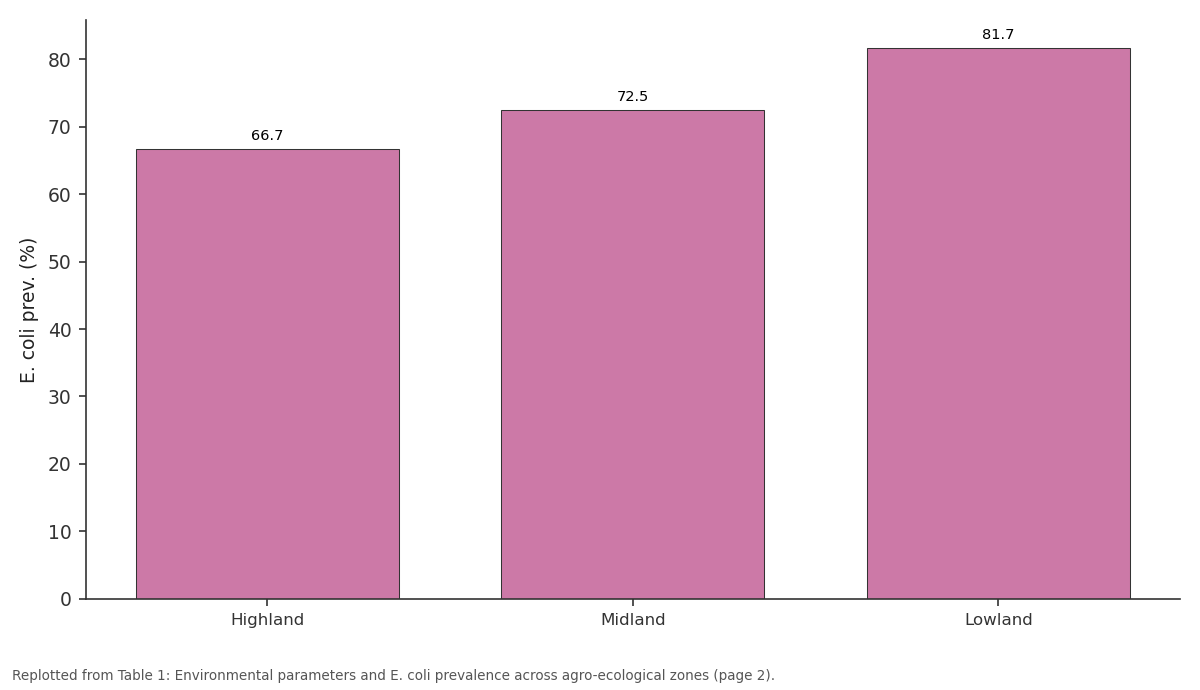
E. coli prev. (%): Highland vs Midland vs Lowland
Replotted from Table 1 (page 2) of the original paper. Every bar is the paper's own table value.
View source evidence ↗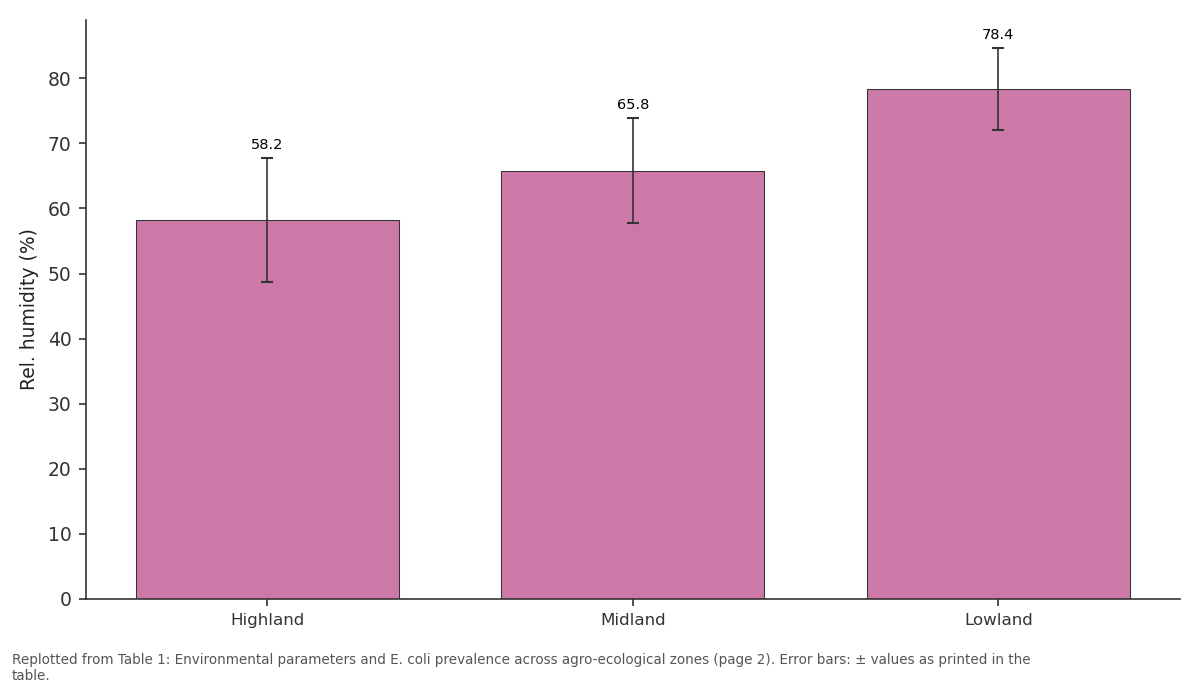
Rel. humidity (%): Highland vs Midland vs Lowland
Replotted from Table 1 (page 2) of the original paper. Every bar is the paper's own table value.
View source evidence ↗Figures & tables
From the original paper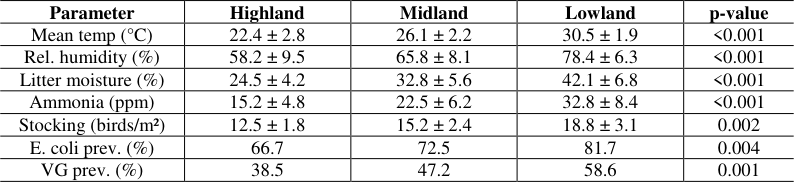 Table 1
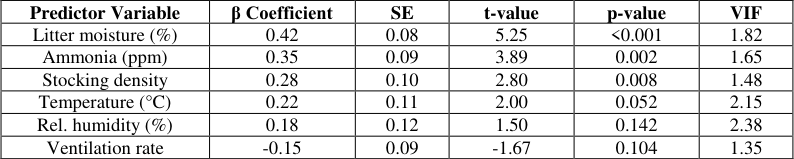 Table 2
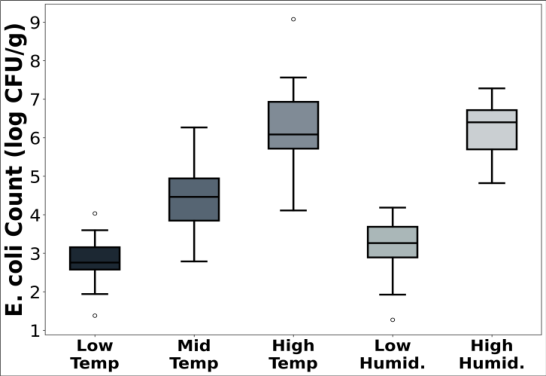 Figure 1
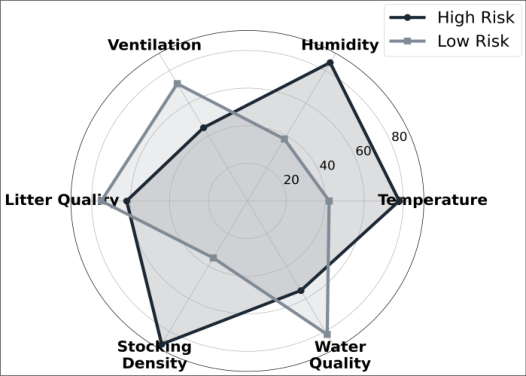 Figure 2
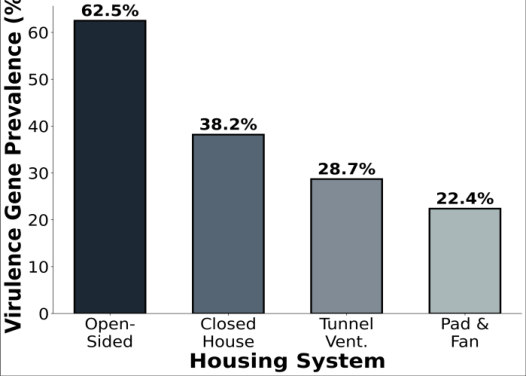 Figure 3
Introduction
The environment within broiler production facilities functions as a complex ecological system in which microbial populations interact with physical, chemical, and biological factors that collectively shape colonization dynamics and virulence gene maintenance [1] . Leading experts in poultry microbiology have emphasized that the management of environmental conditions represents the most effective upstream approach for controlling pathogenic Escherichia coli populations, as environmental modification addresses the root causes of colonization rather than treating downstream consequences [2] . The recognition that environmental factors operate as selective forces influencing not only bacterial prevalence but also the expression and horizontal transfer of virulence-associated genes has shifted the paradigm of pathogen management from reactive treatment to proactive environmental engineering [3] . Among the environmental parameters most consistently associated with E. coli colonization in broiler facilities, litter quality, temperature, humidity, ammonia concentration, and stocking density have been identified as critical modulators [4] . These factors operate through interconnected mechanisms: elevated litter moisture promotes bacterial survival and proliferation, high ammonia concentrations compromise mucosal immunity and increase susceptibility to colonization, and increased stocking density facilitates horizontal transmission through enhanced fecal-oral contact rates [5] . The investigation of virulence genes rfbE, eaeA, and fliCH7 within the context of environmental determinants provides insights into the conditions that favor the maintenance and dissemination of pathogenic potential within broiler-associated E. coli populations [6] . This research aimed to identify and quantify the environmental determinants of E. coli colonization and virulence gene dissemination across diverse broiler production systems in Kenya.
Material and Methods
Material and Methods
Material
A total of 360 samples were collected from twelve commercial broiler facilities distributed across three agroecological zones in Kenya: highland (Nairobi area, >1500m elevation, n=4 facilities), midland (Nakuru area, 1000-1500m, n=4), and lowland (Mombasa area, <500m, n=4). Each facility contributed 30 samples comprising cloacal swabs (n=6), litter (n=6), drinking water (n=6), feed (n=6), and air samples via impaction (n=6). Sampling was conducted at three time points during each production cycle (days 14, 28, 42). Concurrent environmental monitoring recorded temperature, relative humidity, litter moisture, ammonia concentration, ventilation rate, and stocking density at each sampling visit. Research approval was obtained from the Nairobi Research Center for Livestock Health Ethics Committee (Protocol NRCLH-EC-2023-052). Methods E. coli isolation followed standard protocols with biochemical confirmation. PCR amplification targeted rfbE, eaeA, and fliCH7 genes. Environmental parameters were measured using calibrated instruments:
temperature/humidity (digital logger), ammonia (electrochemical sensor), litter moisture (oven-drying gravimetric method), and air sampling (Andersen impactor at 28.3 L/min). Multiple linear regression modeled the relationship between environmental variables (independent) and virulence gene prevalence (dependent). Principal component analysis (PCA) identified the primary environmental drivers. Correlation matrices were generated for all environmental-microbiological variable pairs. Statistical significance was set at p<0.05.
Results
E. coli was isolated from 265 of 360 (73.6%) total samples, with significant variation across agro-ecological zones: lowland facilities demonstrated the highest prevalence (81.7%), followed by midland (72.5%) and highland (66.7%) operations (p = 0.004). Among sample types, litter demonstrated the highest E. coli recovery rate (88.3%), followed by water (76.7%), cloacal (73.3%), air (68.3%), and feed (61.7%). Virulence genes were detected in 128 (48.3%) of E. coli-positive isolates, with rfbE most prevalent (35.8%), followed by eaeA (28.3%) and fliCH7 (18.1%).
Discussion
The identification of litter moisture content as the strongest environmental predictor of virulence gene prevalence (β = 0.42) is consistent with the established role of moisture in supporting bacterial survival, proliferation, and horizontal gene transfer within poultry litter environments [7,8] . The litter matrix functions as a complex ecological niche where elevated moisture creates conditions conducive to biofilm formation, conjugative plasmid transfer, and the maintenance of bacterial populations carrying virulenceassociated genes. The significant contribution of ammonia concentration (β = 0.35) likely reflects the dual mechanism of mucosal immune suppression in exposed birds and direct microbial ecological effects within the litter environment [9,10] . The agro-ecological zone comparisons reveal that lowland facilities, characterized by higher temperatures, humidity, and litter moisture, consistently demonstrated elevated E. coli prevalence and virulence gene detection rates. This gradient effect provides a natural experimental framework demonstrating the dose-response relationship between environmental conditions and pathogenic E. coli populations [11] . The practical implication is that facilities in warmer, more humid zones require proportionally more intensive environmental management interventions to achieve pathogen control equivalent to that naturally achieved in cooler, drier highland locations [12] .
Litter Management as Primary Intervention
Given the identification of litter moisture as the strongest predictor of virulence gene prevalence, litter management strategies represent the highest-priority intervention target for environmental pathogen control. Evidence-based approaches including litter acidification, moisture management through ventilation optimization, and strategic litter replacement schedules offer practical mechanisms for reducing the environmental support of pathogenic E. coli populations.
Integrated Environmental Monitoring
The environmental risk framework established by this research supports the development of integrated monitoring systems that combine continuous environmental parameter measurement with periodic microbiological surveillance. Real-time monitoring of key environmental predictors enables early identification of conditions favorable for pathogenic E. coli proliferation and allows for preemptive management adjustments.
Conclusion
Within the context of expanding broiler production across diverse agro-ecological conditions in East Africa, environmental management represents the most impactful upstream strategy for controlling pathogenic E. coli. This research identified litter moisture content, ammonia concentration, and stocking density as the three most significant environmental predictors of virulence gene prevalence, collectively explaining 68% of the observed variation across twelve Kenyan broiler facilities. It is recommended that environmental monitoring protocols be integrated into routine poultry health management programs, with particular emphasis on litter moisture control as the primary intervention target. Looking forward, the development of predictive models incorporating real-time environmental data for early warning of elevated pathogenic E. coli risk periods represents a promising direction for precision livestock management in tropical broiler production systems.
Acknowledgement
AcknowledgementsResearcher contributions: JMK conceptualized the research framework and performed regression analyses; GWN conducted field sampling across all three agro-ecological zones; POO managed environmental monitoring data collection; FNK performed microbiological assays and PCR analyses. Financial support was provided by the Kenya National Research. The authors gratefully acknowledge the Nairobi Research Center for Livestock Health for providing institutional support and laboratory facilities.
Figures and tables from the paper
| Parameter | Highland | Midland | Lowland | p-value |
|---|---|---|---|---|
| Mean temp (°C) | 22.4 ± 2.8 | 26.1 ± 2.2 | 30.5 ± 1.9 | <0.001 |
| Rel. humidity (%) | 58.2 ± 9.5 | 65.8 ± 8.1 | 78.4 ± 6.3 | <0.001 |
| Litter moisture (%) | 24.5 ± 4.2 | 32.8 ± 5.6 | 42.1 ± 6.8 | <0.001 |
| Ammonia (ppm) | 15.2 ± 4.8 | 22.5 ± 6.2 | 32.8 ± 8.4 | <0.001 |
| Stocking (birds/m²) | 12.5 ± 1.8 | 15.2 ± 2.4 | 18.8 ± 3.1 | 0.002 |
| E. coli prev. (%) | 66.7 | 72.5 | 81.7 | 0.004 |
| VG prev. (%) | 38.5 | 47.2 | 58.6 | 0.001 |
Table text extracted from the original PDF; superscript letters are shown inline. The original table image is below.
View original table image
| Predictor Variable | β Coefficient | SE | t-value | p-value | VIF |
|---|---|---|---|---|---|
| Litter moisture (%) | 0.42 | 0.08 | 5.25 | <0.001 | 1.82 |
| Ammonia (ppm) | 0.35 | 0.09 | 3.89 | 0.002 | 1.65 |
| Stocking density | 0.28 | 0.10 | 2.80 | 0.008 | 1.48 |
| Temperature (°C) | 0.22 | 0.11 | 2.00 | 0.052 | 2.15 |
| Rel. humidity (%) | 0.18 | 0.12 | 1.50 | 0.142 | 2.38 |
| Ventilation rate | -0.15 | 0.09 | -1.67 | 0.104 | 1.35 |
Table text extracted from the original PDF; superscript letters are shown inline. The original table image is below.
View original table image
References
18 in the original paper- Luyckx KY, Van Weyenberg S, Dewulf J, Herman L, Zoons J, Vervaet E. On-farm comparisons of different cleaning protocols in broiler houses. Poult Sci. 2015;94(8):1986-1993.
- Aruwa CE, Pillay C, Nyaga MM, Sabiu S. Poultry gut health -microbiome functions. J Anim Sci Biotechnol. 2021;12:119.
- Aljuhaishi DA, Albawi FHK. Investigating the presence of E. coli bacteria in broiler chickens and detecting virulence genes (rfbE, eaeA, fliCH7). Zool Entomol Lett. 2024;4(1):120-124.
- Luo C, Walk ST, Gordon DM, Feldgarden M, Tiedje JM, Konstantinidis KT. Genome sequencing of environmental Escherichia coli. Proc Natl Acad Sci. 2011;108(17):7200-7205.
- Graham JP, Leibler JH, Price LB, Otte JM, Pfeiffer DU, Tiensin T. The animal-human interface. PLoS Pathog. 2008;4(5):e1000064.
- Kaper JB, Nataro JP, Mobley HLT. Pathogenic Escherichia coli. Nat Rev Microbiol. 2024;2(2):123140.
- Ewers C, Janssen T, Kiessling S, Philipp HC, Wieler LH. Molecular epidemiology of APEC. Vet Microbiol. 2004;104(1-2):91-101.
- Dho-Moulin M, Fairbrother JM. Avian pathogenic Escherichia coli. Vet Res. 1999;30(2-3):299-316.
- Nhung NT, Chansiripornchai N, Carrique-Mas JJ. Antimicrobial resistance in bacterial poultry pathogens. Front Vet Sci. 2017;4:126.
- Mellata M. Human and avian extraintestinal pathogenic Escherichia coli. Foodborne Pathog Dis. 2013;10(11):916-932.
- Mupfunya CR, Ramatla T, Nkhebenyane J, Ngoma L, Thekisoe O. Impact of climate change on foodborne pathogens. Pathogens. 2023;12(11):1326.
- Mottet A, Tempio G. Global poultry production: Current state and future outlook. Worlds Poult Sci J. 2017;73(2):245-256.
- Johnson TJ, Nolan LK. Pathogenomics of the virulence plasmids of Escherichia coli. Microbiol Mol Biol Rev. 2009;73(4):750-774.
- Rouger A, Tresse O, Zagorec M. Bacterial contaminants of poultry meat. Microorganisms. 2017;5(3):50.
- Ibrahim WA, Marouf SA, Erfan AM, Younis GA, Soliman HA. Molecular characterization of virulence genes in E. coli from broiler chickens. Adv Anim Vet Sci. 2023;11(6):973-982.
- Szmolka A, Nagy B. Multidrug resistant commensal Escherichia coli in animals. Front Microbiol. 2013;4:258.
- Kabir SML. Avian colibacillosis and salmonellosis. Int J Environ Res Public Health. 2010;7(1):89-114.
- Tenaillon O, Skurnik D, Picard B, Denamur E. The population genetics of commensal Escherichia coli. Nat Rev Microbiol. 2010;8(3):207-217.