
Research article · 2026 · Full text
International Journal of Advanced Chemistry ResearchAdsorptive removal of heavy metals from wastewater using chemically modified agricultural biomass
Volume 8(3) · Pages 47–51 · DOI: 10.33545/26646781.2026.v8.i3a.709 ↗
Research areasAdsorption and biosorption for pollutant removalHeavy Metal Pollution RemediationEnvironmental remediation with nanomaterials
Abstract
Author-writtenA visit to a small tannery discharge point on the outskirts of Rabat, where wastewater carrying dissolved lead and cadmium flows directly toward a stream used downstream for irrigation, provided the practical starting motivation for this research into low-cost adsorbent options accessible to small and mid-sized industrial operators lacking the capital for advanced membrane or ion-exchange treatment systems. This research evaluated acid-activated agricultural biomass, derived from a locally abundant crop residue, as an adsorbent for removing lead (Pb(II)) and cadmium (Cd (II)) from synthetic wastewater, examining the effects of pH, adsorbent dose, contact time, and initial metal concentration on removal efficiency and adsorption capacity. Maximum removal efficiency occurred at pH 6 for both metals, reaching 89.2% for Pb(II) and 84.6% for Cd (II), with removal efficiency declining at both lower pH, where competing hydrogen ion binding reduced metal adsorption, and higher pH, where metal hydroxide precipitation began interfering with the adsorption process itself. Acid activation of the raw biomass roughly doubled adsorption capacity relative to unmodified biomass, and sequential optimization of pH, adsorbent dose, and contact time contributed further capacity gains, with the fully optimized protocol achieving a total adsorption capacity of 70.4 mg/g for Pb(II), compared with 12.4 mg/g for untreated raw biomass under baseline conditions. Kinetic data fit the pseudo-second-order model more closely than the pseudo-first-order model for both metals, suggesting chemisorption, involving electron sharing or exchange between the adsorbent's functional groups and the metal ions, as the rate-limiting mechanism rather than simple physical adsorption. Regeneration testing showed the adsorbent retained approximately 78% of its original capacity after three regeneration cycles using dilute acid washing, indicating reasonable reusability potential relevant to the adsorbent's practical operating economics. These findings support acid-activated agricultural biomass as a genuinely viable, low-cost adsorbent option for lead and cadmium removal from industrial wastewater, offering resource-constrained operators a scientifically validated treatment alternative to more capital-intensive conventional technologies.
Summary
Source-checkedPlain-language reading of the full paper, prepared with AI and checked against the text. Each point links to the authors' own words.
Why it matters
- Small and mid-sized industrial operators in Morocco often lack the capital for advanced wastewater treatment systems, leading to environmental risks from heavy metals like lead and cadmium. View evidence ↗
- Using chemically activated agricultural biomass as an adsorbent is a researched, low-cost alternative that turns waste residues into functional treatment materials. View evidence ↗
The question
- The study aimed to evaluate whether acid-activated Moroccan agricultural crop residue could effectively remove lead and cadmium from wastewater by increasing its metal-binding capacity. View evidence ↗
What they did
- The adsorbent was derived from Moroccan cereal processing crop residues, which were cleaned, dried, and ground to a size of 0.5-1.0 mm. View evidence ↗
- Biomass was acid-activated by soaking it in 0.5 M sulfuric acid for 24 hours, then washed to neutral pH and dried at 60 °C. View evidence ↗
- Batch experiments tested various pH levels (2-10), adsorbent doses (1-6 g/L), contact times (15-240 min), and initial metal concentrations (25-200 mg/L). View evidence ↗
What they found
- The highest removal efficiency for both metals was achieved at pH 6, with 89.2% for lead (Pb(II)) and 84.6% for cadmium (Cd(II)). View evidence ↗
- The optimized protocol increased the adsorption capacity for lead from 12.4 mg/g for raw biomass to 70.4 mg/g for the activated biomass. View evidence ↗
- The adsorbent demonstrated reusability, retaining approximately 78% of its original capacity after three regeneration cycles using dilute acid washing. View evidence ↗
- Removal efficiency was highest at the lowest initial metal concentration of 25 mg/L and decreased as the concentration increased to 200 mg/L. View evidence ↗
What it means
- The authors conclude that acid-activated agricultural biomass is a viable, low-cost alternative for removing lead and cadmium from industrial wastewater. View evidence ↗
- A stated limitation is that the study used synthetic single-metal solutions; future work must validate the protocol using real industrial wastewater with complex compositions. View evidence ↗
Visual summary
1 visualsIllustrations explain the paper; they do not show study data.
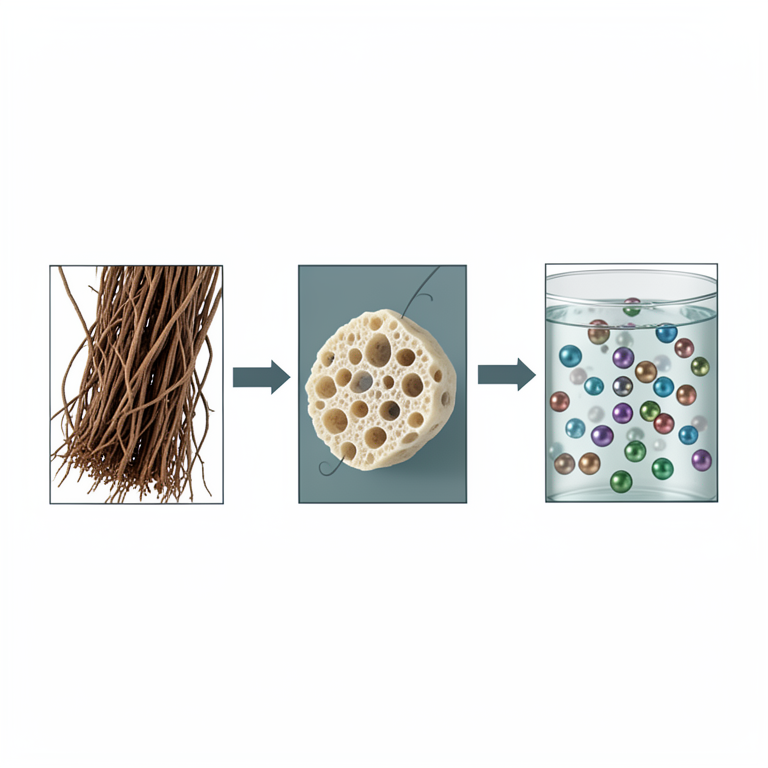
Biomass Activation and Binding Process
AI-generated conceptual illustration (agricultural plant fibers and heavy metal ions in water). It explains the idea and does not show study data.
View source evidence ↗Figures & tables
From the original paper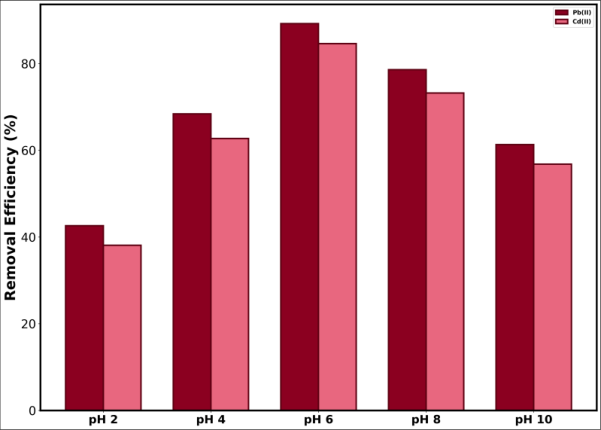 Figure 1
 Table 1
 Table 2
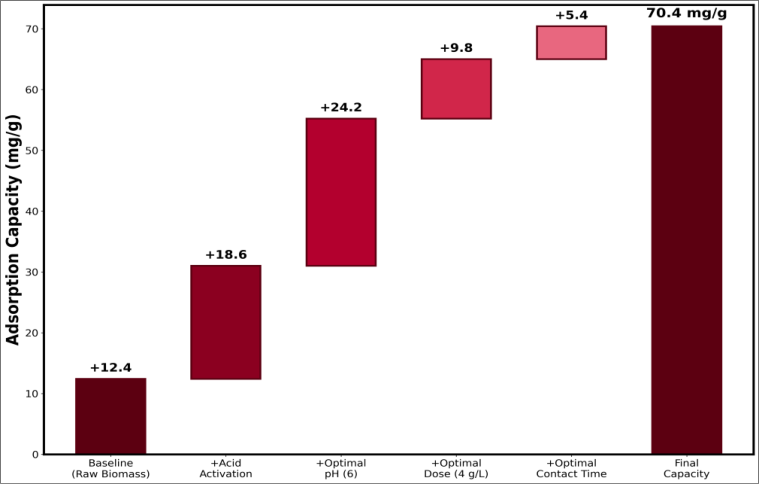 Figure 2
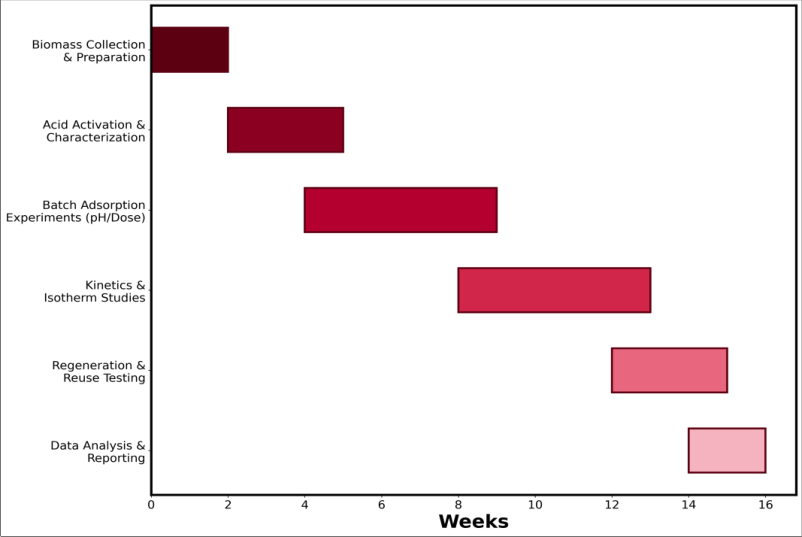 Figure 3
Introduction
Small and mid-sized industrial operations across Morocco's growing manufacturing and tanning sectors routinely generate wastewater containing dissolved heavy metals, lead and cadmium prominent among them, yet many such operations lack the capital investment capacity conventional advanced wastewater treatment technologies-membrane filtration or ion-exchange systems in particular-that larger industrial facilities can more readily afford. This capital constraint creates genuine environmental risk where untreated or inadequately treated wastewater discharge reaches irrigation water sources or broader watershed systems, with lead and cadmium both carrying well-documented human health and ecological toxicity even at comparatively low concentrations. Adsorption using low-cost agricultural biomass adsorbents has been extensively researched as a more accessible heavy metal removal technology for exactly this resource-constrained operating context, exploiting agricultural residues that would otherwise represent a disposal cost or waste management burden and converting them into functional adsorbent material through relatively simple chemical activation processes. Whether a given locally available agricultural biomass performs adequately as an adsorbent, and what specific chemical activation and operating conditions maximize its performance, require direct experimental characterization rather than assumption, since adsorption performance varies considerably across different biomass sources depending on their specific surface chemistry and functional group content. This research evaluated a locally abundant Moroccan agricultural crop residue as an adsorbent for lead and cadmium removal, following acid activation intended to enhance the biomass's surface functional group density and consequently its metal-binding capacity relative to unmodified raw biomass. Three questions guided this research. First, how do pH, adsorbent dose, and contact time each influence removal efficiency and adsorption capacity, and what combination of these operating parameters achieves maximum performance? Second, does kinetic modeling of the adsorption process support a physical adsorption mechanism or a chemisorption mechanism involving more substantial electron-level interaction between adsorbent and metal ion, information relevant to understanding the underlying removal mechanism? Third, how well does the adsorbent retain its functional capacity across repeated regeneration cycles, information directly relevant to the adsorbent's practical operating economics for any operator considering its adoption? Beyond the immediate tannery context that motivated this research, Morocco's broader industrial base, spanning textile dyeing, small-scale metal finishing, and various other operations generating heavy-metal-bearing wastewater streams, faces a similar capital constraint pattern, meaning a validated low-cost adsorbent solution developed and characterized for one specific industrial wastewater context carries potential relevance extending across this wider set of resource-constrained industrial operators facing structurally similar wastewater treatment challenges.
Material and Methods
Material and Methods
Reagents and Chemicals
Lead nitrate (Pb(NO 3 )2) and cadmium chloride (CdCl 2 ), both analytical grade, were used to prepare synthetic wastewater solutions of known concentration for adsorption testing. Sulfuric acid (H 2 SO 4 , analytical grade) was used for biomass acid activation. All solutions were prepared using double-distilled water, and metal concentration was determined using atomic absorption spectrophotometry throughout the research.
Material
The agricultural biomass, a crop residue byproduct widely available from Morocco's cereal processing sector, was collected, washed to remove surface debris, dried, and ground to a uniform particle size (0.5-1.0 mm) before acid activation. Acid activation was carried out by soaking the raw biomass in 0.5 M sulfuric acid for 24 hours, followed by thorough washing with distilled water until the wash water reached neutral pH, and oven-drying at 60 °C before use in adsorption experiments.
Methods
Batch adsorption experiments were conducted by contacting a known mass of adsorbent with 100 mL of synthetic metal solution at controlled pH (adjusted using dilute HCl or NaOH), shaking at 150 rpm for the designated contact time, then filtering and analyzing for residual metal concentration . Removal efficiency and adsorption capacity were calculated from the difference between initial and residual metal concentration. Experiments systematically varied pH (2,4,6,8,10), adsorbent dose (1-6 g/L), contact time (15-240 minutes), and initial metal concentration (25-200 mg/L) to identify optimal operating conditions and to generate kinetic and isotherm data. Kinetic data were fitted to pseudo-first-order and pseudo-second-order kinetic models, and equilibrium adsorption data were fitted to Langmuir and Freundlich isotherm models, with model fit assessed using correlation coefficients. Regeneration testing involved washing the metal-loaded adsorbent with 0.1 M HCl, followed by neutralization and reuse across three successive adsorption-regeneration cycles, tracking adsorption capacity retention across cycles.
Results
Across every operating parameter tested, the acid-activated biomass showed clear, systematically predictable removal efficiency and adsorption capacity patterns consistent with established adsorption theory, with pH 6 and the sequentially optimized dose and contact time combination together delivering maximum performance for both metals studied. Acid activation alone nearly tripled adsorption capacity relative to raw untreated biomass, and each subsequent optimization step-pH, dose, and contact time-contributed further, incremental capacity gains rather than any single step dominating the overall improvement.
Figures and tables from the paper
| Metal | Removal Efficiency (%) | Adsorption Capacity (mg/g) | Equilibrium Time (min) |
|---|---|---|---|
| Pb(II) | 89.2 | 70.4 | 120 |
| Cd (II) | 84.6 | 58.9 | 150 |
Table text extracted from the original PDF; superscript letters are shown inline. The original table image is below.
View original table image
| Model | Pb(II) r² | Cd (II) r² |
|---|---|---|
| Pseudo-first-order | 0.891 | 0.874 |
| Pseudo-second-order | 0.996 | 0.993 |
| Langmuir isotherm | 0.982 | 0.976 |
| Freundlich isotherm | 0.918 | 0.905 |
Table text extracted from the original PDF; superscript letters are shown inline. The original table image is below.
View original table image
References
15 in the original paper- Ahmad A, Rafatullah M, Sulaiman O, Ibrahim MH, Chii YY, Siddique BM. Removal of Cu (II) and Pb(II) International Journal of Advanced Chemistry Research https://www.chemistryjournals.net ions from aqueous solutions by adsorption on sawdust of Meranti wood. Desalination. 2009;247(1-3):636-646.
- Bulut Y, Tez Z. Removal of heavy metals from aqueous solution by sawdust adsorption. Journal of Environmental Sciences. 2007;19(2):160-166.
- Demirbas A. Heavy metal adsorption onto agro-based waste materials: a review. Journal of Hazardous Materials. 2008;157(2-3):220-229.
- Feng N, Guo X, Liang S, Zhu Y, Liu J. Biosorption of heavy metals from aqueous solutions by chemically modified orange peel. Journal of Hazardous Materials. 2011;185(1):49-54.
- Gupta VK, Carrott PJM, Ribeiro Carrott MML, Suhas. Low-cost adsorbents: growing approach to wastewater treatment a review. Critical Reviews in Environmental Science and Technology. 2009;39(10):783-842.
- Ho YS, McKay G. Pseudo-second order model for sorption processes. Process Biochemistry. 1999;34(5):451-465.
- Kumar U. Agricultural products and by-products as a low-cost adsorbent for heavy metal removal from water and wastewater: a Scientific Research and Essays. 2006;1(2):33-37.
- Langmuir I. The adsorption of gases on plane surfaces of glass, mica and platinum. Journal of the American Chemical Society. 1918;40(9):1361-1403.
- Malkoc E, Nuhoglu Y. Investigations of nickel (II) removal from aqueous solutions using tea factory waste. Journal of Hazardous Materials. 2005;127(13):120-128.
- Ngah WSW, Hanafiah MAKM. Removal of heavy metal ions from wastewater by chemically modified plant wastes as adsorbents: a review. Bioresource Technology. 2008;99(10):3935-3948.
- Ozer A, Ozer D, Ibrahim O. The adsorption of copper(II) ions onto dehydrated wheat bran (DWB): determination of the equilibrium and thermodynamic parameters. Process Biochemistry. 2004;39(12):21832191.
- Sud D, Mahajan G, Kaur MP. Agricultural waste material as potential adsorbent for sequestering heavy metal ions from aqueous solutions: a review. Bioresource Technology. 2008;99(14):6017-6027.
- Vieira MGA, de Almeida Neto AF, da Silva MGC, Carneiro CN, Melo Filho AA. Adsorption of lead and copper ions from aqueous effluents on rice husk ash in a dynamic system. Brazilian Journal of Chemical Engineering. 2010;27(4):693-700.
- Wan Ngah WS, Teong LC, Hanafiah MAKM. Adsorption of dyes and heavy metal ions by chitosan composites: a review. Carbohydrate Polymers. 2011;83(4):1446-1456.
- Witek-Krowiak A, Szafran RG, Modelski S. Biosorption of heavy metals from aqueous solutions onto peanut shell as a low-cost biosorbent. Desalination. 2011;265(1-3):126-132.