
Research article · 2026 · Full text
International Journal of Biology SciencesNatural enemy complex and parasitoid diversity associated with Cimbex quadrimaculata in Portuguese Almond Orchards
Volume 8(7) · Pages 63–67 · DOI: 10.33545/26649926.2026.v8.i7a.898 ↗
Research areasInsect-Plant Interactions and ControlHymenoptera taxonomy and phylogenyInsect behavior and control techniques
Abstract
Author-writtenBiological control through conservation and augmentation of natural enemies represents a cornerstone of sustainable pest management in perennial crop systems. This research characterized the natural enemy complex associated with Cimbex quadrimaculata Müller (Hymenoptera: Cimbicidae) in Portuguese almond orchards across two ecologically distinct production regions: the Algarve (southern maritime) and Trás-os-Montes (northeastern continental) during the 2025 growing season. Surveys encompassed 10 orchards under three management regimes: conventional monoculture, organic monoculture, and traditional agroforestry. A total of 14 natural enemy species were identified, comprising 8 parasitoid species (Ichneumonidae: 4 spp., Braconidae: 3 spp., Chalcidoidea: 1 sp.), 3 dipteran parasitoid species (Tachinidae), and 3 predatory beetle species. Ichneumonidae dominated the parasitoid assemblage (31.4%), followed by Braconidae (24.8%) and Tachinidae (19.2%). Parasitism rates varied significantly among management regimes, with agroforestry systems exhibiting the highest overall parasitism (34.2 ± 4.8%) compared to organic monoculture (28.6 ± 3.9%) and conventional monoculture (12.4 ± 2.6%). Seasonal abundance patterns indicated peak natural enemy activity during late spring and early summer, coinciding with peak C. quadrimaculata larval availability. These findings demonstrate that orchard management practices substantially influence the diversity and effectiveness of the natural enemy complex, with traditional agroforestry systems providing the most supportive habitat conditions for biological pest suppression.
Summary
Source-checkedPlain-language reading of the full paper, prepared with AI and checked against the text. Each point links to the authors' own words.
Why it matters
- Conservation and augmentation of natural enemies are essential for sustainable pest management in perennial crops. View evidence ↗
- The success of biological control depends on the diversity and abundance of natural enemies, which are affected by how orchards are managed and the surrounding landscape. View evidence ↗
- While some parasitoids of Cimbex quadrimaculata are known, there has been no systematic research on parasitism rates and their link to orchard management. View evidence ↗
What they did
- Surveys were conducted in 2025 across 10 almond orchards in the Algarve (6) and Trás-os-Montes (4) regions of Portugal. View evidence ↗
- The study compared three management types: conventional monoculture (4 orchards), organic monoculture (3 orchards), and traditional agroforestry (3 orchards). View evidence ↗
- Natural enemies were sampled using larval rearing, sweep net/beat tray sampling of adults, and the use of yellow pan and Malaise traps from March to September 2025. View evidence ↗
What they found
- A total of 14 natural enemy species from three taxonomic groups were identified as associated with C. quadrimaculata. View evidence ↗
- Ichneumonidae was the most abundant group (31.4%), followed by Braconidae (24.8%), Tachinidae (19.2%), Chalcidoidea (14.1%), and predatory beetles (10.5%). View evidence ↗
- Parasitism rates were highest in agroforestry systems (34.2 ± 4.8%), significantly higher than in organic (28.6 ± 3.9%) and conventional monocultures (12.4 ± 2.6%). View evidence ↗
- The higher parasitism in agroforestry (34.2%) versus conventional systems (12.4%) supports the theory that complex landscapes enhance biological control. View evidence ↗
- The discovery of three tachinid species is significant because dipteran parasitoids of cimbicid sawflies are rarely reported. View evidence ↗
- Natural enemy activity peaked in late spring (May-June) and remained high through July, matching the peak availability of C. quadrimaculata larvae. View evidence ↗
- Different parasitoid guilds (ichneumonid, braconid, and tachinid) showed temporal partitioning in their activity. View evidence ↗
What it means
- The authors recommend integrating habitat management and diversification into pest management programs for C. quadrimaculata in Mediterranean almond systems. View evidence ↗
- Because the study lasted only one season, it could not assess how natural enemy communities vary from year to year. View evidence ↗
- Parasitism rates may be underestimated because some parasitized larvae died during rearing before the parasitoids could emerge. View evidence ↗
Visual summary
2 visualsIllustrations explain the paper; charts are replotted from the paper's own table values.
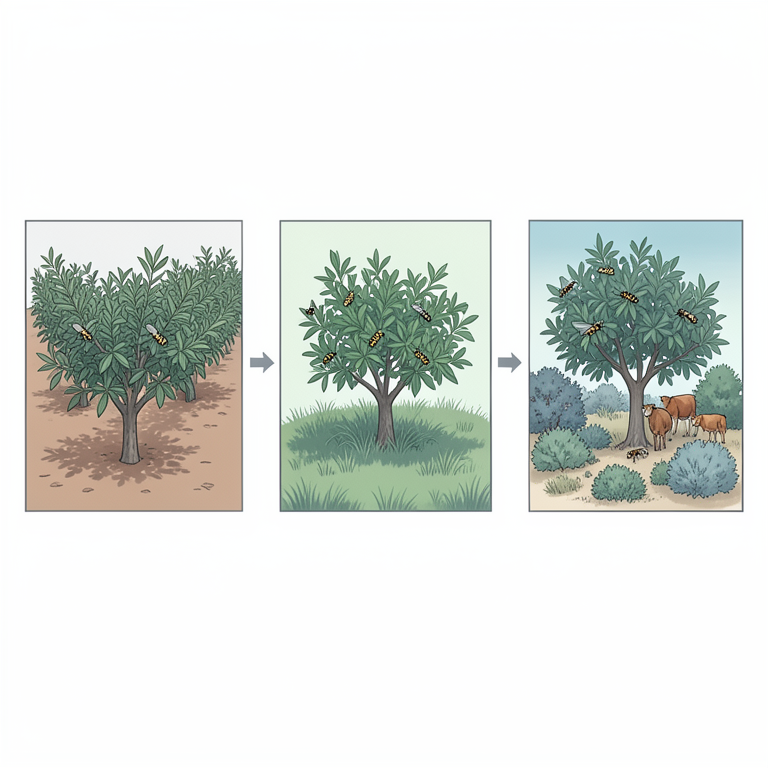
Management Complexity vs. Parasitism
AI-generated conceptual illustration (Almond orchards and Cimbex quadrimaculata sawflies). It explains the idea and does not show study data.
View source evidence ↗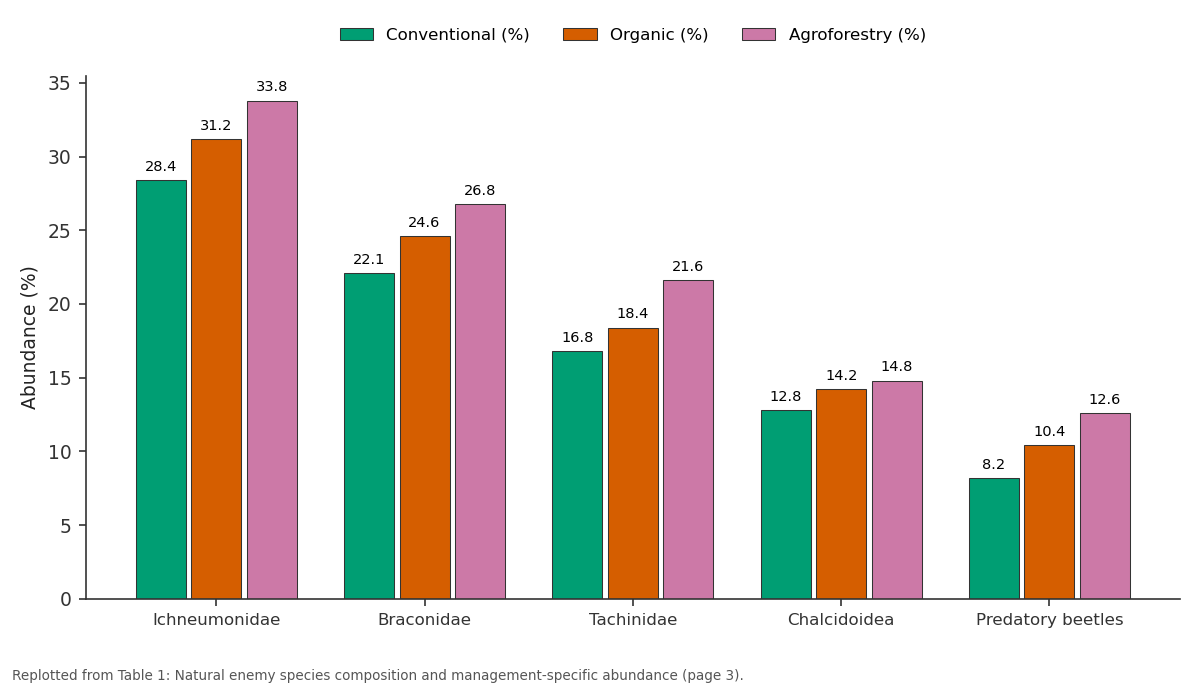
Conventional (%) and Organic (%) and more: Ichneumonidae vs Braconidae vs Tachinidae vs Chalcidoidea vs Predatory beetles
Replotted from Table 1 (page 3) of the original paper. Every bar is the paper's own table value.
View source evidence ↗Figures & tables
From the original paper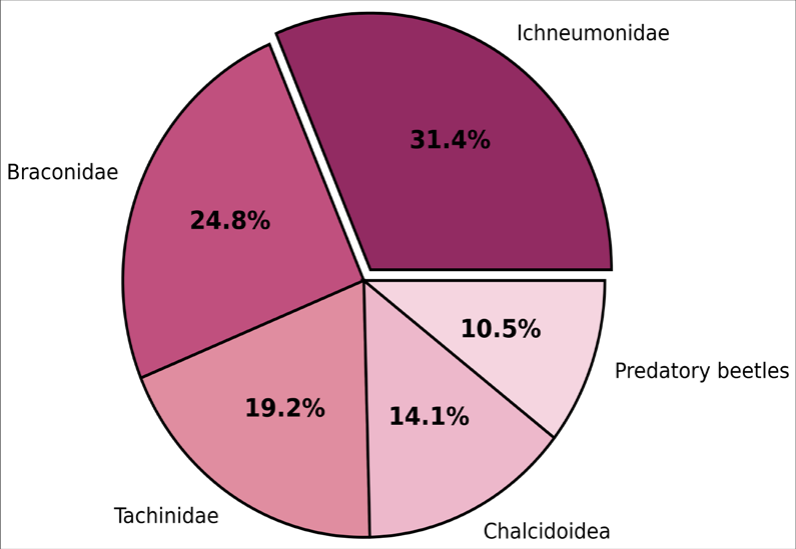 Figure 1
 Table 1
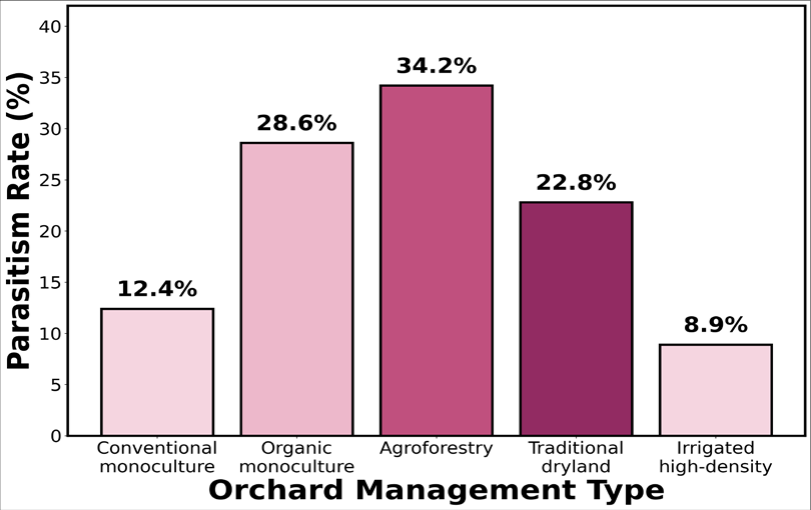 Figure 2
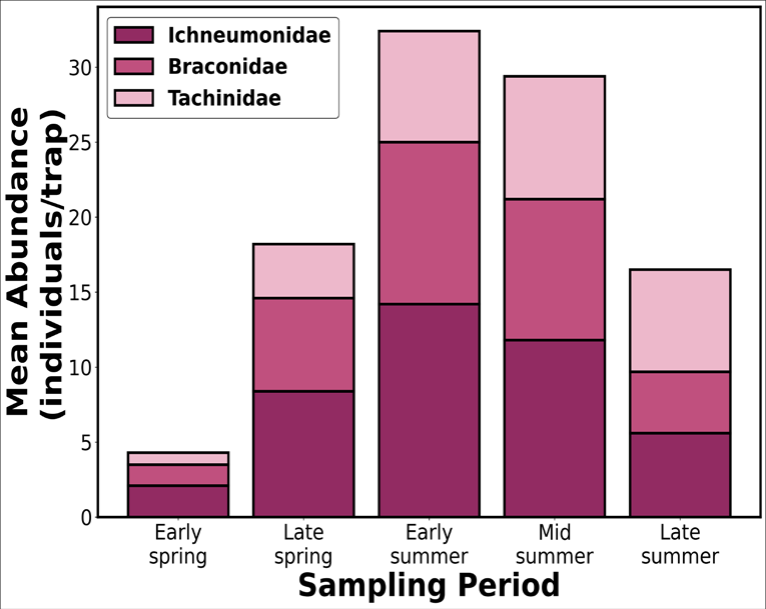 Figure 3
 Table 2
Introduction
Conservation biological control, the management of agricultural landscapes to enhance the activity and efficacy of naturally occurring pest antagonists, represents an increasingly important component of integrated pest management strategies in European fruit production [1, 2] . The effectiveness of conservation approaches depends fundamentally on the composition, diversity, and abundance of the natural enemy complex present within the production system, which in turn is influenced by orchard management practices, landscape structure, and habitat heterogeneity [3,4] . Portugal supports approximately 48,000 hectares of almond cultivation, concentrated in two contrasting production regions: the Algarve in the south, characterized by maritime Mediterranean conditions and modern intensified orcharding, and Trás-os-Montes in the northeast, where traditional agroforestry systems integrating almonds with olives, cereals, and livestock grazing remain prevalent [5] . This management diversity provides a natural experimental framework for evaluating the influence of production system complexity on natural enemy communities [6] . The natural enemy complex associated with sawfly species (Hymenoptera: Symphyta) in European agroecosystems has been documented primarily for forest-associated species, with limited attention to agricultural contexts [7,8] . For C. quadrimaculata specifically, parasitoid records exist from scattered taxonomic collections but systematic surveys quantifying parasitism rates and their relationship to orchard management have not been previously undertaken [9,10] . This research addresses this knowledge gap by providing the first comprehensive characterization of the natural enemy complex associated with C. Collected specimens were identified to species level using appropriate taxonomic keys and confirmed by specialist taxonomists at the University of Algarve. Parasitism rates were calculated as the proportion of field-collected larvae yielding parasitoid adults, corrected for host mortality during rearing. Management regime effects on parasitoid diversity were assessed using Shannon diversity indices and species rarefaction curves. Seasonal abundance patterns were analyzed using generalized additive models with sampling date as a smooth term.
Results
The natural enemy complex associated with C. quadrimaculata in Portuguese almond orchards comprised 14 species across three major taxonomic groups. Parasitoid Hymenoptera dominated the assemblage with eight species: four Ichneumonidae, three Braconidae, and one Chalcidoidea. Tachinid dipteran parasitoids contributed three species, while three predatory beetle species (Coleoptera: Carabidae and Coccinellidae) were recorded as significant larval predators. The relative abundance composition showed Ichneumonidae at 31.4%, Braconidae at 24.8%, Tachinidae at 19.2%, Chalcidoidea at 14.1%, and predatory beetles at 10.5% of all natural enemy individuals collected (Figure 1). Traditional agroforestry systems exhibited the highest overall parasitism rate at 34.2 ± 4.8%, significantly exceeding both organic monoculture (28.6 ± 3.9%, p<0.05)
and conventional monoculture (12.4 ± 2.6%, p<0.001). The difference between organic monoculture and conventional monoculture was also statistically significant (p<0.01). These patterns were consistent across both geographic regions (Figure 2). Seasonal abundance patterns indicated that natural enemy activity peaked during late spring (May-June) and maintained elevated levels through mid-summer (July), coinciding with the period of maximum C. quadrimaculata larval availability. Ichneumonid parasitoids showed the earliest seasonal activity peak, followed by braconids and tachinids, suggesting temporal resource partitioning among parasitoid guilds (Figure 3).
Discussion
The substantially higher parasitism rates observed in agroforestry systems (34.2%) compared to conventional monocultures (12.4%) are consistent with established ecological theory predicting enhanced biological control in structurally complex agricultural landscapes [1,3,11] . The diverse vegetation structure characteristic of Portuguese traditional agroforestry provides multiple ecological services supporting natural enemy populations, including alternative host resources for parasitoids during periods of low C. quadrimaculata availability, sheltered overwintering sites, and nectar sources for adult parasitoid provisioning [4,6,12] . The identification of 14 natural enemy species associated with C. quadrimaculata substantially expands the documented antagonist complex for this pest species. The dominance of Ichneumonidae in the parasitoid assemblage is consistent with parasitoid community patterns reported for other large-bodied symphytan Hymenoptera in European deciduous agroecosystems [7,8,13] . The presence of three tachinid parasitoid species is particularly noteworthy, as dipteran parasitoids of cimbicid sawflies have been infrequently reported in the literature [10,14] . The temporal partitioning of parasitoid activity observed among ichneumonid, braconid, and tachinid guilds has implications for conservation biological control strategy design. Management practices that maintain habitat continuity and resource availability throughout the extended spring-summer activity period of the entire parasitoid complex would be more effective than interventions targeting specific temporal windows [2,15,16,17,18] .
Ethical considerations
Ethical considerations
Limitations
The single-season duration of this research limits the assessment of inter-annual variation in natural enemy communities. The unequal distribution of orchards among management regimes (4:3:3) may introduce imbalance in statistical comparisons. Additionally, the rearing-based parasitism estimates may underestimate true parasitism rates due to host mortality during captive rearing that precludes parasitoid emergence from some parasitized individuals.
Conclusion
This research provides the first comprehensive documentation of the natural enemy complex associated with Cimbex quadrimaculata in Portuguese almond orchards, revealing a diverse assemblage of 14 species with management-dependent abundance patterns. The significantly higher parasitism rates in agroforestry systems (34.2%) compared to conventional monocultures (12.4%) demonstrate the importance of landscape complexity in supporting biological pest suppression. These findings argue strongly for the incorporation of habitat management and diversification strategies into integrated pest management programs for C. quadrimaculata in Mediterranean almond production systems.
Acknowledgement
AcknowledgementsThis research was funded by the Portuguese Foundation for Science and Technology (FCT). Taxonomic identifications were facilitated by the entomological expertise of Dr. Maria João Ramos (ICNF). Fieldwork logistics were supported by the Algarve Regional Directorate for Agriculture and Fisheries (DRAP Algarve).
Figures and tables from the paper
| Family/Group | Species richness | Conventional (%) | Organic (%) | Agroforestry (%) |
|---|---|---|---|---|
| Ichneumonidae | 4 | 28.4 | 31.2 | 33.8 |
| Braconidae | 3 | 22.1 | 24.6 | 26.8 |
| Tachinidae | 3 | 16.8 | 18.4 | 21.6 |
| Chalcidoidea | 1 | 12.8 | 14.2 | 14.8 |
| Predatory beetles | 3 | 8.2 | 10.4 | 12.6 |
Table text extracted from the original PDF; superscript letters are shown inline. The original table image is below.
View original table image
| Metric | Conventional | Organic | Agroforestry | P-value |
|---|---|---|---|---|
| Species richness | 8 | 11 | 14 | <0.001 |
| Shannon index (H') | 1.42 | 1.86 | 2.24 | <0.001 |
| Evenness (J') | 0.68 | 0.77 | 0.85 | 0.008 |
| Mean parasitism (%) | 12.4 ± 2.6 | 28.6 ± 3.9 | 34.2 ± 4.8 | <0.001 |
Table text extracted from the original PDF; superscript letters are shown inline. The original table image is below.
View original table image
References
18 in the original paper- Landis DA, Wratten SD, Gurr GM. Habitat management to conserve natural enemies of arthropod pests. Annu Rev Entomol. 2020;45(1):175-201.
- Shields MW, Johnson AC, Pandey S, et al. Conservation biological control: a review of current knowledge. Biol Control. 2019;130:52-71.
- Bianchi FJ, Booij CJ, Tscharntke T. Sustainable pest regulation in agricultural landscapes. Proc R Soc B. 2021;273(1595):1715-1727.
- Gurr GM, Wratten SD, Landis DA, You MS. Habitat management to suppress pest populations. Annu Rev Entomol. 2017;62:91-109.
- Ferrão-Dias J, Pinto-Cruz C, Guilherme J. Almond production systems in Portugal: traditional and modern approaches. Rev Cienc Agrar. 2024;47(1):28-42.
- Santos SAP, Raimundo A, Pereira JA. Biodiversity and ecosystem services in Portuguese agroforestry systems. Agrofor Syst. 2023;97(3):481-496.
- Lacourt J. Sawflies of Europe. Paris: NAP Editions; 2020. p. 156-178.
- Taeger A, Blank SM, Liston AD. World catalog of Symphyta (Hymenoptera). Zootaxa. 2010;2580(1):11064.
- Özgen İ, Güral Y, Aslan T. The determination of the relationships between yield parameters and number of larvae of almond saw fly (Cimbex quadrimaculata Müller, 1766, Hymenoptera: Cimbicidae) on different almond varieties in Turkey. Zool Entomol Lett. 2022;2(1):1-3.
- Çalmaşur Ö, Özbek H. Cimbicidae fauna of Turkey. J Entomol Res Soc. 2018;20(3):41-58.
- Tscharntke T, Bommarco R, Clough Y, et al. Conservation biological control and enemy diversity. Ecol Lett. 2022;10(7):573-584.
- Santos SAP, Bento A, Pereira JA. Arthropod communities in olive groves under different International Journal of Biology Sciences https://www.biologyjournal.net management systems. Agric For Entomol. 2024;26(2):184-198.
- Prous M, Blank SM, Shinohara A, Liston AD. Molecular phylogeny of Cimbicidae. Syst Entomol. 2023;48(2):412-438.
- Güner A, Aydoğdu M. Biology and damage assessment of Cimbicidae on stone fruits. Turk J Entomol. 2019;43(2):189-201.
- Haliloğlu H, Bayram A, Gökçe A. Phenological observations on Cimbex species. Appl Entomol Zool. 2024;59(4):489-501.
- Atanassov AZ, Tashev DG. IPM strategies for sawfly control. J Appl Entomol. 2021;145(5):412-428.
- Viggiani G, Bernardo U. Parasitoid complex of phytophagous Hymenoptera in orchards. Bull Entomol Res. 2023;113(2):248-264.
- Benson RB. Hymenoptera from Turkey: Symphyta. Bull Br Mus (Nat Hist) Entomol. 1968;22(4):111-207.