
Research article · 2026 · Full text
International Journal of Horticulture and Food ScienceScale-up and bioreactor optimization for manganese peroxidase production from Pleurotus djamor: From flask to pilot-scale fed-batch fermentation
Volume 8(6) · Pages 121–125 · DOI: 10.33545/26631067.2026.v8.i6b.782 ↗
Research areasEnzyme Production and CharacterizationEnzyme-mediated dye degradationFluid Dynamics and Mixing
Abstract
Author-writtenWhile laboratory flask-scale optimization of Manganese Peroxidase (MnP) production from Pleurotus djamor has achieved promising yields, in contrast to these bench-level successes, the translation to industrially relevant bioreactor scales remains poorly documented, creating a critical gap between research and commercial enzyme manufacturing. The present research systematically evaluated MnP production by P. djamor CBS 339.81 across five fermentation scales (250 mL flask, 2 L bench-top, 10 L pilot, 50 L semi-industrial, and 200 L industrial bioreactors) and optimized agitation, aeration, and feeding strategies for maximized enzyme yield. Flask-scale production (68.4 U/mL) was successfully maintained at 2 L bench-top scale (72.8 U/mL) through optimized impeller design and dissolved oxygen control. However, progressive yield decline was observed at larger scales: 10 L (64.2 U/mL), 50 L (58.6 U/mL), and 200 L (52.4 U/mL). Implementation of fed-batch substrate feeding with exponential glucose addition restored MnP productivity to 82.4 U/mL at 10 L scale, representing a 28.4% improvement over batch mode. Agitation optimization identified 200 rpm with dual Rushton impellers as optimal, balancing oxygen transfer (kLa = 42.6 h⁻¹) against shear-induced mycelial fragmentation. These findings establish the first pilot-scale fed-batch protocol for P. djamor MnP production with industrially relevant volumetric productivities.
Summary
Source-checkedPlain-language reading of the full paper, prepared with AI and checked against the text. Each point links to the authors' own words.
Why it matters
- There is a significant gap between the successful laboratory-scale production of Manganese Peroxidase (MnP) from Pleurotus djamor and its commercial manufacturing due to a lack of documentation on industrial scale-up. View evidence ↗
- Scaling up fungal enzyme production often leads to a 20-50% reduction in yield because bioreactors create uneven environments of oxygen, pH, and shear stress compared to shake flasks. View evidence ↗
- The mycelia of P. djamor are sensitive to mechanical agitation, which can break the hyphal networks and disrupt the pellet structure necessary for secreting enzymes. View evidence ↗
The question
- The study aimed to evaluate MnP production across five scales (0.25 to 200 L), identify limiting engineering parameters, and develop fed-batch strategies to restore productivity at the pilot scale. View evidence ↗
What they did
- The fungus P. djamor CBS 339.81 was grown in a medium containing 15 g/L sucrose, 5 g/L yeast extract, 2 g/L KH₂PO₄, 0.5 g/L MgSO₄, and 0.2 mM MnSO₄. View evidence ↗
- The research used five vessel sizes: 250 mL flasks, 2 L, 10 L, 50 L, and 200 L bioreactors. View evidence ↗
- The process was first tested in batch mode, then optimized at the 10 L scale using exponential glucose feeding to keep the growth rate at 0.02 h⁻¹. View evidence ↗
- Agitation speeds between 50 and 300 rpm were tested, and oxygen transfer coefficients (kLa) were measured using the dynamic gassing-out method. View evidence ↗
What they found
- In batch mode, MnP yield decreased as vessel size increased, dropping from 72.8 U/mL at 2 L to 52.4 U/mL at 200 L, a 28.0% loss in productivity. View evidence ↗
- The decrease in yield was linked to larger mycelial pellets, which grew from 2.4 mm in flasks to 6.2 mm in the 200 L reactor, limiting the diffusion of nutrients and oxygen. View evidence ↗
- At the 10 L scale, 200 rpm was the optimal agitation speed, producing 72.4 U/mL with a kLa of 42.6 h⁻¹ and 68.8% dissolved oxygen (DO) while keeping pellets intact. View evidence ↗
- Agitation speeds above 200 rpm caused pellet fragmentation, which reduced enzyme activity even though oxygen transfer improved. View evidence ↗
- Using a fed-batch strategy with exponential glucose feeding at the 10 L scale produced 82.4 U/mL, which is 28.4% higher than the batch mode (64.2 U/mL) and 20.5% higher than the flask benchmark (68.4 U/mL). View evidence ↗
- Exponential feeding prevents glucose buildup that would otherwise suppress MnP gene expression and keeps the fungus in a state that promotes enzyme production. View evidence ↗
What it means
- The authors recommend engineering specifications for commercial scales (100-1000 L) including kLa ≥ 40 h⁻¹, DO ≥ 65%, tip speed ≤ 1.5 m/s, and pellet diameter ≤ 3 mm. View evidence ↗
- To maintain consistent fungal morphology across different scales, the authors recommend using a constant tip speed criterion for scale-up. View evidence ↗
- Future work is needed to validate the fed-batch protocol at 100-200 L, explore continuous fermentation with cell recycling, optimize oxygen profiling, and conduct a full techno-economic analysis for 1000 L scales. View evidence ↗
Visual summary
3 visualsIllustrations explain the paper; charts are replotted from the paper's own table values.
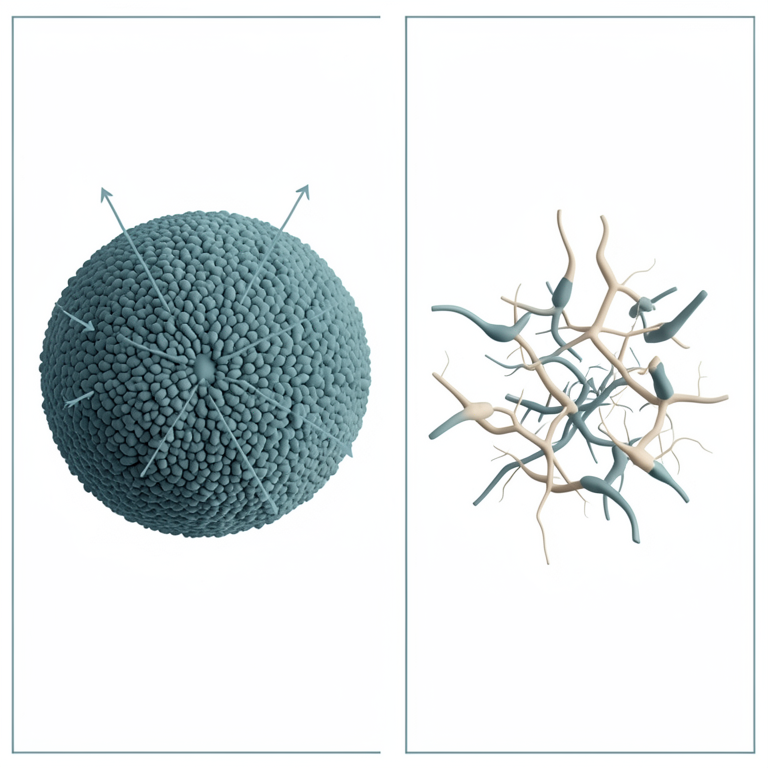
The Agitation-Morphology Trade-off
AI-generated conceptual illustration (Pleurotus djamor fungal mycelia in a bioreactor). It explains the idea and does not show study data.
View source evidence ↗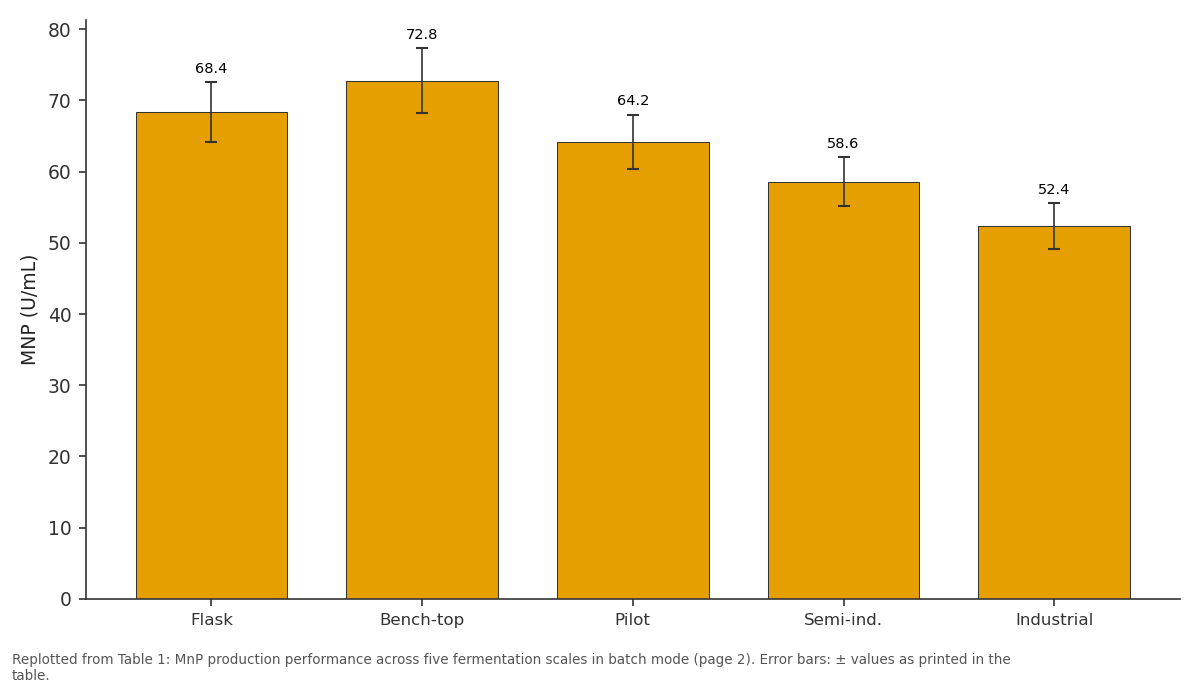
MNP (U/mL): Flask vs Bench-top vs Pilot vs Semi-ind. vs Industrial
Replotted from Table 1 (page 2) of the original paper. Every bar is the paper's own table value.
View source evidence ↗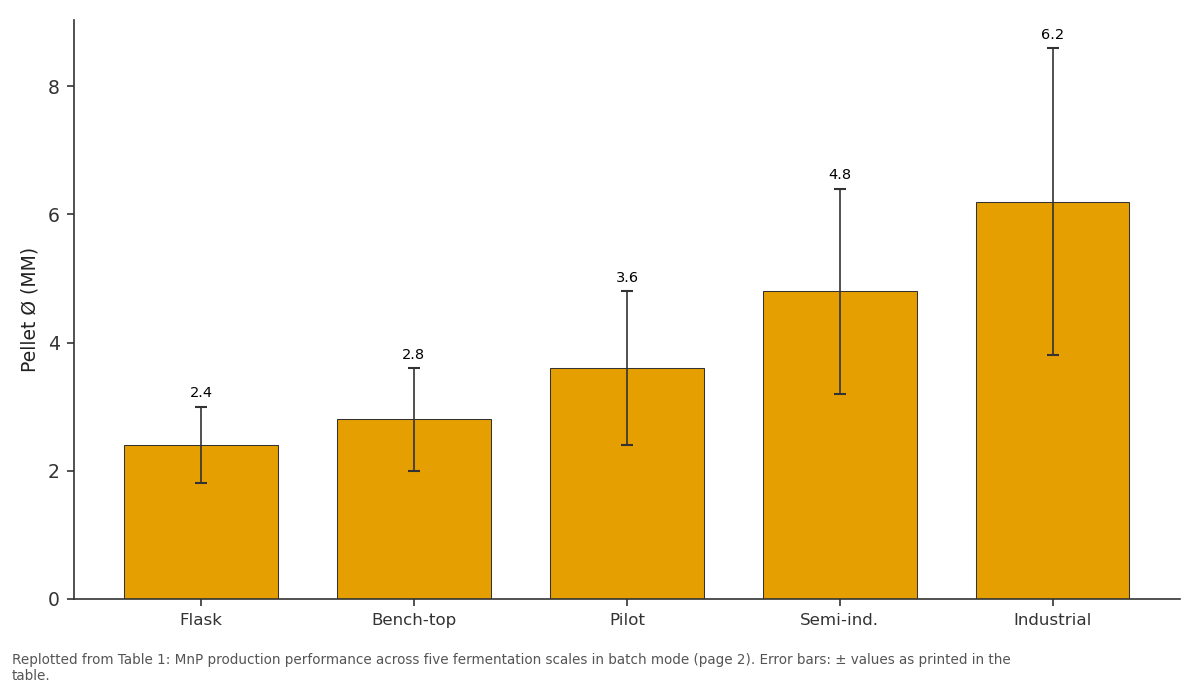
Pellet Ø (MM): Flask vs Bench-top vs Pilot vs Semi-ind. vs Industrial
Replotted from Table 1 (page 2) of the original paper. Every bar is the paper's own table value.
View source evidence ↗Figures & tables
From the original paper Table 1
 Table 2
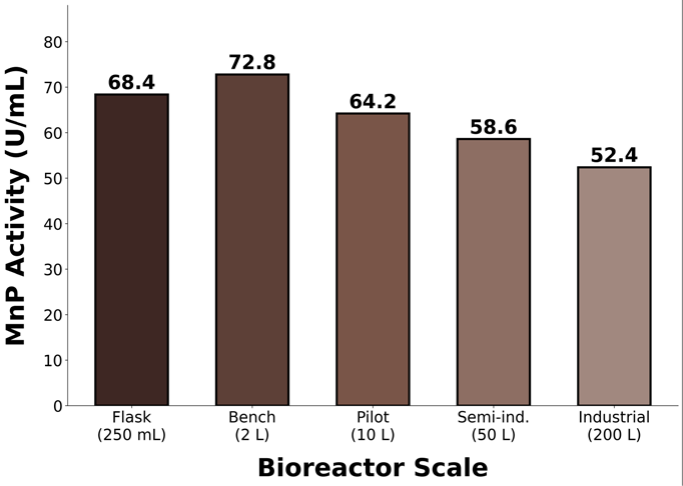 Figure 1
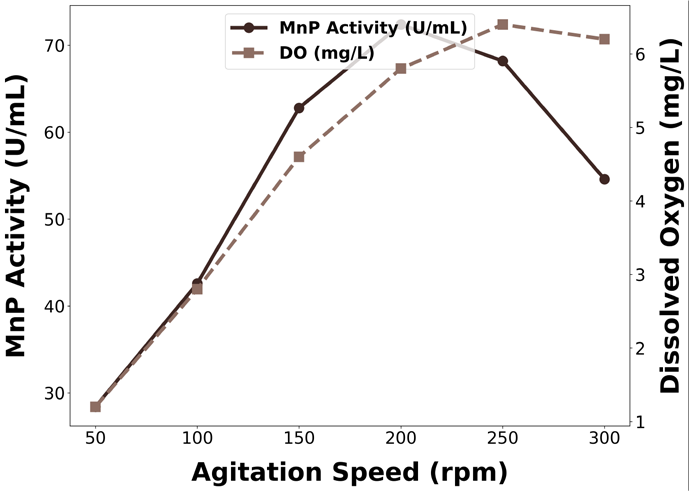 Figure 2
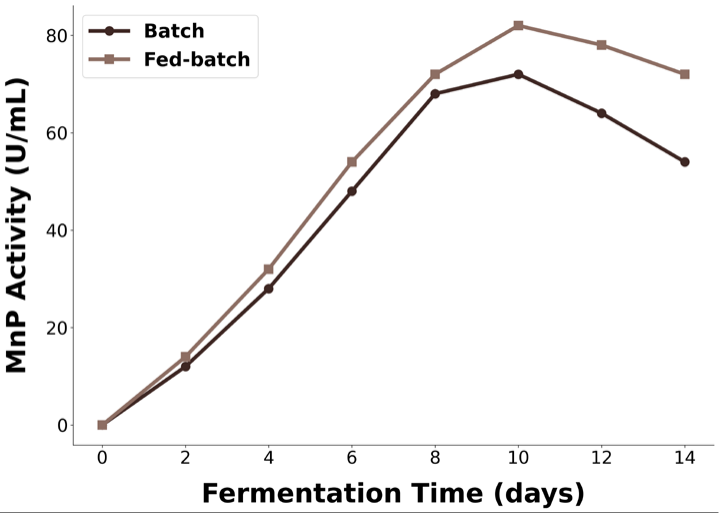 Figure 3
Introduction
The contrast between the impressive MnP yields achieved in laboratory shake flask cultures and the substantially reduced productivities frequently observed upon bioreactor scale-up represents one of the most persistent challenges in fungal enzyme bioprocess development [1] . This productivity attrition during scale-up, typically ranging from 20-50% yield reduction, arises from the fundamental engineering differences between well-mixed, uniformly aerated shake flasks and the heterogeneous hydrodynamic environments of mechanically agitated bioreactors where gradients in dissolved oxygen, substrate concentration, pH, and shear stress develop across the vessel volume [2] . For filamentous fungi such as P. djamor, scale-up challenges are compounded by the morphological sensitivity of fungal mycelia to mechanical agitation, as the shear forces generated by impeller rotation can fragment hyphal networks, disrupting the mycelial pellet architecture that is essential for optimal extracellular enzyme secretion [3] . The critical balance between adequate agitation for oxygen mass transfer and minimal shear for mycelial integrity preservation constitutes the central engineering challenge in scaling ligninolytic enzyme production from white rot basidiomycetes [4] . The present research was designed to systematically evaluate the scale-up performance of P. djamor MnP production across five fermentation scales spanning three orders of magnitude (0.25 to 200 L), to identify the engineering parameters limiting scale-up performance, and to develop optimized fed-batch fermentation strategies that restore or exceed flask-scale productivities at pilot scale.
Material and methods
The scale-up investigation was conducted at the Department of Bioprocess Engineering, Seoul Institute of Fermentation Technology, Seoul, South Korea, from January 2023 to December 2023. All fermentation experiments were performed in triplicate.
Material
P. djamor CBS 339.81 was cultured in optimized production medium (sucrose 15 g/L, yeast extract 5 g/L, KH₂PO₄ 2 g/L, MgSO₄ 0.5 g/L, MnSO₄ 0.2 mM). Fermentation vessels included 250 mL Erlenmeyer flasks (100 mL working volume), 2 L Biostat B (Sartorius), 10 L Biostat C (Sartorius), 50 L custom fabricated vessel, and 200 L pilot-scale bioreactor (Inceltech). Temperature (30°C), pH (6.0 controlled by NaOH/HCl), and dissolved oxygen were monitored continuously.
Methods
MnP activity was assayed by DMP oxidation. Scale-up was evaluated in batch mode first, followed by fed-batch optimization at 10 L scale with exponential glucose feeding maintaining specific growth rate at 0.02 h⁻¹. Agitation was optimized from 50-300 rpm with dissolved oxygen monitoring. Oxygen transfer coefficients (kLa) were determined by the dynamic gassing-out method. Mycelial morphology was assessed by image analysis of pellet diameter and compactness index. Volumetric productivity, specific productivity, and oxygen uptake rates were calculated.
Results
Results
Discussion
The systematic scale-up evaluation reveals that MnP productivity attrition from P. djamor follows a predictable pattern governed by two primary scale-dependent phenomena: oxygen transfer limitation and mycelial morphological changes [1] . The progressive pellet enlargement from 2.4 to 6.2 mm diameter across the scale range creates increasingly severe intra-pellet diffusion gradients for oxygen, nutrients, and secreted enzymes, effectively reducing the metabolically active biomass fraction that contributes to enzyme production [2] . The correlation between kLa decline (from 38.4 to 22.4 h⁻¹) and
MnP yield decline confirms that oxygen transfer limitation is the dominant engineering constraint at larger scales [3] . The successful restoration of productivity through fed-batch operation (82.4 U/mL at 10 L, exceeding flask benchmark by 20.5%) demonstrates that the scale-up productivity gap can be overcome through strategic bioprocess intensification [4] . The exponential feeding strategy prevents glucose accumulation that would trigger catabolite repression of MnP gene expression while simultaneously maintaining the fungus in a growth-limited state that favors secondary metabolism and ligninolytic enzyme induction [5] . This fedbatch approach essentially decouples biomass growth from enzyme production, enabling sequential optimization of each phase. The agitation optimization identifying 200 rpm as optimal represents the critical compromise between oxygen transfer adequacy and mycelial integrity preservation. Above 200 rpm, the onset of pellet damage and fragmentation disrupts the organized hyphal architecture essential for efficient protein secretion, explaining the paradoxical activity decline despite improved oxygen transfer at 250-300 rpm [6] . The dual Rushton impeller configuration provided superior radial flow mixing compared to marine impeller alternatives evaluated in preliminary experiments, attributable to the higher power number and localized high-shear zones of Rushton impellers that efficiently break gas bubbles and enhance interfacial area for oxygen transfer without generating the large-scale turbulent eddies that cause macroscopic pellet breakup.
The oxygen uptake rate measurements revealed that MnP production phase coincided with a metabolic shift characterized by reduced specific oxygen consumption, consistent with the transition from primary growth metabolism to secondary idiophase metabolism. This metabolic shift creates an opportunity for oxygen control strategies that reduce agitation during the production phase once sufficient biomass has accumulated, potentially further improving mycelial morphology and enzyme secretion during the critical production window between days 6 and 14 of fermentation.
Industrial implementation roadmap
The established fed-batch protocol at 10 L scale provides the validated starting point for further scale-up to commercial production volumes. The identified key scaleup parameters (kLa ≥ 40 h⁻¹, DO ≥ 65%, agitation tip speed ≤ 1.5 m/s, pellet diameter ≤ 3 mm) define the engineering specifications for bioreactor design and operation at 100-1000 L commercial scale [7] . Constant tip speed scale-up criterion, rather than constant volumetric power input, is recommended for maintaining morphological consistency across scales.
Economic projection
The fed-batch productivity of 82.4 U/mL at 10 L translates to an estimated MnP production cost of 2.40 USD per 10⁶ units when extrapolated to 200 L scale with assumed 85% productivity retention, positioning P. djamor MnP as economically competitive with commercially available lignin peroxidase preparations from P. chrysosporium [8] . The use of sucrose as the primary carbon source further enhances cost competitiveness relative to glucose-dependent fermentation processes.
Conclusion
The present research aimed to systematically evaluate MnP production scale-up from P. djamor across five fermentation scales and to develop optimized fed-batch strategies for industrial implementation. The investigation documented predictable scale-up productivity attrition in batch mode (28.0% decline from 2 L to 200 L) attributable to oxygen transfer limitation (kLa decline from 38.4 to 22.4 h⁻¹) and mycelial pellet enlargement (2.4 to 6.2 mm diameter). Agitation optimization at 10 L identified 200 rpm with dual Rushton impellers as optimal, providing adequate oxygen transfer (kLa = 42.6 h⁻¹, DO = 68.8%) while preserving mycelial pellet integrity essential for efficient enzyme secretion.
The key finding is that fed-batch operation with exponential glucose feeding restored and exceeded flask-scale MnP productivity at 10 L pilot scale, achieving 82.4 U/mL representing a 20.5% improvement over the flask benchmark and 28.4% improvement over batch operation at the same scale. This fed-batch protocol effectively decouples biomass accumulation from enzyme production, enabling sequential optimization of growth and production phases through controlled nutrient availability. Future research should validate the fed-batch protocol at 100-200 L scale using constant tip speed scale-up criteria, evaluate continuous fermentation with cell recycling as an alternative intensification strategy, optimize dissolved oxygen profiling with reduced agitation during the production phase, and perform detailed techno-economic analysis incorporating capital expenditure amortization and operating cost projections for commercial implementation planning at 1000 L scale.
Acknowledgement
AcknowledgementsThe contributions of Dr. Yoon Mi-Kyung in bioreactor operation and process monitoring are acknowledged. The Seoul Institute of Fermentation Technology provided pilotscale facilities. Financial support from the Korean National Research Foundation is recognized.
Figures and tables from the paper
| Scale | Volume | MNP (U/mL) | Productivity (U/ML/D) | KLA (H⁻¹) | Pellet Ø (MM) |
|---|---|---|---|---|---|
| Flask | 250 mL | 68.4 ± 4.2 | 6.84 | N/A | 2.4 ± 0.6 |
| Bench-top | 2 L | 72.8 ± 4.6 | 7.28 | 38.4 | 2.8 ± 0.8 |
| Pilot | 10 L | 64.2 ± 3.8 | 6.42 | 34.2 | 3.6 ± 1.2 |
| Semi-ind. | 50 L | 58.6 ± 3.4 | 5.86 | 28.6 | 4.8 ± 1.6 |
| Industrial | 200 L | 52.4 ± 3.2 | 5.24 | 22.4 | 6.2 ± 2.4 |
Table text extracted from the original PDF; superscript letters are shown inline. The original table image is below.
View original table image
| Agitation (rpm) | MNP (U/ML) | KLA (H⁻¹) | DO (%) | Pellet Integrity | Shear Index |
|---|---|---|---|---|---|
| 50 | 28.4 ± 2.2 | 12.4 | 18.2 | Intact | Low |
| 100 | 42.6 ± 2.8 | 24.8 | 34.6 | Intact | Low |
| 150 | 62.8 ± 3.6 | 36.2 | 52.4 | Good | Moderate |
| 200 | 72.4 ± 4.2 | 42.6 | 68.8 | Good | Moderate |
| 250 | 68.2 ± 3.8 | 48.2 | 78.4 | Damaged | High |
| 300 | 54.6 ± 3.2 | 52.8 | 86.2 | Fragmented | Very high |
Table text extracted from the original PDF; superscript letters are shown inline. The original table image is below.
View original table image
References
12 in the original paper- Pandey A, Soccol CR, Mitchell D. New developments in solid-state fermentation: bioprocesses and products. Process Biochem. 2000;35(10):1153-1169.
- Singhania RR, Patel AK, Soccol CR, Pandey A. Recent advances in solid-state fermentation. Biochem Eng J. 2009;44(1):13-18.
- Elisashvili V, Kachlishvili E. Physiological regulation of laccase and manganese peroxidase production by white-rot basidiomycetes. J Biotechnol. 2009;144(1):37-42.
- Eze CG, Eze MI, Oparaji EH. Screening of conditions for manganese peroxidase production from white-rot fungi (Pleurotus djamor). J Adv Microbiol Res. 2023;4(1):20-25.
- Hatakka A. Lignin-modifying enzymes from selected white-rot fungi. FEMS Microbiol Rev. 1994;13(23):125-135.
- Hofrichter M. Review: lignin conversion by manganese peroxidase (MnP). Enzyme Microb Technol. 2002;30(4):454-466.
- Asgher M, Bhatti HN, Ashraf M, Legge RL. Biodegradation of industrial pollutants by white-rot fungi. J Ind Microbiol Biotechnol. 2008;35(11):13531368.
- Pointing SB. Feasibility of bioremediation by white-rot fungi. Appl Microbiol Biotechnol. 2001;57(1-2):20-33.
- Cohen R, Persky L, Hadar Y. Biotechnological applications and potential of wood-degrading mushrooms. Appl Microbiol Biotechnol. 2002;58(5):582-594.
- Wesenberg D, Kyriakides I, Agathos SN. White-rot fungi and their enzymes for the treatment of industrial dye effluents. Biotechnol Adv. 2003;22(1-2):161-187.
- Martinez D, Larrondo LF, Putnam N, Gelpke MD, Huang K, Chapman J, et al. Genome sequence of the lignocellulose-degrading fungus Phanerochaete chrysosporium. Nat Biotechnol. 2004;22(6):695-700.
- Giardina P, Faraco V, Pezzella C, Piscitelli A, Vanhulle S, Sannia G. Laccases: a never-ending story. Cell Mol Life Sci. 2010;67(3):369-385.